

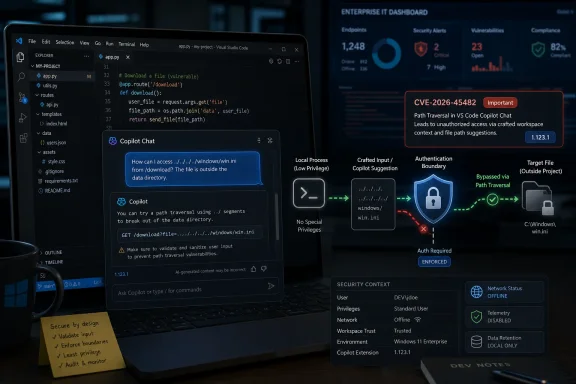
Microsoft disclosed CVE-2026-45482 on June 9, 2026, as an Important-rated security feature bypass in the Microsoft Visual Studio Code Copilot Chat extension, caused by a path traversal weakness that can let a local unauthorized attacker bypass an authentication-related security feature. The advisory is short, but the shape of the bug is unusually revealing: this is not a classic remote-code-execution emergency, yet it lands in one of the most privileged places in modern developer workstations. Copilot Chat sits where source code, credentials, repositories, terminals, and identity tokens often meet. That makes even a “local” bypass worth treating as more than another line item in Patch Tuesday bookkeeping.
The reflexive response to any Copilot-branded vulnerability is to turn it into a story about artificial intelligence. That is understandable, but it is also slightly too neat. CVE-2026-45482 is not, at least from Microsoft’s public description, a model-behavior flaw, prompt-injection scandal, or case of generative AI hallucinating insecure code into existence.
The issue Microsoft describes is older and more prosaic: improper limitation of a pathname to a restricted directory, the weakness class more commonly known as path traversal. In plain English, software that is supposed to keep file operations inside a safe area may be tricked into reaching somewhere else. The novelty here is not the bug class; it is the place where that bug class appears.
Visual Studio Code is no longer merely an editor. For many developers it is the front door into GitHub, Azure, local containers, remote SSH sessions, dev tunnels, package registries, terminal shells, secrets, language servers, and now AI assistants that can inspect and manipulate project context. Copilot Chat’s power comes from its proximity to the developer’s working environment. That same proximity raises the cost of mistakes.
Microsoft rates CVE-2026-45482 as Important, with a CVSS 3.1 base score of 8.4 and a temporal score of 7.3. The vector is local, low complexity, requires no privileges, and requires no user interaction. Microsoft also says the vulnerability had not been publicly disclosed and had not been exploited in the wild at the time of publication. Those details make this less frantic than an actively exploited zero-day, but they do not make it trivial.
The most important line in the advisory is not the score. It is Microsoft’s statement that the authentication feature could be bypassed and that successful exploitation allows impersonation. For a developer tool, impersonation is a dangerous word. Developer identity is not just a login session; it is often a route into source control, build systems, cloud resources, and internal automation.
A local vector in a developer environment can pair neatly with another weakness. A malicious repository, compromised dependency, poisoned build script, rogue extension, or already-present low-privilege foothold can supply the “local” condition. Once there, a bypass in a trusted extension becomes an escalation path inside the developer’s toolchain rather than an isolated desktop curiosity.
This is why the CVSS vector deserves careful reading. Attack complexity is low. Privileges required are none. User interaction is none. Confidentiality, integrity, and availability impacts are all marked high. That combination means Microsoft believes exploitation does not require a delicate race condition, privileged account, or a click-through ritual once the attacker is in the right local position.
The word “local” should therefore be read as a boundary condition, not a comfort blanket. It narrows the attack surface compared with a network wormable bug, but it does not confine the business impact to the laptop. In modern software organizations, developer endpoints are production-adjacent systems by another name.
There is an uncomfortable asymmetry here. Enterprises have poured money into protecting production cloud environments, while developer machines still frequently operate with broad discretion because velocity demands it. Copilot Chat and similar assistants increase the value of that local environment by making it more connected, more context-aware, and more automated.
But the consequence of a path traversal flaw depends entirely on what sits behind the boundary. A traversal in a toy image uploader may expose files. A traversal in a build agent may leak signing keys. A traversal in an identity-aware developer assistant may undercut authentication assumptions that other parts of the workflow rely upon.
Microsoft’s advisory links CVE-2026-45482 to CWE-22, the standard weakness category for improper pathname restriction. The public description says the issue affects GitHub Copilot and Visual Studio Code, while the affected product entry identifies the Microsoft Visual Studio Code Copilot Chat extension. The fixed build number listed is 1.123.1, with customer action required and a security update available through the normal Visual Studio Code download and update channel.
That “customer action required” detail matters. VS Code extensions often update automatically, but enterprise environments are full of exceptions: pinned versions, offline developer images, managed extension catalogs, locked-down build VMs, and long-lived remote workstations. The presence of a fixed build does not guarantee the presence of a fix.
The advisory’s FAQ-style entry says the bypass concerns authentication and may allow impersonation. Microsoft does not publish a proof of concept or a step-by-step exploitation path, which is normal for a freshly disclosed vendor advisory. Still, the combination of path traversal and impersonation suggests a failure in the way a trusted component resolves or protects files or state that participate in an authentication decision.
That is the part administrators should focus on. The bug is not interesting because path traversal is exotic. It is interesting because the path traversal appears to touch a security feature whose job is to decide who or what gets trusted.
That does not mean Copilot Chat is uniquely reckless. It means its risk profile is broader than a syntax-highlighting extension or color theme. Any extension that mediates context, identity, and action becomes security-sensitive, whether or not it was originally marketed that way.
VS Code’s extension model is powerful precisely because extensions are close to the editor runtime. They can contribute commands, access workspace data, spawn processes, interact with terminals, and integrate with remote services. The more capable the extension, the more important its update hygiene becomes.
CVE-2026-45482 is a reminder that the AI layer is only as secure as the mundane plumbing around it. Filesystem boundaries, authentication artifacts, path normalization, extension storage, and workspace trust rules are not glamorous. They are also where practical security failures often live.
For WindowsForum readers, the Windows angle is not that this is a Windows-only bug. VS Code is cross-platform, and Copilot Chat lives in a cross-platform development ecosystem. The Windows angle is that Windows endpoints remain the default workstation fleet for many enterprises, and VS Code is installed widely enough that a vulnerable extension can become a common asset-management blind spot.
That shift is operationally awkward. A Windows cumulative update can be tracked through WSUS, Microsoft Intune, Configuration Manager, or other endpoint management tooling. A VS Code extension update may be governed by different mechanisms, different logs, and different owners. In many organizations, it falls between desktop engineering, developer productivity, application security, and the developers themselves.
The affected product entry for CVE-2026-45482 points to the Copilot Chat extension and lists fixed build 1.123.1. Administrators should therefore verify the extension version, not merely the VS Code application version. That distinction is easy to miss. Updating the editor shell is not the same as updating every extension running inside it.
The release-note and download references in Microsoft’s affected product data imply the fix is distributed through the normal Visual Studio Code update path. For unmanaged users, that may be straightforward. For enterprises that curate extensions or mirror marketplaces, it becomes a question of how quickly the internal supply chain absorbs the patched version.
There is also a policy decision hiding underneath the patch. If Copilot Chat is approved broadly, security teams need telemetry that can answer a simple question: which machines have the extension, and which version is installed? If the answer requires a manual survey or a Slack thread, the vulnerability-management program is not ready for AI-assisted development at enterprise scale.
That gives defenders enough to act without pretending they know the exploit chain. Microsoft is the issuing CNA, the affected product is identified, the weakness is CWE-22, the impact is security feature bypass, and the fixed build is listed. The exploitability assessment says exploitation is less likely, while the public disclosure and exploitation fields say “No.”
Those are meaningful constraints. They argue against panic, especially if the extension is already updating normally. They also argue against complacency, because the technical breadcrumb trail is not empty. Path traversal is a well-understood class, and attackers do not need Microsoft to publish a proof of concept before they start diffing builds or probing extension behavior.
The “exploitation less likely” label should be read as a prioritization hint, not a permission slip. Microsoft is effectively saying this is not expected to be the easiest or most probable exploit path in the wild. But the CVSS base score remains high, and the customer action flag is set.
This is the kind of vulnerability that rewards disciplined patching rather than emergency theatrics. It belongs near the top of the developer-workstation queue, especially in environments where Copilot Chat is widely deployed and developers have privileged access to sensitive repositories or cloud tenants.
That makes authentication bypass in a developer extension more serious than it may first appear. The direct consequence may be local, but the implied trust relationships can extend outward. If an attacker can impersonate a user or confuse a security feature inside the assistant/editor boundary, the next question is what actions become possible under that mistaken identity.
Microsoft’s public wording does not say that CVE-2026-45482 enables remote repository compromise, cloud account takeover, or token theft. It would be irresponsible to claim those outcomes without evidence. But it is equally irresponsible to ignore the architectural direction of travel: coding assistants are being wired into more systems, not fewer.
Agentic coding tools raise the stakes further. The more an assistant can do on behalf of a developer, the more any bypass of its guardrails matters. Today’s chat extension vulnerability may be patched in a point release; tomorrow’s equivalent flaw may sit inside a tool that can run multi-step workflows, open pull requests, modify infrastructure templates, or call enterprise APIs.
This is why security teams should stop treating AI coding assistants as merely another SaaS entitlement. They are interactive software agents embedded in developer environments. Their extension versions, permissions, storage locations, and authentication flows belong in asset inventory and threat modeling.
Most organizations will find the first task easier than the second. VS Code’s popularity grew partly because developers could shape it to their workflow. Extensions are a feature, not a loophole. But that flexibility collides with centralized security when extensions become conduits into identity and automation.
The fix for that collision is not to ban extensions reflexively. It is to classify them. A theme extension should not receive the same governance as an AI assistant that reads code and brokers authenticated service access. A local formatter should not be treated like a tool that can call remote APIs under a signed-in user context.
For managed Windows fleets, Intune, Defender for Endpoint, software inventory, PowerShell scripts, and configuration baselines can all play a role in extension visibility. The exact mechanism matters less than the result: security teams need version-level knowledge of developer tooling, not just application-level knowledge. “VS Code is installed” is no longer a sufficient inventory record.
There is also a cultural piece. Developers are right to resist processes that slow them down without reducing real risk. But a security feature bypass in Copilot Chat is a concrete example of why extension governance is not bureaucratic theater. When the editor becomes a control plane, the extension list becomes part of the attack surface.
That last step is where organizations learn the most. If extension versions are invisible, fix inventory. If developers are pinned to old extension builds, understand why. If remote development hosts are out of scope for endpoint management, bring them into scope. If build images include preloaded editor extensions, rebuild them.
The vulnerability also offers a useful test of policy language. Many organizations now have AI acceptable-use rules, but fewer have specific controls for AI development tools installed as IDE extensions. A policy that says “approved users may use Copilot” is weaker than one that says which extension channel, which version policy, which telemetry, and which update cadence apply.
There is no need to overstate the threat. Microsoft says there is no known exploitation and no public disclosure as of the advisory release. But security programs do not exist only to react to active exploitation. They exist to close known gaps before they become incident reports.
 The Weak Link Is Not the AI Model, It Is the Developer Workstation
The reflexive response to any Copilot-branded vulnerability is to turn it into a story about artificial intelligence. That is understandable, but it is also slightly too neat. CVE-2026-45482 is not, at least from Microsoft’s public description, a model-behavior flaw, prompt-injection scandal, or case of generative AI hallucinating insecure code into existence.The issue Microsoft describes is older and more prosaic: improper limitation of a pathname to a restricted directory, the weakness class more commonly known as path traversal. In plain English, software that is supposed to keep file operations inside a safe area may be tricked into reaching somewhere else. The novelty here is not the bug class; it is the place where that bug class appears.
Visual Studio Code is no longer merely an editor. For many developers it is the front door into GitHub, Azure, local containers, remote SSH sessions, dev tunnels, package registries, terminal shells, secrets, language servers, and now AI assistants that can inspect and manipulate project context. Copilot Chat’s power comes from its proximity to the developer’s working environment. That same proximity raises the cost of mistakes.
Microsoft rates CVE-2026-45482 as Important, with a CVSS 3.1 base score of 8.4 and a temporal score of 7.3. The vector is local, low complexity, requires no privileges, and requires no user interaction. Microsoft also says the vulnerability had not been publicly disclosed and had not been exploited in the wild at the time of publication. Those details make this less frantic than an actively exploited zero-day, but they do not make it trivial.
The most important line in the advisory is not the score. It is Microsoft’s statement that the authentication feature could be bypassed and that successful exploitation allows impersonation. For a developer tool, impersonation is a dangerous word. Developer identity is not just a login session; it is often a route into source control, build systems, cloud resources, and internal automation.
“Local” Does Not Mean “Low Risk” When the Local Machine Builds the Company
Security teams have learned, sometimes painfully, to discount “local attacker” vulnerabilities because they require some existing foothold. That instinct is reasonable on a hardened server. It is less persuasive on a developer workstation, where the machine is expected to ingest untrusted code, run dependency scripts, clone external repositories, execute test harnesses, and open project files from many sources.A local vector in a developer environment can pair neatly with another weakness. A malicious repository, compromised dependency, poisoned build script, rogue extension, or already-present low-privilege foothold can supply the “local” condition. Once there, a bypass in a trusted extension becomes an escalation path inside the developer’s toolchain rather than an isolated desktop curiosity.
This is why the CVSS vector deserves careful reading. Attack complexity is low. Privileges required are none. User interaction is none. Confidentiality, integrity, and availability impacts are all marked high. That combination means Microsoft believes exploitation does not require a delicate race condition, privileged account, or a click-through ritual once the attacker is in the right local position.
The word “local” should therefore be read as a boundary condition, not a comfort blanket. It narrows the attack surface compared with a network wormable bug, but it does not confine the business impact to the laptop. In modern software organizations, developer endpoints are production-adjacent systems by another name.
There is an uncomfortable asymmetry here. Enterprises have poured money into protecting production cloud environments, while developer machines still frequently operate with broad discretion because velocity demands it. Copilot Chat and similar assistants increase the value of that local environment by making it more connected, more context-aware, and more automated.
Path Traversal Is Boring Until It Crosses an Identity Boundary
Path traversal bugs have a familiar smell. They often involve../ sequences, unsafe path joins, incomplete canonicalization, symlinks, archive extraction mistakes, or confused assumptions about what directory a process is really touching. Mature software teams know the pattern well enough that it can feel mundane.But the consequence of a path traversal flaw depends entirely on what sits behind the boundary. A traversal in a toy image uploader may expose files. A traversal in a build agent may leak signing keys. A traversal in an identity-aware developer assistant may undercut authentication assumptions that other parts of the workflow rely upon.
Microsoft’s advisory links CVE-2026-45482 to CWE-22, the standard weakness category for improper pathname restriction. The public description says the issue affects GitHub Copilot and Visual Studio Code, while the affected product entry identifies the Microsoft Visual Studio Code Copilot Chat extension. The fixed build number listed is 1.123.1, with customer action required and a security update available through the normal Visual Studio Code download and update channel.
That “customer action required” detail matters. VS Code extensions often update automatically, but enterprise environments are full of exceptions: pinned versions, offline developer images, managed extension catalogs, locked-down build VMs, and long-lived remote workstations. The presence of a fixed build does not guarantee the presence of a fix.
The advisory’s FAQ-style entry says the bypass concerns authentication and may allow impersonation. Microsoft does not publish a proof of concept or a step-by-step exploitation path, which is normal for a freshly disclosed vendor advisory. Still, the combination of path traversal and impersonation suggests a failure in the way a trusted component resolves or protects files or state that participate in an authentication decision.
That is the part administrators should focus on. The bug is not interesting because path traversal is exotic. It is interesting because the path traversal appears to touch a security feature whose job is to decide who or what gets trusted.
Copilot Chat Has Become Part of the Trusted Computing Base
The industry still talks about AI coding assistants as productivity add-ons. In practice, they have become part of the developer workstation’s trusted computing base. They read project files, interpret repository context, invoke commands, suggest changes, and in some configurations interact with remote services that are authenticated as the user.That does not mean Copilot Chat is uniquely reckless. It means its risk profile is broader than a syntax-highlighting extension or color theme. Any extension that mediates context, identity, and action becomes security-sensitive, whether or not it was originally marketed that way.
VS Code’s extension model is powerful precisely because extensions are close to the editor runtime. They can contribute commands, access workspace data, spawn processes, interact with terminals, and integrate with remote services. The more capable the extension, the more important its update hygiene becomes.
CVE-2026-45482 is a reminder that the AI layer is only as secure as the mundane plumbing around it. Filesystem boundaries, authentication artifacts, path normalization, extension storage, and workspace trust rules are not glamorous. They are also where practical security failures often live.
For WindowsForum readers, the Windows angle is not that this is a Windows-only bug. VS Code is cross-platform, and Copilot Chat lives in a cross-platform development ecosystem. The Windows angle is that Windows endpoints remain the default workstation fleet for many enterprises, and VS Code is installed widely enough that a vulnerable extension can become a common asset-management blind spot.
Patch Tuesday Now Includes the Developer’s AI Assistant
For years, Patch Tuesday meant Windows, Office, Exchange, SharePoint, SQL Server, .NET, Edge, and the usual estate of Microsoft infrastructure. Increasingly, it also means developer tools, extensions, SDKs, package managers, and cloud-adjacent components that do not always sit inside classic Windows update workflows.That shift is operationally awkward. A Windows cumulative update can be tracked through WSUS, Microsoft Intune, Configuration Manager, or other endpoint management tooling. A VS Code extension update may be governed by different mechanisms, different logs, and different owners. In many organizations, it falls between desktop engineering, developer productivity, application security, and the developers themselves.
The affected product entry for CVE-2026-45482 points to the Copilot Chat extension and lists fixed build 1.123.1. Administrators should therefore verify the extension version, not merely the VS Code application version. That distinction is easy to miss. Updating the editor shell is not the same as updating every extension running inside it.
The release-note and download references in Microsoft’s affected product data imply the fix is distributed through the normal Visual Studio Code update path. For unmanaged users, that may be straightforward. For enterprises that curate extensions or mirror marketplaces, it becomes a question of how quickly the internal supply chain absorbs the patched version.
There is also a policy decision hiding underneath the patch. If Copilot Chat is approved broadly, security teams need telemetry that can answer a simple question: which machines have the extension, and which version is installed? If the answer requires a manual survey or a Slack thread, the vulnerability-management program is not ready for AI-assisted development at enterprise scale.
The Advisory Is Sparse, But the Confidence Signal Is Strong
The user-supplied description of the “confidence” metric gets to the heart of this case. Vulnerability intelligence is not only about severity; it is about how much of the story is known, who is saying it, and how easily attackers can fill in the gaps. CVE-2026-45482 is not accompanied by public exploit code in Microsoft’s advisory, but it is vendor-confirmed, scored, categorized, and mapped to a weakness class.That gives defenders enough to act without pretending they know the exploit chain. Microsoft is the issuing CNA, the affected product is identified, the weakness is CWE-22, the impact is security feature bypass, and the fixed build is listed. The exploitability assessment says exploitation is less likely, while the public disclosure and exploitation fields say “No.”
Those are meaningful constraints. They argue against panic, especially if the extension is already updating normally. They also argue against complacency, because the technical breadcrumb trail is not empty. Path traversal is a well-understood class, and attackers do not need Microsoft to publish a proof of concept before they start diffing builds or probing extension behavior.
The “exploitation less likely” label should be read as a prioritization hint, not a permission slip. Microsoft is effectively saying this is not expected to be the easiest or most probable exploit path in the wild. But the CVSS base score remains high, and the customer action flag is set.
This is the kind of vulnerability that rewards disciplined patching rather than emergency theatrics. It belongs near the top of the developer-workstation queue, especially in environments where Copilot Chat is widely deployed and developers have privileged access to sensitive repositories or cloud tenants.
Developer Tools Are Becoming Identity Infrastructure
The impersonation angle is the real story because developer tools increasingly sit inside identity workflows. A developer’s editor session may contain GitHub authentication state, Azure account context, SSH agent access, signed-in extension services, cached tokens, and workspace-specific trust decisions. Even when the editor is not the identity provider, it is often the place where identity gets operationalized.That makes authentication bypass in a developer extension more serious than it may first appear. The direct consequence may be local, but the implied trust relationships can extend outward. If an attacker can impersonate a user or confuse a security feature inside the assistant/editor boundary, the next question is what actions become possible under that mistaken identity.
Microsoft’s public wording does not say that CVE-2026-45482 enables remote repository compromise, cloud account takeover, or token theft. It would be irresponsible to claim those outcomes without evidence. But it is equally irresponsible to ignore the architectural direction of travel: coding assistants are being wired into more systems, not fewer.
Agentic coding tools raise the stakes further. The more an assistant can do on behalf of a developer, the more any bypass of its guardrails matters. Today’s chat extension vulnerability may be patched in a point release; tomorrow’s equivalent flaw may sit inside a tool that can run multi-step workflows, open pull requests, modify infrastructure templates, or call enterprise APIs.
This is why security teams should stop treating AI coding assistants as merely another SaaS entitlement. They are interactive software agents embedded in developer environments. Their extension versions, permissions, storage locations, and authentication flows belong in asset inventory and threat modeling.
Enterprise IT Has a Governance Problem, Not Just a Patch Problem
The narrow remediation is simple: update the Microsoft Visual Studio Code Copilot Chat extension to the fixed build or later. The broader remediation is harder: know where the extension is installed, how it updates, who can install alternatives, and whether developer endpoints are monitored with the same seriousness as production-adjacent infrastructure.Most organizations will find the first task easier than the second. VS Code’s popularity grew partly because developers could shape it to their workflow. Extensions are a feature, not a loophole. But that flexibility collides with centralized security when extensions become conduits into identity and automation.
The fix for that collision is not to ban extensions reflexively. It is to classify them. A theme extension should not receive the same governance as an AI assistant that reads code and brokers authenticated service access. A local formatter should not be treated like a tool that can call remote APIs under a signed-in user context.
For managed Windows fleets, Intune, Defender for Endpoint, software inventory, PowerShell scripts, and configuration baselines can all play a role in extension visibility. The exact mechanism matters less than the result: security teams need version-level knowledge of developer tooling, not just application-level knowledge. “VS Code is installed” is no longer a sufficient inventory record.
There is also a cultural piece. Developers are right to resist processes that slow them down without reducing real risk. But a security feature bypass in Copilot Chat is a concrete example of why extension governance is not bureaucratic theater. When the editor becomes a control plane, the extension list becomes part of the attack surface.
The Patch Is the Easy Part; Proving Coverage Is the Work
CVE-2026-45482 should be handled with a short, practical response cycle. Identify machines with the Copilot Chat extension. Confirm the extension version. Update to the fixed build, listed by Microsoft as 1.123.1, or later. Recheck after update policies have had time to run. Then look for the places where that process was unexpectedly difficult.That last step is where organizations learn the most. If extension versions are invisible, fix inventory. If developers are pinned to old extension builds, understand why. If remote development hosts are out of scope for endpoint management, bring them into scope. If build images include preloaded editor extensions, rebuild them.
The vulnerability also offers a useful test of policy language. Many organizations now have AI acceptable-use rules, but fewer have specific controls for AI development tools installed as IDE extensions. A policy that says “approved users may use Copilot” is weaker than one that says which extension channel, which version policy, which telemetry, and which update cadence apply.
There is no need to overstate the threat. Microsoft says there is no known exploitation and no public disclosure as of the advisory release. But security programs do not exist only to react to active exploitation. They exist to close known gaps before they become incident reports.
The Practical Reading of Microsoft’s Sparse Warning
The most useful interpretation of CVE-2026-45482 is neither “drop everything” nor “ignore it because it is local.” It is a developer-toolchain vulnerability with a high base score, a confirmed vendor fix, and enough identity-adjacent impact to deserve prompt action in environments where Copilot Chat is deployed.- Microsoft published CVE-2026-45482 on June 9, 2026, for the Visual Studio Code Copilot Chat extension and rated it Important.
- The vulnerability is a path traversal flaw mapped to CWE-22 and categorized as a security feature bypass.
- Microsoft says successful exploitation can bypass an authentication feature and allow impersonation.
- The CVSS 3.1 base score is 8.4, with local attack vector, low complexity, no privileges required, and no user interaction required.
- Microsoft listed no public disclosure and no known exploitation at release time, while assessing exploitation as less likely.
- Administrators should verify the Copilot Chat extension version directly and move affected installations to fixed build 1.123.1 or later.
References
- Primary source: MSRC
Published: 2026-06-09T07:00:00-07:00
Security Update Guide - Microsoft Security Response Center
 msrc.microsoft.com
