

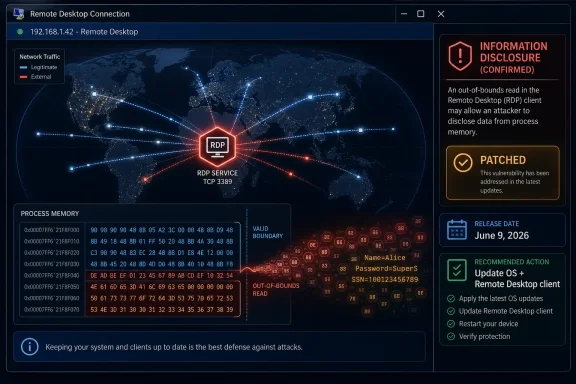
Microsoft released CVE-2026-45639 on June 9, 2026 as an Important Windows Remote Desktop Protocol information disclosure vulnerability, describing an out-of-bounds read that can let an unauthenticated network attacker disclose portions of process memory across affected Windows and Remote Desktop clients. That is not the stuff of instant BlueKeep panic, but it is also not a footnote. The interesting part is the confidence signal: Microsoft says the issue is confirmed, remotely reachable, and fixed, while rating exploitation as less likely. For administrators, the right response is neither alarm nor indifference; it is disciplined patching of one of Windows’ most exposed trust boundaries.
Remote Desktop has a peculiar place in Windows security. It is at once a convenience feature, a business necessity, an administrative lifeline, and a perennial target. When something lands under the RDP banner, even when it is “only” information disclosure, defenders tend to read it through the memory of more catastrophic bugs.
CVE-2026-45639 is not described as remote code execution. Microsoft’s advisory says the impact is information disclosure, with no loss of integrity or availability in the CVSS breakdown. The vulnerability is tied to CWE-125, out-of-bounds read, which usually means software reads data beyond the intended memory boundary and may expose information it should not.
That distinction matters because information disclosure bugs rarely make headlines on their own. They do not encrypt file shares, install web shells, or hand an attacker a SYSTEM shell by themselves. But they can reveal the kind of memory contents that make later exploitation easier, especially when combined with other flaws or used to defeat assumptions about isolation.
The CVSS vector explains why this one deserves attention. The attack vector is network, attack complexity is low, privileges are not required, and user interaction is not required. In plain English, Microsoft is saying the vulnerable component can be reached remotely under ordinary conditions, and a successful attack does not require a logged-in account or a victim clicking a prompt.
That is the tension at the heart of this advisory. The consequence is bounded to confidentiality, but the route to the bug is broad. In RDP, breadth is rarely academic.
The base score is doing a lot of work here. Network reachability, low complexity, no privileges, and no user interaction are the same attributes that make defenders nervous in far more severe vulnerabilities. The score is held back because Microsoft assigns impact only to confidentiality, not integrity or availability.
That does not make the bug harmless. A high confidentiality impact means Microsoft believes a successful attacker could obtain sensitive information, and the advisory’s short answer says the disclosed data could include portions of process memory. That is necessarily vague, but the category is recognizable: memory disclosure can expose tokens, pointers, fragments of user data, protocol state, or implementation details depending on where the read occurs and how the vulnerable process is laid out.
The temporal score is lower because Microsoft lists exploit code maturity as unproven and remediation level as official fix. In other words, Microsoft is not saying attackers are currently using the bug, nor that public exploit code is circulating. It is saying the vulnerability is real, a patch exists, and the current exploitation picture is calmer than the base mechanics might otherwise suggest.
That is exactly where many organizations make a bad trade. They downgrade a vulnerability because it is not exploited today, then leave a network-reachable primitive exposed long enough for someone else to do the work tomorrow. The practical lesson is that “exploitation less likely” is a prioritization aid, not a permission slip.
Security teams often obsess over base scores because they are easy to sort in dashboards. But confidence is what tells you whether you are acting on smoke, a lab artifact, or a verified weakness. A confirmed vulnerability in a core Windows remote access path deserves a different operational posture than a rumor attached to an incomplete CVE stub.
Here, the confidence signal is reinforced by the rest of the advisory. Microsoft published fixes across supported Windows client and server versions, the standalone Remote Desktop client for Windows Desktop, and the Windows App client for Windows Desktop. The breadth of affected products suggests the issue sits in shared RDP-related code or behavior rather than a fringe configuration.
The acknowledgements also matter. Microsoft credits pwn2addr and Kyeongmin Kim of KAIST Hacking Lab, which points to coordinated vulnerability disclosure rather than a rushed response to active exploitation. That is good news, but it is not the same as low value to attackers. Coordinated disclosure often means defenders get the first clean move, provided they actually take it.
Report Confidence also speaks to attacker knowledge. A confirmed bug with a defined weakness class and published affected builds gives researchers and adversaries a map, even if it does not give them a working exploit. The more concrete the public technical frame, the easier it becomes for skilled parties to diff patches, inspect protocol paths, and work backward from the fix.
That does not mean CVE-2026-45639 should be treated as a guaranteed stepping stone to code execution. Microsoft’s advisory does not claim that, and there is no public indication in the material reviewed that it is being exploited in the wild. The sober reading is narrower: unauthorized network access to process memory is an exposure that belongs on the urgent side of routine maintenance.
RDP makes that exposure more consequential because it mediates a rich session between local and remote environments. The protocol family supports authentication flows, graphics, device redirection, clipboard behavior, file and printer redirection, gateways, and client/server negotiation. Every one of those features is a convenience, and every convenience expands the amount of state that remote access software must safely manage.
The advisory does not say exactly which memory can be read. That uncertainty is not comforting. When a vendor says “portions of process memory,” the safe assumption for defenders is that the contents are implementation-dependent and environment-dependent, not that they are trivial.
For a home user who never enables Remote Desktop and only receives the vulnerable component as part of Windows, the exposure is likely much less immediate. For an enterprise with Remote Desktop Services, jump hosts, helpdesk tooling, virtual desktop infrastructure, or published apps, the calculation changes. The same bug category becomes more interesting when it sits near authentication, session brokering, or administrative access patterns.
The comparison is useful only if it is disciplined. BlueKeep was remote code execution; this is information disclosure. BlueKeep raised fears of automated compromise at internet scale; Microsoft currently rates exploitation of this bug as less likely and says it has not been publicly disclosed or exploited. Treating the two as equivalent would be lazy.
But ignoring the family resemblance would be equally lazy. RDP is frequently exposed in ways organizations forget, inherit, or rationalize. It appears on internal networks, VPN-only segments, cloud jump boxes, management subnets, and sometimes—still, inexplicably—directly on the public internet. A vulnerability that is network reachable and unauthenticated has different stakes when the service is reachable from places you do not fully control.
The more recent abuse of Remote Desktop connection files adds another wrinkle. Microsoft introduced new warnings for RDP files in 2026 because malicious RDP configurations can be used to trick users into connecting while redirecting local resources. That is a different attack path from CVE-2026-45639, but it points to the same strategic reality: RDP is no longer just a protocol defenders use; it is also a medium attackers try to weaponize.
That is why the correct mental model is not “Is this the next catastrophic RDP bug?” It is “How many RDP-adjacent assumptions do we currently depend on, and how fast can we reduce exposure when one of them fails?”
That range tells administrators two things. First, this is not a niche issue limited to a modern preview track or a single aging server branch. Second, older estate segments still matter because RDP is often more prevalent on servers that have accumulated years of operational exceptions.
The standalone Remote Desktop client for Windows Desktop is also listed, with fixed build 1.2.7214.0. The Windows App client for Windows Desktop is listed with fixed build 2.0.1193.0. That matters because many organizations now have a mixed client story: built-in Windows components, Microsoft Store-delivered clients, packaged clients, VDI access apps, and Windows App deployments may all coexist.
The patch KBs vary by platform. Windows 11 24H2 and 25H2 are associated with KB5094126, Windows 11 23H2 with KB5093998, Windows 10 21H2 and 22H2 with KB5094127, Windows Server 2022 with KB5094128, Windows Server 2025 with KB5094125, Windows Server 2019 and Windows 10 1809 with KB5094123, and Windows Server 2016 and Windows 10 1607 with KB5094122. Older Windows Server 2012 and 2012 R2 systems receive their respective monthly rollups, KB5094042 and KB5094041.
Those numbers are operationally useful, but the bigger point is simpler: if your inventory says “RDP” only when a server role is installed, you may miss client-side exposure. The advisory names both Windows itself and Remote Desktop client packages. Asset management has to follow the feature, not just the server role.
The distinction matters because RDP clients are deployed widely and updated through different channels. A server cumulative update may be handled by maintenance windows and change boards. A Remote Desktop client update may flow through Store policies, application packaging, Intune, Configuration Manager, winget, or manual install habits that vary by team.
That fragmentation creates a patching trap. A security dashboard may show the operating system as current while the remote access client lags behind. Conversely, an endpoint might have the latest app client but still lack the Windows cumulative update that fixes the platform component. Vulnerability management needs to reconcile both views.
The Windows App angle is particularly important. Microsoft has been consolidating access to Windows 365, Azure Virtual Desktop, Dev Box, Remote Desktop, and related cloud-hosted Windows experiences under the Windows App brand. That means RDP-like trust boundaries are no longer confined to old-school mstsc usage or server admin habits.
If a memory disclosure issue affects the client side, the exposure can travel with administrators, helpdesk staff, contractors, and power users. That is a different risk map than a static server inventory. The blast radius follows the people who connect.
But exploitability assessments are snapshots. They describe what Microsoft knows at publication time, not what will be true after patch diffing, researcher analysis, or criminal triage. The moment a vendor ships a patch, the fix becomes a clue.
Attackers do not need a fully public proof of concept to benefit from disclosure. They can compare binaries, inspect changed code paths, fuzz adjacent inputs, and test reachable services. In many cases, the gap between “no known exploitation” and “private exploit in progress” is invisible from the outside.
For this specific bug, the current data argues against panic. There is an official fix, no claimed public exploitation, and no public exploit maturity according to Microsoft. It is reasonable to schedule it through normal accelerated patch lanes rather than emergency out-of-band handling.
What is not reasonable is to leave internet-exposed RDP untouched because the temporal score is lower than the base score. The temporal score falls in part because a fix exists. Organizations that do not install the fix have not earned the benefit the score assumes.
The first practical question is reachability. Any RDP service directly exposed to the internet should already be considered a finding, but CVE-2026-45639 is another reason to revisit that assumption. Even when a vulnerability is “only” information disclosure, unauthenticated network reachability turns it into a useful reconnaissance or chaining primitive.
The second question is role. Domain controllers, management servers, certificate authorities, backup servers, virtualization hosts, and RDS session hosts deserve different treatment than ordinary endpoints. If RDP is enabled on systems that hold administrative credentials or high-value session material, memory disclosure is more worrying.
The third question is client hygiene. Remote Desktop clients used by privileged staff should be patched with the same urgency as the systems they administer. An admin workstation is not safer because it initiates connections rather than accepts them; it is often one of the most valuable machines in the network.
The fourth question is segmentation. If an attacker on a guest VLAN, compromised workstation subnet, or vendor VPN can reach RDP endpoints broadly, the practical severity rises. Network ACLs and just-in-time access are not cosmetic controls here; they decide how many unauthenticated packets can get near the vulnerable code.
That is precisely why they matter. Legacy servers are more likely to have permissive firewall rules, older administrative practices, and a longer history of one-off configuration changes. They are also more likely to be excluded from the cleanest parts of a modern patch pipeline.
The presence of fixed builds for older platforms is good news. Microsoft has provided a path for supported or ESU-covered systems. The bad news is that availability of a patch does not mean deployment is simple, especially where change freezes and application compatibility fears dominate.
This is where security teams should resist making CVE-2026-45639 a debate about whether every legacy server is doomed. The immediate task is narrower: identify where RDP is enabled, determine whether the June 2026 update applies, and close unnecessary network paths. Those are tractable actions even in a messy estate.
Longer term, every RDP advisory on legacy Windows should feed the same modernization argument. Remote administration is not a side feature; it is part of the security boundary. If an operating system branch is too fragile to patch promptly, it is too fragile to expose to broad administrative access.
That sparseness is normal for Microsoft vulnerability advisories, but it puts pressure on defenders to interpret carefully. The absence of exploit detail is not evidence of low severity. It is also not evidence of hidden catastrophe. It is simply the standard shape of coordinated disclosure for a memory safety issue in a major platform component.
The acknowledgement to external researchers suggests Microsoft received enough technical material to validate and fix the issue. The Report Confidence value of Confirmed reinforces that this is not speculative. The Exploit Code Maturity value of Unproven limits the alarm.
Put together, the advisory says: this is real, fixed, reachable, and not known to be under active attack. That is a familiar patch management pattern, but one attached to a component whose exposure is often underestimated. The right response is to act as though the vulnerability will become better understood over time.
There is also a communications lesson here. Users and IT leaders hear “information disclosure” and often translate it to “minor privacy leak.” In memory safety terms, that translation can be dangerously shallow. Process memory is not a harmless debug log; it can be a warehouse of secrets and exploit-enabling structure.
That is not the same vulnerability as CVE-2026-45639, and conflating them would be wrong. One is about malicious connection configuration and user-facing warnings; the other is a memory disclosure flaw in RDP. But together they show why Microsoft is tightening the entire Remote Desktop experience.
The old enterprise story treated RDP as a trusted administrative channel. The modern threat model treats it as a bidirectional exposure surface. Servers can be attacked through exposed services, clients can be lured into hostile sessions, redirected local resources can become valuable, and protocol parsing bugs can sit in either direction.
For WindowsForum readers, that shift should feel familiar. The desktop is no longer a simple endpoint and the server is no longer the only perimeter. Remote access collapses those categories. A remote session can turn a user’s local clipboard, camera, drive mapping, identity prompt, and credential flow into security-relevant material.
CVE-2026-45639 is therefore best understood as part of Microsoft’s continuing attempt to reduce risk in one of Windows’ most heavily used remote control paths. The fix is a patch, but the strategy is broader: fewer silent trust decisions, more explicit warnings, and fewer unaudited RDP paths.
The prioritization order should start with reachable systems. Patch externally exposed RDP infrastructure first, then RDP gateways, session hosts, bastion hosts, virtualization and management servers, and privileged admin workstations. If RDP is enabled where it is not needed, disable it rather than merely patching and moving on.
This is also a good moment to inventory RDP exposure from the outside and from major internal trust zones. Many organizations know what their vulnerability scanner sees from a server subnet but not what a compromised workstation could reach. CVE-2026-45639’s unauthenticated network vector makes that internal reachability question especially relevant.
Client updates deserve a named owner. If Remote Desktop client for Windows Desktop is present, confirm version 1.2.7214.0 or later. If Windows App client for Windows Desktop is used, confirm version 2.0.1193.0 or later. If those clients are packaged through endpoint management, make sure the deployment channel is not lagging behind OS patch compliance.
Finally, review compensating controls without pretending they are substitutes. Network Level Authentication, VPN restrictions, conditional access, RD Gateway, firewall rules, and privileged access workstations are all valuable. But Microsoft shipped a code fix because controls around the vulnerable component do not erase the vulnerable component.
 Microsoft’s RDP Patch Is Quiet, but the Attack Surface Is Loud
Remote Desktop has a peculiar place in Windows security. It is at once a convenience feature, a business necessity, an administrative lifeline, and a perennial target. When something lands under the RDP banner, even when it is “only” information disclosure, defenders tend to read it through the memory of more catastrophic bugs.CVE-2026-45639 is not described as remote code execution. Microsoft’s advisory says the impact is information disclosure, with no loss of integrity or availability in the CVSS breakdown. The vulnerability is tied to CWE-125, out-of-bounds read, which usually means software reads data beyond the intended memory boundary and may expose information it should not.
That distinction matters because information disclosure bugs rarely make headlines on their own. They do not encrypt file shares, install web shells, or hand an attacker a SYSTEM shell by themselves. But they can reveal the kind of memory contents that make later exploitation easier, especially when combined with other flaws or used to defeat assumptions about isolation.
The CVSS vector explains why this one deserves attention. The attack vector is network, attack complexity is low, privileges are not required, and user interaction is not required. In plain English, Microsoft is saying the vulnerable component can be reached remotely under ordinary conditions, and a successful attack does not require a logged-in account or a victim clicking a prompt.
That is the tension at the heart of this advisory. The consequence is bounded to confidentiality, but the route to the bug is broad. In RDP, breadth is rarely academic.
The Score Says Important; the Shape Says Patch Soon
Microsoft gives CVE-2026-45639 a CVSS 3.1 base score of 7.5 and a temporal score of 6.5. That lands in the familiar “Important” tier in Microsoft’s severity language, below the emergencies that trigger weekend bridge calls but high enough that a mature patch program should not push it into the indefinite backlog.The base score is doing a lot of work here. Network reachability, low complexity, no privileges, and no user interaction are the same attributes that make defenders nervous in far more severe vulnerabilities. The score is held back because Microsoft assigns impact only to confidentiality, not integrity or availability.
That does not make the bug harmless. A high confidentiality impact means Microsoft believes a successful attacker could obtain sensitive information, and the advisory’s short answer says the disclosed data could include portions of process memory. That is necessarily vague, but the category is recognizable: memory disclosure can expose tokens, pointers, fragments of user data, protocol state, or implementation details depending on where the read occurs and how the vulnerable process is laid out.
The temporal score is lower because Microsoft lists exploit code maturity as unproven and remediation level as official fix. In other words, Microsoft is not saying attackers are currently using the bug, nor that public exploit code is circulating. It is saying the vulnerability is real, a patch exists, and the current exploitation picture is calmer than the base mechanics might otherwise suggest.
That is exactly where many organizations make a bad trade. They downgrade a vulnerability because it is not exploited today, then leave a network-reachable primitive exposed long enough for someone else to do the work tomorrow. The practical lesson is that “exploitation less likely” is a prioritization aid, not a permission slip.
Report Confidence Is the Underrated Metric
The user-supplied excerpt points to the Report Confidence metric, and in this case Microsoft marks it Confirmed. That small word is more useful than it looks. It separates a speculative advisory from a vulnerability the vendor acknowledges or can reproduce with enough certainty to ship a fix.Security teams often obsess over base scores because they are easy to sort in dashboards. But confidence is what tells you whether you are acting on smoke, a lab artifact, or a verified weakness. A confirmed vulnerability in a core Windows remote access path deserves a different operational posture than a rumor attached to an incomplete CVE stub.
Here, the confidence signal is reinforced by the rest of the advisory. Microsoft published fixes across supported Windows client and server versions, the standalone Remote Desktop client for Windows Desktop, and the Windows App client for Windows Desktop. The breadth of affected products suggests the issue sits in shared RDP-related code or behavior rather than a fringe configuration.
The acknowledgements also matter. Microsoft credits pwn2addr and Kyeongmin Kim of KAIST Hacking Lab, which points to coordinated vulnerability disclosure rather than a rushed response to active exploitation. That is good news, but it is not the same as low value to attackers. Coordinated disclosure often means defenders get the first clean move, provided they actually take it.
Report Confidence also speaks to attacker knowledge. A confirmed bug with a defined weakness class and published affected builds gives researchers and adversaries a map, even if it does not give them a working exploit. The more concrete the public technical frame, the easier it becomes for skilled parties to diff patches, inspect protocol paths, and work backward from the fix.
Memory Disclosure Is Not a Sideshow in Remote Access
An out-of-bounds read sounds sterile, the kind of phrase that hides risk behind taxonomy. In practice, memory disclosure has long been one of the enabling technologies of modern exploitation. It can turn a difficult target into a predictable one by leaking secrets, addresses, or state that defensive mitigations assume will remain hidden.That does not mean CVE-2026-45639 should be treated as a guaranteed stepping stone to code execution. Microsoft’s advisory does not claim that, and there is no public indication in the material reviewed that it is being exploited in the wild. The sober reading is narrower: unauthorized network access to process memory is an exposure that belongs on the urgent side of routine maintenance.
RDP makes that exposure more consequential because it mediates a rich session between local and remote environments. The protocol family supports authentication flows, graphics, device redirection, clipboard behavior, file and printer redirection, gateways, and client/server negotiation. Every one of those features is a convenience, and every convenience expands the amount of state that remote access software must safely manage.
The advisory does not say exactly which memory can be read. That uncertainty is not comforting. When a vendor says “portions of process memory,” the safe assumption for defenders is that the contents are implementation-dependent and environment-dependent, not that they are trivial.
For a home user who never enables Remote Desktop and only receives the vulnerable component as part of Windows, the exposure is likely much less immediate. For an enterprise with Remote Desktop Services, jump hosts, helpdesk tooling, virtual desktop infrastructure, or published apps, the calculation changes. The same bug category becomes more interesting when it sits near authentication, session brokering, or administrative access patterns.
RDP’s Reputation Was Earned the Hard Way
Remote Desktop has been at the center of some of the Windows security community’s most memorable warnings. BlueKeep in 2019 was the obvious historical marker: a wormable RDP vulnerability severe enough that Microsoft issued extraordinary guidance and patches for older systems. CVE-2026-45639 is not BlueKeep, but BlueKeep changed how defenders read every later RDP advisory.The comparison is useful only if it is disciplined. BlueKeep was remote code execution; this is information disclosure. BlueKeep raised fears of automated compromise at internet scale; Microsoft currently rates exploitation of this bug as less likely and says it has not been publicly disclosed or exploited. Treating the two as equivalent would be lazy.
But ignoring the family resemblance would be equally lazy. RDP is frequently exposed in ways organizations forget, inherit, or rationalize. It appears on internal networks, VPN-only segments, cloud jump boxes, management subnets, and sometimes—still, inexplicably—directly on the public internet. A vulnerability that is network reachable and unauthenticated has different stakes when the service is reachable from places you do not fully control.
The more recent abuse of Remote Desktop connection files adds another wrinkle. Microsoft introduced new warnings for RDP files in 2026 because malicious RDP configurations can be used to trick users into connecting while redirecting local resources. That is a different attack path from CVE-2026-45639, but it points to the same strategic reality: RDP is no longer just a protocol defenders use; it is also a medium attackers try to weaponize.
That is why the correct mental model is not “Is this the next catastrophic RDP bug?” It is “How many RDP-adjacent assumptions do we currently depend on, and how fast can we reduce exposure when one of them fails?”
The Affected List Reaches from Legacy Servers to New Windows 11 Builds
The security update table is broad. Microsoft lists fixes for Windows Server 2012 and 2012 R2, Windows Server 2016, 2019, 2022, and 2025, including Server Core installations where applicable. On the client side, the advisory covers Windows 10 versions including 1607, 1809, 21H2, and 22H2, as well as Windows 11 23H2, 24H2, 25H2, and 26H1 on supported architectures.That range tells administrators two things. First, this is not a niche issue limited to a modern preview track or a single aging server branch. Second, older estate segments still matter because RDP is often more prevalent on servers that have accumulated years of operational exceptions.
The standalone Remote Desktop client for Windows Desktop is also listed, with fixed build 1.2.7214.0. The Windows App client for Windows Desktop is listed with fixed build 2.0.1193.0. That matters because many organizations now have a mixed client story: built-in Windows components, Microsoft Store-delivered clients, packaged clients, VDI access apps, and Windows App deployments may all coexist.
The patch KBs vary by platform. Windows 11 24H2 and 25H2 are associated with KB5094126, Windows 11 23H2 with KB5093998, Windows 10 21H2 and 22H2 with KB5094127, Windows Server 2022 with KB5094128, Windows Server 2025 with KB5094125, Windows Server 2019 and Windows 10 1809 with KB5094123, and Windows Server 2016 and Windows 10 1607 with KB5094122. Older Windows Server 2012 and 2012 R2 systems receive their respective monthly rollups, KB5094042 and KB5094041.
Those numbers are operationally useful, but the bigger point is simpler: if your inventory says “RDP” only when a server role is installed, you may miss client-side exposure. The advisory names both Windows itself and Remote Desktop client packages. Asset management has to follow the feature, not just the server role.
The Client Side Deserves More Attention Than It Gets
Administrators tend to think of RDP risk as inbound risk: a server listening on TCP 3389, a gateway publishing access, a bastion host waiting for admins. CVE-2026-45639 complicates that instinct because Microsoft includes Remote Desktop client products in the affected list. In modern Windows environments, the client is often as important as the host.The distinction matters because RDP clients are deployed widely and updated through different channels. A server cumulative update may be handled by maintenance windows and change boards. A Remote Desktop client update may flow through Store policies, application packaging, Intune, Configuration Manager, winget, or manual install habits that vary by team.
That fragmentation creates a patching trap. A security dashboard may show the operating system as current while the remote access client lags behind. Conversely, an endpoint might have the latest app client but still lack the Windows cumulative update that fixes the platform component. Vulnerability management needs to reconcile both views.
The Windows App angle is particularly important. Microsoft has been consolidating access to Windows 365, Azure Virtual Desktop, Dev Box, Remote Desktop, and related cloud-hosted Windows experiences under the Windows App brand. That means RDP-like trust boundaries are no longer confined to old-school mstsc usage or server admin habits.
If a memory disclosure issue affects the client side, the exposure can travel with administrators, helpdesk staff, contractors, and power users. That is a different risk map than a static server inventory. The blast radius follows the people who connect.
Exploitation Less Likely Is a Forecast, Not a Defense
Microsoft’s exploitability assessment says CVE-2026-45639 was not publicly disclosed, not exploited, and assessed as “Exploitation Less Likely” at original publication. That is useful. It should prevent this advisory from being treated like a fire drill on par with an actively exploited zero-day.But exploitability assessments are snapshots. They describe what Microsoft knows at publication time, not what will be true after patch diffing, researcher analysis, or criminal triage. The moment a vendor ships a patch, the fix becomes a clue.
Attackers do not need a fully public proof of concept to benefit from disclosure. They can compare binaries, inspect changed code paths, fuzz adjacent inputs, and test reachable services. In many cases, the gap between “no known exploitation” and “private exploit in progress” is invisible from the outside.
For this specific bug, the current data argues against panic. There is an official fix, no claimed public exploitation, and no public exploit maturity according to Microsoft. It is reasonable to schedule it through normal accelerated patch lanes rather than emergency out-of-band handling.
What is not reasonable is to leave internet-exposed RDP untouched because the temporal score is lower than the base score. The temporal score falls in part because a fix exists. Organizations that do not install the fix have not earned the benefit the score assumes.
Enterprise Risk Depends on Exposure, Not Just Severity
The CVSS base score is environment-neutral by design. It cannot know whether your RDP endpoints sit behind a gateway with conditional access, whether Network Level Authentication is enforced, whether legacy servers remain reachable from contractor VPN ranges, or whether admins routinely connect from unmanaged laptops. Your environment decides whether this is a Tuesday patch or a near-term risk reduction project.The first practical question is reachability. Any RDP service directly exposed to the internet should already be considered a finding, but CVE-2026-45639 is another reason to revisit that assumption. Even when a vulnerability is “only” information disclosure, unauthenticated network reachability turns it into a useful reconnaissance or chaining primitive.
The second question is role. Domain controllers, management servers, certificate authorities, backup servers, virtualization hosts, and RDS session hosts deserve different treatment than ordinary endpoints. If RDP is enabled on systems that hold administrative credentials or high-value session material, memory disclosure is more worrying.
The third question is client hygiene. Remote Desktop clients used by privileged staff should be patched with the same urgency as the systems they administer. An admin workstation is not safer because it initiates connections rather than accepts them; it is often one of the most valuable machines in the network.
The fourth question is segmentation. If an attacker on a guest VLAN, compromised workstation subnet, or vendor VPN can reach RDP endpoints broadly, the practical severity rises. Network ACLs and just-in-time access are not cosmetic controls here; they decide how many unauthenticated packets can get near the vulnerable code.
Legacy Windows Remains the Quiet Complication
The affected list includes Windows Server 2012 and 2012 R2, which for many organizations means Extended Security Updates, special procurement, exceptions, and systems that nobody wants to reboot. Those machines often run the workloads that survived every modernization program because they are brittle, expensive, or politically protected.That is precisely why they matter. Legacy servers are more likely to have permissive firewall rules, older administrative practices, and a longer history of one-off configuration changes. They are also more likely to be excluded from the cleanest parts of a modern patch pipeline.
The presence of fixed builds for older platforms is good news. Microsoft has provided a path for supported or ESU-covered systems. The bad news is that availability of a patch does not mean deployment is simple, especially where change freezes and application compatibility fears dominate.
This is where security teams should resist making CVE-2026-45639 a debate about whether every legacy server is doomed. The immediate task is narrower: identify where RDP is enabled, determine whether the June 2026 update applies, and close unnecessary network paths. Those are tractable actions even in a messy estate.
Longer term, every RDP advisory on legacy Windows should feed the same modernization argument. Remote administration is not a side feature; it is part of the security boundary. If an operating system branch is too fragile to patch promptly, it is too fragile to expose to broad administrative access.
Microsoft’s Sparse Advisory Leaves Room for Defender Judgment
Microsoft’s advisory is concise to the point of austerity. It names the bug class, the impact, the affected products, the fixed builds, the exploitability assessment, and a brief statement that successful exploitation could read portions of process memory. It does not describe packets, protocol stages, prerequisites beyond the CVSS metrics, or whether the vulnerable code is more client-side, server-side, or shared.That sparseness is normal for Microsoft vulnerability advisories, but it puts pressure on defenders to interpret carefully. The absence of exploit detail is not evidence of low severity. It is also not evidence of hidden catastrophe. It is simply the standard shape of coordinated disclosure for a memory safety issue in a major platform component.
The acknowledgement to external researchers suggests Microsoft received enough technical material to validate and fix the issue. The Report Confidence value of Confirmed reinforces that this is not speculative. The Exploit Code Maturity value of Unproven limits the alarm.
Put together, the advisory says: this is real, fixed, reachable, and not known to be under active attack. That is a familiar patch management pattern, but one attached to a component whose exposure is often underestimated. The right response is to act as though the vulnerability will become better understood over time.
There is also a communications lesson here. Users and IT leaders hear “information disclosure” and often translate it to “minor privacy leak.” In memory safety terms, that translation can be dangerously shallow. Process memory is not a harmless debug log; it can be a warehouse of secrets and exploit-enabling structure.
The RDP File Warning Era Changes the Background Noise
This advisory lands in the same year Microsoft expanded security warnings for Remote Desktop connection files. Beginning with April 2026 security updates, the Remote Desktop Connection app began presenting stronger warnings when users open RDP files, including details about the destination and requested local resource redirection. Microsoft made those changes because crafted RDP files can be abused in phishing and credential theft campaigns.That is not the same vulnerability as CVE-2026-45639, and conflating them would be wrong. One is about malicious connection configuration and user-facing warnings; the other is a memory disclosure flaw in RDP. But together they show why Microsoft is tightening the entire Remote Desktop experience.
The old enterprise story treated RDP as a trusted administrative channel. The modern threat model treats it as a bidirectional exposure surface. Servers can be attacked through exposed services, clients can be lured into hostile sessions, redirected local resources can become valuable, and protocol parsing bugs can sit in either direction.
For WindowsForum readers, that shift should feel familiar. The desktop is no longer a simple endpoint and the server is no longer the only perimeter. Remote access collapses those categories. A remote session can turn a user’s local clipboard, camera, drive mapping, identity prompt, and credential flow into security-relevant material.
CVE-2026-45639 is therefore best understood as part of Microsoft’s continuing attempt to reduce risk in one of Windows’ most heavily used remote control paths. The fix is a patch, but the strategy is broader: fewer silent trust decisions, more explicit warnings, and fewer unaudited RDP paths.
What Administrators Should Do Before the Week Ends
For most organizations, the response should be boring and structured. Deploy the June 2026 security updates to affected Windows systems, update Remote Desktop client packages, and validate fixed build numbers where app-based clients are used. Boring is good; boring is how you keep a confirmed vulnerability from becoming an incident.The prioritization order should start with reachable systems. Patch externally exposed RDP infrastructure first, then RDP gateways, session hosts, bastion hosts, virtualization and management servers, and privileged admin workstations. If RDP is enabled where it is not needed, disable it rather than merely patching and moving on.
This is also a good moment to inventory RDP exposure from the outside and from major internal trust zones. Many organizations know what their vulnerability scanner sees from a server subnet but not what a compromised workstation could reach. CVE-2026-45639’s unauthenticated network vector makes that internal reachability question especially relevant.
Client updates deserve a named owner. If Remote Desktop client for Windows Desktop is present, confirm version 1.2.7214.0 or later. If Windows App client for Windows Desktop is used, confirm version 2.0.1193.0 or later. If those clients are packaged through endpoint management, make sure the deployment channel is not lagging behind OS patch compliance.
Finally, review compensating controls without pretending they are substitutes. Network Level Authentication, VPN restrictions, conditional access, RD Gateway, firewall rules, and privileged access workstations are all valuable. But Microsoft shipped a code fix because controls around the vulnerable component do not erase the vulnerable component.
The June RDP Memory Leak Leaves Five Concrete Jobs
CVE-2026-45639 is not a reason to declare an RDP emergency, but it is a useful forcing function. It asks whether organizations actually know where Remote Desktop lives, which clients they use, and how quickly they can update a remote access stack that spans Windows builds, server roles, and modern app clients.- CVE-2026-45639 is a confirmed RDP information disclosure flaw released by Microsoft on June 9, 2026, with a CVSS 3.1 base score of 7.5 and an Important severity rating.
- Microsoft says successful exploitation could allow an unauthenticated network attacker to read portions of process memory, while also saying the vulnerability was not publicly disclosed or exploited at publication.
- The affected surface includes supported Windows client and server releases, Server Core installations, Remote Desktop client for Windows Desktop, and Windows App client for Windows Desktop.
- The fastest risk reduction comes from patching exposed RDP infrastructure, privileged management systems, RDS hosts, and administrator workstations before treating the issue as a routine endpoint backlog item.
- Organizations should verify both operating system updates and app-client fixed builds, because RDP risk is no longer confined to servers listening for inbound connections.
- Any RDP endpoint that is reachable from the public internet or broad internal networks deserves a separate exposure review, regardless of whether this specific vulnerability is currently being exploited.
References
- Primary source: MSRC
Published: 2026-06-09T07:00:00-07:00
Security Update Guide - Microsoft Security Response Center
 msrc.microsoft.com
