

Microsoft has listed CVE-2026-45608 as a Windows DHCP Client information disclosure vulnerability in the Microsoft Security Response Center update guide on June 9, 2026, placing a familiar but easily underestimated networking component back into the Patch Tuesday risk conversation. The important word is not “DHCP,” and it is not even “information disclosure.” The important word is client, because this is the piece of Windows that quietly negotiates network identity before most users think their machine has done anything at all. That makes this advisory a reminder that the low-level plumbing of Windows security still deserves more respect than it usually gets.
DHCP is not glamorous. It does not sit in the browser chrome, launch a Copilot panel, or advertise itself in the Start menu. It is the old, necessary protocol that lets a machine join a network without a human typing in an IP address, subnet mask, default gateway, and DNS servers.
That ordinariness is precisely why DHCP bugs deserve attention. A Windows client asking for network configuration is doing so at a moment when it is trying to establish trust with its local environment. On a corporate LAN, hotel Wi-Fi, coffee-shop network, lab subnet, or virtual test network, the DHCP exchange is part of the system’s first conversation with the outside world.
CVE-2026-45608 is described by Microsoft as an information disclosure vulnerability in the Windows DHCP Client. Microsoft’s public advisory language, at least at publication time, does not provide the kind of root-cause narrative researchers love: no packet field autopsy, no exploit walkthrough, no memory layout diagram. But the classification alone gives administrators a useful starting point. This is not a remote code execution alert demanding panic, nor is it a meaningless footnote to be buried under a hundred higher-scoring items.
Information disclosure sits in the awkward middle of vulnerability management. It often does not break systems on its own. It helps other attacks work better.
But attackers rarely build campaigns out of one perfect vulnerability. They assemble chains. An information disclosure bug may reveal memory contents, configuration details, network identifiers, tokens, addresses, or internal state that make a later stage more reliable. In isolation, the vulnerability might score as moderate. In a chain, it can be the difference between a crash and a working exploit.
That is why Windows information disclosure flaws should not be dismissed with a shrug. Windows is not a single application; it is a sprawling execution environment where local services, drivers, network stacks, authentication flows, and management agents all intersect. A small leak in one layer can become leverage in another.
The DHCP Client angle sharpens that concern. DHCP traffic is local-network traffic, and local networks are no longer the implicitly trusted spaces they were in old diagrams. Enterprise endpoints move constantly between office, home, guest, VPN-adjacent, virtualized, and cloud-managed contexts. A vulnerability in how a Windows client handles network configuration data matters because the attacker may not need to be on the other side of the internet. The attacker may only need to influence the network the machine joins.
That sparseness is not simply evasiveness. Vulnerability advisories have to inform defenders without gifting attackers a recipe. For a vulnerability class like information disclosure, the line is especially thin. Too much detail can turn a theoretical or difficult bug into something reproducible by a wider audience.
This is where the confidence metric language matters. The supplied description refers to the degree of confidence in the existence of the vulnerability and the credibility of known technical details. That is a vulnerability-management way of saying: not all CVEs are equal in how much the public knows, how certain the root cause is, or how easily attackers can act on the write-up.
In this case, Microsoft’s acknowledgement is itself significant. A vendor-confirmed Windows vulnerability is not rumor, even if public technical detail is limited. For defenders, the absence of exploit code is good news. The absence of detail is not a reason to ignore the patch.
The modern Windows DHCP Client sits in a much richer environment than the protocol’s age might imply. It interacts with network adapters, event logging, name resolution, policy, VPN clients, endpoint security tooling, virtualization stacks, and sometimes device management workflows. Even if the protocol remains familiar, the ecosystem around it keeps changing.
That is why “old protocol” does not mean “solved risk.” Old protocol parsers are still code. They still handle edge cases. They still receive input from environments the user may not control. And they still exist in operating systems where a small disclosure can have consequences far beyond the protocol transcript.
For Windows enthusiasts, this is one of the more interesting aspects of the advisory. DHCP is not some optional enterprise role you only install on a server. Windows client operating systems include DHCP client functionality as a basic part of TCP/IP networking, and DHCP is enabled by default in ordinary network configurations. The affected component is not exotic; it is part of the default rhythm of Windows connectivity.
A DHCP Client information disclosure bug forces a more contextual question: where are your Windows machines when they ask for addresses? A domain-joined desktop bolted to a well-segmented office port is not the same risk profile as a consultant laptop that spends half its life on unfamiliar Wi-Fi. A lab machine attached to experimental VLANs is not the same as a kiosk network. A developer workstation running nested virtualization and test DHCP services is its own little universe of weirdness.
The security decision, then, is not whether CVE-2026-45608 sounds scary in a headline. The decision is whether the systems in your estate routinely attach to networks where DHCP responses could be malicious, malformed, or merely unexpected. For many mobile Windows fleets, the honest answer is yes.
That does not mean administrators should invent drama. Microsoft has characterized the issue as information disclosure, not arbitrary code execution. There is no public basis, from the advisory alone, to claim mass exploitation or wormability. The right response is disciplined patching, not theatrical incident response.
Employees work from home networks filled with unmanaged devices. Laptops join conference Wi-Fi and customer networks. Engineers spin up virtual switches. Branch offices rely on consumer-grade connectivity more often than their architecture diagrams admit. Even in well-run enterprises, local network adjacency is not rare enough to be dismissed.
DHCP is particularly sensitive in this model because it is designed around discovery and response. The client broadcasts or otherwise seeks configuration; the network answers. If something in that answer can trigger disclosure, the defensive boundary has moved earlier than many security controls expect.
Endpoint detection tools may see later-stage behavior. Firewalls may control outbound flows after the system has an address. Identity controls may govern access after the user authenticates. DHCP happens before much of that higher-level security story becomes visible.
The machines to prioritize are the ones with the messiest network lives. Mobile endpoints, executive laptops, developer systems, red-team lab hosts, classroom PCs, shared workstations, and machines that frequently attach to untrusted networks deserve faster attention. Servers may be less likely to roam, but Windows Server systems using DHCP in dynamic environments should not be forgotten.
Administrators should also remember that information disclosure can matter more on high-value endpoints. A leak from a hardened workstation used for privileged administration is more consequential than the same class of leak from a disposable test box. Asset criticality should modify patch priority.
The practical mitigation story is not glamorous. Apply the relevant Microsoft security updates. Keep Windows Update for Business, WSUS, Intune, Configuration Manager, or your third-party patch platform honest. Watch for failed installs. Reboot where required. Validate that the machine actually moved to the patched build, not merely that a deployment ring claimed success.
For defenders, confidence is a calibration tool. Vendor confirmation raises confidence that the vulnerability exists. Sparse technical detail lowers the immediate usefulness of the advisory to attackers, but it also limits what defenders can detect with precision. Public proof-of-concept code would shift the urgency again.
This is the uncomfortable truth of vulnerability management in 2026: patching decisions are often made under partial information. Waiting for perfect detail is rarely safer. By the time the exploit path is fully described in public, the window for quiet remediation may already have narrowed.
CVE-2026-45608 appears to occupy the familiar Microsoft advisory zone: confirmed enough to patch, not described enough to reverse-engineer from prose alone. That is exactly the stage where disciplined IT shops gain ground. They do not need a dramatic blog post to move a monthly Windows security update through rings.
Without technical detail about the vulnerable condition, defenders should be cautious about writing confident detection rules. A malformed DHCP response may be interesting in a lab, but enterprise networks already contain enough odd devices, relays, appliances, and misconfigurations to make broad signatures noisy. The better use of telemetry is to understand exposure and anomalies, not to pretend every exploit attempt can be cleanly spotted.
That means patch status is the primary control. Network hygiene is secondary but still useful. Rogue DHCP prevention, switch protections, segmentation, wireless isolation, and monitoring for unauthorized DHCP servers all reduce the opportunities for local-network abuse. These controls are worth having regardless of this specific CVE.
For home and small-business users, the advice is simpler. Install the Windows security updates. Be cautious on unfamiliar networks. Do not assume that a vulnerability is irrelevant just because it does not hand an attacker full control in the first sentence of the advisory.
To be fair, Microsoft has to balance transparency with exploit enablement. But operational context does not always require exploit detail. Administrators benefit from knowing whether exploitation is more likely from the same subnet, whether default configurations are affected, whether mitigations exist, whether the issue involves IPv4, IPv6, or both, and whether successful exploitation exposes highly sensitive material or limited state.
The industry has slowly improved on this front, especially as CVSS v4.0 and related prioritization models push vendors to distinguish severity, exploit maturity, remediation effort, and provider urgency. But the lived experience for Windows admins remains uneven. The advisory tells you what to patch. It does not always tell you how to argue for the patch window.
That gap is where community analysis matters. WindowsForum readers know that the difference between “medium information disclosure” and “must patch the laptop fleet this week” is rarely contained in the CVE title. It depends on architecture, mobility, controls, and how much trust your endpoints place in the networks they visit.
For IT teams building their June 2026 patch plan, the advisory should translate into a few practical decisions rather than a panic memo.
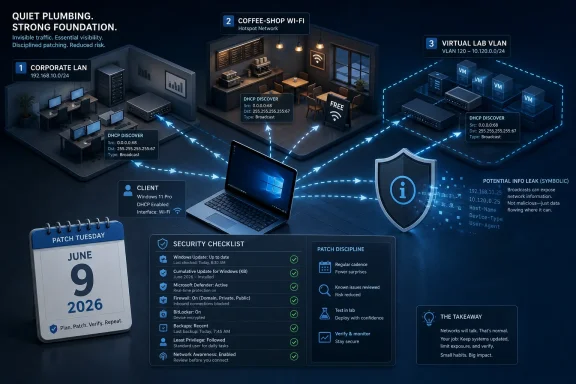 The Quietest Windows Component Is Often the Earliest One Exposed
DHCP is not glamorous. It does not sit in the browser chrome, launch a Copilot panel, or advertise itself in the Start menu. It is the old, necessary protocol that lets a machine join a network without a human typing in an IP address, subnet mask, default gateway, and DNS servers.That ordinariness is precisely why DHCP bugs deserve attention. A Windows client asking for network configuration is doing so at a moment when it is trying to establish trust with its local environment. On a corporate LAN, hotel Wi-Fi, coffee-shop network, lab subnet, or virtual test network, the DHCP exchange is part of the system’s first conversation with the outside world.
CVE-2026-45608 is described by Microsoft as an information disclosure vulnerability in the Windows DHCP Client. Microsoft’s public advisory language, at least at publication time, does not provide the kind of root-cause narrative researchers love: no packet field autopsy, no exploit walkthrough, no memory layout diagram. But the classification alone gives administrators a useful starting point. This is not a remote code execution alert demanding panic, nor is it a meaningless footnote to be buried under a hundred higher-scoring items.
Information disclosure sits in the awkward middle of vulnerability management. It often does not break systems on its own. It helps other attacks work better.
Information Disclosure Is the Reconnaissance Layer of Modern Exploitation
The security industry has trained people to fear code execution above all else, and for good reason. A reliable remote code execution bug can turn a network service into an entry point. A wormable one can turn a Tuesday patch cycle into a global incident.But attackers rarely build campaigns out of one perfect vulnerability. They assemble chains. An information disclosure bug may reveal memory contents, configuration details, network identifiers, tokens, addresses, or internal state that make a later stage more reliable. In isolation, the vulnerability might score as moderate. In a chain, it can be the difference between a crash and a working exploit.
That is why Windows information disclosure flaws should not be dismissed with a shrug. Windows is not a single application; it is a sprawling execution environment where local services, drivers, network stacks, authentication flows, and management agents all intersect. A small leak in one layer can become leverage in another.
The DHCP Client angle sharpens that concern. DHCP traffic is local-network traffic, and local networks are no longer the implicitly trusted spaces they were in old diagrams. Enterprise endpoints move constantly between office, home, guest, VPN-adjacent, virtualized, and cloud-managed contexts. A vulnerability in how a Windows client handles network configuration data matters because the attacker may not need to be on the other side of the internet. The attacker may only need to influence the network the machine joins.
The Advisory Says Less Than Defenders Want, and That Is the Point
The user-facing frustration with many MSRC entries is that they can feel terse by design. Administrators want exact preconditions, exploit shape, and affected internal components. Microsoft often provides a title, severity data, affected products, update guidance, and a short impact category. The rest is intentionally sparse.That sparseness is not simply evasiveness. Vulnerability advisories have to inform defenders without gifting attackers a recipe. For a vulnerability class like information disclosure, the line is especially thin. Too much detail can turn a theoretical or difficult bug into something reproducible by a wider audience.
This is where the confidence metric language matters. The supplied description refers to the degree of confidence in the existence of the vulnerability and the credibility of known technical details. That is a vulnerability-management way of saying: not all CVEs are equal in how much the public knows, how certain the root cause is, or how easily attackers can act on the write-up.
In this case, Microsoft’s acknowledgement is itself significant. A vendor-confirmed Windows vulnerability is not rumor, even if public technical detail is limited. For defenders, the absence of exploit code is good news. The absence of detail is not a reason to ignore the patch.
DHCP Is Old, but the Windows Attack Surface Around It Is Not Static
DHCP dates from an era when network convenience was the primary design goal. The protocol exists so machines can appear on a network and be told how to communicate. That means the protocol’s job is to accept structured data from a network peer and turn it into operating-system configuration.The modern Windows DHCP Client sits in a much richer environment than the protocol’s age might imply. It interacts with network adapters, event logging, name resolution, policy, VPN clients, endpoint security tooling, virtualization stacks, and sometimes device management workflows. Even if the protocol remains familiar, the ecosystem around it keeps changing.
That is why “old protocol” does not mean “solved risk.” Old protocol parsers are still code. They still handle edge cases. They still receive input from environments the user may not control. And they still exist in operating systems where a small disclosure can have consequences far beyond the protocol transcript.
For Windows enthusiasts, this is one of the more interesting aspects of the advisory. DHCP is not some optional enterprise role you only install on a server. Windows client operating systems include DHCP client functionality as a basic part of TCP/IP networking, and DHCP is enabled by default in ordinary network configurations. The affected component is not exotic; it is part of the default rhythm of Windows connectivity.
Patch Tuesday Risk Is About Exposure, Not Just Severity
The temptation after any Patch Tuesday is to sort by CVSS score, patch the top of the list, and call that prioritization. That is understandable, but incomplete. CVSS is a severity framework, not a perfect expression of operational risk.A DHCP Client information disclosure bug forces a more contextual question: where are your Windows machines when they ask for addresses? A domain-joined desktop bolted to a well-segmented office port is not the same risk profile as a consultant laptop that spends half its life on unfamiliar Wi-Fi. A lab machine attached to experimental VLANs is not the same as a kiosk network. A developer workstation running nested virtualization and test DHCP services is its own little universe of weirdness.
The security decision, then, is not whether CVE-2026-45608 sounds scary in a headline. The decision is whether the systems in your estate routinely attach to networks where DHCP responses could be malicious, malformed, or merely unexpected. For many mobile Windows fleets, the honest answer is yes.
That does not mean administrators should invent drama. Microsoft has characterized the issue as information disclosure, not arbitrary code execution. There is no public basis, from the advisory alone, to claim mass exploitation or wormability. The right response is disciplined patching, not theatrical incident response.
The Local Network Is No Longer a Safe Boundary
The industry’s slow death of perimeter thinking applies neatly here. Once, a local-network attacker sounded like a lesser threat because the corporate LAN was assumed to be controlled territory. Today, that assumption is brittle.Employees work from home networks filled with unmanaged devices. Laptops join conference Wi-Fi and customer networks. Engineers spin up virtual switches. Branch offices rely on consumer-grade connectivity more often than their architecture diagrams admit. Even in well-run enterprises, local network adjacency is not rare enough to be dismissed.
DHCP is particularly sensitive in this model because it is designed around discovery and response. The client broadcasts or otherwise seeks configuration; the network answers. If something in that answer can trigger disclosure, the defensive boundary has moved earlier than many security controls expect.
Endpoint detection tools may see later-stage behavior. Firewalls may control outbound flows after the system has an address. Identity controls may govern access after the user authenticates. DHCP happens before much of that higher-level security story becomes visible.
Windows Admins Should Treat This as a Hygiene Patch With Network-Aware Priority
For most organizations, CVE-2026-45608 should land in the “patch promptly through the normal security update process” bucket. That sounds boring, but boring is the point. The Windows servicing model is built to absorb precisely these classes of platform vulnerabilities before they become incident headlines.The machines to prioritize are the ones with the messiest network lives. Mobile endpoints, executive laptops, developer systems, red-team lab hosts, classroom PCs, shared workstations, and machines that frequently attach to untrusted networks deserve faster attention. Servers may be less likely to roam, but Windows Server systems using DHCP in dynamic environments should not be forgotten.
Administrators should also remember that information disclosure can matter more on high-value endpoints. A leak from a hardened workstation used for privileged administration is more consequential than the same class of leak from a disposable test box. Asset criticality should modify patch priority.
The practical mitigation story is not glamorous. Apply the relevant Microsoft security updates. Keep Windows Update for Business, WSUS, Intune, Configuration Manager, or your third-party patch platform honest. Watch for failed installs. Reboot where required. Validate that the machine actually moved to the patched build, not merely that a deployment ring claimed success.
The Scoring Language Is Trying to Tell You What the Headline Cannot
The quoted metric language is useful because it separates vulnerability existence from vulnerability knowledge. A CVE can be real but poorly understood publicly. It can be technically detailed but not vendor-confirmed. It can be confirmed and patched without public exploit material. Each of those states changes attacker economics.For defenders, confidence is a calibration tool. Vendor confirmation raises confidence that the vulnerability exists. Sparse technical detail lowers the immediate usefulness of the advisory to attackers, but it also limits what defenders can detect with precision. Public proof-of-concept code would shift the urgency again.
This is the uncomfortable truth of vulnerability management in 2026: patching decisions are often made under partial information. Waiting for perfect detail is rarely safer. By the time the exploit path is fully described in public, the window for quiet remediation may already have narrowed.
CVE-2026-45608 appears to occupy the familiar Microsoft advisory zone: confirmed enough to patch, not described enough to reverse-engineer from prose alone. That is exactly the stage where disciplined IT shops gain ground. They do not need a dramatic blog post to move a monthly Windows security update through rings.
Detection Will Be Harder Than Deployment
If administrators are hoping for a clean detection story, DHCP Client information disclosure is unlikely to provide one. The protocol is noisy in normal life. Renewals, rebinds, adapter changes, sleep-resume cycles, VPN transitions, and Wi-Fi roaming can all generate DHCP activity that looks mundane because it is mundane.Without technical detail about the vulnerable condition, defenders should be cautious about writing confident detection rules. A malformed DHCP response may be interesting in a lab, but enterprise networks already contain enough odd devices, relays, appliances, and misconfigurations to make broad signatures noisy. The better use of telemetry is to understand exposure and anomalies, not to pretend every exploit attempt can be cleanly spotted.
That means patch status is the primary control. Network hygiene is secondary but still useful. Rogue DHCP prevention, switch protections, segmentation, wireless isolation, and monitoring for unauthorized DHCP servers all reduce the opportunities for local-network abuse. These controls are worth having regardless of this specific CVE.
For home and small-business users, the advice is simpler. Install the Windows security updates. Be cautious on unfamiliar networks. Do not assume that a vulnerability is irrelevant just because it does not hand an attacker full control in the first sentence of the advisory.
Microsoft’s Terse Advisory Style Leaves Room for Better Operational Context
Microsoft’s security update guide has become an essential clearinghouse, but it still often underserves the people who have to translate CVEs into change windows. A title and impact category may be enough for compliance dashboards. They are not always enough for administrators deciding which emergency meeting to cancel and which one to convene.To be fair, Microsoft has to balance transparency with exploit enablement. But operational context does not always require exploit detail. Administrators benefit from knowing whether exploitation is more likely from the same subnet, whether default configurations are affected, whether mitigations exist, whether the issue involves IPv4, IPv6, or both, and whether successful exploitation exposes highly sensitive material or limited state.
The industry has slowly improved on this front, especially as CVSS v4.0 and related prioritization models push vendors to distinguish severity, exploit maturity, remediation effort, and provider urgency. But the lived experience for Windows admins remains uneven. The advisory tells you what to patch. It does not always tell you how to argue for the patch window.
That gap is where community analysis matters. WindowsForum readers know that the difference between “medium information disclosure” and “must patch the laptop fleet this week” is rarely contained in the CVE title. It depends on architecture, mobility, controls, and how much trust your endpoints place in the networks they visit.
The DHCP Client Bug Belongs in the First Patch Ring
The concrete lesson from CVE-2026-45608 is not that DHCP is suddenly terrifying. It is that foundational client-side networking code should be treated as exposed code, especially on mobile Windows systems. The more a machine moves, the less comfortable we should be with slow patch cycles for pre-authentication network components.For IT teams building their June 2026 patch plan, the advisory should translate into a few practical decisions rather than a panic memo.
- Organizations should include CVE-2026-45608 in normal June 2026 Windows security update deployment rather than waiting for public exploit details.
- Mobile Windows endpoints should receive higher priority because they are more likely to encounter untrusted or poorly controlled DHCP environments.
- Administrators should verify successful update installation instead of relying only on deployment intent from management consoles.
- Network teams should continue enforcing rogue DHCP protections and segmentation because those controls reduce exposure to this class of local-network issue.
- Security teams should avoid overpromising detection for this CVE unless Microsoft or researchers publish enough technical detail to support reliable signatures.
- Risk owners should treat information disclosure vulnerabilities as possible chain components, not as harmless paperwork entries.
References
- Primary source: MSRC
Published: 2026-06-09T07:00:00-07:00
Security Update Guide - Microsoft Security Response Center
 msrc.microsoft.com
- Related coverage: sentinelone.com
CVE-2022-38026: Windows DHCP Client Info Disclosure Flaw
CVE-2022-38026 is an information disclosure vulnerability in Windows DHCP Client. Learn about its impact, affected versions, and mitigation methods.www.sentinelone.com
- Related coverage: ws.buildingsbt.stage.honeywell.com
- Related coverage: assets.kpmg.com
16 september 2022 microsoft september 2022 patch tuesday fixes 64 flaws.pdf.coredownload.inline
PDF documentassets.kpmg.com
- Related coverage: hivepro.com
- Related coverage: buildings.honeywell.com
The purpose of this document is to identify the patches that have been delivered by Microsoft® which have been tested against Pro-Watch
PDF documentbuildings.honeywell.com
- Related coverage: miggo.io
CVE-2026-42578: Netty ProxyHandler CRLF Inject | Miggo
Netty HttpProxyHandler HTTP header injection via CRLF sequences in outboundHeaders with disabled validation grants proxy auth bypass or request smuggling.www.miggo.io
- Related coverage: osv.dev

OSV - Open Source Vulnerabilities
Comprehensive vulnerability database for your open source projects and dependencies.
osv.dev
- Related coverage: docs.redhat.com
Red Hat Software Certification 2026 Red Hat Vulnerability Management Certification Policy Guide
PDF documentdocs.redhat.com
- Related coverage: orca.security
CVSS: Common Vulnerability Scoring System Guide | Orca Security
Learn how CVSS vulnerability scoring works, its limitations, and best practices for risk-based vulnerability management in cloud environments. orca.security
- Related coverage: first.org
