

CVE-2026-45844 is a Linux kernel netfilter flaw, published by NVD on May 27, 2026, in which arptables mishandles IPv4-over-IEEE1394 ARP packets, causing incorrect rule matching and potentially unsafe packet mangling on FireWire network interfaces. It is not the sort of bug that will send most WindowsForum readers racing to unplug servers, but it is exactly the kind of obscure kernel edge case that exposes how brittle network filtering can become when old assumptions survive longer than the hardware that inspired them. The practical impact is narrow; the engineering lesson is not. A firewall that reads the wrong bytes is still a firewall making decisions with bad evidence.
The headline version of CVE-2026-45844 sounds almost antique: FireWire, ARP, arptables, and IPv4-over-IEEE1394. That combination feels pulled from a lab bench rather than a modern production rack. Yet the vulnerability lands in 2026 because the Linux kernel remains a living archive of protocol support, compatibility layers, and special-case transport behavior.
The issue sits in netfilter’s ARP handling, specifically the legacy
Once that field disappears, ordinary pointer arithmetic becomes dangerous in the most prosaic way. The parser advances as though bytes exist where they do not, then interprets the wrong part of the packet as the target device address or target IP address. The result is not a spectacular remote-code-execution story; it is a quieter failure mode in which filtering logic may accept what it meant to reject, or reject what it meant to accept.
That distinction matters. Security failures are often imagined as memory corruption, privilege escalation, and shell access. But network enforcement also fails when policy engines misread reality, especially at a layer as foundational as ARP, where hosts learn how to reach one another before higher-level security controls ever enter the conversation.
That dismissal would be too easy. The flaw is not interesting because FireWire is common. It is interesting because the kernel path treated one ARP format as if it were the only ARP format that mattered. The ARP stack itself already knew better: the kernel’s ordinary ARP create and process paths accounted for IEEE1394’s shorter ARP payload by skipping the absent target hardware address.
Netfilter’s ARP matching code did not mirror that care. In
That is the security smell here. One subsystem had the protocol exception encoded correctly, while another subsystem handling related packet data carried a simpler model. When kernel code duplicates protocol knowledge, one copy eventually drifts.
That can cut both ways. A packet intended to match a drop rule might not match, and a packet intended to pass might be dropped. In policy terms, this is a failure of determinism: the firewall’s behavior no longer follows the model the administrator configured.
The CVE description is careful not to overstate this as universal firewall bypass. It is constrained to ARP handling, arptables, and IEEE1394-style ARP payloads. It also requires relevant interfaces and rules. For most cloud hosts, laptops, Windows dual-boot users, and ordinary Linux desktops, the affected path is unlikely to be in play.
But for systems that do expose or emulate IEEE1394 networking, particularly older specialized deployments, lab networks, retrofitted industrial environments, or niche embedded systems, the fix is worth taking seriously. ARP is local-link plumbing, and local-link plumbing is exactly where attackers with physical, adjacent, or compromised-segment access like to live.
That behavior applies even to inverse matching, which may surprise people who think in pure boolean terms. The reasoning is blunt: target hardware address matching for ARPHRD_IEEE1394 was never actually supported in a meaningful way. Allowing the expression to evaluate as true because a field is absent would preserve syntax at the expense of semantics.
Second, the patch hardens
That is a conservative choice, and it is the correct one. In theory, some IEEE1394 IP address mangling could be implemented with a layout-aware offset calculation. In practice, the old behavior did not correctly support it, and a firewall mangling packet bytes at the wrong offset is worse than a firewall refusing to perform an unsupported transformation.
It does not mean an AI system autonomously patched the Linux kernel. The patch is based on work credited to Weiming Shi, and the stable references come through the usual kernel channels. But the phrase hints at a now-familiar reality: maintainers and contributors are increasingly using AI tools somewhere in the workflow, whether for analysis, explanation, test generation, or patch exploration.
For security readers, the important question is not whether AI was involved. The important question is whether the final change reflects maintainable kernel logic and reviewable intent. In this case, the intent is straightforward: do not match on fields that do not exist, and do not mangle packet fields when the code cannot safely locate them.
Still, the wording is a reminder that CVE records are no longer just sterile vulnerability blurbs. They are increasingly artifacts of modern development culture, carrying traces of mailing-list debate, generated analysis, maintainer edits, and stable-tree backports. That can make them more informative, but also more awkward.
That is a common frustration for administrators who triage vulnerabilities from dashboards. A CVE without a score can either look harmless or look ominous, depending on how a scanner presents it. Neither instinct is reliable. The absence of a CVSS score is not evidence of low impact; it is evidence that the scoring process has not finished.
In this case, practical severity depends heavily on exposure. Systems without IEEE1394 networking, without affected arptables rules, or without any realistic local-link attacker path are unlikely to face meaningful risk. Systems that do rely on arptables policy around ARP traffic over FireWire-style interfaces should treat the patch as a correctness and security fix.
The more mature way to triage this CVE is to ask operational questions rather than wait for a number. Do any kernels in your fleet include the affected code? Are any IEEE1394 network interfaces present or emulated? Does policy depend on arptables target hardware address or target IP matching? Is ARP mangling used at all? Those answers matter more than a future decimal score.
Netfilter is especially consequential because it is not an ornamental subsystem. It is the packet filtering and mangling framework behind iptables, arptables, ebtables, nftables-era compatibility paths, container networking, and countless firewall appliances. Even when a given bug is narrow, the subsystem’s job is sensitive: decide what crosses the boundary.
CVE-2026-45844 is not an argument that FireWire is suddenly a major threat vector. It is an argument that old protocol support becomes risk when parser assumptions are copied, forgotten, and then invoked by security policy. Legacy code is not dangerous merely because it is old. It is dangerous when nobody remembers which invariants were never universal.
The irony is that the kernel already had the correct behavior nearby. The ordinary ARP implementation handled IEEE1394 correctly. The firewall path did not. That kind of inconsistency is exactly why security fixes in mature kernels often look less like invention and more like reconciliation.
The indirect exposure is more plausible. A Windows-heavy environment may still use Linux-based network appliances, storage systems, monitoring taps, virtualization hosts, or embedded controllers. Some of those systems may be older, specialized, or connected to unusual hardware buses. The more bespoke the environment, the more likely it is to contain dusty features that ordinary fleet scanning does not model well.
There is also the WSL distinction. Windows Subsystem for Linux does not make a Windows client vulnerable simply because a Linux CVE exists. WSL uses Microsoft’s managed kernel integration, and it is not a normal physical Linux networking stack with FireWire ARP filtering in the way a bare-metal Linux host would be. Administrators should avoid both panic and complacency: WSL is usually not the path of concern here, but Linux appliances and hosts may be.
The right Windows-world response is inventory, not alarm. If your Linux estate is limited to current cloud images and mainstream Ethernet networking, this CVE is likely to arrive and disappear inside routine kernel updates. If your environment includes specialized hardware, lab buses, or long-lived appliances, it deserves a closer look.
That long tail is where subtle bugs endure. Old firewall commands tend to be treated as boring infrastructure: once a script works, nobody wants to touch it. Appliances may hide the underlying ruleset entirely. Documentation may say “iptables” even when the system is translating beneath the surface.
Arptables is even more obscure than iptables because it filters ARP rather than IP traffic. That makes it less visible to administrators who think in TCP ports and IP addresses. But ARP filtering can be security-relevant in local networks, especially where spoofing, bridging, virtualization, or segmentation controls are involved.
CVE-2026-45844 shows how correctness bugs in these older paths remain worth fixing. The fact that a feature is rarely used does not make it safe. It may make it less tested, less reviewed, and more likely to contain assumptions nobody has challenged in years.
Packet mangling is inherently invasive. It does not merely observe traffic and choose a verdict; it rewrites packet contents. When mangling code miscalculates offsets, the system risks producing corrupted packets, confusing peers, or creating behavior that no administrator can explain from the visible ruleset.
The patch’s choice to drop packets for unsupported IEEE1394 mangle operations may look harsh, but it is a clean security boundary. If the kernel cannot confidently identify the field being modified, it should not modify anything. Silent corruption is the worst outcome because it preserves the illusion that the feature is working.
This is a useful principle for administrators too. Firewall features that rewrite packets should be treated with more skepticism than features that merely filter them. They need stronger testing, clearer observability, and more caution during upgrades because a small parser bug can become a packet-integrity bug.
The pattern is familiar. A protocol has a special case. One subsystem handles the special case. Another subsystem assumes the common layout. Years pass. A researcher, maintainer, fuzzer, or careful reviewer notices that the two code paths disagree. The fix is small, but the question it raises is large: how many other security decisions depend on duplicated parsing logic?
That is why “low exposure” should not be confused with “low significance.” CVE-2026-45844 will not dominate boardroom risk reports. It should, however, encourage kernel and security engineers to look for places where filtering code parses protocol structures independently from the stack that already understands them.
The best security architecture minimizes those divergences. The more a firewall subsystem can rely on canonical parsing, validated metadata, or shared helpers, the fewer chances there are for policy to drift away from packet reality.
Rolling distributions and fast-moving server platforms may absorb the fix quickly through ordinary kernel updates. Enterprise distributions may backport the patch into older supported kernels while keeping version numbers that look unchanged to casual inspection. Appliances may lag unless the vendor explicitly ships a firmware or OS update.
This is where CVE management often gets messy. A scanner might flag a kernel version as vulnerable even after a vendor backport, or fail to flag a customized appliance kernel that still contains the vulnerable code. The only reliable answer often comes from vendor advisories, changelogs, package metadata, or direct confirmation that the relevant upstream commits were included.
Administrators should also remember that kernel updates usually require a reboot to take effect. Installing a patched package is not the same as running the patched kernel. In tightly controlled environments, that reboot window may be the real remediation delay.
The second step is to inspect policy. Arptables rules that match target hardware addresses or target IP addresses over IEEE1394 are the interesting case for filtering decisions. Rules that use ARP mangling on those fields are the interesting case for packet corruption and the new drop behavior.
The third step is to understand adjacency. ARP is a local-link protocol, so exploitation scenarios generally start from the same L2 segment or from a position that can inject relevant traffic into that segment. That does not make the issue irrelevant. Local networks are not inherently trusted anymore, especially in labs, shared facilities, industrial environments, and mixed-trust operational networks.
Finally, administrators should decide whether mitigation is even needed beyond patching. For most, routine kernel updates are enough. For specialized systems, disabling unused IEEE1394 networking support, removing obsolete arptables rules, or migrating away from legacy ARP filtering constructs may be more durable than chasing individual CVEs.
That means a configuration that accidentally appeared to work may stop behaving the same way after the update. In security terms, that is desirable: the old behavior was not reliable. In operations terms, it may still surprise anyone depending on the accidental outcome.
The right test is not whether old rules produce identical counters after patching. The right test is whether the intended security policy can be expressed accurately. If a rule depended on matching a target hardware address that IEEE1394 ARP does not carry, the policy was already fictional.
This is one of the hardest messages in infrastructure maintenance. A patch that “breaks” an invalid configuration is not necessarily a regression. Sometimes it is the first time the system has told the truth.
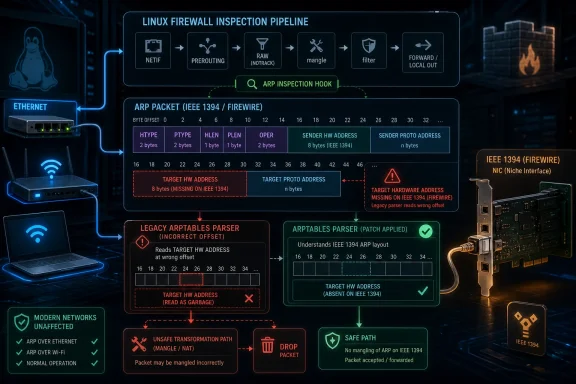 A Small FireWire Bug Says Something Larger About Kernel Security
The headline version of CVE-2026-45844 sounds almost antique: FireWire, ARP, arptables, and IPv4-over-IEEE1394. That combination feels pulled from a lab bench rather than a modern production rack. Yet the vulnerability lands in 2026 because the Linux kernel remains a living archive of protocol support, compatibility layers, and special-case transport behavior.The issue sits in netfilter’s ARP handling, specifically the legacy
arp_tables path used by arptables. The vulnerable logic assumed an ARP payload layout with both source and target hardware addresses present. That assumption is true often enough to look harmless, but it is not true for IPv4-over-IEEE1394, where the target hardware address field is omitted.Once that field disappears, ordinary pointer arithmetic becomes dangerous in the most prosaic way. The parser advances as though bytes exist where they do not, then interprets the wrong part of the packet as the target device address or target IP address. The result is not a spectacular remote-code-execution story; it is a quieter failure mode in which filtering logic may accept what it meant to reject, or reject what it meant to accept.
That distinction matters. Security failures are often imagined as memory corruption, privilege escalation, and shell access. But network enforcement also fails when policy engines misread reality, especially at a layer as foundational as ARP, where hosts learn how to reach one another before higher-level security controls ever enter the conversation.
The Vulnerability Lives in an Assumption, Not in FireWire Nostalgia
FireWire networking has never been mainstream in the way Ethernet or Wi-Fi became mainstream. IEEE 1394 had real technical strengths and a real following in media workflows, storage, and certain embedded or industrial contexts, but it largely vanished from ordinary client networking. That makes CVE-2026-45844 tempting to dismiss as a museum-piece bug.That dismissal would be too easy. The flaw is not interesting because FireWire is common. It is interesting because the kernel path treated one ARP format as if it were the only ARP format that mattered. The ARP stack itself already knew better: the kernel’s ordinary ARP create and process paths accounted for IEEE1394’s shorter ARP payload by skipping the absent target hardware address.
Netfilter’s ARP matching code did not mirror that care. In
arp_packet_match(), the packet was parsed as though both hardware addresses were always present. For ordinary ARP layouts, that works. For ARPHRD_IEEE1394, it walks past a field that was never there.That is the security smell here. One subsystem had the protocol exception encoded correctly, while another subsystem handling related packet data carried a simpler model. When kernel code duplicates protocol knowledge, one copy eventually drifts.
Arptables Was Making Decisions From Garbage Data
The most direct impact is incorrect filtering. If an arptables rule attempted to match the target device address or target IP address on an IEEE1394 interface, the comparison could be made against unrelated bytes. A rule administrator might believe they had written a precise ARP policy, while the kernel was comparing that policy to packet data shifted out of alignment.That can cut both ways. A packet intended to match a drop rule might not match, and a packet intended to pass might be dropped. In policy terms, this is a failure of determinism: the firewall’s behavior no longer follows the model the administrator configured.
The CVE description is careful not to overstate this as universal firewall bypass. It is constrained to ARP handling, arptables, and IEEE1394-style ARP payloads. It also requires relevant interfaces and rules. For most cloud hosts, laptops, Windows dual-boot users, and ordinary Linux desktops, the affected path is unlikely to be in play.
But for systems that do expose or emulate IEEE1394 networking, particularly older specialized deployments, lab networks, retrofitted industrial environments, or niche embedded systems, the fix is worth taking seriously. ARP is local-link plumbing, and local-link plumbing is exactly where attackers with physical, adjacent, or compromised-segment access like to live.
The Patch Chooses Safety Over Pretending the Feature Worked
The fix does two important things. First, it alignsarp_packet_match() with the reality that IEEE1394 ARP packets do not contain the target hardware address field. If a user attempts to match on that absent target hardware address, the patched code returns no match.That behavior applies even to inverse matching, which may surprise people who think in pure boolean terms. The reasoning is blunt: target hardware address matching for ARPHRD_IEEE1394 was never actually supported in a meaningful way. Allowing the expression to evaluate as true because a field is absent would preserve syntax at the expense of semantics.
Second, the patch hardens
arpt_mangle, the code path that modifies ARP packets. The mangle logic also assumed a standard ARP layout. On IEEE1394, that means it could calculate the wrong offset for the target IP address and write to the wrong place in the packet. The patch therefore drops packets when mangling is requested for the affected fields on IEEE1394 devices.That is a conservative choice, and it is the correct one. In theory, some IEEE1394 IP address mangling could be implemented with a layout-aware offset calculation. In practice, the old behavior did not correctly support it, and a firewall mangling packet bytes at the wrong offset is worse than a firewall refusing to perform an unsupported transformation.
The “AI Suggests” Line Is the Odd Detail Everyone Will Notice
One phrase in the CVE description is bound to draw attention: “as AI suggests.” It appears in the discussion of adjustingarpt_mangle to drop packets when mangling is requested for fields that cannot be safely mapped under the existing implementation. In 2026, that wording lands differently than it would have even two years ago.It does not mean an AI system autonomously patched the Linux kernel. The patch is based on work credited to Weiming Shi, and the stable references come through the usual kernel channels. But the phrase hints at a now-familiar reality: maintainers and contributors are increasingly using AI tools somewhere in the workflow, whether for analysis, explanation, test generation, or patch exploration.
For security readers, the important question is not whether AI was involved. The important question is whether the final change reflects maintainable kernel logic and reviewable intent. In this case, the intent is straightforward: do not match on fields that do not exist, and do not mangle packet fields when the code cannot safely locate them.
Still, the wording is a reminder that CVE records are no longer just sterile vulnerability blurbs. They are increasingly artifacts of modern development culture, carrying traces of mailing-list debate, generated analysis, maintainer edits, and stable-tree backports. That can make them more informative, but also more awkward.
NVD Has a Record, But Not Yet a Verdict
At publication time, the NVD entry for CVE-2026-45844 is marked as awaiting enrichment. That means there is no NVD-provided CVSS score yet, no NVD severity label, and no fully populated weakness classification from NIST’s enrichment process. The record exists, the description is detailed, and the kernel.org source is clear, but the scoring layer has not caught up.That is a common frustration for administrators who triage vulnerabilities from dashboards. A CVE without a score can either look harmless or look ominous, depending on how a scanner presents it. Neither instinct is reliable. The absence of a CVSS score is not evidence of low impact; it is evidence that the scoring process has not finished.
In this case, practical severity depends heavily on exposure. Systems without IEEE1394 networking, without affected arptables rules, or without any realistic local-link attacker path are unlikely to face meaningful risk. Systems that do rely on arptables policy around ARP traffic over FireWire-style interfaces should treat the patch as a correctness and security fix.
The more mature way to triage this CVE is to ask operational questions rather than wait for a number. Do any kernels in your fleet include the affected code? Are any IEEE1394 network interfaces present or emulated? Does policy depend on arptables target hardware address or target IP matching? Is ARP mangling used at all? Those answers matter more than a future decimal score.
Legacy Code Is Still Attack Surface When It Parses Packets
The WindowsForum audience mostly lives in a world of Windows Update, Microsoft Defender, Hyper-V, Azure, Entra, Intune, and the occasional Linux box doing something important in the corner. But Linux kernel networking bugs matter here because Windows shops rarely run only Windows. They run appliances, NAS devices, hypervisors, Kubernetes nodes, routers, security tools, build systems, lab gear, and developer machines that quietly depend on Linux kernels.Netfilter is especially consequential because it is not an ornamental subsystem. It is the packet filtering and mangling framework behind iptables, arptables, ebtables, nftables-era compatibility paths, container networking, and countless firewall appliances. Even when a given bug is narrow, the subsystem’s job is sensitive: decide what crosses the boundary.
CVE-2026-45844 is not an argument that FireWire is suddenly a major threat vector. It is an argument that old protocol support becomes risk when parser assumptions are copied, forgotten, and then invoked by security policy. Legacy code is not dangerous merely because it is old. It is dangerous when nobody remembers which invariants were never universal.
The irony is that the kernel already had the correct behavior nearby. The ordinary ARP implementation handled IEEE1394 correctly. The firewall path did not. That kind of inconsistency is exactly why security fixes in mature kernels often look less like invention and more like reconciliation.
The Windows Angle Is Indirect, But Not Imaginary
For Windows administrators, this CVE is unlikely to be a desktop emergency. Modern Windows machines are not typically using Linux arptables over IEEE1394. Even Windows systems with old FireWire adapters are not directly affected by a Linux kernel netfilter flaw.The indirect exposure is more plausible. A Windows-heavy environment may still use Linux-based network appliances, storage systems, monitoring taps, virtualization hosts, or embedded controllers. Some of those systems may be older, specialized, or connected to unusual hardware buses. The more bespoke the environment, the more likely it is to contain dusty features that ordinary fleet scanning does not model well.
There is also the WSL distinction. Windows Subsystem for Linux does not make a Windows client vulnerable simply because a Linux CVE exists. WSL uses Microsoft’s managed kernel integration, and it is not a normal physical Linux networking stack with FireWire ARP filtering in the way a bare-metal Linux host would be. Administrators should avoid both panic and complacency: WSL is usually not the path of concern here, but Linux appliances and hosts may be.
The right Windows-world response is inventory, not alarm. If your Linux estate is limited to current cloud images and mainstream Ethernet networking, this CVE is likely to arrive and disappear inside routine kernel updates. If your environment includes specialized hardware, lab buses, or long-lived appliances, it deserves a closer look.
The Arptables Footnote Is Really About the Long Tail of iptables
Another reason this bug matters is that it lives in the older arptables world, not in the shiny center of modern Linux firewall administration. Linux has been moving toward nftables for years, with iptables-family tools often running through compatibility layers or lingering because old scripts, distributions, vendors, and administrators still depend on them.That long tail is where subtle bugs endure. Old firewall commands tend to be treated as boring infrastructure: once a script works, nobody wants to touch it. Appliances may hide the underlying ruleset entirely. Documentation may say “iptables” even when the system is translating beneath the surface.
Arptables is even more obscure than iptables because it filters ARP rather than IP traffic. That makes it less visible to administrators who think in TCP ports and IP addresses. But ARP filtering can be security-relevant in local networks, especially where spoofing, bridging, virtualization, or segmentation controls are involved.
CVE-2026-45844 shows how correctness bugs in these older paths remain worth fixing. The fact that a feature is rarely used does not make it safe. It may make it less tested, less reviewed, and more likely to contain assumptions nobody has challenged in years.
Packet Mangling Is Where “Mostly Correct” Stops Being Acceptable
Matching the wrong bytes is bad. Writing to the wrong bytes is worse. That is why thearpt_mangle portion of the fix deserves attention beyond the matching behavior.Packet mangling is inherently invasive. It does not merely observe traffic and choose a verdict; it rewrites packet contents. When mangling code miscalculates offsets, the system risks producing corrupted packets, confusing peers, or creating behavior that no administrator can explain from the visible ruleset.
The patch’s choice to drop packets for unsupported IEEE1394 mangle operations may look harsh, but it is a clean security boundary. If the kernel cannot confidently identify the field being modified, it should not modify anything. Silent corruption is the worst outcome because it preserves the illusion that the feature is working.
This is a useful principle for administrators too. Firewall features that rewrite packets should be treated with more skepticism than features that merely filter them. They need stronger testing, clearer observability, and more caution during upgrades because a small parser bug can become a packet-integrity bug.
The CVE Is Narrow, the Pattern Is Common
Every mature operating system has bugs like this. Windows has legacy parser paths. Linux has legacy parser paths. BSDs have legacy parser paths. Network appliances have the worst of all worlds: old code, vendor patches, long support cycles, and limited visibility.The pattern is familiar. A protocol has a special case. One subsystem handles the special case. Another subsystem assumes the common layout. Years pass. A researcher, maintainer, fuzzer, or careful reviewer notices that the two code paths disagree. The fix is small, but the question it raises is large: how many other security decisions depend on duplicated parsing logic?
That is why “low exposure” should not be confused with “low significance.” CVE-2026-45844 will not dominate boardroom risk reports. It should, however, encourage kernel and security engineers to look for places where filtering code parses protocol structures independently from the stack that already understands them.
The best security architecture minimizes those divergences. The more a firewall subsystem can rely on canonical parsing, validated metadata, or shared helpers, the fewer chances there are for policy to drift away from packet reality.
Distribution Patching Will Decide the Real Administrative Timeline
The upstream and stable-tree fixes are only the beginning for most administrators. The practical question is when the corrected kernel lands in a distribution, appliance firmware, hypervisor host image, or vendor-maintained embedded build. That timeline can vary widely.Rolling distributions and fast-moving server platforms may absorb the fix quickly through ordinary kernel updates. Enterprise distributions may backport the patch into older supported kernels while keeping version numbers that look unchanged to casual inspection. Appliances may lag unless the vendor explicitly ships a firmware or OS update.
This is where CVE management often gets messy. A scanner might flag a kernel version as vulnerable even after a vendor backport, or fail to flag a customized appliance kernel that still contains the vulnerable code. The only reliable answer often comes from vendor advisories, changelogs, package metadata, or direct confirmation that the relevant upstream commits were included.
Administrators should also remember that kernel updates usually require a reboot to take effect. Installing a patched package is not the same as running the patched kernel. In tightly controlled environments, that reboot window may be the real remediation delay.
Risk Triage Starts With Hardware and Rules, Not With Panic
The first triage step is simple: determine whether IEEE1394 networking exists in the environment. Most systems will answer no. If there are no FireWire network interfaces, no relevant modules, and no emulated ARPHRD_IEEE1394 devices, the reachable impact drops sharply.The second step is to inspect policy. Arptables rules that match target hardware addresses or target IP addresses over IEEE1394 are the interesting case for filtering decisions. Rules that use ARP mangling on those fields are the interesting case for packet corruption and the new drop behavior.
The third step is to understand adjacency. ARP is a local-link protocol, so exploitation scenarios generally start from the same L2 segment or from a position that can inject relevant traffic into that segment. That does not make the issue irrelevant. Local networks are not inherently trusted anymore, especially in labs, shared facilities, industrial environments, and mixed-trust operational networks.
Finally, administrators should decide whether mitigation is even needed beyond patching. For most, routine kernel updates are enough. For specialized systems, disabling unused IEEE1394 networking support, removing obsolete arptables rules, or migrating away from legacy ARP filtering constructs may be more durable than chasing individual CVEs.
The Patch Is Also a Compatibility Change, However Small
Security fixes often change behavior, and this one does so intentionally. Matching on the target hardware address for ARPHRD_IEEE1394 now returns no match because the field is not present. Mangling certain fields on IEEE1394 packets now drops the packet rather than attempting an unsafe rewrite.That means a configuration that accidentally appeared to work may stop behaving the same way after the update. In security terms, that is desirable: the old behavior was not reliable. In operations terms, it may still surprise anyone depending on the accidental outcome.
The right test is not whether old rules produce identical counters after patching. The right test is whether the intended security policy can be expressed accurately. If a rule depended on matching a target hardware address that IEEE1394 ARP does not carry, the policy was already fictional.
This is one of the hardest messages in infrastructure maintenance. A patch that “breaks” an invalid configuration is not necessarily a regression. Sometimes it is the first time the system has told the truth.
The FireWire CVE Leaves Administrators With a Short Checklist
CVE-2026-45844 is best understood as a narrow kernel correctness fix with security consequences, not as a broad Internet-facing emergency. The systems that matter are the ones combining affected Linux kernels, netfilter ARP handling, IEEE1394 networking, and relevant arptables matching or mangling behavior.- Administrators should confirm whether any Linux hosts or appliances in their environment expose IEEE1394 networking or unusual FireWire-based network paths.
- Security teams should treat the missing NVD score as an unfinished classification step, not as evidence that the bug has no operational impact.
- Kernel updates should be tracked through distribution or vendor advisories, especially where enterprise backports make version numbers misleading.
- Arptables rules that match or mangle ARP target hardware or IP fields deserve review on any system using nonstandard ARP layouts.
- Systems that do not use FireWire networking should still receive the fix through normal kernel maintenance, but they do not need emergency handling solely because this CVE exists.
- Long-lived appliances and embedded Linux systems are the most likely places for this kind of obscure parser bug to matter after everyone else has moved on.
References
- Primary source: NVD / Linux Kernel
Published: 2026-05-28T01:11:49-07:00
NVD - CVE-2026-45844
 nvd.nist.gov
- Security advisory: MSRC
Published: 2026-05-28T01:11:49-07:00
Original feed URL
Security Update Guide - Microsoft Security Response Center
 msrc.microsoft.com
- Related coverage: ieee1394.docs.kernel.org
- Related coverage: git.ti.com
eth1394.c « ieee1394 « drivers - processor-sdk/processor-sdk-linux - Project for various Processor-SDK related git repositories - Linux kernel staging tree for processor-sdk.
Texas Instruments Git Open Source Repositoriesgit.ti.com
- Related coverage: android.googlesource.com
