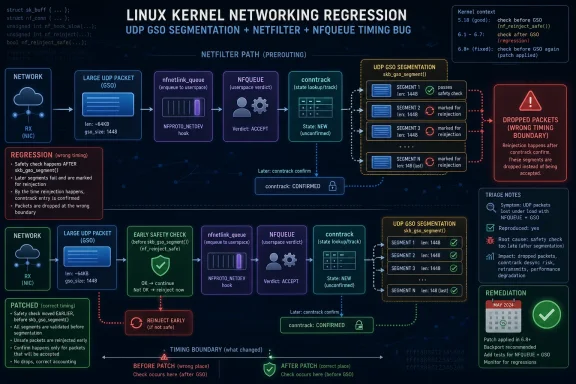
CVE-2026-45859, published by NVD on May 27, 2026, tracks a Linux kernel netfilter nfnetlink_queue regression in which certain UDP GSO packets tied to unconfirmed conntrack entries could be dropped instead of queued for userspace inspection. That sentence sounds narrow because the bug is narrow. But the lesson is broad: modern packet filtering is no longer a simple story of rules, matches, and verdicts, and the security surface now includes the subtle choreography between offload, segmentation, conntrack lifetime rules, and userspace firewalls.
The vulnerability record is still awaiting NVD enrichment, with no CVSS score from NIST at publication time. That absence matters. In the gap between a kernel.org CVE assignment and a fully scored advisory, administrators have to make a practical judgment: whether this is an exploitable catastrophe, a reliability bug wearing a CVE badge, or something in between.
The first important thing about CVE-2026-45859 is what it does not currently say. The public description does not describe privilege escalation, remote code execution, information disclosure, or a straightforward firewall bypass. It describes packets being dropped when they should have been queued.
That distinction will disappoint anyone scanning CVE feeds for drama, but it is exactly the kind of distinction operators need to preserve. Netfilter bugs have a long history of ranging from mundane packet-handling regressions to serious security flaws, and the component name alone is not enough to rank the risk. In this case, the known behavior is a failure mode in the nfqueue path involving UDP, GSO, and conntrack confirmation state.
The affected code path sits in
Here, the edge case appears when a userspace application has not advertised the
That is why the fix moves the check earlier, before segmentation, and then marks later segments so a second check can happen at reinjection. The kernel is not merely “allowing packets again.” It is trying to preserve conntrack’s assumption that unconfirmed entries are not being modified concurrently while still avoiding unnecessary drops in the normal ordered-reinjection case.
NFQUEUE, meanwhile, is a deliberate interruption of the fast path. It takes a packet that would otherwise continue through kernel logic and sends it to userspace for a verdict. That model is useful for intrusion prevention systems, traffic classifiers, custom firewalls, and policy engines, but it also means the kernel has to preserve enough state across a round trip to userspace.
Conntrack adds another layer. An
CVE-2026-45859 lives at the intersection of those three things: segmentation, userspace queueing, and unconfirmed conntrack state. The packet is not malicious by definition. The problem is that a legitimate performance transformation changes the reference-count picture before the safety check runs, causing the queueing logic to conclude that it must drop traffic.
That is the kind of bug that security teams hate because it does not map neatly to a familiar exploit category. It may present as intermittent UDP breakage, degraded inspection, or mysterious drops under specific traffic patterns. It may never appear on a workstation. It may matter a great deal on a Linux gateway doing userspace packet inspection at line rate.
That does not mean every UDP service is exposed to a security disaster. It means UDP-heavy environments are where administrators should look first if they run NFQUEUE-based inspection. DNS relays, VPN concentrators, telemetry collectors, game servers, voice and video infrastructure, QUIC-heavy edges, and custom appliances may all produce traffic profiles where UDP behavior matters more than old TCP-centric mental models suggest.
The rise of QUIC has made this especially uncomfortable. For years, admins could treat UDP as a side channel for DNS, NTP, and a handful of special cases. Today, major application traffic can be UDP by default. That does not automatically place QUIC deployments in the path of this bug, but it does make UDP packet handling harder to dismiss as a niche concern.
The phrase “only happens with UDP” therefore cuts both ways. It narrows the affected scenario, but it does not make it irrelevant. Modern networks have spent the last decade making UDP important again, and kernel packet-handling bugs have followed the traffic.
The second part is more subtle. The patch annotates individual segments except the first one so that reinjection can perform another check later. In the common case, userspace reinjects packets in order. The first segment continues traversal and confirms the conntrack entry; later segments then observe a confirmed entry and proceed.
But the kernel cannot assume the happy path. Userspace might reinject out of order. A multithreaded application might reinject in parallel. The first segment might be dropped. In those cases, later segments tied to an unconfirmed conntrack entry may still be unsafe to process, because another CPU could be modifying conntrack extension data in parallel.
That is why the patch does not simply delete the drop behavior. It moves it to a point where it is less likely to punish normal traffic and retains it where the kernel still cannot prove safety. This is good kernel engineering: preserve the invariant, avoid the regression, and document the exceptional paths.
The accompanying simplification to
That mixed reality changes the impact model. A Windows desktop user may never touch
The most plausible operational impact from the public description is availability or inspection reliability, not direct compromise. Packets that should be queued are dropped. If the affected box is acting as a firewall or inspection bridge, that can look like application failure. If the workload is UDP-sensitive, the failure may be intermittent, performance-dependent, and maddeningly hard to reproduce.
There is also a policy risk. Many NFQUEUE deployments are not just forwarding traffic; they are enforcing decisions. If a queueing path behaves unexpectedly, administrators need to know whether the system fails closed, fails noisy, or silently changes traffic behavior. In this case, the reported behavior is dropping, which is safer than bypassing inspection but still operationally painful.
That is why this CVE belongs in the WindowsForum feed. It is not because Windows users should panic about Linux internals. It is because Windows environments increasingly rely on Linux internals they do not directly see.
CVSS is especially awkward for kernel regressions that primarily describe packet drops. If the issue is framed as a denial-of-service condition under specific traffic and configuration requirements, the score may land in a moderate range. If later analysis finds a more direct attack path, the assessment could change. If distributors decide the issue is mostly a regression with limited security properties, it may be treated with less urgency.
Administrators should resist both extremes. It is premature to call CVE-2026-45859 critical based on the public record. It is also lazy to ignore it because the CVSS boxes are empty. The right response is to determine whether your systems use NFQUEUE, whether they process UDP GSO/GRO traffic in relevant ways, and whether vendor kernels have picked up the stable fix.
This is where Linux CVEs often frustrate enterprise teams. The CVE record points to upstream commits, but production exposure depends on the kernel version, distribution backports, configuration, modules loaded, and appliance vendor packaging. Two systems reporting different kernel versions may both be fixed, or both unfixed, depending on downstream maintenance.
For Windows administrators who only occasionally manage Linux, the trap is assuming that
The cost is that queueing creates a split-brain packet path. A packet is no longer simply moving through hooks; it is parked, described, copied or referenced, handed over, and later reinjected with a verdict. Every optimization that changes packet shape or ownership has to remain compatible with that detour.
GSO makes that harder because the packet a userspace program imagines it is seeing may not be the packet shape the wire eventually sees. If the application does not advertise GSO support, the kernel may segment on its behalf. That is sensible compatibility behavior, but it means segmentation occurs in a path already juggling queue entries and conntrack state.
Conntrack confirmation makes the problem still harder. The unconfirmed phase is temporary, but temporary states are where race conditions and false assumptions thrive. The kernel wants to avoid concurrent modification of connection-tracking data. The nfqueue path wants to preserve userspace inspection semantics. Offload wants to keep the network stack fast. CVE-2026-45859 is what happens when those goals briefly line up in the wrong order.
This is not an indictment of NFQUEUE. It is a reminder that userspace packet inspection is not free, even when it works perfectly. Performance features and policy features share the same packets, and the kernel has to arbitrate between them.
That makes remediation slower. A sysadmin can update a distribution kernel on a server. An appliance owner may have to wait for a vendor firmware release, read a terse advisory, and schedule a maintenance window. If the vendor does not mention CVE-2026-45859 by name, the fix may be buried under “kernel stability improvements” or “networking fixes.”
The operational symptom may also be misattributed. UDP application failures are easy to blame on MTU, firewall policy, NAT timeout, ISP behavior, or the application itself. A queueing regression triggered by GSO and unconfirmed conntrack state is not the first explanation anyone reaches for at 2 a.m.
That is why administrators should treat this CVE less as an emergency banner and more as a diagnostic clue. If an NFQUEUE-based device has shown unexplained UDP drops under load, especially after a kernel update that introduced related netfilter changes, this fix deserves attention. It may not be the cause, but it belongs on the shortlist.
The fact that the upstream patch references a regression is important here. Regressions often affect systems that were otherwise correctly configured. Nothing in the administrator’s policy may have changed. The packet path changed underneath.
A drop is usually preferable to an unintended accept. But availability is also a security property, especially in enforcement devices. If a firewall, IDS bridge, or traffic broker starts dropping legitimate UDP flows because a kernel edge case misidentifies conntrack ownership risk, the result can be service disruption, blind troubleshooting, and emergency policy rollbacks.
Those rollbacks matter. When inspection infrastructure becomes unreliable, operators often bypass it to restore service. A bug that initially fails closed can indirectly pressure teams into less secure configurations. That is not the same as a kernel exploit, but it is a real security consequence in production.
There is also a trust issue. Packet security systems are only useful when their behavior is predictable. If administrators cannot tell whether a packet was dropped by policy, queue overflow, conntrack safety logic, or a segmentation side effect, the enforcement layer becomes harder to reason about. The fix restores a more intuitive model: do the ownership check before segmentation changes the reference-count picture, then validate exceptional reinjection cases later.
This is why the best reading of CVE-2026-45859 is neither panic nor dismissal. It is a small but meaningful correction in the machinery that lets Linux act as a programmable network enforcement platform.
The first triage question is whether
Distribution timing will matter. Upstream stable commits are only the beginning. Debian, Ubuntu, Red Hat, SUSE, Arch, Fedora, appliance vendors, and cloud image maintainers all package kernel fixes differently. Some will expose the CVE in security notices. Others may roll the patch into routine kernel updates.
For enterprise teams, the best process is boring and effective: inventory systems performing Linux-based packet inspection, check vendor advisories, stage the kernel or firmware update, and watch UDP-heavy workloads after deployment. The regression being fixed involves packet drops, so validation should include functional traffic tests rather than simply confirming that a package installed.
Administrators should also avoid overfitting mitigation. Disabling offload features can sometimes sidestep packet-shape bugs, but it can also reduce performance and create new bottlenecks. Changing NFQUEUE application flags may alter behavior, but it should be tested against the application’s actual GSO support. The clean answer is to consume the kernel fix through the appropriate vendor channel.
The result is a kind of interpretive burden. “Use-after-free” gets attention. “Out-of-bounds write” gets attention. “Do shared-unconfirmed check before segmentation” requires translation. Without that translation, organizations either overreact to every kernel CVE or underreact to the ones that matter.
This bug is a case study in why the commit-message model can be both excellent and insufficient. The upstream text is technically clear: it names nfqueue, GSO, unconfirmed conntrack entries,
For everyone else, it needs operational framing. The practical question is not “What is
NVD enrichment may eventually add scoring and structured metadata, but scoring will not replace engineering judgment. Kernel CVEs increasingly demand a two-step process: read the vulnerability record, then map it to workload reality.
The vulnerability record is still awaiting NVD enrichment, with no CVSS score from NIST at publication time. That absence matters. In the gap between a kernel.org CVE assignment and a fully scored advisory, administrators have to make a practical judgment: whether this is an exploitable catastrophe, a reliability bug wearing a CVE badge, or something in between.
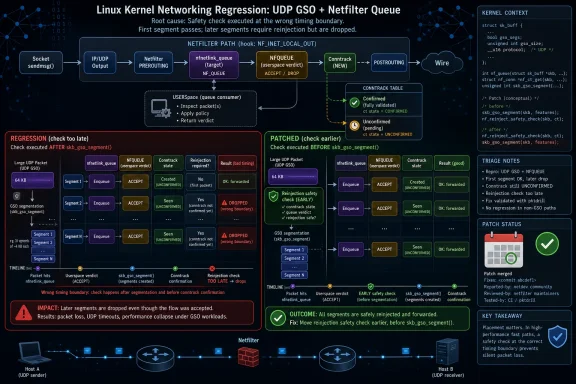 A CVE That Reads More Like a Kernel Regression Than a Break-In
The first important thing about CVE-2026-45859 is what it does not currently say. The public description does not describe privilege escalation, remote code execution, information disclosure, or a straightforward firewall bypass. It describes packets being dropped when they should have been queued.That distinction will disappoint anyone scanning CVE feeds for drama, but it is exactly the kind of distinction operators need to preserve. Netfilter bugs have a long history of ranging from mundane packet-handling regressions to serious security flaws, and the component name alone is not enough to rank the risk. In this case, the known behavior is a failure mode in the nfqueue path involving UDP, GSO, and conntrack confirmation state.
The affected code path sits in
nfnetlink_queue, the kernel mechanism that lets packets be handed from netfilter to userspace for a verdict. Tools built around NFQUEUE can inspect, modify, accept, or drop traffic outside the kernel’s fast path. That is powerful, and power in the packet path usually means uncomfortable edge cases.Here, the edge case appears when a userspace application has not advertised the
F_GSO capability flag and the kernel receives a GSO packet associated with an unconfirmed nf_conn entry. The old ordering performed a shared-unconfirmed conntrack check after skb_gso_segment(), and segmentation itself could clone the skb and raise the conntrack reference count. The kernel then saw a condition that looked unsafe and dropped the packets rather than queuing them.That is why the fix moves the check earlier, before segmentation, and then marks later segments so a second check can happen at reinjection. The kernel is not merely “allowing packets again.” It is trying to preserve conntrack’s assumption that unconfirmed entries are not being modified concurrently while still avoiding unnecessary drops in the normal ordered-reinjection case.
The Packet Was Innocent, the Timing Was Not
The mechanics of this bug are a reminder that kernel networking often fails at boundaries, not at slogans. GSO, or Generic Segmentation Offload, is designed to let the stack handle large packets efficiently and split them later. GRO, its receive-side cousin, can aggregate packets for performance. These mechanisms are not optional polish in modern networking; they are part of why Linux can push serious traffic without wasting cycles on every packet at the earliest possible moment.NFQUEUE, meanwhile, is a deliberate interruption of the fast path. It takes a packet that would otherwise continue through kernel logic and sends it to userspace for a verdict. That model is useful for intrusion prevention systems, traffic classifiers, custom firewalls, and policy engines, but it also means the kernel has to preserve enough state across a round trip to userspace.
Conntrack adds another layer. An
nf_conn entry represents connection-tracking state, and “unconfirmed” entries occupy a particularly delicate stage of life. The kernel has seen enough to create state, but that state has not yet been confirmed into the global tracking table. During that phase, assumptions about ownership and concurrent modification matter.CVE-2026-45859 lives at the intersection of those three things: segmentation, userspace queueing, and unconfirmed conntrack state. The packet is not malicious by definition. The problem is that a legitimate performance transformation changes the reference-count picture before the safety check runs, causing the queueing logic to conclude that it must drop traffic.
That is the kind of bug that security teams hate because it does not map neatly to a familiar exploit category. It may present as intermittent UDP breakage, degraded inspection, or mysterious drops under specific traffic patterns. It may never appear on a workstation. It may matter a great deal on a Linux gateway doing userspace packet inspection at line rate.
UDP Gets the Weird Corner Case Again
The upstream description is explicit that this scenario happens with UDP, not TCP. With TCP, the relevant unconfirmed packet is the SYN, and SYN packets are not aggregated by GRO in the same way. UDP, by contrast, can enter the problematic path when aggregation and segmentation interact with nfqueue.That does not mean every UDP service is exposed to a security disaster. It means UDP-heavy environments are where administrators should look first if they run NFQUEUE-based inspection. DNS relays, VPN concentrators, telemetry collectors, game servers, voice and video infrastructure, QUIC-heavy edges, and custom appliances may all produce traffic profiles where UDP behavior matters more than old TCP-centric mental models suggest.
The rise of QUIC has made this especially uncomfortable. For years, admins could treat UDP as a side channel for DNS, NTP, and a handful of special cases. Today, major application traffic can be UDP by default. That does not automatically place QUIC deployments in the path of this bug, but it does make UDP packet handling harder to dismiss as a niche concern.
The phrase “only happens with UDP” therefore cuts both ways. It narrows the affected scenario, but it does not make it irrelevant. Modern networks have spent the last decade making UDP important again, and kernel packet-handling bugs have followed the traffic.
The Fix Is a Lesson in Kernel Conservatism
The patch’s core move is conceptually simple: perform the shared-unconfirmed check before segmentation, when the kernel is still looking at the aggregated packet and still has the ownership picture it needs. If that check passes, segmentation can proceed without creating a false-positive drop condition.The second part is more subtle. The patch annotates individual segments except the first one so that reinjection can perform another check later. In the common case, userspace reinjects packets in order. The first segment continues traversal and confirms the conntrack entry; later segments then observe a confirmed entry and proceed.
But the kernel cannot assume the happy path. Userspace might reinject out of order. A multithreaded application might reinject in parallel. The first segment might be dropped. In those cases, later segments tied to an unconfirmed conntrack entry may still be unsafe to process, because another CPU could be modifying conntrack extension data in parallel.
That is why the patch does not simply delete the drop behavior. It moves it to a point where it is less likely to punish normal traffic and retains it where the kernel still cannot prove safety. This is good kernel engineering: preserve the invariant, avoid the regression, and document the exceptional paths.
The accompanying simplification to
nf_ct_drop_unconfirmed() also tells a story. The function no longer needs to special-case dying entries in the same way; the issue of interest is unconfirmed entries with a reference count greater than one. Kernel fixes often look like this: one part behavioral correction, one part cleanup, and one part admission that the previous code had accreted more defensive complexity than the actual invariant required.Why WindowsForum Readers Should Care About a Linux Kernel CVE
At first glance, a Linux netfilter CVE may seem like a strange item for a Windows-centric community. But the modern Windows shop is rarely Windows-only. Linux sits in WSL, containers, firewalls, load balancers, NAS appliances, hypervisors, cloud images, Kubernetes nodes, VPN gateways, and security appliances that Windows clients depend on every day.That mixed reality changes the impact model. A Windows desktop user may never touch
nfnetlink_queue, but their traffic may traverse a Linux box that does. A Windows administrator may not patch Linux kernels by hand, but they may own the appliance lifecycle for products that embed Linux and expose only a vendor firmware update button. A SOC may see symptoms in Windows client telemetry while the root cause lives in a Linux packet path upstream.The most plausible operational impact from the public description is availability or inspection reliability, not direct compromise. Packets that should be queued are dropped. If the affected box is acting as a firewall or inspection bridge, that can look like application failure. If the workload is UDP-sensitive, the failure may be intermittent, performance-dependent, and maddeningly hard to reproduce.
There is also a policy risk. Many NFQUEUE deployments are not just forwarding traffic; they are enforcing decisions. If a queueing path behaves unexpectedly, administrators need to know whether the system fails closed, fails noisy, or silently changes traffic behavior. In this case, the reported behavior is dropping, which is safer than bypassing inspection but still operationally painful.
That is why this CVE belongs in the WindowsForum feed. It is not because Windows users should panic about Linux internals. It is because Windows environments increasingly rely on Linux internals they do not directly see.
The Missing CVSS Score Is Not a Permission Slip
NVD lists CVE-2026-45859 as awaiting enrichment, and no NIST CVSS score is currently provided. That should slow down hot takes, not patch management. A missing score is an absence of analysis, not a statement of harmlessness.CVSS is especially awkward for kernel regressions that primarily describe packet drops. If the issue is framed as a denial-of-service condition under specific traffic and configuration requirements, the score may land in a moderate range. If later analysis finds a more direct attack path, the assessment could change. If distributors decide the issue is mostly a regression with limited security properties, it may be treated with less urgency.
Administrators should resist both extremes. It is premature to call CVE-2026-45859 critical based on the public record. It is also lazy to ignore it because the CVSS boxes are empty. The right response is to determine whether your systems use NFQUEUE, whether they process UDP GSO/GRO traffic in relevant ways, and whether vendor kernels have picked up the stable fix.
This is where Linux CVEs often frustrate enterprise teams. The CVE record points to upstream commits, but production exposure depends on the kernel version, distribution backports, configuration, modules loaded, and appliance vendor packaging. Two systems reporting different kernel versions may both be fixed, or both unfixed, depending on downstream maintenance.
For Windows administrators who only occasionally manage Linux, the trap is assuming that
uname -r tells the whole story. It does not. Enterprise distributions routinely backport fixes without moving to a mainline version that appears obviously patched. The authoritative answer usually comes from the vendor’s security tracker or package changelog.NFQUEUE Is Powerful Because It Is Awkward
NFQUEUE exists because some packet decisions need userspace context. That is its appeal. The kernel can classify and steer packets, while userspace can run richer logic, integrate policy, or perform inspection that would be impractical inside the kernel.The cost is that queueing creates a split-brain packet path. A packet is no longer simply moving through hooks; it is parked, described, copied or referenced, handed over, and later reinjected with a verdict. Every optimization that changes packet shape or ownership has to remain compatible with that detour.
GSO makes that harder because the packet a userspace program imagines it is seeing may not be the packet shape the wire eventually sees. If the application does not advertise GSO support, the kernel may segment on its behalf. That is sensible compatibility behavior, but it means segmentation occurs in a path already juggling queue entries and conntrack state.
Conntrack confirmation makes the problem still harder. The unconfirmed phase is temporary, but temporary states are where race conditions and false assumptions thrive. The kernel wants to avoid concurrent modification of connection-tracking data. The nfqueue path wants to preserve userspace inspection semantics. Offload wants to keep the network stack fast. CVE-2026-45859 is what happens when those goals briefly line up in the wrong order.
This is not an indictment of NFQUEUE. It is a reminder that userspace packet inspection is not free, even when it works perfectly. Performance features and policy features share the same packets, and the kernel has to arbitrate between them.
The Appliance Angle Is the Quiet Risk
The systems most likely to care about this bug may not look like general-purpose Linux servers. They may be firewalls, routers, SD-WAN boxes, IDS appliances, container hosts, or virtual network functions. Many of those products use Linux networking components internally while hiding the implementation behind a web console.That makes remediation slower. A sysadmin can update a distribution kernel on a server. An appliance owner may have to wait for a vendor firmware release, read a terse advisory, and schedule a maintenance window. If the vendor does not mention CVE-2026-45859 by name, the fix may be buried under “kernel stability improvements” or “networking fixes.”
The operational symptom may also be misattributed. UDP application failures are easy to blame on MTU, firewall policy, NAT timeout, ISP behavior, or the application itself. A queueing regression triggered by GSO and unconfirmed conntrack state is not the first explanation anyone reaches for at 2 a.m.
That is why administrators should treat this CVE less as an emergency banner and more as a diagnostic clue. If an NFQUEUE-based device has shown unexplained UDP drops under load, especially after a kernel update that introduced related netfilter changes, this fix deserves attention. It may not be the cause, but it belongs on the shortlist.
The fact that the upstream patch references a regression is important here. Regressions often affect systems that were otherwise correctly configured. Nothing in the administrator’s policy may have changed. The packet path changed underneath.
The Security Story Is About Failure Mode, Not Exploit Glamour
Security coverage tends to privilege bugs that hand an attacker a shell. CVE-2026-45859 is not currently that story. Its significance is that it touches a security enforcement path and changes whether packets reach the userspace component responsible for judgment.A drop is usually preferable to an unintended accept. But availability is also a security property, especially in enforcement devices. If a firewall, IDS bridge, or traffic broker starts dropping legitimate UDP flows because a kernel edge case misidentifies conntrack ownership risk, the result can be service disruption, blind troubleshooting, and emergency policy rollbacks.
Those rollbacks matter. When inspection infrastructure becomes unreliable, operators often bypass it to restore service. A bug that initially fails closed can indirectly pressure teams into less secure configurations. That is not the same as a kernel exploit, but it is a real security consequence in production.
There is also a trust issue. Packet security systems are only useful when their behavior is predictable. If administrators cannot tell whether a packet was dropped by policy, queue overflow, conntrack safety logic, or a segmentation side effect, the enforcement layer becomes harder to reason about. The fix restores a more intuitive model: do the ownership check before segmentation changes the reference-count picture, then validate exceptional reinjection cases later.
This is why the best reading of CVE-2026-45859 is neither panic nor dismissal. It is a small but meaningful correction in the machinery that lets Linux act as a programmable network enforcement platform.
Patch Triage Starts With Configuration, Not Headlines
For most desktop Linux users, this CVE is likely background noise. For servers that do not use NFQUEUE and are not acting as network enforcement points, the practical risk appears limited based on the public description. For systems using NFQUEUE with UDP-heavy traffic, the priority rises.The first triage question is whether
nfnetlink_queue is in use. That can be through custom software, security tools, packet brokers, firewall integrations, or container/networking stacks that administrators did not write themselves. The second question is whether affected traffic patterns include UDP packets that may be aggregated and segmented in the relevant path. The third is whether the kernel already includes one of the stable fixes or an equivalent vendor backport.Distribution timing will matter. Upstream stable commits are only the beginning. Debian, Ubuntu, Red Hat, SUSE, Arch, Fedora, appliance vendors, and cloud image maintainers all package kernel fixes differently. Some will expose the CVE in security notices. Others may roll the patch into routine kernel updates.
For enterprise teams, the best process is boring and effective: inventory systems performing Linux-based packet inspection, check vendor advisories, stage the kernel or firmware update, and watch UDP-heavy workloads after deployment. The regression being fixed involves packet drops, so validation should include functional traffic tests rather than simply confirming that a package installed.
Administrators should also avoid overfitting mitigation. Disabling offload features can sometimes sidestep packet-shape bugs, but it can also reduce performance and create new bottlenecks. Changing NFQUEUE application flags may alter behavior, but it should be tested against the application’s actual GSO support. The clean answer is to consume the kernel fix through the appropriate vendor channel.
The Kernel’s CVE Firehose Needs Better Interpretation
CVE-2026-45859 also illustrates a broader problem with modern vulnerability operations: the Linux kernel CVE pipeline produces many records whose descriptions are copied from commit messages. That is transparent, but it is not always accessible. A good commit message tells kernel developers what invariant changed. It does not necessarily tell a security manager whether to wake the on-call team.The result is a kind of interpretive burden. “Use-after-free” gets attention. “Out-of-bounds write” gets attention. “Do shared-unconfirmed check before segmentation” requires translation. Without that translation, organizations either overreact to every kernel CVE or underreact to the ones that matter.
This bug is a case study in why the commit-message model can be both excellent and insufficient. The upstream text is technically clear: it names nfqueue, GSO, unconfirmed conntrack entries,
skb_gso_segment(), reference counts, reinjection ordering, UDP, and a follow-up UDP GRO test. For a kernel networking developer, that is a compact map of the issue.For everyone else, it needs operational framing. The practical question is not “What is
skb_clone()?” It is “Do I run a Linux packet inspection path where UDP traffic might be dropped because queueing and segmentation disagree about conntrack ownership?” That is the question security teams need answered.NVD enrichment may eventually add scoring and structured metadata, but scoring will not replace engineering judgment. Kernel CVEs increasingly demand a two-step process: read the vulnerability record, then map it to workload reality.
The Small Netfilter Bug That Belongs on the Change Calendar
The concrete lessons from CVE-2026-45859 are narrower than the netfilter name suggests, but they are concrete enough to act on. Treat this as a targeted patch-management and diagnostics item, especially where Linux systems inspect or mediate UDP traffic for Windows-heavy environments.- Systems that do not use NFQUEUE are unlikely to be meaningfully exposed to the specific behavior described in the public record.
- Linux gateways, firewalls, IDS components, and appliances that rely on userspace NFQUEUE verdicts should be checked against vendor kernel fixes.
- UDP-heavy services deserve special validation because the upstream description says the scenario does not arise the same way for TCP SYN traffic.
- A missing NVD CVSS score should not be read as a safety rating, because the record was still awaiting enrichment when published.
- The most visible symptom is likely packet loss or inspection-path instability rather than a dramatic local privilege escalation or remote code execution event.
- Vendor backports matter more than mainline version guessing, so administrators should rely on distribution and appliance advisories rather than raw kernel version comparisons alone.
References
- Primary source: NVD / Linux Kernel
Published: 2026-05-28T01:08:39-07:00
NVD - CVE-2026-45859
 nvd.nist.gov
- Security advisory: MSRC
Published: 2026-05-28T01:08:39-07:00
Original feed URL
Security Update Guide - Microsoft Security Response Center
 msrc.microsoft.com
- Related coverage: gitlab.ilabt.imec.be

include/net/netfilter/nf_queue.h · master · Jordi Thijsman / Linux · GitLab
Welcome gitlab.ilabt.imec.be
- Related coverage: kernel.googlesource.com
- Related coverage: cve.imfht.com
CVE-2026-43451: netfilter: nfnetlink_queue: fix entry leak in bridge verdict error path
## Overview A memory leak vulnerability exists in the Linux kernel Netfilter `nfnetlink_queue` module. When processing `PF_BRIDGE` type packets, if the parsing of VLAN attributes fails (e.g., `NFQA_VL cve.imfht.com
- Related coverage: support.bull.com