CVE-2026-46012 is a Linux kernel vulnerability published by NVD on May 27, 2026, after kernel.org assigned a CVE to a memory-leak fix in the rxrpc authentication path, specifically the
The bug itself is prosaic in the way many kernel bugs are prosaic. A function allocates objects, takes a few conditional turns, and on some exits fails to release what it took. But the setting — kernel networking code, authentication response handling, and a subsystem with a recent trail of related fixes — makes CVE-2026-46012 more than another line item in a vulnerability feed.
The vulnerability description is unusually compact: rxrpc’s
That kind of patch is not glamorous, but kernel maintainers have learned to respect it. Memory leaks in user-space applications are bugs; memory leaks in the kernel are bugs with system-wide consequences. If the right path can be triggered repeatedly, the leaked memory is not contained inside a misbehaving process that can simply be killed. It sits in the operating system’s core, competing with everything else the machine is trying to do.
RxRPC is not a household name even among many WindowsForum readers who manage Linux workloads. It is a remote procedure call mechanism used most visibly around AFS-related infrastructure, with kernel support that includes security mechanisms such as rxkad and rxgk. That makes it easy to dismiss for desktop users and tempting to overstate for threat feeds. The truth is narrower and more useful: most systems are not likely to be exposed in a meaningful way, but environments that actually load and use rxrpc should treat this as part of a broader kernel maintenance pattern rather than an isolated curiosity.
The most important detail is what the CVE record does not yet say. There is no NVD CVSS score, no NVD vector, and no completed weakness classification visible in the supplied record. That does not make the flaw harmless. It means the public metadata has not caught up with the patch, and administrators have to read the actual technical description instead of waiting for a red, orange, or green badge.
This is the kind of change that rarely makes headlines because it does not introduce a new mitigation framework or rewrite a subsystem. It simply reduces the number of ways a function can forget what it owns. In C, that is not a stylistic preference; it is a survival technique.
Kernel code is filled with functions that allocate resources in stages. The happy path is easy to reason about: allocate a ticket, obtain or derive a key, verify a response, return success. The hard part is every unhappy path between those steps. If a parse fails after the first allocation but before the second, one object must be freed. If a later authentication check fails, both may need releasing. If the function returns early in more than one place, every branch becomes a maintenance liability.
The CVE description strongly suggests that
That matters because security fixes are often judged by exploitability, while maintainers also care about structural fragility. A memory leak found in an authentication path can be a direct denial-of-service risk, a reliability problem, or simply a symptom that error handling in that area has become too easy to get wrong. The patch addresses the immediate leak, but it also tells downstream maintainers where the code was brittle.
A kernel CVE without a score is not a kernel CVE without consequences. It is a kernel CVE without a simplified risk label. That distinction matters most in environments where patch windows are negotiated by dashboards: no score can mean no ticket, no ticket can mean no owner, and no owner can mean the fix waits until the next routine update cycle.
That may be reasonable here for many fleets. CVE-2026-46012 is described as a memory leak, not a remote code execution bug, not a privilege escalation, and not an information disclosure. There is no public indication in the supplied record that it has been exploited in the wild. But a sane risk model does not stop there. It asks whether the affected subsystem is reachable, whether the vulnerable code path can be exercised repeatedly, and whether the system’s role makes memory pressure a security boundary in practice.
For a general-purpose Windows desktop user running WSL occasionally, this CVE is likely background noise unless a Linux distribution ships an affected kernel and the relevant module is in use. For a Linux server participating in AFS-like workflows or carrying rxrpc-dependent services, it deserves a closer look. For an administrator maintaining mixed Windows and Linux estates, the broader lesson is that kernel CVEs now arrive in a high-volume stream where the first usable signal is often the patch itself, not the vulnerability database entry.
Obscurity is not isolation. Kernel subsystems can sit dormant on most machines and still become important when a workload, package, or configuration pulls them into service. The Linux kernel’s modularity is one of its strengths, but it also spreads security exposure across areas that many asset inventories do not model well.
This is especially relevant for WindowsForum readers because modern infrastructure rarely respects platform boundaries. A Windows shop may run Linux appliances, Linux containers, Azure-hosted Linux VMs, backup infrastructure, network services, developer workstations with WSL, and security tools built on Linux images. The question is not “Do we use Linux?” anymore. The question is “Where is Linux hiding, and who owns its patch cycle?”
RxRPC is a good example of that blind spot. It is not a component most administrators discuss in weekly change meetings. Yet if a kernel includes it, a module can be present, loadable, or already loaded depending on distribution configuration and workload. A vulnerability in such a component may be irrelevant on one machine and operationally meaningful on another.
The attack model matters. A one-time leak on a rare administrative path is probably low priority. A leak reachable through repeated network interactions is a different conversation. The supplied CVE text does not establish a complete exploitation scenario, and without NVD enrichment or a vendor advisory describing reachability, it would be irresponsible to claim more than the record supports. Still, the affected function name places the flaw in response verification, not in a decorative corner of the codebase.
That is why administrators should avoid both extremes. There is no basis here for panic, emergency shutdowns, or dramatic “kernel under siege” language. There is also no basis for ignoring the fix solely because the bug is a leak. Kernel availability failures can become production incidents long before anyone writes an exploit banner.
In practical terms, the right response is to fold this into normal kernel update discipline, then give special scrutiny to systems where rxrpc is loaded or where AFS-related functionality exists. If a fleet already has emergency procedures for high-impact kernel vulnerabilities, CVE-2026-46012 probably does not meet that bar based on current public data. If a fleet has been deferring kernel updates because “only low-scored CVEs remain,” this is another reminder that the metadata may be incomplete.
This is good for transparency but difficult for consumers. The old world, flawed as it was, often handed administrators a curated advisory with severity, affected products, mitigation notes, and a vendor’s interpretation of risk. The newer kernel CVE stream often starts closer to the code: here is the subsystem, here is the bug, here are the stable commits, and enrichment may follow later.
For kernel developers, that is a reasonable source of truth. For enterprise patch teams, it can feel like being handed a parts diagram instead of an incident brief. CVE-2026-46012 sits squarely in that gap. The technical fix is clear, but the operational priority depends on environment-specific questions that the CVE entry cannot answer on its own.
The answer is not to demand that every kernel CVE arrive fully packaged. The answer is to build processes that can consume early, code-adjacent vulnerability records. That means mapping kernel versions, tracking distribution backports, watching module usage, and distinguishing upstream commit IDs from the package versions that actually ship in RHEL, Ubuntu, Debian, SUSE, Fedora, Arch, and cloud images.
This matters because asking “Am I running a vulnerable kernel version?” is often the wrong first question. The better question is “Has my vendor shipped the fix for my kernel package, and have I installed it?” Enterprise distributions frequently backport security fixes without changing to a newer upstream kernel series. A machine running a numerically older kernel may be patched, while a machine running a self-built newer tree may not be, depending on when it was built.
The commit references in the CVE record are therefore useful to kernel maintainers and distribution engineers, but not always directly actionable for a sysadmin staring at
For Windows-heavy teams that only occasionally touch Linux, this distinction is easy to miss. Windows Update hides much of this complexity behind cumulative updates and KB numbers. Linux gives you more visibility and more responsibility. The patch may be in a stable tree before your distribution ships it, and your distribution may ship it under a package revision that looks nothing like the upstream commit list.
Administrators should also look at what role the system plays. A developer laptop with no rxrpc usage has a different profile from a file-service host, research environment, or legacy infrastructure node where AFS-related components still exist. Internet exposure matters, but so does authenticated internal reachability. Many denial-of-service conditions are most relevant inside networks where workloads trust one another too much.
Cloud complicates the picture. Linux images may be patched by image refresh, live patching, automated package updates, or not at all. Container hosts matter more than containers for kernel bugs, because containers share the host kernel. WSL users should remember that the Linux kernel involved in WSL is maintained through Microsoft’s update path, not through the package manager inside a distro instance in quite the same way as a normal Linux VM.
That does not make CVE-2026-46012 a Windows emergency. It makes it a useful audit prompt. If your environment has Linux kernels, someone should be able to answer which update channel owns them, which machines load rxrpc, and how quickly kernel fixes move from upstream disclosure to production deployment.
That combination is where many organizations are weakest. They may know which Windows builds are deployed because endpoint management demands it. They may know which Linux distributions run in production because cloud billing exposes them. But fewer teams know which kernel modules are loaded, which obscure protocol stacks are reachable, or which appliances embed kernels that lag behind their visible version banners.
The result is a patching culture that overreacts to branded bugs and underreacts to maintenance debt. CVE-2026-46012 is not branded, not scored, and not likely to trend outside vulnerability feeds. Yet it is exactly the sort of issue that reveals whether a team’s Linux maintenance process is systematic or improvisational.
A mature response looks boring. Track the CVE. Map the fix to distribution updates. Patch through the normal kernel maintenance path. Reboot where required. Verify the running kernel, not just the installed package. Check whether rxrpc is loaded on systems where that matters. Document exceptions instead of letting them become folklore.
rxkad_verify_response() function used by the RxRPC subsystem. It is not yet scored by NVD, and the record is still awaiting enrichment. That absence of a severity rating is the story’s first warning sign: modern kernel vulnerability management increasingly moves faster than the scoring systems that many organizations still use to decide what matters.The bug itself is prosaic in the way many kernel bugs are prosaic. A function allocates objects, takes a few conditional turns, and on some exits fails to release what it took. But the setting — kernel networking code, authentication response handling, and a subsystem with a recent trail of related fixes — makes CVE-2026-46012 more than another line item in a vulnerability feed.
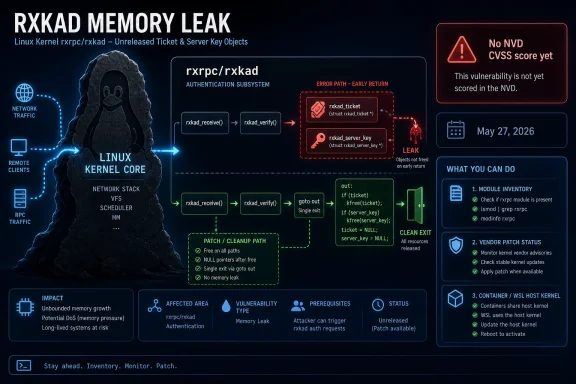 A Small Leak Lands in a Noisy Part of the Kernel
The vulnerability description is unusually compact: rxrpc’s rxkad_verify_response() failed to free both the ticket and the server key under all circumstances. The fix initializes the ticket pointer to NULL and funnels post-allocation exits through a common cleanup path, where release operations safely skip null pointers. In plain English, the patch turns a fragile collection of exits into one controlled door out.That kind of patch is not glamorous, but kernel maintainers have learned to respect it. Memory leaks in user-space applications are bugs; memory leaks in the kernel are bugs with system-wide consequences. If the right path can be triggered repeatedly, the leaked memory is not contained inside a misbehaving process that can simply be killed. It sits in the operating system’s core, competing with everything else the machine is trying to do.
RxRPC is not a household name even among many WindowsForum readers who manage Linux workloads. It is a remote procedure call mechanism used most visibly around AFS-related infrastructure, with kernel support that includes security mechanisms such as rxkad and rxgk. That makes it easy to dismiss for desktop users and tempting to overstate for threat feeds. The truth is narrower and more useful: most systems are not likely to be exposed in a meaningful way, but environments that actually load and use rxrpc should treat this as part of a broader kernel maintenance pattern rather than an isolated curiosity.
The most important detail is what the CVE record does not yet say. There is no NVD CVSS score, no NVD vector, and no completed weakness classification visible in the supplied record. That does not make the flaw harmless. It means the public metadata has not caught up with the patch, and administrators have to read the actual technical description instead of waiting for a red, orange, or green badge.
The Fix Is Boring Because the Failure Mode Is Familiar
The patch strategy described in the CVE entry is almost textbook defensive kernel programming. Initialize a pointer before use. Avoid duplicated cleanup logic. Route all exits after allocation through a shared epilogue. Make release calls tolerant ofNULL.This is the kind of change that rarely makes headlines because it does not introduce a new mitigation framework or rewrite a subsystem. It simply reduces the number of ways a function can forget what it owns. In C, that is not a stylistic preference; it is a survival technique.
Kernel code is filled with functions that allocate resources in stages. The happy path is easy to reason about: allocate a ticket, obtain or derive a key, verify a response, return success. The hard part is every unhappy path between those steps. If a parse fails after the first allocation but before the second, one object must be freed. If a later authentication check fails, both may need releasing. If the function returns early in more than one place, every branch becomes a maintenance liability.
The CVE description strongly suggests that
rxkad_verify_response() had exactly that shape. The answer was not to add one more ad hoc free call to one more branch, but to reorganize the cleanup contract. Once a function has a single epilogue, future changes are less likely to reintroduce the same category of bug.That matters because security fixes are often judged by exploitability, while maintainers also care about structural fragility. A memory leak found in an authentication path can be a direct denial-of-service risk, a reliability problem, or simply a symptom that error handling in that area has become too easy to get wrong. The patch addresses the immediate leak, but it also tells downstream maintainers where the code was brittle.
The Missing CVSS Score Is Not a Permission Slip
NVD’s “awaiting enrichment” label has become a familiar pause state in the vulnerability pipeline. The CVE exists, the description is public, and references point to stable kernel commits, but the scoring work has not been completed. For organizations that drive patching entirely from CVSS thresholds, this creates a dangerous dead zone.A kernel CVE without a score is not a kernel CVE without consequences. It is a kernel CVE without a simplified risk label. That distinction matters most in environments where patch windows are negotiated by dashboards: no score can mean no ticket, no ticket can mean no owner, and no owner can mean the fix waits until the next routine update cycle.
That may be reasonable here for many fleets. CVE-2026-46012 is described as a memory leak, not a remote code execution bug, not a privilege escalation, and not an information disclosure. There is no public indication in the supplied record that it has been exploited in the wild. But a sane risk model does not stop there. It asks whether the affected subsystem is reachable, whether the vulnerable code path can be exercised repeatedly, and whether the system’s role makes memory pressure a security boundary in practice.
For a general-purpose Windows desktop user running WSL occasionally, this CVE is likely background noise unless a Linux distribution ships an affected kernel and the relevant module is in use. For a Linux server participating in AFS-like workflows or carrying rxrpc-dependent services, it deserves a closer look. For an administrator maintaining mixed Windows and Linux estates, the broader lesson is that kernel CVEs now arrive in a high-volume stream where the first usable signal is often the patch itself, not the vulnerability database entry.
RxRPC Keeps Showing Up Because Edge Subsystems Still Matter
The recent cluster of rxrpc-related fixes gives CVE-2026-46012 a context that a single CVE page cannot provide. Search results around the same subsystem show other 2026 records involving rxrpc memory leaks, reference-count issues, response handling, and packet-processing defects. Not every one of those bugs is related in code, severity, or exploitability, but together they explain why security-minded administrators should not wave away obscure kernel modules.Obscurity is not isolation. Kernel subsystems can sit dormant on most machines and still become important when a workload, package, or configuration pulls them into service. The Linux kernel’s modularity is one of its strengths, but it also spreads security exposure across areas that many asset inventories do not model well.
This is especially relevant for WindowsForum readers because modern infrastructure rarely respects platform boundaries. A Windows shop may run Linux appliances, Linux containers, Azure-hosted Linux VMs, backup infrastructure, network services, developer workstations with WSL, and security tools built on Linux images. The question is not “Do we use Linux?” anymore. The question is “Where is Linux hiding, and who owns its patch cycle?”
RxRPC is a good example of that blind spot. It is not a component most administrators discuss in weekly change meetings. Yet if a kernel includes it, a module can be present, loadable, or already loaded depending on distribution configuration and workload. A vulnerability in such a component may be irrelevant on one machine and operationally meaningful on another.
Memory Leaks Are Denial-of-Service Bugs Until Proven Otherwise
Security teams sometimes treat memory leaks as second-class vulnerabilities because they do not sound like code execution. That is understandable, and often correct. But in kernel space, repeated allocation without corresponding release can become an availability issue, and availability is one of the three pillars security programs claim to protect.The attack model matters. A one-time leak on a rare administrative path is probably low priority. A leak reachable through repeated network interactions is a different conversation. The supplied CVE text does not establish a complete exploitation scenario, and without NVD enrichment or a vendor advisory describing reachability, it would be irresponsible to claim more than the record supports. Still, the affected function name places the flaw in response verification, not in a decorative corner of the codebase.
That is why administrators should avoid both extremes. There is no basis here for panic, emergency shutdowns, or dramatic “kernel under siege” language. There is also no basis for ignoring the fix solely because the bug is a leak. Kernel availability failures can become production incidents long before anyone writes an exploit banner.
In practical terms, the right response is to fold this into normal kernel update discipline, then give special scrutiny to systems where rxrpc is loaded or where AFS-related functionality exists. If a fleet already has emergency procedures for high-impact kernel vulnerabilities, CVE-2026-46012 probably does not meet that bar based on current public data. If a fleet has been deferring kernel updates because “only low-scored CVEs remain,” this is another reminder that the metadata may be incomplete.
Kernel.org’s CNA Role Changes the Tempo
One reason CVE-2026-46012 appeared quickly and plainly is that the Linux kernel project now acts as a CVE Numbering Authority for kernel issues. That has changed the rhythm of Linux vulnerability disclosure. More fixes are mapped directly to CVEs, often with descriptions that mirror commit messages rather than polished vendor advisories.This is good for transparency but difficult for consumers. The old world, flawed as it was, often handed administrators a curated advisory with severity, affected products, mitigation notes, and a vendor’s interpretation of risk. The newer kernel CVE stream often starts closer to the code: here is the subsystem, here is the bug, here are the stable commits, and enrichment may follow later.
For kernel developers, that is a reasonable source of truth. For enterprise patch teams, it can feel like being handed a parts diagram instead of an incident brief. CVE-2026-46012 sits squarely in that gap. The technical fix is clear, but the operational priority depends on environment-specific questions that the CVE entry cannot answer on its own.
The answer is not to demand that every kernel CVE arrive fully packaged. The answer is to build processes that can consume early, code-adjacent vulnerability records. That means mapping kernel versions, tracking distribution backports, watching module usage, and distinguishing upstream commit IDs from the package versions that actually ship in RHEL, Ubuntu, Debian, SUSE, Fedora, Arch, and cloud images.
Stable Commits Are the Real Trail to Follow
The CVE record lists multiple stable kernel references, which is what administrators should expect for a fix carried across supported branches. Upstream Linux fixes do not land in only one place. They are backported, adapted, and shipped through stable series and distribution kernels that may not share the same version number as the original development branch.This matters because asking “Am I running a vulnerable kernel version?” is often the wrong first question. The better question is “Has my vendor shipped the fix for my kernel package, and have I installed it?” Enterprise distributions frequently backport security fixes without changing to a newer upstream kernel series. A machine running a numerically older kernel may be patched, while a machine running a self-built newer tree may not be, depending on when it was built.
The commit references in the CVE record are therefore useful to kernel maintainers and distribution engineers, but not always directly actionable for a sysadmin staring at
uname -r. Administrators should consult their distribution’s security tracker, package changelog, or kernel advisory feed once those updates appear. For self-managed kernels, the stable commit hashes are the evidence trail.For Windows-heavy teams that only occasionally touch Linux, this distinction is easy to miss. Windows Update hides much of this complexity behind cumulative updates and KB numbers. Linux gives you more visibility and more responsibility. The patch may be in a stable tree before your distribution ships it, and your distribution may ship it under a package revision that looks nothing like the upstream commit list.
The Practical Exposure Test Starts With the Module, Not the CVE Feed
The first operational question is whether rxrpc is present and in use. On many systems, it will not be loaded. On others, it may appear because a service or dependency brought it in. A simple module inventory is not a full risk assessment, but it is a better starting point than staring at an unscored NVD page.Administrators should also look at what role the system plays. A developer laptop with no rxrpc usage has a different profile from a file-service host, research environment, or legacy infrastructure node where AFS-related components still exist. Internet exposure matters, but so does authenticated internal reachability. Many denial-of-service conditions are most relevant inside networks where workloads trust one another too much.
Cloud complicates the picture. Linux images may be patched by image refresh, live patching, automated package updates, or not at all. Container hosts matter more than containers for kernel bugs, because containers share the host kernel. WSL users should remember that the Linux kernel involved in WSL is maintained through Microsoft’s update path, not through the package manager inside a distro instance in quite the same way as a normal Linux VM.
That does not make CVE-2026-46012 a Windows emergency. It makes it a useful audit prompt. If your environment has Linux kernels, someone should be able to answer which update channel owns them, which machines load rxrpc, and how quickly kernel fixes move from upstream disclosure to production deployment.
This Is Where Patch Management Becomes Asset Management
The deeper lesson of CVE-2026-46012 is not that every memory leak deserves a war room. It is that the vulnerability industry still encourages teams to think in records, while operating systems fail in configurations. A CVE entry is a starting point. Risk lives in the combination of code, configuration, exposure, workload, and update path.That combination is where many organizations are weakest. They may know which Windows builds are deployed because endpoint management demands it. They may know which Linux distributions run in production because cloud billing exposes them. But fewer teams know which kernel modules are loaded, which obscure protocol stacks are reachable, or which appliances embed kernels that lag behind their visible version banners.
The result is a patching culture that overreacts to branded bugs and underreacts to maintenance debt. CVE-2026-46012 is not branded, not scored, and not likely to trend outside vulnerability feeds. Yet it is exactly the sort of issue that reveals whether a team’s Linux maintenance process is systematic or improvisational.
A mature response looks boring. Track the CVE. Map the fix to distribution updates. Patch through the normal kernel maintenance path. Reboot where required. Verify the running kernel, not just the installed package. Check whether rxrpc is loaded on systems where that matters. Document exceptions instead of letting them become folklore.
The Unscored Kernel Leak Still Leaves a Clear Checklist
CVE-2026-46012 does not need hype to be useful. It is a small, concrete kernel fix that tells administrators where to look and how to think about exposure before NVD’s enrichment process finishes. The right response is measured, but it is not passive.- Administrators should treat the May 27, 2026 publication date as the start of their tracking window, not as proof that downstream packages were already updated that day.
- Linux systems that load or depend on rxrpc deserve priority review over generic desktops or servers where the module is absent and unused.
- Kernel package status from the distribution vendor is more actionable than upstream version guessing, especially for enterprise kernels with heavy backporting.
- The lack of an NVD CVSS score should not block triage, because the technical description and stable commits already identify the affected subsystem and fix pattern.
- Container platforms and virtualization hosts should be considered part of the exposure surface, because kernel flaws belong to the host even when workloads are packaged above it.
- Windows-centric teams should use this CVE as a prompt to inventory Linux dependencies hiding in WSL, appliances, cloud images, and infrastructure tooling.
References
- Primary source: NVD / Linux Kernel
Published: 2026-05-28T01:03:18-07:00
NVD - CVE-2026-46012
 nvd.nist.gov
- Security advisory: MSRC
Published: 2026-05-28T01:03:18-07:00
Original feed URL
Security Update Guide - Microsoft Security Response Center
 msrc.microsoft.com
- Related coverage: stack.watch
- Related coverage: spinics.net
Re: [PATCH net 1/4] rxrpc: Fix memory leaks in rxkad_verify_response() — Linux Kernel
Linux Kernel: Re: [PATCH net 1/4] rxrpc: Fix memory leaks in rxkad_verify_response() www.spinics.net
- Related coverage: cve.imfht.com
CVE-2026-23066: rxrpc: Fix recvmsg() unconditional requeue - Vulnerability Platform
[HIGH 7.8] Overview A unconditional requeueing issue exists in the function of the module in the Linux kernel, which may lead to corruption of the receive queue cve.imfht.com