CVE-2026-46019 is a Linux kernel vulnerability published by NVD on May 27, 2026, after kernel.org reported that the Atmel AES crypto driver leaked three of four allocated pages during buffer cleanup because it freed one page with the wrong allocator call. It is not, on the available evidence, the kind of headline-grabbing flaw that hands an attacker root or crosses a network boundary. But it is a useful reminder that the Linux kernel’s security surface is not only syscalls, filesystems, and packet parsers; it is also the long tail of hardware drivers whose failures become operational debt. For WindowsForum readers running Linux in appliances, WSL-adjacent development pipelines, embedded fleets, or mixed infrastructure, the lesson is less “panic” than “know what you actually ship.”
The bug is almost comically tidy.
That is the kind of mismatch C programmers recognize instantly once it is pointed out. It is also the kind of mismatch that can survive for years because it does not necessarily crash the system, corrupt a visible data structure, or scream in logs. It simply leaves memory behind after a cleanup path that looked, at a glance, plausible.
In user space, a leak of three pages is often a bug report and a shrug. In kernel space, it is more serious because the leaked memory belongs to the operating system’s most privileged execution environment, and repeated leaks can contribute to denial-of-service conditions or brittle behavior under pressure. The CVE text does not claim exploitation beyond resource leakage, and NVD had not yet assigned CVSS scoring at the time of publication, but the security relevance is clear enough: memory the kernel cannot reclaim is memory the machine cannot depend on.
The detail that matters is symmetry. Kernel code that allocates with an order-aware page allocator must free with the matching order-aware call. Freeing only the first page of a multi-page allocation is not a harmless approximation; it is a contract violation.
That niche placement is why a vulnerability like CVE-2026-46019 can be easy to underrate. If you are thinking only in terms of mainstream servers, the affected driver may not even be built. If you are responsible for appliances, factory systems, vendor images, or long-lived board support packages, the driver may be exactly the sort of component that exists quietly in production for a decade.
The Linux kernel’s breadth is both its superpower and its security headache. A single source tree supports cloud servers, phones, routers, dev boards, storage appliances, medical equipment, industrial controllers, and hobbyist hardware. The same CVE feed that includes high-profile privilege-escalation bugs also includes small driver fixes for hardware many administrators have never seen.
That does not make those CVEs noise. It means triage must be based on exposure, not vibes. A memory leak in an Atmel crypto accelerator is irrelevant to a fleet that cannot load or reach the driver, but it is operationally relevant to systems that rely on that accelerator for cryptographic workloads.
CVE-2026-46019 fits that pattern. The NVD entry says the record is awaiting enrichment, with no NIST CVSS vector yet assigned. The public description is essentially the upstream fix summary: four pages allocated, one page freed, three pages leaked, use the correct free function. There is no disclosed exploit chain, no remote attack path, and no vendor drama.
For administrators, that creates an awkward middle ground. The vulnerability is real, but the correct reaction is not the same as for a remotely reachable pre-authentication flaw. The task is to map the CVE to actual systems: Is the affected driver present? Is the hardware present? Is the code reachable? Are workloads using the crypto engine? Is the device in a maintenance window or stuck on a vendor kernel?
The modern CVE feed punishes organizations that treat all vulnerabilities alike. It also punishes organizations that dismiss small kernel bugs as “not security.” CVE-2026-46019 sits precisely between those bad habits.
That is why the most honest assessment is conservative. This bug appears more aligned with local or workload-driven denial of service than with direct compromise. It is not currently presented as a key-leak vulnerability, an AES implementation flaw, or a cryptographic weakness in the algorithm itself.
The word “crypto” in the title should not mislead anyone. This is not an attack on AES. It is a resource-management defect in a hardware crypto driver. The distinction matters because crypto-labeled vulnerabilities often attract inflated interpretations, especially when automated scanners reduce them to a component name and a CVE identifier.
Still, reliability and security are not cleanly separated in kernel engineering. A system that can be pushed into memory exhaustion is a system whose security properties degrade. Services fail, watchdogs reboot devices, logs become incomplete, and clustered systems may enter recovery behavior that attackers or accidents can exploit.
That simplicity is comforting but also revealing. Many serious production bugs are not complicated. They are off-by-one assumptions, missing reference drops, wrong error-path exits, and allocator/free mismatches. Kernel code is full of paths that run only when hardware is initialized, a request fails, a module exits, or a rare mode is used.
Those paths are exactly where leaks like this hide. Happy-path testing may never catch them. A driver can perform useful cryptographic work while quietly mishandling teardown. Static analysis, fuzzing, code review, and runtime leak detectors have improved the situation, but they do not eliminate the old truth that cleanup code is security-sensitive code.
The stable-tree references attached to the CVE also matter. They indicate that the fix is being carried across maintained kernel branches rather than existing as a one-off patch. For downstream distributions and device vendors, that is the starting gun for backporting, rebuilding, and shipping updates.
Many embedded products ship vendor kernels, board support packages, or customized long-term branches. The kernel may be patched by the silicon vendor, the device maker, an integrator, or nobody at all. Even when upstream stable has the fix, the device owner may not have a clean route to deploy it.
That is the deeper significance of CVE-2026-46019. It exposes the distance between upstream correctness and field reality. A three-page leak fixed in mainline code can remain alive in products that are difficult to update, poorly inventoried, or dependent on abandoned vendor trees.
This is especially relevant for organizations that buy appliances rather than build Linux systems themselves. The affected component may be hidden inside a gateway, controller, security box, lab instrument, or industrial device. The procurement label may not say “Linux kernel with Atmel AES accelerator,” but the firmware might.
CVE-2026-46019 is unlikely to affect a standard Windows desktop. It is also unlikely to matter inside a typical WSL instance because WSL does not simply expose arbitrary embedded Atmel crypto hardware drivers to user workloads. But Windows-centric organizations often operate mixed estates where the most fragile Linux systems are not the obvious ones.
The risk is not that every Windows admin needs to become a kernel driver specialist. The risk is that nobody owns the Linux firmware and appliance layer because it sits outside the traditional Windows patch rhythm. That is where small kernel CVEs can linger.
Microsoft’s own enterprise world has made Linux unavoidable. Azure workloads, container images, network appliances, security tools, and developer stacks all blur the platform boundary. A vulnerability in an obscure Linux driver may not be a Windows problem, but it can absolutely be a Windows shop’s problem.
Both errors are dangerous. A false positive wastes time and trains teams to ignore kernel CVEs. A false negative leaves an affected device unpatched because it never appeared in the dashboard.
The right triage starts with configuration. Determine whether the Atmel AES driver is built into the kernel, available as a module, or absent. Then determine whether the hardware exists and whether any process or kernel subsystem can drive the affected path. A compiled-but-unused module is a different risk from an actively used hardware crypto accelerator on a constrained embedded device.
For most enterprise servers, the answer will probably be “not applicable.” For certain ARM boards and embedded systems, the answer may be “patch during the next safe maintenance window.” For unsupported devices, the answer may be “isolate, monitor, and pressure the vendor.”
Kernel memory leaks deserve better than that reflex. They can degrade availability, trigger watchdog resets, destabilize workloads, and create unpredictable failure modes. In constrained devices, a small leak repeated enough times can be more than theoretical.
The practical severity of CVE-2026-46019 depends on triggerability. If the cleanup path is rarely reached, impact may be minimal. If a local user, workload, or remote protocol can cause repeated use and teardown of the driver, the leak becomes more meaningful. The public record does not yet settle that question.
That uncertainty is not a reason to invent a worst case. It is a reason to avoid lazy scoring before NVD enrichment and vendor advisories catch up. Treat the bug as a real kernel resource leak, then let asset context decide urgency.
That is where many organizations struggle. They know their Windows build numbers and their endpoint security posture. They may even know their cloud image versions. But they often lack equivalent visibility into appliances, lab gear, edge gateways, and “temporary” Linux boxes that became permanent infrastructure.
CVE-2026-46019 rewards teams that maintain kernel-level asset detail. If you can answer which systems use Atmel AES acceleration, this is a quick triage item. If you cannot, the CVE becomes another ticket in a swamp of uncertainty.
The same lesson applies beyond this driver. The kernel’s long tail of hardware support means the next small CVE may land in storage, networking, display, USB, DMA, or a crypto accelerator. The organization that can quickly say “we do not ship that code” has a major operational advantage.
CVE-2026-46019 does not undermine AES. It undermines a tiny piece of memory hygiene around an AES accelerator. That distinction is exactly why driver trust matters. The cryptographic primitive can be sound while the software around it leaks memory, mishandles errors, or exposes unsafe interfaces.
For embedded systems, this is a recurring pattern. Hardware blocks add performance and power-efficiency benefits, but every block needs kernel code. That code may be maintained by a small group, exercised by a smaller user base, and reviewed less intensely than headline subsystems.
The security promise of hardware acceleration is therefore conditional. It depends not only on the silicon but on the boring lifecycle of driver maintenance. CVE-2026-46019 is boring in that precise and important way.
But the alternative is worse. Without public identifiers, downstream vendors and operators struggle to track which security-relevant fixes have landed where. A memory leak in an obscure driver might be silently fixed upstream and never mapped to the firmware that still ships the vulnerable code.
The CVE gives the bug a handle. It lets distributions, embedded vendors, scanners, customers, and auditors talk about the same defect. Even when NVD enrichment is pending and scoring is unavailable, the identifier anchors the remediation chain.
The task for the industry is not to stop labeling small flaws. It is to get better at contextualizing them. CVE-2026-46019 is not a universal emergency, but it is a legitimate kernel fix that affected vendors should carry and affected operators should deploy.
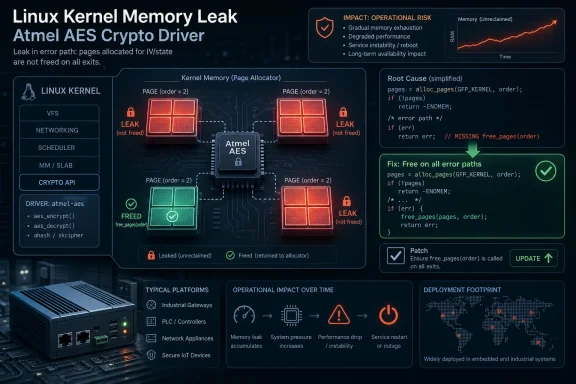 A Three-Page Leak Is Small Until It Is in the Kernel
The bug is almost comically tidy. atmel_aes_buff_init() allocates four pages using __get_free_pages() with ATMEL_AES_BUFFER_ORDER; atmel_aes_buff_cleanup() then frees only the first page with free_page(). The fix is to use free_pages() with the same order value used at allocation time.That is the kind of mismatch C programmers recognize instantly once it is pointed out. It is also the kind of mismatch that can survive for years because it does not necessarily crash the system, corrupt a visible data structure, or scream in logs. It simply leaves memory behind after a cleanup path that looked, at a glance, plausible.
In user space, a leak of three pages is often a bug report and a shrug. In kernel space, it is more serious because the leaked memory belongs to the operating system’s most privileged execution environment, and repeated leaks can contribute to denial-of-service conditions or brittle behavior under pressure. The CVE text does not claim exploitation beyond resource leakage, and NVD had not yet assigned CVSS scoring at the time of publication, but the security relevance is clear enough: memory the kernel cannot reclaim is memory the machine cannot depend on.
The detail that matters is symmetry. Kernel code that allocates with an order-aware page allocator must free with the matching order-aware call. Freeing only the first page of a multi-page allocation is not a harmless approximation; it is a contract violation.
The Atmel AES Driver Lives in the Part of Linux Most People Never Inventory
The affected component,atmel-aes, is not something most desktop users configure knowingly. It supports Atmel hardware AES acceleration, a feature more likely to appear in embedded boards, industrial devices, IoT gateways, and specialized ARM-based systems than on a typical x86 laptop.That niche placement is why a vulnerability like CVE-2026-46019 can be easy to underrate. If you are thinking only in terms of mainstream servers, the affected driver may not even be built. If you are responsible for appliances, factory systems, vendor images, or long-lived board support packages, the driver may be exactly the sort of component that exists quietly in production for a decade.
The Linux kernel’s breadth is both its superpower and its security headache. A single source tree supports cloud servers, phones, routers, dev boards, storage appliances, medical equipment, industrial controllers, and hobbyist hardware. The same CVE feed that includes high-profile privilege-escalation bugs also includes small driver fixes for hardware many administrators have never seen.
That does not make those CVEs noise. It means triage must be based on exposure, not vibes. A memory leak in an Atmel crypto accelerator is irrelevant to a fleet that cannot load or reach the driver, but it is operationally relevant to systems that rely on that accelerator for cryptographic workloads.
This Is the Kernel CVE Machine Doing What It Was Built to Do
There is a tendency to read every new kernel CVE as evidence of a crisis. The more accurate reading is more mundane: the kernel project is increasingly formalizing bug fixes as security records when they affect availability, integrity, confidentiality, or hardening assumptions. That means many CVEs now look like changelog entries because, in effect, they are changelog entries with security metadata attached.CVE-2026-46019 fits that pattern. The NVD entry says the record is awaiting enrichment, with no NIST CVSS vector yet assigned. The public description is essentially the upstream fix summary: four pages allocated, one page freed, three pages leaked, use the correct free function. There is no disclosed exploit chain, no remote attack path, and no vendor drama.
For administrators, that creates an awkward middle ground. The vulnerability is real, but the correct reaction is not the same as for a remotely reachable pre-authentication flaw. The task is to map the CVE to actual systems: Is the affected driver present? Is the hardware present? Is the code reachable? Are workloads using the crypto engine? Is the device in a maintenance window or stuck on a vendor kernel?
The modern CVE feed punishes organizations that treat all vulnerabilities alike. It also punishes organizations that dismiss small kernel bugs as “not security.” CVE-2026-46019 sits precisely between those bad habits.
The Exploit Story Is Less Dramatic Than the Reliability Story
The immediate impact described in the record is a memory leak, not arbitrary code execution. A successful abuse scenario would likely depend on repeatedly triggering the relevant allocation-and-cleanup path until leaked kernel pages accumulate. Whether that is practical depends heavily on driver availability, permissions, workload design, and system memory pressure.That is why the most honest assessment is conservative. This bug appears more aligned with local or workload-driven denial of service than with direct compromise. It is not currently presented as a key-leak vulnerability, an AES implementation flaw, or a cryptographic weakness in the algorithm itself.
The word “crypto” in the title should not mislead anyone. This is not an attack on AES. It is a resource-management defect in a hardware crypto driver. The distinction matters because crypto-labeled vulnerabilities often attract inflated interpretations, especially when automated scanners reduce them to a component name and a CVE identifier.
Still, reliability and security are not cleanly separated in kernel engineering. A system that can be pushed into memory exhaustion is a system whose security properties degrade. Services fail, watchdogs reboot devices, logs become incomplete, and clustered systems may enter recovery behavior that attackers or accidents can exploit.
The Patch Is Small Because the Bug Is About a Broken Pairing
The fix is conceptually simple: replace the single-page free operation with the multi-page free operation that matches the original allocation order. In kernel terms, the problem is not that memory allocation happened; it is that cleanup did not mirror allocation.That simplicity is comforting but also revealing. Many serious production bugs are not complicated. They are off-by-one assumptions, missing reference drops, wrong error-path exits, and allocator/free mismatches. Kernel code is full of paths that run only when hardware is initialized, a request fails, a module exits, or a rare mode is used.
Those paths are exactly where leaks like this hide. Happy-path testing may never catch them. A driver can perform useful cryptographic work while quietly mishandling teardown. Static analysis, fuzzing, code review, and runtime leak detectors have improved the situation, but they do not eliminate the old truth that cleanup code is security-sensitive code.
The stable-tree references attached to the CVE also matter. They indicate that the fix is being carried across maintained kernel branches rather than existing as a one-off patch. For downstream distributions and device vendors, that is the starting gun for backporting, rebuilding, and shipping updates.
Embedded Linux Turns “Just Patch It” Into a Supply-Chain Problem
On a general-purpose Linux distribution, the remediation path is boring in the best possible way: wait for the kernel package containing the fix, test it, reboot into it, and verify the running version. On embedded systems, the path can be much less direct.Many embedded products ship vendor kernels, board support packages, or customized long-term branches. The kernel may be patched by the silicon vendor, the device maker, an integrator, or nobody at all. Even when upstream stable has the fix, the device owner may not have a clean route to deploy it.
That is the deeper significance of CVE-2026-46019. It exposes the distance between upstream correctness and field reality. A three-page leak fixed in mainline code can remain alive in products that are difficult to update, poorly inventoried, or dependent on abandoned vendor trees.
This is especially relevant for organizations that buy appliances rather than build Linux systems themselves. The affected component may be hidden inside a gateway, controller, security box, lab instrument, or industrial device. The procurement label may not say “Linux kernel with Atmel AES accelerator,” but the firmware might.
Windows Shops Are Still Linux Shops Now
A Windows-focused audience may reasonably ask why this matters here. The answer is that the old boundary between Windows administration and Linux administration has collapsed. Windows environments now routinely include Linux servers, Linux-based appliances, container hosts, Kubernetes nodes, edge devices, WSL development environments, and cloud images.CVE-2026-46019 is unlikely to affect a standard Windows desktop. It is also unlikely to matter inside a typical WSL instance because WSL does not simply expose arbitrary embedded Atmel crypto hardware drivers to user workloads. But Windows-centric organizations often operate mixed estates where the most fragile Linux systems are not the obvious ones.
The risk is not that every Windows admin needs to become a kernel driver specialist. The risk is that nobody owns the Linux firmware and appliance layer because it sits outside the traditional Windows patch rhythm. That is where small kernel CVEs can linger.
Microsoft’s own enterprise world has made Linux unavoidable. Azure workloads, container images, network appliances, security tools, and developer stacks all blur the platform boundary. A vulnerability in an obscure Linux driver may not be a Windows problem, but it can absolutely be a Windows shop’s problem.
Scanner Output Will Overstate and Understate This Bug at the Same Time
Vulnerability scanners are likely to treat CVE-2026-46019 in the usual imperfect way. Some will flag any system running an affected kernel version, whether or notCONFIG_CRYPTO_DEV_ATMEL_AES is enabled. Others may miss customized kernels or embedded firmware entirely because they cannot authenticate, fingerprint, or parse the vendor image.Both errors are dangerous. A false positive wastes time and trains teams to ignore kernel CVEs. A false negative leaves an affected device unpatched because it never appeared in the dashboard.
The right triage starts with configuration. Determine whether the Atmel AES driver is built into the kernel, available as a module, or absent. Then determine whether the hardware exists and whether any process or kernel subsystem can drive the affected path. A compiled-but-unused module is a different risk from an actively used hardware crypto accelerator on a constrained embedded device.
For most enterprise servers, the answer will probably be “not applicable.” For certain ARM boards and embedded systems, the answer may be “patch during the next safe maintenance window.” For unsupported devices, the answer may be “isolate, monitor, and pressure the vendor.”
Memory Leaks Are Availability Bugs With Security Consequences
Security culture still tends to rank vulnerabilities by drama. Remote code execution gets attention. Local privilege escalation gets attention. Information disclosure gets attention when secrets are involved. Memory leaks often sound like housekeeping.Kernel memory leaks deserve better than that reflex. They can degrade availability, trigger watchdog resets, destabilize workloads, and create unpredictable failure modes. In constrained devices, a small leak repeated enough times can be more than theoretical.
The practical severity of CVE-2026-46019 depends on triggerability. If the cleanup path is rarely reached, impact may be minimal. If a local user, workload, or remote protocol can cause repeated use and teardown of the driver, the leak becomes more meaningful. The public record does not yet settle that question.
That uncertainty is not a reason to invent a worst case. It is a reason to avoid lazy scoring before NVD enrichment and vendor advisories catch up. Treat the bug as a real kernel resource leak, then let asset context decide urgency.
The Real Patch Management Test Is Knowing Where the Driver Exists
The most useful response to this CVE is not a frantic reboot campaign. It is an inventory exercise. Kernel vulnerabilities are only actionable when teams can connect them to running kernels, build options, loaded modules, hardware, and vendor support channels.That is where many organizations struggle. They know their Windows build numbers and their endpoint security posture. They may even know their cloud image versions. But they often lack equivalent visibility into appliances, lab gear, edge gateways, and “temporary” Linux boxes that became permanent infrastructure.
CVE-2026-46019 rewards teams that maintain kernel-level asset detail. If you can answer which systems use Atmel AES acceleration, this is a quick triage item. If you cannot, the CVE becomes another ticket in a swamp of uncertainty.
The same lesson applies beyond this driver. The kernel’s long tail of hardware support means the next small CVE may land in storage, networking, display, USB, DMA, or a crypto accelerator. The organization that can quickly say “we do not ship that code” has a major operational advantage.
The Atmel Fix Draws a Line Between Cryptographic Trust and Driver Trust
It is tempting to think of hardware crypto as a shortcut to security: dedicated silicon, accelerated operations, less CPU overhead, cleaner architecture. But hardware acceleration also moves trust into drivers, DMA paths, buffers, interrupts, and vendor-specific glue code.CVE-2026-46019 does not undermine AES. It undermines a tiny piece of memory hygiene around an AES accelerator. That distinction is exactly why driver trust matters. The cryptographic primitive can be sound while the software around it leaks memory, mishandles errors, or exposes unsafe interfaces.
For embedded systems, this is a recurring pattern. Hardware blocks add performance and power-efficiency benefits, but every block needs kernel code. That code may be maintained by a small group, exercised by a smaller user base, and reviewed less intensely than headline subsystems.
The security promise of hardware acceleration is therefore conditional. It depends not only on the silicon but on the boring lifecycle of driver maintenance. CVE-2026-46019 is boring in that precise and important way.
The Small Fixes Are How Kernel Security Actually Improves
There is a cynical view that assigning CVEs to narrow kernel bugs merely inflates vulnerability counts. There is some truth in the frustration: not every CVE carries the same practical risk, and automated compliance systems can turn low-context records into bureaucratic noise.But the alternative is worse. Without public identifiers, downstream vendors and operators struggle to track which security-relevant fixes have landed where. A memory leak in an obscure driver might be silently fixed upstream and never mapped to the firmware that still ships the vulnerable code.
The CVE gives the bug a handle. It lets distributions, embedded vendors, scanners, customers, and auditors talk about the same defect. Even when NVD enrichment is pending and scoring is unavailable, the identifier anchors the remediation chain.
The task for the industry is not to stop labeling small flaws. It is to get better at contextualizing them. CVE-2026-46019 is not a universal emergency, but it is a legitimate kernel fix that affected vendors should carry and affected operators should deploy.
The Signal Hidden in the Four-Page Accounting Error
CVE-2026-46019 is a narrow bug, but its handling says a lot about mature vulnerability response.- The vulnerability is a Linux kernel memory leak in the Atmel AES crypto driver, not a flaw in the AES algorithm itself.
- The bug occurs because four pages are allocated but only one page is freed during buffer cleanup.
- The practical risk is most relevant to systems that build, load, and use the Atmel AES hardware accelerator driver.
- NVD had not assigned a CVSS score when the record was published, so severity should be based on exposure rather than scanner panic.
- General-purpose Windows systems are not the target population, but Windows-heavy organizations may still own affected Linux appliances, embedded devices, or mixed infrastructure.
- The right remediation path is to track kernel updates from the relevant distribution or device vendor and confirm whether the fixed stable-tree patch is included.
References
- Primary source: NVD / Linux Kernel
Published: 2026-05-28T01:08:51-07:00
NVD - CVE-2026-46019
 nvd.nist.gov
- Security advisory: MSRC
Published: 2026-05-28T01:08:51-07:00
Original feed URL
Security Update Guide - Microsoft Security Response Center
 msrc.microsoft.com
- Related coverage: cateee.net
- Related coverage: stack.watch
- Related coverage: ww1.microchip.com
h@üJ6ô(:…Ë¥
ŽwáÝq ãlüò¤Tf Íï™æxe±ÈTfêZ sŽî_BF%ÿô¼£ýß t!:^Œ” •áÂ}ì;ÔLËîõäž¡P1y‘ +7p Æœé ýjh$½ü^d„sß) áSww1.microchip.com
- Related coverage: cdn.sparkfun.com