

CVE-2026-46293 is a newly published Linux kernel vulnerability, added to NVD on June 8, 2026, covering an out-of-bounds access in the Microchip PolarFire SoC fabric clock driver during registration of clock outputs. The bug is not the kind of headline-grabbing flaw that sends Windows desktop administrators sprinting for emergency change windows. But it is a useful reminder that “Linux kernel CVE” is now a very broad phrase, spanning everything from remotely reachable server bugs to narrowly scoped embedded-driver defects. For WindowsForum readers, the interesting story is less panic and more plumbing: how a one-line indexing fix in a RISC-V SoC clock driver becomes a CVE, lands in stable trees, and eventually matters to the long tail of devices that sit beside, beneath, and sometimes inside Windows estates.
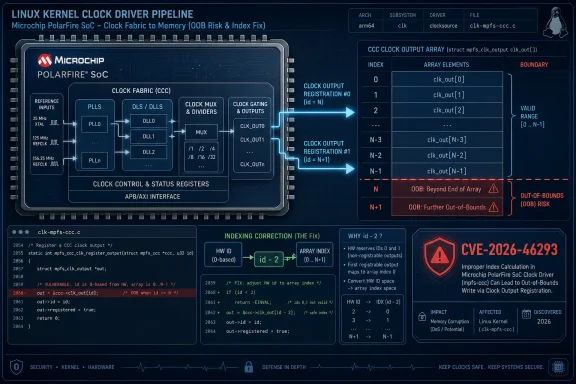
The core of CVE-2026-46293 is almost comically small. In the
That is the kind of bug modern kernel tooling is designed to catch. UBSAN, the Undefined Behavior Sanitizer, reported the out-of-bounds access; the fix adjusts the output IDs by subtracting two before placing them into the hardware clock array. In patch terms, this is a one-line behavioral correction with a comment-worthy subtlety around sparse clock IDs.
The CVE description says the mismatch comes from the ordering of IDs: PLLs first, then DLLs, then PLL outputs, then DLL outputs. The driver supports the PLLs and their output dividers, but not the DLLs and their outputs. The result was a numbering gap that the driver treated as if it were not a gap.
That is why this CVE looks strange at first glance. There is no dramatic exploit chain in the public record, no weaponized proof-of-concept, no ransomware crew bragging about it, and no NVD score yet. What we have instead is the kernel security machine doing what it increasingly does: turning correctness fixes, especially memory-safety fixes, into traceable vulnerability records.
That distinction matters. A Windows 11 laptop with an Intel or AMD processor is not suddenly exposed because a Microchip RISC-V SoC clock driver had an array-indexing bug. This is not a vulnerability in WSL, Hyper-V, Windows Subsystem for Linux, or the Linux guest kernels Microsoft ships for Windows users. The affected code sits in a hardware-specific Linux driver.
Still, dismissing it entirely would be the wrong lesson. Enterprise Windows environments increasingly contain Linux in places that are not labeled “Linux server” on the asset spreadsheet. Backup appliances, storage controllers, development boards, security gateways, observability boxes, lab gear, and industrial systems may all run Linux kernels with vendor-specific device trees and drivers.
That is where this kind of CVE becomes operationally relevant. The risk is not that every Windows admin must patch a desktop fleet overnight. The risk is that embedded and appliance Linux remains under-inventoried, under-patched, and occasionally invisible until a CVE forces someone to ask what kernel is actually running on that black box in the rack.
In this case, the driver was dealing with PolarFire SoC fabric clock support. The relevant IDs described a broader hardware layout than the driver implemented. The IDs included PLLs, DLLs, PLL outputs, and DLL outputs; the allocated array covered the supported subset. That made the code numerically honest to the binding but spatially dishonest to the allocation.
This is a classic kernel maintenance trap. The hardware description is stable, the driver’s support is partial, and the numbers look legitimate until they are used as direct array offsets. The bug is not that the developer forgot arrays have boundaries; it is that two different abstractions used the same numbers for different purposes.
The fix, “decrement the PLL output IDs by two,” is not a generic security mitigation. It is a mapping correction. The driver now packs the supported sparse clock IDs into the array it actually allocated, rather than treating the hardware binding’s full ID order as a dense list of implemented clocks.
That may sound mundane, but mundane is where a lot of kernel risk lives. Kernel code is full of translation layers between firmware descriptions, hardware manuals, subsystem APIs, and internal structures. When one layer assumes density and another layer encodes sparsity, memory safety bugs tend to appear.
That does not mean the issue is harmless. Out-of-bounds access in kernel space is a real class of bug, and kernel memory errors deserve respect. But it does mean readers should be careful not to import assumptions from unrelated Linux kernel CVEs. Not every out-of-bounds kernel bug is remotely exploitable, widely reachable, or privilege-escalation ready.
The public description points to detection by UBSAN during output registration. That suggests a path tied to driver initialization and hardware description rather than a hot user-facing syscall. The practical attack surface is therefore likely constrained by whether the affected driver is present, whether the hardware is relevant, whether the vulnerable code path runs, and what control an attacker has over the inputs involved.
The CVE record’s lack of CWE assignment in the excerpt is also telling. It leaves defenders with the broad nature of the flaw but not a fully enriched taxonomy. This is common in newly published kernel CVEs: the identifier arrives before the vulnerability ecosystem has finished decorating it with severity, weakness mapping, vendor advisories, and scanner logic.
For IT teams, that timing gap creates noise. Vulnerability scanners may flag the CVE before they can explain it well. Patch teams may see “Linux kernel” and “out of bounds” before they know whether any managed asset runs Microchip PolarFire SoC hardware. The right response is triage, not theater.
CVE-2026-46293 is a good example of the trade-off. On one hand, the public record is precise: it names the driver, explains the array sizing mismatch, identifies the unsupported DLL-related IDs, and points to stable commits. That is useful information for vendors and maintainers building kernels for affected platforms.
On the other hand, the record is easy to misread. A dashboard that flattens every kernel CVE into the same red square will make this bug look adjacent to high-impact local privilege escalations or remotely reachable network flaws. The metadata says “Linux kernel”; the engineering context says “specific Microchip clock driver during output registration.”
This is where mature vulnerability management has to separate exposure from existence. A flaw can exist upstream without being relevant to a given environment. Conversely, a narrow embedded-driver bug can matter a great deal if an organization depends on that exact hardware in safety, manufacturing, energy, networking, or lab automation contexts.
The supply-chain angle is especially important because many organizations do not patch embedded Linux directly. They wait for device vendors, board-support-package maintainers, appliance makers, Linux distributions, or OEM firmware updates. The CVE identifier becomes a shared language for asking those vendors whether a fix is included, not necessarily a direct instruction to compile a new kernel in-house.
That is a healthier use of the record. CVE-2026-46293 should prompt targeted inventory questions. It should not become another undifferentiated “critical kernel vuln” forwarded from a scanner to a help desk with no platform context.
Stable backports are how a correction like this reaches production systems. Embedded Linux devices often track long-term kernels, distribution kernels, or vendor-maintained forks rather than Linus Torvalds’ current development tree. A fix that lands only upstream may be academically satisfying; a fix that lands in stable branches has a much better chance of appearing in firmware images and distro updates.
The patch discussion also shows the kernel review culture at work. Reviewers noticed that subtracting two from an ID could become a trap if DLL support were added later. The proposed answer was not to allocate a much larger sparse array, but to document the packing assumption so future maintainers do not accidentally reintroduce a mismatch.
That exchange is worth dwelling on because it captures kernel engineering in miniature. Fixing the immediate memory error is necessary, but so is preserving the mental model around why the fix is correct. A one-line change without the surrounding reasoning can become tomorrow’s regression.
For security teams, the stable-tree references are also a clue about remediation. If your environment includes affected Microchip PolarFire SoC Linux systems, the question is not merely “does the CVE exist?” It is “which kernel branch is this device on, and has that branch received the stable commit or an equivalent vendor backport?”
That distinction can be frustrating, but it is unavoidable. Embedded devices often advertise a product firmware version, not a kernel commit. The administrator’s job is to translate between the CVE, the upstream fix, the stable branch, and the vendor’s release notes.
CVE-2026-46293 does not change Windows patching guidance. It does not require a Windows Update action, does not implicate Microsoft’s monthly Patch Tuesday workflow, and does not suggest that WSL users are exposed. If your assets are ordinary Windows PCs and servers, this CVE is almost certainly background noise.
But the advisory is relevant to Windows-centered teams in three cases. First, it matters if you manage embedded Linux hardware based on Microchip PolarFire SoC platforms. Second, it matters if your organization buys appliances whose internal bill of materials may include affected kernels. Third, it matters if your vulnerability management process treats all Linux kernel CVEs as equally urgent without validating platform reachability.
That last point is the broader lesson. Security teams often inherit scanner output stripped of engineering context. A CVE like this exposes the weakness of that workflow. The name alone tells you almost nothing about practical exposure; the driver name, hardware dependency, code path, and vendor kernel lineage tell you nearly everything.
Windows administrators do not need to become kernel clock-framework experts. They do need to know when to ask better questions. “Do we run Linux?” is too broad. “Do any managed appliances or embedded systems run Linux kernels with Microchip PolarFire SoC clock support?” is much closer to the operational truth.
That space is where dashboard-driven security can go wrong. A security program optimized around closing every CVE equally will waste time on irrelevant kernel drivers while missing genuinely exposed systems. A program that ignores unscored CVEs may miss early warnings in platforms it actually uses.
The better approach is asset-aware triage. Does the vulnerable driver exist in the running kernel or shipped firmware? Is the hardware present? Is the code compiled in, loaded as a module, or unreachable? Is there a vendor fix? Is the device exposed to untrusted users, untrusted device-tree data, or other controllable initialization paths?
For CVE-2026-46293, those questions will eliminate most Windows desktop and server estates quickly. They may not eliminate embedded labs, RISC-V development environments, or vendors building on Microchip’s PolarFire SoC platform. That is precisely why context beats score chasing.
NVD scoring, when it arrives, will help, but it should not be treated as the entire risk story. CVSS is a useful standardization tool; it is not a substitute for knowing what hardware you own. A low score on a mission-critical appliance and a high score on code you do not ship can produce very different operational priorities.
The reviewer concern about future DLL support is the most interesting part of the patch conversation. If the driver later grows support for the DLLs that are currently skipped, the packing logic may need to change again. That is not a criticism of the fix; it is a warning that today’s correct mapping is tied to today’s supported feature set.
This is the kind of detail that vulnerability scanners cannot represent. They can tell you a CVE applies to a kernel version or package. They usually cannot tell you that a fix is also a design note about sparse identifiers in a hardware-specific clock provider.
For developers, the lesson is familiar: never treat externally defined IDs as internal array indexes unless the density and range are explicitly guaranteed. For maintainers, the lesson is sharper: when a driver intentionally supports only a subset of a hardware binding, the translation layer must be obvious enough for the next person to maintain.
For security people, the lesson is about humility. Memory safety bugs are not always the result of reckless coding. Sometimes they emerge from perfectly reasonable abstractions crossing paths in a way nobody tested until a sanitizer did exactly what it was supposed to do.
That changes how vulnerability disclosure feels. In the old caricature, a CVE followed a dramatic exploit or researcher report. In the modern kernel, a CVE may follow from a tooling-assisted correctness fix that closes a potential memory-safety issue in a niche subsystem. The security record is becoming more continuous, more mechanical, and more comprehensive.
There is an upside: fewer bugs remain invisible simply because they are obscure. There is also a cost: the CVE stream becomes harder for administrators to interpret. More visibility produces more noise unless organizations invest in filtering by asset, architecture, configuration, and actual reachability.
For open-source infrastructure, this is still a net win. A public fix, a stable backport path, and a CVE identifier give vendors a clean trail to follow. The alternative is quiet divergence, where the same bug is fixed in one branch, missed in another, and rediscovered by each downstream maintainer in turn.
The trick is to avoid confusing transparency with emergency. CVE-2026-46293 deserves tracking by affected platform owners. It does not deserve generalized panic across Windows estates that have no path to the vulnerable driver.
 A Tiny Driver Bug Becomes a Public Security Record
The core of CVE-2026-46293 is almost comically small. In the clk-mpfs-ccc.c driver, the kernel allocated space for the clocks it actually supported, then indexed that storage using IDs that also accounted for clocks the driver did not support. When the last two outputs were registered, the driver could write past the end of the array.That is the kind of bug modern kernel tooling is designed to catch. UBSAN, the Undefined Behavior Sanitizer, reported the out-of-bounds access; the fix adjusts the output IDs by subtracting two before placing them into the hardware clock array. In patch terms, this is a one-line behavioral correction with a comment-worthy subtlety around sparse clock IDs.
The CVE description says the mismatch comes from the ordering of IDs: PLLs first, then DLLs, then PLL outputs, then DLL outputs. The driver supports the PLLs and their output dividers, but not the DLLs and their outputs. The result was a numbering gap that the driver treated as if it were not a gap.
That is why this CVE looks strange at first glance. There is no dramatic exploit chain in the public record, no weaponized proof-of-concept, no ransomware crew bragging about it, and no NVD score yet. What we have instead is the kernel security machine doing what it increasingly does: turning correctness fixes, especially memory-safety fixes, into traceable vulnerability records.
The Important Word Is “Kernel,” Not “Linux Desktop”
For many readers, “Linux kernel vulnerability” still evokes servers, cloud hosts, Android phones, or maybe a dual-boot workstation. CVE-2026-46293 lives in a narrower neighborhood. It concerns the Microchip PolarFire SoC clock conditioning circuit driver, a component tied to Microchip’s PolarFire SoC family rather than mainstream x86 Windows PCs.That distinction matters. A Windows 11 laptop with an Intel or AMD processor is not suddenly exposed because a Microchip RISC-V SoC clock driver had an array-indexing bug. This is not a vulnerability in WSL, Hyper-V, Windows Subsystem for Linux, or the Linux guest kernels Microsoft ships for Windows users. The affected code sits in a hardware-specific Linux driver.
Still, dismissing it entirely would be the wrong lesson. Enterprise Windows environments increasingly contain Linux in places that are not labeled “Linux server” on the asset spreadsheet. Backup appliances, storage controllers, development boards, security gateways, observability boxes, lab gear, and industrial systems may all run Linux kernels with vendor-specific device trees and drivers.
That is where this kind of CVE becomes operationally relevant. The risk is not that every Windows admin must patch a desktop fleet overnight. The risk is that embedded and appliance Linux remains under-inventoried, under-patched, and occasionally invisible until a CVE forces someone to ask what kernel is actually running on that black box in the rack.
The Bug Is an Indexing Error With a Hardware Backstory
Clock drivers are not glamorous, but they are fundamental. A system-on-chip needs clocks to coordinate CPU cores, buses, peripherals, fabric, and timing-sensitive blocks. The kernel’s common clock framework provides a way for drivers and device trees to describe those clocks so the operating system can enable, disable, divide, and expose them consistently.In this case, the driver was dealing with PolarFire SoC fabric clock support. The relevant IDs described a broader hardware layout than the driver implemented. The IDs included PLLs, DLLs, PLL outputs, and DLL outputs; the allocated array covered the supported subset. That made the code numerically honest to the binding but spatially dishonest to the allocation.
This is a classic kernel maintenance trap. The hardware description is stable, the driver’s support is partial, and the numbers look legitimate until they are used as direct array offsets. The bug is not that the developer forgot arrays have boundaries; it is that two different abstractions used the same numbers for different purposes.
The fix, “decrement the PLL output IDs by two,” is not a generic security mitigation. It is a mapping correction. The driver now packs the supported sparse clock IDs into the array it actually allocated, rather than treating the hardware binding’s full ID order as a dense list of implemented clocks.
That may sound mundane, but mundane is where a lot of kernel risk lives. Kernel code is full of translation layers between firmware descriptions, hardware manuals, subsystem APIs, and internal structures. When one layer assumes density and another layer encodes sparsity, memory safety bugs tend to appear.
NVD Has a Record, But Not Yet a Verdict
As of the record described by NVD, CVE-2026-46293 has been published and included in the dataset, but NVD had not yet provided CVSS 4.0, CVSS 3.x, or CVSS 2.0 scoring. That absence is important because severity is doing real interpretive work here. Without a score, defenders have a CVE identifier and a patch trail, but not a nationally curated severity judgment.That does not mean the issue is harmless. Out-of-bounds access in kernel space is a real class of bug, and kernel memory errors deserve respect. But it does mean readers should be careful not to import assumptions from unrelated Linux kernel CVEs. Not every out-of-bounds kernel bug is remotely exploitable, widely reachable, or privilege-escalation ready.
The public description points to detection by UBSAN during output registration. That suggests a path tied to driver initialization and hardware description rather than a hot user-facing syscall. The practical attack surface is therefore likely constrained by whether the affected driver is present, whether the hardware is relevant, whether the vulnerable code path runs, and what control an attacker has over the inputs involved.
The CVE record’s lack of CWE assignment in the excerpt is also telling. It leaves defenders with the broad nature of the flaw but not a fully enriched taxonomy. This is common in newly published kernel CVEs: the identifier arrives before the vulnerability ecosystem has finished decorating it with severity, weakness mapping, vendor advisories, and scanner logic.
For IT teams, that timing gap creates noise. Vulnerability scanners may flag the CVE before they can explain it well. Patch teams may see “Linux kernel” and “out of bounds” before they know whether any managed asset runs Microchip PolarFire SoC hardware. The right response is triage, not theater.
Kernel CVEs Have Become a Supply-Chain Language
The Linux kernel’s CVE process has changed the texture of vulnerability management. More kernel fixes now receive CVE identifiers, including narrowly scoped bugs in drivers and subsystems that many organizations will never load. This improves traceability, but it also increases the volume of vulnerability records that security teams must interpret.CVE-2026-46293 is a good example of the trade-off. On one hand, the public record is precise: it names the driver, explains the array sizing mismatch, identifies the unsupported DLL-related IDs, and points to stable commits. That is useful information for vendors and maintainers building kernels for affected platforms.
On the other hand, the record is easy to misread. A dashboard that flattens every kernel CVE into the same red square will make this bug look adjacent to high-impact local privilege escalations or remotely reachable network flaws. The metadata says “Linux kernel”; the engineering context says “specific Microchip clock driver during output registration.”
This is where mature vulnerability management has to separate exposure from existence. A flaw can exist upstream without being relevant to a given environment. Conversely, a narrow embedded-driver bug can matter a great deal if an organization depends on that exact hardware in safety, manufacturing, energy, networking, or lab automation contexts.
The supply-chain angle is especially important because many organizations do not patch embedded Linux directly. They wait for device vendors, board-support-package maintainers, appliance makers, Linux distributions, or OEM firmware updates. The CVE identifier becomes a shared language for asking those vendors whether a fix is included, not necessarily a direct instruction to compile a new kernel in-house.
That is a healthier use of the record. CVE-2026-46293 should prompt targeted inventory questions. It should not become another undifferentiated “critical kernel vuln” forwarded from a scanner to a help desk with no platform context.
Stable Backports Are the Real Delivery Vehicle
The NVD entry lists several stable kernel commit references, which tells the practical story. The fix was not merely proposed on a mailing list and forgotten; it was routed into stable lines. For users and vendors, that matters more than the elegance of the one-line patch.Stable backports are how a correction like this reaches production systems. Embedded Linux devices often track long-term kernels, distribution kernels, or vendor-maintained forks rather than Linus Torvalds’ current development tree. A fix that lands only upstream may be academically satisfying; a fix that lands in stable branches has a much better chance of appearing in firmware images and distro updates.
The patch discussion also shows the kernel review culture at work. Reviewers noticed that subtracting two from an ID could become a trap if DLL support were added later. The proposed answer was not to allocate a much larger sparse array, but to document the packing assumption so future maintainers do not accidentally reintroduce a mismatch.
That exchange is worth dwelling on because it captures kernel engineering in miniature. Fixing the immediate memory error is necessary, but so is preserving the mental model around why the fix is correct. A one-line change without the surrounding reasoning can become tomorrow’s regression.
For security teams, the stable-tree references are also a clue about remediation. If your environment includes affected Microchip PolarFire SoC Linux systems, the question is not merely “does the CVE exist?” It is “which kernel branch is this device on, and has that branch received the stable commit or an equivalent vendor backport?”
That distinction can be frustrating, but it is unavoidable. Embedded devices often advertise a product firmware version, not a kernel commit. The administrator’s job is to translate between the CVE, the upstream fix, the stable branch, and the vendor’s release notes.
The Windows Angle Is Indirect but Real
WindowsForum is not an embedded Linux outlet, but Windows administrators increasingly own mixed estates. The modern Microsoft shop may run Windows endpoints, Azure resources, Linux build agents, network appliances, Kubernetes clusters, storage systems, security cameras, and hardware test rigs. The border between “Windows environment” and “Linux environment” is now an accounting convention more than a technical reality.CVE-2026-46293 does not change Windows patching guidance. It does not require a Windows Update action, does not implicate Microsoft’s monthly Patch Tuesday workflow, and does not suggest that WSL users are exposed. If your assets are ordinary Windows PCs and servers, this CVE is almost certainly background noise.
But the advisory is relevant to Windows-centered teams in three cases. First, it matters if you manage embedded Linux hardware based on Microchip PolarFire SoC platforms. Second, it matters if your organization buys appliances whose internal bill of materials may include affected kernels. Third, it matters if your vulnerability management process treats all Linux kernel CVEs as equally urgent without validating platform reachability.
That last point is the broader lesson. Security teams often inherit scanner output stripped of engineering context. A CVE like this exposes the weakness of that workflow. The name alone tells you almost nothing about practical exposure; the driver name, hardware dependency, code path, and vendor kernel lineage tell you nearly everything.
Windows administrators do not need to become kernel clock-framework experts. They do need to know when to ask better questions. “Do we run Linux?” is too broad. “Do any managed appliances or embedded systems run Linux kernels with Microchip PolarFire SoC clock support?” is much closer to the operational truth.
The Severity Vacuum Rewards Bad Dashboards
The absence of an NVD severity score creates a familiar problem. Some tools will display the CVE as unscored, some will infer a generic severity from keywords, and some will wait for vendor enrichment. In the meantime, the vulnerability exists in the uncomfortable space between “publicly known” and “properly ranked.”That space is where dashboard-driven security can go wrong. A security program optimized around closing every CVE equally will waste time on irrelevant kernel drivers while missing genuinely exposed systems. A program that ignores unscored CVEs may miss early warnings in platforms it actually uses.
The better approach is asset-aware triage. Does the vulnerable driver exist in the running kernel or shipped firmware? Is the hardware present? Is the code compiled in, loaded as a module, or unreachable? Is there a vendor fix? Is the device exposed to untrusted users, untrusted device-tree data, or other controllable initialization paths?
For CVE-2026-46293, those questions will eliminate most Windows desktop and server estates quickly. They may not eliminate embedded labs, RISC-V development environments, or vendors building on Microchip’s PolarFire SoC platform. That is precisely why context beats score chasing.
NVD scoring, when it arrives, will help, but it should not be treated as the entire risk story. CVSS is a useful standardization tool; it is not a substitute for knowing what hardware you own. A low score on a mission-critical appliance and a high score on code you do not ship can produce very different operational priorities.
The One-Line Fix Says More Than It Seems
The patch itself changes an array index fromout_hw->id to out_hw->id - 2. That is easy to summarize and easy to underestimate. In kernel code, one-line fixes often sit on top of multi-layer assumptions about hardware numbering, device-tree bindings, subsystem APIs, and memory layout.The reviewer concern about future DLL support is the most interesting part of the patch conversation. If the driver later grows support for the DLLs that are currently skipped, the packing logic may need to change again. That is not a criticism of the fix; it is a warning that today’s correct mapping is tied to today’s supported feature set.
This is the kind of detail that vulnerability scanners cannot represent. They can tell you a CVE applies to a kernel version or package. They usually cannot tell you that a fix is also a design note about sparse identifiers in a hardware-specific clock provider.
For developers, the lesson is familiar: never treat externally defined IDs as internal array indexes unless the density and range are explicitly guaranteed. For maintainers, the lesson is sharper: when a driver intentionally supports only a subset of a hardware binding, the translation layer must be obvious enough for the next person to maintain.
For security people, the lesson is about humility. Memory safety bugs are not always the result of reckless coding. Sometimes they emerge from perfectly reasonable abstractions crossing paths in a way nobody tested until a sanitizer did exactly what it was supposed to do.
Sanitizers Are Quietly Reshaping Kernel Security
UBSAN’s role here should not be treated as an incidental footnote. Sanitizers have become a major force in finding kernel bugs that might otherwise sit quietly for years. They convert undefined behavior and memory misuse into visible reports, often before there is evidence of exploitation.That changes how vulnerability disclosure feels. In the old caricature, a CVE followed a dramatic exploit or researcher report. In the modern kernel, a CVE may follow from a tooling-assisted correctness fix that closes a potential memory-safety issue in a niche subsystem. The security record is becoming more continuous, more mechanical, and more comprehensive.
There is an upside: fewer bugs remain invisible simply because they are obscure. There is also a cost: the CVE stream becomes harder for administrators to interpret. More visibility produces more noise unless organizations invest in filtering by asset, architecture, configuration, and actual reachability.
For open-source infrastructure, this is still a net win. A public fix, a stable backport path, and a CVE identifier give vendors a clean trail to follow. The alternative is quiet divergence, where the same bug is fixed in one branch, missed in another, and rediscovered by each downstream maintainer in turn.
The trick is to avoid confusing transparency with emergency. CVE-2026-46293 deserves tracking by affected platform owners. It does not deserve generalized panic across Windows estates that have no path to the vulnerable driver.
The PolarFire Clock Bug Belongs on the Inventory Sheet, Not the War Room Screen
The practical response to CVE-2026-46293 is narrow, but not nonexistent. Organizations should treat it as a platform-specific Linux kernel maintenance item with supply-chain implications, especially where embedded RISC-V systems or vendor appliances are in scope.- CVE-2026-46293 affects a Microchip PolarFire SoC fabric clock driver in the Linux kernel, not ordinary Windows PCs or Windows Update components.
- The flaw is an out-of-bounds access during clock output registration caused by sparse hardware clock IDs being used as dense array indexes.
- NVD had published the record by June 8, 2026, but had not yet assigned CVSS severity in the details provided.
- The upstream fix adjusts the array index for PLL outputs and was routed through stable kernel commits for downstream adoption.
- Windows-centered IT teams should check embedded Linux appliances and specialized hardware inventories rather than treating this as a desktop patching event.
- The most useful remediation question is whether a vendor firmware or kernel update includes the stable backport or an equivalent fix.
References
- Primary source: NVD / Linux Kernel
Published: 2026-06-10T01:04:51-07:00
NVD - CVE-2026-46293
 nvd.nist.gov
- Security advisory: MSRC
Published: 2026-06-10T01:04:51-07:00
Original feed URL
Security Update Guide - Microsoft Security Response Center
 msrc.microsoft.com
- Related coverage: patchew.org
- Related coverage: lore-kernel.gnuweeb.org
- Related coverage: kernel.org

The Linux Kernel Archives
www.kernel.org
- Related coverage: kernel.googlesource.com
- Related coverage: gitlab.com
- Related coverage: cvefeed.io
CVE-2026-23225 - sched/mmcid: Don't assume CID is CPU owned on mode switch
In the Linux kernel, the following vulnerability has been resolved: sched/mmcid: Don't assume CID is CPU owned on mode switch Shinichiro reported a KASAN UAF, which is actually an out of bounds access in the MMCID management code. CPU0 CPU1 T1 runs in userspace T0: fork(T4) -> Switch to...cvefeed.io - Official source: github.com
GitHub - gregkh/linux: Linux kernel stable tree mirror · GitHub
Linux kernel stable tree mirror. Contribute to gregkh/linux development by creating an account on GitHub. github.com
- Related coverage: cateee.net
- Related coverage: da.lib.kobe-u.ac.jp
</rdf:Alt> </dc:title> </rdf:Description> <rdf:Description rdf:about="" xmlns:xmpMM="http://ns.adobe.com/xap/1.0/mm/"> <xmpMM:DocumentID>uuid:5c1ec284-792e-6c40-a0d4-2e85a71a852b</xmpMM:DocumentID> <
</rdf:Alt> </dc:description> <dc:title> <rdf:Alt> <rdf:li xml:lang="x-default"/> </rdf:Alt> </dc:title> </rdf:Description> <rdf:Description rdf:about="" xmlns:xmpMM="http://ns.adobe.com/xap/1.0/mm/">...da.lib.kobe-u.ac.jp

