

CVE-2026-46296 is a newly published Linux kernel vulnerability, received by NVD from kernel.org on June 8, 2026, that fixes a NULL-pointer dereference in the Samsung S3C64xx SPI controller driver during driver unbind. The bug is narrow, hardware-specific, and not yet scored by NVD, but it is still a useful reminder that kernel security increasingly includes lifecycle correctness, not just spectacular remote-code-execution flaws. For WindowsForum readers, the story is not that desktop Windows is suddenly exposed; it is that modern IT estates are hybrid, and Linux kernel maintenance has become part of the Windows administrator’s peripheral vision.
The description of CVE-2026-46296 is almost comically terse: a DMA channel allocation path moved, a corresponding free path did not, and driver removal could trip over a NULL pointer. That is the kind of defect that once might have lived quietly in a subsystem changelog, understood by the dozen people who maintain or deploy the relevant hardware. In 2026, it receives a CVE identifier, lands in NVD, and becomes part of the same vulnerability-management feed that tracks browser zero-days and Exchange Server emergencies.
That shift is not accidental. Since the Linux kernel project began assigning CVEs more directly, administrators have seen a larger number of kernel CVEs that look less like attacker playbooks and more like correctness fixes with security implications. CVE-2026-46296 fits that pattern exactly. The vulnerability is real, but its operational significance depends heavily on whether the vulnerable driver exists, whether it is built into a running kernel, whether affected hardware is present, and whether an attacker can trigger the relevant unbind path.
The affected area is the
That makes this CVE a case study in proportion. It is not a reason for panic across Windows desktops. It is, however, exactly the kind of low-level kernel flaw that matters to teams responsible for Linux-based edge devices, ARM boards, embedded controllers, custom appliances, or vendor platforms that quietly run Linux beneath a Windows-managed estate.
The problem was that the removal path apparently still behaved as if the old allocation model were in place. When the driver was unbound, its
This matters because driver teardown is one of the least forgiving parts of kernel programming. Initialization code tends to be exercised repeatedly by developers because a device either works or it does not. Normal I/O paths are beaten on by users and benchmarks. Remove paths, hot-unplug paths, suspend and resume paths, and error unwinding paths often get less attention, yet they must be perfectly synchronized with resource ownership.
The phrase driver unbind may sound administrative rather than security-relevant. In Linux, unbinding a driver detaches it from a device, often through sysfs or during module removal, device removal, power-state transitions, or bus reconfiguration. If a bug in that path causes a NULL-pointer dereference, the likely immediate effect is a kernel oops or crash. Depending on kernel configuration and context, that can mean a denial of service for the local system.
The distinction between an exploitable memory corruption and a crash-only NULL dereference matters. The public description does not indicate code execution, privilege escalation, data exposure, or remote reachability. It indicates a kernel NULL dereference on a specific driver lifecycle path. That places the flaw closer to reliability and local denial-of-service territory than to the nightmare class of remotely exploitable kernel vulnerabilities.
This lag is now familiar. Kernel.org can publish a CVE record based on a resolved upstream issue before NVD has completed its own enrichment. For defenders, that creates an awkward interim period. The CVE exists, scanners may flag it, dashboards may show it, but the usual severity fields remain blank or marked unavailable.
The temptation is to treat “no score” as “no urgency.” That is a mistake. The equally bad opposite temptation is to treat every unscored kernel CVE as urgent until proven otherwise. CVE-2026-46296 argues for a third posture: identify whether the code is present and reachable, then prioritize based on deployment reality.
In a generic cloud VM, the Samsung S3C64xx SPI controller driver is unlikely to be relevant. In a Linux-based embedded product, kiosk, industrial controller, router, lab board, or vendor-supplied appliance, it might be very relevant indeed. Vulnerability management systems are not good at this nuance unless administrators feed them asset context.
The lack of a CVSS score also highlights a broader mismatch between CVE publication and operational risk. CVSS wants to encode severity into a portable vector. Kernel flaws often resist portability because build configuration, module loading, hardware presence, namespace exposure, and local administrative access determine whether a bug is theoretical or practical. A CVE feed can tell you that a fix exists; it cannot always tell you whether your exact device can be crashed by it.
There is WSL on developer workstations. There are Linux containers in CI pipelines. There are Linux-based appliances joined to Microsoft Entra ID-backed management workflows. There are edge systems feeding data into Azure. There are firewalls, NAS devices, Kubernetes nodes, thin clients, hypervisors, firmware build boxes, and ARM development boards sitting in organizations whose desktop management muscle memory is still Windows-first.
CVE-2026-46296 probably does not affect WSL in any ordinary configuration. WSL is not exposing a Samsung S3C64xx SPI controller driver to a Windows laptop user. But that is precisely the point: administrators need to distinguish “Linux kernel CVE” from “all Linux things we operate are equally exposed.” A disciplined Windows shop does not ignore the alert; it routes it to the inventory question.
The practical question is whether any managed Linux kernel in the environment includes and uses the
There is another Windows-adjacent angle: supply chain opacity. Many devices administered through Windows tools, web consoles, or cloud portals are Linux boxes underneath. Their vulnerability posture depends not on Windows Update but on vendor kernel maintenance. When a CVE like this lands, the exposed organization may not have the source tree, kernel config, or ability to patch directly. It has a vendor contract and a firmware update cadence.
DMA resources are especially sensitive because they connect device I/O to memory movement. Drivers must request channels, prepare transfers, handle errors, terminate activity, release resources, and coordinate with subsystem frameworks. Moving allocation from one phase of a driver’s life to another is the kind of refactor that looks straightforward until every cleanup path is audited.
Here, the driver’s prepare-transfer path became the relevant allocation site. The remove path was left carrying an obsolete cleanup step. If no DMA channel had been allocated in the expected slot, the cleanup code could dereference a NULL pointer. The kernel fix removes the stale cleanup action, bringing resource release back into line with where resources are actually acquired.
That is a familiar pattern across systems software. Bugs happen when code remembers yesterday’s architecture. The compiler cannot always save you from a function that is still logically valid but no longer valid under the new ownership model. Review tools and human reviewers have to catch that mismatch.
The CVE description notes that the issue was flagged by Sashiko while reviewing a controller deregistration fix. That detail is worth pausing on. It suggests the bug was found in the orbit of broader teardown and deregistration review work, not necessarily because someone weaponized it. Security maintenance often looks like this: one lifecycle bug leads reviewers to inspect adjacent assumptions, and a second flaw falls out of the audit.
The exploitability bar is highly contextual. If unbinding the driver requires root privileges on a device that only trusted administrators can access, the security impact is limited. If some management stack, container escape route, debug interface, or poorly isolated service can trigger the unbind path indirectly, the risk picture changes. The public CVE text does not establish that broader reachability, so the responsible reading is narrow.
Embedded systems also complicate severity. A crash on a laptop is annoying. A crash on a gateway, controller, sensor hub, point-of-sale device, vehicle-adjacent board, factory node, or medical-adjacent appliance may be operationally significant even if there is no data theft and no persistent compromise. Availability is security when the system being protected has to stay online.
Administrators should also resist the assumption that hardware-specific means irrelevant. In the x86 server world, hardware-specific Linux driver CVEs often vanish into the noise. In embedded ARM environments, a single controller driver may define whether storage, displays, sensors, or board peripherals work reliably. The blast radius is not measured by global install base alone; it is measured by whether the affected fleet is mission-critical.
The other reason unbind bugs matter is that modern systems are more dynamic than the old mental model of “boot once and never touch drivers.” Devices suspend, resume, reprobe, reload modules, apply live-ish updates, shift power states, and interact with management tooling. Code paths that once seemed rare are less rare in the field.
CVE-2026-46296 is a perfect example. A vulnerability scanner may eventually report it against a kernel package version. But the package version alone may not answer whether the affected driver is compiled, loaded, reachable, or backed by relevant hardware. A distribution kernel can include thousands of drivers for hardware that will never exist on a given machine.
For servers and endpoints, administrators can usually start by checking loaded modules and kernel configuration. For appliances, the path is harder: review vendor advisories, firmware release notes, software bills of materials where available, and support channels. For custom Linux builds, the maintainers should check whether the stable commits referenced by kernel.org have been pulled into their maintained branches.
The stable backport references attached to the CVE indicate the fix has been propagated across multiple kernel lines. That is normal for kernel security fixes and important for downstream consumers. Many organizations do not run mainline Linux; they run long-term support kernels, vendor kernels, Android-derived kernels, Yocto builds, or distribution-patched trees. The relevant question is not “is mainline fixed?” but “has my branch received the equivalent fix?”
Windows administrators who also own Linux-based infrastructure should translate the alert into change-management language. Which devices run affected kernels? Which are vendor-managed? Which can be patched in the next maintenance window? Which cannot be touched without certification, validation, or plant downtime? That framing turns a CVE record into an operational plan.
In many enterprises, Windows endpoints are visible, patched, measured, and reported. Linux devices may be split across developers, network teams, facilities, security labs, product engineering, or vendors. Some are lovingly maintained; others are “the box in the cabinet” that only gets touched when it stops working. A hardware-specific kernel CVE is a test of whether those devices are in the asset inventory at all.
This is also where Microsoft’s own ecosystem has changed expectations. Azure, Defender, Intune-adjacent management patterns, GitHub-based development, and hybrid identity have made Linux part of the same operational conversation. The Windows professional no longer needs to administer every Linux kernel personally, but they do need to know when Linux risk crosses into their service boundary.
CVE-2026-46296 does not ask Windows admins to patch Windows. It asks them to verify the non-Windows systems that Windows users, applications, and business processes depend on. That may include build infrastructure, embedded test hardware, monitoring appliances, IoT gateways, and partner-supplied systems. The vulnerability’s narrowness is not an excuse for ignorance; it is a reason to triage precisely.
The best security programs have learned to avoid two bad habits. They do not inflate every Linux kernel CVE into a board-level emergency. They also do not dismiss kernel CVEs merely because the affected subsystem sounds obscure. They ask where the code runs, who controls the update path, and what happens if the affected device crashes.
This is why stable kernels matter. Organizations sometimes imagine that avoiding change is the safest posture for low-level infrastructure. CVE-2026-46296 is a reminder that old code can contain known bugs, while new code can introduce regressions, and the answer is not stasis but controlled maintenance. The stable process exists to move targeted fixes into maintained branches without forcing every deployment onto the bleeding edge.
Regression risk also cuts the other way. A small patch that removes a bogus release call should be low-risk, but embedded systems deserve testing because drivers interact with board-specific device trees, DMA engines, clocks, power domains, and vendor modifications. A patch that is correct upstream can still land in a downstream environment with local changes that deserve validation.
For IT teams consuming vendor firmware, this means asking better questions. Has the vendor incorporated the upstream fix? Which kernel branch is the device based on? Is the
Those questions sound basic, but they are often difficult to answer under time pressure. The value of a CVE like this is partly that it gives organizations another reason to demand clearer firmware provenance and patch transparency from suppliers. If a vendor cannot say whether a named upstream kernel CVE affects its product, that is itself useful risk information.
In standard Linux configurations, driver unbinding is not something ordinary users can do casually. It usually requires elevated privileges. That substantially limits the vulnerability’s severity in many environments. If an attacker already has root on the host, crashing the system through a driver bug is rarely their most powerful option.
But embedded products are not standard hosts. Vendors sometimes expose maintenance operations through web interfaces, debug APIs, factory tools, or scripts with broader permissions than intended. A local-only kernel bug can become remotely triggerable when wrapped in a careless management layer. That does not mean CVE-2026-46296 is remotely exploitable; it means product teams should evaluate the real control paths around driver binding and module operations.
There is also the question of module unload policy. Some production systems do not allow module unloading or compile critical drivers directly into the kernel. Others use modular drivers extensively. Some have lockdown mechanisms, secure boot policies, or stripped-down sysfs access. Each of those choices changes the practical attack surface.
This is where CVSS often struggles. A single score may eventually appear, but administrators should not let it replace local reasoning. The difference between a lab board with root shell access, an appliance with a remote admin panel, and a locked-down production image is the difference between negligible and meaningful operational risk.
Security teams should also watch how their tooling reports this CVE. A scanner that flags every Linux system solely because of an upstream kernel version may generate noise. A scanner that can correlate kernel configuration, loaded modules, and package backports is more useful. The same CVE can be a real issue on one embedded board and irrelevant on a rack of x86 servers.
For custom kernel builders, the fix should be treated as a normal stable backport candidate. The code change is narrowly scoped, and the bug it addresses is clear. The testing burden should focus on SPI transfer behavior, driver bind and unbind cycles, DMA-backed transfers, suspend and resume if relevant, and any board-specific overlays or device-tree configurations.
For enterprise risk owners, the right status may be “monitor and patch through normal kernel maintenance” rather than “emergency change.” That is not minimization. It is a recognition that vulnerability management is about matching the urgency of a fix to the likelihood and consequence of exploitation in your environment.
The worst response is to let the lack of an NVD score suspend thought. NVD enrichment will arrive when it arrives. Your environment’s exposure can be assessed before then.
 A Small SPI Bug Shows the Kernel’s New Security Grammar
The description of CVE-2026-46296 is almost comically terse: a DMA channel allocation path moved, a corresponding free path did not, and driver removal could trip over a NULL pointer. That is the kind of defect that once might have lived quietly in a subsystem changelog, understood by the dozen people who maintain or deploy the relevant hardware. In 2026, it receives a CVE identifier, lands in NVD, and becomes part of the same vulnerability-management feed that tracks browser zero-days and Exchange Server emergencies.That shift is not accidental. Since the Linux kernel project began assigning CVEs more directly, administrators have seen a larger number of kernel CVEs that look less like attacker playbooks and more like correctness fixes with security implications. CVE-2026-46296 fits that pattern exactly. The vulnerability is real, but its operational significance depends heavily on whether the vulnerable driver exists, whether it is built into a running kernel, whether affected hardware is present, and whether an attacker can trigger the relevant unbind path.
The affected area is the
spi-s3c64xx driver, which supports Samsung S3C64xx-style SPI controllers. SPI, or Serial Peripheral Interface, is not a glamorous subsystem, but it is everywhere in embedded computing. It connects processors to flash chips, sensors, controllers, radios, and board-level devices that users rarely see and administrators often inherit as part of appliances, development boards, industrial systems, and vendor hardware.That makes this CVE a case study in proportion. It is not a reason for panic across Windows desktops. It is, however, exactly the kind of low-level kernel flaw that matters to teams responsible for Linux-based edge devices, ARM boards, embedded controllers, custom appliances, or vendor platforms that quietly run Linux beneath a Windows-managed estate.
The Crash Is in the Cleanup, Not the Data Path
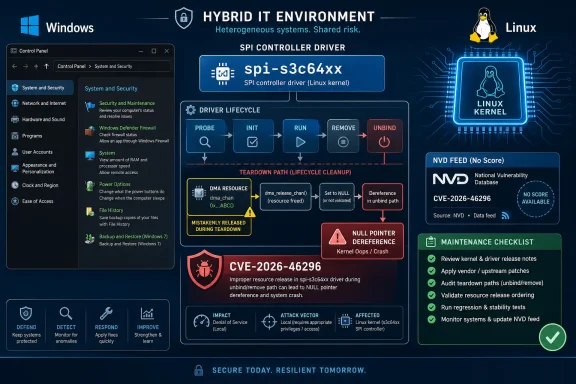
The vulnerability description says a previous change moved DMA channel allocation fromprobe() back to s3c64xx_spi_prepare_transfer(). In plain English, the driver stopped reserving DMA resources when the device was first initialized and instead deferred that work until a transfer was being prepared. That can be a reasonable design choice: allocate resources closer to actual use, reduce assumptions during initialization, and avoid holding hardware resources earlier than necessary.The problem was that the removal path apparently still behaved as if the old allocation model were in place. When the driver was unbound, its
remove() routine tried to release DMA channels that might no longer have been allocated there, or might not exist in the expected state. The fix is blunt: drop the bogus DMA channel release from the remove path so the driver does not dereference a NULL pointer during teardown.This matters because driver teardown is one of the least forgiving parts of kernel programming. Initialization code tends to be exercised repeatedly by developers because a device either works or it does not. Normal I/O paths are beaten on by users and benchmarks. Remove paths, hot-unplug paths, suspend and resume paths, and error unwinding paths often get less attention, yet they must be perfectly synchronized with resource ownership.
The phrase driver unbind may sound administrative rather than security-relevant. In Linux, unbinding a driver detaches it from a device, often through sysfs or during module removal, device removal, power-state transitions, or bus reconfiguration. If a bug in that path causes a NULL-pointer dereference, the likely immediate effect is a kernel oops or crash. Depending on kernel configuration and context, that can mean a denial of service for the local system.
The distinction between an exploitable memory corruption and a crash-only NULL dereference matters. The public description does not indicate code execution, privilege escalation, data exposure, or remote reachability. It indicates a kernel NULL dereference on a specific driver lifecycle path. That places the flaw closer to reliability and local denial-of-service territory than to the nightmare class of remotely exploitable kernel vulnerabilities.
NVD Has the Record, But Not Yet the Judgment
NVD’s entry for CVE-2026-46296 lists the vulnerability but does not yet provide CVSS 4.0, CVSS 3.x, CVSS 2.0, or CWE enrichment. That absence is not a clerical footnote. It is the difference between a record existing in vulnerability feeds and a mature severity assessment that organizations can use for automated prioritization.This lag is now familiar. Kernel.org can publish a CVE record based on a resolved upstream issue before NVD has completed its own enrichment. For defenders, that creates an awkward interim period. The CVE exists, scanners may flag it, dashboards may show it, but the usual severity fields remain blank or marked unavailable.
The temptation is to treat “no score” as “no urgency.” That is a mistake. The equally bad opposite temptation is to treat every unscored kernel CVE as urgent until proven otherwise. CVE-2026-46296 argues for a third posture: identify whether the code is present and reachable, then prioritize based on deployment reality.
In a generic cloud VM, the Samsung S3C64xx SPI controller driver is unlikely to be relevant. In a Linux-based embedded product, kiosk, industrial controller, router, lab board, or vendor-supplied appliance, it might be very relevant indeed. Vulnerability management systems are not good at this nuance unless administrators feed them asset context.
The lack of a CVSS score also highlights a broader mismatch between CVE publication and operational risk. CVSS wants to encode severity into a portable vector. Kernel flaws often resist portability because build configuration, module loading, hardware presence, namespace exposure, and local administrative access determine whether a bug is theoretical or practical. A CVE feed can tell you that a fix exists; it cannot always tell you whether your exact device can be crashed by it.
Why This Matters to a Windows Audience
At first glance, a Linux SPI controller driver vulnerability might look out of place on a Windows-focused site. It is not. Windows administrators increasingly manage environments where Linux is not an exception but an embedded layer, a developer substrate, or a supporting platform. The Windows estate has grown sideways.There is WSL on developer workstations. There are Linux containers in CI pipelines. There are Linux-based appliances joined to Microsoft Entra ID-backed management workflows. There are edge systems feeding data into Azure. There are firewalls, NAS devices, Kubernetes nodes, thin clients, hypervisors, firmware build boxes, and ARM development boards sitting in organizations whose desktop management muscle memory is still Windows-first.
CVE-2026-46296 probably does not affect WSL in any ordinary configuration. WSL is not exposing a Samsung S3C64xx SPI controller driver to a Windows laptop user. But that is precisely the point: administrators need to distinguish “Linux kernel CVE” from “all Linux things we operate are equally exposed.” A disciplined Windows shop does not ignore the alert; it routes it to the inventory question.
The practical question is whether any managed Linux kernel in the environment includes and uses the
spi-s3c64xx driver. If the answer is no, this CVE becomes background noise. If the answer is yes, the next question is whether the vendor kernel has incorporated the stable fixes associated with the CVE. That is not glamour work, but it is the work that prevents vulnerability feeds from becoming either ignored spam or indiscriminate panic.There is another Windows-adjacent angle: supply chain opacity. Many devices administered through Windows tools, web consoles, or cloud portals are Linux boxes underneath. Their vulnerability posture depends not on Windows Update but on vendor kernel maintenance. When a CVE like this lands, the exposed organization may not have the source tree, kernel config, or ability to patch directly. It has a vendor contract and a firmware update cadence.
The Fix Is Small Because the Bug Is About Ownership
The patch logic behind this CVE is simple: stop freeing something inremove() that the driver no longer owns in that context. That simplicity should not be mistaken for triviality. Many kernel bugs begin as mismatches between ownership assumptions and lifecycle reality.DMA resources are especially sensitive because they connect device I/O to memory movement. Drivers must request channels, prepare transfers, handle errors, terminate activity, release resources, and coordinate with subsystem frameworks. Moving allocation from one phase of a driver’s life to another is the kind of refactor that looks straightforward until every cleanup path is audited.
Here, the driver’s prepare-transfer path became the relevant allocation site. The remove path was left carrying an obsolete cleanup step. If no DMA channel had been allocated in the expected slot, the cleanup code could dereference a NULL pointer. The kernel fix removes the stale cleanup action, bringing resource release back into line with where resources are actually acquired.
That is a familiar pattern across systems software. Bugs happen when code remembers yesterday’s architecture. The compiler cannot always save you from a function that is still logically valid but no longer valid under the new ownership model. Review tools and human reviewers have to catch that mismatch.
The CVE description notes that the issue was flagged by Sashiko while reviewing a controller deregistration fix. That detail is worth pausing on. It suggests the bug was found in the orbit of broader teardown and deregistration review work, not necessarily because someone weaponized it. Security maintenance often looks like this: one lifecycle bug leads reviewers to inspect adjacent assumptions, and a second flaw falls out of the audit.
Driver Unbind Bugs Are Boring Until They Hit Production
A NULL dereference during driver unbind sounds like the kind of flaw only a kernel developer can love. But production outages are often built from boring primitives. If a local action, management operation, hotplug event, module reload, or vendor update procedure can crash a device, the result may still be downtime, watchdog resets, corrupted workflows, or failed maintenance windows.The exploitability bar is highly contextual. If unbinding the driver requires root privileges on a device that only trusted administrators can access, the security impact is limited. If some management stack, container escape route, debug interface, or poorly isolated service can trigger the unbind path indirectly, the risk picture changes. The public CVE text does not establish that broader reachability, so the responsible reading is narrow.
Embedded systems also complicate severity. A crash on a laptop is annoying. A crash on a gateway, controller, sensor hub, point-of-sale device, vehicle-adjacent board, factory node, or medical-adjacent appliance may be operationally significant even if there is no data theft and no persistent compromise. Availability is security when the system being protected has to stay online.
Administrators should also resist the assumption that hardware-specific means irrelevant. In the x86 server world, hardware-specific Linux driver CVEs often vanish into the noise. In embedded ARM environments, a single controller driver may define whether storage, displays, sensors, or board peripherals work reliably. The blast radius is not measured by global install base alone; it is measured by whether the affected fleet is mission-critical.
The other reason unbind bugs matter is that modern systems are more dynamic than the old mental model of “boot once and never touch drivers.” Devices suspend, resume, reprobe, reload modules, apply live-ish updates, shift power states, and interact with management tooling. Code paths that once seemed rare are less rare in the field.
The Kernel CVE Firehose Rewards Inventory, Not Alarm
The Linux kernel’s CVE model has produced a steady stream of records for fixes that range from high-risk to deeply situational. Security teams that treat the stream as a single undifferentiated priority queue will burn out. Teams that ignore it will miss the subset that maps to their actual systems. The only sustainable answer is asset-aware triage.CVE-2026-46296 is a perfect example. A vulnerability scanner may eventually report it against a kernel package version. But the package version alone may not answer whether the affected driver is compiled, loaded, reachable, or backed by relevant hardware. A distribution kernel can include thousands of drivers for hardware that will never exist on a given machine.
For servers and endpoints, administrators can usually start by checking loaded modules and kernel configuration. For appliances, the path is harder: review vendor advisories, firmware release notes, software bills of materials where available, and support channels. For custom Linux builds, the maintainers should check whether the stable commits referenced by kernel.org have been pulled into their maintained branches.
The stable backport references attached to the CVE indicate the fix has been propagated across multiple kernel lines. That is normal for kernel security fixes and important for downstream consumers. Many organizations do not run mainline Linux; they run long-term support kernels, vendor kernels, Android-derived kernels, Yocto builds, or distribution-patched trees. The relevant question is not “is mainline fixed?” but “has my branch received the equivalent fix?”
Windows administrators who also own Linux-based infrastructure should translate the alert into change-management language. Which devices run affected kernels? Which are vendor-managed? Which can be patched in the next maintenance window? Which cannot be touched without certification, validation, or plant downtime? That framing turns a CVE record into an operational plan.
Microsoft Shops Need a Linux Peripheral Vision
The most useful way for a Windows-centric organization to respond to CVE-2026-46296 is not to become a kernel subsystem expert overnight. It is to recognize where Linux exists in the estate and ensure those systems have an owner. Vulnerabilities like this expose organizational seams more often than they expose universal technical danger.In many enterprises, Windows endpoints are visible, patched, measured, and reported. Linux devices may be split across developers, network teams, facilities, security labs, product engineering, or vendors. Some are lovingly maintained; others are “the box in the cabinet” that only gets touched when it stops working. A hardware-specific kernel CVE is a test of whether those devices are in the asset inventory at all.
This is also where Microsoft’s own ecosystem has changed expectations. Azure, Defender, Intune-adjacent management patterns, GitHub-based development, and hybrid identity have made Linux part of the same operational conversation. The Windows professional no longer needs to administer every Linux kernel personally, but they do need to know when Linux risk crosses into their service boundary.
CVE-2026-46296 does not ask Windows admins to patch Windows. It asks them to verify the non-Windows systems that Windows users, applications, and business processes depend on. That may include build infrastructure, embedded test hardware, monitoring appliances, IoT gateways, and partner-supplied systems. The vulnerability’s narrowness is not an excuse for ignorance; it is a reason to triage precisely.
The best security programs have learned to avoid two bad habits. They do not inflate every Linux kernel CVE into a board-level emergency. They also do not dismiss kernel CVEs merely because the affected subsystem sounds obscure. They ask where the code runs, who controls the update path, and what happens if the affected device crashes.
The Patch Tells a Larger Story About Regression Risk
The CVE’s root cause appears to be a regression introduced by a change in DMA allocation timing. That is a classic maintenance tradeoff. Kernel developers improve one part of a driver, align it with better subsystem behavior, or fix an older issue, and a stale cleanup path becomes dangerous. Security, in this world, is not a separate activity; it is the discipline of keeping every lifecycle transition coherent.This is why stable kernels matter. Organizations sometimes imagine that avoiding change is the safest posture for low-level infrastructure. CVE-2026-46296 is a reminder that old code can contain known bugs, while new code can introduce regressions, and the answer is not stasis but controlled maintenance. The stable process exists to move targeted fixes into maintained branches without forcing every deployment onto the bleeding edge.
Regression risk also cuts the other way. A small patch that removes a bogus release call should be low-risk, but embedded systems deserve testing because drivers interact with board-specific device trees, DMA engines, clocks, power domains, and vendor modifications. A patch that is correct upstream can still land in a downstream environment with local changes that deserve validation.
For IT teams consuming vendor firmware, this means asking better questions. Has the vendor incorporated the upstream fix? Which kernel branch is the device based on? Is the
spi-s3c64xx driver present? Is the device’s hardware actually using it? Is there a maintenance release, and does it carry only this fix or a broader kernel uplift?Those questions sound basic, but they are often difficult to answer under time pressure. The value of a CVE like this is partly that it gives organizations another reason to demand clearer firmware provenance and patch transparency from suppliers. If a vendor cannot say whether a named upstream kernel CVE affects its product, that is itself useful risk information.
The Real Severity Depends on Who Can Pull the Unbind Lever
The likely impact of CVE-2026-46296 is denial of service through a kernel crash or oops when the vulnerable driver is unbound. The missing public ingredient is attacker reachability. Can an unprivileged local user trigger it? Is root required? Can a containerized workload influence the relevant sysfs path? Can a management daemon expose the action remotely? The CVE text does not answer those questions.In standard Linux configurations, driver unbinding is not something ordinary users can do casually. It usually requires elevated privileges. That substantially limits the vulnerability’s severity in many environments. If an attacker already has root on the host, crashing the system through a driver bug is rarely their most powerful option.
But embedded products are not standard hosts. Vendors sometimes expose maintenance operations through web interfaces, debug APIs, factory tools, or scripts with broader permissions than intended. A local-only kernel bug can become remotely triggerable when wrapped in a careless management layer. That does not mean CVE-2026-46296 is remotely exploitable; it means product teams should evaluate the real control paths around driver binding and module operations.
There is also the question of module unload policy. Some production systems do not allow module unloading or compile critical drivers directly into the kernel. Others use modular drivers extensively. Some have lockdown mechanisms, secure boot policies, or stripped-down sysfs access. Each of those choices changes the practical attack surface.
This is where CVSS often struggles. A single score may eventually appear, but administrators should not let it replace local reasoning. The difference between a lab board with root shell access, an appliance with a remote admin panel, and a locked-down production image is the difference between negligible and meaningful operational risk.
The Signal for Administrators Is Specific, Not Loud
The most concrete action for administrators is to map the CVE to systems, not emotions. If the affected driver is absent, document that and move on. If it is present but unused, assess whether it can be loaded or bound. If it is present and used, plan for a kernel or firmware update that includes the stable fix. If the system is vendor-controlled, ask for an advisory or confirmation.Security teams should also watch how their tooling reports this CVE. A scanner that flags every Linux system solely because of an upstream kernel version may generate noise. A scanner that can correlate kernel configuration, loaded modules, and package backports is more useful. The same CVE can be a real issue on one embedded board and irrelevant on a rack of x86 servers.
For custom kernel builders, the fix should be treated as a normal stable backport candidate. The code change is narrowly scoped, and the bug it addresses is clear. The testing burden should focus on SPI transfer behavior, driver bind and unbind cycles, DMA-backed transfers, suspend and resume if relevant, and any board-specific overlays or device-tree configurations.
For enterprise risk owners, the right status may be “monitor and patch through normal kernel maintenance” rather than “emergency change.” That is not minimization. It is a recognition that vulnerability management is about matching the urgency of a fix to the likelihood and consequence of exploitation in your environment.
The worst response is to let the lack of an NVD score suspend thought. NVD enrichment will arrive when it arrives. Your environment’s exposure can be assessed before then.
The Practical Read for CVE-2026-46296 Is Narrow but Not Negligible
This CVE is a reminder that kernel vulnerability management lives in the details: subsystem, driver, hardware, configuration, privilege boundary, and update path. The public record points to a specific NULL-pointer dereference fixed by removing an invalid DMA release during driver removal. That is a bounded problem, but bounded does not mean irrelevant.- CVE-2026-46296 affects the Linux kernel’s Samsung S3C64xx SPI controller driver, not Windows itself.
- The described failure mode is a NULL-pointer dereference during driver unbind, which points primarily toward local denial of service rather than code execution.
- NVD had published the record as of June 8, 2026, but had not yet provided CVSS or CWE enrichment at the time of publication.
- The practical exposure depends on whether a system includes and uses the
spi-s3c64xxdriver and whether an attacker or management path can trigger driver unbind. - Windows-centric IT teams should treat the CVE as an inventory and vendor-management issue for Linux-based devices, appliances, edge systems, and custom kernels.
- Organizations running affected Linux branches should look for the corresponding stable kernel fix through their distribution, device vendor, or internal kernel-maintenance process.
References
- Primary source: NVD / Linux Kernel
Published: 2026-06-10T01:04:57-07:00
NVD - CVE-2026-46296
 nvd.nist.gov
- Security advisory: MSRC
Published: 2026-06-10T01:04:57-07:00
Original feed URL
Security Update Guide - Microsoft Security Response Center
 msrc.microsoft.com
- Related coverage: spinics.net
[PATCH] spi: s3c64xx: fix NULL-deref on driver unbind — Linux SPI
Linux SPI: [PATCH] spi: s3c64xx: fix NULL-deref on driver unbindwww.spinics.net - Related coverage: vuldb.com
CVE-2026-46296 Linux Kernel spi probe Negação de Serviço
Detectou-se uma vulnerabilidade em Linux Kernel até 6.6.139/6.12.87/6.18.29/7.0.6. Esta vulnerabilidade está registrada como CVE-2026-46296. Recomenda-se a actualização do componente afectado.vuldb.com - Related coverage: windowsforum.com
CVE-2026-46226: Freescale SPI Driver Unbind Fix and Why NVD Scores Lag | Windows Forum
CVE-2026-46226 is a newly published Linux kernel vulnerability, received by NVD from kernel.org on May 28, 2026, that fixes a Freescale SPI driver unbind...windowsforum.com
