

CVE-2026-46111 is a Linux kernel Bluetooth vulnerability published by NVD on May 28, 2026, after kernel.org assigned it to a use-after-free bug in
The immediate story is narrow. In the Linux kernel’s Bluetooth host controller interface connection code, an asynchronous path could keep working with a connection pointer after the object had gone stale or been freed. The vulnerable path involved
The kernel fix adds a validity check before proceeding, re-validates the connection while holding the Bluetooth device lock, and takes a reference to the
Use-after-free vulnerabilities are not exotic in kernel land. They occur when code continues to access memory after the object that owned it has been released, potentially producing crashes, memory corruption, or exploitable behavior depending on timing and attacker control. In a subsystem like Bluetooth, where events arrive asynchronously from hardware, firmware, remote devices, and worker threads, the hardest bugs often live not in the visible feature logic but in the transitions: connect, disconnect, cancel, complete, error, retry.
That is why CVE-2026-46111 deserves attention even before NVD assigns a CVSS score. The absence of a score is not the absence of risk. It is a reminder that kernel vulnerability triage often begins with reading the patch, not the badge.
This does not automatically mean every Linux laptop with Bluetooth enabled is remotely exploitable. The public CVE text, as of publication, does not describe a working exploit, a privilege-escalation chain, or a remote attack recipe. It describes a bug in object lifetime management that could lead to a use-after-free when
The distinction matters. Security teams should resist both extremes: dismissing the vulnerability because it lacks a score, or treating it as a confirmed wormable Bluetooth disaster. The sensible read is that this is a kernel memory-safety flaw in a wireless subsystem, fixed upstream and in stable branches, with practical impact depending on kernel version, distribution backports, Bluetooth hardware, enabled profiles, and exposure to untrusted nearby devices.
Bluetooth’s local-radio nature is often misunderstood. It is not Internet-scale remote exposure, but it is also not “local user only” in the normal sense. A vulnerability reachable through Bluetooth may sit in the uncomfortable middle: physical proximity is required, but the attacker need not have a shell account, browser session, or network foothold. In offices, airports, classrooms, labs, hospitals, factories, and conference halls, proximity is not a meaningful comfort blanket.
That sequence tells us what went wrong. One part of the Bluetooth stack could queue work using a connection object, while another path could confirm connection failure and delete the same object. When the completion path later ran, it could still hold a raw pointer to something the kernel had already freed. The bug is not that a developer forgot a single null check; it is that the code crossed an asynchronous boundary without a proper lifetime guarantee.
The patch also clarifies why locking alone was not enough. Holding
That is the kernel developer’s version of a classic distributed-systems failure. The connection looked valid at one moment, but the world changed before the callback ran. In user space, that might produce an exception. In kernel space, it can become memory corruption.
The published date is May 28, 2026, and the source is kernel.org. The references point to stable kernel commits, which is a strong signal that the Linux stable process considers the fix important enough to backport. For administrators, the commit list is more useful than a missing score because it lets distributions map the fix into supported kernel packages.
This is where the Linux ecosystem remains both powerful and frustrating. The upstream fix may land in multiple stable series, but enterprise distributions rarely expose risk through upstream version numbers alone. Ubuntu, Debian, Fedora, Arch, SUSE, Red Hat derivatives, Android-based vendors, embedded Linux suppliers, and appliance makers may all carry patches differently. A kernel that appears “old” by version may be patched; a kernel that appears “new” may still be waiting on a vendor build.
For WindowsForum readers, the practical point is not that Windows is directly affected by this Linux CVE. It is that mixed estates now make Linux Bluetooth risk a Windows-adjacent problem. Developer workstations, WSL-adjacent workflows, dual-boot laptops, SteamOS handhelds, Linux-based kiosks, conference-room appliances, IoT gateways, NAS devices, and embedded controllers all live in environments administered by people who may otherwise think of themselves as Windows shops.
That is usually a good sign. The safest kernel security fixes often look boring because they extend an existing invariant rather than inventing a new one under pressure. Here, the invariant is straightforward: if asynchronous work may outlive the immediate caller, the object it uses must be kept alive, and its continued membership in connection structures must be checked before use.
The patch also makes a subtle choice about where to release the reference. It drops the final
That is the part of kernel security outsiders rarely see. A fix is not just about stopping the crash reproduced by a sanitizer trace. It is about restoring the intended ownership model without introducing deadlocks, regressions, or subtle performance costs in a subsystem that must handle cheap dongles, laptop radios, firmware oddities, and increasingly complex audio profiles.
Still, use-after-free in kernel Bluetooth code is not a bug class defenders can ignore. Exploitability depends on whether an attacker can influence timing, object reuse, and data layout after the freed connection object becomes available. Kernel mitigations, allocator behavior, Bluetooth controller behavior, profile support, and device state all affect the answer.
A denial-of-service outcome is the easy case: a kernel crash, Bluetooth subsystem instability, or device hang is plausible for many UAF bugs even when code execution is not practical. A privilege escalation or remote code execution chain would require more conditions and more proof. The prudent stance is to treat the vulnerability as potentially serious in exposed systems while avoiding claims the public evidence does not support.
The risk also varies sharply by environment. A headless server with no Bluetooth hardware is not in the same category as a Linux laptop carried through airports. A managed workstation with Bluetooth disabled in firmware is not the same as a developer notebook using Bluetooth earbuds all day. A kiosk, industrial controller, or medical cart with an embedded Linux image and a forgotten Bluetooth radio may be riskier than its owner realizes.
The quiet danger is that Bluetooth is both common and unevenly inventoried. Asset databases often know CPU, OS, disk encryption, and EDR status. They may not know whether Bluetooth is enabled, whether the device has a controller exposed to the OS, which firmware package drives it, or which kernel profiles are compiled and reachable. That turns a targeted kernel Bluetooth CVE into a discovery exercise.
Linux complicates this further because many endpoints run kernels supplied by distribution vendors, cloud images, OEMs, or device manufacturers. The security fix may be available upstream, but that does not mean a given appliance vendor has shipped it. For embedded Linux devices, the difference between “fixed in stable” and “installed in the field” can be measured in quarters.
The correct response is not to rip Bluetooth out of every device. It is to stop treating Bluetooth as an accessory and start treating it as a network interface with peculiar range and pairing semantics. If it can receive untrusted input, it belongs in the exposure model.
The riskiest Linux systems are not always the obvious servers in the data center. A modern enterprise may have Linux inside meeting-room hardware, digital signage, lab equipment, thin clients, point-of-sale peripherals, smart displays, or network appliances. Those devices may ship with Bluetooth enabled for setup, diagnostics, audio, remote controls, or companion apps. They may also sit outside the normal endpoint patch workflow.
The Windows connection is also cultural. Microsoft’s own ecosystem has made Linux more normal for Windows administrators, from WSL to Azure images to cross-platform developer tooling. That has raised the baseline Linux literacy of Windows shops, but it has also expanded the number of places where Linux kernel vulnerabilities can matter to a team that does not think of itself as a Linux team.
For sysadmins, the action item is not philosophical. Find Linux systems with Bluetooth controllers, determine whether Bluetooth is enabled, identify the kernel package source, and check whether the relevant stable fix has been backported. If the answer is “we do not know,” that is already a finding.
For high-risk environments, temporary hardening may be appropriate while waiting for packages. Disabling Bluetooth in firmware, through system policy, or by blocking the relevant kernel modules can reduce exposure when Bluetooth is not operationally required. On laptops and desktops where Bluetooth peripherals are essential, that mitigation may be disruptive, so the decision should be based on device role and threat model.
Security teams should also avoid a common trap: waiting for NVD enrichment before acting. CVSS is useful for normalization, but it is not a substitute for context. A low-scored Bluetooth issue may matter in a hospital ward full of Linux-based carts; a high-scored issue may be irrelevant to a rack of servers without radios.
The more mature approach is to combine three facts: whether the vulnerable code is present, whether Bluetooth is enabled and reachable, and whether the system is in a location where untrusted proximity is plausible. That tells a better story than a single number.
That does not mean Linux Bluetooth is uniquely broken. Wireless stacks are difficult everywhere because they combine external input, hardware state machines, firmware behavior, asynchronous callbacks, and legacy compatibility. The Linux kernel’s advantage is that the fixes are public, reviewable, and often backported aggressively. Its disadvantage is that public fixes also reveal just how many edge cases exist.
The Bluetooth stack has evolved far beyond its early assumptions. LE Audio, broadcast audio, modern controllers, power management, suspend/resume, vendor firmware loading, and coexistence with Wi-Fi all add states and transitions. Each new feature increases the number of ways a connection can be started, canceled, deleted, or completed.
Memory-safe languages are often raised as the long-term answer to this class of bug, and they are part of the answer. But the specific lesson here is also architectural. Even in C, careful ownership rules, reference counting, and lock discipline can prevent stale pointer use. CVE-2026-46111 is a failure of those rules in one path, not proof that the entire subsystem is unrecoverable.
That inference should guide testing. After applying vendor kernels, teams with Linux Bluetooth exposure should validate not just that the system boots, but that Bluetooth still behaves correctly under connect, disconnect, suspend, resume, and audio-device workflows. Security patches in Bluetooth can interact with real hardware in messy ways, especially when vendor firmware or distribution-specific backports are involved.
This matters for desktop Linux users as well. In recent years, many users have experienced Bluetooth regressions after kernel or firmware updates, sometimes unrelated to security fixes. That creates a dangerous incentive to hold back kernels because “Bluetooth finally works.” CVE-2026-46111 is a reminder that staying on a known-good kernel has a cost when the old kernel contains memory-safety fixes.
The better operational pattern is to keep at least one fallback kernel installed while moving forward with security updates. That gives users and administrators a recovery path without normalizing permanent drift from patched builds.
For consumers and enthusiasts, the calculus is straightforward. If your Linux distribution ships a kernel update that mentions this CVE or the relevant Bluetooth
For enterprises, the job is more procedural. Inventory Linux devices with Bluetooth. Separate servers with no radios from mobile endpoints and embedded appliances. Track distribution advisories. Test patched kernels on representative hardware. Decide where temporary Bluetooth disablement is acceptable.
The key is to treat Bluetooth as part of the platform security boundary. A Linux laptop’s Bluetooth controller is not a decorative feature; it is a radio-facing parser and state machine wired into the kernel.
hci_conn during create_big_sync handling for Bluetooth BIG synchronization. The flaw is not yet scored by NVD, which means administrators are staring at a familiar gap between “we know the bug class” and “we know the operational risk.” That gap matters because Bluetooth bugs in the kernel are rarely just about headphones; they are about concurrency, device trust boundaries, and how much wireless hardware modern fleets quietly leave enabled. The fix is small, but the lesson is larger: Linux’s Bluetooth stack is still paying down the debt of making asynchronous radio control paths safe under failure.
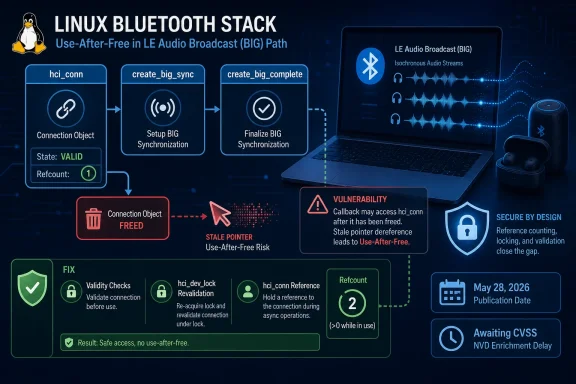 A Small Patch Exposes a Large Class of Kernel Risk
The immediate story is narrow. In the Linux kernel’s Bluetooth host controller interface connection code, an asynchronous path could keep working with a connection pointer after the object had gone stale or been freed. The vulnerable path involved create_big_sync, a function tied to Bluetooth LE Audio’s Broadcast Isochronous Group machinery, where the kernel coordinates synchronization around broadcast audio streams.The kernel fix adds a validity check before proceeding, re-validates the connection while holding the Bluetooth device lock, and takes a reference to the
hci_conn object across the asynchronous boundary. That is the right shape of a fix for this category of bug: do not merely hope the pointer is still alive, and do not confuse list membership with object lifetime. The patch treats lifetime and locking as separate duties, which is precisely the distinction that use-after-free bugs punish developers for blurring.Use-after-free vulnerabilities are not exotic in kernel land. They occur when code continues to access memory after the object that owned it has been released, potentially producing crashes, memory corruption, or exploitable behavior depending on timing and attacker control. In a subsystem like Bluetooth, where events arrive asynchronously from hardware, firmware, remote devices, and worker threads, the hardest bugs often live not in the visible feature logic but in the transitions: connect, disconnect, cancel, complete, error, retry.
That is why CVE-2026-46111 deserves attention even before NVD assigns a CVSS score. The absence of a score is not the absence of risk. It is a reminder that kernel vulnerability triage often begins with reading the patch, not the badge.
Bluetooth LE Audio Makes the Attack Surface More Complicated
The affected code sits near the kernel’s handling of Bluetooth BIG creation, part of the machinery behind broadcast isochronous streams. In plain English, this is the neighborhood of Bluetooth LE Audio where devices coordinate synchronized audio streams rather than traditional point-to-point audio links. That makes the bug more modern than the usual “Bluetooth keyboard and mouse” mental model many administrators still carry around.This does not automatically mean every Linux laptop with Bluetooth enabled is remotely exploitable. The public CVE text, as of publication, does not describe a working exploit, a privilege-escalation chain, or a remote attack recipe. It describes a bug in object lifetime management that could lead to a use-after-free when
create_big_complete() dereferences a connection pointer after error handling and connection deletion have done their damage.The distinction matters. Security teams should resist both extremes: dismissing the vulnerability because it lacks a score, or treating it as a confirmed wormable Bluetooth disaster. The sensible read is that this is a kernel memory-safety flaw in a wireless subsystem, fixed upstream and in stable branches, with practical impact depending on kernel version, distribution backports, Bluetooth hardware, enabled profiles, and exposure to untrusted nearby devices.
Bluetooth’s local-radio nature is often misunderstood. It is not Internet-scale remote exposure, but it is also not “local user only” in the normal sense. A vulnerability reachable through Bluetooth may sit in the uncomfortable middle: physical proximity is required, but the attacker need not have a shell account, browser session, or network foothold. In offices, airports, classrooms, labs, hospitals, factories, and conference halls, proximity is not a meaningful comfort blanket.
The Bug Is About Time, Not Just Memory
The CVE description is unusually helpful because it explains the concurrency model behind the fix. The kernel now checks whether the connection remains valid before BIG creation proceeds, handles-ECANCELED in the completion path, and re-validates the connection under hci_dev_lock() before dereferencing it. It also keeps the hci_conn object alive by taking a reference when the async job is queued and releasing it in the completion callback.That sequence tells us what went wrong. One part of the Bluetooth stack could queue work using a connection object, while another path could confirm connection failure and delete the same object. When the completion path later ran, it could still hold a raw pointer to something the kernel had already freed. The bug is not that a developer forgot a single null check; it is that the code crossed an asynchronous boundary without a proper lifetime guarantee.
The patch also clarifies why locking alone was not enough. Holding
hci_dev_lock() serializes access to the connection hash and protects list operations such as list_del_rcu(). Taking a reference keeps the object allocated while work is pending. Those two mechanisms solve different problems, and CVE-2026-46111 exists in the space between them.That is the kernel developer’s version of a classic distributed-systems failure. The connection looked valid at one moment, but the world changed before the callback ran. In user space, that might produce an exception. In kernel space, it can become memory corruption.
NVD’s “Awaiting Enrichment” Status Is a Workflow Problem for Defenders
NVD currently marks the record as awaiting enrichment, with no NIST CVSS v4.0, v3.x, or v2.0 score provided. That is normal for fresh kernel CVEs, but it is operationally awkward. Patch managers, vulnerability scanners, and executive dashboards are built around severity labels, and those labels often arrive after the people responsible for Linux fleets have already had to make a decision.The published date is May 28, 2026, and the source is kernel.org. The references point to stable kernel commits, which is a strong signal that the Linux stable process considers the fix important enough to backport. For administrators, the commit list is more useful than a missing score because it lets distributions map the fix into supported kernel packages.
This is where the Linux ecosystem remains both powerful and frustrating. The upstream fix may land in multiple stable series, but enterprise distributions rarely expose risk through upstream version numbers alone. Ubuntu, Debian, Fedora, Arch, SUSE, Red Hat derivatives, Android-based vendors, embedded Linux suppliers, and appliance makers may all carry patches differently. A kernel that appears “old” by version may be patched; a kernel that appears “new” may still be waiting on a vendor build.
For WindowsForum readers, the practical point is not that Windows is directly affected by this Linux CVE. It is that mixed estates now make Linux Bluetooth risk a Windows-adjacent problem. Developer workstations, WSL-adjacent workflows, dual-boot laptops, SteamOS handhelds, Linux-based kiosks, conference-room appliances, IoT gateways, NAS devices, and embedded controllers all live in environments administered by people who may otherwise think of themselves as Windows shops.
The Fix Shows Mature Kernel Engineering, Not Panic
The remediation is not dramatic. It does not rip out a feature, disable Bluetooth LE Audio, or introduce a sweeping redesign. It aligns this code path with patterns already used elsewhere in the Bluetooth stack, including completion paths that re-check connection validity under the appropriate lock.That is usually a good sign. The safest kernel security fixes often look boring because they extend an existing invariant rather than inventing a new one under pressure. Here, the invariant is straightforward: if asynchronous work may outlive the immediate caller, the object it uses must be kept alive, and its continued membership in connection structures must be checked before use.
The patch also makes a subtle choice about where to release the reference. It drops the final
hci_conn_put() outside the device lock so that any eventual object release does not run under hdev->lock. The CVE text notes that the release path would likely be safe either way, but the decision reflects defensive kernel hygiene. Avoiding unnecessary destructor work under a hot lock reduces the chance that today’s fix becomes tomorrow’s lock-ordering problem.That is the part of kernel security outsiders rarely see. A fix is not just about stopping the crash reproduced by a sanitizer trace. It is about restoring the intended ownership model without introducing deadlocks, regressions, or subtle performance costs in a subsystem that must handle cheap dongles, laptop radios, firmware oddities, and increasingly complex audio profiles.
The Exploitability Picture Is Still Incomplete
The public record does not yet establish a complete exploit scenario. We do not have a NIST vector, a vendor advisory describing active exploitation, or a reliable proof-of-concept in the CVE text. That should keep the tone measured.Still, use-after-free in kernel Bluetooth code is not a bug class defenders can ignore. Exploitability depends on whether an attacker can influence timing, object reuse, and data layout after the freed connection object becomes available. Kernel mitigations, allocator behavior, Bluetooth controller behavior, profile support, and device state all affect the answer.
A denial-of-service outcome is the easy case: a kernel crash, Bluetooth subsystem instability, or device hang is plausible for many UAF bugs even when code execution is not practical. A privilege escalation or remote code execution chain would require more conditions and more proof. The prudent stance is to treat the vulnerability as potentially serious in exposed systems while avoiding claims the public evidence does not support.
The risk also varies sharply by environment. A headless server with no Bluetooth hardware is not in the same category as a Linux laptop carried through airports. A managed workstation with Bluetooth disabled in firmware is not the same as a developer notebook using Bluetooth earbuds all day. A kiosk, industrial controller, or medical cart with an embedded Linux image and a forgotten Bluetooth radio may be riskier than its owner realizes.
Bluetooth Is Still Too Often Left Out of Patch Prioritization
Many organizations patch servers first, browsers second, VPNs third, and everything else when a maintenance window appears. Bluetooth tends to fall into that everything-else bucket. That made more sense when Bluetooth was mostly a convenience layer for mice, headsets, and file transfer; it makes less sense now that wireless peripherals, audio stacks, identity-adjacent devices, and proximity workflows are everywhere.The quiet danger is that Bluetooth is both common and unevenly inventoried. Asset databases often know CPU, OS, disk encryption, and EDR status. They may not know whether Bluetooth is enabled, whether the device has a controller exposed to the OS, which firmware package drives it, or which kernel profiles are compiled and reachable. That turns a targeted kernel Bluetooth CVE into a discovery exercise.
Linux complicates this further because many endpoints run kernels supplied by distribution vendors, cloud images, OEMs, or device manufacturers. The security fix may be available upstream, but that does not mean a given appliance vendor has shipped it. For embedded Linux devices, the difference between “fixed in stable” and “installed in the field” can be measured in quarters.
The correct response is not to rip Bluetooth out of every device. It is to stop treating Bluetooth as an accessory and start treating it as a network interface with peculiar range and pairing semantics. If it can receive untrusted input, it belongs in the exposure model.
Windows Shops Should Care Because Their Linux Footprint Is No Longer Marginal
It is tempting for a Windows-focused community to file CVE-2026-46111 under “interesting, but not my operating system.” That is increasingly wrong. Most Windows-centric organizations now operate Linux somewhere important: build runners, containers, hypervisors, storage appliances, network tools, developer laptops, security sensors, or line-of-business devices.The riskiest Linux systems are not always the obvious servers in the data center. A modern enterprise may have Linux inside meeting-room hardware, digital signage, lab equipment, thin clients, point-of-sale peripherals, smart displays, or network appliances. Those devices may ship with Bluetooth enabled for setup, diagnostics, audio, remote controls, or companion apps. They may also sit outside the normal endpoint patch workflow.
The Windows connection is also cultural. Microsoft’s own ecosystem has made Linux more normal for Windows administrators, from WSL to Azure images to cross-platform developer tooling. That has raised the baseline Linux literacy of Windows shops, but it has also expanded the number of places where Linux kernel vulnerabilities can matter to a team that does not think of itself as a Linux team.
For sysadmins, the action item is not philosophical. Find Linux systems with Bluetooth controllers, determine whether Bluetooth is enabled, identify the kernel package source, and check whether the relevant stable fix has been backported. If the answer is “we do not know,” that is already a finding.
The Right Mitigation Depends on Exposure, Not Fear
For most users, the best mitigation is simple: install the kernel updates from your distribution when they become available. Rolling distributions may receive stable commits quickly; enterprise distributions may publish advisories and backported packages under their own versioning schemes. The important thing is to track the vendor’s security channel rather than relying on upstream commit IDs alone.For high-risk environments, temporary hardening may be appropriate while waiting for packages. Disabling Bluetooth in firmware, through system policy, or by blocking the relevant kernel modules can reduce exposure when Bluetooth is not operationally required. On laptops and desktops where Bluetooth peripherals are essential, that mitigation may be disruptive, so the decision should be based on device role and threat model.
Security teams should also avoid a common trap: waiting for NVD enrichment before acting. CVSS is useful for normalization, but it is not a substitute for context. A low-scored Bluetooth issue may matter in a hospital ward full of Linux-based carts; a high-scored issue may be irrelevant to a rack of servers without radios.
The more mature approach is to combine three facts: whether the vulnerable code is present, whether Bluetooth is enabled and reachable, and whether the system is in a location where untrusted proximity is plausible. That tells a better story than a single number.
The Kernel’s Bluetooth Run of UAFs Is a Maintenance Signal
CVE-2026-46111 is not appearing in a vacuum. Recent Linux kernel Bluetooth advisories have included multiple use-after-free and race-condition fixes across connection handling, HCI events, management paths, and vendor driver interactions. Some are unrelated at the code level, but together they point to a subsystem under sustained concurrency pressure.That does not mean Linux Bluetooth is uniquely broken. Wireless stacks are difficult everywhere because they combine external input, hardware state machines, firmware behavior, asynchronous callbacks, and legacy compatibility. The Linux kernel’s advantage is that the fixes are public, reviewable, and often backported aggressively. Its disadvantage is that public fixes also reveal just how many edge cases exist.
The Bluetooth stack has evolved far beyond its early assumptions. LE Audio, broadcast audio, modern controllers, power management, suspend/resume, vendor firmware loading, and coexistence with Wi-Fi all add states and transitions. Each new feature increases the number of ways a connection can be started, canceled, deleted, or completed.
Memory-safe languages are often raised as the long-term answer to this class of bug, and they are part of the answer. But the specific lesson here is also architectural. Even in C, careful ownership rules, reference counting, and lock discipline can prevent stale pointer use. CVE-2026-46111 is a failure of those rules in one path, not proof that the entire subsystem is unrecoverable.
Patch Managers Need to Read Beyond the CVE Page
The NVD page is the public doorway, but the patch is where the meaning lives. The description tells administrators that the kernel now takes a reference withhci_conn_get() when queueing work and drops it in the completion callback. It also says the completion path now handles cancellation and re-checks validity under lock. Those details are enough to infer that the vulnerable path depends on timing between queued work and connection teardown.That inference should guide testing. After applying vendor kernels, teams with Linux Bluetooth exposure should validate not just that the system boots, but that Bluetooth still behaves correctly under connect, disconnect, suspend, resume, and audio-device workflows. Security patches in Bluetooth can interact with real hardware in messy ways, especially when vendor firmware or distribution-specific backports are involved.
This matters for desktop Linux users as well. In recent years, many users have experienced Bluetooth regressions after kernel or firmware updates, sometimes unrelated to security fixes. That creates a dangerous incentive to hold back kernels because “Bluetooth finally works.” CVE-2026-46111 is a reminder that staying on a known-good kernel has a cost when the old kernel contains memory-safety fixes.
The better operational pattern is to keep at least one fallback kernel installed while moving forward with security updates. That gives users and administrators a recovery path without normalizing permanent drift from patched builds.
The Practical Story Is Bigger Than One CVE
CVE-2026-46111 should push administrators to improve Bluetooth visibility. Not because this specific flaw is confirmed to be catastrophic, but because the next one may arrive with a score, an exploit, and a much shorter decision window. Wireless exposure is easiest to manage before the emergency.For consumers and enthusiasts, the calculus is straightforward. If your Linux distribution ships a kernel update that mentions this CVE or the relevant Bluetooth
hci_conn fix, take it. If you do not use Bluetooth, consider disabling it. If you rely on Bluetooth input devices, make sure you have a wired keyboard, USB receiver, or remote access path before experimenting with module blacklists or firmware toggles.For enterprises, the job is more procedural. Inventory Linux devices with Bluetooth. Separate servers with no radios from mobile endpoints and embedded appliances. Track distribution advisories. Test patched kernels on representative hardware. Decide where temporary Bluetooth disablement is acceptable.
The key is to treat Bluetooth as part of the platform security boundary. A Linux laptop’s Bluetooth controller is not a decorative feature; it is a radio-facing parser and state machine wired into the kernel.
The Patch Notes Tell Administrators Where to Look Next
The most useful lessons from CVE-2026-46111 are concrete, even while the severity score remains blank.- The vulnerability was published on May 28, 2026, and NVD had not yet assigned CVSS scores at the time of the record’s initial enrichment state.
- The bug affects Linux kernel Bluetooth
hci_connhandling aroundcreate_big_syncandcreate_big_complete, where asynchronous work could dereference a stale connection pointer. - The upstream fix combines validity checks, device-lock revalidation, and reference counting, which indicates a lifetime-management flaw rather than a simple input-validation bug.
- Systems without Bluetooth hardware or with Bluetooth disabled are less exposed, but embedded Linux devices and mobile workstations deserve special attention.
- Administrators should follow distribution kernel advisories and backports rather than assuming upstream version numbers alone prove whether a system is fixed.
- Temporary Bluetooth disablement is a reasonable mitigation only where it does not break required workflows or strand users without input devices.
References
- Primary source: NVD / Linux Kernel
Published: 2026-05-29T01:03:02-07:00
NVD - CVE-2026-46111
 nvd.nist.gov
- Security advisory: MSRC
Published: 2026-05-29T01:03:02-07:00
Original feed URL
Security Update Guide - Microsoft Security Response Center
 msrc.microsoft.com
- Related coverage: windowsforum.com
CVE-2026-43019 Linux Bluetooth Use-After-Free: Fixes, Risk, and Windows Estate Lessons | Windows Forum
CVE-2026-43019 is a high-severity Linux kernel Bluetooth vulnerability, published by NVD on May 1, 2026 and modified on May 8, involving a potential...windowsforum.com
