

A Bluetooth Bug That Is Really a Kernel Process Story
The short version of CVE-2026-43059 sounds almost quaint: a Linux Bluetooth management command handler mishandled a pending command list. That is the sort of subsystem-specific phrasing that makes many administrators mentally file the advisory under probably not my problem. Bluetooth, after all, is the thing users pair headphones with, not the thing most people associate with serious enterprise compromise.
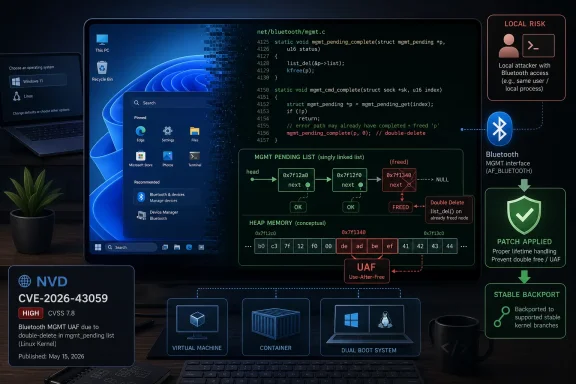
But the details point to a more consequential class of bug. The vulnerable code sits in the Linux kernel’s Bluetooth MGMT layer, which handles management commands and completion callbacks. A previous fix introduced mgmt_pending_valid(), a helper that did more than validate a pending command; it also removed that command from the pending list when valid. That semantic shift meant some later completion handlers were still behaving as though the command remained linked.
That mismatch matters because kernel linked lists are unforgiving. Remove the same node twice and you are no longer merely returning a bad status code; you are corrupting kernel data structures. Free the wrong pending command while concurrent work still expects it to exist and you have the classic use-after-free pattern: stale references, unpredictable behavior, and a possible path from reliability failure to security boundary failure.
NVD assigned the vulnerability a CVSS 3.1 base score of 7.8, with local attack vector, low attack complexity, low privileges required, no user interaction, and high impacts to confidentiality, integrity, and availability. In plain English, this is not a remote drive-by Bluetooth worm as described, but it is a kernel memory-safety vulnerability that a local low-privileged actor may be able to abuse on affected systems. That combination is exactly why “local” has become a less comforting word than it used to be.
The Fix That Changed the Rules
The vulnerability traces back to the aftermath of an earlier kernel change, commit 302a1f674c00, titled “Bluetooth: MGMT: Fix possible UAFs.” That earlier work introduced mgmt_pending_valid(), intended to reduce use-after-free hazards by validating the pending command and unlinking it from the pending list. The catch is that helper functions become dangerous when their side effects are not reflected everywhere they are called.
Two leftover code paths are at the center of CVE-2026-43059. In mgmt_add_adv_patterns_monitor_complete(), the success path still called mgmt_pending_remove() even though mgmt_pending_valid() had already unlinked the command. That created the double-removal scenario: a second list deletion against an object that was no longer in the list, leading to corruption and potential kernel panic.
The second issue lived in set_mesh_complete(). In its error path, the code used mgmt_pending_foreach() in a way that could sweep across other pending mesh commands. Because the current command had already been unlinked, the loop was no longer just cleaning up its own state; it could target other commands that were still being processed. That is where the use-after-free risk becomes more subtle and more alarming.
The patch response was surgical rather than sweeping. One path replaces mgmt_pending_remove() with mgmt_pending_free() after validation has already unlinked the command. Another removes the problematic foreach usage in the error path and simplifies redundant status reporting. That may sound trivial, but trivial-looking changes in kernel lifecycle code are often the difference between a safe cleanup path and a panic that takes down the machine.
“Local” Does Not Mean “Harmless” Anymore
The CVSS vector for CVE-2026-43059 is important because it helps separate hype from operational reality. The attack vector is local, not network. Privileges are required, but only low privileges. No user interaction is required. The scope is unchanged, but confidentiality, integrity, and availability are all rated high.
That profile tells defenders two things at once. First, this is not the sort of bug that should prompt panic about every nearby Bluetooth radio. Second, it is exactly the kind of flaw that matters in post-compromise scenarios, shared Linux systems, research machines, kiosks, multi-user developer hosts, and any environment where a low-privileged account is not supposed to become a kernel-level problem.
A local kernel bug also matters because attackers rarely use one vulnerability in isolation. A phishing email, stolen SSH credential, exposed development box, malicious package, or compromised build script can provide the initial foothold. Once local code execution exists, a kernel memory-safety flaw can become part of the escalation story.
For Windows-heavy shops, this is where the border gets blurry. The affected code is Linux kernel code, but the systems that run it may be managed by the same team that manages Windows clients. Developers may use Linux laptops, Linux virtual machines, WSL-adjacent workflows, container hosts, or dual-boot workstations. Security teams that treat Linux advisories as somebody else’s queue are increasingly betting against the shape of their own infrastructure.
The Affected Kernel Ranges Show the Patchwork Reality of Linux
The NVD configuration data lists multiple affected Linux kernel ranges and release candidates rather than a single neat version line. The affected configurations include kernels from 6.16.10 up to but not including 6.17, 6.17 itself, 6.17.1 up to but not including 6.18.20, 6.19 up to but not including 6.19.10, and 6.12.59 up to but not including 6.12.78. It also lists 6.6.140 up to but not including 6.7, along with 7.0 release candidates rc1 through rc4.
That jagged range is normal in the Linux world, but it is not friendly to administrators who want a single answer. Stable branches receive backports. Long-term support lines move differently. Distribution kernels often carry patches that do not correspond cleanly to upstream version numbers. A vulnerable-looking version string may already have a vendor backport, while a seemingly newer kernel may still need the relevant fix if it sits in the wrong window.
This is why CPE data is useful but insufficient. It describes upstream affected ranges, not every vendor’s final packaging state. Debian, Ubuntu, Red Hat, SUSE, Amazon Linux, Arch, Fedora, and appliance vendors each translate upstream kernel fixes into their own release streams. Administrators should verify the vendor advisory or package changelog rather than relying only on the first line of uname -r.
The four stable kernel patch references attached to the CVE also reflect the backporting model. A fix may appear under different commit IDs across stable branches because the same logical change has been adapted to different code bases. That is not evidence of confusion; it is how long-lived kernel maintenance works. It does, however, mean patch validation must be branch-aware.
Bluetooth Is Often Present Even When Nobody Thinks They Use It
One reason Bluetooth kernel vulnerabilities are easy to underweight is that Bluetooth feels optional. Many servers have no Bluetooth adapter. Many cloud instances expose no Bluetooth hardware. Many enterprise desktops have Bluetooth disabled by policy or effectively unused in practice. On those systems, practical exposure may be low.
But modern endpoint reality is messier. Laptops ship with Wi-Fi/Bluetooth combo modules. Developer workstations often leave Bluetooth enabled. Linux desktops, lab machines, point-of-sale devices, medical peripherals, industrial controllers, and embedded systems may all include Bluetooth support even when the feature is not central to the device’s mission. A kernel subsystem does not have to be fashionable to be reachable.
The advisory’s local vector also means the relevant question is not simply whether an attacker can beam packets at the machine from a parking lot. The question is whether untrusted local code can exercise Bluetooth management paths on an affected kernel. That depends on permissions, capabilities, device availability, distribution defaults, service configuration, and whether Bluetooth management sockets are exposed in the relevant context.
Security teams should resist the instinct to answer that question abstractly. On some hardened servers, the answer may be “no meaningful exposure.” On developer laptops or lab Linux machines, it may be different. On appliances, the answer may be opaque until the vendor says something. The right response is inventory and verification, not theater.
The Windows Angle Is Hybrid Infrastructure, Not Windows Panic
For a WindowsForum audience, the cleanest clarification is this: CVE-2026-43059 is not a Microsoft Windows kernel vulnerability. It does not imply that Windows 10, Windows 11, or Windows Server Bluetooth stacks are affected. It does not require Windows admins to hunt for a Microsoft KB patch for Bluetooth.
Yet Windows administrators increasingly own environments where Linux risk is Windows risk by adjacency. A compromised Linux jump box can be used to attack Active Directory. A vulnerable Linux CI runner can poison builds consumed by Windows endpoints. A developer laptop running Linux can hold VPN credentials, signing keys, browser sessions, source code, or cloud tokens that matter far beyond the local machine.
WSL deserves a careful mention here. WSL 2 uses a Microsoft-maintained Linux kernel, and its exposure to a specific upstream Linux kernel CVE depends on whether the vulnerable subsystem is present, reachable, and built into the shipped kernel configuration. Administrators should not assume WSL is affected solely because a Linux kernel CVE exists, but they also should not ignore WSL kernels as invisible. Microsoft ships and services that kernel separately from traditional distribution kernels, which makes version and configuration verification part of responsible endpoint management.
The broader lesson is that OS boundaries no longer map neatly to administrative boundaries. Windows shops run Linux in Hyper-V, Azure, Kubernetes nodes, build farms, security tools, storage appliances, and network devices. A Linux Bluetooth bug may be operationally irrelevant to many of those systems, but the process for deciding that has to exist.
Memory Safety Keeps Winning the Incident Calendar
The vulnerability class here is CWE-416, use after free. That label has become so common that it risks fading into wallpaper, but it remains one of the most dangerous families of systems bugs. A use-after-free condition appears when software continues to use memory after it has been released, creating an opening for crashes, stale data access, or carefully shaped exploitation.
In kernel space, the stakes are higher because the kernel arbitrates the machine. A browser use-after-free may be serious, but it often faces sandboxing, process isolation, and exploit mitigations layered above the operating system. A kernel use-after-free starts closer to the crown jewels, where a successful exploit can undermine process boundaries, tamper with memory, or destabilize the whole host.
CVE-2026-43059 is also a case study in the vulnerability lifecycle rather than just vulnerability discovery. The original change was meant to fix possible UAFs. The later CVE addresses leftover paths that did not adapt fully to the helper’s changed behavior. That makes it an example of the uncomfortable security truth that fixes can create new assumptions, and assumptions can become bugs.
This is not an indictment of the Linux kernel community in particular. Large systems evolve this way. When a helper function moves from passive validation to validation plus unlinking, the compiler will not necessarily tell every caller that the world changed. Human review, regression testing, static analysis, syzkaller-style fuzzing, and stable-tree discipline all become part of the safety net.
The CVE Factory Is Noisy, but This One Has a Signal
Since the Linux kernel became its own CVE Numbering Authority, the volume and cadence of kernel CVEs have felt different. Many issues that once might have lived primarily as commit messages now show up as named vulnerabilities with CVE IDs, NVD entries, distributor trackers, and vulnerability-management scanner findings. That shift has frustrated some administrators, especially when scanners light up on bugs that are obscure, unreachable, or already backported.
CVE-2026-43059 is the sort of entry that shows both sides of that debate. On one hand, the affected code path is specific, local, and tied to Bluetooth management completion handlers. Many systems will not present a realistic attack surface. On the other hand, it is a high-impact kernel memory-safety issue with a plausible low-privilege local profile, and it affects multiple kernel branches. That is not meaningless noise.
The right editorial stance is not to mock CVE inflation or to treat every kernel CVE as a five-alarm fire. It is to recognize that defenders need better triage language. A high CVSS score should trigger review, but not all review ends with emergency maintenance windows. Exposure, reachability, system role, compensating controls, and vendor patch state determine priority.
For Windows and mixed-platform administrators, this means vulnerability management tools need context. A scanner that reports “Linux kernel vulnerable” without branch, package, backport, subsystem, hardware, and exploitability context is starting a conversation, not ending one. The work is to turn that alert into a decision.
Patch Management Has to Follow the Branch, Not the Headline
The practical response begins with identifying affected systems. Administrators should inventory Linux kernels across endpoints, servers, virtual machines, appliances, lab boxes, and developer devices. For distribution-managed systems, the package manager’s kernel package version and vendor security advisory are more useful than the upstream version number alone.
If the system is on a rolling distribution, updating to the current kernel package is usually the clean path. If it is on a stable enterprise distribution, the fix may arrive as a backported patch without changing the upstream-looking version in an obvious way. If it is an appliance, the customer may have no meaningful remediation path until the vendor ships firmware or an OS update.
Disabling Bluetooth can reduce exposure where Bluetooth is unnecessary, but it should not be mistaken for a universal fix. It may be a reasonable mitigation for laptops, kiosks, and desktops awaiting maintenance windows. On servers, blacklisting modules or disabling Bluetooth services may already be standard hardening. But administrators still need to know whether the vulnerable code exists and whether local users can reach it.
Reboots matter too. Kernel fixes generally do not protect a running system until the patched kernel is booted, unless a live-patching mechanism covers the specific code path. Security teams that celebrate package installation without confirming active kernel versions have learned this lesson repeatedly. uname -r, package metadata, bootloader state, and reboot compliance all belong in the same workflow.
The Quiet Risk Is Concurrent Cleanup Code
The most technically revealing part of CVE-2026-43059 is not Bluetooth-specific at all. It is the collision between validation, unlinking, freeing, iteration, and concurrent processing. Kernel code spends enormous effort deciding who owns an object, when it may be removed from a list, when it may be freed, and who might still hold a reference.
The first issue, a double list_del()-style corruption scenario, is almost mechanical. If a helper already removed the item, another remove call is wrong. The second issue is more subtle because it involves an error path iterating over pending mesh commands and potentially freeing the wrong work. Error paths are where mature systems often hide their sharpest edges because they are harder to exercise consistently than success paths.
That is why fuzzing and fault injection have become so important in kernel security. Normal usage may never trigger the bad interleaving. A stress test, malicious sequence, or unusual hardware state can. Bugs in completion handlers and cleanup code often require the system to be doing several things at once, which is precisely when assumptions about ownership become brittle.
For developers, the lesson is to treat helper semantics as API contracts, even inside the same subsystem. If a function named like a predicate also mutates object state, its name and documentation need to make that obvious. Otherwise, each caller becomes a potential archaeology site for the next maintainer.
The Scanner Alert Needs a Human Interpreter
When CVE-2026-43059 appears in vulnerability dashboards, it will probably arrive as a high-severity Linux kernel finding. That is technically fair and operationally incomplete. A human still has to ask whether the system runs an affected kernel branch, whether the distributor has backported the fix, whether Bluetooth support is enabled, whether untrusted local users exist, and whether the system’s role justifies accelerated patching.
That human interpreter should also understand the difference between NVD publication and exploit reality. As of the advisory details supplied, the entry is based on resolved upstream kernel patches and NVD enrichment rather than a public exploit narrative. That does not make the vulnerability safe. It means defenders should prioritize based on exposure and asset value rather than rumor.
For corporate endpoints, the most likely path is routine kernel update acceleration, especially where Linux desktops or developer workstations are in scope. For servers without Bluetooth hardware or modules, the finding may be lower priority once verified. For shared Linux machines, research systems, lab hosts, and build infrastructure, local privilege escalation potential deserves more urgency.
The uncomfortable category is unmanaged Linux. Old dual-boot laptops, forgotten lab PCs, one-off appliances, and developer-installed distributions often sit outside standard Windows-centric patch processes. CVE-2026-43059 will not be the only kernel advisory they miss. It is simply another reminder that unmanaged systems are where “local only” bugs go to become real incidents.
What the Bluetooth MGMT Bug Tells Mixed-OS Shops to Do Next
CVE-2026-43059 does not require drama, but it does reward disciplined administration. The vulnerability is specific enough to triage and serious enough not to ignore. Its best use for defenders may be as a test of whether their Linux kernel patch process is real or merely assumed.
- Confirm whether any Linux systems in the estate run affected upstream kernel ranges or vendor packages that have not yet received the relevant Bluetooth MGMT fix.
- Treat distribution advisories and package changelogs as authoritative for backported enterprise kernels rather than relying only on the upstream version string.
- Prioritize developer workstations, shared Linux hosts, lab systems, and machines with local untrusted users ahead of isolated servers with no Bluetooth capability.
- Disable Bluetooth services or modules where the feature is unnecessary, but track that as mitigation rather than a substitute for patching.
- Verify that patched kernels are actually running after updates, because installed kernel packages do not protect systems still booted into older images.
- Include WSL, Linux virtual machines, dual-boot endpoints, and embedded appliances in the inventory conversation instead of treating them as exceptions to Windows fleet management.
The enduring lesson is that kernel security increasingly turns on small semantic contracts inside sprawling subsystems: one helper starts unlinking as well as validating, one caller keeps removing as before, and a maintenance patch becomes the next security advisory. For WindowsForum readers, CVE-2026-43059 is not a reason to fear Bluetooth on Windows, but it is a reason to sharpen mixed-platform hygiene, because the modern Windows environment often depends on Linux systems whose risks arrive through side doors rather than front-page alerts.
References
- CVE-2026-43059 Bluetooth: MGMT: Fix list corruption and UAF in command complete handlers NVD / Linux Kernel · 2026-06-10T01:05:35-07:00