

CVE-2026-53148 is a Linux kernel Thunderbolt vulnerability published on June 25, 2026, affecting the XDomain code path in
The immediate facts are narrow. The vulnerability is assigned to the Linux kernel, the affected file is the Thunderbolt XDomain implementation, and the issue is a bounds-checking failure in a response-handling routine. The vulnerable path derives a copy length from a response header without ensuring that the cumulative copy stays within the buffer allocated earlier for the declared data length.
That is a classic kernel-grade mistake: trusting a length field supplied by a peer, then feeding it into a memory copy primitive that assumes the caller has already done the hard thinking. In this case, the fix clamps the per-packet copy length so the accumulated offset cannot exceed the allocated data buffer. The patch is not conceptually exotic; it is the sort of defensive boundary check that looks obvious after the fact and remains painfully easy to miss in code that handles segmented protocol data.
The surprise for some WindowsForum readers will be the Microsoft wrapper around the advisory. Microsoft’s Security Update Guide has increasingly become a clearinghouse for vulnerabilities that matter to Microsoft customers, even when the vulnerable component is not “Windows” in the old, boxed-product sense. A Linux kernel CVE can become Microsoft-relevant through Azure infrastructure, Linux images, container hosts, Windows Subsystem for Linux workflows, developer machines, appliances, and the general sprawl of mixed operating systems inside enterprises that still consider themselves Windows shops.
That does not mean every Windows 11 laptop with a Thunderbolt port is suddenly exposed through Windows Update. It means the security boundary administrators must reason about has moved. If a Windows-centric organization runs Linux kernels anywhere near user hardware, virtualization stacks, build agents, lab systems, edge devices, or cloud workloads, a Linux Thunderbolt bug appearing in Microsoft’s ecosystem is not an editorial oddity. It is a map of how the estate actually works.
The CVE-2026-53148 flaw sits in XDomain handling. In Thunderbolt terminology, XDomain functionality is used for communication between host domains rather than only simple device attachment. That makes the word “peer” important. The issue is not described as a remote internet bug or a drive-by browser exploit; it is about a peer capable of sending crafted Thunderbolt XDomain response data.
The vulnerable routine,
Whether this becomes a crash, memory corruption, denial of service, or something more depends on surrounding context, mitigations, kernel configuration, hardware topology, and exploitability details that are not established by the advisory alone. The published record, at least at this stage, does not provide a CVSS score for CVE-2026-53148. That absence should not be mistaken for “low severity,” but it also should not be inflated into an unproven catastrophe.
Modern systems have also added important protections. IOMMUs, kernel DMA protection, firmware authorization levels, security modes, and operating-system policies have made today’s Thunderbolt landscape less reckless than the early years of external PCIe. But those defenses do not erase all risk, and they do not magically fix parser bugs in kernel protocol code. They reduce classes of DMA abuse; they do not prove every higher-level Thunderbolt message handler is memory-safe.
CVE-2026-53148 is especially useful as a reminder because it does not require us to imagine a Hollywood attack involving custom silicon and a race through a hotel lobby. The flaw is mundane: a length field is trusted too much. That mundanity is exactly why it matters. Peripheral security is not only about dramatic direct memory access; it is also about all the ordinary parsing, allocation, copying, and validation code required to make sophisticated external buses feel seamless.
For IT teams, this is where the practical line should be drawn. If Thunderbolt is not needed on a class of systems, disable or restrict it. If it is needed, enforce firmware and OS-level protections, keep kernels current, and treat docks and high-speed peripherals as part of the trusted hardware chain rather than as interchangeable office furniture.
The fix clamps the copy so that the cumulative offset never exceeds
The detail worth lingering on is
This is why memory-safe languages remain a live discussion in kernel and systems circles, but it is also why C code continues to demand extremely disciplined bounds checks. The issue here is not that the function used
For administrators, the version list is more useful as a warning than as a manual checklist. Most organizations should not be hand-applying upstream commit hashes to production systems unless they are kernel vendors or appliance builders. The safer operational path is to track the fixed kernel packages from the distribution, image provider, or appliance vendor responsible for the affected system.
The original fix landed in the kernel development stream and was then carried across stable branches. That is the normal kernel security pipeline, but it creates lag in the places users actually consume Linux: Ubuntu, Debian, Fedora, Red Hat, SUSE, Arch, container host images, embedded distributions, OEM recovery images, and cloud marketplace builds. A CVE can be “fixed upstream” while still waiting for the package that matters to your fleet.
This is one reason Microsoft’s publication of the issue is notable. Windows administrators often consume Linux indirectly, through vendors and platforms rather than through kernel.org. The advisory pushes the vulnerability into a venue watched by Microsoft customers, not only by Linux kernel specialists.
The practical question is not “Is this a Windows vulnerability?” It is “Where do Windows-administered organizations run affected Linux kernels with reachable Thunderbolt hardware or exposed XDomain paths?” In many environments, the answer may be “almost nowhere,” especially for headless cloud workloads without Thunderbolt controllers. In others, it may include engineering workstations, lab machines, mobile developer systems, and test benches that fall through the cracks of normal server patching.
WSL deserves a careful mention. WSL 2 uses a Microsoft-provided Linux kernel in a virtualized environment, and ordinary WSL users are not exposing a raw Thunderbolt controller to that kernel in the same way a native Linux laptop might. That makes CVE-2026-53148 unlikely to be a typical WSL desktop panic. But the broader lesson still applies: Microsoft-distributed or Microsoft-adjacent Linux kernels are now part of the Windows ecosystem’s security conversation.
Azure is similar. A cloud VM without Thunderbolt hardware is not the obvious target for a Thunderbolt XDomain peer issue. But cloud providers maintain Linux kernels, host images, device passthrough models, specialized hardware offerings, and edge-adjacent services. Microsoft tracking Linux CVEs is less about this one laptop-port bug turning into an Azure emergency and more about the reality that Microsoft’s customer estate is no longer neatly Windows-only.
The neighboring Thunderbolt CVEs disclosed around the same time include issues with clearer scoring in some databases, and it is tempting to let those numbers bleed into this one. Administrators should resist that. CVE-2026-53148 is described as an out-of-bounds write caused by a malicious peer manipulating response length fields. That is serious enough to patch, but the public record does not by itself establish internet-scale exploitability or a known active campaign.
The right posture is neither panic nor indifference. Treat it as a kernel memory corruption flaw in a high-speed peripheral subsystem that should be fixed through normal security channels. Prioritize systems where Thunderbolt is enabled, Linux is running on bare metal, and untrusted devices or hosts could plausibly interact with the machine.
This is also where procurement and configuration policy matter. If corporate laptops ship with Thunderbolt enabled because docking is convenient, then the organization has accepted a hardware attack surface. That decision can be perfectly reasonable. But it should be paired with BIOS settings, device authorization controls, kernel DMA protection, update discipline, and user guidance that reflect the risk.
That matters more for cross-ecosystem CVEs than for ordinary Windows cumulative updates. When Microsoft publishes a Windows vulnerability, the path is often direct: affected builds, update packages, mitigations, known issues, deployment guidance. When Microsoft surfaces a Linux kernel issue, the path may run through upstream kernel commits, downstream distributions, cloud images, OEM firmware settings, and hardware exposure. The advisory can alert you; it cannot inventory your environment.
There is also a naming trap. Seeing “Microsoft Knowledge Base” next to a Linux kernel CVE can lead readers in two wrong directions. Some will assume it is a Windows bug because Microsoft published it. Others will assume it is irrelevant because the assigner is Linux. The better reading is that Microsoft is acting as a vulnerability information broker for a customer base whose systems cross product boundaries.
That is the direction security operations has been moving for years. The operating system vendor is no longer the only meaningful source of exposure. Firmware, open-source libraries, package managers, drivers, cloud agents, container runtimes, hypervisors, and peripheral buses all complicate the patch story. CVE-2026-53148 is a small bug with a large lesson: asset management has to know what is actually running, not merely what logo is on the laptop lid.
A corporate Windows laptop fleet may be tightly controlled through Intune, Group Policy, firmware baselines, and Windows Update for Business, while the Linux workstations in engineering are managed by a mix of local admins, Ansible scripts, vendor images, and “please do not reboot this machine during the test run” exceptions. That unevenness is where vulnerabilities like this become operationally interesting.
Docks deserve attention too. In many offices, docks are shared infrastructure. They move between desks, get replaced without much recordkeeping, and are treated more like monitors than like active devices. Thunderbolt docks and high-speed adapters are part of the trust chain, particularly where device authorization is lax or where users can attach personal peripherals.
None of this means organizations should rip out Thunderbolt. The interface is too useful, and for many workflows it is non-negotiable. But IT should stop pretending that external high-speed I/O is just a convenience feature. It is a security-relevant subsystem, and Linux systems need the same policy seriousness that Windows systems receive.
That makes CVE-2026-53148 a supply-chain story in miniature. The fix may exist as a set of stable commits, but the organization’s exposure is resolved only when the relevant supplier ships, documents, and deploys the corrected kernel. For a laptop running a mainstream Linux distribution, that may be straightforward. For a lab appliance or a vendor-managed workstation image, it may require asking uncomfortable questions.
The same applies to security scanners. A scanner that keys only on version strings may miss a backported fix or flag a kernel that has already received the patch under an older-looking version number. Conversely, a clean dashboard may not cover unmanaged machines or live USB-style environments. Kernel CVE management has always required more nuance than comparing one semantic version against another.
Microsoft’s presence in the advisory chain reinforces that customers increasingly expect major vendors to help track vulnerabilities beyond their own proprietary code. That is a good thing. But it also creates a danger of over-centralized trust. Microsoft can list the issue; it cannot guarantee that every Linux image, every OEM build, every enterprise exception, and every lab workstation has absorbed the fix.
Bare-metal Linux laptops and workstations with Thunderbolt enabled are the highest-interest systems. Linux servers without Thunderbolt hardware are a different story. Virtualized Linux instances with no meaningful path to the Thunderbolt controller should not consume the same attention as an engineer’s mobile workstation that travels, docks, and attaches to unfamiliar hardware.
The vulnerability also pairs naturally with policy review. If Thunderbolt is enabled by default across Linux endpoints, ask why. If firmware settings permit broad device access before user login or without authorization, revisit them. If kernel updates are delayed because users control reboots indefinitely, this is another reminder that workstation patching is not a second-class discipline.
There is a broader cultural point here. Peripheral and driver vulnerabilities rarely generate the same public urgency as browser zero-days or ransomware-enabling server flaws, but they are part of the same attack surface conversation. The systems most valuable to attackers are often developer and administrator machines, and those machines are exactly where high-performance peripherals are common.
drivers/thunderbolt/xdomain.c, where a malicious peer can make the kernel copy more response data than the allocated buffer can safely hold. It is not, on its face, a Windows kernel bug, even though it appears in Microsoft’s Security Update Guide. That distinction matters because the real story is not just another memory-safety fix; it is how modern Windows estates now inherit risk from Linux, firmware, high-speed peripheral buses, and hybrid development stacks that administrators may not think of as part of their patch perimeter.
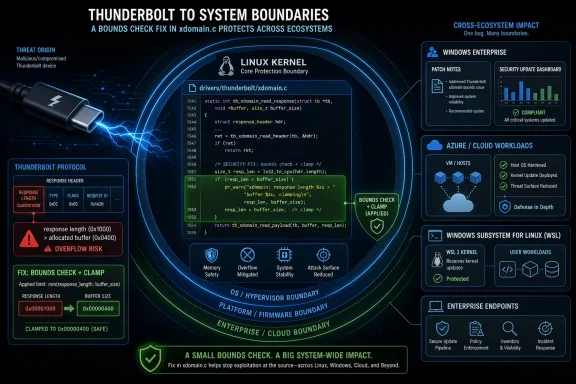 Microsoft’s Advisory Points at a Linux Bug, and That Is the Point
The immediate facts are narrow. The vulnerability is assigned to the Linux kernel, the affected file is the Thunderbolt XDomain implementation, and the issue is a bounds-checking failure in a response-handling routine. The vulnerable path derives a copy length from a response header without ensuring that the cumulative copy stays within the buffer allocated earlier for the declared data length.That is a classic kernel-grade mistake: trusting a length field supplied by a peer, then feeding it into a memory copy primitive that assumes the caller has already done the hard thinking. In this case, the fix clamps the per-packet copy length so the accumulated offset cannot exceed the allocated data buffer. The patch is not conceptually exotic; it is the sort of defensive boundary check that looks obvious after the fact and remains painfully easy to miss in code that handles segmented protocol data.
The surprise for some WindowsForum readers will be the Microsoft wrapper around the advisory. Microsoft’s Security Update Guide has increasingly become a clearinghouse for vulnerabilities that matter to Microsoft customers, even when the vulnerable component is not “Windows” in the old, boxed-product sense. A Linux kernel CVE can become Microsoft-relevant through Azure infrastructure, Linux images, container hosts, Windows Subsystem for Linux workflows, developer machines, appliances, and the general sprawl of mixed operating systems inside enterprises that still consider themselves Windows shops.
That does not mean every Windows 11 laptop with a Thunderbolt port is suddenly exposed through Windows Update. It means the security boundary administrators must reason about has moved. If a Windows-centric organization runs Linux kernels anywhere near user hardware, virtualization stacks, build agents, lab systems, edge devices, or cloud workloads, a Linux Thunderbolt bug appearing in Microsoft’s ecosystem is not an editorial oddity. It is a map of how the estate actually works.
The Bug Is Small, but the Trust Boundary Is Not
Thunderbolt has always been powerful precisely because it collapses distance between external devices and the system’s internal fabric. It can carry PCIe, DisplayPort, USB, networking, and other traffic through a connector users treat as ordinary. That combination has made Thunderbolt enormously useful for docks, storage, capture hardware, high-performance networking, and workstation setups, but it has also made it an unusually sensitive attack surface.The CVE-2026-53148 flaw sits in XDomain handling. In Thunderbolt terminology, XDomain functionality is used for communication between host domains rather than only simple device attachment. That makes the word “peer” important. The issue is not described as a remote internet bug or a drive-by browser exploit; it is about a peer capable of sending crafted Thunderbolt XDomain response data.
The vulnerable routine,
tb_xdp_properties_request(), allocates based on a declared response data length and then copies per-packet data based on a length taken from the response header. If the header length is larger than the data length that governed the allocation, the copy can run beyond the buffer returned by kcalloc. That is the kernel memory-safety failure in one sentence: the allocation and the copy are using different truths.Whether this becomes a crash, memory corruption, denial of service, or something more depends on surrounding context, mitigations, kernel configuration, hardware topology, and exploitability details that are not established by the advisory alone. The published record, at least at this stage, does not provide a CVSS score for CVE-2026-53148. That absence should not be mistaken for “low severity,” but it also should not be inflated into an unproven catastrophe.
Thunderbolt Security Has Always Been About Physical Proximity With Enterprise Consequences
The easiest mistake is to dismiss Thunderbolt vulnerabilities as requiring physical access and therefore being niche. Physical proximity is a constraint, but in corporate environments it is not a fantasy condition. Shared desks, conference-room docks, hot-desking setups, loaner hardware, labs, repair benches, classrooms, kiosks, and unattended workstations all create places where “plug in a device” is not a far-fetched action.Modern systems have also added important protections. IOMMUs, kernel DMA protection, firmware authorization levels, security modes, and operating-system policies have made today’s Thunderbolt landscape less reckless than the early years of external PCIe. But those defenses do not erase all risk, and they do not magically fix parser bugs in kernel protocol code. They reduce classes of DMA abuse; they do not prove every higher-level Thunderbolt message handler is memory-safe.
CVE-2026-53148 is especially useful as a reminder because it does not require us to imagine a Hollywood attack involving custom silicon and a race through a hotel lobby. The flaw is mundane: a length field is trusted too much. That mundanity is exactly why it matters. Peripheral security is not only about dramatic direct memory access; it is also about all the ordinary parsing, allocation, copying, and validation code required to make sophisticated external buses feel seamless.
For IT teams, this is where the practical line should be drawn. If Thunderbolt is not needed on a class of systems, disable or restrict it. If it is needed, enforce firmware and OS-level protections, keep kernels current, and treat docks and high-speed peripherals as part of the trusted hardware chain rather than as interchangeable office furniture.
The Kernel Fix Is a Case Study in Defensive Accounting
The patch pattern here is not glamorous, but it is central to secure systems programming. A response is not just a blob; it is a sequence of claimed lengths, actual packet sizes, offsets, and allocated buffers. The vulnerable logic allowed the per-packet copy length to be governed too heavily by a value from the response header, instead of by the remaining size of the buffer the kernel had actually allocated.The fix clamps the copy so that the cumulative offset never exceeds
data_len. In plain English, the kernel now asks a question it should always ask before copying: how much room is left? That is defensive accounting, and it is one of the most reliable ways to contain bugs in parsers that assemble data across multiple frames.The detail worth lingering on is
kcalloc. Because the buffer size was determined before the hostile length field was used for copying, the bug created a mismatch between allocation size and copy size. Kernel memory allocators do not forgive that kind of mismatch. A write past an allocation can corrupt adjacent metadata or objects, and even when mitigations turn the result into a controlled crash, the security model has already lost.This is why memory-safe languages remain a live discussion in kernel and systems circles, but it is also why C code continues to demand extremely disciplined bounds checks. The issue here is not that the function used
memcpy; memcpy does what it is told. The issue is that the code path failed to ensure the instruction it gave memcpy was constrained by the allocation that preceded it.The Affected Version Story Is Broader Than a Single Release
The published CVE metadata traces affected Linux kernel lines back to version 4.15 and lists fixed or unaffected points across long-term branches, including 5.10.259, 5.15.210, 6.1.176, 6.6.143, 6.12.94, 6.18.36, 7.0.13, and 7.1. That wide spread is not unusual for Linux kernel CVEs. It reflects the long life of kernel subsystems and the backport machinery that keeps enterprise and long-term-support kernels alive.For administrators, the version list is more useful as a warning than as a manual checklist. Most organizations should not be hand-applying upstream commit hashes to production systems unless they are kernel vendors or appliance builders. The safer operational path is to track the fixed kernel packages from the distribution, image provider, or appliance vendor responsible for the affected system.
The original fix landed in the kernel development stream and was then carried across stable branches. That is the normal kernel security pipeline, but it creates lag in the places users actually consume Linux: Ubuntu, Debian, Fedora, Red Hat, SUSE, Arch, container host images, embedded distributions, OEM recovery images, and cloud marketplace builds. A CVE can be “fixed upstream” while still waiting for the package that matters to your fleet.
This is one reason Microsoft’s publication of the issue is notable. Windows administrators often consume Linux indirectly, through vendors and platforms rather than through kernel.org. The advisory pushes the vulnerability into a venue watched by Microsoft customers, not only by Linux kernel specialists.
Windows Shops Now Own Linux Patch Hygiene Whether They Admit It or Not
A decade ago, a Linux Thunderbolt kernel CVE might have felt outside the lane of a Windows-oriented IT community. In 2026, that division is largely ceremonial. Windows environments routinely include Linux build servers, Linux containers, WSL developer workstations, Azure Linux workloads, Kubernetes nodes, security appliances, storage controllers, network tools, and developer laptops that dual-boot or run multiple operating systems.The practical question is not “Is this a Windows vulnerability?” It is “Where do Windows-administered organizations run affected Linux kernels with reachable Thunderbolt hardware or exposed XDomain paths?” In many environments, the answer may be “almost nowhere,” especially for headless cloud workloads without Thunderbolt controllers. In others, it may include engineering workstations, lab machines, mobile developer systems, and test benches that fall through the cracks of normal server patching.
WSL deserves a careful mention. WSL 2 uses a Microsoft-provided Linux kernel in a virtualized environment, and ordinary WSL users are not exposing a raw Thunderbolt controller to that kernel in the same way a native Linux laptop might. That makes CVE-2026-53148 unlikely to be a typical WSL desktop panic. But the broader lesson still applies: Microsoft-distributed or Microsoft-adjacent Linux kernels are now part of the Windows ecosystem’s security conversation.
Azure is similar. A cloud VM without Thunderbolt hardware is not the obvious target for a Thunderbolt XDomain peer issue. But cloud providers maintain Linux kernels, host images, device passthrough models, specialized hardware offerings, and edge-adjacent services. Microsoft tracking Linux CVEs is less about this one laptop-port bug turning into an Azure emergency and more about the reality that Microsoft’s customer estate is no longer neatly Windows-only.
The Missing CVSS Score Should Slow the Hype Machine
At publication, the available vulnerability record for CVE-2026-53148 does not list a CVSS score. That will frustrate dashboards, but it may be a blessing in disguise. CVSS is useful for triage, but it often becomes a substitute for thinking, especially for hardware-adjacent vulnerabilities whose exploitability depends on topology, access, configuration, and policy.The neighboring Thunderbolt CVEs disclosed around the same time include issues with clearer scoring in some databases, and it is tempting to let those numbers bleed into this one. Administrators should resist that. CVE-2026-53148 is described as an out-of-bounds write caused by a malicious peer manipulating response length fields. That is serious enough to patch, but the public record does not by itself establish internet-scale exploitability or a known active campaign.
The right posture is neither panic nor indifference. Treat it as a kernel memory corruption flaw in a high-speed peripheral subsystem that should be fixed through normal security channels. Prioritize systems where Thunderbolt is enabled, Linux is running on bare metal, and untrusted devices or hosts could plausibly interact with the machine.
This is also where procurement and configuration policy matter. If corporate laptops ship with Thunderbolt enabled because docking is convenient, then the organization has accepted a hardware attack surface. That decision can be perfectly reasonable. But it should be paired with BIOS settings, device authorization controls, kernel DMA protection, update discipline, and user guidance that reflect the risk.
The Microsoft Knowledge Base Disclaimer Is Boilerplate With a Message Between the Lines
The user-facing source text includes Microsoft’s familiar Knowledge Base disclaimer: information is provided “as is,” without warranties, and Microsoft disclaims liability for damages. It is tempting to ignore this as legal wallpaper. In security advisories, though, boilerplate has an operational subtext: the vendor is telling you that the advisory is not a substitute for your own risk assessment.That matters more for cross-ecosystem CVEs than for ordinary Windows cumulative updates. When Microsoft publishes a Windows vulnerability, the path is often direct: affected builds, update packages, mitigations, known issues, deployment guidance. When Microsoft surfaces a Linux kernel issue, the path may run through upstream kernel commits, downstream distributions, cloud images, OEM firmware settings, and hardware exposure. The advisory can alert you; it cannot inventory your environment.
There is also a naming trap. Seeing “Microsoft Knowledge Base” next to a Linux kernel CVE can lead readers in two wrong directions. Some will assume it is a Windows bug because Microsoft published it. Others will assume it is irrelevant because the assigner is Linux. The better reading is that Microsoft is acting as a vulnerability information broker for a customer base whose systems cross product boundaries.
That is the direction security operations has been moving for years. The operating system vendor is no longer the only meaningful source of exposure. Firmware, open-source libraries, package managers, drivers, cloud agents, container runtimes, hypervisors, and peripheral buses all complicate the patch story. CVE-2026-53148 is a small bug with a large lesson: asset management has to know what is actually running, not merely what logo is on the laptop lid.
The Real Exposure Lives in Workstations, Labs, and Forgotten Hosts
For most enterprises, the most plausible systems to inspect are not cloud servers but physical Linux machines with Thunderbolt enabled. Developer workstations, data-science laptops, creative-production rigs, hardware validation benches, and engineering lab systems are the obvious candidates. These are also exactly the systems that often sit outside the cleanest parts of endpoint management.A corporate Windows laptop fleet may be tightly controlled through Intune, Group Policy, firmware baselines, and Windows Update for Business, while the Linux workstations in engineering are managed by a mix of local admins, Ansible scripts, vendor images, and “please do not reboot this machine during the test run” exceptions. That unevenness is where vulnerabilities like this become operationally interesting.
Docks deserve attention too. In many offices, docks are shared infrastructure. They move between desks, get replaced without much recordkeeping, and are treated more like monitors than like active devices. Thunderbolt docks and high-speed adapters are part of the trust chain, particularly where device authorization is lax or where users can attach personal peripherals.
None of this means organizations should rip out Thunderbolt. The interface is too useful, and for many workflows it is non-negotiable. But IT should stop pretending that external high-speed I/O is just a convenience feature. It is a security-relevant subsystem, and Linux systems need the same policy seriousness that Windows systems receive.
This CVE Is Also a Supply-Chain Story
The Linux kernel is upstream, but few end users run upstream kernels exactly as released. They run distribution kernels, vendor kernels, cloud kernels, appliance kernels, Android-derived kernels, embedded kernels, or OEM-customized builds. Each layer can introduce delay, backport complexity, or uncertainty about whether a specific fix is present.That makes CVE-2026-53148 a supply-chain story in miniature. The fix may exist as a set of stable commits, but the organization’s exposure is resolved only when the relevant supplier ships, documents, and deploys the corrected kernel. For a laptop running a mainstream Linux distribution, that may be straightforward. For a lab appliance or a vendor-managed workstation image, it may require asking uncomfortable questions.
The same applies to security scanners. A scanner that keys only on version strings may miss a backported fix or flag a kernel that has already received the patch under an older-looking version number. Conversely, a clean dashboard may not cover unmanaged machines or live USB-style environments. Kernel CVE management has always required more nuance than comparing one semantic version against another.
Microsoft’s presence in the advisory chain reinforces that customers increasingly expect major vendors to help track vulnerabilities beyond their own proprietary code. That is a good thing. But it also creates a danger of over-centralized trust. Microsoft can list the issue; it cannot guarantee that every Linux image, every OEM build, every enterprise exception, and every lab workstation has absorbed the fix.
The Patch Priority Is Conditional, Not Optional
Security teams should resist the urge to place every new CVE into either “drop everything” or “ignore” buckets. CVE-2026-53148 belongs in a middle category that mature operations teams should understand well: patch promptly where exposure is plausible, track through normal channels where it is not, and avoid speculative emergency measures unless new exploit information appears.Bare-metal Linux laptops and workstations with Thunderbolt enabled are the highest-interest systems. Linux servers without Thunderbolt hardware are a different story. Virtualized Linux instances with no meaningful path to the Thunderbolt controller should not consume the same attention as an engineer’s mobile workstation that travels, docks, and attaches to unfamiliar hardware.
The vulnerability also pairs naturally with policy review. If Thunderbolt is enabled by default across Linux endpoints, ask why. If firmware settings permit broad device access before user login or without authorization, revisit them. If kernel updates are delayed because users control reboots indefinitely, this is another reminder that workstation patching is not a second-class discipline.
There is a broader cultural point here. Peripheral and driver vulnerabilities rarely generate the same public urgency as browser zero-days or ransomware-enabling server flaws, but they are part of the same attack surface conversation. The systems most valuable to attackers are often developer and administrator machines, and those machines are exactly where high-performance peripherals are common.
The Signal Hidden in One Thunderbolt Bounds Check
The concrete action from CVE-2026-53148 is simple enough: make sure affected Linux kernels receive the stable fixes supplied by the relevant distribution or vendor, especially on bare-metal systems where Thunderbolt is enabled. The more important action is to update the mental model of what belongs inside a Windows shop’s vulnerability program.- Organizations should treat CVE-2026-53148 as a Linux kernel Thunderbolt issue, not as a native Windows kernel flaw.
- Systems running Linux kernel versions in affected lines should be checked against distribution or vendor updates rather than judged solely by upstream version numbers.
- Bare-metal Linux endpoints with Thunderbolt enabled deserve higher priority than cloud or virtual systems with no plausible Thunderbolt exposure.
- Windows-centric IT teams should include WSL, Linux workstations, container hosts, and vendor-managed Linux appliances in their vulnerability inventory.
- Thunderbolt policy should be reviewed alongside patching, because disabling unused ports or tightening device authorization can reduce exposure beyond this one CVE.
- The lack of a published CVSS score should not delay patch planning, but it should temper claims that the bug is already a proven emergency.
References
- Primary source: MSRC
Published: 2026-06-28T02:05:41-07:00
Security Update Guide - Microsoft Security Response Center
 msrc.microsoft.com
- Related coverage: db.gcve.eu
Vulnerability-Lookup
Vulnerability-Lookup - Fast vulnerability lookup correlation from different sources.db.gcve.eu - Related coverage: code.googlesource.com
