

On May 20, 2026, CVE-2026-47784 was published for memcached versions before 1.6.42, describing a timing side channel in SASL password database authentication caused by the use of
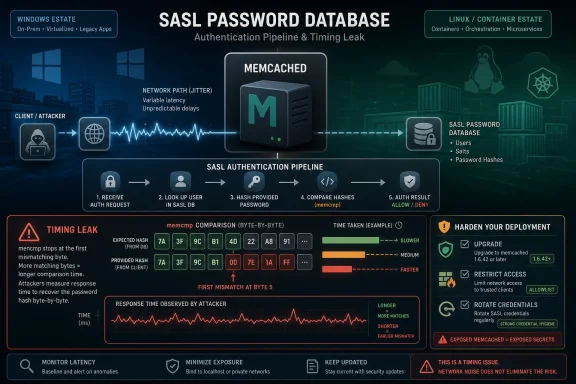
The vulnerability is straightforward enough to fit in a sentence: memcached compared submitted SASL password material in a way that could reveal how much of the secret matched before the comparison failed. That is the danger of
In ordinary programming, early exit is a feature. If two buffers differ at the first byte, returning immediately saves work. In password verification, early exit becomes a leak, because the time taken to reject an attempt can correlate with the number of leading bytes that were correct.
That does not mean every internet-facing memcached instance is instantly surrendering credentials. Timing attacks are noisy, statistical, and heavily dependent on network conditions, authentication configuration, and repeated measurements. But dismissing them as “theoretical” is how side channels survive for years in production systems.
The fix in memcached 1.6.42 matters because it closes a class of exposure, not just a single bug. Authentication routines should avoid comparisons whose runtime depends on attacker-controlled input. That principle is old, but CVE-2026-47784 shows how old lessons keep resurfacing in code paths that many teams rarely inspect.
The reason Windows administrators should still care is that Microsoft’s security tooling, cloud services, container images, developer workflows, and vulnerability management pipelines increasingly surface third-party CVEs alongside Microsoft-native ones. A vulnerability can enter a Windows shop through a Linux VM, a container image, a WSL-backed development environment, an appliance, a vendor bundle, or a cloud workload that no one thinks of as “Windows” until it breaks an internal application.
That is the modern asset-management trap. Security teams organize around vendors, operating systems, and patch cadences. Attackers organize around reachable services, credentials, and mistakes. CVE-2026-47784 sits squarely in that gap.
For WindowsForum readers, the practical question is not “Did Microsoft ship this bug?” It is “Do any of our systems, images, packages, or managed services run a vulnerable memcached build with SASL password database authentication enabled?” If the answer is unknown, the vulnerability has already done its first job: exposing an inventory blind spot.
But the attack complexity is also part of the story. Timing side channels are not usually one-packet miracles. They require repeated authentication attempts, careful measurement, and enough signal to separate real timing differences from network jitter, server load, rate limits, and logging noise.
That nuance is easy to lose when vulnerability scanners flatten everything into a red box. A remote unauthenticated timing leak against an authentication path deserves attention, but it should not be triaged as if it were interchangeable with a commodity remote-code-execution exploit already circulating in botnets. The operational response should be urgent, not panicked.
The best reading of the score is this: if an attacker can repeatedly reach the SASL authentication interface, and if the deployment uses the affected password database path, the vulnerability may enable credential recovery over time. Once credentials are recovered, the attacker’s options expand from probing to authenticating. That is where confidentiality and integrity concerns become much less abstract.
CVE-2026-47784 is fundamentally an authentication side channel. Its most important consequence is not that memcached falls over the moment someone pokes it. Its more dangerous consequence is that an attacker may be able to learn password material and then use legitimate authentication to interact with the cache.
Availability damage can follow from that. An authenticated attacker might flush data, poison cache contents, disrupt application behavior, or consume resources. In systems where memcached sits behind performance-critical web applications, “just the cache” can become a serious outage when session handling, rate limiting, feature flags, or database offload depend on it.
Still, security teams should avoid treating the availability paragraph as a generic denial-of-service advisory. The route to serious disruption may run through credential compromise. That makes log review, authentication monitoring, and exposure analysis just as important as the version check.
In many environments, memcached is not managed like a flagship database. It may have been installed years ago from distribution packages, baked into a container base image, bundled with a product, or deployed as an internal performance layer by an application team that no longer owns the service. The cache becomes invisible until an outage, audit, or CVE forces it back into view.
That invisibility creates two specific risks. First, administrators may not know whether SASL authentication is enabled or which authentication backend is used. Second, they may not know whether the vulnerable code path is reachable from networks where repeated timing measurements are feasible.
The uncomfortable truth is that a vulnerability like this is less about memcached itself than about the quality of the surrounding operations. A well-inventoried environment can identify affected versions, confirm authentication configuration, patch to 1.6.42 or later, and move on. A poorly inventoried one has to start by discovering whether memcached exists.
The harder part is proving coverage. On a single hand-built server,
Security teams should also confirm whether SASL password database authentication is actually in use. A vulnerable version without the exposed authentication mode may carry less immediate risk, but it is still technical debt. Configuration can change, images can be reused, and “not currently exploitable” has a way of becoming “accidentally exposed” during the next migration.
Network reachability is the other half of the proof. Memcached should not be casually exposed beyond trusted application tiers. If an attacker can repeatedly attempt authentication over a low-latency path, the timing side channel becomes more plausible. If access is tightly segmented, rate-limited, and monitored, exploitation becomes harder even before the patch lands.
That is why constant-time comparison routines exist. They are designed to ensure that checking a candidate secret takes the same amount of time regardless of where the first mismatch occurs. The goal is not philosophical purity; it is to deny the attacker a useful measuring stick.
The memcached flaw is a classic example of how secure code depends on using the right boring primitive in the right boring place. There is no grand cryptographic failure here. There is a standard library function doing exactly what it was designed to do, in a context where those semantics are dangerous.
For defenders, the lesson generalizes beyond memcached. Any authentication path that compares secrets, tokens, MACs, API keys, session identifiers, or password-derived values should avoid data-dependent timing. The software industry has learned this many times, which is another way of saying it has not learned it enough.
That is especially true for development and application platforms. WSL, Docker Desktop, Kubernetes clusters, Azure-hosted Linux VMs, and vendor-supplied containers can all bring Linux services into nominally Windows-centric organizations. The person responsible for endpoint compliance may never touch the memcached host, but the incident will still land in the same security queue.
This is where vulnerability management needs to become less brand-centric. If the security dashboard says CVE-2026-47784 exists somewhere in the estate, the right response is not to debate whether it belongs in a Microsoft feed. The right response is to map the affected workload, identify the owner, determine exposure, and patch or isolate it.
The CVE also reinforces an old rule about caches: do not treat them as disposable simply because their contents are transient. Caches often hold session data, authorization decisions, application objects, and operational hints that can be sensitive in aggregate. A compromised cache can be a shortcut around more carefully defended systems.
Logs deserve a look, particularly where SASL authentication failures are visible. Timing attacks may generate many failed attempts as an attacker tests candidate values. Not every burst of failures is an exploit attempt, and not every exploit attempt will be obvious, but authentication patterns around exposed cache services should not be ignored.
Rate limiting and network controls are useful compensating measures, though they are not substitutes for patching. Timing attacks need repetition. Anything that reduces unauthenticated reachability, slows repeated guesses, or restricts access to known application hosts helps reduce practical exploitability.
Credential rotation may be warranted where exposure is credible. If a vulnerable SASL password database was reachable from untrusted networks, simply patching the comparison routine does not prove the old secret was never inferred. The more exposed the service, the stronger the case for rotating credentials after the update.
That is not a criticism of memcached. It is the reality of shared infrastructure. Open-source projects sit at the bottom of enormous dependency trees, and even narrow flaws can force broad coordination when they touch authentication.
The most disciplined organizations will treat this as a quick hygiene event. They will upgrade, confirm configuration, document exposure, and close the ticket. Less disciplined organizations will discover that their scanner can name the CVE but not the owner of the host, the purpose of the service, or the blast radius of a cache credential.
That is the difference between patch management and security engineering. Patch management asks whether the vulnerable version is gone. Security engineering asks why a cache service was reachable, whether authentication was configured safely, whether credentials were reused, and whether monitoring would have caught a slow credential-recovery attempt.
That makes source attribution less useful than impact attribution. Whether a CVE originates in Microsoft code, an upstream open-source project, or a bundled dependency, the administrator’s problem is the same if the affected component is present and reachable. The scanner finding is not the answer; it is the beginning of an investigation.
For Microsoft-heavy environments, this is an argument for deeper software composition awareness. Defender, Intune, Azure, WSUS, and traditional Windows patch tools can only cover part of the estate. The rest requires container scanning, package inventory, configuration management, network mapping, and ownership metadata that does not collapse the moment the vulnerable thing is not an
CVE-2026-47784 is small enough to be manageable and subtle enough to be instructive. It turns a commonplace programming shortcut into a security boundary failure, then turns that boundary failure into an enterprise inventory test. The organizations that pass will barely remember the advisory a month from now; the ones that fail will be reminded, again, that modern Windows security is no longer confined to Windows.
memcmp inside sasl_server_userdb_checkpass. The bug is not a Windows vulnerability in the classic Patch Tuesday sense, but its appearance in Microsoft’s security ecosystem is a reminder that modern Windows estates are full of open-source infrastructure. The real story is not that memcached suddenly became exotic or fragile. It is that a tiny comparison function can turn authentication into a measurement problem, and measurement problems are exactly the kind administrators tend to underestimate.
 A Cache Server Learns the Oldest Lesson in Password Checking
The vulnerability is straightforward enough to fit in a sentence: memcached compared submitted SASL password material in a way that could reveal how much of the secret matched before the comparison failed. That is the danger of memcmp in authentication code. It is fast, familiar, and absolutely the wrong primitive when the timing of a mismatch can be observed by an attacker.In ordinary programming, early exit is a feature. If two buffers differ at the first byte, returning immediately saves work. In password verification, early exit becomes a leak, because the time taken to reject an attempt can correlate with the number of leading bytes that were correct.
That does not mean every internet-facing memcached instance is instantly surrendering credentials. Timing attacks are noisy, statistical, and heavily dependent on network conditions, authentication configuration, and repeated measurements. But dismissing them as “theoretical” is how side channels survive for years in production systems.
The fix in memcached 1.6.42 matters because it closes a class of exposure, not just a single bug. Authentication routines should avoid comparisons whose runtime depends on attacker-controlled input. That principle is old, but CVE-2026-47784 shows how old lessons keep resurfacing in code paths that many teams rarely inspect.
The Microsoft Angle Is About Inventory, Not Ownership
The source named by the user is Microsoft’s Security Update Guide, but memcached is not Microsoft Windows. That distinction matters. This is not a kernel bug, an Edge flaw, or a Windows Server role that can be remediated through the usual cumulative update rhythm.The reason Windows administrators should still care is that Microsoft’s security tooling, cloud services, container images, developer workflows, and vulnerability management pipelines increasingly surface third-party CVEs alongside Microsoft-native ones. A vulnerability can enter a Windows shop through a Linux VM, a container image, a WSL-backed development environment, an appliance, a vendor bundle, or a cloud workload that no one thinks of as “Windows” until it breaks an internal application.
That is the modern asset-management trap. Security teams organize around vendors, operating systems, and patch cadences. Attackers organize around reachable services, credentials, and mistakes. CVE-2026-47784 sits squarely in that gap.
For WindowsForum readers, the practical question is not “Did Microsoft ship this bug?” It is “Do any of our systems, images, packages, or managed services run a vulnerable memcached build with SASL password database authentication enabled?” If the answer is unknown, the vulnerability has already done its first job: exposing an inventory blind spot.
A High Score Does Not Mean a Simple Exploit
Public scoring for CVE-2026-47784 places it in high-severity territory, with network attack vector, no privileges required, no user interaction, and high potential impact to confidentiality, integrity, and availability. That sounds dramatic, and in the right deployment it is. Stolen cache credentials can become a pivot point into application state, session data, or service disruption.But the attack complexity is also part of the story. Timing side channels are not usually one-packet miracles. They require repeated authentication attempts, careful measurement, and enough signal to separate real timing differences from network jitter, server load, rate limits, and logging noise.
That nuance is easy to lose when vulnerability scanners flatten everything into a red box. A remote unauthenticated timing leak against an authentication path deserves attention, but it should not be triaged as if it were interchangeable with a commodity remote-code-execution exploit already circulating in botnets. The operational response should be urgent, not panicked.
The best reading of the score is this: if an attacker can repeatedly reach the SASL authentication interface, and if the deployment uses the affected password database path, the vulnerability may enable credential recovery over time. Once credentials are recovered, the attacker’s options expand from probing to authenticating. That is where confidentiality and integrity concerns become much less abstract.
Availability Is the Loud Impact, but Credential Exposure Is the Quiet One
The user-supplied description emphasizes severe availability loss: the attacker can deny access to resources in the impacted component, either while the attack continues or in a persistent way after it ends. That language maps to the availability dimension of vulnerability scoring, but it can be misleading if read as the whole story.CVE-2026-47784 is fundamentally an authentication side channel. Its most important consequence is not that memcached falls over the moment someone pokes it. Its more dangerous consequence is that an attacker may be able to learn password material and then use legitimate authentication to interact with the cache.
Availability damage can follow from that. An authenticated attacker might flush data, poison cache contents, disrupt application behavior, or consume resources. In systems where memcached sits behind performance-critical web applications, “just the cache” can become a serious outage when session handling, rate limiting, feature flags, or database offload depend on it.
Still, security teams should avoid treating the availability paragraph as a generic denial-of-service advisory. The route to serious disruption may run through credential compromise. That makes log review, authentication monitoring, and exposure analysis just as important as the version check.
Memcached Is Supposed to Be Boring, Which Is Why This Matters
Memcached’s value is its simplicity. It is a high-speed key-value cache, often deployed to do one job quietly for years. That boring reputation is exactly why flaws in it deserve scrutiny: infrastructure that no one thinks about can become infrastructure that no one updates.In many environments, memcached is not managed like a flagship database. It may have been installed years ago from distribution packages, baked into a container base image, bundled with a product, or deployed as an internal performance layer by an application team that no longer owns the service. The cache becomes invisible until an outage, audit, or CVE forces it back into view.
That invisibility creates two specific risks. First, administrators may not know whether SASL authentication is enabled or which authentication backend is used. Second, they may not know whether the vulnerable code path is reachable from networks where repeated timing measurements are feasible.
The uncomfortable truth is that a vulnerability like this is less about memcached itself than about the quality of the surrounding operations. A well-inventoried environment can identify affected versions, confirm authentication configuration, patch to 1.6.42 or later, and move on. A poorly inventoried one has to start by discovering whether memcached exists.
The Fix Is Simple; Proving You Applied It Is Not
The direct remediation is to upgrade memcached to 1.6.42 or later. That is the clean answer and the one administrators should prefer. If a vendor appliance, distribution repository, or managed image lags behind, teams should look for backported patches or vendor advisories that explicitly address the SASL password timing side channel.The harder part is proving coverage. On a single hand-built server,
memcached -h or the package manager may be enough. Across an enterprise, the vulnerable component might exist in containers, Kubernetes clusters, cloud images, developer workstations, CI runners, or embedded third-party products.Security teams should also confirm whether SASL password database authentication is actually in use. A vulnerable version without the exposed authentication mode may carry less immediate risk, but it is still technical debt. Configuration can change, images can be reused, and “not currently exploitable” has a way of becoming “accidentally exposed” during the next migration.
Network reachability is the other half of the proof. Memcached should not be casually exposed beyond trusted application tiers. If an attacker can repeatedly attempt authentication over a low-latency path, the timing side channel becomes more plausible. If access is tightly segmented, rate-limited, and monitored, exploitation becomes harder even before the patch lands.
Side Channels Punish Comfortable Assumptions
Timing vulnerabilities are frustrating because they violate a common mental model of security. The password is never printed, the hash is not dumped, and the server does not return a helpful error message. The leak lives in behavior.That is why constant-time comparison routines exist. They are designed to ensure that checking a candidate secret takes the same amount of time regardless of where the first mismatch occurs. The goal is not philosophical purity; it is to deny the attacker a useful measuring stick.
The memcached flaw is a classic example of how secure code depends on using the right boring primitive in the right boring place. There is no grand cryptographic failure here. There is a standard library function doing exactly what it was designed to do, in a context where those semantics are dangerous.
For defenders, the lesson generalizes beyond memcached. Any authentication path that compares secrets, tokens, MACs, API keys, session identifiers, or password-derived values should avoid data-dependent timing. The software industry has learned this many times, which is another way of saying it has not learned it enough.
Windows Shops Should Hunt the Linux Problem in Their Own House
The Windows relevance becomes clearest in hybrid environments. A company may run Windows desktops, Active Directory, Microsoft Defender, Intune, Azure services, and Windows Server workloads, while also depending on Linux-based cache tiers and open-source packages. The administrative culture may be Windows-first, but the attack surface is not.That is especially true for development and application platforms. WSL, Docker Desktop, Kubernetes clusters, Azure-hosted Linux VMs, and vendor-supplied containers can all bring Linux services into nominally Windows-centric organizations. The person responsible for endpoint compliance may never touch the memcached host, but the incident will still land in the same security queue.
This is where vulnerability management needs to become less brand-centric. If the security dashboard says CVE-2026-47784 exists somewhere in the estate, the right response is not to debate whether it belongs in a Microsoft feed. The right response is to map the affected workload, identify the owner, determine exposure, and patch or isolate it.
The CVE also reinforces an old rule about caches: do not treat them as disposable simply because their contents are transient. Caches often hold session data, authorization decisions, application objects, and operational hints that can be sensitive in aggregate. A compromised cache can be a shortcut around more carefully defended systems.
The Patch Queue Needs More Than a Version Number
A mature response to CVE-2026-47784 starts with version discovery but should not end there. Administrators need to know where memcached is running, how it authenticates clients, who can reach it, and what applications depend on it. Those questions are operational, not merely technical.Logs deserve a look, particularly where SASL authentication failures are visible. Timing attacks may generate many failed attempts as an attacker tests candidate values. Not every burst of failures is an exploit attempt, and not every exploit attempt will be obvious, but authentication patterns around exposed cache services should not be ignored.
Rate limiting and network controls are useful compensating measures, though they are not substitutes for patching. Timing attacks need repetition. Anything that reduces unauthenticated reachability, slows repeated guesses, or restricts access to known application hosts helps reduce practical exploitability.
Credential rotation may be warranted where exposure is credible. If a vulnerable SASL password database was reachable from untrusted networks, simply patching the comparison routine does not prove the old secret was never inferred. The more exposed the service, the stronger the case for rotating credentials after the update.
The Smallest Code Smell Becomes a Fleet Problem
One reason CVE-2026-47784 is worth more attention than its terse description suggests is that it scales badly across modern software supply chains. A one-line comparison bug in an upstream project becomes an advisory in vulnerability databases, a scanner finding in enterprise dashboards, a vendor support ticket, and a weekend maintenance window for teams that barely remember deploying the component.That is not a criticism of memcached. It is the reality of shared infrastructure. Open-source projects sit at the bottom of enormous dependency trees, and even narrow flaws can force broad coordination when they touch authentication.
The most disciplined organizations will treat this as a quick hygiene event. They will upgrade, confirm configuration, document exposure, and close the ticket. Less disciplined organizations will discover that their scanner can name the CVE but not the owner of the host, the purpose of the service, or the blast radius of a cache credential.
That is the difference between patch management and security engineering. Patch management asks whether the vulnerable version is gone. Security engineering asks why a cache service was reachable, whether authentication was configured safely, whether credentials were reused, and whether monitoring would have caught a slow credential-recovery attempt.
The Real Checklist Hiding Inside CVE-2026-47784
The practical response is compact, but it cuts across teams. This is not a vulnerability that should produce a month-long crisis. It should produce a clean inventory exercise, a controlled update, and a few uncomfortable conversations about service exposure.- Upgrade memcached deployments to version 1.6.42 or later, or apply a vendor-confirmed backport that fixes the SASL password timing side channel.
- Identify whether SASL password database authentication is enabled, because the vulnerable code path is tied to that authentication mechanism.
- Restrict memcached reachability to trusted application hosts and management networks rather than allowing broad internal or external access.
- Review authentication failure patterns for signs of repeated measurement attempts against SASL-protected services.
- Rotate cache authentication credentials where the vulnerable service was reachable from untrusted or poorly controlled networks.
- Update asset records so future third-party infrastructure CVEs can be routed to the correct owner without a forensic scavenger hunt.
Microsoft’s Security Feeds Are Becoming a Map of Everyone Else’s Code
There is a broader lesson in seeing a memcached advisory through a Microsoft channel. The boundaries that once made vulnerability management tidy are gone. Windows administrators now inherit risk from npm packages, Linux daemons, container layers, firmware components, browser engines, identity providers, and cloud services that blur the line between first-party and third-party responsibility.That makes source attribution less useful than impact attribution. Whether a CVE originates in Microsoft code, an upstream open-source project, or a bundled dependency, the administrator’s problem is the same if the affected component is present and reachable. The scanner finding is not the answer; it is the beginning of an investigation.
For Microsoft-heavy environments, this is an argument for deeper software composition awareness. Defender, Intune, Azure, WSUS, and traditional Windows patch tools can only cover part of the estate. The rest requires container scanning, package inventory, configuration management, network mapping, and ownership metadata that does not collapse the moment the vulnerable thing is not an
.exe.CVE-2026-47784 is small enough to be manageable and subtle enough to be instructive. It turns a commonplace programming shortcut into a security boundary failure, then turns that boundary failure into an enterprise inventory test. The organizations that pass will barely remember the advisory a month from now; the ones that fail will be reminded, again, that modern Windows security is no longer confined to Windows.
References
- Primary source: MSRC
Published: 2026-05-21T01:01:53-07:00
Security Update Guide - Microsoft Security Response Center
 msrc.microsoft.com
- Related coverage: sentinelone.com
CVE-2026-47784: memcached Timing Side Channel Vulnerability
CVE-2026-47784 is a timing side channel vulnerability in memcached. Learn about its impact, affected versions, and mitigation methods.www.sentinelone.com
- Related coverage: ubuntu.com

CVE search results | Ubuntu
Ubuntu is an open source software operating system that runs from the desktop, to the cloud, to all your internet connected things.
ubuntu.com
- Related coverage: memcached.org

- Related coverage: 2mci.com.mx
Vulnerabilidad de timing side-channel en memcached anterior a 1.6.42 permite enumerar usuarios SASL — 2M Cyber Insight
Memcached versiones anteriores a 1.6.42 contienen una vulnerabilidad de canal auxiliar de tiempo en la autenticación SASL que permite a atacantes enumerar nombrwww.2mci.com.mx - Related coverage: eosl.date
Memcached End of Life (EOL) Dates and End of Support (EOS) Dates | 1.6.42 - May 2026 Release
Memcached end of life dates across 3 release cycles. Memcached 1.6.42 is the latest supported version (May 2026). 1.5 reached EOL on 2020-03-09. Covers EOL, EOS and EOSL dates.eosl.date
- Related coverage: public.dhe.ibm.com
