

Microsoft published CVE-2026-47783 on May 21, 2026, for a memcached timing side-channel flaw fixed upstream in version 1.6.42 and reflected in Microsoft’s Azure Linux 3.0 package update from azl3 memcached 1.6.27-4 to 1.6.27-5. The bug is not a Windows desktop crisis, and that is precisely why it matters to WindowsForum readers. Modern Microsoft estates are no longer bounded by Windows clients and domain controllers; they are hybrid stacks where Linux packages, cloud base images, caches, identity paths, and application dependencies quietly define the blast radius. This CVE is a reminder that the boring layer is often where the real operational risk lives.
The vulnerability sits in memcached’s SASL password database authentication path. In affected versions before 1.6.42, the relevant username-checking loop exits as soon as it finds a valid username, rather than taking a uniform amount of time regardless of whether the submitted name exists. That creates a timing side channel: an attacker does not need the password to learn something useful; they only need to measure how the service behaves.
Timing bugs are easy to underestimate because they sound academic. They do not arrive with the cinematic clarity of remote code execution, ransomware detonation, or a kernel panic. They are attacks against difference — a few milliseconds here, a shorter path there, a response that says too much without ever saying it explicitly.
In this case, the leaked information is username validity for deployments using SASL password database authentication. That sounds small until you remember how credential attacks actually work. Enumerating valid names reduces guesswork, makes password spraying more efficient, helps tune phishing, and gives attackers a map of the authentication surface before they ever touch a privileged account.
The CVSS score attached to the issue is 8.1, high severity, with network attack vector, no privileges required, no user interaction, and high impacts listed for confidentiality, integrity, and availability. Yet the attack complexity is also marked high, and that is the tension administrators should pay attention to. This is not a push-button catastrophe for every memcached instance on earth, but it is serious enough that the default answer should be patching rather than debating whether a stopwatch can really become an exploit.
The affected Microsoft-tracked product entry is Azure Linux 3.0, where the memcached package moves from azl3 memcached 1.6.27-4 to fixed build 1.6.27-5. That distinction matters. Microsoft is not saying that Windows 11 or Windows Server contains a vulnerable memcached daemon; it is telling customers that a Microsoft-supported Linux distribution package needed a security update.
That is now a normal part of Microsoft security operations. The company’s patch surface includes Windows, Office, Edge, Azure services, developer tooling, Linux packages, container images, and open-source components that customers consume through Microsoft channels. The Security Update Guide increasingly functions less like a Windows bulletin board and more like a catalog of obligations across the Microsoft platform.
For enterprises, that means “we patched Windows” is no longer a complete sentence. A Microsoft estate might include Windows endpoints, Entra identity, Azure Kubernetes Service, Azure Linux images, SQL back ends, Redis or memcached caches, GitHub-hosted pipelines, and dozens of application libraries pulled from upstream communities. A CVE like this lands in the spaces between those boxes.
That is also why the memcached version numbers can look confusing at first glance. Upstream fixed the issue in memcached 1.6.42, while Microsoft’s Azure Linux package line references a distribution build based on 1.6.27 with a patched package revision. Distribution maintainers often backport security fixes rather than jump wholesale to a newer upstream release. Administrators should therefore verify the fixed package build for their distribution, not assume that only a literal upstream version string proves safety.
But CVSS is a scoring language, not an incident report. It expresses the theoretical consequences of successful exploitation under the defined conditions, not proof that every exposed memcached instance can be knocked offline trivially by anyone with a laptop. The same vector also lists high attack complexity, which is the scoring system’s way of saying the attacker faces meaningful practical hurdles.
Those hurdles are important in timing side-channel attacks. Network jitter, load variation, authentication throttling, TLS termination, proxy behavior, and noisy shared infrastructure can all blur the signal. An attacker may need repeated measurements, careful statistical handling, and a target configuration that exposes the vulnerable path clearly enough to distinguish valid usernames from invalid ones.
Still, defenders should resist the opposite mistake: dismissing the bug because timing attacks sound fussy. Attackers do not need perfection if they can make repeated attempts cheaply. In cloud environments, “high complexity” can sometimes be reduced by automation, proximity, patience, and scale.
The more useful reading is this: the vulnerability leaks authentication metadata, and that leakage can contribute to larger attacks against the service and the applications depending on it. Availability matters because memcached often sits on a hot path. If cache authentication becomes a foothold for abuse, lockout, saturation, or targeted disruption, the damage is measured not in elegance but in customer-facing failure.
That same simplicity can make it fade from security review. Teams may know where their databases are, where their identity provider lives, and where their public web tier terminates TLS. The cache layer is often treated as internal plumbing — a thing the application “just uses” until it becomes slow, empty, poisoned, exposed, or unavailable.
In many architectures, a cache outage is not merely a performance problem. If the cache absorbs traffic that the database cannot handle directly, losing it can trigger a thundering herd. If session data, rate-limit counters, feature flags, or computed authorization hints depend on cache semantics, a disruption can become an application correctness problem.
That is what makes availability language around a cache server especially uncomfortable. A denial of service against memcached may not sound as dramatic as taking down a database, but in a real production stack the two can be closely linked. A cache-layer failure can amplify load elsewhere and turn a small weakness into a broad service event.
For WindowsForum’s sysadmin audience, the lesson is not “panic about memcached.” It is “inventory the non-Windows components your Windows-adjacent workloads depend on.” A line-of-business application accessed from Windows desktops may fail because a Linux cache node in Azure was never patched, and users will still call the help desk as if Windows broke.
But “configuration-dependent” is not the same as “rare enough to ignore.” SASL exists because administrators wanted authentication in contexts where unauthenticated memcached access would be unacceptable. In other words, the affected deployments are likely to be the ones whose operators already recognized that access control mattered.
That irony is common in security engineering. A hardening feature introduces a new attack surface. The presence of authentication becomes the condition under which username enumeration is possible.
The fix is not to avoid authentication. It is to implement authentication in ways that do not reveal secrets through behavior. Username checks, password comparisons, token validation, and cryptographic operations should be designed so that failure paths do not produce measurable clues that help an attacker distinguish “wrong password for a real user” from “nonexistent account.”
That principle has been known for decades, but code bases accumulate shortcuts. Loops exit early because early exit is efficient. String comparisons stop at the first mismatch because that is what fast comparison routines do. Most of the time nobody notices, until the code moves into an authentication path where speed becomes a side channel.
The harder part is proving that every copy of memcached has been accounted for. In 2026, the vulnerable daemon may live in a VM, a container image, a Kubernetes workload, an appliance-like marketplace image, a developer environment, a CI test stack, or a forgotten internal service still relied upon by a production application. The package database on one host is not the estate.
Container users should be especially careful. Updating the base image does not update already-built application images unless they are rebuilt and redeployed. Updating a node does not patch a container that carries its own vulnerable userland. Updating a repository does not help if a running workload is pinned to an old digest.
The same applies to golden images and templates. If an Azure Linux image used for autoscaling still contains an old memcached package, patched instances may quietly be replaced by newly vulnerable ones during scale-out, disaster recovery testing, or redeployment. Vulnerability management has to chase the source of redeployment, not only the current live node.
This is where Windows-oriented operations teams can get blindsided. They may have mature WSUS, Intune, Configuration Manager, or Windows Update for Business processes, but a much looser model for Linux packages and container rebuilds. The Microsoft logo on the advisory does not mean the remediation will flow through familiar Windows patch channels.
A valid username list improves password spraying because it reduces failed attempts against nonexistent accounts. It sharpens brute-force attempts in environments without strong throttling. It helps attackers decide which names are worth targeting through other channels. It can also reveal naming conventions, service accounts, test accounts, or application-specific identities that would otherwise remain hidden.
In a memcached SASL context, the danger depends heavily on how the cache is exposed and used. A private cache reachable only from a tightly controlled subnet is a different risk from a service reachable across broader internal networks or, worse, the public internet. But internal reachability is not a magic shield. Many real intrusions begin with one compromised workload and then move laterally toward services that were assumed to be “internal only.”
There is also a cultural problem in how teams discuss these bugs. If a vulnerability does not dump data in one step, it is called “only enumeration.” If it does not execute code, it is called “only a side channel.” If it requires repeated measurement, it is called “only theoretical.” Those words may be individually defensible, but together they can become a lullaby.
The better framing is chainability. CVE-2026-47783 may be most useful as a component in a chain: enumerate valid SASL users, focus credential attacks, abuse weak passwords or exposed automation secrets, disrupt cache access, and then pressure the application tier. Defenders should patch it because chains are how many real compromises work.
This point should sound familiar because memcached has history here. The service has repeatedly appeared in discussions of large-scale abuse when exposed instances were misconfigured. Even when a specific CVE is narrow, the operational pattern is broad: a fast, simple network service becomes dangerous when placed somewhere it was never meant to be.
For Azure and hybrid administrators, this means reviewing network security groups, private endpoints or private networking choices, Kubernetes network policies, host firewalls, and service mesh rules. The goal is to make the authentication endpoint reachable only by clients that have a legitimate reason to talk to it. If an attacker cannot send repeated authentication attempts, the timing side channel has little room to breathe.
Monitoring also matters. A timing attack often needs repetition. Logs showing large numbers of failed SASL authentication attempts, username variation, unusual source addresses, or low-and-slow probing patterns should be treated as meaningful, even if no successful login follows.
Rate limiting and account lockout policies can help, but they must be used carefully. A lockout mechanism that can be triggered remotely may itself become a denial-of-service tool. For service-to-service authentication, defenders often need throttling, alerting, source restrictions, and credential hygiene rather than user-style lockout alone.
Azure Linux, formerly tied to the CBL-Mariner lineage, is used as a Microsoft-maintained Linux distribution for cloud and edge scenarios. When its packages receive security fixes, those updates may affect container hosts, appliances, internal services, and workloads that administrators do not mentally file under “Microsoft patches.” The result is a responsibility gap.
That gap is organizational as much as technical. Windows teams may own endpoints and servers; cloud platform teams may own Kubernetes; application teams may own containers; security teams may own scanners; vendors may own managed images. A memcached package inside Azure Linux can cut across all of them.
The fix is not to make every Windows admin a Linux maintainer overnight. It is to build asset and dependency visibility that reflects how systems actually run. If a business service depends on Azure Linux packages, that dependency belongs in patch reporting and incident response playbooks.
The most mature shops already think this way. They treat operating systems, base images, package repositories, runtime libraries, and application dependencies as one patch surface. Everyone else is learning under pressure, one CVE at a time.
The key questions are concrete. Is memcached installed? Is SASL password database authentication enabled? Which package build is running? Is the service reachable over the network, and from where? Are failed authentication attempts logged and monitored? Are credentials unique and rotated? Are containers or images carrying older packages?
Those questions will do more for risk reduction than arguing over whether high attack complexity should push the patch down the queue. High complexity often matters less when the target is stable, reachable, and valuable. Attackers can afford patience when defenders leave a measurable oracle online.
At the same time, security teams should avoid overstating the case to application owners. This is not evidence that every memcached deployment is actively being exploited. It is not a claim that username enumeration alone equals full compromise. Overstatement burns credibility, and credibility is needed when the next patch window has to be defended.
The right message is sober: the affected authentication path leaks information through timing, a fixed release exists, Microsoft has shipped a fixed Azure Linux package, and exposed or high-value deployments should move promptly. That is enough.
Start with exposure. Every memcached listener should have a documented reason to exist and a documented set of clients allowed to reach it. Anything broader than that should be treated as technical debt.
Then review authentication and credentials. Service credentials should not be shared across environments, embedded in long-lived images without rotation, or reused by multiple applications with different risk profiles. If a timing issue can reveal a valid username, the next question is whether that username protects anything meaningful.
Finally, test failure behavior. If memcached disappears, does the application degrade gracefully, stampede the database, or collapse? Availability impact is not only about whether an attacker can touch the cache. It is about whether the rest of the system can survive when the cache stops behaving as expected.
This is where security and reliability meet. A cache service can be both a confidentiality concern and a resilience dependency. Treating it as either one alone misses half the problem.
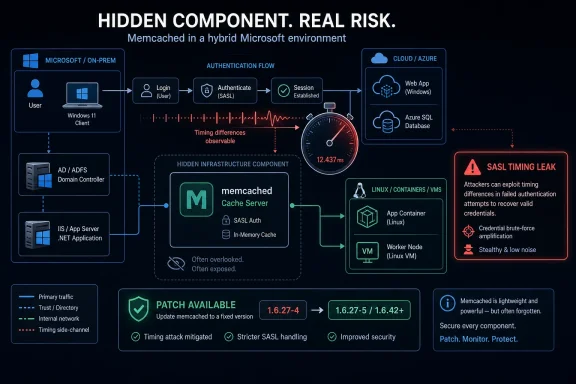 A Cache Server Turns Authentication Into a Stopwatch
The vulnerability sits in memcached’s SASL password database authentication path. In affected versions before 1.6.42, the relevant username-checking loop exits as soon as it finds a valid username, rather than taking a uniform amount of time regardless of whether the submitted name exists. That creates a timing side channel: an attacker does not need the password to learn something useful; they only need to measure how the service behaves.Timing bugs are easy to underestimate because they sound academic. They do not arrive with the cinematic clarity of remote code execution, ransomware detonation, or a kernel panic. They are attacks against difference — a few milliseconds here, a shorter path there, a response that says too much without ever saying it explicitly.
In this case, the leaked information is username validity for deployments using SASL password database authentication. That sounds small until you remember how credential attacks actually work. Enumerating valid names reduces guesswork, makes password spraying more efficient, helps tune phishing, and gives attackers a map of the authentication surface before they ever touch a privileged account.
The CVSS score attached to the issue is 8.1, high severity, with network attack vector, no privileges required, no user interaction, and high impacts listed for confidentiality, integrity, and availability. Yet the attack complexity is also marked high, and that is the tension administrators should pay attention to. This is not a push-button catastrophe for every memcached instance on earth, but it is serious enough that the default answer should be patching rather than debating whether a stopwatch can really become an exploit.
Microsoft’s Entry Is Really About the Supply Chain
The oddity for many Windows administrators is seeing memcached show up in Microsoft’s Security Update Guide at all. This is not because memcached suddenly became a Windows component. It is because Microsoft ships, curates, and supports Linux-based infrastructure through Azure Linux, container ecosystems, cloud workloads, and managed developer platforms.The affected Microsoft-tracked product entry is Azure Linux 3.0, where the memcached package moves from azl3 memcached 1.6.27-4 to fixed build 1.6.27-5. That distinction matters. Microsoft is not saying that Windows 11 or Windows Server contains a vulnerable memcached daemon; it is telling customers that a Microsoft-supported Linux distribution package needed a security update.
That is now a normal part of Microsoft security operations. The company’s patch surface includes Windows, Office, Edge, Azure services, developer tooling, Linux packages, container images, and open-source components that customers consume through Microsoft channels. The Security Update Guide increasingly functions less like a Windows bulletin board and more like a catalog of obligations across the Microsoft platform.
For enterprises, that means “we patched Windows” is no longer a complete sentence. A Microsoft estate might include Windows endpoints, Entra identity, Azure Kubernetes Service, Azure Linux images, SQL back ends, Redis or memcached caches, GitHub-hosted pipelines, and dozens of application libraries pulled from upstream communities. A CVE like this lands in the spaces between those boxes.
That is also why the memcached version numbers can look confusing at first glance. Upstream fixed the issue in memcached 1.6.42, while Microsoft’s Azure Linux package line references a distribution build based on 1.6.27 with a patched package revision. Distribution maintainers often backport security fixes rather than jump wholesale to a newer upstream release. Administrators should therefore verify the fixed package build for their distribution, not assume that only a literal upstream version string proves safety.
The Highest-Rated Impact Is Not Always the Easiest One to Realize
The user-supplied description highlights a total loss of availability, and the CVSS entry includes high availability impact. That language is stark. It describes the ability to deny access to resources in the impacted component, either while the attack continues or in a way that persists after the attack ends.But CVSS is a scoring language, not an incident report. It expresses the theoretical consequences of successful exploitation under the defined conditions, not proof that every exposed memcached instance can be knocked offline trivially by anyone with a laptop. The same vector also lists high attack complexity, which is the scoring system’s way of saying the attacker faces meaningful practical hurdles.
Those hurdles are important in timing side-channel attacks. Network jitter, load variation, authentication throttling, TLS termination, proxy behavior, and noisy shared infrastructure can all blur the signal. An attacker may need repeated measurements, careful statistical handling, and a target configuration that exposes the vulnerable path clearly enough to distinguish valid usernames from invalid ones.
Still, defenders should resist the opposite mistake: dismissing the bug because timing attacks sound fussy. Attackers do not need perfection if they can make repeated attempts cheaply. In cloud environments, “high complexity” can sometimes be reduced by automation, proximity, patience, and scale.
The more useful reading is this: the vulnerability leaks authentication metadata, and that leakage can contribute to larger attacks against the service and the applications depending on it. Availability matters because memcached often sits on a hot path. If cache authentication becomes a foothold for abuse, lockout, saturation, or targeted disruption, the damage is measured not in elegance but in customer-facing failure.
Memcached Is Supposed to Be Boring, Which Is Why It Is Dangerous
Memcached has survived for so long because it does one thing well. It stores ephemeral key-value data in memory and lets applications avoid hitting slower back ends for every request. Its value is speed, simplicity, and predictability.That same simplicity can make it fade from security review. Teams may know where their databases are, where their identity provider lives, and where their public web tier terminates TLS. The cache layer is often treated as internal plumbing — a thing the application “just uses” until it becomes slow, empty, poisoned, exposed, or unavailable.
In many architectures, a cache outage is not merely a performance problem. If the cache absorbs traffic that the database cannot handle directly, losing it can trigger a thundering herd. If session data, rate-limit counters, feature flags, or computed authorization hints depend on cache semantics, a disruption can become an application correctness problem.
That is what makes availability language around a cache server especially uncomfortable. A denial of service against memcached may not sound as dramatic as taking down a database, but in a real production stack the two can be closely linked. A cache-layer failure can amplify load elsewhere and turn a small weakness into a broad service event.
For WindowsForum’s sysadmin audience, the lesson is not “panic about memcached.” It is “inventory the non-Windows components your Windows-adjacent workloads depend on.” A line-of-business application accessed from Windows desktops may fail because a Linux cache node in Azure was never patched, and users will still call the help desk as if Windows broke.
SASL Makes the Bug Narrower, Not Irrelevant
The vulnerability depends on SASL password database authentication. That narrows the affected population. A memcached deployment that does not use the vulnerable authentication path is not exposed to this particular issue in the same way.But “configuration-dependent” is not the same as “rare enough to ignore.” SASL exists because administrators wanted authentication in contexts where unauthenticated memcached access would be unacceptable. In other words, the affected deployments are likely to be the ones whose operators already recognized that access control mattered.
That irony is common in security engineering. A hardening feature introduces a new attack surface. The presence of authentication becomes the condition under which username enumeration is possible.
The fix is not to avoid authentication. It is to implement authentication in ways that do not reveal secrets through behavior. Username checks, password comparisons, token validation, and cryptographic operations should be designed so that failure paths do not produce measurable clues that help an attacker distinguish “wrong password for a real user” from “nonexistent account.”
That principle has been known for decades, but code bases accumulate shortcuts. Loops exit early because early exit is efficient. String comparisons stop at the first mismatch because that is what fast comparison routines do. Most of the time nobody notices, until the code moves into an authentication path where speed becomes a side channel.
The Patch Is Straightforward; Proving Coverage Is Not
The upstream answer is memcached 1.6.42 or later. For Microsoft’s Azure Linux 3.0 packaging, the relevant fixed build is azl3 memcached 1.6.27-5. The practical task is to update the package through the distribution’s normal update mechanism and restart affected services where needed.The harder part is proving that every copy of memcached has been accounted for. In 2026, the vulnerable daemon may live in a VM, a container image, a Kubernetes workload, an appliance-like marketplace image, a developer environment, a CI test stack, or a forgotten internal service still relied upon by a production application. The package database on one host is not the estate.
Container users should be especially careful. Updating the base image does not update already-built application images unless they are rebuilt and redeployed. Updating a node does not patch a container that carries its own vulnerable userland. Updating a repository does not help if a running workload is pinned to an old digest.
The same applies to golden images and templates. If an Azure Linux image used for autoscaling still contains an old memcached package, patched instances may quietly be replaced by newly vulnerable ones during scale-out, disaster recovery testing, or redeployment. Vulnerability management has to chase the source of redeployment, not only the current live node.
This is where Windows-oriented operations teams can get blindsided. They may have mature WSUS, Intune, Configuration Manager, or Windows Update for Business processes, but a much looser model for Linux packages and container rebuilds. The Microsoft logo on the advisory does not mean the remediation will flow through familiar Windows patch channels.
Username Enumeration Is a Small Leak With Large Consequences
Security teams sometimes underrate enumeration because it does not immediately grant access. That is a mistake. Attackers operate by converting uncertainty into certainty, and valid usernames are useful certainty.A valid username list improves password spraying because it reduces failed attempts against nonexistent accounts. It sharpens brute-force attempts in environments without strong throttling. It helps attackers decide which names are worth targeting through other channels. It can also reveal naming conventions, service accounts, test accounts, or application-specific identities that would otherwise remain hidden.
In a memcached SASL context, the danger depends heavily on how the cache is exposed and used. A private cache reachable only from a tightly controlled subnet is a different risk from a service reachable across broader internal networks or, worse, the public internet. But internal reachability is not a magic shield. Many real intrusions begin with one compromised workload and then move laterally toward services that were assumed to be “internal only.”
There is also a cultural problem in how teams discuss these bugs. If a vulnerability does not dump data in one step, it is called “only enumeration.” If it does not execute code, it is called “only a side channel.” If it requires repeated measurement, it is called “only theoretical.” Those words may be individually defensible, but together they can become a lullaby.
The better framing is chainability. CVE-2026-47783 may be most useful as a component in a chain: enumerate valid SASL users, focus credential attacks, abuse weak passwords or exposed automation secrets, disrupt cache access, and then pressure the application tier. Defenders should patch it because chains are how many real compromises work.
The Internet Should Not Be Able to Time Your Cache Login
The most basic defensive control remains exposure reduction. Memcached should not be casually reachable from the public internet. Authentication helps, but it is not a substitute for network design, firewalling, segmentation, and least-privilege access between application components.This point should sound familiar because memcached has history here. The service has repeatedly appeared in discussions of large-scale abuse when exposed instances were misconfigured. Even when a specific CVE is narrow, the operational pattern is broad: a fast, simple network service becomes dangerous when placed somewhere it was never meant to be.
For Azure and hybrid administrators, this means reviewing network security groups, private endpoints or private networking choices, Kubernetes network policies, host firewalls, and service mesh rules. The goal is to make the authentication endpoint reachable only by clients that have a legitimate reason to talk to it. If an attacker cannot send repeated authentication attempts, the timing side channel has little room to breathe.
Monitoring also matters. A timing attack often needs repetition. Logs showing large numbers of failed SASL authentication attempts, username variation, unusual source addresses, or low-and-slow probing patterns should be treated as meaningful, even if no successful login follows.
Rate limiting and account lockout policies can help, but they must be used carefully. A lockout mechanism that can be triggered remotely may itself become a denial-of-service tool. For service-to-service authentication, defenders often need throttling, alerting, source restrictions, and credential hygiene rather than user-style lockout alone.
Azure Linux Makes Microsoft Shops Responsible for Linux Hygiene
The presence of Azure Linux in this advisory deserves attention. Microsoft’s cloud strategy has made Linux not an exception but a first-class citizen. That is good for customers, but it also means Microsoft-centric shops need Linux patch discipline that matches their Windows patch discipline.Azure Linux, formerly tied to the CBL-Mariner lineage, is used as a Microsoft-maintained Linux distribution for cloud and edge scenarios. When its packages receive security fixes, those updates may affect container hosts, appliances, internal services, and workloads that administrators do not mentally file under “Microsoft patches.” The result is a responsibility gap.
That gap is organizational as much as technical. Windows teams may own endpoints and servers; cloud platform teams may own Kubernetes; application teams may own containers; security teams may own scanners; vendors may own managed images. A memcached package inside Azure Linux can cut across all of them.
The fix is not to make every Windows admin a Linux maintainer overnight. It is to build asset and dependency visibility that reflects how systems actually run. If a business service depends on Azure Linux packages, that dependency belongs in patch reporting and incident response playbooks.
The most mature shops already think this way. They treat operating systems, base images, package repositories, runtime libraries, and application dependencies as one patch surface. Everyone else is learning under pressure, one CVE at a time.
CVSS Tells You Severity; Architecture Tells You Urgency
The 8.1 score is useful, but it should not be the only prioritization signal. A vulnerable memcached instance bound to localhost in a disposable development environment is not the same as a production cache reachable by dozens of application nodes across a flat internal network. The score describes the vulnerability; your architecture defines the urgency.The key questions are concrete. Is memcached installed? Is SASL password database authentication enabled? Which package build is running? Is the service reachable over the network, and from where? Are failed authentication attempts logged and monitored? Are credentials unique and rotated? Are containers or images carrying older packages?
Those questions will do more for risk reduction than arguing over whether high attack complexity should push the patch down the queue. High complexity often matters less when the target is stable, reachable, and valuable. Attackers can afford patience when defenders leave a measurable oracle online.
At the same time, security teams should avoid overstating the case to application owners. This is not evidence that every memcached deployment is actively being exploited. It is not a claim that username enumeration alone equals full compromise. Overstatement burns credibility, and credibility is needed when the next patch window has to be defended.
The right message is sober: the affected authentication path leaks information through timing, a fixed release exists, Microsoft has shipped a fixed Azure Linux package, and exposed or high-value deployments should move promptly. That is enough.
The Fix Should Trigger a Broader Cache Review
A narrow CVE is often the best excuse to inspect a broader class of risk. If a team has to touch memcached anyway, it should review how the cache is deployed, authenticated, segmented, monitored, and recovered. The patch closes the known side channel; it does not prove the cache layer is resilient.Start with exposure. Every memcached listener should have a documented reason to exist and a documented set of clients allowed to reach it. Anything broader than that should be treated as technical debt.
Then review authentication and credentials. Service credentials should not be shared across environments, embedded in long-lived images without rotation, or reused by multiple applications with different risk profiles. If a timing issue can reveal a valid username, the next question is whether that username protects anything meaningful.
Finally, test failure behavior. If memcached disappears, does the application degrade gracefully, stampede the database, or collapse? Availability impact is not only about whether an attacker can touch the cache. It is about whether the rest of the system can survive when the cache stops behaving as expected.
This is where security and reliability meet. A cache service can be both a confidentiality concern and a resilience dependency. Treating it as either one alone misses half the problem.
The Patch Window Belongs to the Hidden Linux Estate
The concrete action is simple, but the inventory work is where teams will win or lose time. For Windows-heavy organizations, this CVE should become a test of whether Linux and open-source package exposure is visible enough to patch without improvisation.- Confirm whether any production or pre-production systems run memcached with SASL password database authentication enabled.
- Update upstream memcached deployments to 1.6.42 or later, or apply the fixed package supplied by the relevant Linux distribution.
- For Azure Linux 3.0, verify that affected systems have moved from the vulnerable azl3 memcached 1.6.27-4 package to the fixed 1.6.27-5 build.
- Rebuild and redeploy container images, golden images, and templates that include memcached rather than assuming host updates fixed packaged userlands inside workloads.
- Review network access so memcached authentication endpoints are reachable only from intended application clients, not broad internal networks or the public internet.
- Monitor failed SASL authentication attempts for repeated username probing, unusual timing patterns, or source systems that should not be contacting the cache.
References
- Primary source: MSRC
Published: 2026-05-21T01:01:59-07:00
Security Update Guide - Microsoft Security Response Center
 msrc.microsoft.com
