

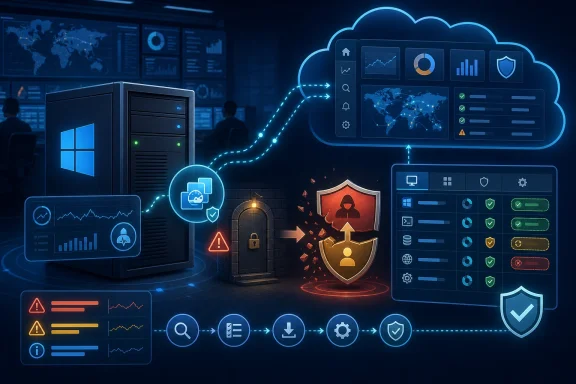
The Agent Sitting in the Corner Is Still Part of the Attack Surface
The Azure Monitor Agent has become one of those background components that many organizations deploy broadly and then mentally file away under “cloud operations.” It collects Windows events, performance counters, syslog data, and other machine telemetry according to data collection rules, then ships that data into Azure Monitor, Log Analytics, Microsoft Sentinel, or adjacent workflows. In hybrid estates, it can sit on Azure virtual machines, Azure Arc-enabled servers, and supported Windows client systems used in server-like monitoring scenarios.
That ubiquity is the reason an elevation-of-privilege bug in the agent deserves attention even when the public advisory is restrained. Agents run close to the operating system. They read from sensitive sources, maintain local state, handle configuration from cloud control planes, and often run services or helper processes with privileges ordinary users do not have.
Security teams are conditioned to panic over remote code execution and to triage local privilege escalation more calmly. That instinct is not irrational, but it is incomplete. In a modern intrusion, local privilege escalation is often the hinge between “the attacker has a foothold” and “the attacker owns the server.”
CVE-2026-32204 should be read in that operational context. The question is not whether the vulnerability lets an unauthenticated attacker reach across the internet and compromise a machine. The question is whether a user or process that already has some level of local access can abuse the agent to climb into a stronger position. For estate-wide monitoring software, that is enough to matter.
Microsoft’s Sparse Wording Is a Signal, Not an Excuse
The text attached to the vulnerability’s confidence metric is dry, but it is more revealing than it first appears. Microsoft’s description explains that this metric measures both confidence in the existence of the vulnerability and the credibility of known technical details. It distinguishes between vague publicized risk, partially corroborated research, and a vulnerability confirmed by the vendor or author of the affected technology.
That framing matters because defenders often treat a lack of public exploit details as a reason to slow down. In some cases, that is sensible. But “few details” and “low confidence” are not the same thing. A vendor-confirmed vulnerability with limited public technical disclosure can be more urgent than a speculative blog post with dramatic diagrams.
For CVE-2026-32204, the useful reading is that Microsoft is not merely passing along rumor. The entry exists in the Security Update Guide, the affected product is named, and the vulnerability class is elevation of privilege. Even if the root cause is not public, administrators have enough information to begin inventory, exposure review, and update validation.
This is one of the recurring tensions in Patch Tuesday-era security operations. Vendors withhold exploit mechanics to reduce attacker enablement, while defenders want enough detail to prioritize accurately. The result is a middle language of CVSS vectors, exploitability assessments, affected components, and confidence metrics. It is imperfect, but it is the language enterprises actually have to use.
Local Privilege Escalation Is the Middle Act of a Breach
Elevation-of-privilege vulnerabilities rarely make for satisfying headlines because they usually require an attacker to already be on the box. That condition sounds comforting until you remember how many incidents begin with stolen credentials, malicious documents, vulnerable edge appliances, exposed remote management, poisoned software updates, or a compromised service account. Initial access is no longer the hard part it once was.
Once an attacker lands, privilege decides the tempo. A low-privilege shell can be noisy, fragile, and contained. A privileged context can dump secrets, tamper with logs, disable protections, move laterally, persist through reboots, and manipulate the very telemetry defenders use to reconstruct what happened.
Monitoring agents are especially sensitive in that middle phase. They may have trusted locations on disk, privileged services, scheduled tasks, update mechanisms, certificate stores, local caches, configuration files, and authenticated channels back to the cloud. Any one of those can become interesting if permissions, path handling, service control, update validation, or interprocess communication is wrong.
That does not mean CVE-2026-32204 involves any particular one of those mechanisms. Microsoft’s public wording does not prove that. But it does explain why the class of bug is important: an agent that bridges local operating system state and cloud monitoring policy is not a decorative component. It is part of the machine’s trust fabric.
Azure Monitor Agent Has Outgrown the “Telemetry Add-On” Mental Model
Azure Monitor Agent is not the old world of one-off log shippers stapled onto servers as an afterthought. Microsoft has been moving Azure monitoring toward data collection rules, centralized configuration, and agent-based collection for virtual machines and hybrid systems. That design is cleaner than the old sprawl of legacy agents, but it also concentrates responsibility.
Data collection rules define what the agent collects, how data is processed, and where it is sent. The agent periodically retrieves and applies those rules. In a well-run environment, that gives administrators a consistent way to manage monitoring across fleets. In a poorly maintained one, it can create a large population of machines running the same privileged component at different patch levels.
The uncomfortable truth is that observability infrastructure often escapes the rigor applied to endpoint detection or identity systems. Everyone knows to patch the EDR agent because the security team is watching it. Monitoring agents, backup agents, asset inventory agents, and management extensions sometimes sit in the gray zone between cloud operations and security operations.
CVE-2026-32204 is a reminder that this gray zone is where attackers love to work. They do not care which team owns the agent. They care whether the agent is installed, whether it runs with useful rights, and whether it can be coerced into doing something it should not.
The Patch Problem Is Really an Inventory Problem
For many organizations, the hard part of responding to an Azure Monitor Agent vulnerability is not clicking “update.” It is knowing where the agent is installed, which deployment path put it there, whether automatic extension upgrades are enabled, and how long rollout will take across Azure VMs, scale sets, Arc-enabled servers, and any supported client systems.
Microsoft’s own guidance for the agent emphasizes automatic extension upgrade, while also warning that automatic rollout can take weeks because updates are deployed in batches. That is operationally reasonable; nobody wants a global agent update to break telemetry everywhere at once. But it means security teams cannot assume that “automatic” means “already done.”
This is where cloud convenience collides with incident response expectations. A vulnerability appears in an agent. The platform offers a safe rolling update mechanism. The vulnerability management team wants evidence of remediation by Friday. The operations team knows the rollout may be staged and that some servers may need manual intervention.
Good shops resolve that tension with inventory and exception handling. They can identify installed versions, separate automatically upgrading machines from pinned or manually managed ones, and force updates where risk is highest. Less mature shops discover during the vulnerability window that their monitoring estate is not as centrally managed as the dashboard made it look.
The right question is not “Do we use Azure Monitor?” It is “Which machines run the affected agent, which version is installed, and what will prove it changed?” That proof may come from Azure Resource Graph, extension metadata, software inventory, endpoint management, vulnerability scanners, or local validation. The source matters less than the discipline.
Version Drift Turns One CVE Into a Fleet Management Test
Agent version drift is the quiet enemy of cloud-hybrid operations. A VM deployed last month may be on a current extension. An Arc-enabled server added during a migration may be on an older package. A lab machine may have been excluded from automatic upgrades because someone feared a regression. A Windows client used for a monitoring scenario may have been installed with a separate client package and then forgotten.
This is why CVE-2026-32204 should not be handled as a single update ticket. It should be handled as a test of whether the organization can control privileged agents at scale. If the answer is no, the vulnerability is merely the latest symptom.
Azure Monitor Agent’s update model gives administrators options. Azure VMs can use extension update workflows. Arc-enabled servers have their own connected machine extension management path. Automatic extension upgrade can reduce long-term exposure, but immediate remediation may still require targeted manual updates for high-risk systems.
That combination is powerful but not magical. It assumes administrators know which path applies to which machine. It also assumes change windows, maintenance policies, and monitoring dependencies do not block the security update indefinitely.
The Lack of Public Exploit Code Should Not Be Comforting for Long
One of the traps in vulnerability response is overfitting prioritization to public exploit availability. If exploit code is public, patch immediately. If no exploit code is public, wait for the next cycle. That model made more sense when exploit development was slower, target environments were less homogeneous, and attacker tooling did not absorb advisories at industrial speed.
Today, the gap between an advisory and a working exploit can close quickly, especially for local privilege escalation classes. Attackers do not always need a full public proof of concept. They can diff patches, inspect changed binaries, monitor researcher chatter, or test likely weak points. Defenders rarely get a second notification saying, “This one is now convenient for criminals.”
The confidence metric in Microsoft’s advisory language cuts against complacency. It says, in effect, that the vulnerability’s existence and technical credibility are part of the urgency calculus. Public exploit maturity is only one dimension. Vendor confirmation, affected deployment base, privilege impact, and asset criticality all matter.
For Azure Monitor Agent, the deployment base may include servers that are important precisely because they are monitored. Domain-adjacent systems, application servers, database hosts, jump boxes, and Arc-managed hybrid machines can all carry higher consequences than their individual CVSS line might suggest. A local elevation path on the wrong server is not a local problem for very long.
Windows Administrators Should Look Past the CVE Number
The forum post that prompted this article highlights Microsoft’s explanation of the confidence metric, not a full exploit narrative. That is fitting, because the practical lesson is bigger than CVE-2026-32204 itself. Administrators need to get better at reading advisory metadata as operational instruction.
A CVE entry is not just a label. It is a bundle of clues. The affected product tells you where to inventory. The vulnerability type tells you what attack phase it supports. The privileges required tell you whether the bug is pre-compromise or post-compromise. The user interaction field tells you whether phishing-like interaction is part of the path. The exploitability and confidence fields tell you how speculative the available information is.
For a local elevation-of-privilege issue in Azure Monitor Agent, those clues point toward a focused response. Inventory the agent. Confirm update posture. Prioritize systems where local access is plausible or consequences are severe. Validate that monitoring still works after update. Watch for suspicious local service manipulation, unexpected file changes in agent directories, or telemetry gaps around the remediation window.
That last point is easy to miss. Updating a monitoring agent is both a security act and an observability risk. If the update breaks data collection, defenders may fix one problem while blinding themselves to another. The right response includes health checks, not just version checks.
Sysadmins Need Evidence, Not Reassurance
A common enterprise failure mode is to translate “Microsoft says automatic updates are enabled” into “we are patched.” That is not evidence. Evidence is a query, report, or scanner result showing the agent version on each relevant machine after remediation. Evidence is also a list of machines that failed to update and a named owner for each exception.
Azure environments make this easier than old server rooms, but only if teams use the tools deliberately. Resource inventories can show extensions. Endpoint management can show installed software. Vulnerability scanners can flag self-reported versions. Log Analytics can sometimes help infer agent health and heartbeat behavior. None of these is perfect alone, but together they can tell a coherent story.
The story should be understandable to both security and operations. Security wants risk reduction. Operations wants service continuity. The compromise is a remediation plan that updates high-value systems quickly, lets lower-risk systems ride safe automatic rollout where appropriate, and refuses to let unknown machines stay unknown.
That discipline pays off beyond this one vulnerability. The next Azure Monitor Agent CVE, Azure Connected Machine Agent issue, backup agent flaw, or EDR service bug will ask the same questions. The organizations that can answer them in hours will experience these advisories as routine. The organizations that cannot will experience them as archaeology.
Hybrid Machines Make the Blast Radius Harder to See
Azure Monitor Agent’s importance is magnified by Azure Arc. Arc is valuable because it pulls non-Azure servers into Azure management patterns. It also means Azure-facing agents can exist on machines that are physically, administratively, or historically outside the neat Azure VM inventory many teams start with.
That hybrid reality complicates risk assessment. A vulnerability in an Azure agent may affect a server in a corporate data center, a branch office, a manufacturing environment, a lab, or a managed customer site. The machine may not be protected by the same update cadence as cloud VMs. It may sit behind a different firewall, follow a different maintenance calendar, or belong to a different operations team.
The name “Azure Monitor Agent” can therefore be misleading if it makes defenders think only of Azure-hosted workloads. The product’s reach follows the monitoring architecture, not the billing boundary. If the agent was deployed through Arc or a client installer, the vulnerability management process has to follow it there.
This is where cross-team ownership becomes more than bureaucracy. Cloud operations may own the Azure policy. Server operations may own the machine. Security may own the vulnerability deadline. Application teams may own the maintenance window. Without a clear runbook, a local privilege escalation bug in a monitoring agent becomes a meeting series.
The Confidence Metric Is Really About Defender Psychology
Microsoft’s confidence metric is written like a standards document, but its real audience is human beings deciding what to do with uncertainty. Security operations lives in a permanent fog: some advisories are overhyped, some are understated, some are actively exploited before defenders understand them, and some never matter in practice. The temptation is to wait for clarity.
But clarity often arrives after the useful response window. By the time exploit code is public, scanner plugins are mature, and threat reports are detailed, attackers may already have folded the bug into their playbooks. Vendor-confirmed vulnerabilities in privileged infrastructure components deserve action before that point.
The confidence metric helps separate “there may be something here” from “the vendor acknowledges there is something here.” That distinction should influence urgency. It does not mean panic. It means the work begins now: identify exposure, apply updates, document exceptions, and keep an eye on exploitation signals.
For CVE-2026-32204, the lack of public root-cause detail should shape how defenders communicate. They should avoid claiming more than Microsoft has said. They should not invent an attack path. But they also should not minimize the issue just because the advisory is terse. Vendor-confirmed local privilege escalation in a broadly deployed agent is enough to justify attention.
CVSS Can Understate the Politics of Privilege
CVSS is useful, but it is not a substitute for judgment. Local privilege escalation vulnerabilities often receive scores that place them below remote unauthenticated flaws. That is mathematically consistent and operationally dangerous if teams treat the number as the whole story.
Privilege is contextual. A local elevation bug on a kiosk is one thing. A local elevation bug on a server that hosts authentication middleware, management tooling, deployment secrets, or sensitive logs is another. A local elevation bug in an agent deployed everywhere can become a repeatable post-compromise accelerator.
This is why mature vulnerability management programs combine vendor severity with asset criticality and exposure likelihood. They ask whether the affected software runs on crown-jewel systems. They ask whether low-privilege local access is common because many users, services, or automation accounts touch the host. They ask whether exploitation would help disable defenses or erase evidence.
Azure Monitor Agent sits close enough to telemetry that those questions are natural. Even if CVE-2026-32204 is not known to enable telemetry tampering, defenders should validate agent health during remediation. The agent’s job is to make systems observable; a security update should not quietly create blind spots.
The Operational Fix Is Boring, Which Is Why It Works
There is no glamorous defensive move here. The practical response is inventory, update, verify, monitor. That is the work security teams sometimes dismiss as patch management and attackers often exploit as neglect.
Start with scope. Identify Azure VMs, VM scale sets, Arc-enabled servers, and supported Windows clients running Azure Monitor Agent. Include systems outside Azure if Arc or manual installation brought them under monitoring. Do not assume the name of the cloud service maps neatly to the location of the machine.
Then determine version and update channel. Machines with automatic extension upgrade enabled may still be in a staged rollout. Machines with pinned versions, custom images, disconnected maintenance processes, or manual client installs may require intervention. High-value systems should not wait indefinitely for batch rollout if a supported immediate update path exists.
Finally, verify both security and function. The agent should report the expected version, the extension state should be healthy, and logs or metrics should continue flowing to the intended destinations. If a machine fails update or loses telemetry, that exception should be visible rather than buried in a change ticket.
The Small CVE That Exposes the Big Agent Problem
CVE-2026-32204 is not just a Microsoft advisory; it is a useful audit prompt for every organization that has turned cloud agents into the connective tissue of its Windows estate. The details may be narrow, but the lesson is broad. If an agent runs broadly and with meaningful privileges, it belongs in the same governance conversation as endpoint protection, identity tooling, and remote management.
The concrete work is not mysterious:
- Organizations should identify every Azure Monitor Agent deployment across Azure VMs, scale sets, Arc-enabled servers, and supported Windows client scenarios.
- Administrators should confirm whether automatic extension upgrade is enabled and understand that staged rollout can still leave machines temporarily behind.
- Security teams should prioritize remediation on servers where local access is plausible, data sensitivity is high, or privilege escalation would materially improve an attacker’s position.
- Operations teams should validate telemetry flow after updating, because a patched but silent monitoring agent creates a different kind of risk.
- Exception lists should name specific machines, owners, versions, and remediation dates rather than relying on broad statements that the environment is “covered.”
This is the sort of vulnerability that rewards disciplined shops and punishes vague ones. The fix path may be routine, but the inventory questions are unforgiving.
CVE-2026-32204 will probably not be remembered as the loudest Microsoft vulnerability of 2026, and that is exactly why it is worth taking seriously. Modern Windows security is increasingly shaped by the privileged agents that manage, monitor, protect, and report on the operating system. If defenders want those agents to remain assets rather than liabilities, they need to patch them with the same seriousness they apply to the workloads those agents were installed to watch.