

Microsoft disclosed CVE-2026-42830 on May 12, 2026, as an Important elevation-of-privilege vulnerability in the Azure Monitor Agent Metrics Extension, assigning it a CVSS score of 6.5 as part of the May Patch Tuesday security release. The bug is not the loudest item in this month’s bulletin, but it lands in a component many administrators treat as invisible plumbing. That is exactly why it deserves attention: monitoring agents are trusted, privileged, and often deployed more widely than anyone remembers.
Azure Monitor Agent has become one of those pieces of infrastructure that only attracts attention when something breaks. It sits on Azure virtual machines, scale sets, and Azure Arc-enabled servers, collecting logs and metrics, feeding Sentinel and Log Analytics, and giving administrators the dashboards they rely on during an outage. The Metrics Extension is part of that telemetry pipeline, and telemetry pipelines tend to run close to the operating system.
That proximity is the point. A monitoring component needs access to performance counters, local event streams, process data, configuration files, and sometimes privileged service contexts. When Microsoft labels a flaw in that neighborhood as elevation of privilege, the practical concern is not that an attacker magically appears from the internet. The concern is that an attacker who already has a foothold may be able to convert limited access into something more useful.
CVE-2026-42830 is therefore a local-posture problem rather than a headline-grabbing wormable crisis. But local privilege escalation is how many real intrusions become durable intrusions. Initial access is often noisy, disposable, and constrained; privilege escalation is what lets an attacker tamper with agents, hide activity, pivot across workloads, or extract secrets that were meant to be available only to trusted services.
The user-provided text points to the CVSS report confidence idea: how certain the ecosystem is that a vulnerability exists and how credible the technical details are. In plain English, this is the difference between rumor, informed suspicion, and vendor-confirmed vulnerability. CVE-2026-42830 sits on the vendor-confirmed end of that spectrum because Microsoft has assigned it a CVE, published it through MSRC, and included it in Patch Tuesday tracking.
That matters operationally. Security teams do not need exploit code to justify patching a privileged agent. They need a credible vendor signal that the vulnerable code exists in deployed environments and that an update is the supported mitigation path. CVE-2026-42830 clears that bar.
CVSS is useful, but it is not a deployment map. A medium-to-high score on a component installed on a handful of lab machines is one thing; the same score on an agent spread across production servers, hybrid machines, and regulated workloads is another. The relevant question is not only “how bad is the bug?” but “where does this code run, and what does it touch?”
For many enterprises, Azure Monitor Agent is deployed by policy, extension management, VM templates, or Arc onboarding workflows. That means the affected footprint may be broader than the team that owns the patch calendar realizes. Monitoring is often owned by platform engineering, security operations, and cloud infrastructure simultaneously, which can make accountability fuzzy just when speed matters.
Recent Azure Monitor Agent release notes show Microsoft updating Metrics Extension versions alongside broader Windows and Linux agent changes. In April 2026, the Windows Azure Monitor Agent release moved to version 1.42 and updated the Metrics Extension to a 2026 build. Earlier releases also bundled Metrics Extension changes, OpenSSL updates, performance improvements, and security-related hardening. This is not a static binary buried forever in a VM image; it is a maintained subsystem that needs lifecycle management.
That lifecycle is where security debt accumulates. If an organization enabled automatic extension upgrades, Microsoft’s staged rollout model should eventually move machines forward. If it did not, the environment may depend on manual extension updates, image refreshes, or policy remediation. In the real world, those three paths often produce inconsistent versions across subscriptions and hybrid machines.
An Azure Monitor Agent flaw may not arrive through Windows Update in the same way a kernel fix does. It may be remediated through extension versioning, Azure VM extension management, Arc extension updates, or automatic upgrade policy. That means the people reading the bulletin and the people who can actually close the exposure may not be the same people.
For WindowsForum readers, this is the new administrative reality. A Windows Server may be fully patched at the OS level and still carry stale cloud management or monitoring agents. Conversely, a cloud platform team may assume Azure extension automation is handling everything while a subset of Arc-enabled machines sits outside the expected policy path.
But automatic does not mean immediate. Microsoft’s own guidance describes staged rollout behavior, with updates moving through batches over time. That is a safer deployment model for reliability, but it creates a window in which some machines are updated and others are not. Security teams need to understand that tradeoff rather than treating “automatic” as a binary state.
The right response to CVE-2026-42830 is therefore not panic-patching every VM by hand. It is inventory first, then targeted acceleration where risk justifies it. Internet-facing workloads, shared jump boxes, sensitive production systems, and Arc-enabled servers in less controlled networks deserve faster verification than low-risk test machines.
That does not prove a catastrophic design failure. It may simply mean Microsoft or an external researcher audited this code path and found more than one issue. In security engineering, that is common: once a privileged service is under the microscope, adjacent bugs often surface together.
Still, clustering changes the operational read. A single moderate EoP can be triaged as a discrete patch. Multiple EoPs in a monitoring extension suggest a stronger case for version hygiene, deployment consistency, and post-update verification. The lesson is not “Azure Monitor Agent is unsafe.” The lesson is that privileged agents deserve the same seriousness as any other component running close to SYSTEM or root.
That is where agent vulnerabilities become especially tricky. A cloud-native VM can often be queried and remediated through consistent Azure mechanisms. A hybrid server estate may include machines with proxy constraints, disconnected periods, stricter change controls, or old onboarding assumptions. The same extension name can hide very different operational realities.
For CVE-2026-42830, Arc inventory deserves a deliberate look. If Azure Monitor Agent is deployed to hybrid machines, administrators should confirm not just that the extension exists, but that it is on a supported and updated version path. The machines most likely to drift are also often the machines least visible to central dashboards.
An elevation-of-privilege flaw in such a component can be attractive even when exploitation requires local access. An attacker who compromises a low-privileged account on a server may look for services that run with higher rights, writable paths, weak update mechanisms, unsafe file handling, or permissive inter-process communication. Monitoring agents have historically been fertile ground for this kind of research because they sit at the intersection of system access and operational complexity.
There is no public indication here that CVE-2026-42830 is being exploited in the wild. That is good news. But defenders should avoid the comforting fallacy that “not exploited yet” means “not useful.” Once a CVE is public, researchers and attackers alike know where to look.
This is why agent security is mostly an inventory discipline. Administrators should be able to answer which machines have Azure Monitor Agent, which operating systems they run on, which extension version is installed, whether automatic upgrade is enabled, and whether the Metrics Extension build corresponds to the fixed release stream. If that sounds tedious, that is because it is. It is also the difference between a clean remediation and a permanent exception list.
The best organizations will turn this CVE into a query and a dashboard. The worst will close the ticket after confirming that “Azure automatic updates are enabled somewhere.” The gap between those two responses is where lingering exposure lives.
That ambiguity matters because ownership is fragmented. The Windows team may own OS patching. The cloud platform team may own Azure Policy. The SOC may own Sentinel. The server team may own maintenance windows. The vulnerability team may own the CVE ticket but lack permission to touch any of the above.
For a component like Azure Monitor Agent Metrics Extension, Microsoft could help by making the remediation path painfully explicit: affected extension names, fixed versions, platform differences, automatic upgrade expectations, and verification commands. Some of that information is discoverable through Azure Monitor Agent management and version documentation, but security advisories work best when they reduce cross-team translation.
But “not the worst bug this month” is not a mitigation strategy. The right response is boring and specific: identify affected systems, update the agent or extension, verify rollout, and make sure automatic upgrade policy is doing what administrators think it is doing. Boring is a compliment in vulnerability management.
The organizations that get hurt by issues like this are rarely the ones that read the advisory and made a conscious risk decision. They are the ones that never knew the agent was installed, never noticed automatic upgrades were disabled, or never checked the hybrid machines outside the clean Azure estate.
Source: MSRC Security Update Guide - Microsoft Security Response Center
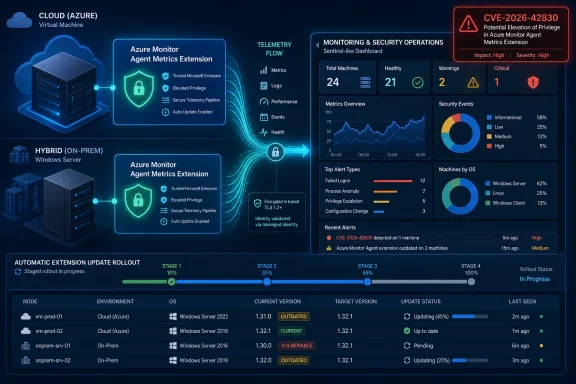 The Monitoring Agent Is No Longer Background Noise
Azure Monitor Agent has become one of those pieces of infrastructure that only attracts attention when something breaks. It sits on Azure virtual machines, scale sets, and Azure Arc-enabled servers, collecting logs and metrics, feeding Sentinel and Log Analytics, and giving administrators the dashboards they rely on during an outage. The Metrics Extension is part of that telemetry pipeline, and telemetry pipelines tend to run close to the operating system.That proximity is the point. A monitoring component needs access to performance counters, local event streams, process data, configuration files, and sometimes privileged service contexts. When Microsoft labels a flaw in that neighborhood as elevation of privilege, the practical concern is not that an attacker magically appears from the internet. The concern is that an attacker who already has a foothold may be able to convert limited access into something more useful.
CVE-2026-42830 is therefore a local-posture problem rather than a headline-grabbing wormable crisis. But local privilege escalation is how many real intrusions become durable intrusions. Initial access is often noisy, disposable, and constrained; privilege escalation is what lets an attacker tamper with agents, hide activity, pivot across workloads, or extract secrets that were meant to be available only to trusted services.
Microsoft’s Sparse Advisory Still Says Enough
The public details around CVE-2026-42830 are thin, which is normal for Microsoft advisories on privilege escalation flaws in cloud-adjacent agents. The MSRC entry identifies the affected product family, impact, severity, and scoring, but it does not hand out root-cause internals or a proof-of-concept path. That absence should not be mistaken for irrelevance.The user-provided text points to the CVSS report confidence idea: how certain the ecosystem is that a vulnerability exists and how credible the technical details are. In plain English, this is the difference between rumor, informed suspicion, and vendor-confirmed vulnerability. CVE-2026-42830 sits on the vendor-confirmed end of that spectrum because Microsoft has assigned it a CVE, published it through MSRC, and included it in Patch Tuesday tracking.
That matters operationally. Security teams do not need exploit code to justify patching a privileged agent. They need a credible vendor signal that the vulnerable code exists in deployed environments and that an update is the supported mitigation path. CVE-2026-42830 clears that bar.
A 6.5 Score Can Still Matter in the Wrong Place
The 6.5 CVSS score will tempt some organizations to push this issue into the “later” bucket. That would be understandable if the affected software were a desktop utility or an optional helper with little access to sensitive state. It is less comforting when the affected component is part of the monitoring stack on servers.CVSS is useful, but it is not a deployment map. A medium-to-high score on a component installed on a handful of lab machines is one thing; the same score on an agent spread across production servers, hybrid machines, and regulated workloads is another. The relevant question is not only “how bad is the bug?” but “where does this code run, and what does it touch?”
For many enterprises, Azure Monitor Agent is deployed by policy, extension management, VM templates, or Arc onboarding workflows. That means the affected footprint may be broader than the team that owns the patch calendar realizes. Monitoring is often owned by platform engineering, security operations, and cloud infrastructure simultaneously, which can make accountability fuzzy just when speed matters.
The Metrics Extension Sits in a Sensitive Trust Boundary
The Metrics Extension is not just a passive observer. It participates in the collection and forwarding of performance and system telemetry, and Microsoft’s own release history shows the Metrics Extension being updated repeatedly inside Azure Monitor Agent releases. That tells administrators something important: this component evolves, ships fixes, and has dependencies of its own.Recent Azure Monitor Agent release notes show Microsoft updating Metrics Extension versions alongside broader Windows and Linux agent changes. In April 2026, the Windows Azure Monitor Agent release moved to version 1.42 and updated the Metrics Extension to a 2026 build. Earlier releases also bundled Metrics Extension changes, OpenSSL updates, performance improvements, and security-related hardening. This is not a static binary buried forever in a VM image; it is a maintained subsystem that needs lifecycle management.
That lifecycle is where security debt accumulates. If an organization enabled automatic extension upgrades, Microsoft’s staged rollout model should eventually move machines forward. If it did not, the environment may depend on manual extension updates, image refreshes, or policy remediation. In the real world, those three paths often produce inconsistent versions across subscriptions and hybrid machines.
Patch Tuesday Now Reaches Deep Into Cloud Plumbing
Microsoft’s Patch Tuesday used to feel like a Windows desktop and server ritual. That world is gone. The monthly security release now routinely includes Azure services, developer tools, Copilot surfaces, agents, SDKs, and cloud management components. CVE-2026-42830 is a good example of why the old patching mental model no longer fits.An Azure Monitor Agent flaw may not arrive through Windows Update in the same way a kernel fix does. It may be remediated through extension versioning, Azure VM extension management, Arc extension updates, or automatic upgrade policy. That means the people reading the bulletin and the people who can actually close the exposure may not be the same people.
For WindowsForum readers, this is the new administrative reality. A Windows Server may be fully patched at the OS level and still carry stale cloud management or monitoring agents. Conversely, a cloud platform team may assume Azure extension automation is handling everything while a subset of Arc-enabled machines sits outside the expected policy path.
Automatic Extension Upgrade Is Helpful, Not Magical
Microsoft recommends keeping Azure Monitor Agent current and opting in to automatic extension upgrade. That is sensible advice, and for many organizations it is the right default. Automatic rollout reduces the chance that every agent update becomes a bespoke change request.But automatic does not mean immediate. Microsoft’s own guidance describes staged rollout behavior, with updates moving through batches over time. That is a safer deployment model for reliability, but it creates a window in which some machines are updated and others are not. Security teams need to understand that tradeoff rather than treating “automatic” as a binary state.
The right response to CVE-2026-42830 is therefore not panic-patching every VM by hand. It is inventory first, then targeted acceleration where risk justifies it. Internet-facing workloads, shared jump boxes, sensitive production systems, and Arc-enabled servers in less controlled networks deserve faster verification than low-risk test machines.
The Second Metrics Extension Bug Makes This a Pattern Worth Watching
CVE-2026-42830 is not alone in the May 2026 advisory set. Public Patch Tuesday summaries also list CVE-2026-32204 as another Azure Monitor Agent Metrics Extension elevation-of-privilege vulnerability, with a higher CVSS score of 7.8. When two EoP flaws land in the same narrow component area in the same monthly release, administrators should pay attention to the component, not just the individual CVE numbers.That does not prove a catastrophic design failure. It may simply mean Microsoft or an external researcher audited this code path and found more than one issue. In security engineering, that is common: once a privileged service is under the microscope, adjacent bugs often surface together.
Still, clustering changes the operational read. A single moderate EoP can be triaged as a discrete patch. Multiple EoPs in a monitoring extension suggest a stronger case for version hygiene, deployment consistency, and post-update verification. The lesson is not “Azure Monitor Agent is unsafe.” The lesson is that privileged agents deserve the same seriousness as any other component running close to SYSTEM or root.
Hybrid Servers Are the Awkward Edge
Azure Arc makes Azure management useful beyond Azure, but it also stretches the patching problem into places cloud teams do not fully control. Arc-enabled servers may live in on-premises racks, branch offices, other clouds, or segmented networks with different maintenance windows. They may be managed by teams that do not think of themselves as Azure administrators.That is where agent vulnerabilities become especially tricky. A cloud-native VM can often be queried and remediated through consistent Azure mechanisms. A hybrid server estate may include machines with proxy constraints, disconnected periods, stricter change controls, or old onboarding assumptions. The same extension name can hide very different operational realities.
For CVE-2026-42830, Arc inventory deserves a deliberate look. If Azure Monitor Agent is deployed to hybrid machines, administrators should confirm not just that the extension exists, but that it is on a supported and updated version path. The machines most likely to drift are also often the machines least visible to central dashboards.
Attackers Like Trusted Agents Because Defenders Trust Them Too
Security tools and monitoring agents occupy a strange place in enterprise defense. They are trusted because they help defenders see the environment. They are dangerous because that trust often comes with high privileges, broad deployment, and exceptions in endpoint controls.An elevation-of-privilege flaw in such a component can be attractive even when exploitation requires local access. An attacker who compromises a low-privileged account on a server may look for services that run with higher rights, writable paths, weak update mechanisms, unsafe file handling, or permissive inter-process communication. Monitoring agents have historically been fertile ground for this kind of research because they sit at the intersection of system access and operational complexity.
There is no public indication here that CVE-2026-42830 is being exploited in the wild. That is good news. But defenders should avoid the comforting fallacy that “not exploited yet” means “not useful.” Once a CVE is public, researchers and attackers alike know where to look.
Version Drift Is the Real Enemy
The practical failure mode after this advisory will not be a lack of knowledge. It will be version drift. One subscription gets the updated extension, another remains behind. Azure VMs move forward, Arc machines lag. Production is patched, disaster recovery images are not. Golden images are updated, but long-running pets keep their old agent state.This is why agent security is mostly an inventory discipline. Administrators should be able to answer which machines have Azure Monitor Agent, which operating systems they run on, which extension version is installed, whether automatic upgrade is enabled, and whether the Metrics Extension build corresponds to the fixed release stream. If that sounds tedious, that is because it is. It is also the difference between a clean remediation and a permanent exception list.
The best organizations will turn this CVE into a query and a dashboard. The worst will close the ticket after confirming that “Azure automatic updates are enabled somewhere.” The gap between those two responses is where lingering exposure lives.
Microsoft’s Agent Strategy Needs Clearer Security Signaling
Microsoft has improved its cloud security documentation over the years, but agent advisories still ask a lot of administrators. The MSRC format is efficient for vulnerability management systems, but not always for humans trying to understand whether the fix arrives through Windows Update, an Azure extension version, an Arc command, an image refresh, or a service-side change.That ambiguity matters because ownership is fragmented. The Windows team may own OS patching. The cloud platform team may own Azure Policy. The SOC may own Sentinel. The server team may own maintenance windows. The vulnerability team may own the CVE ticket but lack permission to touch any of the above.
For a component like Azure Monitor Agent Metrics Extension, Microsoft could help by making the remediation path painfully explicit: affected extension names, fixed versions, platform differences, automatic upgrade expectations, and verification commands. Some of that information is discoverable through Azure Monitor Agent management and version documentation, but security advisories work best when they reduce cross-team translation.
The Sensible Response Is Boring, Which Is Good
There is no need to dramatize CVE-2026-42830 into a breach-in-waiting. It is an Important elevation-of-privilege vulnerability with a 6.5 score, no public exploitation signal in the major Patch Tuesday summaries, and limited public technical detail. That places it below the month’s most urgent remote code execution and critical cloud issues.But “not the worst bug this month” is not a mitigation strategy. The right response is boring and specific: identify affected systems, update the agent or extension, verify rollout, and make sure automatic upgrade policy is doing what administrators think it is doing. Boring is a compliment in vulnerability management.
The organizations that get hurt by issues like this are rarely the ones that read the advisory and made a conscious risk decision. They are the ones that never knew the agent was installed, never noticed automatic upgrades were disabled, or never checked the hybrid machines outside the clean Azure estate.
The Patch Is Really a Test of Your Azure Inventory
CVE-2026-42830 is less a five-alarm fire than a useful audit prompt. If your estate can answer the agent-version question quickly, this should be a routine closure. If it cannot, the vulnerability has exposed a process gap that will matter again.- CVE-2026-42830 affects the Azure Monitor Agent Metrics Extension and was published by Microsoft as an Important elevation-of-privilege issue with a CVSS score of 6.5.
- Public reporting around the May 2026 Patch Tuesday release does not indicate known exploitation or public disclosure at the time of release.
- The affected component is operationally sensitive because monitoring agents commonly run with elevated privileges and broad host visibility.
- Administrators should verify Azure Monitor Agent and Metrics Extension versions across Azure VMs, scale sets, and Azure Arc-enabled servers.
- Automatic extension upgrade is useful, but staged rollout means high-risk systems may still deserve manual verification or accelerated remediation.
- The presence of another Metrics Extension EoP in the same Patch Tuesday batch makes version consistency more important than treating this as an isolated footnote.
Source: MSRC Security Update Guide - Microsoft Security Response Center
