

CVE-2026-46158 is a newly published Linux kernel vulnerability, received by NVD from kernel.org on May 28, 2026, covering a reference-count leak in Multipath TCP’s path-manager handling of retransmitted ADD_ADDR messages. The bug is not a headline-grabbing remote-code-execution flaw, and NVD has not yet assigned CVSS scoring. But it is exactly the kind of kernel maintenance issue that matters to administrators running modern Linux workloads, appliances, WSL-adjacent development environments, and mixed Windows/Linux infrastructure: small lifecycle mistakes in networking code can become operational risk long before they become dramatic security stories.
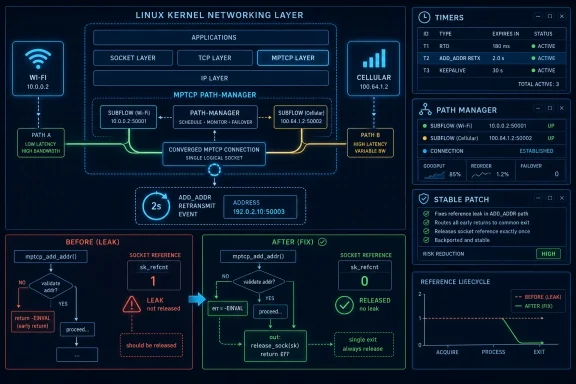
The short version is that the MPTCP path manager was taking a socket reference when scheduling or resetting a retransmission timer, then failing to release that reference on some unlikely early-return paths. The fix changes the function’s control flow so cleanup always runs, removing a small but real opportunity for leaked kernel socket references. That sounds mundane because it is mundane — and that is the point. Kernel security in 2026 is increasingly a story of boring correctness work being promoted into the vulnerability pipeline because boring correctness bugs are still vulnerabilities when they sit in privileged networking code.
CVE-2026-46158 lands in the Linux kernel’s Multipath TCP implementation, specifically in the path-management logic responsible for retransmitting ADD_ADDR messages. MPTCP allows a single logical connection to use multiple network paths, such as Wi-Fi and cellular, or multiple interfaces in a server or appliance. ADD_ADDR is one of the protocol mechanisms used to announce additional addresses that a peer may be able to use for additional subflows.
The vulnerability description is unusually clear because it is essentially the upstream commit message. When an ADD_ADDR message is retransmitted, the relevant socket is held through
This is not the sort of bug that gives defenders an obvious indicator of compromise or attackers a one-line exploit primitive. It is a lifecycle defect: a resource is acquired, a rare branch is taken, and the matching release does not happen. In user space, that would usually be filed as a leak. In kernel networking code, it becomes more consequential because the object being leaked is tied to socket lifetime, timers, and memory pressure inside the operating system.
The NVD entry is still marked as awaiting enrichment, with no CVSS 4.0, 3.x, or 2.0 score assigned by NIST at publication time. That matters because administrators who triage by severity dashboard alone may not see this issue light up yet. The absence of a score is not the same thing as the absence of a bug.
That kind of defect is easy to underestimate because the vulnerable branch is not necessarily common. The upstream wording itself calls the checks unlikely. But “unlikely” is not “impossible,” and kernel bugs often live in precisely the places developers reasonably expect not to matter during ordinary testing.
The fix also removes a check for a null MPTCP socket pointer that the maintainers concluded could not happen because the pointer is never reset. That is a small cleanup, but it tells a larger story: once a maintainer is auditing an ownership path, dead conditions and misleading defensive checks become part of the security surface too. Code that appears cautious can still obscure the real invariant.
The remaining check is explicitly marked unlikely, and the cleanup path is centralized. That is classic defensive kernel maintenance. It does not add a new mitigation layer, redesign MPTCP, or change the protocol. It makes the function obey its own ownership contract.
That coordination requires more timers, more state transitions, and more cleanup paths. ADD_ADDR retransmission exists because address announcements may need to be sent again if the peer has not acknowledged or acted on them. That means the kernel needs to remember the pending announcement, schedule timers, update retransmission counters, and safely manage the socket while all of that happens asynchronously.
Asynchronous timers are fertile ground for reference-count bugs. The timer needs an object to remain valid while it runs, so the code holds a reference. But the rest of the stack may also be closing, tearing down, or changing state. Every branch that exits early becomes a potential lifecycle trap.
That is why this CVE is more interesting than its likely severity score will suggest. It is not merely “MPTCP has a leak.” It is a reminder that protocol features designed for resilience and path agility increase the number of edge cases the kernel must get exactly right.
A leaked socket reference can prevent an object from being freed when it otherwise should be. Over time, repeated leaks can consume kernel memory or keep related state alive longer than intended. Whether that becomes attacker-controllable depends on how easily a remote or local actor can force the affected ADD_ADDR retransmission paths and rare checks.
That is the key uncertainty. MPTCP is a network protocol feature, but not every Linux system has it enabled, exposed, or used in a way that makes this path reachable by an untrusted party. Some systems may compile MPTCP support but never negotiate it. Others may use it in controlled environments where peer behavior is limited.
Security teams should therefore resist both extremes. It would be wrong to treat CVE-2026-46158 as an emergency on the strength of a CVE identifier alone. It would also be wrong to ignore it simply because it lacks a score and does not describe a flashy exploit. Kernel reference leaks are the kind of bug that becomes operationally expensive when they align with a real workload.
For Windows administrators, the practical question is not whether Windows itself is vulnerable to this Linux kernel bug. It is whether Linux systems inside the estate are running kernels that include the affected MPTCP code and whether those systems expose MPTCP-capable networking paths. That is especially relevant for teams that manage hybrid fleets but centralize vulnerability reporting in a Windows-oriented operations process.
The Windows angle is also cultural. Microsoft has spent years making Linux a first-class citizen in developer and cloud workflows. That has blurred the old boundary between “Windows patching” and “Linux patching.” A kernel networking CVE in Linux can affect a Windows-centered organization through the build agents, lab machines, gateways, NAS boxes, and container hosts that keep the Windows estate moving.
WSL deserves a careful caveat. WSL 2 uses a Microsoft-provided Linux kernel, and Microsoft services that kernel through its own update mechanisms. Whether any given WSL environment is affected depends on the kernel version and configuration, not merely on the fact that it is WSL. Administrators should verify rather than assume, especially on managed developer endpoints where WSL images linger for months.
The referenced patches are in the stable tree, meaning downstream distributions and vendors will pull them into their supported kernels on their own schedules. That distinction matters. Very few production Linux systems run a vanilla kernel.org build. Most run kernels from Ubuntu, Debian, Red Hat, SUSE, Oracle, Amazon, Microsoft, or appliance vendors, each with backports and version numbering that may not map cleanly to upstream releases.
Administrators should therefore avoid the trap of checking only the headline kernel version. A distribution kernel can carry the fix without advertising the same upstream version, and an older-looking enterprise kernel may be patched through a backport. Conversely, a custom kernel or neglected appliance may remain vulnerable long after the upstream fix exists.
The right workflow is vendor-first: check the distribution or appliance advisory, inspect the package changelog where available, and confirm whether the specific CVE or the relevant MPTCP commit was backported. If the system is self-built from upstream stable, then the referenced stable commits become directly actionable.
But CVE-2026-46158 illustrates why the flood is not meaningless. A kernel reference-count leak in networking code is not a documentation typo or a cosmetic bug. It may be low severity, hard to trigger, and irrelevant to many deployments, but it still belongs in the security conversation because it can affect availability and resource lifetime in privileged code.
The challenge for defenders is not to complain that the CVE exists. The challenge is to triage it intelligently. That means asking whether MPTCP is enabled, whether the affected code path is reachable, whether the host is exposed to untrusted peers, and whether the vendor has already shipped the fix.
A mature vulnerability program should have room for this category: not urgent enough to wake the incident commander, but concrete enough to fold into the next kernel maintenance cycle. Treating all CVEs as emergencies is unsustainable. Treating all low-drama kernel CVEs as noise is negligent.
That distinction should guide prioritization. If MPTCP is unused, the practical risk is low. If MPTCP is enabled on a lab host, the risk is probably manageable. If MPTCP is part of a production network design or embedded in an appliance that accepts connections from less trusted networks, patching deserves a firmer timeline.
The lack of CVSS scoring also complicates service-level agreements. Many organizations tie remediation deadlines to severity numbers. For a CVE awaiting enrichment, teams may need to apply internal judgment before the official score arrives. That is not a failure of process; it is what vulnerability management looks like when upstream disclosure moves faster than enrichment databases.
The better approach is to classify this as a kernel networking availability concern pending vendor assessment. That phrasing is not dramatic, but it is useful. It tells operations teams what could go wrong and why the fix should not be lost in the backlog.
This is the unglamorous discipline that keeps kernels alive. Operating systems are not secured only by memory-safe rewrites, sandboxing, and exploit mitigations. They are secured by maintainers noticing that a timer-held socket reference is not released on every path and then making the control flow impossible to misread.
There is a temptation in security coverage to reserve attention for bugs with names, logos, and proof-of-concept exploits. CVE-2026-46158 will not get that treatment. It should not. But the industry depends on exactly this class of maintenance: precise, reviewable, and backportable fixes that close off failure modes before they become outages.
For IT pros, that means the right response is boring too. Inventory, verify exposure, track vendor kernels, patch during the next appropriate window, and move on. The mistake would be to wait for drama before acting.
The short version is that the MPTCP path manager was taking a socket reference when scheduling or resetting a retransmission timer, then failing to release that reference on some unlikely early-return paths. The fix changes the function’s control flow so cleanup always runs, removing a small but real opportunity for leaked kernel socket references. That sounds mundane because it is mundane — and that is the point. Kernel security in 2026 is increasingly a story of boring correctness work being promoted into the vulnerability pipeline because boring correctness bugs are still vulnerabilities when they sit in privileged networking code.
 A Quiet Kernel CVE With a Very Specific Shape
CVE-2026-46158 lands in the Linux kernel’s Multipath TCP implementation, specifically in the path-management logic responsible for retransmitting ADD_ADDR messages. MPTCP allows a single logical connection to use multiple network paths, such as Wi-Fi and cellular, or multiple interfaces in a server or appliance. ADD_ADDR is one of the protocol mechanisms used to announce additional addresses that a peer may be able to use for additional subflows.The vulnerability description is unusually clear because it is essentially the upstream commit message. When an ADD_ADDR message is retransmitted, the relevant socket is held through
sk_reset_timer(). That reference is supposed to be dropped at the end of the function, but a few unlikely checks returned directly instead of flowing through the reference-release path. The patch routes those cases through a new exit label and calls the appropriate socket put operation before leaving.This is not the sort of bug that gives defenders an obvious indicator of compromise or attackers a one-line exploit primitive. It is a lifecycle defect: a resource is acquired, a rare branch is taken, and the matching release does not happen. In user space, that would usually be filed as a leak. In kernel networking code, it becomes more consequential because the object being leaked is tied to socket lifetime, timers, and memory pressure inside the operating system.
The NVD entry is still marked as awaiting enrichment, with no CVSS 4.0, 3.x, or 2.0 score assigned by NIST at publication time. That matters because administrators who triage by severity dashboard alone may not see this issue light up yet. The absence of a score is not the same thing as the absence of a bug.
The Bug Is About Ownership, Not Packets
At the center of CVE-2026-46158 is a familiar kernel programming rule: if code takes a reference, every possible path out must drop it. The MPTCP ADD_ADDR retransmission path did not always satisfy that rule. Some checks that were expected to be rare could return before the reference count was decremented.That kind of defect is easy to underestimate because the vulnerable branch is not necessarily common. The upstream wording itself calls the checks unlikely. But “unlikely” is not “impossible,” and kernel bugs often live in precisely the places developers reasonably expect not to matter during ordinary testing.
The fix also removes a check for a null MPTCP socket pointer that the maintainers concluded could not happen because the pointer is never reset. That is a small cleanup, but it tells a larger story: once a maintainer is auditing an ownership path, dead conditions and misleading defensive checks become part of the security surface too. Code that appears cautious can still obscure the real invariant.
The remaining check is explicitly marked unlikely, and the cleanup path is centralized. That is classic defensive kernel maintenance. It does not add a new mitigation layer, redesign MPTCP, or change the protocol. It makes the function obey its own ownership contract.
MPTCP Makes Small State Bugs More Interesting
Multipath TCP is not exotic anymore, but it remains less visible than ordinary TCP in many enterprise environments. Its purpose is to let a connection survive and benefit from multiple paths, which is attractive for mobile devices, high-availability systems, VPN-like setups, routers, appliances, and specialized network services. Where classic TCP thinks in terms of one connection over one path, MPTCP has to coordinate multiple subflows under one logical session.That coordination requires more timers, more state transitions, and more cleanup paths. ADD_ADDR retransmission exists because address announcements may need to be sent again if the peer has not acknowledged or acted on them. That means the kernel needs to remember the pending announcement, schedule timers, update retransmission counters, and safely manage the socket while all of that happens asynchronously.
Asynchronous timers are fertile ground for reference-count bugs. The timer needs an object to remain valid while it runs, so the code holds a reference. But the rest of the stack may also be closing, tearing down, or changing state. Every branch that exits early becomes a potential lifecycle trap.
That is why this CVE is more interesting than its likely severity score will suggest. It is not merely “MPTCP has a leak.” It is a reminder that protocol features designed for resilience and path agility increase the number of edge cases the kernel must get exactly right.
The Security Impact Is Probably Denial-of-Service Shaped
With NVD still awaiting enrichment, any hard claim about exploitability would be premature. The available description points to a potential leak of socket references, not memory corruption, privilege escalation, or direct data disclosure. In practical terms, the most plausible risk shape is resource exhaustion or degraded system behavior if the condition can be triggered repeatedly.A leaked socket reference can prevent an object from being freed when it otherwise should be. Over time, repeated leaks can consume kernel memory or keep related state alive longer than intended. Whether that becomes attacker-controllable depends on how easily a remote or local actor can force the affected ADD_ADDR retransmission paths and rare checks.
That is the key uncertainty. MPTCP is a network protocol feature, but not every Linux system has it enabled, exposed, or used in a way that makes this path reachable by an untrusted party. Some systems may compile MPTCP support but never negotiate it. Others may use it in controlled environments where peer behavior is limited.
Security teams should therefore resist both extremes. It would be wrong to treat CVE-2026-46158 as an emergency on the strength of a CVE identifier alone. It would also be wrong to ignore it simply because it lacks a score and does not describe a flashy exploit. Kernel reference leaks are the kind of bug that becomes operationally expensive when they align with a real workload.
Windows Shops Should Still Pay Attention
At first glance, a Linux kernel MPTCP CVE may look outside the WindowsForum brief. It is not. Modern Windows environments are rarely Windows-only environments. They include Linux VMs on Hyper-V, Linux containers in development and CI systems, WSL installations on developer workstations, network appliances built on Linux, and cloud workloads that sit beside Microsoft infrastructure.For Windows administrators, the practical question is not whether Windows itself is vulnerable to this Linux kernel bug. It is whether Linux systems inside the estate are running kernels that include the affected MPTCP code and whether those systems expose MPTCP-capable networking paths. That is especially relevant for teams that manage hybrid fleets but centralize vulnerability reporting in a Windows-oriented operations process.
The Windows angle is also cultural. Microsoft has spent years making Linux a first-class citizen in developer and cloud workflows. That has blurred the old boundary between “Windows patching” and “Linux patching.” A kernel networking CVE in Linux can affect a Windows-centered organization through the build agents, lab machines, gateways, NAS boxes, and container hosts that keep the Windows estate moving.
WSL deserves a careful caveat. WSL 2 uses a Microsoft-provided Linux kernel, and Microsoft services that kernel through its own update mechanisms. Whether any given WSL environment is affected depends on the kernel version and configuration, not merely on the fact that it is WSL. Administrators should verify rather than assume, especially on managed developer endpoints where WSL images linger for months.
The Patch Trail Shows a Normal Stable-Kernel Story
The CVE entry points to stable kernel commits, which is typical for these kernel.org CVEs. The Linux kernel project increasingly assigns CVEs to fixes that land through normal upstream and stable maintenance, even when the issue is not accompanied by a public exploit or a polished advisory. That can make the CVE stream feel noisy, but it also gives defenders better visibility into security-relevant correctness fixes.The referenced patches are in the stable tree, meaning downstream distributions and vendors will pull them into their supported kernels on their own schedules. That distinction matters. Very few production Linux systems run a vanilla kernel.org build. Most run kernels from Ubuntu, Debian, Red Hat, SUSE, Oracle, Amazon, Microsoft, or appliance vendors, each with backports and version numbering that may not map cleanly to upstream releases.
Administrators should therefore avoid the trap of checking only the headline kernel version. A distribution kernel can carry the fix without advertising the same upstream version, and an older-looking enterprise kernel may be patched through a backport. Conversely, a custom kernel or neglected appliance may remain vulnerable long after the upstream fix exists.
The right workflow is vendor-first: check the distribution or appliance advisory, inspect the package changelog where available, and confirm whether the specific CVE or the relevant MPTCP commit was backported. If the system is self-built from upstream stable, then the referenced stable commits become directly actionable.
CVE Inflation Is Real, but This Is Not Just Noise
There is a broader debate around Linux kernel CVEs because the project has moved toward assigning identifiers for a large number of bug fixes that may have security implications. Critics argue that this floods vulnerability management systems with issues whose practical exploitability is unclear. They have a point. When every obscure edge-case fix becomes a CVE, dashboards can lose signal.But CVE-2026-46158 illustrates why the flood is not meaningless. A kernel reference-count leak in networking code is not a documentation typo or a cosmetic bug. It may be low severity, hard to trigger, and irrelevant to many deployments, but it still belongs in the security conversation because it can affect availability and resource lifetime in privileged code.
The challenge for defenders is not to complain that the CVE exists. The challenge is to triage it intelligently. That means asking whether MPTCP is enabled, whether the affected code path is reachable, whether the host is exposed to untrusted peers, and whether the vendor has already shipped the fix.
A mature vulnerability program should have room for this category: not urgent enough to wake the incident commander, but concrete enough to fold into the next kernel maintenance cycle. Treating all CVEs as emergencies is unsustainable. Treating all low-drama kernel CVEs as noise is negligent.
The Real Risk Lives in Long-Lived Hosts
Reference leaks are often most relevant on systems that stay up for a long time and handle repeated network activity. A developer laptop rebooted daily may never show symptoms even if the vulnerable path exists. A router, storage appliance, container host, or edge server running for months is a different story.That distinction should guide prioritization. If MPTCP is unused, the practical risk is low. If MPTCP is enabled on a lab host, the risk is probably manageable. If MPTCP is part of a production network design or embedded in an appliance that accepts connections from less trusted networks, patching deserves a firmer timeline.
The lack of CVSS scoring also complicates service-level agreements. Many organizations tie remediation deadlines to severity numbers. For a CVE awaiting enrichment, teams may need to apply internal judgment before the official score arrives. That is not a failure of process; it is what vulnerability management looks like when upstream disclosure moves faster than enrichment databases.
The better approach is to classify this as a kernel networking availability concern pending vendor assessment. That phrasing is not dramatic, but it is useful. It tells operations teams what could go wrong and why the fix should not be lost in the backlog.
The Fix Is Small Because the Discipline Is Large
The most revealing part of this vulnerability is how small the code change appears to be. A direct return becomes a jump to a common exit path. A reference decrement becomes guaranteed. An impossible check disappears. The remaining exceptional case is marked as unlikely.This is the unglamorous discipline that keeps kernels alive. Operating systems are not secured only by memory-safe rewrites, sandboxing, and exploit mitigations. They are secured by maintainers noticing that a timer-held socket reference is not released on every path and then making the control flow impossible to misread.
There is a temptation in security coverage to reserve attention for bugs with names, logos, and proof-of-concept exploits. CVE-2026-46158 will not get that treatment. It should not. But the industry depends on exactly this class of maintenance: precise, reviewable, and backportable fixes that close off failure modes before they become outages.
For IT pros, that means the right response is boring too. Inventory, verify exposure, track vendor kernels, patch during the next appropriate window, and move on. The mistake would be to wait for drama before acting.
The MPTCP Leak Belongs in the Next Kernel Window, Not the Panic Queue
CVE-2026-46158 is best understood as a low-noise kernel hygiene issue with real operational implications for the subset of systems that use or expose MPTCP. It is not an obvious emergency, but it is also not a paper vulnerability.- Systems that do not enable or use MPTCP are unlikely to face meaningful exposure from this specific code path.
- Systems that rely on MPTCP, especially long-lived servers and appliances, should prioritize vendor kernels that include the fix.
- NVD had not assigned a CVSS score at the time the record was published, so internal triage should not wait solely for dashboard enrichment.
- Distribution and appliance advisories matter more than upstream version strings because many vendors backport kernel fixes.
- Windows-centered organizations should still check Linux VMs, WSL kernels, CI runners, containers hosts, and network appliances in their estate.
References
- Primary source: NVD / Linux Kernel
Published: 2026-05-29T01:04:50-07:00
NVD - CVE-2026-46158
 nvd.nist.gov
- Security advisory: MSRC
Published: 2026-05-29T01:04:50-07:00
Original feed URL
Security Update Guide - Microsoft Security Response Center
 msrc.microsoft.com
- Related coverage: kernel.googlesource.com
- Related coverage: docs.linuxkernel.org.cn
- Related coverage: codebrowser.dev

pm.c source code [linux/net/mptcp/pm.c] - Codebrowser
Source code of linux/net/mptcp/pm.c linux v6.19-r on KDAB Codebrowser
codebrowser.dev
- Related coverage: patchew.org
- Related coverage: linux.googlesource.com
- Related coverage: code.googlesource.com
- Related coverage: gitlab.com
- Related coverage: opennet.ru
- Related coverage: ietf.org
- Related coverage: netdevconf.info
- Related coverage: ralfluebben.de

