

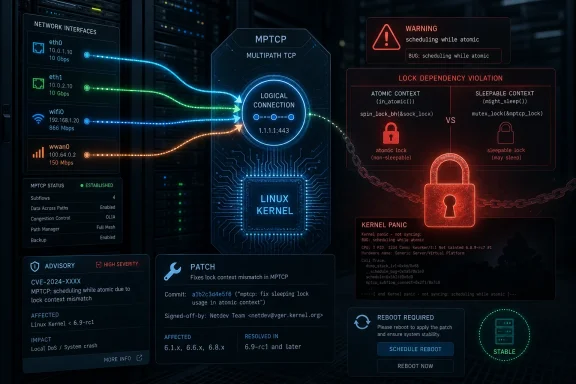
A Small Locking Bug Lands in a Big Networking Stack
The core of CVE-2026-46168 is almost comically terse: the Linux kernel’s MPTCP code used lock_sock_fast() around timestamp-related socket option helpers that are allowed to sleep. In kernel terms, that is a category error. Atomic context is the place where the kernel must not block; sleepable helpers are the place where it sometimes must.
That mismatch can produce the dreaded “scheduling while atomic” condition. On a developer workstation, that might mean a noisy crash during testing. On a server, router, appliance, container host, or storage node, it means the kernel can panic in a networking path that administrators normally expect to be boring.
The fix is equally plain: replace the fast, atomic locking path with the ordinary sleepable socket lock and release sequence. That is not a mitigation bolted onto the outside; it is the kernel being told to use the right kind of lock for the work being done. In security advisories, that sort of change can look minor. In kernel engineering, it is the difference between a fast path and a safe path.
The vulnerability sits in Multipath TCP, or MPTCP, the Linux implementation of a protocol extension that lets one logical TCP connection use multiple underlying network paths. MPTCP is the kind of feature that sounds exotic until you remember how many modern systems juggle Wi-Fi, Ethernet, cellular, VPN overlays, failover links, and multi-homed routing. It is infrastructure plumbing, and plumbing failures rarely announce themselves with a marketing name.
The Word “CVE” Does More Work Than the Scorecard
At the time the record appeared, NVD marked CVE-2026-46168 as awaiting enrichment. That means the public record existed, but the familiar severity machinery — CVSS 3.x, CVSS 4.0, weakness classification, neatly normalized vectors — had not yet caught up. This is increasingly common for Linux kernel CVEs: the identifier arrives before the risk narrative is fully packaged.
That lag creates a problem for IT teams that triage by dashboard color. A vulnerability with no score can be mistaken for a vulnerability with no consequence. CVE-2026-46168 is a reminder that those are not the same thing.
The absence of an NVD score does not prove the flaw is easily exploitable, remotely reachable, or important in every deployment. It also does not prove the flaw is harmless. What the published description does establish is narrower and more concrete: a kernel path could call sleepable timestamp functions while holding a lock that assumes atomic behavior, creating the conditions for a panic.
That makes this a reliability-and-availability issue first. If later analysis shows a wider exploit path, the severity conversation may change. But even without that escalation, a kernel panic in a networking subsystem is not trivia for anyone operating production Linux systems.
MPTCP Keeps Becoming Less Exotic
Multipath TCP has lived for years in the awkward space between “important protocol work” and “feature many admins have never knowingly touched.” Its purpose is straightforward: instead of binding a connection to one path, it can maintain subflows over multiple paths while presenting the application with what looks like a normal TCP socket. That can improve resilience, mobility, and bandwidth aggregation.
The details are messier. MPTCP has to coordinate subflows, socket state, path managers, address advertisements, fallback behavior, and compatibility with the old Internet that still mostly thinks in single TCP flows. It is a protocol feature that moves complexity downward, away from applications and into the kernel.
That makes bugs in MPTCP different from bugs in a leaf driver. A flawed driver can often be avoided by removing hardware or unloading a module. A flawed transport feature intersects with ordinary networking abstractions: sockets, options, timestamps, locks, and protocol state. Even if only a subset of machines actively use MPTCP, distributions and vendors may ship the code broadly.
This is where administrators need to resist the lazy reaction that “we do not use MPTCP.” They may be right. But on Linux systems, “not intentionally used” is not quite the same as “not present, not reachable, and not relevant.” The practical question is whether the deployed kernel includes the vulnerable code path, whether MPTCP is enabled or usable, and whether local workloads or network-facing services can hit the timestamp socket-option path in practice.
Timestamp Options Are Boring Until They Are Not
Socket timestamping is one of those features that lives far below the attention line for most users. Applications and tools may use it to receive timing metadata for packets, measure latency, support diagnostics, or implement precise networking behavior. In ordinary TCP, timestamp-related socket options are part of the broad toolbox available to low-level network programs.
The CVE description points to sock_set_timestamp() and sock_set_timestamping(), both of which can sleep. That does not mean they always sleep in a visible, dramatic way. It means the kernel cannot legally call them from a context where sleeping is forbidden.
Kernel locking rules are not etiquette; they are survival constraints. Atomic context is used where the kernel must keep moving and cannot schedule away. If code inside that context tries to sleep, the kernel’s own debugging and scheduling checks may detect the contradiction and panic rather than continue in an undefined state.
The bug, then, is not that timestamping is dangerous. It is that the MPTCP socket-option handling path wrapped timestamping work in the wrong kind of lock. That is the sort of defect that eludes casual review because each piece makes sense in isolation: socket options need synchronization, fast locks are tempting in networking code, and timestamp helpers are normal kernel utilities. The failure appears at the boundary where those assumptions meet.
“Scheduling While Atomic” Is a Panic With a Philosophy
The phrase scheduling while atomic sounds like an internal developer complaint, but it carries an operational meaning: the kernel found itself trying to perform a blocking operation in a context that promised not to block. It is not a buffer overflow headline or a cryptographic catastrophe. It is the scheduler enforcing a contract.
That contract is central to kernel design. Some code runs where it may sleep, wait for resources, take mutexes, or yield the CPU. Other code runs where it must not do any of those things because it is holding a spinlock, handling an interrupt-adjacent path, or operating under constraints that make rescheduling unsafe.
When those worlds collide, the result can be a warning, a stack trace, or a hard crash depending on configuration and circumstances. For production users, the distinction is cold comfort. A host that panics because a network path trips a kernel scheduling rule is still a host that fell over.
This is why availability bugs often deserve more attention than their CVSS scores suggest. An attacker who can reliably crash a kernel may not have gained root, but they may have achieved denial of service. In clustered environments, that may trigger failover. In edge deployments, it may require a remote reboot. In embedded appliances, it may become an outage nobody can easily diagnose.
The Patch Says More Than the Advisory
The published references point to stable kernel commits, which is the important operational signal. Linux kernel CVEs are often less useful as standalone narratives than as pointers into a patch train. The words in the CVE record tell administrators what went wrong; the stable commits tell distributions and downstream vendors what to pull.
Here, the fix is not a large architectural rewrite. It changes the locking discipline around timestamp socket-option handling in MPTCP. Instead of using lock_sock_fast(), which may acquire the socket lock in a way that leaves the caller in an atomic context, the corrected code uses lock_sock() and release_sock(), the sleepable pair appropriate for helpers that may block.
That gives this CVE a practical shape. It is unlikely to require configuration gymnastics, service rewrites, firewall rules, or application changes. The durable fix is a kernel update that includes the relevant stable patch for the kernel line you run.
The catch, as ever, is the long tail. Cloud images, vendor kernels, embedded systems, NAS devices, security appliances, hypervisors, and enterprise distributions do not all absorb upstream Linux fixes at the same pace. A patch being in stable does not mean it is already on your fleet.
Windows Shops Still Have Linux Kernel Exposure
WindowsForum readers do not need to run Linux desktops to care about a Linux kernel CVE. Most Windows-heavy environments now have Linux in the stack somewhere: WSL on developer machines, Linux containers in CI/CD, Kubernetes worker nodes, network appliances, storage arrays, security sensors, Git hosting, reverse proxies, cloud images, and embedded management controllers.
The most immediate consumer-facing question is WSL. Windows Subsystem for Linux uses a Microsoft-supplied Linux kernel in WSL 2, and its update cadence is not the same as Ubuntu, Debian, Fedora, or Arch inside the guest environment. Updating packages inside a WSL distribution does not necessarily update the WSL kernel itself.
That distinction matters whenever a vulnerability is in the kernel rather than userland. Running apt upgrade may patch OpenSSL, curl, or system libraries inside Ubuntu on WSL. It will not automatically prove that the WSL 2 kernel contains a specific upstream MPTCP fix. Administrators managing developer endpoints should treat the WSL kernel as a platform component, not merely as part of a Linux distro’s package database.
The same principle applies to container hosts. Containers share the host kernel. If a vulnerable code path exists in the host kernel, patching packages inside containers is beside the point. For this CVE, the meaningful inventory item is the kernel build on the host or appliance, not the userspace image that happens to initiate socket calls.
The Risk Is Narrower Than the Noise, But Wider Than the Label
It would be irresponsible to turn CVE-2026-46168 into a panic story. The advisory does not describe privilege escalation. It does not describe remote code execution. It does not, at publication time, provide a scored exploitability assessment. The fix addresses an unsafe scheduling condition, and the most defensible reading is an availability risk in affected MPTCP code paths.
But it would be equally irresponsible to dismiss it because it lacks a score. Kernel panics are security-relevant in environments where availability is part of the threat model. A crashable network stack is a problem for routers, gateways, VPN concentrators, multi-tenant systems, service meshes, and any host where untrusted or semi-trusted workloads can exercise low-level socket behavior.
The hardest part is determining reachability. Does the system have MPTCP enabled? Does the kernel include the affected implementation? Can unprivileged local users set the relevant socket options on MPTCP sockets? Are there network-facing services that expose a path to this behavior indirectly? Those questions are deployment-specific, which is precisely why a one-size CVSS number can be misleading.
In practice, most enterprises should not spend days building elaborate exploit theories for this one CVE. They should spend a smaller amount of time confirming kernel lineage, vendor advisory status, and whether affected machines are on update tracks that include the stable fix. The correct response is boring, which is another way of saying it is manageable.
Kernel CVEs Have Become a Patch-Management Stress Test
The Linux kernel’s recent CVE process has produced a flood of records for bugs that range from severe vulnerabilities to defensive correctness fixes. That has irritated some administrators, because every new identifier becomes another ticket, another scanner finding, another exception request, and another conversation with a risk committee.
CVE-2026-46168 fits into that uncomfortable middle. It is real. It is fixed. It is plausibly security-relevant. It is also not the sort of bug that can be understood from a severity field alone, especially when that field is not yet populated.
The result is a triage burden that increasingly rewards teams with kernel-aware processes. The old workflow — wait for NVD, sort by score, patch the reds — is not enough when upstream fixes land before enrichment and when distribution kernels backport patches without changing their visible major version. A Linux 6.8-based enterprise kernel may contain fixes from much later upstream work; a newer-looking community kernel may still be waiting for a specific stable update depending on timing.
Security teams need to ask more precise questions. Which kernel source package is deployed? Which downstream advisory covers this CVE? Which stable commit was backported? Has the machine rebooted into the fixed kernel, or merely installed it? Those are not academic details. They are the difference between a clean scanner report and a genuinely remediated host.
The Windows Lesson Is About Shared Infrastructure, Not Rival Platforms
There is a temptation in mixed-platform communities to treat Linux kernel CVEs as someone else’s problem. That reflex is obsolete. Windows estates depend on Linux constantly, often invisibly, and the boundary between the two platforms is now an operational seam rather than a wall.
Developers build Windows applications inside Linux containers. Security teams collect telemetry from Linux sensors. Enterprises run identity-adjacent services on Linux appliances. Cloud workloads move between Windows and Linux nodes behind the same load balancers. Even Microsoft’s own developer story assumes comfort with WSL, containers, and cross-platform tooling.
That does not make every Linux CVE a Windows emergency. It does mean Windows administrators increasingly need enough Linux fluency to distinguish userland updates from kernel updates, upstream fixes from vendor backports, and scary CVE counts from actual exposure. CVE-2026-46168 is a good example because its danger is not obvious from the headline. You have to understand where the code lives and how it can be reached.
The same maturity is required in the other direction. Linux administrators who host Windows workloads in virtualization stacks or integrate with Active Directory have their own cross-platform dependencies. Modern infrastructure is not neatly ideological. It is a pile of kernels, runtimes, firmware, agents, and management planes stitched together by maintenance windows.
The Operators’ Job Is to Convert Ambiguity Into Routine
The best response to CVE-2026-46168 is neither alarm nor apathy. It is inventory, vendor tracking, and reboot discipline. Kernel fixes are only real after the fixed kernel is installed and running, and that last step remains one of the most stubborn gaps in enterprise patch management.
Administrators should start by identifying affected Linux kernel streams in their environment. That includes bare-metal servers, VM templates, Kubernetes nodes, developer workstations using WSL 2, network appliances where the vendor exposes kernel advisory data, and CI runners that may lag behind standard update policies. If the system cannot be patched directly because it is an appliance, the question shifts to vendor firmware or support status.
Next comes exposure assessment. Systems with MPTCP disabled and no realistic path to the affected socket-option handling may be lower priority than multi-user Linux hosts, edge systems, or machines that run untrusted workloads. But lower priority is not no priority; kernel patching usually arrives bundled with other fixes, and deferring one “medium-looking” issue often means deferring several others you have not read yet.
Finally, teams should document the basis for their decision. “No NVD score” is a weak justification. “Vendor has not yet issued an affected package,” “MPTCP is disabled by policy,” “fixed kernel scheduled for the next reboot window,” or “host already running a backported patch level” are much stronger. The goal is to turn advisory fog into operational facts.
The Patch Is the Story, and the Reboot Is the Ending
CVE-2026-46168 is not likely to become the vulnerability everyone remembers from 2026. It has no catchy name, no public exploit in the advisory, and no severity score at the time of publication. Its importance lies in what it reveals about the everyday fragility of kernel networking code and the patch systems built around it.
The concrete takeaways are refreshingly direct:
- The vulnerability affects Linux kernel MPTCP socket-option handling, specifically timestamp-related helpers called under an unsafe atomic locking context.
- The known failure mode is a “scheduling while atomic” condition that can lead to a kernel panic, making availability the clearest immediate risk.
- NVD had published the CVE record on May 28, 2026, but had not yet assigned CVSS severity metrics when the record first appeared.
- The upstream fix replaces the fast atomic socket lock with the sleepable
lock_sock()andrelease_sock()sequence appropriate for helpers that may block. - Windows-heavy organizations should still check exposure through WSL 2, Linux container hosts, appliances, cloud images, and developer infrastructure.
- Installing a fixed kernel package is not enough; affected systems must boot into the corrected kernel before the remediation is complete.
This is the kind of CVE that separates checkbox security from operational security. A scanner will eventually learn how to label it, but operators do not need to wait for the label to understand the shape of the problem. MPTCP’s timestamp bug is a small locking mistake with a large lesson: as infrastructure becomes more cross-platform and kernel features become more ambitious, the safest organizations will be the ones that can read past the score, follow the patch, and make the reboot happen before the obscure edge case becomes tomorrow’s outage.
References
- CVE-2026-46168 mptcp: fix scheduling with atomic in timestamp sockopt NVD / Linux Kernel · 2026-05-29T01:02:39-07:00