

CVE-2026-46172 is a newly published Linux kernel vulnerability from kernel.org, added to NVD on May 28, 2026, involving an IPv6 XFRM receive path that can leak route destination references when repeated encapsulated packets hit an error route. It is not yet scored by NVD, and that absence is the story as much as the bug itself. This is the kind of kernel issue that can look modest in a dashboard while still mattering deeply to operators who run Linux networking at scale. The practical lesson is familiar but uncomfortable: modern vulnerability response increasingly begins before the vulnerability database has finished explaining the vulnerability.
The bug fixed under CVE-2026-46172 lives in
The flaw is mechanically simple. When an incoming packet reaches
That is how an unglamorous accounting mistake becomes a security bug. One packet leaks one reference. Repeated packets leak more. Over time, the system can accumulate unreleased destination entries, consuming kernel resources in a path reachable through network traffic under the right conditions.
This is not a flashy memory-corruption exploit with a named logo and a weekend proof-of-concept race. It is a leak in the kernel’s routing object lifecycle. But for administrators, especially those responsible for edge nodes, VPN concentrators, IPv6-capable appliances, and Linux-based infrastructure that processes untrusted traffic, resource leaks are not trivia. They are often the difference between a noisy scan and a service that slowly becomes its own denial-of-service test rig.
That gap is increasingly normal. NVD has been under visible strain from the sheer volume of vulnerability records, and in 2026 it publicly described a risk-based enrichment model that prioritizes some CVEs ahead of others. The result is a two-speed vulnerability ecosystem: upstream maintainers publish fixes and references quickly, while downstream scoring and classification may arrive later.
For a WindowsForum audience, this matters even if the bug is in Linux. Many Windows-heavy organizations now run Linux in the places users never see: WSL developer environments, Azure and AWS workloads, Kubernetes clusters, storage appliances, firewalls, monitoring stacks, CI runners, and VPN infrastructure. A missing CVSS score does not mean the flaw is irrelevant. It means the organization must evaluate exposure rather than outsourcing judgment to a number that has not arrived.
The uncomfortable truth is that CVSS has become a workflow crutch. It is useful for comparison, but it is not a substitute for asking whether a vulnerable subsystem is exposed, reachable, enabled, and carrying business-critical traffic. CVE-2026-46172 is a good example of a vulnerability that rewards context over reflex.
That intersection is fertile ground for bugs. Packet paths are full of early exits: malformed input, failed lookups, policy misses, missing state, error routes, dropped packets. Every one of those exits must clean up exactly the resources it acquired before it decided to abandon the packet. The CVE-2026-46172 fix does not appear to redesign the subsystem; it corrects the cleanup path by releasing the destination reference before jumping to the drop logic.
The pattern should sound familiar to anyone who has debugged kernel networking. The happy path receives most of the testing because it carries production traffic. The failure path receives malicious traffic, weird routing states, malformed packets, and unusual combinations of network configuration. Security researchers and attackers both live in the mismatch.
This is why apparently minor cleanup bugs can become operationally meaningful. Kernel code that processes packets does not need to give an attacker arbitrary code execution to create risk. It can create risk by letting remote or adjacent traffic consume a resource faster than the system releases it.
CVE-2026-46172 is specifically in the IPv6 XFRM receive path. That narrows exposure, but it also makes inventory harder. Many organizations have excellent visibility into public IPv4 listeners and surprisingly little visibility into IPv6 reachability, firewall parity, tunnel behavior, and route policy. The bug’s trigger condition also depends on packets reaching a path where the socket buffer lacks a destination entry and the route lookup resolves to an error route, which is not the same as “any IPv6 packet crashes the host.”
That nuance should prevent panic, not action. The right response is not to declare every Linux system at equal risk. The right response is to identify Linux systems that process IPv6 encapsulated traffic, use IPsec or XFRM-related functionality, sit at routing boundaries, or receive untrusted traffic in complex network topologies.
The operational danger is that IPv6 exposure is often accidental. A system may be reachable over IPv6 because a cloud image, router advertisement, container network, or provider default made it so. A vulnerability in an IPv6 path therefore punishes assumptions made years ago and never audited again.
That distinction matters. Security teams should not inflate the bug into something it is not. Overstating every kernel CVE trains administrators to ignore the next advisory, and it erodes trust when the remediation conversation reaches executives. There is a meaningful difference between “patch because attackers can get root” and “patch because repeated network traffic can leak kernel routing resources.”
But availability bugs can still be serious. A resource leak in a kernel receive path is not equivalent to a leak in a rarely used command-line utility. It lives in code designed to handle repeated input at network speed. If the preconditions are met, repetition is not a theoretical burden for an attacker; repetition is what networks do.
This is why severity scoring, when it arrives, will need to be read alongside deployment reality. A desktop Linux VM with no relevant IPv6/XFRM exposure is not the same as a VPN gateway or multi-tenant host. The same CVE can be background noise in one environment and a weekend change window in another.
That model is fast, but it is not simple for enterprises. Most organizations do not run vanilla kernel.org releases. They run distribution kernels from Ubuntu, Debian, Red Hat, SUSE, Amazon Linux, Oracle, AlmaLinux, Rocky Linux, or appliance vendors. Those kernels may carry backports, custom patches, and version numbers that do not map cleanly to upstream releases.
The practical question is therefore not “which upstream commit fixed this?” but “has my vendor shipped the fix for my kernel line?” In Linux operations, version strings can lie by omission. A distribution kernel may show an older base version while carrying the security fix as a backport. Conversely, an appliance may lag behind while presenting a friendly management UI that hides the kernel entirely.
That is why administrators should resist the temptation to do vulnerability management by upstream commit hash alone. The commit is evidence; the vendor package is the deliverable. For fleets, the reliable path is to track vendor advisories, package changelogs, and kernel build metadata, then verify live systems after reboot.
WSL is the obvious bridge, though it is unlikely to be the primary exposure point for this specific network receive-path issue in most environments. The more important bridge is operational: Windows clients authenticate to services hosted on Linux, developers build Windows software on Linux CI runners, and enterprise networks route traffic through Linux appliances. Even a Microsoft-first shop may have Linux in exactly the places where packet-processing bugs matter most.
There is also a tooling angle. Vulnerability scanners, endpoint platforms, and asset inventories built around Windows patch models can struggle with Linux kernel backports. A Windows cumulative update has a visible identity and a predictable release rhythm. Linux kernel fixes arrive through a distribution-specific chain that may require reboot coordination, workload migration, and careful handling of custom modules.
The lesson for mixed estates is not to panic over every Linux CVE. It is to stop treating Linux as “the other team’s problem” when it underpins Windows-facing services. If a Linux VPN gateway fails, the outage is not a Linux outage to the user. It is “the network is down.”
This new CVE should not be casually folded into those issues as if they are the same flaw. The described impact here is a destination reference leak on an IPv6 error path, not page-cache corruption and not a direct local root primitive. But security teams do not operate one CVE at a time in a vacuum. Patterns influence prioritization.
When the same subsystem family appears repeatedly in advisories, it changes the risk conversation. It suggests that code paths once considered niche are receiving fresh scrutiny from researchers, maintainers, and attackers. It also means patches may land in rapid succession, creating pressure on administrators who prefer quarterly kernel maintenance windows.
That pressure is healthy up to a point. Kernel networking bugs are rarely convenient, and the worst response is to wait for the advisory ecosystem to become tidy. The better response is to treat this as another prompt to examine whether systems using XFRM, IPsec, IPv6, and encapsulated traffic are patched, monitored, and properly segmented.
A system has higher concern if it accepts relevant encapsulated IPv6 traffic from untrusted or semi-trusted networks. A system has lower concern if the affected path is not reachable, IPv6 is disabled or tightly filtered, XFRM/IPsec functionality is unused, and the host is not positioned as a gateway or tunnel endpoint. That is not a guarantee of safety, but it is the beginning of a rational triage model.
Resource leaks also depend on rate and persistence. One malformed or unlucky packet is not the same as a stream of packets engineered to hit the error path repeatedly. Network controls that rate-limit, filter unexpected encapsulation, enforce route sanity, or isolate tunnel endpoints may reduce practical exposure while patches are staged.
Still, mitigation should not become an excuse for indefinite delay. Kernel memory and routing resources are shared foundations. Once a leak is confirmed and fixed upstream, every compensating control should be treated as temporary unless the affected code path is conclusively absent.
For servers that handle network traffic, reboot planning can be politically harder than patch installation. VPN concentrators, routers, Kubernetes nodes, storage gateways, and edge appliances may have maintenance windows tied to business hours, redundancy assumptions, and customer impact. A low-drama kernel bug can still create high-drama scheduling if the system is critical and failover has not been tested.
This is where administrators should be blunt with stakeholders. The cost of rebooting a redundant node during a planned window is visible. The cost of leaving a kernel networking resource leak unpatched is invisible until it becomes an incident. Good operations is the art of preferring visible, controlled inconvenience over invisible, uncontrolled risk.
For fleets, verification matters. After patching and rebooting, administrators should confirm the running kernel build, not merely the installed package list. They should also check whether any long-lived hosts escaped maintenance because they were excluded, pinned, manually customized, or hidden behind appliance abstractions.
That is not purely a tooling failure. Linux kernel vulnerability mapping is genuinely hard. Upstream commits land across several stable branches, distributions backport fixes, cloud providers maintain custom kernels, and appliances may not expose enough information for clean detection. A scanner can be technically correct and still operationally unhelpful.
Security teams should respond by enriching the ticket themselves. The useful fields are concrete: whether the host runs Linux, whether its kernel vendor has issued a fixed package, whether it uses IPv6/XFRM/IPsec or sits in a relevant network role, whether it is internet-facing or exposed to untrusted networks, and whether the fixed kernel is actually running.
That kind of local context is more valuable than waiting for a perfect CVSS number. CVSS can eventually tell you how the industry broadly views the vulnerability. It cannot tell you whether your forgotten IPv6-enabled tunnel host is sitting in the blast radius.
Start with exposure. Identify Linux systems that process IPv6 traffic, especially systems using IPsec, XFRM, tunnel termination, security gateways, or complex routing. Review whether IPv6 is intentionally enabled and whether firewall rules apply consistently across IPv4 and IPv6. In many environments, this audit will produce value beyond the CVE.
Then track vendor fixes. Kernel.org references are the upstream trail, but production systems need distribution packages or vendor firmware. For cloud images and managed nodes, check the provider’s kernel stream. For appliances, push the vendor for explicit confirmation rather than accepting “not affected” without a kernel lineage explanation.
Finally, monitor for symptoms that match the bug’s nature. Resource leaks may appear as memory pressure, route cache anomalies, degraded packet handling, or unexplained networking instability under repeated traffic. Those symptoms are not proof of exploitation, but they are signals worth correlating with exposure and patch status.
The most important facts are already actionable, even without NVD scoring:
The direction of travel is clear: Linux kernel security response is becoming faster upstream, messier downstream, and more dependent on local operational judgment. CVE-2026-46172 asks administrators to do the hard work that databases cannot do for them—map code paths to real exposure, patch what matters, and stop assuming that an unenriched CVE is an unimportant one.
 A Small Reference Leak Lands in a Very Large Attack Surface
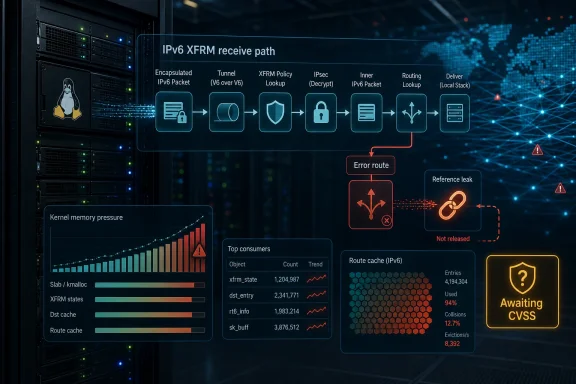
The bug fixed under CVE-2026-46172 lives in xfrm6_rcv_encap(), part of the IPv6 side of Linux’s XFRM framework. XFRM is the kernel machinery behind IPsec transformation and related packet-processing paths, which means it sits close to the plumbing used by VPNs, tunnels, container hosts, gateways, and other systems that do far more than browse the web.The flaw is mechanically simple. When an incoming packet reaches
xfrm6_rcv_encap() without an attached destination cache entry, the kernel performs an IPv6 route lookup. That lookup can return a referenced destination object even when the result is an error route. If the destination object reports an error, the function drops the packet, but the vulnerable code path fails to release the reference it just acquired.That is how an unglamorous accounting mistake becomes a security bug. One packet leaks one reference. Repeated packets leak more. Over time, the system can accumulate unreleased destination entries, consuming kernel resources in a path reachable through network traffic under the right conditions.
This is not a flashy memory-corruption exploit with a named logo and a weekend proof-of-concept race. It is a leak in the kernel’s routing object lifecycle. But for administrators, especially those responsible for edge nodes, VPN concentrators, IPv6-capable appliances, and Linux-based infrastructure that processes untrusted traffic, resource leaks are not trivia. They are often the difference between a noisy scan and a service that slowly becomes its own denial-of-service test rig.
The Missing CVSS Score Is Not a Permission Slip
NVD currently marks the CVE as awaiting enrichment, with no CVSS v4.0, v3.x, or v2.0 score assigned. That means many security tools will ingest the identifier before they can attach the familiar severity shorthand that drives ticket routing, patch windows, and executive reporting. The dashboard may show an incomplete record; the kernel has already moved on.That gap is increasingly normal. NVD has been under visible strain from the sheer volume of vulnerability records, and in 2026 it publicly described a risk-based enrichment model that prioritizes some CVEs ahead of others. The result is a two-speed vulnerability ecosystem: upstream maintainers publish fixes and references quickly, while downstream scoring and classification may arrive later.
For a WindowsForum audience, this matters even if the bug is in Linux. Many Windows-heavy organizations now run Linux in the places users never see: WSL developer environments, Azure and AWS workloads, Kubernetes clusters, storage appliances, firewalls, monitoring stacks, CI runners, and VPN infrastructure. A missing CVSS score does not mean the flaw is irrelevant. It means the organization must evaluate exposure rather than outsourcing judgment to a number that has not arrived.
The uncomfortable truth is that CVSS has become a workflow crutch. It is useful for comparison, but it is not a substitute for asking whether a vulnerable subsystem is exposed, reachable, enabled, and carrying business-critical traffic. CVE-2026-46172 is a good example of a vulnerability that rewards context over reflex.
XFRM Keeps Reappearing Because It Sits Where Packets Become Policy
XFRM is not new, obscure, or optional in the way some kernel modules are optional. It is a central Linux framework for transforming packets, particularly in IPsec scenarios. It is also a place where policy decisions, routing decisions, encryption state, packet metadata, and memory ownership all intersect.That intersection is fertile ground for bugs. Packet paths are full of early exits: malformed input, failed lookups, policy misses, missing state, error routes, dropped packets. Every one of those exits must clean up exactly the resources it acquired before it decided to abandon the packet. The CVE-2026-46172 fix does not appear to redesign the subsystem; it corrects the cleanup path by releasing the destination reference before jumping to the drop logic.
The pattern should sound familiar to anyone who has debugged kernel networking. The happy path receives most of the testing because it carries production traffic. The failure path receives malicious traffic, weird routing states, malformed packets, and unusual combinations of network configuration. Security researchers and attackers both live in the mismatch.
This is why apparently minor cleanup bugs can become operationally meaningful. Kernel code that processes packets does not need to give an attacker arbitrary code execution to create risk. It can create risk by letting remote or adjacent traffic consume a resource faster than the system releases it.
IPv6 Turns Dormant Paths Into Real Exposure
For years, administrators treated IPv6 as the feature that was technically enabled but practically irrelevant. That posture is less defensible now. Cloud providers, mobile networks, enterprise edge devices, modern Windows clients, and Linux servers all increasingly assume IPv6 is part of normal connectivity, even when the human maintenance plan still thinks in IPv4.CVE-2026-46172 is specifically in the IPv6 XFRM receive path. That narrows exposure, but it also makes inventory harder. Many organizations have excellent visibility into public IPv4 listeners and surprisingly little visibility into IPv6 reachability, firewall parity, tunnel behavior, and route policy. The bug’s trigger condition also depends on packets reaching a path where the socket buffer lacks a destination entry and the route lookup resolves to an error route, which is not the same as “any IPv6 packet crashes the host.”
That nuance should prevent panic, not action. The right response is not to declare every Linux system at equal risk. The right response is to identify Linux systems that process IPv6 encapsulated traffic, use IPsec or XFRM-related functionality, sit at routing boundaries, or receive untrusted traffic in complex network topologies.
The operational danger is that IPv6 exposure is often accidental. A system may be reachable over IPv6 because a cloud image, router advertisement, container network, or provider default made it so. A vulnerability in an IPv6 path therefore punishes assumptions made years ago and never audited again.
The Bug Is About Leaking State, Not Stealing Secrets
The available description does not support a claim that CVE-2026-46172 directly enables privilege escalation, remote code execution, or data theft. The stated issue is a leak of referenced destination entries when packets are dropped after an error route result. That points most naturally toward availability risk: resource exhaustion, degraded networking, and potentially service disruption.That distinction matters. Security teams should not inflate the bug into something it is not. Overstating every kernel CVE trains administrators to ignore the next advisory, and it erodes trust when the remediation conversation reaches executives. There is a meaningful difference between “patch because attackers can get root” and “patch because repeated network traffic can leak kernel routing resources.”
But availability bugs can still be serious. A resource leak in a kernel receive path is not equivalent to a leak in a rarely used command-line utility. It lives in code designed to handle repeated input at network speed. If the preconditions are met, repetition is not a theoretical burden for an attacker; repetition is what networks do.
This is why severity scoring, when it arrives, will need to be read alongside deployment reality. A desktop Linux VM with no relevant IPv6/XFRM exposure is not the same as a VPN gateway or multi-tenant host. The same CVE can be background noise in one environment and a weekend change window in another.
Kernel.org’s Fix-First Model Leaves Enterprises With the Hard Part
The CVE record points to multiple stable kernel commits, which is typical for Linux kernel security fixes that need to land across supported branches. The kernel community often resolves the vulnerability in code before the broader ecosystem has translated it into distribution advisories, package versions, scanner plugins, and compliance language.That model is fast, but it is not simple for enterprises. Most organizations do not run vanilla kernel.org releases. They run distribution kernels from Ubuntu, Debian, Red Hat, SUSE, Amazon Linux, Oracle, AlmaLinux, Rocky Linux, or appliance vendors. Those kernels may carry backports, custom patches, and version numbers that do not map cleanly to upstream releases.
The practical question is therefore not “which upstream commit fixed this?” but “has my vendor shipped the fix for my kernel line?” In Linux operations, version strings can lie by omission. A distribution kernel may show an older base version while carrying the security fix as a backport. Conversely, an appliance may lag behind while presenting a friendly management UI that hides the kernel entirely.
That is why administrators should resist the temptation to do vulnerability management by upstream commit hash alone. The commit is evidence; the vendor package is the deliverable. For fleets, the reliable path is to track vendor advisories, package changelogs, and kernel build metadata, then verify live systems after reboot.
Windows Shops Are Not Bystanders Anymore
A decade ago, a Linux IPv6 XFRM bug might have seemed distant to a Windows-centric administrator. In 2026, that boundary is mostly fictional. Windows environments commonly depend on Linux in the cloud, in containers, in identity-adjacent infrastructure, in VPN stacks, in monitoring systems, and in developer workflows.WSL is the obvious bridge, though it is unlikely to be the primary exposure point for this specific network receive-path issue in most environments. The more important bridge is operational: Windows clients authenticate to services hosted on Linux, developers build Windows software on Linux CI runners, and enterprise networks route traffic through Linux appliances. Even a Microsoft-first shop may have Linux in exactly the places where packet-processing bugs matter most.
There is also a tooling angle. Vulnerability scanners, endpoint platforms, and asset inventories built around Windows patch models can struggle with Linux kernel backports. A Windows cumulative update has a visible identity and a predictable release rhythm. Linux kernel fixes arrive through a distribution-specific chain that may require reboot coordination, workload migration, and careful handling of custom modules.
The lesson for mixed estates is not to panic over every Linux CVE. It is to stop treating Linux as “the other team’s problem” when it underpins Windows-facing services. If a Linux VPN gateway fails, the outage is not a Linux outage to the user. It is “the network is down.”
The Recent XFRM Cluster Raises the Temperature
CVE-2026-46172 arrives after a noisy spring for Linux kernel networking and XFRM-related security work. Other recent vulnerabilities have drawn attention to the same broad neighborhood of packet transformation, encryption, and page-cache interaction. Some of those bugs carried more dramatic implications, including local privilege escalation scenarios, proof-of-concept discussion, and urgent distribution response.This new CVE should not be casually folded into those issues as if they are the same flaw. The described impact here is a destination reference leak on an IPv6 error path, not page-cache corruption and not a direct local root primitive. But security teams do not operate one CVE at a time in a vacuum. Patterns influence prioritization.
When the same subsystem family appears repeatedly in advisories, it changes the risk conversation. It suggests that code paths once considered niche are receiving fresh scrutiny from researchers, maintainers, and attackers. It also means patches may land in rapid succession, creating pressure on administrators who prefer quarterly kernel maintenance windows.
That pressure is healthy up to a point. Kernel networking bugs are rarely convenient, and the worst response is to wait for the advisory ecosystem to become tidy. The better response is to treat this as another prompt to examine whether systems using XFRM, IPsec, IPv6, and encapsulated traffic are patched, monitored, and properly segmented.
The Real Exploitability Question Is Reachability
The CVE description gives us the root cause but not a complete exploit recipe. That is common for kernel records, and it leaves administrators with a familiar middle ground: enough information to know what code is wrong, not enough to rank every asset automatically. The most important variable is reachability.A system has higher concern if it accepts relevant encapsulated IPv6 traffic from untrusted or semi-trusted networks. A system has lower concern if the affected path is not reachable, IPv6 is disabled or tightly filtered, XFRM/IPsec functionality is unused, and the host is not positioned as a gateway or tunnel endpoint. That is not a guarantee of safety, but it is the beginning of a rational triage model.
Resource leaks also depend on rate and persistence. One malformed or unlucky packet is not the same as a stream of packets engineered to hit the error path repeatedly. Network controls that rate-limit, filter unexpected encapsulation, enforce route sanity, or isolate tunnel endpoints may reduce practical exposure while patches are staged.
Still, mitigation should not become an excuse for indefinite delay. Kernel memory and routing resources are shared foundations. Once a leak is confirmed and fixed upstream, every compensating control should be treated as temporary unless the affected code path is conclusively absent.
Patch Management Still Ends With a Reboot
Linux kernel fixes have one stubborn property: installing the package is not the same as running the fixed kernel. Unless live patching is available and covers the specific change, systems generally need a reboot before the new kernel is active. That is where vulnerability remediation leaves the scanner and enters the change calendar.For servers that handle network traffic, reboot planning can be politically harder than patch installation. VPN concentrators, routers, Kubernetes nodes, storage gateways, and edge appliances may have maintenance windows tied to business hours, redundancy assumptions, and customer impact. A low-drama kernel bug can still create high-drama scheduling if the system is critical and failover has not been tested.
This is where administrators should be blunt with stakeholders. The cost of rebooting a redundant node during a planned window is visible. The cost of leaving a kernel networking resource leak unpatched is invisible until it becomes an incident. Good operations is the art of preferring visible, controlled inconvenience over invisible, uncontrolled risk.
For fleets, verification matters. After patching and rebooting, administrators should confirm the running kernel build, not merely the installed package list. They should also check whether any long-lived hosts escaped maintenance because they were excluded, pinned, manually customized, or hidden behind appliance abstractions.
Scanners Will Lag Where Operators Need Clarity
Because NVD enrichment is pending, some vulnerability scanners may initially show CVE-2026-46172 with incomplete severity, missing weakness mapping, absent affected-product detail, or generic Linux kernel language. Others may ingest distribution advisories faster than NVD updates. The result is inconsistent reporting during the window when administrators most need consistency.That is not purely a tooling failure. Linux kernel vulnerability mapping is genuinely hard. Upstream commits land across several stable branches, distributions backport fixes, cloud providers maintain custom kernels, and appliances may not expose enough information for clean detection. A scanner can be technically correct and still operationally unhelpful.
Security teams should respond by enriching the ticket themselves. The useful fields are concrete: whether the host runs Linux, whether its kernel vendor has issued a fixed package, whether it uses IPv6/XFRM/IPsec or sits in a relevant network role, whether it is internet-facing or exposed to untrusted networks, and whether the fixed kernel is actually running.
That kind of local context is more valuable than waiting for a perfect CVSS number. CVSS can eventually tell you how the industry broadly views the vulnerability. It cannot tell you whether your forgotten IPv6-enabled tunnel host is sitting in the blast radius.
Defensive Work Starts Before the Advisory Is Complete
The immediate response to CVE-2026-46172 should be measured. Administrators should not rip out IPv6, disable IPsec blindly, or assume compromise. The public description points to a leak fixed by releasing a destination reference on the error path. The response should match that technical shape.Start with exposure. Identify Linux systems that process IPv6 traffic, especially systems using IPsec, XFRM, tunnel termination, security gateways, or complex routing. Review whether IPv6 is intentionally enabled and whether firewall rules apply consistently across IPv4 and IPv6. In many environments, this audit will produce value beyond the CVE.
Then track vendor fixes. Kernel.org references are the upstream trail, but production systems need distribution packages or vendor firmware. For cloud images and managed nodes, check the provider’s kernel stream. For appliances, push the vendor for explicit confirmation rather than accepting “not affected” without a kernel lineage explanation.
Finally, monitor for symptoms that match the bug’s nature. Resource leaks may appear as memory pressure, route cache anomalies, degraded packet handling, or unexplained networking instability under repeated traffic. Those symptoms are not proof of exploitation, but they are signals worth correlating with exposure and patch status.
The CVE Teaches More Than Its Score Will
CVE-2026-46172 will eventually become another row in vulnerability databases, scanner exports, and patch reports. Its long-term importance may be modest compared with higher-impact kernel flaws. But its short-term value is that it exposes several truths administrators cannot afford to ignore.The most important facts are already actionable, even without NVD scoring:
- CVE-2026-46172 was published by NVD on May 28, 2026, from kernel.org material, and NVD has not yet assigned severity metrics.
- The flaw affects an IPv6 XFRM receive path where an error-route destination reference can be leaked instead of released.
- The most plausible risk described by the available record is resource exhaustion or availability impact, not confirmed privilege escalation or data theft.
- Systems that process untrusted IPv6 encapsulated traffic, IPsec, XFRM, or gateway workloads deserve faster attention than ordinary hosts with no relevant exposure.
- Administrators should follow distribution and vendor kernel updates, then verify the fixed kernel is actually running after reboot.
- A missing CVSS score should trigger local triage, not operational paralysis.
The direction of travel is clear: Linux kernel security response is becoming faster upstream, messier downstream, and more dependent on local operational judgment. CVE-2026-46172 asks administrators to do the hard work that databases cannot do for them—map code paths to real exposure, patch what matters, and stop assuming that an unenriched CVE is an unimportant one.
References
- Primary source: NVD / Linux Kernel
Published: 2026-05-29T01:02:25-07:00
NVD - CVE-2026-46172
 nvd.nist.gov
- Security advisory: MSRC
Published: 2026-05-29T01:02:25-07:00
Original feed URL
Security Update Guide - Microsoft Security Response Center
 msrc.microsoft.com
- Official source: nist.gov
National Vulnerability Database
NIST maintains the National Vulnerability Database (NVD), a repository of information on software and hardware flaws that can compromise computer security. This is a key piece of the nation’s cybersecurity infrastructure.www.nist.gov - Related coverage: techradar.com
Another major Linux security issue uncovered - new Fragnesia flaw allows attackers to run malicious code as root | TechRadar
The flaw is in the same family as Dirty Fragwww.techradar.com - Related coverage: infoq.com
Copy Fail and Dirty Frag: Linux Page-Cache Exploits Target Every Major Distribution - InfoQ
Two recent Linux kernel vulnerabilities have been disclosed: Copy Fail (CVE-2026-31431) on April 29, 2026, and Dirty Frag (CVE-2026-43284 and CVE-2026-43500) on May 7, 2026. Both allow local users towww.infoq.com
- Related coverage: labs.cloudsecurityalliance.org
NVD Enrichment Triage: Enterprise Vulnerability Programs Must Adapt
PDF documentlabs.cloudsecurityalliance.org
