

CVE-2026-46215 is a reported Linux kernel local privilege-escalation vulnerability involving the DRM Graphics Execution Manager. The actionable bottom line is straightforward: public reporting says that, where the affected
Administrators should first determine whether the running Linux kernel is covered by an applicable vendor advisory and whether the relevant system exposes
The ioctl was introduced upstream in Linux v6.18-rc1 for an AMD-related checkpoint-and-restore use case. That introduction point is useful for investigation, but it is not a universal affected-version boundary. Distribution and product kernels may omit the feature, modify it, or backport either the affected code or its correction.
CyberPress, summarizing the published researcher analysis, classifies the defect as an expired-pointer dereference or use-after-free associated with CWE-825. The reporting describes a race between
CyberPress also reports that the researcher developed a proof of concept that converted the condition into root access in a test environment, including a demonstration that modified
Those are claims from the public research, not universal results independently reproduced by WindowsForum. Race behavior and exploit reliability may differ among kernel builds, configurations, hardware, and workloads. The supplied facts establish neither a complete affected-product list nor active exploitation in the wild.
According to the analysis summarized by CyberPress, the security issue appears when that handle change occurs concurrently with a handle-close operation. The reporting says the affected implementation did not use the complete handle-lifecycle paths needed to keep object publication, lookup, reference handling, and release coordinated throughout the transition.
Under the reported racing sequence, one thread changes or moves a handle while another closes a handle involved in the operation. CyberPress says this can allow the underlying object to be released while another reachable handle path remains. The resulting condition is reported as a use-after-free.
WindowsForum is not independently declaring a root-cause conclusion beyond that source material. The supportable finding is narrower: CyberPress and the published researcher analysis describe a handle-lifetime race that can reportedly be exploited for local privilege escalation when the affected operation is present and reachable.
The race also explains why ordinary sequential testing may not expose the flaw. The public analysis depends on concurrent operations reaching an unsafe ordering; it does not merely describe a handle-change request failing during routine use.
Use the following matrix as a prioritized investigation guide rather than a universal exploitability statement:
A missing render node means the reported device path is not currently visible at the location checked. It does not prove that the running kernel lacks the affected implementation, and it does not establish that the device can never appear after a driver, service, workload, or configuration change.
Likewise, the presence of a render node does not by itself prove that an account can successfully invoke the affected operation. Device permissions, ACLs, kernel configuration, driver support, and the presence or absence of the relevant ioctl implementation all matter.
CyberPress reports that the researcher’s proof of concept progressed from the DRM condition to root access and demonstrated that outcome by modifying
That number should not be used as an estate-wide probability. The supplied facts do not establish identical behavior across distributions, kernel configurations, processor counts, graphics drivers, or hardware. It is best read as evidence that the researcher reported a repeatable result in a particular tested configuration rather than only a theoretical crash.
The available information does not support adding more specific claims about heap-reclamation objects, pointer disclosures, KASLR defeat, Dirty Pipe techniques, page-cache manipulation, or individual pipe flags. Such details would require direct primary evidence tying them to this vulnerability.
For defensive triage, the reported endpoint is sufficient: public research describes a local route from access to the affected DRM interface to root privileges. That warrants prompt investigation when the vendor confirms an affected build and the device path is reachable.
There is no supplied evidence of active exploitation in the wild. A public proof of concept can increase reproduction risk, but publication does not by itself prove malicious use.
Use the following order of authority:
Installing a package is not the end of the response. A Linux system normally continues running the previously booted kernel until it restarts. The package database can therefore show a newer kernel while
Treat live patching as sufficient only if the responsible vendor explicitly says its live-patch product covers CVE-2026-46215 or the corresponding DRM correction and provides a supported way to verify that coverage. Without that assurance, plan to reboot into the corrected kernel.
Save the exact output with the host name, collection time, and vendor guidance used for comparison.
For custom or appliance kernels, ask the responsible vendor or internal kernel team whether the build contains
Record a no-node result rather than creating a device or assuming one should exist. Perform the check during representative operation if the system’s graphics or accelerated workloads are not always active.
After confirming that render nodes exist, run:
Or use a shell-safe conditional:
Review the owner, group, named-user entries, named-group entries, mask, and effective permissions. If
Where practical, test from the actual user or service context under investigation. A console user, service account, WSL process, VM workload, scheduled job, and containerized process may not have identical access.
This is a supporting observation, not a conclusive vulnerability test. A blank result does not establish that the relevant code is absent, and loaded DRM-related modules do not establish that the affected ioctl is present or reachable.
If no advisory exists yet, do not select a supposed fixed version based only on upstream numbering. Continue monitoring the vendor and document temporary exposure controls.
Before rebooting, follow normal operational checks for boot configuration, storage capacity, redundancy, and recovery access. These are deployment precautions, not evidence about the CVE itself.
After the system returns:
Compare the result with the fixed build identified by the vendor. If the expected kernel is installed but not running, investigate the system’s boot selection and update process.
Repeat the device and permission checks:
Confirm that required workloads still function and that render-node access is no broader than intended.
If the system does not need DRM functionality, administrators may evaluate blocking the relevant modules as defense in depth. This must be tested for the specific platform. The supplied facts do not establish which modules can be disabled safely on any given workstation, server, appliance, VM, or WSL configuration.
Module restrictions are not substitutes for a corrected kernel. They may be incomplete, may be overridden by configuration changes, and may not apply when relevant code is built into the kernel.
Preserve appropriate logs and system state, then follow the organization’s incident-response procedures. The researcher’s reported
Possible future removal does not correct currently running kernels. Near-term response still depends on a vendor-supported determination, installation of a corrected package when available, reboot, and post-reboot verification.
Organizations using the associated AMD or CRIU workflow should track two separate questions:
Those facts do not establish that the person who made the April 12 contact was an unnamed “Cyberstan researcher,” nor do they establish a parallel-discovery sequence between identified individuals. The identities and relationship between those disclosure events should not be inferred without additional evidence.
CyberPress reports the public analysis and proof-of-concept claims. Puttimet Thammasaeng should be credited as the first reporter according to the supplied facts. The correction is attributed in the supplied reporting to AMD’s David Francis working with Dave Airlie.
A concise evidence timeline is therefore:
This separation prevents discovery credit, public analysis, exploit development, remediation, and future interface plans from being collapsed into one unsupported narrative.
Asset labels are not vulnerability determinations. “Headless,” “containerized,” “virtualized,” and “Windows-managed” do not answer whether a Linux kernel contains the affected operation or whether a workload can open a render node. Conversely, a recent-looking kernel version and the presence of
The forward-looking response is disciplined rather than indiscriminate: document the running kernel, locate or await the responsible vendor’s advisory, verify actual render-node exposure, update and reboot when a corrected package is available, and then measure which users and workloads can open
DRM_IOCTL_GEM_CHANGE_HANDLE operation is present and reachable through a DRM render node, local code may be able to elevate from an ordinary account to root.Administrators should first determine whether the running Linux kernel is covered by an applicable vendor advisory and whether the relevant system exposes
/dev/dri/renderD* to untrusted users or workloads. No fixed distribution package, affected distribution list, or corrected released-kernel version has been supplied with these facts. Readers must therefore locate—or, if none has yet been published, wait for—guidance from the distribution, appliance, cloud-image, or system vendor responsible for their kernel. Once a corrected package is available, install it through the supported update channel, reboot into it, and verify the kernel actually running.The ioctl was introduced upstream in Linux v6.18-rc1 for an AMD-related checkpoint-and-restore use case. That introduction point is useful for investigation, but it is not a universal affected-version boundary. Distribution and product kernels may omit the feature, modify it, or backport either the affected code or its correction.
Do this now
- Record the running kernel:
uname -r- Check for render nodes without treating a missing glob as an error condition:
ls -l /dev/dri/renderD* 2>/dev/null || echo "No DRM render nodes found"- If render nodes exist, inspect their ACLs:
getfacl /dev/dri/renderD*
getfaclmay not be installed by default. The command can also fail or print a no-match error when no render nodes exist, so run it only after the preceding check or use:
Code:if compgen -G '/dev/dri/renderD*' >/dev/null; then getfacl /dev/dri/renderD* else echo "No DRM render nodes found" fi- Consult the applicable vendor advisory. If no advisory is available yet, do not infer a fixed package from the upstream introduction point alone.
- When the vendor identifies a corrected kernel, update through the supported channel.
- Reboot, then verify again:
uname -r
 What Public Reporting Says
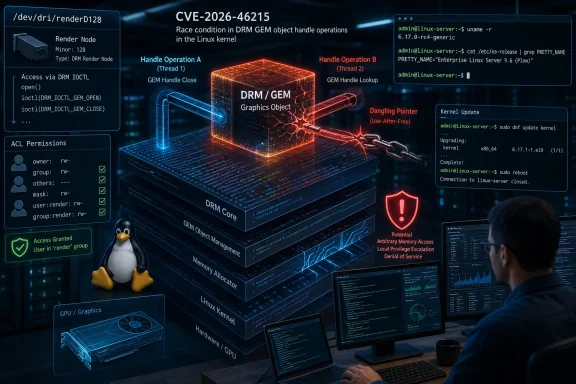
CyberPress, summarizing the published researcher analysis, classifies the defect as an expired-pointer dereference or use-after-free associated with CWE-825. The reporting describes a race between DRM_IOCTL_GEM_CHANGE_HANDLE and DRM_IOCTL_GEM_CLOSE that can reportedly leave a userspace-visible handle associated with a released Graphics Execution Manager object.CyberPress also reports that the researcher developed a proof of concept that converted the condition into root access in a test environment, including a demonstration that modified
/etc/passwd. The researcher reportedly observed an approximately 99 percent success rate in that environment.Those are claims from the public research, not universal results independently reproduced by WindowsForum. Race behavior and exploit reliability may differ among kernel builds, configurations, hardware, and workloads. The supplied facts establish neither a complete affected-product list nor active exploitation in the wild.
A Niche Checkpointing Interface Became a Reported Local Root Path
The affected interface,DRM_IOCTL_GEM_CHANGE_HANDLE, was added upstream in Linux v6.18-rc1 for AMD-related CRIU checkpoint-and-restore work. Public descriptions say the operation changes the userspace-visible handle associated with a Graphics Execution Manager object so that a restored workload can reconstruct relevant graphics state.According to the analysis summarized by CyberPress, the security issue appears when that handle change occurs concurrently with a handle-close operation. The reporting says the affected implementation did not use the complete handle-lifecycle paths needed to keep object publication, lookup, reference handling, and release coordinated throughout the transition.
Under the reported racing sequence, one thread changes or moves a handle while another closes a handle involved in the operation. CyberPress says this can allow the underlying object to be released while another reachable handle path remains. The resulting condition is reported as a use-after-free.
WindowsForum is not independently declaring a root-cause conclusion beyond that source material. The supportable finding is narrower: CyberPress and the published researcher analysis describe a handle-lifetime race that can reportedly be exploited for local privilege escalation when the affected operation is present and reachable.
The race also explains why ordinary sequential testing may not expose the flaw. The public analysis depends on concurrent operations reaching an unsafe ordering; it does not merely describe a handle-change request failing during routine use.
What You Can Verify Locally
Administrators cannot determine complete vulnerability status from a device file or kernel version string alone. They can, however, collect the local facts needed to prioritize vendor-advisory review:- The exact kernel currently running.
- Whether
/dev/dri/renderD*exists. - Which users, groups, or services can access those device files.
- Whether Linux workloads that can execute untrusted code receive that access.
- Whether the responsible vendor identifies the running build as affected or corrected.
/dev/dri/renderD128 or /dev/dri/renderD129. The supplied reporting identifies DRM render-node reachability as part of the reported attack path, but it does not justify broad assumptions about why every node exists, which workloads can use it, or how every distribution assigns permissions.Use the following matrix as a prioritized investigation guide rather than a universal exploitability statement:
| Environment to inspect | What to verify | Priority rule |
|---|---|---|
| Native Linux workstation | Running kernel, render-node presence, and effective user access | High priority when ordinary or untrusted local code can open a render node |
| Shared Linux host | Which accounts and services can open each render node | High priority when multiple users or service contexts share the host |
| GPU-enabled Linux server | Whether jobs or service accounts receive render-device access | High priority when untrusted or tenant-controlled code can reach the device |
| Windows host using WSL | Whether the relevant Linux environment actually exposes /dev/dri/renderD* and which code can access it | Investigate only when the Linux environment exposes the reported device path |
| Windows or Linux VM host | Whether the relevant Linux guest or host exposes /dev/dri/renderD* | Prioritize the Linux kernel instance that owns and exposes the device path |
| Container environment | Whether the Linux host or container context exposes /dev/dri/renderD* | Investigate the responsible Linux kernel and the actual device permissions; do not infer reachability from “containerized” alone |
| Linux system without render nodes | Whether the devices remain absent during representative operation | Lower reachability priority for this reported path, but still check vendor guidance |
Likewise, the presence of a render node does not by itself prove that an account can successfully invoke the affected operation. Device permissions, ACLs, kernel configuration, driver support, and the presence or absence of the relevant ioctl implementation all matter.
Windows Administrator Decision Rule
For Windows administrators responsible for mixed Windows and Linux estates, use this order:- Prioritize native Linux workstations and shared Linux systems where
/dev/dri/renderD*exists and ordinary users can run untrusted code. - Prioritize GPU-enabled Linux servers where service accounts, jobs, or tenant-controlled workloads can access those render nodes.
- *Inspect WSL, VM, and container environments only where the relevant Linux host or guest actually exposes `/dev/dri/renderD`.**
- Do not classify every Windows machine running some form of Linux workload as exposed. Confirm the Linux kernel instance, device path, and effective access first.
- Use the responsible Linux vendor’s advisory to decide affected and fixed status. Windows build numbers do not answer whether a Linux guest, WSL environment, appliance, or container host carries the affected DRM code.
Reported Exploitation Goes Beyond a Kernel Crash
Winning a race or producing a kernel use-after-free does not automatically establish privilege escalation. Practical exploitation must turn the stale object reference into a security-relevant result.CyberPress reports that the researcher’s proof of concept progressed from the DRM condition to root access and demonstrated that outcome by modifying
/etc/passwd. The approximately 99 percent reliability figure also comes from the researcher’s test environment.That number should not be used as an estate-wide probability. The supplied facts do not establish identical behavior across distributions, kernel configurations, processor counts, graphics drivers, or hardware. It is best read as evidence that the researcher reported a repeatable result in a particular tested configuration rather than only a theoretical crash.
The available information does not support adding more specific claims about heap-reclamation objects, pointer disclosures, KASLR defeat, Dirty Pipe techniques, page-cache manipulation, or individual pipe flags. Such details would require direct primary evidence tying them to this vulnerability.
For defensive triage, the reported endpoint is sufficient: public research describes a local route from access to the affected DRM interface to root privileges. That warrants prompt investigation when the vendor confirms an affected build and the device path is reachable.
There is no supplied evidence of active exploitation in the wild. A public proof of concept can increase reproduction risk, but publication does not by itself prove malicious use.
What Is Not Yet Known
The supplied facts do not provide:- A complete affected-version range.
- A list of affected distributions or products.
- A released fixed-package number for any vendor.
- A universally corrected upstream release.
- Confirmation that a particular distribution has backported the affected ioctl.
- Confirmation that a particular distribution has backported the correction.
- A vendor statement covering live patching.
- Evidence of exploitation in the wild.
- A universal exploit-success rate.
- A complete inventory of drivers or hardware combinations that expose the affected operation.
- Final confirmation that the reported future interface removal will appear unchanged in a released Linux 7.1 kernel or in vendor branches.
The Correct Fix Is the Vendor Kernel You Actually Boot
Public descriptions indicate that the correction changes the unsafe handle-transition behavior so the reported race cannot retain a stale route to a released object. WindowsForum has not been provided a specific corrected package or released-kernel version and therefore cannot direct every reader to an immediately available update.Use the following order of authority:
- A security advisory from the distribution or product vendor.
- The vendor’s affected and fixed package or build information.
- The vendor’s changelog or source package showing whether the relevant code and correction were backported.
- Direct inspection by the organization responsible for a custom kernel when no external vendor owns that build.
Installing a package is not the end of the response. A Linux system normally continues running the previously booted kernel until it restarts. The package database can therefore show a newer kernel while
uname -r continues to report the old one.Treat live patching as sufficient only if the responsible vendor explicitly says its live-patch product covers CVE-2026-46215 or the corresponding DRM correction and provides a supported way to verify that coverage. Without that assurance, plan to reboot into the corrected kernel.
Verification and Mitigation Procedure
1. Record the running kernel
uname -rSave the exact output with the host name, collection time, and vendor guidance used for comparison.
uname -r identifies the running kernel; it does not merely report the newest package installed on disk.For custom or appliance kernels, ask the responsible vendor or internal kernel team whether the build contains
DRM_IOCTL_GEM_CHANGE_HANDLE and its correction.2. Enumerate render nodes
ls -l /dev/dri/renderD* 2>/dev/null || echo "No DRM render nodes found"Record a no-node result rather than creating a device or assuming one should exist. Perform the check during representative operation if the system’s graphics or accelerated workloads are not always active.
3. Inspect effective access
Before usinggetfacl, note that it may not be installed by default. It can also error when the render-node pattern matches no files.After confirming that render nodes exist, run:
getfacl /dev/dri/renderD*Or use a shell-safe conditional:
Code:
if compgen -G '/dev/dri/renderD*' >/dev/null; then
    getfacl /dev/dri/renderD*
else
    echo "No DRM render nodes found"
figetfacl is unavailable, use the distribution’s supported ACL-inspection method rather than assuming that the group shown by ls -l represents all effective access.Where practical, test from the actual user or service context under investigation. A console user, service account, WSL process, VM workload, scheduled job, and containerized process may not have identical access.
4. Check loaded modules as supporting context
lsmod | grep '^drm'This is a supporting observation, not a conclusive vulnerability test. A blank result does not establish that the relevant code is absent, and loaded DRM-related modules do not establish that the affected ioctl is present or reachable.
5. Consult the vendor advisory
Search the security guidance for the distribution, appliance, cloud image, or platform that supplied the kernel. Look for CVE-2026-46215 or an explicit description of the DRM GEM handle race.If no advisory exists yet, do not select a supposed fixed version based only on upstream numbering. Continue monitoring the vendor and document temporary exposure controls.
6. Update when a corrected package is identified
Use the platform’s supported update channel. Confirm that the selected package corresponds to the installed kernel flavor and architecture.Before rebooting, follow normal operational checks for boot configuration, storage capacity, redundancy, and recovery access. These are deployment precautions, not evidence about the CVE itself.
7. Reboot and verify
sudo rebootAfter the system returns:
uname -rCompare the result with the fixed build identified by the vendor. If the expected kernel is installed but not running, investigate the system’s boot selection and update process.
Repeat the device and permission checks:
Code:
ls -l /dev/dri/renderD* 2>/dev/null || echo "No DRM render nodes found"

if compgen -G '/dev/dri/renderD*' >/dev/null; then
    getfacl /dev/dri/renderD*
fi8. Restrict unnecessary access carefully
If rendering or GPU functionality is required, use the distribution- or platform-supported device, ACL, group, service, VM, or container policy to limit access to the contexts that need it. Recheck permissions after login changes, service restarts, and reboots because managed permissions may be recreated.If the system does not need DRM functionality, administrators may evaluate blocking the relevant modules as defense in depth. This must be tested for the specific platform. The supplied facts do not establish which modules can be disabled safely on any given workstation, server, appliance, VM, or WSL configuration.
Module restrictions are not substitutes for a corrected kernel. They may be incomplete, may be overridden by configuration changes, and may not apply when relevant code is built into the kernel.
9. Investigate potentially exposed systems
If untrusted local code ran before correction on a vendor-confirmed affected kernel and that context could reach the relevant render node, treat root-level compromise as possible.Preserve appropriate logs and system state, then follow the organization’s incident-response procedures. The researcher’s reported
/etc/passwd modification was a demonstration outcome, not an exhaustive indicator. Its absence does not prove that privilege escalation did not occur.Immediate Repair and Possible Future Removal Are Separate Issues
The supplied reporting says that removal of the ioctl is planned for Linux 7.1. That is forward-looking information and should be confirmed against the final release and the vendor branches organizations actually deploy.Possible future removal does not correct currently running kernels. Near-term response still depends on a vendor-supported determination, installation of a corrected package when available, reboot, and post-reboot verification.
Organizations using the associated AMD or CRIU workflow should track two separate questions:
- Security: Does each deployed kernel branch contain the correction?
- Compatibility: Would alteration or removal of the ioctl affect the organization’s checkpoint-and-restore workflow?
Disclosure Credit Must Remain Precise
The supplied facts say that a researcher reportedly contacted[email][email protected][/email] on April 12, 2026. They separately identify Puttimet Thammasaeng as the first reporter.Those facts do not establish that the person who made the April 12 contact was an unnamed “Cyberstan researcher,” nor do they establish a parallel-discovery sequence between identified individuals. The identities and relationship between those disclosure events should not be inferred without additional evidence.
CyberPress reports the public analysis and proof-of-concept claims. Puttimet Thammasaeng should be credited as the first reporter according to the supplied facts. The correction is attributed in the supplied reporting to AMD’s David Francis working with Dave Airlie.
A concise evidence timeline is therefore:
| Event | Supportable description |
|---|---|
| First report | Puttimet Thammasaeng is credited as the first reporter |
| April 12, 2026 | A researcher reportedly contacted [email][email protected][/email]; the supplied facts do not establish that person’s identity |
| Public technical reporting | CyberPress summarizes the reported race, use-after-free classification, proof of concept, and test-environment reliability |
| Correction | The supplied reporting attributes the correction to David Francis working with Dave Airlie |
| Possible future change | The ioctl is reported as planned for removal in Linux 7.1, subject to final-release and vendor-branch confirmation |
Action checklist for admins
- [ ] Record the running kernel with
uname -r. - [ ] Identify the vendor responsible for that kernel.
- [ ] Locate the applicable vendor advisory, or monitor for one if it has not yet been published.
- [ ] Do not infer a universal affected range from upstream v6.18-rc1.
- [ ] Check for
/dev/dri/renderD*without treating a no-match result as proof of safety. - [ ] Inspect ACLs only after confirming render nodes exist.
- [ ] Account for
getfaclnot being installed by default. - [ ] Test access from relevant users, services, Linux guests, jobs, or workload contexts.
- [ ] Prioritize native Linux workstations, shared hosts, and GPU-enabled Linux servers with reachable render nodes.
- [ ] Investigate WSL, VMs, and containers only where the relevant Linux environment actually exposes
/dev/dri/renderD*. - [ ] Install the corrected vendor kernel when the vendor identifies one.
- [ ] Reboot unless the vendor explicitly confirms verified live-patch coverage.
- [ ] Run
uname -rafter reboot and compare it with the vendor’s fixed build. - [ ] Repeat device and ACL checks after updating.
- [ ] Restrict unnecessary render-node access through supported policy.
- [ ] Test module restrictions before deployment and treat them only as defense in depth.
- [ ] Treat prior untrusted execution on a confirmed affected and reachable system as a possible root-level incident.
Enterprises Should Prioritize Verified Reachability
The right triage method is to identify the intersection of four conditions:- The responsible vendor says the running kernel contains the affected implementation.
- The relevant DRM interface is operational.
/dev/dri/renderD*is exposed to the context under review.- That context can execute untrusted or attacker-controlled code.
Asset labels are not vulnerability determinations. “Headless,” “containerized,” “virtualized,” and “Windows-managed” do not answer whether a Linux kernel contains the affected operation or whether a workload can open a render node. Conversely, a recent-looking kernel version and the presence of
/dev/dri do not establish exploitability without vendor confirmation and effective access.The forward-looking response is disciplined rather than indiscriminate: document the running kernel, locate or await the responsible vendor’s advisory, verify actual render-node exposure, update and reboot when a corrected package is available, and then measure which users and workloads can open
/dev/dri/renderD* so unnecessary access can be reduced without disrupting required Linux graphics or GPU operations.References
- Primary source: cyberpress.org
Published: Thu, 09 Jul 2026 17:42:10 GMT
- Related coverage: cyberstan.co.uk
- Related coverage: securityweek.com
Privilege Escalation Bug Lurked in Linux Kernel for 8 Years - SecurityWeek
A security vulnerability in a driver leading to local privilege escalation in the latest Linux Kernel version was introduced 8 years ago, Check Point reveals.www.securityweek.com
- Related coverage: git.zx2c4.com
- Related coverage: malware.news
- Related coverage: phoronix.com
Linux Performance, Benchmarks & Open-Source News - Phoronix
Phoronix is the leading technology website for Linux hardware reviews, open-source news, Linux benchmarks, open-source benchmarks, and computer hardware performance tests.www.phoronix.com

- Related coverage: tomshardware.com
CISA flags actively exploited ‘Copy Fail’ Linux kernel flaw enabling root takeover across major distros — unpatched systems may remain vulnerable to attack | Tom's Hardware
Researchers released a working exploit before patches were ready.www.tomshardware.com