

Microsoft disclosed CVE-2026-47162 on June 11, 2026, as a high-severity Vim vulnerability in the bundled netrw plugin, where a crafted directory name can inject Vimscript into netrw’s history file and execute code when that file is later sourced. The bug is not a Windows kernel crisis, not a wormable network flaw, and not even primarily a Microsoft product failure. But its appearance in Microsoft’s Security Update Guide is a useful reminder that modern Windows security increasingly depends on the health of open-source tools that live inside developer workstations, WSL environments, Git workflows, and admin shells. The uncomfortable lesson is simple: the editor is part of the attack surface now.
There was a time when a Vim vulnerability would have felt like Linux mailing-list weather: interesting to maintainers, relevant to Unix operators, and mostly invisible to the Windows mainstream. That era is over. Vim ships through package managers, developer toolchains, Unix compatibility layers, container images, remote build hosts, and cloud shells that Windows administrators touch every day.
CVE-2026-47162 affects Vim before version 9.2.0495. The vulnerable component is netrw, the file-browsing and remote-file plugin that has been part of the Vim experience for years. The bug sits in the way netrw saves directory browsing history to a Vimscript file, specifically the
That sounds obscure because it is obscure. But obscurity is not the same as irrelevance. Security failures often live in precisely this kind of plumbing: serialization routines, helper plugins, history files, shell escapes, and convenience features that were designed for power users rather than hostile input.
Microsoft’s presence here matters less because Microsoft owns Vim and more because Microsoft’s ecosystem now consumes Vim. Windows developers use it inside WSL. Administrators use it over SSH. DevOps teams inherit it inside containers. Security teams scan it as part of dependency inventories. Once a tool is common enough to be assumed, its bugs become everyone’s problem.
That is the whole mistake. A directory name should be inert text. In this case, a specially crafted directory name could break out of the string literal and become executable Vimscript. Once that history file is sourced, the attacker’s payload can run with the privileges of the user running Vim.
The phrase with the privileges of the user is doing a lot of work here. This is not automatic privilege escalation to SYSTEM or root. It is not a magic remote takeover of any machine with Vim installed. But for a developer, build engineer, or sysadmin, the user context is often rich enough: SSH keys, Git credentials, cloud tokens, source trees, deployment scripts, and access to internal systems.
That is why editor bugs punch above their apparent weight. They do not need to compromise the operating system to compromise the operator. If an attacker can influence a directory name that a user later browses with netrw, and can get the resulting history file sourced, Vim becomes a command runner.
The fix in Vim 9.2.0495 is conceptually simple: do not generate executable script from untrusted text without escaping it correctly. The broader lesson is harder. Any tool that persists user- or filesystem-derived data into a scriptable configuration format has to treat that boundary as dangerous.
That makes the attack opportunistic rather than universal. It is easier to imagine in shared source repositories, extracted archives, malicious project folders, mounted network paths, build workspaces, and intentionally booby-trapped directories than in random consumer browsing. It is the kind of bug that preys on trust in local development contexts.
That distinction should not be used to dismiss it. Developers routinely open untrusted projects. Security researchers inspect hostile samples. Administrators jump into directories copied from broken systems. Build servers and test VMs accumulate strange trees of files from third parties. In those places, “just a directory name” can be attacker-controlled input.
The bug is especially nasty because it abuses memory and convenience rather than immediate interaction. A poisoned history file is not an obvious executable dropped in a startup folder. It is a record of where the user has been, written in the language the editor already understands. That makes it feel like metadata until it behaves like code.
For WindowsForum readers, the practical point is not that Vim is suddenly unsafe as a concept. It is that developer tooling cannot be treated as harmless because it is old, text-based, or beloved. Attackers follow workflows, and the workflow around opening, browsing, building, and testing code is increasingly central to Windows machines.
That reflects the new shape of Windows administration. The Windows desktop may still be the visible endpoint, but the working system often includes WSL distributions, PowerShell modules, Git for Windows, language runtimes, package managers, Visual Studio Code extensions, container tooling, and Unix utilities installed for convenience. Vim is not an alien object in that world.
Security teams used to draw cleaner lines between Microsoft patches and “everything else.” Those lines have blurred. A vulnerability in an open-source editor can matter to a Windows shop if that editor exists in golden images, CI runners, developer laptops, admin jump boxes, or Linux containers deployed from Windows-managed pipelines.
This is why the advisory should be read less as an isolated Vim notice and more as a signal about inventory. If your patch management story ends at Windows Update, it is incomplete. The machines that build, sign, deploy, and administer software often contain a second ecosystem of tools that Windows Update does not fully govern.
The difficult part is ownership. Desktop operations may own Windows. Platform engineering may own WSL baselines. Developers may install their own editors. Security may scan container images. Nobody may feel personally responsible for the copy of Vim that arrived as a dependency two years ago and was never touched again.
That does not mean netrw is uniquely reckless. It means netrw sits at a dangerous intersection. It parses paths. It displays directory listings. It opens remote resources. It shells out. It keeps state. It exists inside an editor with a powerful scripting language. That combination is useful precisely because it is highly privileged inside the user’s workflow.
Security engineers recognize this as an ambient authority problem. The tool that helps you move around files also has enough authority to run commands, modify buffers, write history, invoke external programs, and interpret scripts. Once untrusted names enter that system, tiny quoting mistakes can become execution primitives.
The same theme has shown up across editors and IDEs for years. Project files become code. Workspace settings become code. Build tasks become code. Extensions become code. Modelines, hooks, formatters, linters, and file watchers all blur the line between opening a project and running it.
Vim’s culture complicates this because power users expect deep scriptability. The editor’s strength is that almost everything can be automated. The security cost is that automation boundaries need to be explicit, and legacy plugin code may not have been written with today’s hostile-project threat model in mind.
WSL makes Linux tooling feel local. That is its value. It is also how Linux userland vulnerabilities become Windows workstation concerns. A vulnerable Vim inside Ubuntu on WSL may not be a vulnerability in
Git workflows create another plausible path. Repositories can contain directories with strange names, and developers often browse unfamiliar trees before building or reviewing them. A malicious proof-of-concept repository does not need to exploit the compiler if it can exploit the tools used before compilation.
Remote administration adds another wrinkle. Many Windows admins now manage Linux systems from Windows clients. They SSH into servers, use whatever editor is present, and browse directories during incident response or maintenance. In that setting, the vulnerable Vim instance may be remote, but the credentials and operational consequences are very real.
Container images are a quieter case. Vim is often installed in base images for convenience, then forgotten. The presence of a vulnerable editor inside a container does not automatically make the container exploitable. But it does expand the set of stale packages that security scanners will flag and teams will need to triage.
For individual users, checking the version is the easy part. The harder part is remembering which Vim you are invoking.
For administrators, this is a good moment to test whether software inventory sees developer tooling at all. If endpoint management can tell you the Windows build number but not which editors, shells, package managers, and runtimes are installed, it is not enough for modern workstation risk. The attack surface has moved into the developer environment, and inventory has to follow it.
There is also a behavioral mitigation: be cautious with untrusted project trees. Do not browse hostile directories with feature-rich tooling when a safer inspection method will do. Use disposable VMs, containers, or sandboxed environments when handling suspicious archives or proof-of-concept repositories. That advice is not new, but editor vulnerabilities make it less theoretical.
Disabling netrw may be an option for some hardened setups, though it is not a universal answer. Many users rely on it, knowingly or not, for directory browsing. The better default is to patch first, then decide whether your environment should reduce plugin functionality for untrusted work.
But severity scores are imperfect instruments for workstation reality. A bug with user interaction requirements can look less urgent than a network service flaw, yet still be valuable to attackers targeting developers. The person opening the poisoned directory may have access to production secrets, signing keys, private repositories, or cloud consoles.
This is the same reason phishing remains dangerous despite requiring a click. User interaction is not a deal-breaker when the target population routinely interacts with untrusted material as part of its job. Developers download dependencies, clone projects, inspect issue reproducers, and test contributions. Security teams open malware samples and suspicious archives. Administrators traverse broken file trees.
The more useful question is not “Can this exploit everyone automatically?” It is “Can this exploit the kind of person an attacker wants?” For CVE-2026-47162, the answer is plausibly yes in targeted scenarios.
That makes patch prioritization context-sensitive. A kiosk machine with no Vim usage is not the same as a developer workstation with WSL and access to internal source code. A production Linux server where admins routinely use Vim over SSH is not the same as a minimal container where Vim is present but unused. Security teams should rank the issue by exposure to untrusted directories and value of the user context.
Editors are especially hard to secure because they are designed to be intimate with user intent. They open files, remember places, execute commands, run plugins, parse project metadata, and adapt to local conventions. That intimacy is the feature. It is also why a malicious directory name can become more than a name.
The safer design pattern is to avoid executable persistence for passive state. A history file should ideally be data, not source code. If it must be sourceable script for compatibility or convenience, then every byte derived from the filesystem has to be escaped as if it were hostile. That is easy to say and hard to retrofit across decades of plugin behavior.
Vim’s maintainers deserve credit for patching the issue. But the repeated attention on netrw suggests a broader audit problem. Once one injection path is found in a component that mixes path handling, scripting, and shell invocation, maintainers should assume cousins exist nearby. Attackers certainly will.
For enterprise IT, the lesson extends beyond Vim. Look at every tool that opens untrusted project folders and then automatically reads state, settings, hooks, tasks, or history. The editor is only one member of a larger class of developer tools whose convenience features can become execution paths.
Those questions are mundane until an advisory lands. Then they become the difference between a one-hour patch and a week of guesswork. The fix for this specific bug is easy; the discovery process is what reveals maturity.
Windows shops should also avoid assuming that Microsoft’s advisory means Windows Update has handled the issue everywhere. Depending on how Vim was installed, remediation may come through a Linux distribution package update, a Windows package manager, a manual upstream build, a container rebuild, or a developer tools refresh. The advisory is a signal, not a universal delivery mechanism.
The cleanest long-term answer is baseline management. Developer workstations should have defined toolchains, update channels, and ownership. WSL distributions should be patched like operating systems, not treated as invisible user toys. Containers should be rebuilt from updated bases. Remote hosts should be covered by the same vulnerability management discipline as Windows endpoints.
This is where the cultural shift matters. For years, many organizations treated developer tools as personal preference. That freedom has value, but unmanaged toolchains now carry enterprise risk. A vulnerable editor plugin may be a small bug, but it lives in a privileged neighborhood.
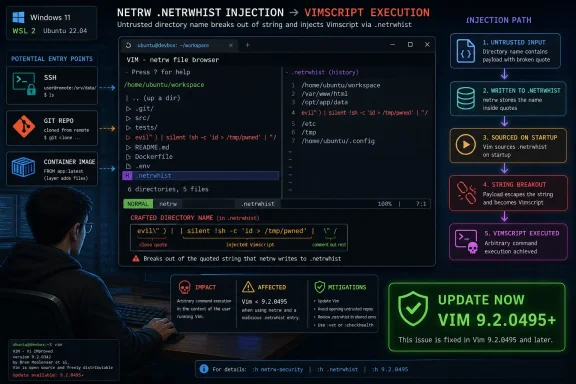 A Text Editor Bug Lands in Microsoft’s Security Orbit
There was a time when a Vim vulnerability would have felt like Linux mailing-list weather: interesting to maintainers, relevant to Unix operators, and mostly invisible to the Windows mainstream. That era is over. Vim ships through package managers, developer toolchains, Unix compatibility layers, container images, remote build hosts, and cloud shells that Windows administrators touch every day.CVE-2026-47162 affects Vim before version 9.2.0495. The vulnerable component is netrw, the file-browsing and remote-file plugin that has been part of the Vim experience for years. The bug sits in the way netrw saves directory browsing history to a Vimscript file, specifically the
.netrwhist file under the user’s Vim directory.That sounds obscure because it is obscure. But obscurity is not the same as irrelevance. Security failures often live in precisely this kind of plumbing: serialization routines, helper plugins, history files, shell escapes, and convenience features that were designed for power users rather than hostile input.
Microsoft’s presence here matters less because Microsoft owns Vim and more because Microsoft’s ecosystem now consumes Vim. Windows developers use it inside WSL. Administrators use it over SSH. DevOps teams inherit it inside containers. Security teams scan it as part of dependency inventories. Once a tool is common enough to be assumed, its bugs become everyone’s problem.
Netrw Turns a Directory Name into Code
The flaw is a classic injection bug with a very Vim-shaped trigger. Netrw records browsed directory paths into a history file that is itself Vimscript. In vulnerable versions, a directory name taken from the filesystem could be placed into a single-quoted Vimscript string without properly escaping embedded single quotes.That is the whole mistake. A directory name should be inert text. In this case, a specially crafted directory name could break out of the string literal and become executable Vimscript. Once that history file is sourced, the attacker’s payload can run with the privileges of the user running Vim.
The phrase with the privileges of the user is doing a lot of work here. This is not automatic privilege escalation to SYSTEM or root. It is not a magic remote takeover of any machine with Vim installed. But for a developer, build engineer, or sysadmin, the user context is often rich enough: SSH keys, Git credentials, cloud tokens, source trees, deployment scripts, and access to internal systems.
That is why editor bugs punch above their apparent weight. They do not need to compromise the operating system to compromise the operator. If an attacker can influence a directory name that a user later browses with netrw, and can get the resulting history file sourced, Vim becomes a command runner.
The fix in Vim 9.2.0495 is conceptually simple: do not generate executable script from untrusted text without escaping it correctly. The broader lesson is harder. Any tool that persists user- or filesystem-derived data into a scriptable configuration format has to treat that boundary as dangerous.
The Exploit Chain Is Narrow, but the Blast Radius Is Personal
CVE-2026-47162 is not the kind of vulnerability that should send every Windows user racing to unplug Ethernet. Exploitation depends on user behavior and environment. An attacker needs a crafted directory name to be present somewhere the victim browses with netrw, and the vulnerable history mechanism has to be exercised in a way that leads to later sourcing.That makes the attack opportunistic rather than universal. It is easier to imagine in shared source repositories, extracted archives, malicious project folders, mounted network paths, build workspaces, and intentionally booby-trapped directories than in random consumer browsing. It is the kind of bug that preys on trust in local development contexts.
That distinction should not be used to dismiss it. Developers routinely open untrusted projects. Security researchers inspect hostile samples. Administrators jump into directories copied from broken systems. Build servers and test VMs accumulate strange trees of files from third parties. In those places, “just a directory name” can be attacker-controlled input.
The bug is especially nasty because it abuses memory and convenience rather than immediate interaction. A poisoned history file is not an obvious executable dropped in a startup folder. It is a record of where the user has been, written in the language the editor already understands. That makes it feel like metadata until it behaves like code.
For WindowsForum readers, the practical point is not that Vim is suddenly unsafe as a concept. It is that developer tooling cannot be treated as harmless because it is old, text-based, or beloved. Attackers follow workflows, and the workflow around opening, browsing, building, and testing code is increasingly central to Windows machines.
Microsoft’s Advisory Is Really About Supply Chain Reality
The Microsoft Knowledge Base disclaimer attached to the advisory is boilerplate, but it lands differently in 2026. Microsoft is not promising that every upstream tool in every developer stack is safe. It is giving customers a structured way to see a vulnerability that may affect environments Microsoft customers actually run.That reflects the new shape of Windows administration. The Windows desktop may still be the visible endpoint, but the working system often includes WSL distributions, PowerShell modules, Git for Windows, language runtimes, package managers, Visual Studio Code extensions, container tooling, and Unix utilities installed for convenience. Vim is not an alien object in that world.
Security teams used to draw cleaner lines between Microsoft patches and “everything else.” Those lines have blurred. A vulnerability in an open-source editor can matter to a Windows shop if that editor exists in golden images, CI runners, developer laptops, admin jump boxes, or Linux containers deployed from Windows-managed pipelines.
This is why the advisory should be read less as an isolated Vim notice and more as a signal about inventory. If your patch management story ends at Windows Update, it is incomplete. The machines that build, sign, deploy, and administer software often contain a second ecosystem of tools that Windows Update does not fully govern.
The difficult part is ownership. Desktop operations may own Windows. Platform engineering may own WSL baselines. Developers may install their own editors. Security may scan container images. Nobody may feel personally responsible for the copy of Vim that arrived as a dependency two years ago and was never touched again.
Netrw Has Become a Repeating Weak Point
CVE-2026-47162 is not appearing in a vacuum. Recent netrw issues have involved command injection and Vimscript injection paths through filenames, URLs, and file-browsing behavior. The details differ, but the pattern is familiar: a plugin that translates filesystem or network-derived strings into editor actions keeps discovering new edges where text becomes command.That does not mean netrw is uniquely reckless. It means netrw sits at a dangerous intersection. It parses paths. It displays directory listings. It opens remote resources. It shells out. It keeps state. It exists inside an editor with a powerful scripting language. That combination is useful precisely because it is highly privileged inside the user’s workflow.
Security engineers recognize this as an ambient authority problem. The tool that helps you move around files also has enough authority to run commands, modify buffers, write history, invoke external programs, and interpret scripts. Once untrusted names enter that system, tiny quoting mistakes can become execution primitives.
The same theme has shown up across editors and IDEs for years. Project files become code. Workspace settings become code. Build tasks become code. Extensions become code. Modelines, hooks, formatters, linters, and file watchers all blur the line between opening a project and running it.
Vim’s culture complicates this because power users expect deep scriptability. The editor’s strength is that almost everything can be automated. The security cost is that automation boundaries need to be explicit, and legacy plugin code may not have been written with today’s hostile-project threat model in mind.
Windows Users Meet the Bug Through WSL, Git, and Remote Work
On a plain Windows 11 desktop, a user who never installed Vim and never opens Unix-like project folders with netrw has little to do here. But that is not the WindowsForum audience most likely to care. The more relevant user is the one who lives between Windows Terminal, WSL, SSH sessions, Git repositories, and container shells.WSL makes Linux tooling feel local. That is its value. It is also how Linux userland vulnerabilities become Windows workstation concerns. A vulnerable Vim inside Ubuntu on WSL may not be a vulnerability in
win32k.sys, but it still runs under a real user account on a real developer machine with real credentials nearby.Git workflows create another plausible path. Repositories can contain directories with strange names, and developers often browse unfamiliar trees before building or reviewing them. A malicious proof-of-concept repository does not need to exploit the compiler if it can exploit the tools used before compilation.
Remote administration adds another wrinkle. Many Windows admins now manage Linux systems from Windows clients. They SSH into servers, use whatever editor is present, and browse directories during incident response or maintenance. In that setting, the vulnerable Vim instance may be remote, but the credentials and operational consequences are very real.
Container images are a quieter case. Vim is often installed in base images for convenience, then forgotten. The presence of a vulnerable editor inside a container does not automatically make the container exploitable. But it does expand the set of stale packages that security scanners will flag and teams will need to triage.
The Right Response Is Patch, Then Reduce Trust
The immediate fix is straightforward: update Vim to 9.2.0495 or later wherever you actually use it. That sounds simple until you remember how many places Vim can live. There may be a Windows build, a WSL package, a portable copy in a tools folder, a version inside MSYS2 or Cygwin, and separate copies inside containers or remote hosts.For individual users, checking the version is the easy part. The harder part is remembering which Vim you are invoking.
vim in PowerShell, vim in WSL, vim inside Git Bash, and vim over SSH may be four different binaries with four different patch histories.For administrators, this is a good moment to test whether software inventory sees developer tooling at all. If endpoint management can tell you the Windows build number but not which editors, shells, package managers, and runtimes are installed, it is not enough for modern workstation risk. The attack surface has moved into the developer environment, and inventory has to follow it.
There is also a behavioral mitigation: be cautious with untrusted project trees. Do not browse hostile directories with feature-rich tooling when a safer inspection method will do. Use disposable VMs, containers, or sandboxed environments when handling suspicious archives or proof-of-concept repositories. That advice is not new, but editor vulnerabilities make it less theoretical.
Disabling netrw may be an option for some hardened setups, though it is not a universal answer. Many users rely on it, knowingly or not, for directory browsing. The better default is to patch first, then decide whether your environment should reduce plugin functionality for untrusted work.
The Severity Score Does Not Capture the Workstation Story
The vulnerability has been described with high severity in vulnerability databases, and the technical impact justifies attention. Arbitrary Vimscript execution can become arbitrary shell command execution. Confidentiality, integrity, and availability can all be affected within the user context.But severity scores are imperfect instruments for workstation reality. A bug with user interaction requirements can look less urgent than a network service flaw, yet still be valuable to attackers targeting developers. The person opening the poisoned directory may have access to production secrets, signing keys, private repositories, or cloud consoles.
This is the same reason phishing remains dangerous despite requiring a click. User interaction is not a deal-breaker when the target population routinely interacts with untrusted material as part of its job. Developers download dependencies, clone projects, inspect issue reproducers, and test contributions. Security teams open malware samples and suspicious archives. Administrators traverse broken file trees.
The more useful question is not “Can this exploit everyone automatically?” It is “Can this exploit the kind of person an attacker wants?” For CVE-2026-47162, the answer is plausibly yes in targeted scenarios.
That makes patch prioritization context-sensitive. A kiosk machine with no Vim usage is not the same as a developer workstation with WSL and access to internal source code. A production Linux server where admins routinely use Vim over SSH is not the same as a minimal container where Vim is present but unused. Security teams should rank the issue by exposure to untrusted directories and value of the user context.
The Patch Tells a Bigger Story About Scriptable Tools
The technical flaw in CVE-2026-47162 is old-fashioned: improper neutralization of special characters in generated code. The modern part is where it appears. We keep building tools that treat text as configuration, configuration as script, and script as workflow. Then we are surprised when an attacker finds the seam.Editors are especially hard to secure because they are designed to be intimate with user intent. They open files, remember places, execute commands, run plugins, parse project metadata, and adapt to local conventions. That intimacy is the feature. It is also why a malicious directory name can become more than a name.
The safer design pattern is to avoid executable persistence for passive state. A history file should ideally be data, not source code. If it must be sourceable script for compatibility or convenience, then every byte derived from the filesystem has to be escaped as if it were hostile. That is easy to say and hard to retrofit across decades of plugin behavior.
Vim’s maintainers deserve credit for patching the issue. But the repeated attention on netrw suggests a broader audit problem. Once one injection path is found in a component that mixes path handling, scripting, and shell invocation, maintainers should assume cousins exist nearby. Attackers certainly will.
For enterprise IT, the lesson extends beyond Vim. Look at every tool that opens untrusted project folders and then automatically reads state, settings, hooks, tasks, or history. The editor is only one member of a larger class of developer tools whose convenience features can become execution paths.
The Practical Vim Check Belongs in the Developer Baseline
Most organizations do not need a war room for CVE-2026-47162. They do need a repeatable way to answer boring questions quickly. Which machines have Vim? Which version? Which package manager owns it? Is it in WSL? Is it baked into developer images? Is it present in CI images? Is it reachable in admin workflows?Those questions are mundane until an advisory lands. Then they become the difference between a one-hour patch and a week of guesswork. The fix for this specific bug is easy; the discovery process is what reveals maturity.
Windows shops should also avoid assuming that Microsoft’s advisory means Windows Update has handled the issue everywhere. Depending on how Vim was installed, remediation may come through a Linux distribution package update, a Windows package manager, a manual upstream build, a container rebuild, or a developer tools refresh. The advisory is a signal, not a universal delivery mechanism.
The cleanest long-term answer is baseline management. Developer workstations should have defined toolchains, update channels, and ownership. WSL distributions should be patched like operating systems, not treated as invisible user toys. Containers should be rebuilt from updated bases. Remote hosts should be covered by the same vulnerability management discipline as Windows endpoints.
This is where the cultural shift matters. For years, many organizations treated developer tools as personal preference. That freedom has value, but unmanaged toolchains now carry enterprise risk. A vulnerable editor plugin may be a small bug, but it lives in a privileged neighborhood.
The Small Directory Name That Should Change the Checklist
CVE-2026-47162 is concrete enough to act on without turning it into a crisis. The bug is patched, the affected version boundary is clear, and the exploit conditions are narrower than drive-by remote code execution. The value is in using the incident to harden the places where Windows and open-source tooling now overlap.- Update Vim to version 9.2.0495 or later in every environment where it is used, including WSL distributions, remote Linux hosts, developer images, and containers.
- Treat untrusted project directories and archives as active content, not passive files, especially when opening them with scriptable editors or IDEs.
- Verify which Vim binary is actually being launched in each shell environment, because Windows Terminal, WSL, Git Bash, SSH sessions, and containers may resolve to different installations.
- Do not assume Microsoft’s Security Update Guide entry means Windows Update has remediated every copy of Vim in your environment.
- Use this advisory as a test of whether your asset inventory can see developer tools, package-manager installations, and Unix userlands on Windows workstations.
References
- Primary source: MSRC
Published: 2026-06-13T01:01:47-07:00
Security Update Guide - Microsoft Security Response Center
 msrc.microsoft.com
- Related coverage: osv.dev

OSV - Open Source Vulnerabilities
Comprehensive vulnerability database for your open source projects and dependencies.
osv.dev
- Official source: microsoft.com
MSRC - Microsoft Security Response Center
The Microsoft Security Response Center is part of the defender community and on the front line of security response evolution. For over twenty years, we have been engaged with security researchers working to protect customers and the broader ecosystem.www.microsoft.com
- Related coverage: sentinelone.com
CVE-2026-41411: Vim Text Editor RCE Vulnerability
CVE-2026-41411 is a command injection vulnerability in Vim text editor. Learn about its impact, affected versions, and mitigation methods.www.sentinelone.com
