

CVE-2026-52858 is a Vim vulnerability published in June 2026 affecting Python omni-completion before Vim 9.2.0561, where invoking completion on a hostile Python buffer can execute attacker-controlled import code with the privileges of the user running the editor. That makes this less a “remote code execution” bomb than a sharp reminder that developer tooling is part of the attack surface. The bug matters because it sits in a workflow security teams often treat as harmless: opening source code to inspect it. In Vim’s case, the danger arrives not when the file is merely viewed, but when a language-aware editing feature is asked to be helpful.
The uncomfortable lesson of CVE-2026-52858 is that the boundary between “reading code” and “running code” has become porous. Vim’s Python omni-completion exists to make editing Python more convenient: it parses the current buffer, looks at symbols, and tries to offer smarter completions than plain word matching. That sounds like editor behavior, not execution behavior.
But Python is not a passive format. Importing a module runs top-level code. If a completion engine harvests
The reported attack scenario is therefore mundane enough to be plausible. A developer checks out a third-party repository, opens a Python file, and invokes omni-completion with
That last clause is the point. This is not code running in a container by default, not code confined to a linter sandbox, and not code executing as some intentionally low-privilege scanner account. It runs inside the editor process, with the editor user’s filesystem access, environment variables, credentials, SSH agent reachability, and network permissions.
Developer machines routinely hold source repositories, signing material, cloud credentials, package registry tokens, Git remotes, SSH keys, VPN access, and cached browser sessions. Even where modern secret management has improved, the workstation remains a trusted bridge between code and infrastructure. An editor-triggered code execution flaw does not need kernel privileges to matter.
That is why “the user has to press completion” should not be treated as a dismissal. Completion is muscle memory. In many setups it is also indirectly triggered through plugins, mappings, or editor distributions that turn Vim into a lightweight IDE. A vulnerability that requires a common editing action is still a credible attack when the attacker’s lure is “please review this Python patch.”
The operational risk is especially sharp for maintainers, security researchers, and sysadmins who routinely open untrusted code. Malware analysts and incident responders already know not to double-click suspicious binaries. Fewer teams have equally crisp guidance for opening a source tree and asking the editor for completions.
The design makes sense if the primary goal is useful completions. To complete members of imported modules, the editor wants the module object. In Python, the ordinary way to obtain that object is to import it. The problem is that import is a side-effecting operation, and Python has always made module initialization executable.
The attack hinges on search path behavior. Because the working directory can be present on
This is not unique to Vim in spirit. Any editor, IDE, language server, test discovery tool, notebook environment, static analyzer, or code intelligence feature that evaluates user-controlled code to understand a project is standing near the same cliff. CVE-2026-52858 is a Vim bug, but the class of problem belongs to the modern developer experience.
The mitigation introduced a compatibility escape hatch,
The practical rule is simple: update Vim, and do not opt back into import execution unless the Python codebase is trusted. For developers who frequently inspect outside contributions, forks, archives, or proof-of-concept exploit repositories, the safer default matters more than perfect completion fidelity.
This patch also exposes an architectural tension. Completion engines want semantic truth; security wants inert inspection. The safest completion engine is one that can reason about code without running it. The most accurate one is often tempted to run just enough code to discover what the program means. CVE-2026-52858 is what happens when that temptation crosses a boundary users did not realize existed.
This matters for CVE-2026-52858 because it changes how administrators should think about “patched.” Stopping import execution in 9.2.0561 addressed the specific CVE, but it did not mean every dangerous execution pattern in the Python completion engine had disappeared. If your risk model is “untrusted Python code plus Vim completion,” the safer answer is to move beyond 9.2.0561 and deploy a build that includes the subsequent omni-completion hardening as well.
The two disclosures together tell a broader story. Once a completion engine reconstructs source and calls
That is the deeper security lesson. Patch notes often describe one exploit path. Attackers think in surfaces. If a feature’s design principle is “evaluate pieces of the buffer to understand it,” then one fixed route may leave adjacent roads open until the design is tightened more comprehensively.
A Vim build without
On Windows, the practical stakes can be different but not smaller. A compromised editor process may reach Git credentials, SSH keys, local repositories, developer certificates, cloud CLI tokens, Windows Credential Manager material accessible to the user, or network shares mounted in that session. The blast radius follows the user account.
WSL deserves special attention because many Windows developers treat it as a Linux-like workstation inside the workstation. A malicious repository opened in Vim inside WSL can target the Linux user environment, but that environment may still have access to cloned Windows-mounted paths, SSH agent forwarding, Git remotes, package credentials, and deployment tooling. The boundary is not as clean as the marketing diagram.
That distinction is important for WindowsForum readers. Seeing a CVE on an MSRC page does not automatically mean Windows Update will patch your local Vim binary. If Vim came from a standalone installer, a package manager, Git for Windows, MSYS2, Cygwin, WSL distribution repositories, or an IDE bundle, the update path follows that source.
This is where many endpoint inventories still fall short. They can tell you whether Windows is patched, whether Defender definitions are current, and whether Office is updated. They may not reliably tell you which Vim binary a developer actually launches from a terminal, which runtime files it uses, or whether Python support is compiled in.
Security teams should treat MSRC’s visibility here as a prompt to inventory developer tools, not as evidence that the platform has absorbed the problem. The vulnerable component may be several packaging layers away from Microsoft’s normal servicing machinery.
That chain is not guaranteed, but it maps neatly onto real developer behavior. Open-source maintainers review drive-by pull requests. Enterprise developers inspect vendor SDKs and sample code. Security researchers open proof-of-concept repositories from strangers. Sysadmins copy scripts from ticket attachments and downloaded ZIP files.
The key is that the malicious code does not need to be run as a script. The attacker is abusing the tooling around the code, not the code’s official entry point. That is exactly why these bugs are easy to underestimate: “I never ran it” is no longer the same thing as “nothing ran.”
The more automated the editor setup, the fuzzier the trigger becomes. A plain Vim user may only invoke omni-completion manually. A heavily customized environment may bind completion to keystrokes, autocompletion popups, or plugins that call the omnifunc behind the scenes. Organizations that standardize developer dotfiles should review those settings alongside the Vim version itself.
That does not mean developers should become paralyzed. It means the workflow for untrusted code should look more like the workflow for untrusted documents: inspect in a constrained environment first, delay enabling rich features, and avoid letting convenience tooling execute project-controlled logic before trust is established.
For Vim specifically, that can mean updating to a safe release, avoiding import execution in Python omni-completion, disabling Python-aware completion when reviewing hostile trees, or using a minimal
The principle applies beyond Vim. Do not let package managers install hooks, test runners discover modules, linters import application packages, or IDEs execute project startup scripts in a privileged developer context unless the project is trusted. “Just opening the repo” has become an increasingly loaded phrase.
The first step is version discovery. Administrators should identify Vim installations and confirm whether they are older than 9.2.0561. Because a related Python omni-completion issue was fixed later in 9.2.0597, conservative teams should prefer versions at or above that level where available rather than stopping at the minimum CVE fix.
The second step is feature discovery. Vim without Python support is not exposed to this specific path, though it may still need updates for other vulnerabilities. Vim with
The third step is policy. If developers routinely review untrusted code, organizations should document how to do that safely. A short internal standard that says “use a disposable environment for first inspection, do not enable project-local editor automation, and do not invoke semantic completion until trust is established” is more useful than a generic reminder to be careful.
Those two issues can sound almost identical in headlines. Both involve Vim, Python omni-completion, hostile buffers, and code execution. But they are not the same exploit path, and they do not have the same minimum fixed version.
That distinction matters when writing tickets, scanning assets, or validating remediation. If a scanner reports CVE-2026-52858, the minimum fixed version tied to that record is 9.2.0561. If your concern is the broader Python omni-completion attack surface described in the subsequent advisory, you should verify the later fix as well.
Security teams should avoid the common patch-management trap of reducing a story to a single CVE string. CVE identifiers are useful accounting labels. They are not always a complete model of the risk, especially when multiple bugs cluster in the same subsystem within days.
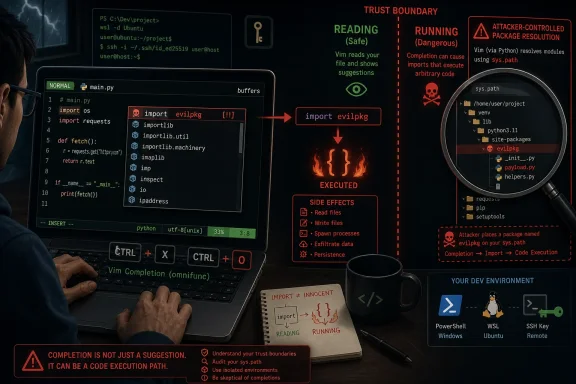 The Editor Became Part of the Program
The uncomfortable lesson of CVE-2026-52858 is that the boundary between “reading code” and “running code” has become porous. Vim’s Python omni-completion exists to make editing Python more convenient: it parses the current buffer, looks at symbols, and tries to offer smarter completions than plain word matching. That sounds like editor behavior, not execution behavior.But Python is not a passive format. Importing a module runs top-level code. If a completion engine harvests
import or from statements from a buffer and feeds them into Python’s import machinery, then completion is no longer just analysis; it is execution.The reported attack scenario is therefore mundane enough to be plausible. A developer checks out a third-party repository, opens a Python file, and invokes omni-completion with
CTRL-X CTRL-O, or uses a plugin that triggers the same completion function. If the repository layout includes a malicious sibling package matching an import in the edited file, Vim can execute that package’s top-level code as the local user.That last clause is the point. This is not code running in a container by default, not code confined to a linter sandbox, and not code executing as some intentionally low-privilege scanner account. It runs inside the editor process, with the editor user’s filesystem access, environment variables, credentials, SSH agent reachability, and network permissions.
A Medium Bug With High-Value Credentials Nearby
The vulnerability received a high CVSS 4.0 base score from GitHub’s CNA record, while the Vim security advisory framed the practical severity as medium because exploitation requires user interaction. Both readings can be true. The bug is not wormable, and opening the file alone is not enough. But the asset at risk is often a developer workstation, which is one of the richest targets in an organization.Developer machines routinely hold source repositories, signing material, cloud credentials, package registry tokens, Git remotes, SSH keys, VPN access, and cached browser sessions. Even where modern secret management has improved, the workstation remains a trusted bridge between code and infrastructure. An editor-triggered code execution flaw does not need kernel privileges to matter.
That is why “the user has to press completion” should not be treated as a dismissal. Completion is muscle memory. In many setups it is also indirectly triggered through plugins, mappings, or editor distributions that turn Vim into a lightweight IDE. A vulnerability that requires a common editing action is still a credible attack when the attacker’s lure is “please review this Python patch.”
The operational risk is especially sharp for maintainers, security researchers, and sysadmins who routinely open untrusted code. Malware analysts and incident responders already know not to double-click suspicious binaries. Fewer teams have equally crisp guidance for opening a source tree and asking the editor for completions.
The Flaw Lives in Convenience, Not Carelessness
The vulnerable behavior came from Vim’s Python completion implementation, not from a user doing something obviously reckless. The completion script looked at the Python buffer and reconstructed enough context to populate completion results. In affected versions, that process could executeimport and from statements found in the current buffer.The design makes sense if the primary goal is useful completions. To complete members of imported modules, the editor wants the module object. In Python, the ordinary way to obtain that object is to import it. The problem is that import is a side-effecting operation, and Python has always made module initialization executable.
The attack hinges on search path behavior. Because the working directory can be present on
sys.path, a hostile repository can place a package or module next to the file being edited. When the completion engine imports the name from the buffer, Python may resolve it to the attacker-controlled local package and execute its initialization code.This is not unique to Vim in spirit. Any editor, IDE, language server, test discovery tool, notebook environment, static analyzer, or code intelligence feature that evaluates user-controlled code to understand a project is standing near the same cliff. CVE-2026-52858 is a Vim bug, but the class of problem belongs to the modern developer experience.
The Patch Draws a Line Around Imports
Vim 9.2.0561 changed the default behavior so the Python omni-completer no longer executes harvested import statements by default. That is the correct security tradeoff: completions may become less magical for imported module members, but editing an untrusted file should not silently cross into executing untrusted code.The mitigation introduced a compatibility escape hatch,
g:pythoncomplete_allow_import, for users who explicitly want the old behavior. That is defensible, but it should be treated like a trust boundary override. Enabling it globally because completions feel incomplete is the kind of small convenience decision that reintroduces the entire vulnerability class.The practical rule is simple: update Vim, and do not opt back into import execution unless the Python codebase is trusted. For developers who frequently inspect outside contributions, forks, archives, or proof-of-concept exploit repositories, the safer default matters more than perfect completion fidelity.
This patch also exposes an architectural tension. Completion engines want semantic truth; security wants inert inspection. The safest completion engine is one that can reason about code without running it. The most accurate one is often tempted to run just enough code to discover what the program means. CVE-2026-52858 is what happens when that temptation crosses a boundary users did not realize existed.
The Second Omni-Completion Bug Makes the First Patch Look Like a Warning Shot
The timing is worth noting because Vim’s Python omni-completion surface saw another closely related disclosure days later, fixed in Vim 9.2.0597. That later issue involved reconstructed function and class definitions being executed withexec() while building completion dictionaries. Python evaluates default argument expressions, annotations, and class base expressions at definition time, which means a hostile buffer could still cause code execution through a path not covered by the import-focused mitigation.This matters for CVE-2026-52858 because it changes how administrators should think about “patched.” Stopping import execution in 9.2.0561 addressed the specific CVE, but it did not mean every dangerous execution pattern in the Python completion engine had disappeared. If your risk model is “untrusted Python code plus Vim completion,” the safer answer is to move beyond 9.2.0561 and deploy a build that includes the subsequent omni-completion hardening as well.
The two disclosures together tell a broader story. Once a completion engine reconstructs source and calls
exec(), the set of dangerous constructs is not limited to explicit imports. Python’s definition-time semantics are rich enough that code can run in places many non-Python specialists would not instinctively treat as execution points.That is the deeper security lesson. Patch notes often describe one exploit path. Attackers think in surfaces. If a feature’s design principle is “evaluate pieces of the buffer to understand it,” then one fixed route may leave adjacent roads open until the design is tightened more comprehensively.
Windows Users Are Not Spectators
Vim is not only a Unix editor. Windows users encounter it through native Vim for Windows builds, Git for Windows environments, MSYS2, Cygwin, WSL, package managers, portable dev toolkits, and cross-platform editor workflows. Some of those builds include Python integration; others do not. That difference determines exposure.A Vim build without
+python3 or legacy +python support is not affected by this specific bug. A build with Python support, filetype plugins enabled, and Python omni-completion available is in the relevant zone. Users can check their Vim feature set with :version and look for +python3, +python3/dyn, or +python.On Windows, the practical stakes can be different but not smaller. A compromised editor process may reach Git credentials, SSH keys, local repositories, developer certificates, cloud CLI tokens, Windows Credential Manager material accessible to the user, or network shares mounted in that session. The blast radius follows the user account.
WSL deserves special attention because many Windows developers treat it as a Linux-like workstation inside the workstation. A malicious repository opened in Vim inside WSL can target the Linux user environment, but that environment may still have access to cloned Windows-mounted paths, SSH agent forwarding, Git remotes, package credentials, and deployment tooling. The boundary is not as clean as the marketing diagram.
Microsoft’s Presence Is a Signal, Not Ownership
The user-submitted source points to Microsoft’s Security Update Guide entry for CVE-2026-52858, but the vulnerability is not a Microsoft-authored Windows component flaw. The CVE record names Vim as the affected open-source editor, with GitHub acting as the CNA source in public vulnerability data. Microsoft’s listing matters because the company’s security ecosystem tracks vulnerabilities that affect customers, dependencies, developer environments, or products distributed through Microsoft channels.That distinction is important for WindowsForum readers. Seeing a CVE on an MSRC page does not automatically mean Windows Update will patch your local Vim binary. If Vim came from a standalone installer, a package manager, Git for Windows, MSYS2, Cygwin, WSL distribution repositories, or an IDE bundle, the update path follows that source.
This is where many endpoint inventories still fall short. They can tell you whether Windows is patched, whether Defender definitions are current, and whether Office is updated. They may not reliably tell you which Vim binary a developer actually launches from a terminal, which runtime files it uses, or whether Python support is compiled in.
Security teams should treat MSRC’s visibility here as a prompt to inventory developer tools, not as evidence that the platform has absorbed the problem. The vulnerable component may be several packaging layers away from Microsoft’s normal servicing machinery.
The Attack Requires a Habit, Not a Zero-Day Miracle
The likely exploit chain is refreshingly ordinary. An attacker sends or publishes a repository, archive, or branch that appears to contain Python code worth reviewing. The victim opens a Python file in an affected Vim build. The victim invokes omni-completion. The malicious package or reconstructed code path executes inside Vim.That chain is not guaranteed, but it maps neatly onto real developer behavior. Open-source maintainers review drive-by pull requests. Enterprise developers inspect vendor SDKs and sample code. Security researchers open proof-of-concept repositories from strangers. Sysadmins copy scripts from ticket attachments and downloaded ZIP files.
The key is that the malicious code does not need to be run as a script. The attacker is abusing the tooling around the code, not the code’s official entry point. That is exactly why these bugs are easy to underestimate: “I never ran it” is no longer the same thing as “nothing ran.”
The more automated the editor setup, the fuzzier the trigger becomes. A plain Vim user may only invoke omni-completion manually. A heavily customized environment may bind completion to keystrokes, autocompletion popups, or plugins that call the omnifunc behind the scenes. Organizations that standardize developer dotfiles should review those settings alongside the Vim version itself.
The Real Mitigation Is Treating Source Trees as Active Content
Patching is necessary, but it is not sufficient as a mental model. Source code repositories are active content. They contain not only code, but package metadata, build scripts, editor configuration, dependency hooks, test fixtures, notebook cells, generated files, and sometimes deliberate traps for tools that try to be helpful.That does not mean developers should become paralyzed. It means the workflow for untrusted code should look more like the workflow for untrusted documents: inspect in a constrained environment first, delay enabling rich features, and avoid letting convenience tooling execute project-controlled logic before trust is established.
For Vim specifically, that can mean updating to a safe release, avoiding import execution in Python omni-completion, disabling Python-aware completion when reviewing hostile trees, or using a minimal
vim -u NONE -U NONE -N style session for initial inspection. It can also mean doing first-pass review in a throwaway VM, container, or WSL instance without credentials mounted into the environment.The principle applies beyond Vim. Do not let package managers install hooks, test runners discover modules, linters import application packages, or IDEs execute project startup scripts in a privileged developer context unless the project is trusted. “Just opening the repo” has become an increasingly loaded phrase.
Enterprise IT Has to Inventory the Tools Developers Actually Use
For corporate environments, CVE-2026-52858 is less about one editor and more about unmanaged developer surface area. The vulnerable binary may not be installed by central IT. It may arrive through a language stack, a Git distribution, a portable ZIP, a package manager, a WSL distro, or a developer’s personal toolkit.The first step is version discovery. Administrators should identify Vim installations and confirm whether they are older than 9.2.0561. Because a related Python omni-completion issue was fixed later in 9.2.0597, conservative teams should prefer versions at or above that level where available rather than stopping at the minimum CVE fix.
The second step is feature discovery. Vim without Python support is not exposed to this specific path, though it may still need updates for other vulnerabilities. Vim with
+python3 or dynamic Python support deserves closer attention, especially on systems used for code review, security research, DevOps, and release engineering.The third step is policy. If developers routinely review untrusted code, organizations should document how to do that safely. A short internal standard that says “use a disposable environment for first inspection, do not enable project-local editor automation, and do not invoke semantic completion until trust is established” is more useful than a generic reminder to be careful.
The CVE Number Hides a Naming Trap
There is a small but important taxonomy problem around this disclosure. CVE-2026-52858 refers to the import-execution issue fixed in Vim 9.2.0561. A nearby disclosure describes another arbitrary code execution route in Python omni-completion fixed in Vim 9.2.0597, involving reconstructed definitions andexec().Those two issues can sound almost identical in headlines. Both involve Vim, Python omni-completion, hostile buffers, and code execution. But they are not the same exploit path, and they do not have the same minimum fixed version.
That distinction matters when writing tickets, scanning assets, or validating remediation. If a scanner reports CVE-2026-52858, the minimum fixed version tied to that record is 9.2.0561. If your concern is the broader Python omni-completion attack surface described in the subsequent advisory, you should verify the later fix as well.
Security teams should avoid the common patch-management trap of reducing a story to a single CVE string. CVE identifiers are useful accounting labels. They are not always a complete model of the risk, especially when multiple bugs cluster in the same subsystem within days.
The Safer Vim Is the One That Refuses to Be Clever Too Soon
The concrete response is straightforward: update Vim, confirm build features, and avoid re-enabling risky completion behavior for untrusted Python code. The more strategic response is to make sure developer tooling does not silently execute project-controlled code during inspection.- Vim installations older than 9.2.0561 are vulnerable to CVE-2026-52858 when Python omni-completion is available and invoked on a hostile Python buffer.
- Vim builds without Python support are not affected by this specific Python omni-completion flaw, though they may still require updates for other security fixes.
- Users should avoid setting
g:pythoncomplete_allow_import = 1globally unless they understand that it restores import execution behavior for completion. - Teams that review untrusted Python repositories should prefer Vim versions at or beyond 9.2.0597 because a closely related omni-completion execution issue was fixed after the CVE-2026-52858 patch.
- Developers should inspect unfamiliar repositories in low-trust environments before enabling semantic completion, project-local automation, test discovery, or other tooling that may execute code.
- Windows administrators should remember that Vim may be installed outside normal Windows Update channels through Git, WSL, MSYS2, Cygwin, standalone installers, or portable toolchains.
References
- Primary source: MSRC
Published: 2026-06-13T01:01:54-07:00
Security Update Guide - Microsoft Security Response Center
 msrc.microsoft.com
- Related coverage: osv.dev

OSV - Open Source Vulnerabilities
Comprehensive vulnerability database for your open source projects and dependencies.
osv.dev
- Related coverage: sentinelone.com
CVE-2026-41411: Vim Text Editor RCE Vulnerability
CVE-2026-41411 is a command injection vulnerability in Vim text editor. Learn about its impact, affected versions, and mitigation methods.www.sentinelone.com
