

Microsoft’s Security Update Guide now lists CVE-2026-52860, a Vim vulnerability disclosed in June 2026 that allows attacker-controlled Python code to run when a user opens a hostile Python buffer and triggers Vim’s Python omni-completion before upgrading to Vim 9.2.0597. The bug is not a Windows kernel emergency, and it is not a remote worm. But it is a sharp reminder that developer tooling has become part of the endpoint attack surface, especially on Windows systems where editors, shells, interpreters, package managers, and source trees increasingly blur into one trusted workspace.
The interesting part is not that Vim had a bug. Mature software has bugs, and Vim’s long history makes that both unsurprising and forgivable. The interesting part is where the bug lived: in a convenience feature designed to help programmers inspect code more intelligently, and in a path that already had one mitigation but not the right one.
CVE-2026-52860 sits in Vim’s Python omni-completion feature, the machinery behind the editor’s ability to offer Python-aware suggestions rather than simple word matching. In affected builds, Vim reconstructed Python function and class definitions from the current buffer and executed those reconstructed definitions with Python’s
In plain English, a malicious Python file could place executable expressions in places that look like structure rather than action. The code does not need to be a top-level payload screaming “run me.” It can be embedded in the metadata-like parts of a function or class definition that Python still evaluates while the editor is trying to understand the file.
That is why this bug is more subtle than the usual “open a malicious file and instantly lose” scare. According to the public advisory trail, simply opening the file is not enough. The user must trigger Python omni-completion, typically through Vim’s completion shortcut or through a plugin that invokes the same completion function.
That requirement lowers the practical risk, but it does not make the bug academic. Developers trigger completion constantly, often reflexively, and security models that depend on users not pressing the tool’s normal productivity shortcut are not models anyone should admire for long.
That is the uncomfortable pattern. Modern attacks against developers often do not need to break through a firewall first. They can ride the social and technical trust chain of development work itself.
For Windows administrators, this matters even if the first mental image of Vim is a Linux terminal. Vim is widely available on Windows, ships through multiple package channels, and is embedded in workflows that span Windows Terminal, Git for Windows, MSYS2, Cygwin, WSL, SSH sessions, and remote development environments. A Windows workstation used for coding is rarely just “a Windows workstation” anymore; it is a layered toolchain with Unix habits, Python interpreters, Git checkouts, and editor plugins sitting on top.
That makes inventory more annoying than it looks. An enterprise may have no sanctioned standalone Vim deployment and still have Vim binaries scattered across developer laptops, CI images, build hosts, containers, and administrative jump boxes. The risk is not evenly distributed across every employee. It clusters around the people who regularly inspect unfamiliar code.
Instead, the vulnerable path involved reconstructed definitions. Python’s semantics do the rest. Default values and annotations are not inert strings; they can cause evaluation at definition time, and class base expressions are likewise evaluated when the class statement is executed.
That distinction matters because it shows the trap in narrowly patching one dangerous pattern inside a feature that fundamentally crosses a trust boundary. If an editor executes code to understand code, then every bit of language syntax that can trigger evaluation becomes security-relevant. Closing imports is sensible, but it is not equivalent to making completion safe.
The fix in Vim 9.2.0597 addresses the newly disclosed path. The broader lesson is harder: editor intelligence cannot be treated as harmless UI frosting. Once it shells out, imports, evaluates, introspects, or runs interpreter logic against untrusted text, it belongs in the same risk conversation as build scripts and package install hooks.
That is good for developers and administrators. It also means Windows security teams cannot draw a neat line between “Windows software” and “open-source developer tools.” The attack surface on a real endpoint is the toolchain the user actually runs, not the product family named in a patch dashboard.
Microsoft’s listing of the CVE in its Security Update Guide does not mean Vim suddenly became a Microsoft product in the ordinary sense. It does, however, reflect a practical reality: Microsoft’s security ecosystem tracks third-party and open-source components because Windows environments depend on them. The Knowledge Base disclaimer attached to the entry is legal boilerplate, but the operational message is clearer than the disclaimer language: know whether affected software is present, and update it through the channel that supplied it.
That last phrase is crucial. A Windows user might have Vim from an official upstream installer, a package manager, Git for Windows tooling, MSYS2, Cygwin, Chocolatey, Scoop, winget, WSL distributions, or a vendor-supplied bundle. “Patch Vim” is not one action; it is a search across where Vim actually lives.
For attackers, this is attractive because it can fit into ordinary development behavior. A hostile repository can contain Python files that appear worth inspecting. A code review can direct a maintainer to a specific function. A bug report can include a minimal reproduction. The victim’s impulse is not reckless execution; it is reading and navigating code.
That is why “user interaction required” should not be read as a comfort blanket. Security scoring systems need a field for interaction, and this bug deserves that field. But in the developer world, opening suspicious code and invoking editor features is not unusual behavior. It is the job.
The safer mental model is that untrusted source code is active content, even before a developer runs it. Build files, package manifests, editor modelines, language server hooks, test discovery, dependency resolvers, documentation previewers, notebook renderers, and completion engines all create opportunities for source trees to influence the local machine. CVE-2026-52860 is one more example of that pattern, not an isolated oddity.
That may sound outrageous in hindsight, but it comes from a common temptation in tooling design. Programming languages are complex, and the fastest way to understand a language construct is often to ask the language runtime itself. The runtime already knows how to resolve definitions, evaluate expressions, inspect objects, and surface attributes.
The problem is that runtimes do not merely understand code. They run it. Python in particular has many evaluation points that are not visually obvious to casual readers, including defaults, decorators, annotations depending on version and future imports, metaclass behavior, descriptors, imports, and class construction side effects.
Completion tools have to choose where they sit on the spectrum between static analysis and runtime introspection. Static analysis is harder and sometimes less accurate. Runtime introspection is powerful and convenient, but it turns untrusted text into executable input unless aggressively sandboxed or constrained. CVE-2026-52860 is what happens when that boundary gets crossed in a feature users perceive as passive.
On individual Windows machines, checking Vim’s version is usually easy. The harder question is whether the version being checked is the version actually invoked in daily work. A developer may have multiple
Enterprise IT should treat this as a software composition and endpoint hygiene problem. Security tooling often inventories installed applications well enough, but developer tools installed through user-space package managers can be slippery. The affected asset may not appear as a neat entry in “Programs and Features.”
For sysadmins, the better approach is layered. Patch managed packages. Ask developers to update self-managed toolchains. Check common package-manager inventories. Scan for Vim binaries in known developer paths. And, where practical, reduce the use of Python-enabled Vim builds on systems that do not need that feature.
That shift has changed the security stakes. A classic text editor could mostly be judged by how it opened files and handled escape sequences. A modern editor or IDE may parse entire repositories, invoke interpreters, query dependency metadata, run background analyzers, load plugins, and communicate with remote services.
Vim is unusually old, but the problem is thoroughly modern. The more an editor knows, the more it is tempted to execute. The more it executes, the more it needs the controls we expect from software that processes untrusted input: sandboxing, least privilege, explicit trust prompts, safe defaults, and auditability.
This is where the industry still feels inconsistent. Browsers learned, painfully, that rendering untrusted content requires hard isolation. Office learned, painfully, that documents are active content. Developer tools are still catching up to the idea that source code from an unknown repository deserves similar suspicion.
CVE-2026-52860 does not require us to panic about Vim. It does require us to stop treating developer convenience features as exempt from endpoint security design. If the editor can run Python in the user’s context, then the editor is part of the execution chain. If a malicious repository can influence that path, then code review itself becomes an exposure moment.
There is also a permissions problem. Developer accounts often have broad access: source repositories, signing material, cloud credentials, internal package feeds, SSH keys, production-adjacent secrets, and administrative scripts. Arbitrary code execution in a developer’s editor process may not begin with SYSTEM privileges, but it may begin inside the most valuable user context in the company.
That is why least privilege for developers is not just an enterprise slogan. It is a practical mitigation when tools misbehave. If the user running Vim has access to everything, then the editor process does too.
The other wrong reaction is to shrug because the trigger is local and interactive. Developer compromise has become a favored route into organizations precisely because it looks like normal work. A malicious code sample is easier to explain than a suspicious executable, and editor features are easier to overlook than post-install scripts.
A sane response puts this vulnerability into the “patch promptly, verify exposure, harden workflow” bucket. It is not an all-hands incident for most organizations. It is a useful forcing function for checking whether developer endpoints are being inventoried with the same seriousness as browsers, VPN clients, and office suites.
For individual enthusiasts, the advice is simpler: update Vim, especially if you edit Python. If you use a package manager, update through that package manager. If you run Vim inside WSL, update the Linux distribution package as well as any Windows-native copy. If you maintain a heavily customized Vim setup, check whether plugins invoke omni-completion automatically.
The interesting part is not that Vim had a bug. Mature software has bugs, and Vim’s long history makes that both unsurprising and forgivable. The interesting part is where the bug lived: in a convenience feature designed to help programmers inspect code more intelligently, and in a path that already had one mitigation but not the right one.
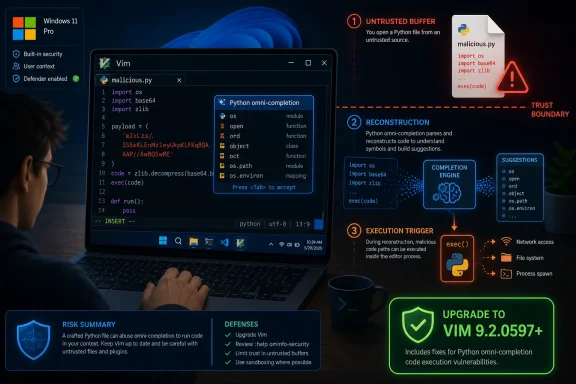 The Exploit Hides in the Editor’s Attempt to Be Helpful
CVE-2026-52860 sits in Vim’s Python omni-completion feature, the machinery behind the editor’s ability to offer Python-aware suggestions rather than simple word matching. In affected builds, Vim reconstructed Python function and class definitions from the current buffer and executed those reconstructed definitions with Python’s exec() while building completion data. That choice mattered because Python evaluates default argument values, parameter annotations, and class base expressions at definition time.In plain English, a malicious Python file could place executable expressions in places that look like structure rather than action. The code does not need to be a top-level payload screaming “run me.” It can be embedded in the metadata-like parts of a function or class definition that Python still evaluates while the editor is trying to understand the file.
That is why this bug is more subtle than the usual “open a malicious file and instantly lose” scare. According to the public advisory trail, simply opening the file is not enough. The user must trigger Python omni-completion, typically through Vim’s completion shortcut or through a plugin that invokes the same completion function.
That requirement lowers the practical risk, but it does not make the bug academic. Developers trigger completion constantly, often reflexively, and security models that depend on users not pressing the tool’s normal productivity shortcut are not models anyone should admire for long.
This Is Local Code Execution, but the File Can Come From Anywhere
The published severity has been treated as high by major vulnerability trackers, with the central impact being code execution in the user’s Vim process. The phrase local can be misleading here. The execution happens locally, but the malicious input can arrive by all the usual routes developers use every day: a cloned repository, a patch sent for review, a sample file attached to a ticket, a proof-of-concept downloaded from a security blog, or a Python snippet copied into a scratch buffer.That is the uncomfortable pattern. Modern attacks against developers often do not need to break through a firewall first. They can ride the social and technical trust chain of development work itself.
For Windows administrators, this matters even if the first mental image of Vim is a Linux terminal. Vim is widely available on Windows, ships through multiple package channels, and is embedded in workflows that span Windows Terminal, Git for Windows, MSYS2, Cygwin, WSL, SSH sessions, and remote development environments. A Windows workstation used for coding is rarely just “a Windows workstation” anymore; it is a layered toolchain with Unix habits, Python interpreters, Git checkouts, and editor plugins sitting on top.
That makes inventory more annoying than it looks. An enterprise may have no sanctioned standalone Vim deployment and still have Vim binaries scattered across developer laptops, CI images, build hosts, containers, and administrative jump boxes. The risk is not evenly distributed across every employee. It clusters around the people who regularly inspect unfamiliar code.
The Previous Mitigation Solved the Wrong Shape of the Same Problem
One reason CVE-2026-52860 deserves attention is that it follows a related earlier issue in the same general surface. A prior mitigation, controlled throughg:pythoncomplete_allow_import, addressed Python omni-completion behavior around harvested import and from statements. That mitigation was useful, but the new issue did not rely on executing imported modules.Instead, the vulnerable path involved reconstructed definitions. Python’s semantics do the rest. Default values and annotations are not inert strings; they can cause evaluation at definition time, and class base expressions are likewise evaluated when the class statement is executed.
That distinction matters because it shows the trap in narrowly patching one dangerous pattern inside a feature that fundamentally crosses a trust boundary. If an editor executes code to understand code, then every bit of language syntax that can trigger evaluation becomes security-relevant. Closing imports is sensible, but it is not equivalent to making completion safe.
The fix in Vim 9.2.0597 addresses the newly disclosed path. The broader lesson is harder: editor intelligence cannot be treated as harmless UI frosting. Once it shells out, imports, evaluates, introspects, or runs interpreter logic against untrusted text, it belongs in the same risk conversation as build scripts and package install hooks.
Windows Users Should Not Dismiss a Vim CVE as Somebody Else’s Unix Problem
The Windows angle is easy to underplay because Vim is culturally associated with Unix, terminal diehards, and server-side administration. But Windows has spent the last decade becoming friendlier to exactly those workflows. Windows Terminal, WSL, OpenSSH, winget, Git integration, Dev Drive, Visual Studio Code remote workflows, and Python-first automation have made Windows a perfectly normal place to run Vim.That is good for developers and administrators. It also means Windows security teams cannot draw a neat line between “Windows software” and “open-source developer tools.” The attack surface on a real endpoint is the toolchain the user actually runs, not the product family named in a patch dashboard.
Microsoft’s listing of the CVE in its Security Update Guide does not mean Vim suddenly became a Microsoft product in the ordinary sense. It does, however, reflect a practical reality: Microsoft’s security ecosystem tracks third-party and open-source components because Windows environments depend on them. The Knowledge Base disclaimer attached to the entry is legal boilerplate, but the operational message is clearer than the disclaimer language: know whether affected software is present, and update it through the channel that supplied it.
That last phrase is crucial. A Windows user might have Vim from an official upstream installer, a package manager, Git for Windows tooling, MSYS2, Cygwin, Chocolatey, Scoop, winget, WSL distributions, or a vendor-supplied bundle. “Patch Vim” is not one action; it is a search across where Vim actually lives.
The Real Trigger Is Trusting the Buffer
The vulnerability’s trigger condition is unusually revealing. Vim does not need to compile a project, run a test suite, or execute a script. It only needs to be asked for Python-aware completion while the malicious buffer is present. That makes the file itself the attack staging area, and the completion gesture the ignition.For attackers, this is attractive because it can fit into ordinary development behavior. A hostile repository can contain Python files that appear worth inspecting. A code review can direct a maintainer to a specific function. A bug report can include a minimal reproduction. The victim’s impulse is not reckless execution; it is reading and navigating code.
That is why “user interaction required” should not be read as a comfort blanket. Security scoring systems need a field for interaction, and this bug deserves that field. But in the developer world, opening suspicious code and invoking editor features is not unusual behavior. It is the job.
The safer mental model is that untrusted source code is active content, even before a developer runs it. Build files, package manifests, editor modelines, language server hooks, test discovery, dependency resolvers, documentation previewers, notebook renderers, and completion engines all create opportunities for source trees to influence the local machine. CVE-2026-52860 is one more example of that pattern, not an isolated oddity.
Language Semantics Turned a Parser Shortcut Into an Execution Path
The technical root of the bug is a mismatch between “parsing enough code to offer completions” and “executing reconstructed code to discover completions.” Vim’s Python completion script was not simply tokenizing names. It rebuilt pieces of the current buffer and handed them to Python execution machinery as part of populating a completion dictionary.That may sound outrageous in hindsight, but it comes from a common temptation in tooling design. Programming languages are complex, and the fastest way to understand a language construct is often to ask the language runtime itself. The runtime already knows how to resolve definitions, evaluate expressions, inspect objects, and surface attributes.
The problem is that runtimes do not merely understand code. They run it. Python in particular has many evaluation points that are not visually obvious to casual readers, including defaults, decorators, annotations depending on version and future imports, metaclass behavior, descriptors, imports, and class construction side effects.
Completion tools have to choose where they sit on the spectrum between static analysis and runtime introspection. Static analysis is harder and sometimes less accurate. Runtime introspection is powerful and convenient, but it turns untrusted text into executable input unless aggressively sandboxed or constrained. CVE-2026-52860 is what happens when that boundary gets crossed in a feature users perceive as passive.
The Patch Is Straightforward; the Inventory Is Not
The immediate remediation is simple: upgrade to Vim 9.2.0597 or later. Users running Vim builds without Python support are not affected by the Python execution path. Users who never invoke Python omni-completion on untrusted files have a lower exposure. But those caveats should guide prioritization, not become excuses for ignoring the update.On individual Windows machines, checking Vim’s version is usually easy. The harder question is whether the version being checked is the version actually invoked in daily work. A developer may have multiple
vim.exe binaries on the path, different versions inside WSL distributions, and yet another copy used by Git commit workflows.Enterprise IT should treat this as a software composition and endpoint hygiene problem. Security tooling often inventories installed applications well enough, but developer tools installed through user-space package managers can be slippery. The affected asset may not appear as a neat entry in “Programs and Features.”
For sysadmins, the better approach is layered. Patch managed packages. Ask developers to update self-managed toolchains. Check common package-manager inventories. Scan for Vim binaries in known developer paths. And, where practical, reduce the use of Python-enabled Vim builds on systems that do not need that feature.
Completion Engines Are Becoming Security Boundaries
This bug lands in a world where completion is no longer a small editor convenience. Developers now live inside a dense mesh of completion engines, language servers, AI assistants, static analyzers, refactoring tools, package indexers, and test discovery services. The editor is not just displaying text; it is orchestrating a miniature development platform.That shift has changed the security stakes. A classic text editor could mostly be judged by how it opened files and handled escape sequences. A modern editor or IDE may parse entire repositories, invoke interpreters, query dependency metadata, run background analyzers, load plugins, and communicate with remote services.
Vim is unusually old, but the problem is thoroughly modern. The more an editor knows, the more it is tempted to execute. The more it executes, the more it needs the controls we expect from software that processes untrusted input: sandboxing, least privilege, explicit trust prompts, safe defaults, and auditability.
This is where the industry still feels inconsistent. Browsers learned, painfully, that rendering untrusted content requires hard isolation. Office learned, painfully, that documents are active content. Developer tools are still catching up to the idea that source code from an unknown repository deserves similar suspicion.
The Windows Development Stack Needs a Cleaner Trust Story
Windows has made enormous progress as a developer platform, but trust boundaries remain messy. A user can clone code in Windows, edit it in a terminal editor, run commands through PowerShell, drop into WSL, invoke Linux package managers, call Windows binaries from Linux paths, and authenticate to cloud services from the same session. That power is precisely why the endpoint matters.CVE-2026-52860 does not require us to panic about Vim. It does require us to stop treating developer convenience features as exempt from endpoint security design. If the editor can run Python in the user’s context, then the editor is part of the execution chain. If a malicious repository can influence that path, then code review itself becomes an exposure moment.
There is also a permissions problem. Developer accounts often have broad access: source repositories, signing material, cloud credentials, internal package feeds, SSH keys, production-adjacent secrets, and administrative scripts. Arbitrary code execution in a developer’s editor process may not begin with SYSTEM privileges, but it may begin inside the most valuable user context in the company.
That is why least privilege for developers is not just an enterprise slogan. It is a practical mitigation when tools misbehave. If the user running Vim has access to everything, then the editor process does too.
Security Teams Should Avoid Both Panic and Shrugging
The wrong reaction is to call this a catastrophic remote-code-execution event on every Windows machine. The exploit requires a vulnerable Vim build with Python support, a hostile Python buffer, and completion being triggered. That chain matters, and it should keep the response proportional.The other wrong reaction is to shrug because the trigger is local and interactive. Developer compromise has become a favored route into organizations precisely because it looks like normal work. A malicious code sample is easier to explain than a suspicious executable, and editor features are easier to overlook than post-install scripts.
A sane response puts this vulnerability into the “patch promptly, verify exposure, harden workflow” bucket. It is not an all-hands incident for most organizations. It is a useful forcing function for checking whether developer endpoints are being inventoried with the same seriousness as browsers, VPN clients, and office suites.
For individual enthusiasts, the advice is simpler: update Vim, especially if you edit Python. If you use a package manager, update through that package manager. If you run Vim inside WSL, update the Linux distribution package as well as any Windows-native copy. If you maintain a heavily customized Vim setup, check whether plugins invoke omni-completion automatically.
The Small Vim Bug With the Large Toolchain Lesson
The concrete facts are narrow, but the operational lesson is broad. CVE-2026-52860 is best understood as a developer-tool trust flaw, not merely a Vim flaw.- Vim versions before 9.2.0597 are affected when Python omni-completion is available through Python-enabled builds.
- The exploit path requires a hostile Python buffer and a completion trigger, so opening the file alone is not the complete attack sequence.
- The vulnerable behavior comes from executing reconstructed function and class definitions while building completion data.
- The earlier import-focused mitigation did not cover this path because the attacker-controlled expressions were not harvested import statements.
- Windows users should check every place Vim may be installed, including WSL distributions, Git-adjacent environments, and user-space package managers.
- Developers who inspect untrusted repositories should treat editor intelligence features as active processing, not as passive reading.
References
- Primary source: MSRC
Published: 2026-06-13T01:01:27-07:00
Security Update Guide - Microsoft Security Response Center
 msrc.microsoft.com
- Related coverage: osv.dev

OSV - Open Source Vulnerabilities
Comprehensive vulnerability database for your open source projects and dependencies.
osv.dev
- Related coverage: stackoverflow.com
Vim, omnicomplete and Python documentation - Stack Overflow
I started to learn Python, and I tried to set up my Vim for it. I have Vim 7.3.5.3, it has omnicompletion and I downloaded pyflakes. I read this article
and it says that omnicompletion should alsostackoverflow.com
