

Microsoft disclosed CVE-2026-47291 on June 9, 2026, as a Windows HTTP.sys remote code execution vulnerability in the HTTP protocol stack, giving administrators a Patch Tuesday item that matters most on systems where Windows itself is listening for and processing HTTP traffic. This is not merely another web-server bug with a familiar port number. HTTP.sys sits in the Windows networking path, below IIS and beside any application that relies on the Windows HTTP Server API. That placement is why the advisory’s bland wording should make server teams move quickly, even while public technical detail remains limited.
The important phrase in Microsoft’s entry is not just remote code execution. It is the combination of remote reachability, a kernel-mode HTTP component, and Microsoft’s confirmation that the vulnerability exists. The user-facing advisory may not hand attackers a root-cause essay, but the affected component is well understood, heavily deployed, and historically capable of turning a malformed request into a server-side emergency.
Security advisories often look underwhelming on first read. A CVE name, a component, a severity rating, a CVSS vector, a list of affected products, and a patch mapping do not feel like a story. For administrators, however, that is the story: Microsoft is saying that a supported Windows component in the HTTP request path has a flaw serious enough to be tracked as remote code execution.
The lack of exploit narrative should not be mistaken for lack of risk. Microsoft frequently withholds triggering conditions, packet structure, and root-cause detail until customers have had time to patch. That is especially true for vulnerabilities in components that can be reached over the network and are common across server builds.
CVE-2026-47291 is therefore a confidence problem as much as a vulnerability problem. The excerpt supplied with the advisory describes the Report Confidence concept: how certain the vulnerability is, how credible the technical details are, and how much an attacker might be able to infer from what has been published. In plain English, Microsoft’s acknowledgement moves this out of rumor territory. It is not a scanner vendor guessing from a crash log; it is the platform vendor publishing a security update.
That does not mean every Windows machine is equally exposed. It means every Windows machine that exposes HTTP.sys-backed services deserves immediate inventory and patch consideration. The operational difference between “vulnerable code exists” and “reachable vulnerable code exists” is where defenders earn their keep.
That architecture is a performance win. It lets Windows accept and process high volumes of HTTP traffic without handing every byte to a user-mode process immediately. It also allows multiple applications to share URL namespaces and ports in a controlled way through the HTTP Server API.
The security trade-off is obvious: a parsing or memory-handling bug in this layer can live closer to the operating system than many web administrators expect. A flaw in a user-mode web application is bad; a flaw in a kernel-mode HTTP listener is a different class of bad. It can sit in front of applications, before normal logging, middleware, authentication code, or application-level request filters ever get a vote.
That is why HTTP.sys bugs are watched so closely by defenders. They live at the seam between Windows as an operating system and Windows as an internet-facing platform. When that seam frays, the blast radius is rarely limited to one website.
Here, the practical reading is straightforward. Microsoft has acknowledged the vulnerability through MSRC, assigned it a CVE, and tied it to the Windows HTTP.sys component. Even if exploit code is not public, the existence of the flaw is no longer speculative.
That matters because exploit development is increasingly metadata-driven. Attackers do not need a full proof-of-concept on day one to begin triage. A component name, impact class, affected product list, patch diff, and CVSS vector can be enough to start comparing binaries, probing exposed services, and searching for crashable request patterns.
Defenders should resist the old comfort phrase: “No public exploit exists.” That phrase is useful only if it buys time for patching, not if it becomes a reason to defer. For HTTP.sys, the better assumption is that the clock starts when the update ships.
For HTTP.sys, the concern is sharpened by where request processing begins. A crafted HTTP request can reach the Windows HTTP stack before an application framework applies business logic. That does not automatically make every HTTP.sys RCE wormable, but it does make network placement and service exposure central to risk.
Publicly reachable IIS servers are the obvious candidates for immediate attention. So are internal Windows servers hosting management portals, line-of-business applications, device dashboards, certificate services, update infrastructure, or custom services built on the HTTP Server API. Modern enterprise networks are full of “internal only” HTTP endpoints that became trusted simply because they were not on the public internet.
That trust model has aged badly. VPN access, compromised laptops, cloud peering, flat internal segments, and vendor appliances routinely put attackers inside networks where internal HTTP services are reachable. For a remote HTTP.sys flaw, “not internet-facing” lowers risk; it does not erase it.
That is more complicated than searching for “IIS installed.” A Windows server can use HTTP.sys without being a traditional IIS web server. Applications built on ASP.NET Core’s HTTP.sys server, Windows services using HTTP Server API bindings, and management components that register URL prefixes may all depend on the same underlying stack.
The fastest practical path is to combine patch management data with network listening data. Patch tools tell you which machines have not yet received the relevant cumulative update. Network telemetry tells you which of those machines are actually accepting connections on ports such as 80, 443, 5985, 5986, or application-specific HTTP ports.
The priority order almost writes itself. Internet-facing Windows servers come first. Externally reachable HTTPS endpoints, reverse-proxied services that still terminate on Windows, and edge-adjacent systems follow. Internal servers with broad east-west reachability come next, especially if they sit in privileged network zones or host administrative functions.
The most credible interim controls are boring network controls. Remove unnecessary HTTP.sys-backed services from the internet. Restrict access to management listeners. Put administrative HTTP endpoints behind VPN, conditional access, or privileged access workstations. Block inbound traffic to services that do not need broad reachability.
For IIS workloads, administrators should review bindings, host headers, TLS termination points, and reverse proxy paths. If a proxy sits in front of IIS but forwards malformed traffic unchanged, it may not reduce risk as much as assumed. If the proxy terminates and normalizes requests before sending them to Windows, it may help, but it should not become an excuse to leave the host unpatched.
Service owners also need to know that disabling IIS is not the same thing as disabling HTTP.sys. The HTTP service is a Windows component with dependencies, and bluntly stopping it can break more than a website. That is why patching remains the clean operational route: it fixes the vulnerable component while preserving the platform behavior applications expect.
That does not make monitoring useless. It means teams should widen the lens. Look for unusual connection patterns, unexplained HTTPERR spikes, crashes or restarts of services bound to HTTP.sys, kernel bugchecks on web-facing systems, anomalous process creation following HTTP traffic, and endpoint detection alerts tied to web server identities.
The absence of obvious web logs is not exculpatory. A malformed request designed to tickle a protocol parser may never look like a normal GET or POST in application telemetry. Network detection, crash telemetry, EDR, and Windows event logs all have to be part of the picture.
This is also where patch validation becomes a security control rather than a compliance ritual. If a server is in the exposed set, it is not enough for a dashboard to show “update approved.” Administrators need evidence that the update installed, the system rebooted if required, and the vulnerable build is no longer present.
That history should not be abused. Not every HTTP.sys flaw is the next crisis, and not every RCE becomes a mass-exploitation event. Security writing often overreaches by turning every critical CVE into a countdown to catastrophe.
But history does justify seriousness. HTTP.sys is reachable, common, and privileged enough that defenders should treat a confirmed RCE as a high-priority maintenance event. The right posture is neither hysteria nor complacency; it is fast, boring execution.
That means patch the systems that matter first, reduce exposure where patching lags, and keep watching for follow-up guidance. Microsoft advisories can change after initial publication as affected products, exploitation assessments, or mitigations are clarified. Patch Tuesday is a publication date, not the end of the story.
Those machines often sit in permissive network zones. They may not have the same patch cadence as domain controllers or public web servers. They may be owned by an application team, a facilities vendor, a manufacturing group, or nobody in particular.
CVE-2026-47291 is exactly the kind of advisory that exposes that governance gap. If your asset inventory cannot answer “Which Windows hosts are listening through HTTP.sys?” then your vulnerability response will be slower than the attacker’s reconnaissance. The CVE becomes a mirror held up to basic hygiene.
The good news is that this is fixable. Windows shops already have most of the ingredients: endpoint management, vulnerability scanners, EDR, firewall logs, load balancer inventories, certificate inventories, and configuration management databases. The failure mode is not lack of data; it is failure to join the data quickly when a component-level advisory lands.
Application teams should therefore know whether their deployment uses Kestrel behind a reverse proxy, IIS in-process or out-of-process hosting, or HTTP.sys directly. That distinction affects exposure, logging, performance behavior, and vulnerability response. Too many incident calls begin with a deceptively simple question no one can answer: “What is actually listening on that port?”
CVE-2026-47291 is a reminder that framework choices do not eliminate platform risk. Even clean application code can inherit vulnerability from the listener beneath it. Secure development includes knowing which operating system components are in the request path.
For software vendors shipping Windows-based appliances or bundled management servers, the bar is higher. Customers need clear advisories that say whether the product uses HTTP.sys, whether Microsoft’s update is sufficient, and whether any service-level workaround is safe. Silence from a vendor forces customers to reverse-engineer their own exposure.
This is why long change windows are dangerous for externally reachable infrastructure. A two-week patch cycle may feel disciplined in ordinary months. For a confirmed remote code execution flaw in a network-facing Windows component, two weeks can be generous to the wrong people.
Enterprises will argue, correctly, that patching kernel components requires testing. Web servers carry business-critical traffic, and cumulative updates can introduce regressions. But the answer is not to slow-walk everything; it is to segment the fleet into risk tiers and move the exposed tier faster.
A mature process lets administrators patch edge systems and high-risk internal servers urgently while continuing compatibility testing for lower-risk assets. A weak process treats every server as equally delicate and therefore patches none of them quickly. CVE-2026-47291 rewards the former and punishes the latter.
Here is the operational shape of the week for Windows administrators:
The temptation is to wait for third-party write-ups, scanner plugins, exploit chatter, or emergency government alerts. Sometimes that extra signal helps. Sometimes it arrives after the most important patching window has already closed.
For CVE-2026-47291, the smarter reading is that the advisory has already crossed the threshold for action. A confirmed RCE in HTTP.sys does not need drama to be important. It needs inventory, prioritization, patching, and verification.
The broader lesson is that Windows security is increasingly component security. Administrators cannot think only in terms of named products like IIS, Exchange, or SharePoint. They must understand shared operating system layers — HTTP.sys, SMB, RPC, TCP/IP, Win32k, Kerberos, Netlogon — because those layers define the real attack surface.
CVE-2026-47291 may or may not become the vulnerability everyone remembers from this Patch Tuesday. But it should become the one that forces Windows shops to answer a basic question with confidence: when Microsoft says the HTTP stack is vulnerable, can you find every system where that stack is exposed before someone else does?
The important phrase in Microsoft’s entry is not just remote code execution. It is the combination of remote reachability, a kernel-mode HTTP component, and Microsoft’s confirmation that the vulnerability exists. The user-facing advisory may not hand attackers a root-cause essay, but the affected component is well understood, heavily deployed, and historically capable of turning a malformed request into a server-side emergency.
 Microsoft’s Sparse Advisory Still Says Enough
Security advisories often look underwhelming on first read. A CVE name, a component, a severity rating, a CVSS vector, a list of affected products, and a patch mapping do not feel like a story. For administrators, however, that is the story: Microsoft is saying that a supported Windows component in the HTTP request path has a flaw serious enough to be tracked as remote code execution.The lack of exploit narrative should not be mistaken for lack of risk. Microsoft frequently withholds triggering conditions, packet structure, and root-cause detail until customers have had time to patch. That is especially true for vulnerabilities in components that can be reached over the network and are common across server builds.
CVE-2026-47291 is therefore a confidence problem as much as a vulnerability problem. The excerpt supplied with the advisory describes the Report Confidence concept: how certain the vulnerability is, how credible the technical details are, and how much an attacker might be able to infer from what has been published. In plain English, Microsoft’s acknowledgement moves this out of rumor territory. It is not a scanner vendor guessing from a crash log; it is the platform vendor publishing a security update.
That does not mean every Windows machine is equally exposed. It means every Windows machine that exposes HTTP.sys-backed services deserves immediate inventory and patch consideration. The operational difference between “vulnerable code exists” and “reachable vulnerable code exists” is where defenders earn their keep.
HTTP.sys Is Not Just IIS Wearing a Different Hat
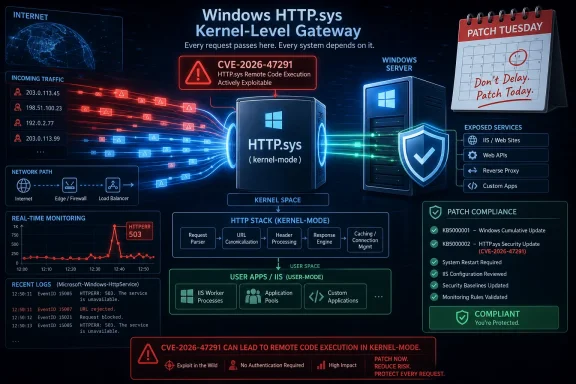
HTTP.sys is easy to underestimate because many administrators encounter it indirectly. IIS uses it, but IIS is not the boundary of the problem. Microsoft’s HTTP protocol stack is a kernel-mode driver that receives HTTP and HTTPS requests, handles connection management, performs request queuing, supports kernel-mode caching, and routes requests to user-mode services.That architecture is a performance win. It lets Windows accept and process high volumes of HTTP traffic without handing every byte to a user-mode process immediately. It also allows multiple applications to share URL namespaces and ports in a controlled way through the HTTP Server API.
The security trade-off is obvious: a parsing or memory-handling bug in this layer can live closer to the operating system than many web administrators expect. A flaw in a user-mode web application is bad; a flaw in a kernel-mode HTTP listener is a different class of bad. It can sit in front of applications, before normal logging, middleware, authentication code, or application-level request filters ever get a vote.
That is why HTTP.sys bugs are watched so closely by defenders. They live at the seam between Windows as an operating system and Windows as an internet-facing platform. When that seam frays, the blast radius is rarely limited to one website.
The “Confirmed” Bit Changes the Patch Calculus
The text attached to CVE-2026-47291 focuses on a metric that sounds bureaucratic but matters in practice: confidence. In vulnerability scoring, confidence is a way of saying how much defenders should trust the claim and how much attackers can trust the public breadcrumb trail. A theoretical bug with vague provenance does not demand the same response as a vendor-confirmed issue with an available fix.Here, the practical reading is straightforward. Microsoft has acknowledged the vulnerability through MSRC, assigned it a CVE, and tied it to the Windows HTTP.sys component. Even if exploit code is not public, the existence of the flaw is no longer speculative.
That matters because exploit development is increasingly metadata-driven. Attackers do not need a full proof-of-concept on day one to begin triage. A component name, impact class, affected product list, patch diff, and CVSS vector can be enough to start comparing binaries, probing exposed services, and searching for crashable request patterns.
Defenders should resist the old comfort phrase: “No public exploit exists.” That phrase is useful only if it buys time for patching, not if it becomes a reason to defer. For HTTP.sys, the better assumption is that the clock starts when the update ships.
Remote Code Execution Is the Part Nobody Gets to Hand-Wave
Remote code execution is the vulnerability impact category that collapses the distance between exposure and compromise. It means an attacker may be able to run code on the target system, not merely deny service or learn something they should not know. The details determine how reliable and damaging exploitation is, but the category itself justifies urgency.For HTTP.sys, the concern is sharpened by where request processing begins. A crafted HTTP request can reach the Windows HTTP stack before an application framework applies business logic. That does not automatically make every HTTP.sys RCE wormable, but it does make network placement and service exposure central to risk.
Publicly reachable IIS servers are the obvious candidates for immediate attention. So are internal Windows servers hosting management portals, line-of-business applications, device dashboards, certificate services, update infrastructure, or custom services built on the HTTP Server API. Modern enterprise networks are full of “internal only” HTTP endpoints that became trusted simply because they were not on the public internet.
That trust model has aged badly. VPN access, compromised laptops, cloud peering, flat internal segments, and vendor appliances routinely put attackers inside networks where internal HTTP services are reachable. For a remote HTTP.sys flaw, “not internet-facing” lowers risk; it does not erase it.
Patch Tuesday Turns Into an Exposure Census
The correct first response is not panic. It is inventory. Administrators need to know which hosts are running supported Windows builds, which ones have HTTP.sys active, which ones expose HTTP or HTTPS listeners, and which ones are reachable from untrusted networks.That is more complicated than searching for “IIS installed.” A Windows server can use HTTP.sys without being a traditional IIS web server. Applications built on ASP.NET Core’s HTTP.sys server, Windows services using HTTP Server API bindings, and management components that register URL prefixes may all depend on the same underlying stack.
The fastest practical path is to combine patch management data with network listening data. Patch tools tell you which machines have not yet received the relevant cumulative update. Network telemetry tells you which of those machines are actually accepting connections on ports such as 80, 443, 5985, 5986, or application-specific HTTP ports.
The priority order almost writes itself. Internet-facing Windows servers come first. Externally reachable HTTPS endpoints, reverse-proxied services that still terminate on Windows, and edge-adjacent systems follow. Internal servers with broad east-west reachability come next, especially if they sit in privileged network zones or host administrative functions.
Mitigation Is a Bridge, Not a Strategy
When a kernel-mode protocol stack receives a security fix, the durable answer is to apply the update. Mitigations can reduce exposure, but they rarely provide the same assurance as patched code. For CVE-2026-47291, that distinction matters because public detail is limited: defenders cannot safely craft a precise request filter for a trigger they do not know.The most credible interim controls are boring network controls. Remove unnecessary HTTP.sys-backed services from the internet. Restrict access to management listeners. Put administrative HTTP endpoints behind VPN, conditional access, or privileged access workstations. Block inbound traffic to services that do not need broad reachability.
For IIS workloads, administrators should review bindings, host headers, TLS termination points, and reverse proxy paths. If a proxy sits in front of IIS but forwards malformed traffic unchanged, it may not reduce risk as much as assumed. If the proxy terminates and normalizes requests before sending them to Windows, it may help, but it should not become an excuse to leave the host unpatched.
Service owners also need to know that disabling IIS is not the same thing as disabling HTTP.sys. The HTTP service is a Windows component with dependencies, and bluntly stopping it can break more than a website. That is why patching remains the clean operational route: it fixes the vulnerable component while preserving the platform behavior applications expect.
Logging May Not Show the Attack You Care About
One of the frustrating realities of HTTP.sys is that it can reject or process requests before IIS application logs see them. HTTPERR logs can capture certain HTTP.sys-level errors, and IIS logs remain useful for ordinary web traffic, but a low-level vulnerability may not leave the tidy application-layer trail defenders want.That does not make monitoring useless. It means teams should widen the lens. Look for unusual connection patterns, unexplained HTTPERR spikes, crashes or restarts of services bound to HTTP.sys, kernel bugchecks on web-facing systems, anomalous process creation following HTTP traffic, and endpoint detection alerts tied to web server identities.
The absence of obvious web logs is not exculpatory. A malformed request designed to tickle a protocol parser may never look like a normal GET or POST in application telemetry. Network detection, crash telemetry, EDR, and Windows event logs all have to be part of the picture.
This is also where patch validation becomes a security control rather than a compliance ritual. If a server is in the exposed set, it is not enough for a dashboard to show “update approved.” Administrators need evidence that the update installed, the system rebooted if required, and the vulnerable build is no longer present.
The Historical Shadow of HTTP.sys Is Long
Windows administrators have seen this movie before. HTTP.sys has previously appeared in serious advisories, including remote code execution and denial-of-service cases. The details vary from year to year, but the pattern remains consistent: when the Windows HTTP protocol stack mishandles network input, the resulting advisory attracts attention far beyond IIS administrators.That history should not be abused. Not every HTTP.sys flaw is the next crisis, and not every RCE becomes a mass-exploitation event. Security writing often overreaches by turning every critical CVE into a countdown to catastrophe.
But history does justify seriousness. HTTP.sys is reachable, common, and privileged enough that defenders should treat a confirmed RCE as a high-priority maintenance event. The right posture is neither hysteria nor complacency; it is fast, boring execution.
That means patch the systems that matter first, reduce exposure where patching lags, and keep watching for follow-up guidance. Microsoft advisories can change after initial publication as affected products, exploitation assessments, or mitigations are clarified. Patch Tuesday is a publication date, not the end of the story.
Enterprise Risk Lives in the Unnamed Server
The hardest hosts to secure are not the flagship IIS servers everyone knows about. They are the forgotten Windows machines that acquired an HTTP listener because a product installer needed one. They run dashboards, enrollment portals, backup consoles, monitoring tools, print services, device management panels, or one-off internal APIs written years ago.Those machines often sit in permissive network zones. They may not have the same patch cadence as domain controllers or public web servers. They may be owned by an application team, a facilities vendor, a manufacturing group, or nobody in particular.
CVE-2026-47291 is exactly the kind of advisory that exposes that governance gap. If your asset inventory cannot answer “Which Windows hosts are listening through HTTP.sys?” then your vulnerability response will be slower than the attacker’s reconnaissance. The CVE becomes a mirror held up to basic hygiene.
The good news is that this is fixable. Windows shops already have most of the ingredients: endpoint management, vulnerability scanners, EDR, firewall logs, load balancer inventories, certificate inventories, and configuration management databases. The failure mode is not lack of data; it is failure to join the data quickly when a component-level advisory lands.
Developers Are in the Blast Radius Too
This is not only an operations story. Developers who choose HTTP.sys for ASP.NET Core or custom Windows services do so for valid reasons: Windows authentication, port sharing, kernel-mode capabilities, and enterprise integration. Those benefits come with dependency on the Windows servicing model.Application teams should therefore know whether their deployment uses Kestrel behind a reverse proxy, IIS in-process or out-of-process hosting, or HTTP.sys directly. That distinction affects exposure, logging, performance behavior, and vulnerability response. Too many incident calls begin with a deceptively simple question no one can answer: “What is actually listening on that port?”
CVE-2026-47291 is a reminder that framework choices do not eliminate platform risk. Even clean application code can inherit vulnerability from the listener beneath it. Secure development includes knowing which operating system components are in the request path.
For software vendors shipping Windows-based appliances or bundled management servers, the bar is higher. Customers need clear advisories that say whether the product uses HTTP.sys, whether Microsoft’s update is sufficient, and whether any service-level workaround is safe. Silence from a vendor forces customers to reverse-engineer their own exposure.
The Real Race Is Between Patch Diffing and Change Control
Attackers love Patch Tuesday for the same reason administrators dread it: it publishes a map. Once an update is available, skilled researchers can compare patched and unpatched binaries to identify changed code paths. That does not guarantee a working exploit, but it can sharply reduce the search space.This is why long change windows are dangerous for externally reachable infrastructure. A two-week patch cycle may feel disciplined in ordinary months. For a confirmed remote code execution flaw in a network-facing Windows component, two weeks can be generous to the wrong people.
Enterprises will argue, correctly, that patching kernel components requires testing. Web servers carry business-critical traffic, and cumulative updates can introduce regressions. But the answer is not to slow-walk everything; it is to segment the fleet into risk tiers and move the exposed tier faster.
A mature process lets administrators patch edge systems and high-risk internal servers urgently while continuing compatibility testing for lower-risk assets. A weak process treats every server as equally delicate and therefore patches none of them quickly. CVE-2026-47291 rewards the former and punishes the latter.
The Patch Window Should Be Shorter Than the Guesswork
The concrete response to CVE-2026-47291 is less mysterious than the vulnerability itself. The advisory does not need to disclose the vulnerable function for defenders to act. It has already disclosed the component, the impact class, and the vendor’s confirmation.Here is the operational shape of the week for Windows administrators:
- Identify Windows servers and clients that expose HTTP or HTTPS services backed by HTTP.sys, including IIS, HTTP Server API applications, and management listeners.
- Prioritize internet-facing and broadly reachable internal systems before ordinary workstations or isolated lab machines.
- Apply the relevant Microsoft security updates and verify installation by build number or patch compliance evidence, not by approval status alone.
- Reduce network exposure for systems that cannot be patched immediately, especially administrative HTTP endpoints and legacy application servers.
- Monitor HTTPERR logs, IIS logs, EDR alerts, crash telemetry, and network traffic for signs of malformed request activity or post-exploitation behavior.
- Revisit vendor-managed Windows appliances and bundled applications, because their HTTP.sys dependency may not be obvious from the product name.
Microsoft’s Minimalism Puts More Weight on Local Discipline
Microsoft’s Security Update Guide is built for scale, not storytelling. It tells millions of administrators what needs attention without publishing a tutorial for exploitation. That restraint is defensible, but it also leaves local teams responsible for translating sparse advisory language into action.The temptation is to wait for third-party write-ups, scanner plugins, exploit chatter, or emergency government alerts. Sometimes that extra signal helps. Sometimes it arrives after the most important patching window has already closed.
For CVE-2026-47291, the smarter reading is that the advisory has already crossed the threshold for action. A confirmed RCE in HTTP.sys does not need drama to be important. It needs inventory, prioritization, patching, and verification.
The broader lesson is that Windows security is increasingly component security. Administrators cannot think only in terms of named products like IIS, Exchange, or SharePoint. They must understand shared operating system layers — HTTP.sys, SMB, RPC, TCP/IP, Win32k, Kerberos, Netlogon — because those layers define the real attack surface.
CVE-2026-47291 may or may not become the vulnerability everyone remembers from this Patch Tuesday. But it should become the one that forces Windows shops to answer a basic question with confidence: when Microsoft says the HTTP stack is vulnerable, can you find every system where that stack is exposed before someone else does?
References
- Primary source: MSRC
Published: 2026-06-09T07:00:00-07:00
Security Update Guide - Microsoft Security Response Center
 msrc.microsoft.com
- Official source: microsoft.com
MSRC - Microsoft Security Response Center
The Microsoft Security Response Center is part of the defender community and on the front line of security response evolution. For over twenty years, we have been engaged with security researchers working to protect customers and the broader ecosystem.www.microsoft.com
- Related coverage: sentinelone.com
CVE-2025-47291: Containerd CRI DoS Vulnerability
CVE-2025-47291 is a denial of service vulnerability in containerd CRI implementation. Learn about its impact, affected versions, and mitigation methods.www.sentinelone.com
- Official source: learn.microsoft.com
Security Advisories and Bulletins | Microsoft Learn
learn.microsoft.com - Related coverage: unit42.paloaltonetworks.com
Microsoft WSUS Remote Code Execution (CVE-2025-59287) Actively Exploited in the Wild (Updated November 3)
CVE-2025-59287 is a critical RCE vulnerability identified in Microsoft’s WSUS. Our observations from cases show a consistent methodology.unit42.paloaltonetworks.com - Related coverage: wiz.io
CVE-2025-47291 Impact, Exploitability, and Mitigation Steps | Wiz
Understand the critical aspects of CVE-2025-47291 with a detailed vulnerability assessment, exploitation potential, affected technologies, and remediation guidance.www.wiz.io
- Related coverage: appsecure.security
CVE-2026-21240 | High Vulnerability in Microsoft HTTP.sys
High-severity privilege escalation in Microsoft HTTP.sys due to TOCTOU race condition. Patch immediately to prevent local exploitation.www.appsecure.security
- Related coverage: f.hubspotusercontent20.net
six degrees http protocol stack remote code execution vulnerability report final
internet security and data protection concept, blockchain and cybersecurityf.hubspotusercontent20.net
- Related coverage: solarwinds.com
