

Microsoft’s advisory listing for a Windows HTTP.sys elevation-of-privilege flaw should be treated as a high-priority remediation item: the vulnerability is recorded in vendor telemetry and public trackers, it affects the kernel-mode HTTP protocol stack that terminates HTTP requests for IIS and many inbox services, and the public disclosure so far confirms an Elevation of Privilege impact without publishing low-level exploit mechanics — a disclosure posture that demands immediate, conservative operational action from defenders.
Microsoft’s Security Update Guide records a CVE associated with the Windows HTTP protocol stack (HTTP.sys) that is classified as an Elevation of Privilege issue affecting multiple Windows builds. Public vulnerability databases and independent trackers list the issue with a CVSS v3.1 score in the high range (7.5), attack vector network, and low privileges required — an indicator that a standard user account or an attacker controlling a low‑privilege process could potentially act as the initial trigger for exploitation. Microsoft’s initial advisory text is intentionally terse: the vendor confirms the vulnerability and maps it to HTTP.sys, but it does not (at first publication) include kernel-level exploit mechanics, proof-of-concept code, or full patch diffs.
That combination — vendor confirmation + limited public technical detail — is a familiar disclosure posture for inbox kernel components. It signals the vendor has validated the issue and is releasing or staging fixes, but is not yet publishing the exploit recipe. Historically, HTTP.sys flaws have carried outsized operational risk because the component runs in ring‑0, processes network-facing input, and services a broad set of server and management workflows. Past HTTP.sys vulnerabilities have ranged from denial-of-service to wormable remote code execution, which is why the presence of this CVE in the Security Update Guide should raise immediate prioritization in patching plans.
Historical precedent raises the stakes. Notable past HTTP.sys bugs have produced fast-moving proof-of-concept (PoC) publication and active exploitation. That pattern demonstrates two operational lessons:
Each model above maps to both known historical classes and realistic exploitation strategies for kernel-mode components. Importantly: until patch diffs or authoritative analysis appear, do not assume a specific exploit recipe.
Patch promptly, reduce exposure for unpatched hosts, strengthen detection around HTTP.sys activity, and assume the risk is high until vendor patches are installed and validated. Where technical details remain unpublished, resist speculation, but proceed with conservative, evidence-based mitigation: inventory, prioritize, patch, and monitor.
If you have a mixed estate, the single immediate operational takeaway is straightforward: treat the Security Update Guide entry as authoritative, map the CVE to the KBs for your SKUs, and move the most exposed systems to the front of your update ring. Then verify and monitor — the cost of delay when a kernel-mode HTTP stack is involved is simply too high.
Source: MSRC Security Update Guide - Microsoft Security Response Center
 Background / Overview
Microsoft’s Security Update Guide records a CVE associated with the Windows HTTP protocol stack (HTTP.sys) that is classified as an Elevation of Privilege issue affecting multiple Windows builds. Public vulnerability databases and independent trackers list the issue with a CVSS v3.1 score in the high range (7.5), attack vector network, and low privileges required — an indicator that a standard user account or an attacker controlling a low‑privilege process could potentially act as the initial trigger for exploitation. Microsoft’s initial advisory text is intentionally terse: the vendor confirms the vulnerability and maps it to HTTP.sys, but it does not (at first publication) include kernel-level exploit mechanics, proof-of-concept code, or full patch diffs.That combination — vendor confirmation + limited public technical detail — is a familiar disclosure posture for inbox kernel components. It signals the vendor has validated the issue and is releasing or staging fixes, but is not yet publishing the exploit recipe. Historically, HTTP.sys flaws have carried outsized operational risk because the component runs in ring‑0, processes network-facing input, and services a broad set of server and management workflows. Past HTTP.sys vulnerabilities have ranged from denial-of-service to wormable remote code execution, which is why the presence of this CVE in the Security Update Guide should raise immediate prioritization in patching plans.
Why HTTP.sys matters: architecture and historical context
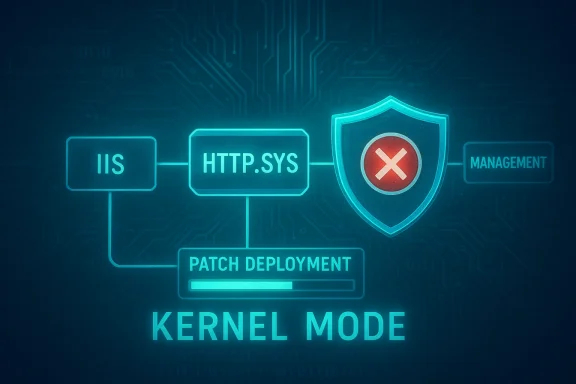
HTTP.sys is a kernel-mode HTTP protocol stack used by Windows to terminate and process HTTP requests for:- Internet Information Services (IIS)
- HTTP Server API consumer applications
- Several inbox services and management endpoints that rely on the kernel HTTP listener
Historical precedent raises the stakes. Notable past HTTP.sys bugs have produced fast-moving proof-of-concept (PoC) publication and active exploitation. That pattern demonstrates two operational lessons:
- Treat kernel-mode HTTP stack CVEs as high-impact even when vendor advisories are terse.
- Assume both local escalation and remote weaponization are plausible until vendor details rule either out.
What is authoritative right now (confirmed facts)
- The vulnerability identifier is recorded in Microsoft’s Security Update Guide and mapped to the HTTP.sys component, which establishes vendor confirmation of existence.
- Public trackers and the NVD record the CVE with a high-severity score and list the attack vector as network and privileges required as low.
- Microsoft’s public advisory text at publication is intentionally concise and does not include low-level exploit mechanics or a public PoC.
- There is no widely published technical write‑up (patch diff or public exploit chain) at the time of initial disclosure.
Plausible technical fault classes (evidence-based hypotheses)
When vendor advisories omit low-level details, defenders must reason from the component’s role and the types of bugs historically seen in HTTP stacks. The following fault models are plausible given HTTP.sys’s behavior — they are not confirmed facts about this CVE and should be treated as analyst hypotheses until corroborated.1. Memory-safety bugs (use-after-free, buffer overflow)
Kernel-mode parsing of HTTP frames, headers, or trailers frequently requires careful memory handling. A use-after-free or out-of-bounds write in parsing or buffering logic can be escalated into a privilege elevation primitive by overwriting kernel objects, function pointers, or security tokens.2. Improper validation or untrusted pointer dereference
If kernel code dereferences pointers constructed from user-controllable input without validating ownership or lifetime, an attacker can influence kernel memory to read/write sensitive structures. In kernel context, such an error can be converted into token manipulation or function pointer override, resulting in SYSTEM privileges.3. Race conditions and TOCTOU (time-of-check/time-of-use)
Concurrency bugs in or around authorization checks and subsequent actions may allow an attacker to trick privileged logic into performing operations on attacker-controlled resources. Race-based primitives are a frequent escalation vector in kernel code.4. Authorization bypasses in admin or metadata paths
If the HTTP stack mediates administrative endpoints or attaches sensitive metadata to requests, an authorization bypass could allow an unprivileged caller to cause privileged code paths to act on behalf of the attacker.Each model above maps to both known historical classes and realistic exploitation strategies for kernel-mode components. Importantly: until patch diffs or authoritative analysis appear, do not assume a specific exploit recipe.
Exploitability, impact, and attacker model
Based on the metadata published by vendors and independent trackers, the likely operational profile is:- Attack vector: Network in many affected instances — meaning Internet-exposed HTTP endpoints and perimeter-facing services present the highest exposure.
- Privileges required: Low — a standard non-admin user or a compromised user‑level process could be the initial trigger.
- Impact: Elevation of Privilege to SYSTEM is the primary concern; secondary consequences include kernel crashes (DoS), post‑compromise persistence, credential theft, or elevated access that enables remote code execution when chained with other bugs.
Operational urgency: what to assume and why
- Assume the vendor record is authoritative. Microsoft’s listing confirms the CVE exists and names HTTP.sys as the affected component — that is the canonical source for remediation planning.
- Assume limited public details do not equal low risk. Microsoft’s conservative disclosure is intended to limit short-term weaponization, but historically exploit code can appear rapidly after patches or diffs become available.
- Prioritize internet‑facing HTTP.sys hosts. External IIS servers, management hosts with HTTP listeners, and edge services should be first in the patch ring.
Immediate mitigation checklist (while you stage updates)
When a kernel-mode HTTP stack vulnerability is disclosed with limited details, apply a layered mitigation posture to reduce exposure and give defenders time to patch and validate.- Patch first: identify the exact KB mapping for your OS builds in Microsoft’s Security Update Guide and apply the vendor-supplied updates through WSUS, SCCM/ConfigMgr, Intune, or your patch management chain. Patch is the only reliable mitigation.
- If you cannot patch immediately, reduce external exposure:
- Block inbound HTTP/S (ports 80/443) to non-essential hosts at the perimeter.
- Place internet-facing services behind an up‑to‑date reverse proxy, WAF, or load balancer, and apply strict filtering and request-size limits.
- Disable or unbind unnecessary HTTP.sys listeners and stop services that rely on the HTTP Server API if they are not required.
- Harden server configuration:
- Disable unused HTTP features (e.g., HTTP/2 or trailer support) when safe and only if documented mitigations are known for the specific CVE.
- Remove unneeded IIS modules and minimize attack surface.
- Network segmentation:
- Move critical management hosts and control-plane services behind restricted management subnets accessible only via jump hosts or trusted VPNs.
- Restrict lateral movement paths and administrative ports with host-based and network firewalls.
- Least privilege and application control:
- Enforce least-privilege access on hosts that expose HTTP services.
- Use application allow-listing to limit execution of unknown binaries on high-risk servers.
Detection and hunting guidance (EDR / SIEM playbook)
Add targeted telemetry and detection rules to your security stack to identify potential exploitation attempts and post‑exploit behavior.- Monitor for kernel stability signals:
- Repeated Blue Screens of Death (BSOD) or WER reports where the faulting module references HTTP.sys.
- Sudden system crashes correlated with inbound HTTP requests.
- Hunt for anomalous process behavior tied to HTTP activity:
- SYSTEM-level child processes spawned shortly after HTTP requests (especially if spawned by service or worker processes).
- Unexpected privilege escalations or creation of new administrative accounts after web traffic hits a host.
- Correlate network telemetry and logs:
- Unusual or malformed HTTP request patterns (odd request sizes, odd headers or repeated abnormal requests).
- Netstat and firewall logs showing unexpected connections to HTTP services.
- Forensic artifacts:
- Collect kernel memory and crash dumps for triage if you suspect exploitation.
- Preserve IIS and Windows Event logs on suspected hosts for retrospective analysis.
- Detection rules (examples):
- EDR rule: alert on child process creation where parent is an HTTP listener process and the child is a privileged system binary.
- SIEM correlation: alert on WER crashes mentioning HTTP.sys within 30 minutes of inbound HTTP requests from external IPs.
Patch management playbook — practical steps for administrators
- Validate vendor mapping: Confirm the CVE-to-KB mapping for each Windows build used in your estate by consulting Microsoft’s Security Update Guide.
- Inventory and prioritize:
- Inventory hosts running HTTP.sys-backed services (IIS, HTTP Server API consumers, management endpoints).
- Rank by exposure: externally-exposed → internal high-value → endpoints/workstations.
- Test update:
- Pilot the update on a small set of representative hosts (including a test IIS host and an admin workstation).
- Validate application compatibility and service availability post-install.
- Stage rollout:
- Apply updates in controlled rings (pilot → production) with monitoring for regressions.
- Use automation (SCCM, WSUS, Intune) to scale safely and track compliance.
- Post-patch validation:
- Confirm KBs installed across targeted builds.
- Monitor for any residual WER crashes or anomalous service behavior for at least 48–72 hours.
- Document and communicate:
- Provide SOC and helpdesk teams with playbooks, indicators to watch for, and rollback steps in case of unexpected regressions.
- Record patch versions and host inventories for compliance audits.
Risk assessment matrix: exposure × exploitability × impact
- Exposure: high if HTTP.sys services are reachable from untrusted networks; moderate for internal-only hosts.
- Exploitability maturity: initially moderate — vendor confirms existence but publishes minimal technical details; absence of public PoC reduces visible evidence of exploitation but does not mean a private exploit does not exist.
- Impact: high because HTTP.sys is kernel-mode; successful exploitation can yield SYSTEM-level privileges and enable wide lateral movement.
Communication and incident readiness
- Notify stakeholders immediately: CISO, SOC, ITOps and patch managers must be aligned on triage and rollout timing.
- Prepare incident response:
- Ensure forensic triage steps are documented and teams know how to capture and preserve kernel dumps and IIS logs.
- Provide guidance for helpdesk staff on how to respond to reported server instability or crashes following suspicious HTTP traffic.
- Coordinate with change control: schedule patching windows that balance urgency with operational stability, and maintain rollback plans.
What remains unverified — apply caution
- The precise root cause (e.g., whether the bug is an integer overflow, pointer dereference, parsing bug, race condition) is not publicly confirmed by vendor advisories at the time of initial disclosure.
- There is no widely published proof-of-concept exploit available at initial vendor publication.
- Any assertions that name the exact exploit chain, root cause, or a PoC should be treated as speculation until corroborated by Microsoft’s patch details or independent, trusted research write-ups.
Strengths and risks in Microsoft’s disclosure posture
Notable strengths
- Vendor confirmation via the Security Update Guide provides a single canonical source for CVE mapping and KB numbers — invaluable for accurate patch targeting.
- Staged disclosure reduces short-term weaponization risk by withholding low-level exploit mechanics until patches are widely available.
Potential risks
- Terse advisories impose more burden on defenders, who must triage urgency without detailed exploit mechanics.
- The gap between vendor confirmation and public technical detail can create a window where private exploit development or targeted abuse could occur, especially against high-value targets.
- Organizations that delay patching or rely on incomplete inventories risk exposure if downstream exploit information appears.
Practical checklist (for immediate action)
- Confirm which KB(s) map to the CVE for each Windows SKU in your environment.
- Prioritize patch rollout for internet-facing IIS and HTTP.sys-backed hosts.
- Block or limit inbound HTTP/S access to non-essential servers until patched.
- Harden configuration: remove unnecessary modules, restrict HTTP features, and apply least-privilege controls.
- Add EDR/SIEM detections for HTTP.sys crashes, unusual child process creation, and anomalous HTTP request patterns.
- Collect and preserve crash dumps and logs from any host that exhibited unusual HTTP‑related instability.
- Communicate remediation plans to SOC and IT teams; document mitigation steps and rollback procedures.
Conclusion
The presence of an HTTP.sys elevation-of-privilege CVE in Microsoft’s Security Update Guide is an operational red flag. Even without published exploit mechanics, the combination of kernel-mode context, network-facing exposure, and a confirmed vendor entry makes this vulnerability a high-priority item for enterprise patching and defense-in-depth controls.Patch promptly, reduce exposure for unpatched hosts, strengthen detection around HTTP.sys activity, and assume the risk is high until vendor patches are installed and validated. Where technical details remain unpublished, resist speculation, but proceed with conservative, evidence-based mitigation: inventory, prioritize, patch, and monitor.
If you have a mixed estate, the single immediate operational takeaway is straightforward: treat the Security Update Guide entry as authoritative, map the CVE to the KBs for your SKUs, and move the most exposed systems to the front of your update ring. Then verify and monitor — the cost of delay when a kernel-mode HTTP stack is involved is simply too high.
Source: MSRC Security Update Guide - Microsoft Security Response Center
