

CVE-2026-48581 exposes a local elevation-of-privilege path across multiple Microsoft Surface product lines, including Surface Pro 8, Surface Laptop 4, Surface Laptop Go 3, Surface Go, Surface Hub, and Windows Dev Kit devices. Microsoft published the vulnerability on July 14, 2026, assigning it a CVSS 3.1 score of 7.8 High and addressing it through the Surface servicing channel.
Detailed in Microsoft’s Security Update Guide and subsequently added to the National Vulnerability Database, the flaw is described as insufficiently granular access control in Surface Broker SDMA. A successful attacker could elevate privileges locally, potentially gaining broad control over the confidentiality, integrity, and availability of the affected device.
This is not a remote, unauthenticated entry point. The attacker must already have local access and low-level privileges, but exploitation requires neither user interaction nor unusually complex conditions.
Microsoft’s CVSS vector for CVE-2026-48581 is
That combination makes the vulnerability more relevant to shared, managed, or already partially compromised devices than to a personal Surface sitting behind a locked Windows account. It could still become a valuable second stage in an attack chain: malware, a malicious user, or an intruder who has obtained ordinary credentials may be able to convert restricted access into substantially greater authority.
The potential impact is rated high across all three principal CVSS categories. Successful exploitation could allow an attacker to read protected information, modify system resources, and interfere with device availability. Microsoft classifies the underlying weakness as CWE-1220, Insufficient Granularity of Access Control, indicating that a security boundary does not distinguish permissions as precisely as it should.
CISA’s initial Stakeholder-Specific Vulnerability Categorization assessment recorded no known exploitation and determined that automated exploitation was not expected. It nevertheless assigned the flaw a “total” technical impact, reflecting the degree of control that successful exploitation could provide rather than the probability of an attack.
That distinction matters. A 7.8 score does not mean an unpatched Surface can be seized directly over the internet, but it does mean administrators should not dismiss the issue merely because an attacker needs an initial foothold.
Surface Pro 8 and Surface Laptop 4 remain within Microsoft’s published driver and firmware servicing windows in July 2026. Microsoft’s lifecycle documentation lists firmware support for Surface Laptop 4 through April 15, 2027, and Surface Pro 8 through October 5, 2027. The presence of older, generically named products such as “Microsoft Surface Pro” and “Microsoft Surface Go” in the CVE data makes lifecycle status especially important: a vulnerability listing does not automatically guarantee that every historical device carrying that family name will receive new firmware.
Surface Hub also requires separate attention. These systems are frequently deployed in conference rooms and other shared spaces, where many users may interact with the hardware and where update rings can lag behind ordinary Windows endpoints. The local attack requirement lowers internet-facing risk but does not eliminate the concern for accessible collaboration devices.
Administrators should review Windows Update, Windows Update for Business, Microsoft Intune, or their chosen endpoint-management platform for applicable Surface firmware and driver releases dated on or after July 14. Devices may require a restart, and firmware installation can continue during the reboot sequence, so deployment windows should account for more than a normal cumulative-update restart.
A practical validation process should include checking the exact Surface model, confirming that all applicable firmware updates completed successfully, and comparing installed component versions with Microsoft’s model-specific Surface update history. Security teams should not use the Windows build number alone as proof that CVE-2026-48581 has been remediated.
Driver-update policies deserve a review as well. Some enterprises intentionally exclude drivers from routine Windows quality-update rings to reduce hardware regressions. That can be a reasonable operational choice, but it creates a separate remediation queue when Microsoft fixes a vulnerability below the normal Windows software layer.
Those factors support staged deployment rather than an emergency shutdown of Surface fleets. They do not support leaving the vulnerability open indefinitely. Local privilege-escalation bugs are commonly combined with phishing, malicious downloads, browser flaws, credential theft, or abuse by an authorized user whose account has deliberately limited permissions.
Shared Surface devices should move toward the front of the deployment queue, particularly Surface Hubs, lab systems, loaner machines, kiosks, and Windows Dev Kits used by multiple developers. High-value Surface laptops assigned to administrators, executives, or software developers also warrant early testing because privilege escalation on those endpoints could expose credentials, source code, signing assets, or management tools.
Organizations should initially treat CVE-2026-48581 as a firmware and device-management problem, not merely another row in the July Windows patch report. The immediate milestone is confirmation that every affected Surface model has received and successfully installed its applicable July 2026 servicing package; until Microsoft’s model-specific version data is reconciled with the installed inventory, a fully patched Windows build is not sufficient evidence that the underlying Surface component is protected.
Detailed in Microsoft’s Security Update Guide and subsequently added to the National Vulnerability Database, the flaw is described as insufficiently granular access control in Surface Broker SDMA. A successful attacker could elevate privileges locally, potentially gaining broad control over the confidentiality, integrity, and availability of the affected device.
This is not a remote, unauthenticated entry point. The attacker must already have local access and low-level privileges, but exploitation requires neither user interaction nor unusually complex conditions.
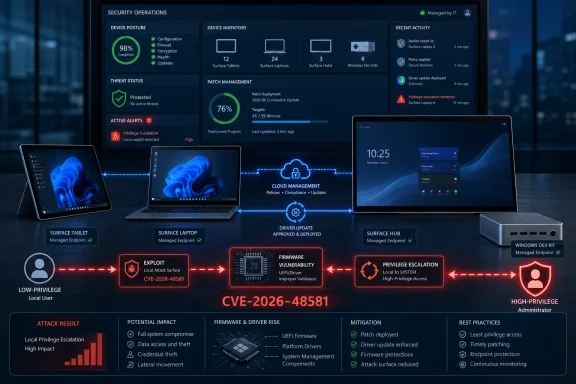 A Local Foothold Can Become Full Device Control
Microsoft’s CVSS vector for CVE-2026-48581 is CVSS:3.1/AV:L/AC:L/PR:L/UI:N/S:U/C:H/I:H/A:H. In practical terms, the attack vector is local, complexity is low, and the attacker must begin with some existing authorization on the system.That combination makes the vulnerability more relevant to shared, managed, or already partially compromised devices than to a personal Surface sitting behind a locked Windows account. It could still become a valuable second stage in an attack chain: malware, a malicious user, or an intruder who has obtained ordinary credentials may be able to convert restricted access into substantially greater authority.
The potential impact is rated high across all three principal CVSS categories. Successful exploitation could allow an attacker to read protected information, modify system resources, and interfere with device availability. Microsoft classifies the underlying weakness as CWE-1220, Insufficient Granularity of Access Control, indicating that a security boundary does not distinguish permissions as precisely as it should.
CISA’s initial Stakeholder-Specific Vulnerability Categorization assessment recorded no known exploitation and determined that automated exploitation was not expected. It nevertheless assigned the flaw a “total” technical impact, reflecting the degree of control that successful exploitation could provide rather than the probability of an attack.
That distinction matters. A 7.8 score does not mean an unpatched Surface can be seized directly over the internet, but it does mean administrators should not dismiss the issue merely because an attacker needs an initial foothold.
Microsoft’s Product List Spans Several Surface Generations
The initial CVE record identifies the following affected product families:- Microsoft Surface Go devices are listed as affected.
- Microsoft Surface Hub devices are listed as affected.
- Microsoft Surface Laptop Go and Surface Laptop Go 3 are listed as affected.
- Microsoft Surface Pro and Surface Pro 8 are listed as affected.
- Surface Laptop 4 models with AMD and Intel processors are listed as affected.
- Surface Windows Dev Kit devices are listed as affected.
Surface Pro 8 and Surface Laptop 4 remain within Microsoft’s published driver and firmware servicing windows in July 2026. Microsoft’s lifecycle documentation lists firmware support for Surface Laptop 4 through April 15, 2027, and Surface Pro 8 through October 5, 2027. The presence of older, generically named products such as “Microsoft Surface Pro” and “Microsoft Surface Go” in the CVE data makes lifecycle status especially important: a vulnerability listing does not automatically guarantee that every historical device carrying that family name will receive new firmware.
Surface Hub also requires separate attention. These systems are frequently deployed in conference rooms and other shared spaces, where many users may interact with the hardware and where update rings can lag behind ordinary Windows endpoints. The local attack requirement lowers internet-facing risk but does not eliminate the concern for accessible collaboration devices.
Surface Firmware Does Not Behave Like an Ordinary App Patch
Surface security fixes can arrive as coordinated packages containing firmware, drivers, and system components rather than as a conventional application update with an obvious standalone installer. Organizations that approve Windows cumulative updates but defer driver or firmware deployment may therefore remain exposed even when the operating system reports that its monthly quality update is installed.Administrators should review Windows Update, Windows Update for Business, Microsoft Intune, or their chosen endpoint-management platform for applicable Surface firmware and driver releases dated on or after July 14. Devices may require a restart, and firmware installation can continue during the reboot sequence, so deployment windows should account for more than a normal cumulative-update restart.
A practical validation process should include checking the exact Surface model, confirming that all applicable firmware updates completed successfully, and comparing installed component versions with Microsoft’s model-specific Surface update history. Security teams should not use the Windows build number alone as proof that CVE-2026-48581 has been remediated.
Driver-update policies deserve a review as well. Some enterprises intentionally exclude drivers from routine Windows quality-update rings to reduce hardware regressions. That can be a reasonable operational choice, but it creates a separate remediation queue when Microsoft fixes a vulnerability below the normal Windows software layer.
The Exploitability Signals Reduce Panic, Not Patch Priority
At publication, the public record showed no evidence that CVE-2026-48581 was being exploited. It also did not identify public exploit code, and the required local access makes broad automated attacks less straightforward than exploitation of a network-facing service.Those factors support staged deployment rather than an emergency shutdown of Surface fleets. They do not support leaving the vulnerability open indefinitely. Local privilege-escalation bugs are commonly combined with phishing, malicious downloads, browser flaws, credential theft, or abuse by an authorized user whose account has deliberately limited permissions.
Shared Surface devices should move toward the front of the deployment queue, particularly Surface Hubs, lab systems, loaner machines, kiosks, and Windows Dev Kits used by multiple developers. High-value Surface laptops assigned to administrators, executives, or software developers also warrant early testing because privilege escalation on those endpoints could expose credentials, source code, signing assets, or management tools.
Organizations should initially treat CVE-2026-48581 as a firmware and device-management problem, not merely another row in the July Windows patch report. The immediate milestone is confirmation that every affected Surface model has received and successfully installed its applicable July 2026 servicing package; until Microsoft’s model-specific version data is reconciled with the installed inventory, a fully patched Windows build is not sufficient evidence that the underlying Surface component is protected.
References
- Primary source: MSRC
Published: 2026-07-14T07:00:00-07:00
Security Update Guide - Microsoft Security Response Center
 msrc.microsoft.com
