

Microsoft has fixed CVE-2026-50371, an Important-rated elevation-of-privilege vulnerability in the Windows LUA File Virtualization Filter Driver, through the July 14, 2026 security updates. The flaw spans supported Windows client and server releases, and successful exploitation could let an attacker who already has local access gain substantially greater control of the affected machine.
Detailed in Microsoft’s Security Update Guide and corroborated by the July Patch Tuesday tracking from SANS Internet Storm Center, CVE-2026-50371 carries a CVSS 3.1 base score of 7.0. Microsoft lists no evidence that the vulnerability was publicly disclosed or exploited before the update became available.
That combination makes this a routine but consequential patching issue rather than an Internet-facing emergency. Administrators do not need to isolate systems solely because of this CVE, but they should include it in the normal accelerated rollout for Windows cumulative updates—especially on shared workstations, Remote Desktop Session Hosts, and servers where lower-privileged users can execute code.
CVE-2026-50371 is a local elevation-of-privilege vulnerability. Its CVSS vector indicates that an attacker needs low-level privileges and must execute the attack on the target system; it cannot be exploited directly across the network, and it does not require another user to click a file or approve a prompt.
Microsoft rates the attack complexity as high. That generally means exploitation depends on conditions beyond simply launching a malicious executable, such as winning a race, manipulating object lifetimes, or arranging system state in a precise way. The vulnerability is associated with both CWE-362, a race condition, and CWE-416, a use-after-free memory-safety error.
Those classifications suggest a timing-sensitive flaw in how the driver manages an object while file operations are being processed. A use-after-free occurs when software continues to access memory after the associated object has been released; combined with a race condition, the attacker may need to coordinate competing operations so the driver reaches an unsafe state. Microsoft has not published exploit code or sufficiently detailed internals to reproduce the issue, so that mechanism should be treated as an informed reading of the classifications rather than a confirmed exploitation recipe.
The potential result is not limited to a small permission bypass. Microsoft’s scoring assigns high potential impact to confidentiality, integrity, and availability, indicating that a successful attacker could read protected data, alter system resources, and disrupt the machine.
For defenders, the practical attack chain is familiar: phishing, a malicious download, a compromised application, or stolen standard-user credentials establishes the initial foothold; CVE-2026-50371 then supplies the privilege escalation. Once elevated, an attacker may be able to disable security tooling, access other users’ files, extract credentials, install persistent services, or move further through an enterprise environment.
Older Windows software often assumed that configuration files and application data could be written beneath locations such as Program Files. Modern Windows security boundaries normally prevent a standard user from modifying those system-wide directories. File virtualization can redirect eligible writes into a per-user virtual store, allowing legacy applications to continue operating without giving them unrestricted access to protected paths.
The LUAFV filter driver sits in the file-system path needed to implement that redirection. A flaw in this position matters because kernel-mode filter drivers process operations across a trust boundary between ordinary applications and privileged operating-system resources.
Disabling compatibility features is not an adequate substitute for applying Microsoft’s update. Even where an organization believes file virtualization is rarely used, the vulnerable driver and relevant code paths may remain present, while undocumented workarounds could break older line-of-business applications without reliably removing exposure.
The safer response is to patch the operating system and verify the resulting build. There is no Microsoft-published mitigation that administrators should prefer over installing the July cumulative update.
Key corrected client build thresholds include:
Windows Server 2012 and Windows Server 2012 R2 appear in Microsoft’s affected data as well. Those releases require the appropriate Extended Security Updates entitlement or another applicable servicing arrangement; their presence in the vulnerability record does not restore ordinary support to systems outside Microsoft’s lifecycle policies.
Administrators should verify deployment by OS build rather than relying only on a management console’s “installed” status. A device can report that it received an update while remaining below the expected build because of a failed reboot, rollback, servicing-stack problem, or incorrect applicability assessment.
Its CVSS temporal score of 6.1 reflects the state of exploit maturity and remediation, not doubt about whether the bug is real. Microsoft’s vector records an official fix and confirmed report confidence while indicating unproven exploitation. Put simply, defenders can be highly confident that the vulnerability existed, while attackers do not appear to have had a publicly demonstrated exploit at release time.
That distinction is useful during triage. “Not publicly disclosed” and “not exploited” mean there was no known evidence in Microsoft’s assessment on July 14; they do not prove that exploitation is impossible or that nobody independently discovered the same flaw. Race-condition vulnerabilities can also move from difficult research targets to practical exploit chains once patch analysis reveals what changed.
At the same time, CVE-2026-50371 should not displace July’s actively exploited vulnerabilities or remotely reachable critical flaws at the top of an emergency queue. Its prerequisites—local access, existing low privileges, and high attack complexity—provide defenders with more deployment flexibility than a pre-authentication network attack would.
Endpoints already protected by application control, strong endpoint detection and response, least-privilege policies, and restricted scripting have useful layers around the initial foothold. Those controls reduce opportunity, but they do not repair the driver flaw and should not become a reason to defer the cumulative update indefinitely.
Security teams should deploy the July 14 Windows updates through their established Windows Update for Business, Microsoft Intune, Windows Server Update Services, Configuration Manager, or third-party patch workflow. After pilot validation, the important checks are straightforward: confirm the expected OS build, verify that a reboot completed where required, and investigate machines that repeatedly roll back or remain below the corrected revision.
CVE-2026-50371 is not a wormable crisis, but it is exactly the sort of local privilege-escalation flaw attackers combine with a more ordinary entry technique. Once the July cumulative update passes application testing, leaving the LUAFV driver unpatched preserves a useful path from a standard account to system-level compromise.
Detailed in Microsoft’s Security Update Guide and corroborated by the July Patch Tuesday tracking from SANS Internet Storm Center, CVE-2026-50371 carries a CVSS 3.1 base score of 7.0. Microsoft lists no evidence that the vulnerability was publicly disclosed or exploited before the update became available.
That combination makes this a routine but consequential patching issue rather than an Internet-facing emergency. Administrators do not need to isolate systems solely because of this CVE, but they should include it in the normal accelerated rollout for Windows cumulative updates—especially on shared workstations, Remote Desktop Session Hosts, and servers where lower-privileged users can execute code.
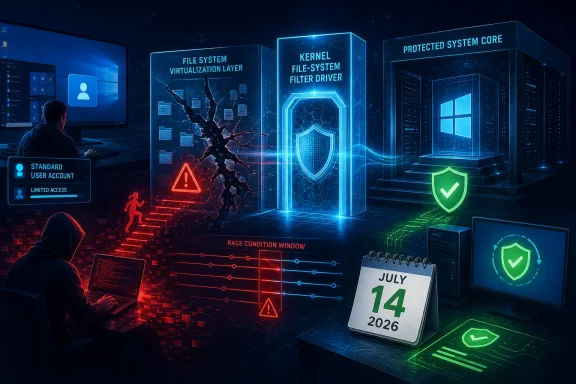 A Local Foothold Can Become Full System Control
CVE-2026-50371 is a local elevation-of-privilege vulnerability. Its CVSS vector indicates that an attacker needs low-level privileges and must execute the attack on the target system; it cannot be exploited directly across the network, and it does not require another user to click a file or approve a prompt.Microsoft rates the attack complexity as high. That generally means exploitation depends on conditions beyond simply launching a malicious executable, such as winning a race, manipulating object lifetimes, or arranging system state in a precise way. The vulnerability is associated with both CWE-362, a race condition, and CWE-416, a use-after-free memory-safety error.
Those classifications suggest a timing-sensitive flaw in how the driver manages an object while file operations are being processed. A use-after-free occurs when software continues to access memory after the associated object has been released; combined with a race condition, the attacker may need to coordinate competing operations so the driver reaches an unsafe state. Microsoft has not published exploit code or sufficiently detailed internals to reproduce the issue, so that mechanism should be treated as an informed reading of the classifications rather than a confirmed exploitation recipe.
The potential result is not limited to a small permission bypass. Microsoft’s scoring assigns high potential impact to confidentiality, integrity, and availability, indicating that a successful attacker could read protected data, alter system resources, and disrupt the machine.
For defenders, the practical attack chain is familiar: phishing, a malicious download, a compromised application, or stolen standard-user credentials establishes the initial foothold; CVE-2026-50371 then supplies the privilege escalation. Once elevated, an attacker may be able to disable security tooling, access other users’ files, extract credentials, install persistent services, or move further through an enterprise environment.
LUAFV Is a Compatibility Layer, Not a Virtual Machine
The “virtualization” in Windows LUA File Virtualization does not refer to Hyper-V, virtual machines, or Windows Sandbox. Limited User Account file virtualization is a compatibility mechanism designed to help older applications that expect to write into protected locations despite running without administrator rights.Older Windows software often assumed that configuration files and application data could be written beneath locations such as Program Files. Modern Windows security boundaries normally prevent a standard user from modifying those system-wide directories. File virtualization can redirect eligible writes into a per-user virtual store, allowing legacy applications to continue operating without giving them unrestricted access to protected paths.
The LUAFV filter driver sits in the file-system path needed to implement that redirection. A flaw in this position matters because kernel-mode filter drivers process operations across a trust boundary between ordinary applications and privileged operating-system resources.
Disabling compatibility features is not an adequate substitute for applying Microsoft’s update. Even where an organization believes file virtualization is rarely used, the vulnerable driver and relevant code paths may remain present, while undocumented workarounds could break older line-of-business applications without reliably removing exposure.
The safer response is to patch the operating system and verify the resulting build. There is no Microsoft-published mitigation that administrators should prefer over installing the July cumulative update.
The Affected Range Reaches Across Windows Generations
Microsoft’s affected-product data covers Windows 10, current Windows 11 releases, and Windows Server editions from Windows Server 2012 through Windows Server 2025. Server Core installations are included where applicable, reinforcing that the flaw is in an underlying Windows component rather than a desktop-only interface.Key corrected client build thresholds include:
- Windows 10 Version 21H2 must reach OS build 19044.7548.
- Windows 10 Version 22H2 must reach OS build 19045.7548.
- Windows 11 Version 24H2 must reach OS build 26100.8875.
- Windows 11 Version 25H2 must reach OS build 26200.8875.
- Windows 11 Version 26H1 must reach OS build 28000.2525.
Windows Server 2012 and Windows Server 2012 R2 appear in Microsoft’s affected data as well. Those releases require the appropriate Extended Security Updates entitlement or another applicable servicing arrangement; their presence in the vulnerability record does not restore ordinary support to systems outside Microsoft’s lifecycle policies.
Administrators should verify deployment by OS build rather than relying only on a management console’s “installed” status. A device can report that it received an update while remaining below the expected build because of a failed reboot, rollback, servicing-stack problem, or incorrect applicability assessment.
Confidence Is High Even Though Exploitability Is Lower
The supplied metric concerns report confidence: how certain the industry can be that the vulnerability exists and that the published technical information is credible. CVE-2026-50371 has vendor-backed confirmation because Microsoft acknowledged the issue, assigned severity and scoring data, identified affected products, and released corrected builds.Its CVSS temporal score of 6.1 reflects the state of exploit maturity and remediation, not doubt about whether the bug is real. Microsoft’s vector records an official fix and confirmed report confidence while indicating unproven exploitation. Put simply, defenders can be highly confident that the vulnerability existed, while attackers do not appear to have had a publicly demonstrated exploit at release time.
That distinction is useful during triage. “Not publicly disclosed” and “not exploited” mean there was no known evidence in Microsoft’s assessment on July 14; they do not prove that exploitation is impossible or that nobody independently discovered the same flaw. Race-condition vulnerabilities can also move from difficult research targets to practical exploit chains once patch analysis reveals what changed.
At the same time, CVE-2026-50371 should not displace July’s actively exploited vulnerabilities or remotely reachable critical flaws at the top of an emergency queue. Its prerequisites—local access, existing low privileges, and high attack complexity—provide defenders with more deployment flexibility than a pre-authentication network attack would.
Patch Shared and Multiuser Systems First
The most exposed systems are those where untrusted or lightly trusted users can run programs locally. That includes shared desktops, application-hosting servers, developer workstations, virtual desktop infrastructure, classroom and laboratory PCs, and Remote Desktop hosts serving multiple accounts.Endpoints already protected by application control, strong endpoint detection and response, least-privilege policies, and restricted scripting have useful layers around the initial foothold. Those controls reduce opportunity, but they do not repair the driver flaw and should not become a reason to defer the cumulative update indefinitely.
Security teams should deploy the July 14 Windows updates through their established Windows Update for Business, Microsoft Intune, Windows Server Update Services, Configuration Manager, or third-party patch workflow. After pilot validation, the important checks are straightforward: confirm the expected OS build, verify that a reboot completed where required, and investigate machines that repeatedly roll back or remain below the corrected revision.
CVE-2026-50371 is not a wormable crisis, but it is exactly the sort of local privilege-escalation flaw attackers combine with a more ordinary entry technique. Once the July cumulative update passes application testing, leaving the LUAFV driver unpatched preserves a useful path from a standard account to system-level compromise.
References
- Primary source: MSRC
Published: 2026-07-14T07:00:00-07:00
Security Update Guide - Microsoft Security Response Center
 msrc.microsoft.com
