

CVE-2026-50436 is a newly patched Windows Kernel use-after-free vulnerability that can let a locally authenticated attacker elevate privileges, potentially gaining SYSTEM-level control over an affected PC or server. Microsoft addressed the flaw in its July 14, 2026 security updates for Windows 11 24H2, Windows 11 25H2, Windows 11 26H1, and Windows Server 2025.
Detailed in Microsoft’s Security Update Guide, the vulnerability carries an Important severity rating and a CVSS 3.1 base score of 7.8. Microsoft has assessed exploitation as more likely, although the company says the vulnerability was neither publicly disclosed nor known to be exploited when the updates shipped.
That distinction matters. CVE-2026-50436 is not a remote entry point or an active zero-day, but it is the kind of kernel privilege-escalation flaw that can turn an initial, limited compromise into complete control of a Windows machine.
Microsoft describes CVE-2026-50436 as a use-after-free issue in the Windows Kernel. This class of memory-safety bug occurs when software continues to reference memory after the associated object has been released, creating an opportunity for an attacker to influence what occupies that memory and how the kernel subsequently handles it.
Successful exploitation requires the attacker to already possess local access and low-level privileges. The CVSS vector is AV:L/AC:L/PR:L/UI:N/S:U/C:H/I:H/A:H: local attack vector, low complexity, low privileges required, and no user interaction.
Those conditions prevent the flaw from being directly exploited over the internet. They do not make it harmless. An attacker who has gained a foothold through a malicious attachment, compromised application, stolen standard-user account, or another vulnerability could use CVE-2026-50436 as the second stage of an attack.
Elevation to the kernel’s security context can give an attacker broad control over the system. Depending on the exploit and surrounding defenses, that may include disabling security tools, accessing protected data, installing persistent malware, manipulating other processes, or creating administrative accounts.
The vulnerability’s high confidentiality, integrity, and availability impact ratings explain why the CVSS score reaches 7.8 despite requiring local access. Once exploited, the boundary between a constrained user session and the trusted core of Windows effectively disappears.
This is an important distinction because “confirmed” can look more alarming when separated from the CVSS context. Report confidence describes certainty about the vulnerability, whereas the publicly disclosed and exploited fields describe what is known about exposure outside Microsoft’s coordinated disclosure process.
Zero Day Initiative’s July 2026 update review lists CVE-2026-50436 as neither publicly disclosed nor exploited. SANS Internet Storm Center reached the same conclusion in its Patch Tuesday tracking, while Tenable identified it as one of six Windows Kernel elevation-of-privilege vulnerabilities Microsoft considers more likely to be exploited.
The combined picture is straightforward: defenders have a verified, technically credible vulnerability with no reported in-the-wild activity, but Microsoft believes attackers could develop working exploitation. That places CVE-2026-50436 above routine “patch eventually” territory without making it an emergency comparable to an internet-facing remote-code-execution zero-day.
Microsoft has not publicly provided a proof of concept, exploit procedure, affected kernel function, or detailed trigger condition. That limited disclosure is normal for a newly fixed kernel vulnerability and reduces the immediate technical guidance available to defenders, but it also avoids handing attackers an implementation roadmap.
Windows Server 2025 receives the fix through KB5099536, raising the server operating system to build 26100.33158. That cumulative package also contains the month’s other security fixes and quality changes, so administrators cannot isolate CVE-2026-50436 as a standalone patch.
The Windows 11 26H1 listing is less intuitive. Microsoft’s affected-version range ends before build 28000.2269, which was delivered through June’s KB5095051, while July release data also associates newer 26H1 servicing with the vulnerability. Administrators should rely on Microsoft’s update applicability rules and install the latest offered cumulative security update rather than using the CVE publication date alone to decide whether a 26H1 device is protected.
Build-based verification is preferable to checking only whether Windows Update recently ran. Administrators can inspect
On a single-user home PC, exploitation would generally require malware or another attacker-controlled process to reach the machine first. The July update should still be installed promptly, but CVE-2026-50436 does not create a new remotely accessible service that home users need to disable.
Enterprise risk rises when standard-user execution is common. A kernel elevation vulnerability can undermine the containment assumptions behind least-privilege accounts, application sandboxes, and service identities. Even where endpoint protection catches an initial payload, a successful kernel exploit may give that payload more options to tamper with monitoring or establish persistence.
Administrators should prioritize deployment to systems with interactive logons, exposed remote-access paths, or broad application execution rights. Domain controllers and other tightly controlled servers may be less likely to provide the required initial access, but Windows Server 2025 still needs the cumulative update because a compromised service account or management session could satisfy the local-access requirement.
There is no Microsoft-documented workaround that offers the same protection as the security update. Restricting local logon rights, limiting Remote Desktop access, enforcing application control with Windows Defender Application Control or AppLocker, and monitoring unusual privilege transitions can reduce exposure, but these controls do not remove the underlying kernel defect.
For deployment teams, the practical response is not to create a one-off package solely for CVE-2026-50436. The fix is cumulative, so the objective is to move supported devices onto the corrected July build while watching for operational problems across the broader update.
A sensible rollout should verify that:
CVE-2026-50436 is not known to be under attack as of July 15, 2026, but Microsoft’s exploitation more likely assessment shortens the comfortable testing window. Organizations should validate the July cumulative updates against critical applications, then move interactive Windows 11 endpoints and multi-user Windows Server 2025 systems through deployment before a public exploit changes the calculation.
Detailed in Microsoft’s Security Update Guide, the vulnerability carries an Important severity rating and a CVSS 3.1 base score of 7.8. Microsoft has assessed exploitation as more likely, although the company says the vulnerability was neither publicly disclosed nor known to be exploited when the updates shipped.
That distinction matters. CVE-2026-50436 is not a remote entry point or an active zero-day, but it is the kind of kernel privilege-escalation flaw that can turn an initial, limited compromise into complete control of a Windows machine.
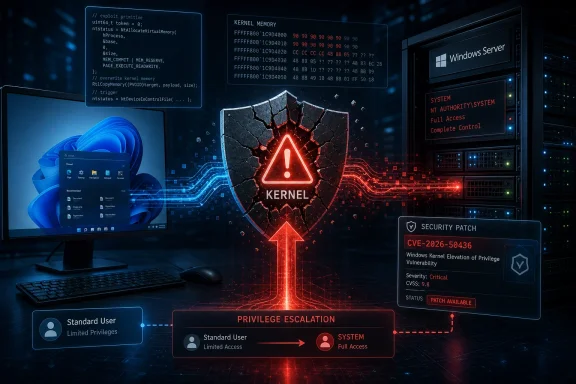 A Local Flaw With System-Wide Consequences
Microsoft describes CVE-2026-50436 as a use-after-free issue in the Windows Kernel. This class of memory-safety bug occurs when software continues to reference memory after the associated object has been released, creating an opportunity for an attacker to influence what occupies that memory and how the kernel subsequently handles it.Successful exploitation requires the attacker to already possess local access and low-level privileges. The CVSS vector is AV:L/AC:L/PR:L/UI:N/S:U/C:H/I:H/A:H: local attack vector, low complexity, low privileges required, and no user interaction.
Those conditions prevent the flaw from being directly exploited over the internet. They do not make it harmless. An attacker who has gained a foothold through a malicious attachment, compromised application, stolen standard-user account, or another vulnerability could use CVE-2026-50436 as the second stage of an attack.
Elevation to the kernel’s security context can give an attacker broad control over the system. Depending on the exploit and surrounding defenses, that may include disabling security tools, accessing protected data, installing persistent malware, manipulating other processes, or creating administrative accounts.
The vulnerability’s high confidentiality, integrity, and availability impact ratings explain why the CVSS score reaches 7.8 despite requiring local access. Once exploited, the boundary between a constrained user session and the trusted core of Windows effectively disappears.
Microsoft’s “Confirmed” Rating Is Not an Exploitation Warning
The Security Update Guide lists the vulnerability’s report confidence as confirmed. That metric indicates Microsoft has confirmed the flaw’s existence and considers the available technical information credible. It does not mean Microsoft has confirmed attacks against customers.This is an important distinction because “confirmed” can look more alarming when separated from the CVSS context. Report confidence describes certainty about the vulnerability, whereas the publicly disclosed and exploited fields describe what is known about exposure outside Microsoft’s coordinated disclosure process.
Zero Day Initiative’s July 2026 update review lists CVE-2026-50436 as neither publicly disclosed nor exploited. SANS Internet Storm Center reached the same conclusion in its Patch Tuesday tracking, while Tenable identified it as one of six Windows Kernel elevation-of-privilege vulnerabilities Microsoft considers more likely to be exploited.
The combined picture is straightforward: defenders have a verified, technically credible vulnerability with no reported in-the-wild activity, but Microsoft believes attackers could develop working exploitation. That places CVE-2026-50436 above routine “patch eventually” territory without making it an emergency comparable to an internet-facing remote-code-execution zero-day.
Microsoft has not publicly provided a proof of concept, exploit procedure, affected kernel function, or detailed trigger condition. That limited disclosure is normal for a newly fixed kernel vulnerability and reduces the immediate technical guidance available to defenders, but it also avoids handing attackers an implementation roadmap.
The Affected Builds Draw a Narrow Windows Boundary
The published product data identifies current Windows 11 and Windows Server 2025 releases rather than every supported Windows branch. Affected installations include both x64 and Arm64 editions where applicable:- Windows 11 24H2 builds earlier than 26100.8875 are affected.
- Windows 11 25H2 builds earlier than 26200.8875 are affected.
- Windows 11 26H1 builds earlier than 28000.2269 are affected.
- Windows Server 2025 builds earlier than 26100.33158 are affected, including Server Core installations.
Windows Server 2025 receives the fix through KB5099536, raising the server operating system to build 26100.33158. That cumulative package also contains the month’s other security fixes and quality changes, so administrators cannot isolate CVE-2026-50436 as a standalone patch.
The Windows 11 26H1 listing is less intuitive. Microsoft’s affected-version range ends before build 28000.2269, which was delivered through June’s KB5095051, while July release data also associates newer 26H1 servicing with the vulnerability. Administrators should rely on Microsoft’s update applicability rules and install the latest offered cumulative security update rather than using the CVE publication date alone to decide whether a 26H1 device is protected.
Build-based verification is preferable to checking only whether Windows Update recently ran. Administrators can inspect
winver, query device inventory through Microsoft Intune, Configuration Manager, or another endpoint-management platform, and compare the resulting build against Microsoft’s corrected-version thresholds.Kernel Elevation Deserves Priority on Shared Systems
The most exposed systems are those where untrusted or less-trusted users can execute code locally. That includes Windows 365 and Azure Virtual Desktop environments, Remote Desktop Session Hosts, developer workstations, classroom and laboratory PCs, kiosks with escape opportunities, and servers used by multiple administrative teams.On a single-user home PC, exploitation would generally require malware or another attacker-controlled process to reach the machine first. The July update should still be installed promptly, but CVE-2026-50436 does not create a new remotely accessible service that home users need to disable.
Enterprise risk rises when standard-user execution is common. A kernel elevation vulnerability can undermine the containment assumptions behind least-privilege accounts, application sandboxes, and service identities. Even where endpoint protection catches an initial payload, a successful kernel exploit may give that payload more options to tamper with monitoring or establish persistence.
Administrators should prioritize deployment to systems with interactive logons, exposed remote-access paths, or broad application execution rights. Domain controllers and other tightly controlled servers may be less likely to provide the required initial access, but Windows Server 2025 still needs the cumulative update because a compromised service account or management session could satisfy the local-access requirement.
There is no Microsoft-documented workaround that offers the same protection as the security update. Restricting local logon rights, limiting Remote Desktop access, enforcing application control with Windows Defender Application Control or AppLocker, and monitoring unusual privilege transitions can reduce exposure, but these controls do not remove the underlying kernel defect.
Patch Validation Matters More Than the CVSS Number
CVE-2026-50436 arrived inside an unusually large July 2026 Patch Tuesday release. BleepingComputer counted 570 corrected vulnerabilities across Microsoft products, including two actively exploited zero-days and one additional publicly disclosed flaw. That volume makes it easy for an Important-rated local vulnerability to become buried beneath Critical remote-code-execution entries.For deployment teams, the practical response is not to create a one-off package solely for CVE-2026-50436. The fix is cumulative, so the objective is to move supported devices onto the corrected July build while watching for operational problems across the broader update.
A sensible rollout should verify that:
- Windows 11 24H2 devices reach build 26100.8875 or later.
- Windows 11 25H2 devices reach build 26200.8875 or later.
- Windows Server 2025 devices reach build 26100.33158 or later.
- Windows 11 26H1 systems receive the latest applicable cumulative security update and are not left below Microsoft’s fixed-build threshold.
- Endpoint-management reports distinguish successful installation from devices awaiting a restart.
CVE-2026-50436 is not known to be under attack as of July 15, 2026, but Microsoft’s exploitation more likely assessment shortens the comfortable testing window. Organizations should validate the July cumulative updates against critical applications, then move interactive Windows 11 endpoints and multi-user Windows Server 2025 systems through deployment before a public exploit changes the calculation.
References
- Primary source: MSRC
Published: 2026-07-14T07:00:00-07:00
Security Update Guide - Microsoft Security Response Center
 msrc.microsoft.com
- Related coverage: aha.org
- Related coverage: tomshardware.com
Windows Server vulnerability can grant system privileges with just a malformed packet — domain controllers are being exploited in the wild | Tom's Hardware
System administrators, run the May 12 patch immediately if you haven't already.www.tomshardware.com
