

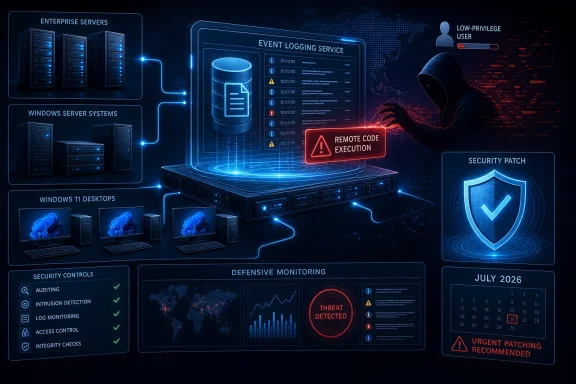
CVE-2026-50502 exposes the Windows Event Logging Service to remote code execution, with Microsoft assigning the flaw a CVSS 3.1 score of 8.0 High and shipping fixes in the July 14, 2026 security updates. Administrators should prioritize supported Windows clients and servers that have not reached Microsoft’s listed fixed build levels, particularly systems where lower-privileged users can interact with untrusted people or content across a network.
Detailed in Microsoft’s Security Update Guide and published alongside the July 2026 Patch Tuesday releases, the vulnerability stems from insufficiently granular access control in the Windows Event Logging Service. The National Vulnerability Database lists the weakness as CWE-1220 and describes the outcome as network-based code execution by an authorized attacker.
This is not an unauthenticated, zero-click path into every Windows machine. Microsoft’s CVSS vector says exploitation requires low privileges and user interaction, but it also assigns low attack complexity and high potential impact to confidentiality, integrity, and availability.
The CVSS vector for CVE-2026-50502 is
The network attack vector means the attacker does not necessarily need local console access to the target. However, the attacker must already possess some authorized, low-privilege access, and exploitation requires action by another user. Microsoft has not publicly documented the exact interaction, the affected Event Logging Service interface, or the code-execution context in sufficient detail to build a reliable attack narrative.
That makes CVE-2026-50502 particularly relevant to environments where ordinary accounts can communicate with other users or systems across trust boundaries. Shared Windows servers, Remote Desktop Session Hosts, development environments, managed service infrastructure, and networks with contractors or partially trusted domain accounts deserve closer attention than isolated single-user PCs.
The potential consequences are broad. Microsoft’s scoring indicates that successful exploitation could fully compromise data confidentiality and integrity while also affecting system availability. The scope remains unchanged in the CVSS assessment, meaning the vulnerable component and the resulting security impact remain within the same security authority rather than crossing into a separate security domain.
Microsoft rates the vulnerability Important rather than Critical. That rating reflects the required privileges and user interaction, not a limited technical payoff after exploitation succeeds.
The fixed build thresholds recorded for the vulnerability are:
For Windows Server 2016, the July fix arrives through KB5099535, bringing the operating system to build 14393.9339. Windows Server 2019 receives KB5099538 and build 17763.9020, while Windows Server 2022 receives KB5099540 and build 20348.5386.
Administrators should verify the installed OS build rather than relying only on whether Windows Update reports a recent successful installation. An endpoint may have completed an older cumulative update, remained pending after a reboot, or failed to reach the minimum build despite appearing generally current in an inventory dashboard.
That makes a code-execution flaw in the service operationally sensitive even when exploitation has prerequisites. Event logs often sit at the center of incident response, endpoint detection, compliance reporting, account monitoring, and troubleshooting. A compromised process interacting with this subsystem could undermine confidence in the same telemetry defenders use to reconstruct an attack.
Microsoft has not publicly said that CVE-2026-50502 permits deletion, alteration, or fabrication of event records. Administrators should therefore avoid assuming a specific log-tampering capability that the available advisory does not establish. The high confidentiality, integrity, and availability impact still supports treating successful exploitation as a full-compromise scenario.
The vulnerability’s classification as insufficient granularity of access control points toward permissions that fail to distinguish adequately between authorized operations. It does not, by itself, reveal whether the defective check applies to an RPC method, event subscription, log-management operation, or another interface exposed by the service.
That lack of technical detail lowers immediate confidence in public exploit claims but should not lower patch priority. Microsoft has confirmed the vulnerability, assigned affected versions and fixed builds, and released updates; defenders do not need a proof of concept to establish that unpatched systems remain exposed.
Organizations using staged deployment rings should place internet-facing management systems, multi-user servers, jump hosts, and machines accepting connections from less-trusted network segments in an early ring. Domain controllers and security-management servers should also receive prompt attention, even though Microsoft has not described the flaw as a domain-controller-specific vulnerability.
Until patching is complete, administrators can reduce opportunity by limiting unnecessary remote access, reviewing membership in groups that grant interactive or service logon rights, and restricting low-trust accounts from sensitive servers. Disabling the Windows Event Log service is not a sensible general mitigation: it would damage auditing and monitoring while potentially creating a larger security and operational blind spot.
Security teams should also watch for suspicious processes launched around unusual Event Logging Service activity, unexpected service failures, unexplained gaps in collected events, and authenticated access from low-privilege accounts followed by privilege changes or code execution. These are broad hunting signals rather than confirmed indicators for CVE-2026-50502, because Microsoft has not published exploit-specific indicators of compromise.
The practical line for administrators is the installed build number. Systems below Microsoft’s fixed thresholds remain exposed to a confirmed Windows Event Logging Service RCE path; systems at or above them have the vendor correction and can move into normal post-update validation.
Detailed in Microsoft’s Security Update Guide and published alongside the July 2026 Patch Tuesday releases, the vulnerability stems from insufficiently granular access control in the Windows Event Logging Service. The National Vulnerability Database lists the weakness as CWE-1220 and describes the outcome as network-based code execution by an authorized attacker.
This is not an unauthenticated, zero-click path into every Windows machine. Microsoft’s CVSS vector says exploitation requires low privileges and user interaction, but it also assigns low attack complexity and high potential impact to confidentiality, integrity, and availability.
 “Remote” Does Not Mean “Unauthenticated”
The CVSS vector for CVE-2026-50502 is AV:N/AC:L/PR:L/UI:R/S:U/C:H/I:H/A:H. Each element matters when determining whether this is an emergency perimeter patch or a serious post-access threat.The network attack vector means the attacker does not necessarily need local console access to the target. However, the attacker must already possess some authorized, low-privilege access, and exploitation requires action by another user. Microsoft has not publicly documented the exact interaction, the affected Event Logging Service interface, or the code-execution context in sufficient detail to build a reliable attack narrative.
That makes CVE-2026-50502 particularly relevant to environments where ordinary accounts can communicate with other users or systems across trust boundaries. Shared Windows servers, Remote Desktop Session Hosts, development environments, managed service infrastructure, and networks with contractors or partially trusted domain accounts deserve closer attention than isolated single-user PCs.
The potential consequences are broad. Microsoft’s scoring indicates that successful exploitation could fully compromise data confidentiality and integrity while also affecting system availability. The scope remains unchanged in the CVSS assessment, meaning the vulnerable component and the resulting security impact remain within the same security authority rather than crossing into a separate security domain.
Microsoft rates the vulnerability Important rather than Critical. That rating reflects the required privileges and user interaction, not a limited technical payoff after exploitation succeeds.
The Affected List Reaches from Server 2012 to Windows 11 26H1
Microsoft’s affected-product record covers current Windows 11 releases, several Windows 10 branches, and Windows Server editions dating back to Windows Server 2012. Server Core installations are explicitly included where applicable, so removing the graphical shell does not remove this exposure.The fixed build thresholds recorded for the vulnerability are:
- Windows 10 Version 1607 and Windows Server 2016 are affected below build 14393.9339.
- Windows 10 Version 1809 and Windows Server 2019 are affected below build 17763.9020.
- Windows 10 Version 21H2 is affected below build 19044.7548.
- Windows 10 Version 22H2 is affected below build 19045.7548.
- Windows 11 Version 24H2 is affected below build 26100.8875.
- Windows 11 Version 25H2 is affected below build 26200.8875.
- Windows 11 Version 26H1 is affected below build 28000.2269.
- Windows Server 2012 is affected below build 9200.26226.
- Windows Server 2012 R2 is affected below build 9600.23291.
- Windows Server 2022 is affected below build 20348.5386.
- Windows Server 2025 is affected below build 26100.33158.
For Windows Server 2016, the July fix arrives through KB5099535, bringing the operating system to build 14393.9339. Windows Server 2019 receives KB5099538 and build 17763.9020, while Windows Server 2022 receives KB5099540 and build 20348.5386.
Administrators should verify the installed OS build rather than relying only on whether Windows Update reports a recent successful installation. An endpoint may have completed an older cumulative update, remained pending after a reboot, or failed to reach the minimum build despite appearing generally current in an inventory dashboard.
Event Logging Is a Security Boundary Worth Defending
The Windows Event Logging Service is foundational infrastructure rather than an optional desktop feature. Windows components, applications, audit policies, and security products depend on it to record activity in channels including System, Application, and Security.That makes a code-execution flaw in the service operationally sensitive even when exploitation has prerequisites. Event logs often sit at the center of incident response, endpoint detection, compliance reporting, account monitoring, and troubleshooting. A compromised process interacting with this subsystem could undermine confidence in the same telemetry defenders use to reconstruct an attack.
Microsoft has not publicly said that CVE-2026-50502 permits deletion, alteration, or fabrication of event records. Administrators should therefore avoid assuming a specific log-tampering capability that the available advisory does not establish. The high confidentiality, integrity, and availability impact still supports treating successful exploitation as a full-compromise scenario.
The vulnerability’s classification as insufficient granularity of access control points toward permissions that fail to distinguish adequately between authorized operations. It does not, by itself, reveal whether the defective check applies to an RPC method, event subscription, log-management operation, or another interface exposed by the service.
That lack of technical detail lowers immediate confidence in public exploit claims but should not lower patch priority. Microsoft has confirmed the vulnerability, assigned affected versions and fixed builds, and released updates; defenders do not need a proof of concept to establish that unpatched systems remain exposed.
Patch First, Then Review Lower-Privilege Access Paths
The direct remediation is to install the applicable July 2026 cumulative or security update and confirm that the resulting build meets or exceeds Microsoft’s fixed boundary. No configuration workaround in the available advisory provides an equivalent substitute for the code fix.Organizations using staged deployment rings should place internet-facing management systems, multi-user servers, jump hosts, and machines accepting connections from less-trusted network segments in an early ring. Domain controllers and security-management servers should also receive prompt attention, even though Microsoft has not described the flaw as a domain-controller-specific vulnerability.
Until patching is complete, administrators can reduce opportunity by limiting unnecessary remote access, reviewing membership in groups that grant interactive or service logon rights, and restricting low-trust accounts from sensitive servers. Disabling the Windows Event Log service is not a sensible general mitigation: it would damage auditing and monitoring while potentially creating a larger security and operational blind spot.
Security teams should also watch for suspicious processes launched around unusual Event Logging Service activity, unexpected service failures, unexplained gaps in collected events, and authenticated access from low-privilege accounts followed by privilege changes or code execution. These are broad hunting signals rather than confirmed indicators for CVE-2026-50502, because Microsoft has not published exploit-specific indicators of compromise.
The practical line for administrators is the installed build number. Systems below Microsoft’s fixed thresholds remain exposed to a confirmed Windows Event Logging Service RCE path; systems at or above them have the vendor correction and can move into normal post-update validation.
References
- Primary source: MSRC
Published: 2026-07-14T07:00:00-07:00
Security Update Guide - Microsoft Security Response Center
 msrc.microsoft.com
- Related coverage: tomshardware.com
Windows Server vulnerability can grant system privileges with just a malformed packet — domain controllers are being exploited in the wild | Tom's Hardware
System administrators, run the May 12 patch immediately if you haven't already.www.tomshardware.com
