

CVE-2026-50525 allows an unauthenticated attacker to remotely exhaust resources in affected .NET installations, potentially making applications or services unavailable. Microsoft addressed the denial-of-service flaw in its July 14, 2026 security updates for .NET 8, .NET 9, .NET 10, and supported .NET Framework releases.
Detailed in the Microsoft Security Response Center advisory, the vulnerability stems from resource allocation without adequate limits or throttling. It is tracked under CWE-770 and carries a CVSS 3.1 base score of 7.5, placing it in Microsoft’s Important severity category.
That rating reflects an availability threat rather than a path to data theft or code execution. The practical concern is nevertheless significant for Windows administrators running network-facing ASP.NET applications, APIs, middleware, or other services whose availability depends on the affected .NET components.
Microsoft describes CVE-2026-50525 as remotely exploitable over a network without authentication. An attacker could send specially constructed traffic that causes an application to allocate resources without sufficient restrictions, eventually degrading performance or preventing the service from responding.
The public description does not identify the exact protocol, request structure, runtime subsystem, or resource being consumed. Administrators should therefore avoid assuming that an existing request-size limit, reverse proxy, web application firewall, or rate-limiting rule automatically blocks the attack.
A denial-of-service flaw of this kind may manifest as rising memory consumption, sustained processor load, thread or connection exhaustion, increased garbage-collection activity, request timeouts, or repeated process recycling. The observable behavior will depend on the affected component and how the application is hosted.
CVE-2026-50525 does not, based on Microsoft’s published classification, provide confidentiality or integrity impact. In other words, the documented outcome is service disruption rather than disclosure, tampering, privilege escalation, or remote code execution.
That distinction matters when triaging July’s substantial .NET update set, but it should not be mistaken for harmlessness. A public API, customer portal, identity-dependent application, or internal automation service can become an operational incident if an attacker can repeatedly consume its available resources.
For Windows Server 2022, Microsoft lists the fix in KB5101010, the July 14 cumulative update for .NET Framework 3.5 and 4.8. The related KB5102206 package covers .NET Framework 3.5, 4.8, and 4.8.1 for that server platform.
Windows 11 version 24H2 receives the corresponding .NET Framework servicing through KB5101001 for .NET Framework 3.5 and 4.8.1. Exact package applicability varies by Windows version, installed framework level, and servicing channel, so administrators should rely on update-management inventory rather than deploying one KB universally.
Microsoft says the updates are available through Windows Update, Microsoft Update, Windows Update for Business, the Microsoft Update Catalog, and Windows Server Update Services where applicable. Modern .NET servicing updates are also offered to supported Windows systems when the corresponding runtime is installed.
.NET 10 follows Microsoft’s normal upgrade-style servicing model. Installing the latest .NET 10 servicing release removes the previous servicing version from that feature band after installation succeeds, rather than maintaining every patched runtime revision side by side.
The July packages address considerably more than CVE-2026-50525. Microsoft’s Windows Server 2022 .NET Framework documentation lists multiple denial-of-service issues alongside security-feature bypass, elevation-of-privilege, tampering, and remote-code-execution vulnerabilities. That wider patch scope gives administrators another reason to treat the update as a full compatibility change requiring normal validation, not as an isolated one-file fix.
A framework update installed on the host does not necessarily patch every deployed application. Framework-dependent applications use a centrally installed runtime, while self-contained deployments can ship their own .NET runtime files. Containers likewise require administrators or developers to rebuild and redeploy images from patched Microsoft base images.
That distinction regularly creates false confidence during .NET patching. A Windows server can appear fully current in WSUS while an older self-contained application directory or container image continues to include vulnerable runtime components.
Administrators should prioritize the following work during the July rollout:
It also limits attackers’ immediate knowledge of the root cause. However, once security and pre-update binaries are available, researchers can compare them to identify changed code. The gap between patch publication and practical exploit understanding can consequently narrow after Patch Tuesday.
Microsoft’s support documentation says it is not currently aware of problems with the relevant Windows Server 2022 .NET Framework update. A restart may still be required when affected files are in use, and Microsoft recommends closing .NET Framework applications before installation.
For clustered services, administrators can reduce downtime by draining and updating nodes sequentially. Single-server applications should receive a defined maintenance window, post-update health checks, and verification that the expected runtime or framework servicing level is actually loaded by the application.
CVE-2026-50525 is not the most dramatic vulnerability class in July’s .NET release, but its combination of remote reachability, no authentication requirement, and high availability impact makes it relevant to production Windows estates. The immediate milestone is straightforward: deploy the July 14, 2026 .NET updates, then verify that self-contained applications and container images were not left behind.
Detailed in the Microsoft Security Response Center advisory, the vulnerability stems from resource allocation without adequate limits or throttling. It is tracked under CWE-770 and carries a CVSS 3.1 base score of 7.5, placing it in Microsoft’s Important severity category.
That rating reflects an availability threat rather than a path to data theft or code execution. The practical concern is nevertheless significant for Windows administrators running network-facing ASP.NET applications, APIs, middleware, or other services whose availability depends on the affected .NET components.
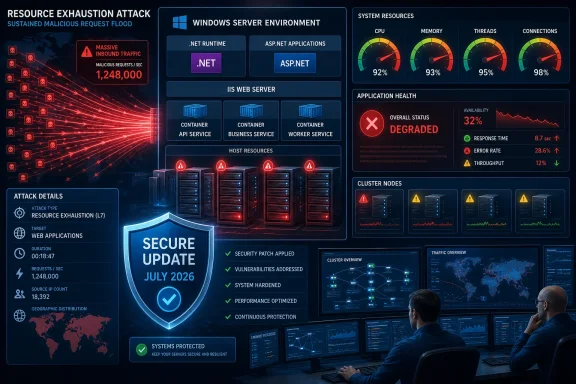 Resource Exhaustion Turns Traffic Into an Availability Risk
Microsoft describes CVE-2026-50525 as remotely exploitable over a network without authentication. An attacker could send specially constructed traffic that causes an application to allocate resources without sufficient restrictions, eventually degrading performance or preventing the service from responding.The public description does not identify the exact protocol, request structure, runtime subsystem, or resource being consumed. Administrators should therefore avoid assuming that an existing request-size limit, reverse proxy, web application firewall, or rate-limiting rule automatically blocks the attack.
A denial-of-service flaw of this kind may manifest as rising memory consumption, sustained processor load, thread or connection exhaustion, increased garbage-collection activity, request timeouts, or repeated process recycling. The observable behavior will depend on the affected component and how the application is hosted.
CVE-2026-50525 does not, based on Microsoft’s published classification, provide confidentiality or integrity impact. In other words, the documented outcome is service disruption rather than disclosure, tampering, privilege escalation, or remote code execution.
That distinction matters when triaging July’s substantial .NET update set, but it should not be mistaken for harmlessness. A public API, customer portal, identity-dependent application, or internal automation service can become an operational incident if an attacker can repeatedly consume its available resources.
The Fix Spans Modern .NET and .NET Framework
Microsoft’s servicing material associates CVE-2026-50525 with the July 2026 updates for .NET 8.0, .NET 9.0, and .NET 10.0. The flaw also appears in July’s cumulative .NET Framework packages, including updates for .NET Framework 3.5, 4.8, and 4.8.1 on supported Windows releases.For Windows Server 2022, Microsoft lists the fix in KB5101010, the July 14 cumulative update for .NET Framework 3.5 and 4.8. The related KB5102206 package covers .NET Framework 3.5, 4.8, and 4.8.1 for that server platform.
Windows 11 version 24H2 receives the corresponding .NET Framework servicing through KB5101001 for .NET Framework 3.5 and 4.8.1. Exact package applicability varies by Windows version, installed framework level, and servicing channel, so administrators should rely on update-management inventory rather than deploying one KB universally.
Microsoft says the updates are available through Windows Update, Microsoft Update, Windows Update for Business, the Microsoft Update Catalog, and Windows Server Update Services where applicable. Modern .NET servicing updates are also offered to supported Windows systems when the corresponding runtime is installed.
.NET 10 follows Microsoft’s normal upgrade-style servicing model. Installing the latest .NET 10 servicing release removes the previous servicing version from that feature band after installation succeeds, rather than maintaining every patched runtime revision side by side.
The July packages address considerably more than CVE-2026-50525. Microsoft’s Windows Server 2022 .NET Framework documentation lists multiple denial-of-service issues alongside security-feature bypass, elevation-of-privilege, tampering, and remote-code-execution vulnerabilities. That wider patch scope gives administrators another reason to treat the update as a full compatibility change requiring normal validation, not as an isolated one-file fix.
Internet-Facing Services Belong at the Front of the Queue
The most exposed systems are those accepting untrusted network input through applications built on affected .NET versions. IIS-hosted ASP.NET applications are obvious candidates, but inventories should also include self-hosted services, Windows services with network listeners, containerized ASP.NET Core deployments, development utilities, third-party server products, and applications carrying a private runtime.A framework update installed on the host does not necessarily patch every deployed application. Framework-dependent applications use a centrally installed runtime, while self-contained deployments can ship their own .NET runtime files. Containers likewise require administrators or developers to rebuild and redeploy images from patched Microsoft base images.
That distinction regularly creates false confidence during .NET patching. A Windows server can appear fully current in WSUS while an older self-contained application directory or container image continues to include vulnerable runtime components.
Administrators should prioritize the following work during the July rollout:
- Inventory installed .NET Framework components, modern .NET runtimes, application-local runtimes, and container base images.
- Patch internet-facing and business-critical services before low-exposure desktop applications.
- Rebuild self-contained deployments and containers against the corrected runtime rather than relying solely on Windows Update.
- Monitor memory, CPU, request queues, process restarts, and application-pool recycling for signs of attempted or accidental resource exhaustion.
- Confirm that load balancers and health checks do not amplify disruption by repeatedly routing traffic to an unhealthy instance.
Sparse Technical Detail Raises the Value of Fast Servicing
The exploitability information accompanying CVE-2026-50525 indicates that Microsoft has confirmed the vulnerability, but the initial public disclosure leaves substantial implementation detail unpublished. That limits defenders’ ability to create a precise network signature or determine whether a particular endpoint is unreachable through their existing architecture.It also limits attackers’ immediate knowledge of the root cause. However, once security and pre-update binaries are available, researchers can compare them to identify changed code. The gap between patch publication and practical exploit understanding can consequently narrow after Patch Tuesday.
Microsoft’s support documentation says it is not currently aware of problems with the relevant Windows Server 2022 .NET Framework update. A restart may still be required when affected files are in use, and Microsoft recommends closing .NET Framework applications before installation.
For clustered services, administrators can reduce downtime by draining and updating nodes sequentially. Single-server applications should receive a defined maintenance window, post-update health checks, and verification that the expected runtime or framework servicing level is actually loaded by the application.
CVE-2026-50525 is not the most dramatic vulnerability class in July’s .NET release, but its combination of remote reachability, no authentication requirement, and high availability impact makes it relevant to production Windows estates. The immediate milestone is straightforward: deploy the July 14, 2026 .NET updates, then verify that self-contained applications and container images were not left behind.
References
- Primary source: MSRC
Published: 2026-07-14T07:00:00-07:00
Security Update Guide - Microsoft Security Response Center
 msrc.microsoft.com
- Related coverage: vuln.today
Denial of Service - Attack Technique - vuln.today
Denial of Service attacks render applications or systems unavailable by overwhelming resources or triggering failure conditions.vuln.today
