

CVE-2026-52992 is a newly published Linux kernel vulnerability, disclosed through the CVE ecosystem on June 24, 2026, that fixes an out-of-bounds write in the ADFS filesystem driver when a crafted disc image reports a zero zone count. The bug is narrow, old-fashioned, and easy to dismiss if your servers never mount Acorn Disc Filing System images. That dismissal would be a mistake. This CVE is less a five-alarm breach story than a reminder that kernel attack surface often hides in the compatibility code nobody thinks about until fuzzers drag it into daylight.
The vulnerable code lives in
The dangerous sequence is the kind of thing kernel developers have been stamping out for decades.
That is the essence of CVE-2026-52992: not a spectacular cryptographic failure, not a remote worm, but a missing validation check that lets a malformed filesystem image push kernel code into memory it has no business touching. The fix rejects zero-zone new-format ADFS images during probe-time validation, before the bad disc record is used.
The interesting part is that old-format ADFS images already had a comparable guard.
That matters because this is not a remote network vulnerability in the normal sense. A vulnerable system is not suddenly exposed because it has an IP address. The kernel has to parse the malicious filesystem metadata, and that usually means some local or semi-local path into filesystem probing.
But “requires mounting a weird image” is not the same thing as “irrelevant.” The modern computing stack is full of places where untrusted images are handled automatically. Security researchers mount samples. Digital forensics tools examine old media formats. CI systems manipulate disk images. Desktop environments may probe removable media to decide what to display. Hypervisor and container workflows often involve image formats and loop devices, even if ADFS itself is obscure.
That is why filesystem bugs remain security bugs. The kernel’s filesystem layer is parser code running with kernel privilege. If an attacker can feed it structured data and trigger a memory safety bug, the age or obscurity of the format does not erase the architectural risk.
Filesystem code is particularly fertile territory for fuzzing. It is full of binary structures, historical compatibility rules, complex mount-time parsing, and edge cases that human testers rarely exercise. A human may not naturally create an ADFS image with zero zones; a fuzzer will cheerfully generate every pathological input the format allows, and many that it does not.
The lesson is not that Linux is unusually sloppy. The lesson is that mature kernels accumulate decades of parser logic for hardware, protocols, and filesystems whose user bases shrink long before their code leaves the tree. Fuzzers are now systematically interrogating that inheritance.
That is a net win for security, but it changes the rhythm of vulnerability disclosure. We now see many CVEs that look tiny in isolation: a bounds check here, a reference count there, an integer validation somewhere else. Taken together, they describe an operating system being continuously pressure-tested at its least glamorous seams.
The absence of a score should not be read as a verdict of low severity. It simply means the enrichment process has not yet reduced the vulnerability into a standardized vector. Administrators still have to reason about exposure based on the affected subsystem, required attacker control, exploit preconditions, and available fixes.
This one likely falls into the “low exposure, potentially serious consequence” bucket. Most production Linux servers do not intentionally mount ADFS images. Many kernels may include the driver only as a module. Some distributions may build, package, or enable it differently. But the primitive is still an out-of-bounds kernel write, and kernel memory corruption is rarely something defenders should wave away.
The responsible posture is proportionate urgency. This is not a reason to panic-reboot every Linux box in the fleet at noon. It is a reason to make sure normal kernel patching is not stalled, and to look harder at systems that handle untrusted disk images.
That distinction is important for WindowsForum readers who run mixed environments. Linux kernel security is not consumed like a single application update. The same fix may appear under different package versions depending on whether the system is running a vendor kernel, a distribution long-term support kernel, a cloud-provider build, or a custom-compiled tree.
For administrators, the commit hashes in the CVE record are useful to kernel maintainers and distribution engineers, but less useful as day-to-day operational guidance. Most shops should track distribution advisories and install vendor kernel updates. If you maintain your own kernel, the relevant question is whether your tree includes the
The CVE metadata also lists fixed stable versions such as 5.10.258, 5.15.209, 6.1.175, and 6.6.141 for their respective lines. Those numbers matter because many enterprise and embedded deployments stay on long-term kernels for years. A box running an older LTS line is not inherently safe or unsafe by branch name alone; it is safe only if the distributor has carried the fix.
Kernel filesystem drivers are part of the trusted computing base even when they exist for legacy compatibility. If the module is present and autoloadable, a crafted image may be enough to bring old code into a modern threat model. That does not make ADFS uniquely dangerous; it makes it representative.
The same logic applies across Linux, Windows, and macOS. Legacy parsers, media handlers, optional drivers, and compatibility layers keep old workflows alive, but they also preserve attack surface. Security teams often inventory running services but spend less time inventorying “things the kernel might parse if asked nicely.”
That gap is where bugs like CVE-2026-52992 live. They are not headline-grabbing until someone chains them into a workflow that defenders forgot was reachable.
The most relevant question is not whether users are double-clicking Acorn disk images on their laptops. It is whether any Linux component in the estate accepts untrusted filesystem images or removable media. A developer machine with broad privileges and a habit of mounting test images may be more exposed than a locked-down web server.
For WSL specifically, the risk depends on kernel version, feature exposure, and whether the vulnerable filesystem code is present and reachable in the shipped kernel. Administrators should avoid assuming either safety or exposure from the CVE name alone. The right move is to check the kernel package and update channel, then let the vendor’s patched kernel cadence do its job.
This is also a reminder that endpoint defense models often stop at process behavior while kernel parsing happens below the line. If a vulnerability requires a crafted image and local interaction, it may fall between traditional server patching and user-awareness training. That middle zone is where practical security programs have to be boringly thorough.
That is the right pattern. Parser code should establish invariants as close to the input boundary as possible. If later code assumes there is at least one zone, validation should make that true or fail closed. Letting a zero-value sentinel wander through allocation code is how “small” bugs become memory corruption.
The especially telling detail is the mismatch between old-format and new-format image handling. Old-format validation already enforced a stricter expectation. New-format validation did not. That is a classic bug shape in mature codebases: one path learns a defensive rule, another path that looks similar does not, and years pass until generated inputs find the asymmetry.
There is no grand architecture failure here. There is an ordinary engineering failure with privileged consequences. Kernel security is largely the art of finding those before attackers do.
For CVE-2026-52992, defenders should start with reachability. Systems that never mount untrusted media and do not expose filesystem probing workflows have lower practical risk. Systems used for malware analysis, digital forensics, backup ingestion, archival conversion, or developer testing deserve closer attention.
Disabling or blacklisting unused filesystem modules can be a defensible mitigation where operationally possible. That is not a substitute for patching, but it narrows the attack surface. If ADFS is not required, there is little reason to keep it conveniently loadable on systems that handle untrusted input.
The broader lesson is to stop treating optional kernel features as free. Every filesystem driver, protocol helper, and compatibility module carries some maintenance liability. Linux’s modularity gives administrators tools to reduce that liability, but only if they know what is enabled.
The drawback is noise. Many kernel CVEs describe narrow issues found by fuzzers, fixed quickly, and unlikely to be weaponized in broad campaigns. Security teams already drowning in scanner output may see another kernel CVE and either overreact or tune out.
CVE-2026-52992 sits right in that tension. It is real memory corruption in the kernel. It is also locked behind a relatively specific input path involving ADFS images. Calling it “critical” without context would be misleading; ignoring it because the filesystem is obscure would be careless.
The better model is contextual triage. Kernel CVEs should be mapped to reachable subsystems, configuration, workload, and vendor patch availability. That is slower than sorting by score, but it is how serious infrastructure teams separate practical exposure from database anxiety.
This does not mean a public exploit chain exists. The available record points to a syzkaller-found kernel bug fixed through stable commits, not an in-the-wild campaign. But defenders have learned the hard way that “requires local access” and “requires crafted file” are conditions attackers often satisfy through phishing, supply-chain workflows, developer tooling, or compromised low-privilege accounts.
The technical primitive matters too. An out-of-bounds write before an allocation is not automatically exploitable for code execution on every kernel build. Modern kernels include hardening, allocator behavior differs, and turning a crash into a reliable privilege escalation is work. Still, memory corruption in kernel space remains the category defenders least want exposed to untrusted input.
That is why the sensible reading is cautious, not catastrophic. Treat the bug as a patching priority for exposed systems and a normal kernel update item elsewhere.
Distribution-specific advisories should be the operational source of truth. Debian, Red Hat, Ubuntu, Amazon Linux, and other vendors may classify and ship fixes according to their own kernel packaging timelines. A system can be upstream-vulnerable in theory but vendor-patched in practice, or vice versa if it is pinned to stale packages.
Custom kernels deserve special scrutiny. If an organization builds its own kernel, it owns the backport question. The relevant fix is the ADFS
The same goes for appliances. Many storage, security, and embedded products run Linux kernels that customers rarely inspect. If those products ingest disk images or removable media, vendors should be asked whether the relevant stable fix has been incorporated.
 A Tiny Filesystem Bug Exposes a Big Kernel Habit
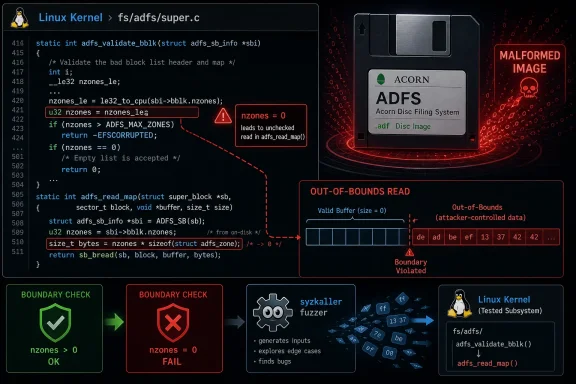
The vulnerable code lives in fs/adfs/super.c, the Linux kernel’s support for ADFS, the Acorn Disc Filing System used by Acorn-era machines rather than modern Windows, Linux, or cloud workloads. The failure mode is deceptively simple: during boot block validation, the kernel accepted a new-format ADFS disc record with nzones set to zero. That value then traveled deeper into the filesystem mounting path, where allocation and layout assumptions stopped matching reality.The dangerous sequence is the kind of thing kernel developers have been stamping out for decades.
adfs_read_map() receives the zero zone count and calls kmalloc_array(0, ...). In Linux, a zero-sized allocation may produce ZERO_SIZE_PTR, a special non-NULL pointer used to represent “nothing allocated.” The subsequent layout code then writes to dm[-1], an out-of-bounds write before the allocated buffer.That is the essence of CVE-2026-52992: not a spectacular cryptographic failure, not a remote worm, but a missing validation check that lets a malformed filesystem image push kernel code into memory it has no business touching. The fix rejects zero-zone new-format ADFS images during probe-time validation, before the bad disc record is used.
The interesting part is that old-format ADFS images already had a comparable guard.
adfs_validate_dr0() rejected invalid zone counts for old-format images, including anything other than the expected single zone. The new fix extends that same logic to adfs_validate_bblk(), closing a gap between two validation paths that should have been aligned.The Exploit Path Runs Through Mounting, Not Magic
The practical risk starts with a crafted filesystem image. An attacker would need a way to get a vulnerable Linux system to inspect or mount a malicious ADFS image, whether through a local user action, an automated analysis pipeline, a forensic workstation, a desktop file manager, a removable-media workflow, or a service that probes uploaded disk images.That matters because this is not a remote network vulnerability in the normal sense. A vulnerable system is not suddenly exposed because it has an IP address. The kernel has to parse the malicious filesystem metadata, and that usually means some local or semi-local path into filesystem probing.
But “requires mounting a weird image” is not the same thing as “irrelevant.” The modern computing stack is full of places where untrusted images are handled automatically. Security researchers mount samples. Digital forensics tools examine old media formats. CI systems manipulate disk images. Desktop environments may probe removable media to decide what to display. Hypervisor and container workflows often involve image formats and loop devices, even if ADFS itself is obscure.
That is why filesystem bugs remain security bugs. The kernel’s filesystem layer is parser code running with kernel privilege. If an attacker can feed it structured data and trigger a memory safety bug, the age or obscurity of the format does not erase the architectural risk.
Syzkaller Keeps Finding the Cobwebs
The CVE record says the issue was found by syzkaller, Google’s long-running kernel fuzzing infrastructure. That detail is not incidental. Syzkaller has become one of the Linux kernel’s most effective machines for converting dusty assumptions into reproducible bug reports.Filesystem code is particularly fertile territory for fuzzing. It is full of binary structures, historical compatibility rules, complex mount-time parsing, and edge cases that human testers rarely exercise. A human may not naturally create an ADFS image with zero zones; a fuzzer will cheerfully generate every pathological input the format allows, and many that it does not.
The lesson is not that Linux is unusually sloppy. The lesson is that mature kernels accumulate decades of parser logic for hardware, protocols, and filesystems whose user bases shrink long before their code leaves the tree. Fuzzers are now systematically interrogating that inheritance.
That is a net win for security, but it changes the rhythm of vulnerability disclosure. We now see many CVEs that look tiny in isolation: a bounds check here, a reference count there, an integer validation somewhere else. Taken together, they describe an operating system being continuously pressure-tested at its least glamorous seams.
No CVSS Score Is Not the Same as No Risk
At publication, NVD had not assigned CVSS 4.0, CVSS 3.x, or CVSS 2.0 scores for CVE-2026-52992. That is common for fresh kernel CVEs, especially when the record is newly ingested and enrichment is still pending. It also creates a familiar problem for enterprise teams: ticketing systems love scores, while kernel reality often arrives before the scoring metadata does.The absence of a score should not be read as a verdict of low severity. It simply means the enrichment process has not yet reduced the vulnerability into a standardized vector. Administrators still have to reason about exposure based on the affected subsystem, required attacker control, exploit preconditions, and available fixes.
This one likely falls into the “low exposure, potentially serious consequence” bucket. Most production Linux servers do not intentionally mount ADFS images. Many kernels may include the driver only as a module. Some distributions may build, package, or enable it differently. But the primitive is still an out-of-bounds kernel write, and kernel memory corruption is rarely something defenders should wave away.
The responsible posture is proportionate urgency. This is not a reason to panic-reboot every Linux box in the fleet at noon. It is a reason to make sure normal kernel patching is not stalled, and to look harder at systems that handle untrusted disk images.
The Affected Versions Tell a Maintenance Story
The CVE record identifies Linux as affected from the kernel history that introduced the vulnerable logic, with fixed commits across stable branches. The version data shows the familiar kernel security pattern: the bug exists across multiple supported lines, and the fix is backported into several maintained stable releases rather than being solved only in the newest mainline tree.That distinction is important for WindowsForum readers who run mixed environments. Linux kernel security is not consumed like a single application update. The same fix may appear under different package versions depending on whether the system is running a vendor kernel, a distribution long-term support kernel, a cloud-provider build, or a custom-compiled tree.
For administrators, the commit hashes in the CVE record are useful to kernel maintainers and distribution engineers, but less useful as day-to-day operational guidance. Most shops should track distribution advisories and install vendor kernel updates. If you maintain your own kernel, the relevant question is whether your tree includes the
adfs_validate_bblk() validation change, not whether your marketing version string looks reassuring.The CVE metadata also lists fixed stable versions such as 5.10.258, 5.15.209, 6.1.175, and 6.6.141 for their respective lines. Those numbers matter because many enterprise and embedded deployments stay on long-term kernels for years. A box running an older LTS line is not inherently safe or unsafe by branch name alone; it is safe only if the distributor has carried the fix.
The Obscure Driver Is Still Part of the Trusted Computing Base
ADFS support is not a mainstream feature in 2026. That is exactly why this vulnerability is a useful case study. Operating systems do not become secure merely by protecting the code everyone knows they use. They become secure by reducing the amount of privileged code that can be reached by untrusted input.Kernel filesystem drivers are part of the trusted computing base even when they exist for legacy compatibility. If the module is present and autoloadable, a crafted image may be enough to bring old code into a modern threat model. That does not make ADFS uniquely dangerous; it makes it representative.
The same logic applies across Linux, Windows, and macOS. Legacy parsers, media handlers, optional drivers, and compatibility layers keep old workflows alive, but they also preserve attack surface. Security teams often inventory running services but spend less time inventorying “things the kernel might parse if asked nicely.”
That gap is where bugs like CVE-2026-52992 live. They are not headline-grabbing until someone chains them into a workflow that defenders forgot was reachable.
For Windows Shops, the Linux Angle Is Not Academic
A Windows-heavy organization may be tempted to treat this as somebody else’s housekeeping. That would miss how often Linux kernels now sit inside Windows-adjacent infrastructure. WSL, developer workstations, appliance VMs, NAS devices, CI runners, Kubernetes nodes, forensic toolkits, backup appliances, and cloud workloads all blur the old line between “Windows environment” and “Linux exposure.”The most relevant question is not whether users are double-clicking Acorn disk images on their laptops. It is whether any Linux component in the estate accepts untrusted filesystem images or removable media. A developer machine with broad privileges and a habit of mounting test images may be more exposed than a locked-down web server.
For WSL specifically, the risk depends on kernel version, feature exposure, and whether the vulnerable filesystem code is present and reachable in the shipped kernel. Administrators should avoid assuming either safety or exposure from the CVE name alone. The right move is to check the kernel package and update channel, then let the vendor’s patched kernel cadence do its job.
This is also a reminder that endpoint defense models often stop at process behavior while kernel parsing happens below the line. If a vulnerability requires a crafted image and local interaction, it may fall between traditional server patching and user-awareness training. That middle zone is where practical security programs have to be boringly thorough.
The Fix Is Small Because the Bug Was Conceptual
The patch’s intent is straightforward: reject invalid ADFS disc records with zero zones before the disc record influences allocation and layout. In security engineering terms, the fix moves the trust boundary earlier. Instead of letting downstream code cope with impossible metadata, the validator declares the metadata invalid.That is the right pattern. Parser code should establish invariants as close to the input boundary as possible. If later code assumes there is at least one zone, validation should make that true or fail closed. Letting a zero-value sentinel wander through allocation code is how “small” bugs become memory corruption.
The especially telling detail is the mismatch between old-format and new-format image handling. Old-format validation already enforced a stricter expectation. New-format validation did not. That is a classic bug shape in mature codebases: one path learns a defensive rule, another path that looks similar does not, and years pass until generated inputs find the asymmetry.
There is no grand architecture failure here. There is an ordinary engineering failure with privileged consequences. Kernel security is largely the art of finding those before attackers do.
Patch Management Has to Account for Boring CVEs
The modern CVE firehose creates an incentive to triage by drama. Actively exploited remote code execution bugs get immediate attention. Kernel filesystem bugs in legacy drivers drift into “next maintenance window” territory. That may be reasonable, but only if the maintenance window actually happens.For CVE-2026-52992, defenders should start with reachability. Systems that never mount untrusted media and do not expose filesystem probing workflows have lower practical risk. Systems used for malware analysis, digital forensics, backup ingestion, archival conversion, or developer testing deserve closer attention.
Disabling or blacklisting unused filesystem modules can be a defensible mitigation where operationally possible. That is not a substitute for patching, but it narrows the attack surface. If ADFS is not required, there is little reason to keep it conveniently loadable on systems that handle untrusted input.
The broader lesson is to stop treating optional kernel features as free. Every filesystem driver, protocol helper, and compatibility module carries some maintenance liability. Linux’s modularity gives administrators tools to reduce that liability, but only if they know what is enabled.
The CVE Program Is Becoming a Kernel Changelog With Teeth
Since the Linux kernel became more directly involved in CVE assignment, kernel CVE records have increasingly resembled a security-indexed view of stable-tree maintenance. That has benefits and drawbacks. The benefit is transparency: bugs with security implications get durable identifiers, distribution trackers can align around them, and administrators can follow fixes across branches.The drawback is noise. Many kernel CVEs describe narrow issues found by fuzzers, fixed quickly, and unlikely to be weaponized in broad campaigns. Security teams already drowning in scanner output may see another kernel CVE and either overreact or tune out.
CVE-2026-52992 sits right in that tension. It is real memory corruption in the kernel. It is also locked behind a relatively specific input path involving ADFS images. Calling it “critical” without context would be misleading; ignoring it because the filesystem is obscure would be careless.
The better model is contextual triage. Kernel CVEs should be mapped to reachable subsystems, configuration, workload, and vendor patch availability. That is slower than sorting by score, but it is how serious infrastructure teams separate practical exposure from database anxiety.
The Real Risk Is the Chain You Did Not Model
On its own, CVE-2026-52992 appears constrained. In a chain, constraints can disappear. A local attacker with permission to mount filesystems, a sandbox escape path that reaches a mount helper, a desktop automounter, or an image-processing pipeline could all change the calculus.This does not mean a public exploit chain exists. The available record points to a syzkaller-found kernel bug fixed through stable commits, not an in-the-wild campaign. But defenders have learned the hard way that “requires local access” and “requires crafted file” are conditions attackers often satisfy through phishing, supply-chain workflows, developer tooling, or compromised low-privilege accounts.
The technical primitive matters too. An out-of-bounds write before an allocation is not automatically exploitable for code execution on every kernel build. Modern kernels include hardening, allocator behavior differs, and turning a crash into a reliable privilege escalation is work. Still, memory corruption in kernel space remains the category defenders least want exposed to untrusted input.
That is why the sensible reading is cautious, not catastrophic. Treat the bug as a patching priority for exposed systems and a normal kernel update item elsewhere.
The Practical Reading for Administrators Is Narrow but Clear
CVE-2026-52992 should push administrators toward a few concrete checks rather than broad panic. The first is whether Linux systems in the environment are running patched vendor kernels. The second is whether any of those systems parse untrusted disk images, removable media, or archived filesystem samples. The third is whether unused filesystem modules can be disabled without breaking legitimate workflows.Distribution-specific advisories should be the operational source of truth. Debian, Red Hat, Ubuntu, Amazon Linux, and other vendors may classify and ship fixes according to their own kernel packaging timelines. A system can be upstream-vulnerable in theory but vendor-patched in practice, or vice versa if it is pinned to stale packages.
Custom kernels deserve special scrutiny. If an organization builds its own kernel, it owns the backport question. The relevant fix is the ADFS
nzones validation in adfs_validate_bblk(), and the presence of that fix is more meaningful than a generic version label.The same goes for appliances. Many storage, security, and embedded products run Linux kernels that customers rarely inspect. If those products ingest disk images or removable media, vendors should be asked whether the relevant stable fix has been incorporated.
The Small ADFS Patch Carries a Larger Inventory Lesson
The concrete response to CVE-2026-52992 is simple, but the operational lesson is broader. Filesystem drivers are parsers, parsers are attack surface, and obscure parsers are often the ones least represented in threat models.- Systems that mount or inspect untrusted filesystem images should receive patched kernels promptly, even if ADFS appears obscure.
- Administrators should verify vendor kernel updates rather than relying only on upstream version numbers or CVE scanner summaries.
- Unused filesystem modules should be disabled or blacklisted where that does not interfere with legitimate business needs.
- Forensic, malware-analysis, archival, and developer workstations deserve special attention because they are more likely to handle strange disk images.
- Custom kernel maintainers should confirm that the
adfs_validate_bblk()zero-zone rejection has been backported into their trees.
References
- Primary source: NVD / Linux Kernel
Published: 2026-07-03T01:01:51-07:00
NVD - CVE-2026-52992
 nvd.nist.gov
- Security advisory: MSRC
Published: 2026-07-03T01:01:51-07:00
Original feed URL
Security Update Guide - Microsoft Security Response Center
 msrc.microsoft.com
- Official source: nist.gov
National Vulnerability Database
NIST maintains the National Vulnerability Database (NVD), a repository of information on software and hardware flaws that can compromise computer security. This is a key piece of the nation’s cybersecurity infrastructure.www.nist.gov - Related coverage: ubuntu.com
CVE search results | Ubuntu
Ubuntu is an open source software operating system that runs from the desktop, to the cloud, to all your internet connected things. ubuntu.com
