

CVE-2026-53091 is a newly published Linux kernel networking vulnerability, added to NVD on June 24, 2026 and modified on June 28, that affects packet handling in
The core of CVE-2026-53091 is deceptively mundane. Some Linux network drivers expect headers for GSO packets to already be present in the linear portion of an
That difference sounds microscopic until you remember what kernel networking code does for a living. It is built around fast paths, shortcuts, and assumptions that are reasonable only if every preceding layer has done exactly what it promised. When a driver’s transmit method, commonly exposed as
The CVE description specifically calls out users of
This is why the fix is not merely a defensive check bolted onto a driver. It moves the responsibility up into common networking code, where GSO packet dissection already happens. The kernel is effectively saying that individual drivers should not each have to rediscover this edge case and reimplement their own partial protection.
That distinction matters for defenders because “local” is often misunderstood as “low priority.” In modern infrastructure, local access can mean a container workload, a compromised low-privilege service, a restricted shell, a development VM, a CI runner, or an untrusted tenant on a shared Linux host. The old mental model of “local attacker” as somebody already sitting at your keyboard is obsolete.
The high confidentiality and availability impacts are the more worrying parts of the vector. The description points to malicious packets being fed into the stack and detected earlier with a new
The absence of an integrity impact in the CVSS vector suggests this is not being presented as a straightforward arbitrary write or direct privilege escalation in the public record. But kernel bugs do not need clean textbook exploit primitives to matter. A memory disclosure path can leak secrets, weaken ASLR, expose adjacent state, or become a stepping stone; a crash path can become denial of service against a host that was supposed to isolate untrusted workloads.
The kernel’s packet buffer layout is part of that bargain. Some packet data may be linear and immediately accessible; other data may live in fragments. Code that reads protocol headers has to know whether those bytes are actually where it expects them to be. When the common path assumes the header is linear but the packet is crafted so that the assumption breaks, the offload optimization becomes an attack surface.
The fix’s use of
This is the kind of bug that can make non-kernel programmers’ eyes glaze over, but it is central to Linux security. Networking offloads are everywhere: servers, virtual machines, cloud instances, containers, storage appliances, firewalls, VPN gateways, Kubernetes nodes, and developer laptops. The abstractions that make networking fast also make it easy for a subtle invariant violation to travel far before anybody notices.
Linux has always had tension between performance and centralization. A common check in shared code can prevent an entire class of driver mistakes, but it can also add cost to a path where maintainers care deeply about cycles. The decision to pull headers in
That is almost always the better security model. If every driver has to remember to validate the layout of GSO headers before using helper code, some drivers will get it right, some will get it wrong, and some will be correct only for the packet shapes their authors happened to test. Putting the requirement in the shared queuing and segmentation path makes the system less dependent on distributed tribal knowledge.
The addition of a dedicated drop reason also matters. Observability is security infrastructure. When malformed GSO packets are dropped as
That patch geography is typical of kernel CVEs, but it is still painful for administrators. The version printed by
This is why the practical remediation advice for kernel vulnerabilities is usually less glamorous than the vulnerability write-up itself. Do not try to hand-audit upstream commit hashes against a production fleet unless you are already set up for that level of kernel provenance. Use your distribution’s security tracker and kernel package changelog, then confirm the running kernel after reboot. A patched kernel package that has not been booted is, operationally, an unpatched system.
For Windows-centric shops, the same logic applies to Linux hiding in plain sight. WSL distributions, Docker Desktop backends, Hyper-V Linux guests, developer workstations, GitHub Actions-like runners, embedded Linux management appliances, NAS systems, and Kubernetes nodes all complicate the inventory. If your CMDB treats “Windows estate” and “Linux estate” as separate planets, CVEs like this are how the gap widens.
The obvious bridge is WSL. Microsoft’s Windows Subsystem for Linux has made Linux tooling ordinary on Windows developer machines, and WSL 2 uses a real Linux kernel inside a lightweight virtualized environment. Whether this specific CVE affects a given WSL deployment depends on the kernel version Microsoft ships and whether the vulnerable code path is reachable in that environment, but the operational lesson is clear: Windows endpoints can carry Linux kernel risk as a first-class component.
The broader bridge is infrastructure. Windows administrators increasingly manage identity, endpoint policy, virtualization, storage, logging, and deployment pipelines that touch Linux systems even when their primary fleet is Windows. A vulnerability in a Linux host running containers can affect Windows developers who push code to it, Windows services that depend on it, and Active Directory-integrated environments that trust it.
There is also a security tooling angle. Many EDR, SIEM, and vulnerability-management programs still have better coverage for mainstream Windows patching than for Linux kernel lineage across appliances and ephemeral workloads. A CVE like this is a reminder that “Linux box” is not a sufficient asset category. You need to know the kernel, the distro, the support channel, the reboot status, and whether the system accepts untrusted local workloads.
That does not mean every containerized environment is automatically exploitable. Attack reachability depends on capabilities, namespaces, traffic control permissions, packet-generation ability, virtual network configuration, and the details of how workloads interact with the host networking stack. But it does mean defenders should resist the comforting but wrong instinct to downgrade local kernel networking bugs just because they require some foothold.
The most exposed environments are the ones that already make local-but-untrusted execution normal. Multi-tenant build systems, shared research clusters, hosting platforms, CI workers, sandbox services, and Kubernetes clusters running workloads from many teams all fit that pattern. The attacker does not need to be a remote unauthenticated Internet client if your platform business model is to run other people’s code.
This is where the CVSS score’s “low privileges required” becomes operationally meaningful. A bug that requires root is one thing; a bug that can be approached from a lesser privilege level inside a shared host context is another. Administrators should focus less on whether exploit code is public today and more on whether their systems permit untrusted users or workloads to generate unusual GSO packet states tomorrow.
That timing matters because vulnerability records are not static tablets handed down from the mountain. They are living documents assembled from maintainer commits, CNA submissions, downstream analysis, and vulnerability database enrichment. Early records can be accurate but incomplete; later records can gain scores, affected-version refinements, and downstream vendor links.
For administrators, this creates a familiar race. The CVE appears before every vendor advisory is polished. Security scanners start flagging it before every distribution kernel package is clearly mapped. Application teams ask whether they are affected before infrastructure teams have a clean answer. The correct response is not panic, but it is also not waiting for perfect certainty.
The right posture is staged verification. Identify systems running Linux kernels in the affected family, prioritize multi-tenant and untrusted-workload systems, watch distribution advisories for backported fixes, schedule reboots where required, and verify the running kernel afterward. That may sound boring, but boring is what successful kernel patch management usually looks like.
Linux’s stability culture is one of its strengths, but it can become an excuse. Administrators often fear kernel updates because they can affect drivers, out-of-tree modules, proprietary agents, storage stacks, or uptime commitments. Those fears are not imaginary. They are why disciplined patch windows, test rings, and rollback plans exist.
But deferring kernel maintenance has a compounding cost. A single local networking bug may not justify an emergency outage for every environment. A backlog of local kernel bugs, memory disclosure issues, namespace escape candidates, netfilter flaws, filesystem problems, and driver crashes eventually changes the risk calculation. CVE-2026-53091 belongs in that cumulative ledger.
The uncomfortable truth is that modern infrastructure keeps adding reasons for local kernel bugs to matter. More workloads are containerized. More development happens on shared runners. More Windows users run Linux tooling. More appliances are Linux under a plastic shell. More network paths are virtualized. The attack surface once reserved for system programmers is now exposed indirectly through everyday operations.
The part administrators still own is verification. Kernel updates are not like application library updates that take effect when a process restarts. In most cases, the system must boot into the new kernel. On fleets with live patching, kexec workflows, immutable images, or cloud-managed kernels, the details vary, but the principle does not: confirm the active kernel, not merely the installed package.
That verification should extend to golden images and templates. If your cloud image, VDI template, WSL base, container host AMI, or hypervisor node image carries the old kernel, today’s patch will be undone by tomorrow’s scale-out event. The most frustrating kernel vulnerabilities are the ones you fix on existing hosts only to redeploy through automation a week later.
Teams should also monitor for regressions in network-heavy workloads after patching. Because this fix touches packet handling and GSO behavior, the sensible test set includes high-throughput services, virtual networking, container networking, VPN paths, load balancers, and anything using unusual offload settings. Security fixes are not optional, but production changes still deserve production-grade validation.
The Signal Hidden in
The new drop reason,
If distributions expose this drop reason through tracing, observability, or packet-drop tooling, defenders may eventually be able to distinguish benign edge-case fallout from suspicious malformed GSO activity. That is not the same as an out-of-the-box intrusion detection rule. It is a raw signal that tooling can build on.
This is an underappreciated part of secure engineering. Preventing exploitation is the first goal, but naming and surfacing abnormal behavior helps operators understand whether they were merely vulnerable or possibly being probed. The kernel’s drop-reason framework gives administrators more ways to reason about packet deaths than the old world of silent failure.
There is a caution, though. A new drop reason should not become a substitute for patching. If you are seeing bad GSO drops on a vulnerable kernel, you are already too deep into the story. Observability helps confirm and investigate; it does not turn an unsafe code path into a safe one.
The bug sits at the intersection of performance engineering, packet-buffer layout, driver expectations, and shared kernel code. Those are places where small assumptions persist for years because they are correct almost all the time. Security work is often the discipline of caring about the remaining fraction.
For WindowsForum’s audience, the broader lesson is platform humility. Windows administrators cannot ignore Linux because Linux increasingly lives inside their development tooling, server estate, network appliances, and cloud substrate. Linux administrators cannot assume “local” means harmless because containers and shared automation have changed what local means. Security teams cannot treat CVE scoring as a replacement for reachability analysis because a high score still requires context.
The fix also shows something positive about the kernel community. The vulnerable behavior was resolved by tightening a shared invariant and adding a clearer drop reason. That is the right direction: fewer driver-specific assumptions, more common validation, and better telemetry when malformed state appears.
qdisc_pkt_len_segs_init() and has been rated high severity by kernel.org with a CVSS 3.1 score of 8.4. The bug is not a splashy remote worm story, but it sits in the kind of low-level transmit-path plumbing that modern Linux systems depend on every second. Its importance is less about a single scary exploit scenario than about what it reveals: the kernel’s networking stack still contains brittle assumptions about where packet headers live, and attackers thrive in those assumptions. For WindowsForum readers running WSL, Linux servers, containers, appliances, routers, NAS boxes, or mixed Windows/Linux infrastructure, this is exactly the kind of “not my desktop” vulnerability that quietly becomes your problem through the supply chain.
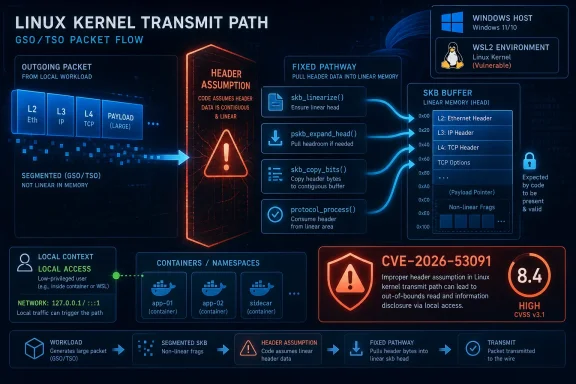 A Small Header Assumption Becomes a Kernel-Space Security Boundary
The core of CVE-2026-53091 is deceptively mundane. Some Linux network drivers expect headers for GSO packets to already be present in the linear portion of an sk_buff, the kernel’s central packet buffer structure. The kernel fix changes behavior in qdisc_pkt_len_segs_init() so that instead of merely looking at packet headers through skb_header_pointer(), the code actively pulls the needed header data into place with pskb_may_pull().That difference sounds microscopic until you remember what kernel networking code does for a living. It is built around fast paths, shortcuts, and assumptions that are reasonable only if every preceding layer has done exactly what it promised. When a driver’s transmit method, commonly exposed as
ndo_start_xmit(), assumes headers are already in skb->head, that assumption becomes a contract. If malformed or malicious packets can break the contract, then the next memcpy() is no longer just a copy operation; it is a trust fall.The CVE description specifically calls out users of
net/core/tso.c, where tso_build_hdr() performs a direct copy from skb->data based on a computed header length. In normal operation, that is exactly the kind of hot-path operation the kernel wants: no wasted checks, no extra indirection, no avoidable penalty on throughput. But in security terms, it also means that the shape of the packet buffer matters as much as the packet’s protocol fields.This is why the fix is not merely a defensive check bolted onto a driver. It moves the responsibility up into common networking code, where GSO packet dissection already happens. The kernel is effectively saying that individual drivers should not each have to rediscover this edge case and reimplement their own partial protection.
The Severity Score Is High, but the Attack Shape Is Narrow
Kernel.org’s CVSS 3.1 vector rates the flaw at 8.4, which is high, with local attack vector, low attack complexity, low privileges required, no user interaction, changed scope, high confidentiality impact, no integrity impact, and high availability impact. That mix deserves careful reading. This is not described as a remote network packet that anyone on the Internet can fire at a vulnerable host. It is a local, low-privilege path into dangerous networking behavior.That distinction matters for defenders because “local” is often misunderstood as “low priority.” In modern infrastructure, local access can mean a container workload, a compromised low-privilege service, a restricted shell, a development VM, a CI runner, or an untrusted tenant on a shared Linux host. The old mental model of “local attacker” as somebody already sitting at your keyboard is obsolete.
The high confidentiality and availability impacts are the more worrying parts of the vector. The description points to malicious packets being fed into the stack and detected earlier with a new
SKB_DROP_REASON_SKB_BAD_GSO drop reason. In practice, that means the kernel maintainers saw malformed GSO state as something worth classifying and discarding explicitly, not merely something that might fail later in a driver-dependent way.The absence of an integrity impact in the CVSS vector suggests this is not being presented as a straightforward arbitrary write or direct privilege escalation in the public record. But kernel bugs do not need clean textbook exploit primitives to matter. A memory disclosure path can leak secrets, weaken ASLR, expose adjacent state, or become a stepping stone; a crash path can become denial of service against a host that was supposed to isolate untrusted workloads.
GSO and TSO Are Performance Features With Security Consequences
Generic Segmentation Offload and TCP Segmentation Offload exist because pushing every byte of packet segmentation through the CPU in the most literal way would be wasteful. The operating system can hand a large packet-like unit down the stack and let software or hardware split it into wire-sized segments later. That is good engineering. It is also a complicated bargain between abstraction and reality.The kernel’s packet buffer layout is part of that bargain. Some packet data may be linear and immediately accessible; other data may live in fragments. Code that reads protocol headers has to know whether those bytes are actually where it expects them to be. When the common path assumes the header is linear but the packet is crafted so that the assumption breaks, the offload optimization becomes an attack surface.
The fix’s use of
pskb_may_pull() is important because it does not merely obtain a temporary pointer to header bytes. It ensures that the requested data is pulled into the linear area of the skb if possible. That aligns the buffer’s physical layout with what downstream transmit code expects.This is the kind of bug that can make non-kernel programmers’ eyes glaze over, but it is central to Linux security. Networking offloads are everywhere: servers, virtual machines, cloud instances, containers, storage appliances, firewalls, VPN gateways, Kubernetes nodes, and developer laptops. The abstractions that make networking fast also make it easy for a subtle invariant violation to travel far before anybody notices.
The Fix Is Also a Design Admission
The most interesting part of CVE-2026-53091 is not that a missing pull operation was corrected. It is that the fix acknowledges that drivers should not be expected to defend themselves against a condition the core stack can prevent. That is an architectural statement.Linux has always had tension between performance and centralization. A common check in shared code can prevent an entire class of driver mistakes, but it can also add cost to a path where maintainers care deeply about cycles. The decision to pull headers in
qdisc_pkt_len_segs_init() suggests maintainers judged the correctness and security gain to be worth putting the invariant in one place.That is almost always the better security model. If every driver has to remember to validate the layout of GSO headers before using helper code, some drivers will get it right, some will get it wrong, and some will be correct only for the packet shapes their authors happened to test. Putting the requirement in the shared queuing and segmentation path makes the system less dependent on distributed tribal knowledge.
The addition of a dedicated drop reason also matters. Observability is security infrastructure. When malformed GSO packets are dropped as
SKB_BAD_GSO, administrators and developers have a clearer signal than a vague transmit failure, unexplained crash, or driver-specific error. The kernel is not only preventing bad packets from flowing deeper into the stack; it is naming the failure mode.The Version Matrix Is Messy Because Kernel Security Is Messy
The affected-version information in the CVE record is not a simple “all versions before X” story. It identifies affected Git ranges beginning with commite876f208af18b074f800656e4d1b99da75b2135f and fixed by stable commits including 9d4f5c68f5ad4ab425f3ce1500c97c9f9743999a and 7fb4c19670110f052c04e1ec1d2b953b9f4f57e4. It also lists Linux 3.16 as affected, versions before 3.16 as unaffected, and marks 7.0.10 in the 7.0 series and 7.1 and later as unaffected.That patch geography is typical of kernel CVEs, but it is still painful for administrators. The version printed by
uname -r is only part of the answer. Distribution kernels carry backports, vendor patches, cloud-provider modifications, and long-term support deltas that do not map cleanly onto upstream semantic versions.This is why the practical remediation advice for kernel vulnerabilities is usually less glamorous than the vulnerability write-up itself. Do not try to hand-audit upstream commit hashes against a production fleet unless you are already set up for that level of kernel provenance. Use your distribution’s security tracker and kernel package changelog, then confirm the running kernel after reboot. A patched kernel package that has not been booted is, operationally, an unpatched system.
For Windows-centric shops, the same logic applies to Linux hiding in plain sight. WSL distributions, Docker Desktop backends, Hyper-V Linux guests, developer workstations, GitHub Actions-like runners, embedded Linux management appliances, NAS systems, and Kubernetes nodes all complicate the inventory. If your CMDB treats “Windows estate” and “Linux estate” as separate planets, CVEs like this are how the gap widens.
Why Windows Administrators Should Still Care
At first glance, a Linux kernel GSO bug looks outside the WindowsForum wheelhouse. Windows uses its own networking stack and driver model, and CVE-2026-53091 is not a Windows kernel vulnerability. But modern Windows environments are rarely Windows-only environments anymore.The obvious bridge is WSL. Microsoft’s Windows Subsystem for Linux has made Linux tooling ordinary on Windows developer machines, and WSL 2 uses a real Linux kernel inside a lightweight virtualized environment. Whether this specific CVE affects a given WSL deployment depends on the kernel version Microsoft ships and whether the vulnerable code path is reachable in that environment, but the operational lesson is clear: Windows endpoints can carry Linux kernel risk as a first-class component.
The broader bridge is infrastructure. Windows administrators increasingly manage identity, endpoint policy, virtualization, storage, logging, and deployment pipelines that touch Linux systems even when their primary fleet is Windows. A vulnerability in a Linux host running containers can affect Windows developers who push code to it, Windows services that depend on it, and Active Directory-integrated environments that trust it.
There is also a security tooling angle. Many EDR, SIEM, and vulnerability-management programs still have better coverage for mainstream Windows patching than for Linux kernel lineage across appliances and ephemeral workloads. A CVE like this is a reminder that “Linux box” is not a sufficient asset category. You need to know the kernel, the distro, the support channel, the reboot status, and whether the system accepts untrusted local workloads.
The Container Angle Is the One to Watch
The local attack vector makes containers central to the risk conversation. Containers are not virtual machines; they share the host kernel. If an untrusted or compromised container can exercise a vulnerable kernel code path, the bug belongs to the host’s threat model, not merely the container’s.That does not mean every containerized environment is automatically exploitable. Attack reachability depends on capabilities, namespaces, traffic control permissions, packet-generation ability, virtual network configuration, and the details of how workloads interact with the host networking stack. But it does mean defenders should resist the comforting but wrong instinct to downgrade local kernel networking bugs just because they require some foothold.
The most exposed environments are the ones that already make local-but-untrusted execution normal. Multi-tenant build systems, shared research clusters, hosting platforms, CI workers, sandbox services, and Kubernetes clusters running workloads from many teams all fit that pattern. The attacker does not need to be a remote unauthenticated Internet client if your platform business model is to run other people’s code.
This is where the CVSS score’s “low privileges required” becomes operationally meaningful. A bug that requires root is one thing; a bug that can be approached from a lesser privilege level inside a shared host context is another. Administrators should focus less on whether exploit code is public today and more on whether their systems permit untrusted users or workloads to generate unusual GSO packet states tomorrow.
The CVE Record Shows the Kernel’s New Security Machinery at Work
The Linux kernel’s CVE process has become more systematic in recent years, and CVE-2026-53091 reflects that machinery. The record was published on June 24, 2026, then updated on June 28 with the kernel.org CVSS vector. NVD had not yet provided its own CVSS assessment at the time of the provided record, which is not unusual during the early enrichment window.That timing matters because vulnerability records are not static tablets handed down from the mountain. They are living documents assembled from maintainer commits, CNA submissions, downstream analysis, and vulnerability database enrichment. Early records can be accurate but incomplete; later records can gain scores, affected-version refinements, and downstream vendor links.
For administrators, this creates a familiar race. The CVE appears before every vendor advisory is polished. Security scanners start flagging it before every distribution kernel package is clearly mapped. Application teams ask whether they are affected before infrastructure teams have a clean answer. The correct response is not panic, but it is also not waiting for perfect certainty.
The right posture is staged verification. Identify systems running Linux kernels in the affected family, prioritize multi-tenant and untrusted-workload systems, watch distribution advisories for backported fixes, schedule reboots where required, and verify the running kernel afterward. That may sound boring, but boring is what successful kernel patch management usually looks like.
The Real Risk Is Deferred Maintenance Masquerading as Stability
The systems most likely to suffer from vulnerabilities like CVE-2026-53091 are not necessarily the flashiest servers. They are often the machines that nobody wants to reboot. Storage boxes, edge routers, lab hypervisors, bespoke appliances, old Kubernetes nodes, developer VMs, and “temporary” CI hosts can run for months or years on kernels that were once acceptable and are now security debt.Linux’s stability culture is one of its strengths, but it can become an excuse. Administrators often fear kernel updates because they can affect drivers, out-of-tree modules, proprietary agents, storage stacks, or uptime commitments. Those fears are not imaginary. They are why disciplined patch windows, test rings, and rollback plans exist.
But deferring kernel maintenance has a compounding cost. A single local networking bug may not justify an emergency outage for every environment. A backlog of local kernel bugs, memory disclosure issues, namespace escape candidates, netfilter flaws, filesystem problems, and driver crashes eventually changes the risk calculation. CVE-2026-53091 belongs in that cumulative ledger.
The uncomfortable truth is that modern infrastructure keeps adding reasons for local kernel bugs to matter. More workloads are containerized. More development happens on shared runners. More Windows users run Linux tooling. More appliances are Linux under a plastic shell. More network paths are virtualized. The attack surface once reserved for system programmers is now exposed indirectly through everyday operations.
Patch the Kernel, Then Prove the New One Is Running
For most organizations, remediation will come through vendor-supplied kernel updates rather than manual cherry-picking of the upstream commits. That is the sane path. Distribution maintainers exist precisely to translate upstream fixes into supported kernel packages with the right ABI expectations, config choices, and regression testing for their ecosystems.The part administrators still own is verification. Kernel updates are not like application library updates that take effect when a process restarts. In most cases, the system must boot into the new kernel. On fleets with live patching, kexec workflows, immutable images, or cloud-managed kernels, the details vary, but the principle does not: confirm the active kernel, not merely the installed package.
That verification should extend to golden images and templates. If your cloud image, VDI template, WSL base, container host AMI, or hypervisor node image carries the old kernel, today’s patch will be undone by tomorrow’s scale-out event. The most frustrating kernel vulnerabilities are the ones you fix on existing hosts only to redeploy through automation a week later.
Teams should also monitor for regressions in network-heavy workloads after patching. Because this fix touches packet handling and GSO behavior, the sensible test set includes high-throughput services, virtual networking, container networking, VPN paths, load balancers, and anything using unusual offload settings. Security fixes are not optional, but production changes still deserve production-grade validation.
The Signal Hidden in SKB_BAD_GSO
The new drop reason, SKB_DROP_REASON_SKB_BAD_GSO, is more than a programmer convenience. It gives the kernel a vocabulary for a class of malformed packet-buffer state that previously could be harder to separate from generic failure. In large environments, better labels make better detection possible.If distributions expose this drop reason through tracing, observability, or packet-drop tooling, defenders may eventually be able to distinguish benign edge-case fallout from suspicious malformed GSO activity. That is not the same as an out-of-the-box intrusion detection rule. It is a raw signal that tooling can build on.
This is an underappreciated part of secure engineering. Preventing exploitation is the first goal, but naming and surfacing abnormal behavior helps operators understand whether they were merely vulnerable or possibly being probed. The kernel’s drop-reason framework gives administrators more ways to reason about packet deaths than the old world of silent failure.
There is a caution, though. A new drop reason should not become a substitute for patching. If you are seeing bad GSO drops on a vulnerable kernel, you are already too deep into the story. Observability helps confirm and investigate; it does not turn an unsafe code path into a safe one.
The Lesson From This CVE Is Bigger Than This CVE
CVE-2026-53091 is not likely to become a household name. It has no branding, no logo, and no obvious mass-exploitation narrative in the public description. But that is precisely why it is worth paying attention to. Most real infrastructure risk is not cinematic.The bug sits at the intersection of performance engineering, packet-buffer layout, driver expectations, and shared kernel code. Those are places where small assumptions persist for years because they are correct almost all the time. Security work is often the discipline of caring about the remaining fraction.
For WindowsForum’s audience, the broader lesson is platform humility. Windows administrators cannot ignore Linux because Linux increasingly lives inside their development tooling, server estate, network appliances, and cloud substrate. Linux administrators cannot assume “local” means harmless because containers and shared automation have changed what local means. Security teams cannot treat CVE scoring as a replacement for reachability analysis because a high score still requires context.
The fix also shows something positive about the kernel community. The vulnerable behavior was resolved by tightening a shared invariant and adding a clearer drop reason. That is the right direction: fewer driver-specific assumptions, more common validation, and better telemetry when malformed state appears.
The Practical Readout for Mixed Windows and Linux Shops
CVE-2026-53091 should land as a prioritization exercise, not a panic button. The highest-priority systems are those running vulnerable Linux kernels while allowing low-privilege or untrusted local workloads to interact with networking paths. The lowest-priority systems are isolated, single-purpose hosts with vendor-managed kernels and no practical route for untrusted local packet generation, though they still need normal patching.- Administrators should check distribution advisories and kernel package changelogs rather than relying only on upstream version numbers.
- Systems running containers, CI jobs, shared shells, or multi-tenant workloads deserve earlier attention than single-user lab machines.
- WSL and Linux-based developer tooling should be included in inventory discussions, even if the final exposure depends on Microsoft’s shipped kernel version and configuration.
- Kernel updates should be followed by a reboot or equivalent activation step, then verified against the running kernel.
- Golden images, cloud templates, and appliance firmware channels should be checked so the vulnerable kernel is not reintroduced by automation.
- Network observability teams should watch for emerging use of
SKB_BAD_GSOas distributions and tooling expose the new drop reason.
References
- Primary source: NVD / Linux Kernel
Published: 2026-06-28T01:48:53-07:00
NVD - CVE-2026-53091
 nvd.nist.gov
- Security advisory: MSRC
Published: 2026-06-28T01:48:53-07:00
Original feed URL
Security Update Guide - Microsoft Security Response Center
 msrc.microsoft.com
- Related coverage: vuldb.com
CVE-2026-53091 Linux Kernel net tso.c qdisc_pkt_len_segs_init information disclosure
A vulnerability was determined in Linux Kernel up to 7.0.9. This vulnerability is handled as CVE-2026-53091. Upgrading the affected component is advised.vuldb.com
