

CVE-2026-53098 is a newly published Linux kernel vulnerability in the MediaTek mt76 mt7915 Wi-Fi driver, disclosed through the NVD on June 24, 2026, after kernel maintainers fixed a use-after-free race in the driver’s crash-dump work path. The bug is narrow, technical, and not yet scored by NVD, but it is exactly the kind of kernel flaw that matters in real systems because it sits at the intersection of hardware removal, asynchronous workqueues, and privileged memory access. For WindowsForum readers who also run Linux on laptops, routers, lab boxes, Proxmox hosts, or dual-boot workstations, the lesson is not panic. It is that Wi-Fi drivers remain one of the least glamorous and most failure-prone parts of the modern operating system stack.
The vulnerability lives in the Linux kernel’s mt76 driver family, specifically the mt7915 support code for MediaTek wireless hardware. The affected function,
The race described in the CVE is straightforward in the way kernel bugs often are only after someone has found them. One CPU can be tearing down the device and freeing
That is the textbook shape of a use-after-free: memory that was once valid is released, but stale code still treats it as live. In user-space applications, that can mean a crash, data corruption, or in some cases code execution. In the kernel, the stakes are higher because the memory is privileged, the failure domain is the whole machine, and even “just a crash” can be a serious availability problem for infrastructure.
The immediate fix is also classic kernel engineering: cancel and synchronize the work item before freeing the memory it might use. The patch adds
The danger is that deferred work has its own lifetime. If a driver queues work that refers to device-owned memory, the driver must prove that memory remains valid until the work is finished or canceled. Device removal, module unload, PCI detach, and error recovery are where that proof often falls apart.
In CVE-2026-53098, the vulnerable sequence involves the mt7915 PCI chip detaching while recovery-related work may still be queued. The removal path proceeds through device unregister and coredump unregister, eventually freeing crash data. Meanwhile, the recovery path can queue the dump work, and that worker can later reach into the freed structure.
That makes this bug more relevant to stability and controlled teardown than to casual drive-by Wi-Fi exploitation. The available description does not establish a remote packet-triggered exploit, and NVD had not assigned a CVSS score at the time of publication. Still, kernel use-after-free vulnerabilities should not be dismissed merely because their first public description is a race diagram rather than a weaponized proof-of-concept.
That is good news for Linux users. Upstream drivers are usually better than abandoned vendor drops, binary-only blobs, or out-of-tree code that breaks every second kernel release. But it also means that when bugs land in upstream-supported drivers, they can propagate across distributions and downstream products before fixes work their way back through stable trees and vendor images.
The mt7915 generation is especially relevant in access points and router-class hardware, where a Wi-Fi device may be expected to run for months under load. A teardown-path UAF may not sound urgent for a desktop that is rarely hot-unplugging PCIe Wi-Fi hardware, but routers and embedded devices hit reset and recovery paths under stress. A driver that mismanages lifetime during recovery can turn a recoverable radio failure into a kernel oops, watchdog reboot, or unexplained service disruption.
That is the practical lens sysadmins should use. This CVE is not just about whether an attacker can gain root tomorrow. It is about whether the network device you expect to self-heal can instead trip over its own cleanup logic.
That distinction between canceling and synchronizing is not pedantry. A non-synchronous cancellation might remove pending work but fail to account for a work item already executing on another CPU. In a multicore system, “I removed the reference” and “no one can still be using the reference” are different claims.
This is why teardown bugs are so persistent. The code that registers a device is usually linear and optimistic: allocate structures, initialize locks, register with subsystems, start work. The code that unregisters a device has to unwind that world while interrupts, timers, workqueues, firmware callbacks, and userspace-visible interfaces may still be in motion.
The CVE’s race diagram captures that asymmetry. CPU 0 walks the removal path and frees crash data. CPU 1 queues or executes recovery work and touches the same object. No single line looks reckless in isolation, but the combined timeline produces a dangling pointer.
This is a familiar problem for Linux kernel CVEs. The kernel project’s modern CVE flow can produce a large number of records for fixed bugs, including many driver issues whose exploitability depends heavily on hardware, configuration, privilege boundaries, and reachable trigger paths. Security teams then face a messy middle ground: too many CVEs to treat every one as a five-alarm fire, but too much kernel privilege to ignore them all.
For this issue, the risk profile is bounded by the affected driver and hardware. Systems without mt7915-supported MediaTek hardware are not meaningfully exposed to this specific code path. Systems that do use that driver should treat the fix as a normal kernel maintenance item, especially if the hardware is part of infrastructure rather than a disposable test box.
The absence of a score should push administrators toward context, not complacency. If this driver is in your fleet, the relevant question is not “Is the CVSS high?” It is “Do we run affected kernels on systems where wireless failure or local kernel instability has operational impact?”
Those numbers matter less as trivia than as a reminder that “Linux kernel” is not one moving target. A laptop distribution, a router firmware image, a NAS appliance, and a hypervisor host may all say they run Linux, while each carries a different kernel branch, backport policy, driver configuration, and patch cadence. The fix may arrive as a new kernel version, a vendor backport, or part of a distribution security update that does not advertise the upstream commit hash in the package name.
For administrators, the safest workflow is boring: inventory kernels, identify whether mt7915 support is present and used, check the vendor’s kernel changelog or security tracker, then schedule updates according to exposure. If the device is an access point, edge router, or remote site appliance, that schedule should account for reboot windows and fallback connectivity.
For desktop Linux users, the calculus is simpler. If you are running a mainstream distribution and you receive kernel updates, take them. If you have pinned an older kernel because a Wi-Fi or GPU regression hurt you in the past, this is one more reason to revisit that pin and decide whether the workaround has become the bigger risk.
The direct vulnerability is not in Windows. A Windows system using a MediaTek wireless adapter with a Windows driver is not affected by this Linux kernel code path. But Windows administrators often own the surrounding infrastructure, and that infrastructure may include Linux-powered Wi-Fi gear or Linux hosts with wireless adapters used for lab, kiosk, industrial, or remote-access scenarios.
There is also a broader driver lesson here that absolutely applies to Windows. Hardware support is one of the last places where operating systems must trust code that is close to the metal, full of asynchronous state, and dependent on firmware behavior the OS may not fully control. Whether the driver model is Linux’s in-kernel approach or Windows’ layered driver framework, lifetime bugs around cleanup and cancellation remain a stubborn class of failures.
Windows users who have watched Wi-Fi adapters disappear after sleep, Bluetooth radios stall after resume, or laptops require a cold reboot to restore wireless connectivity already understand the symptom pattern. CVE-2026-53098 is the security-record version of that familiar instability: a tiny ordering mistake in a driver can have system-wide consequences.
Both instincts are understandable, and both are incomplete. The public details for CVE-2026-53098 do not show a broad Internet-exposed attack surface. The bug appears tied to device removal and recovery work, which may require local conditions, specific hardware, or rare timing. That argues against melodrama.
But the bug is in kernel space, in a wireless driver, in a cleanup path, and in code that can run during failure recovery. That argues against indifference. Availability matters, and the same primitives that produce crashes can sometimes become exploitable when an attacker can shape timing, memory reuse, and trigger conditions.
The right interpretation is narrower and more useful: this is a real kernel memory-lifetime bug with hardware-specific exposure and a straightforward upstream fix. Treat it as part of your kernel patch program, not as an isolated emergency unless your environment gives it unusual relevance.
Embedded Linux is different. Consumer routers, wireless bridges, and access points may run old vendor trees that only occasionally receive security updates. Even when a fix exists upstream, users may wait weeks or months for OEM firmware, if it arrives at all. Devices based on open firmware ecosystems can move faster, but only if the specific hardware target is maintained and the user is willing to flash it.
That is why Wi-Fi driver CVEs punch above their apparent weight in the real world. The systems most likely to use wireless chipsets as core infrastructure are often the systems least likely to receive prompt, transparent patching. A desktop kernel update is an annoyance. A router firmware update can be a gamble involving configuration backups, downtime, compatibility concerns, and vendor release notes that say little more than “improved stability.”
For small businesses and home labs, the lesson is to treat wireless infrastructure as software-maintained infrastructure, not as plastic furniture. If a device cannot receive kernel and driver fixes, its shelf life is defined by vendor maintenance, not by whether the radios still power on.
CVE-2026-53098 belongs in the category that rewards asset awareness. If you know your hardware, loaded modules, kernel branches, and distribution backports, this is a manageable item. If your scanner simply says “Linux kernel vulnerable” across every host, you are left with false urgency and little prioritization.
The better triage process starts with whether the affected code can run. Is
This is also where software bills of materials and hardware inventory meet reality. Knowing package versions is not enough when the vulnerable code is conditional on drivers and devices. Kernel risk management is increasingly a map of what silicon is actually deployed.
This is the quiet craft of kernel maintenance. The best patches often do not add features, introduce new abstractions, or refactor the world. They put the fence in the one place where every possible timeline must pass.
There is a cultural point here, too. The Linux kernel’s public development model makes these bugs visible in a way that can look alarming to casual observers. But visibility is not the same as fragility. A transparent record of driver fixes is what lets downstream vendors, distributions, and administrators reason about exposure.
The less comfortable truth is that every operating system has these bugs. Some are fixed in public. Some are fixed in opaque vendor drops. Some sit undiscovered until a crash dump, a fuzzer, or an exploit chain drags them into view.
The most useful takeaways are specific:
CVE-2026-53098 will probably not be remembered as a landmark Linux security event, and that is precisely why it is useful. It shows how modern system risk accumulates in the seams: a work item queued one moment too long, a crash buffer freed one step too early, a wireless device recovering while another CPU tears it down. The fix is already known, but the broader lesson remains current for every platform we depend on: operating systems are only as resilient as the driver lifetimes they enforce, and the next meaningful security update may arrive disguised as an unglamorous cleanup patch.
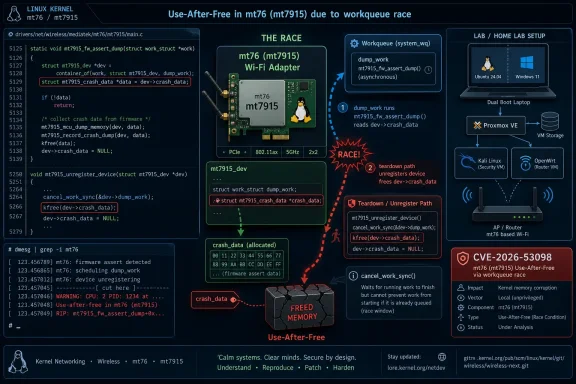 A Small Wi-Fi Race Becomes a Kernel Security Record
The vulnerability lives in the Linux kernel’s mt76 driver family, specifically the mt7915 support code for MediaTek wireless hardware. The affected function, mt7915_mac_dump_work(), is part of a crash-dump and recovery path rather than the normal happy path of moving packets across the air. That detail matters because many driver bugs hide not in everyday operation, but in cleanup, teardown, recovery, suspend, reset, and hot-unplug sequences.The race described in the CVE is straightforward in the way kernel bugs often are only after someone has found them. One CPU can be tearing down the device and freeing
mt7915_crash_data through mt7915_coredump_unregister(). Another CPU can still have a pending or executing work item that eventually runs mt7915_mac_dump_work() and dereferences that same crash-data pointer after it has already been freed.That is the textbook shape of a use-after-free: memory that was once valid is released, but stale code still treats it as live. In user-space applications, that can mean a crash, data corruption, or in some cases code execution. In the kernel, the stakes are higher because the memory is privileged, the failure domain is the whole machine, and even “just a crash” can be a serious availability problem for infrastructure.
The immediate fix is also classic kernel engineering: cancel and synchronize the work item before freeing the memory it might use. The patch adds
cancel_work_sync() in mt7915_unregister_device(), making teardown wait until any pending or running dump_work can no longer touch the soon-to-be-freed crash-data structure. This is not a sweeping redesign. It is a one-line kind of fix with years of concurrency discipline behind it.The Bug Is Less Exotic Than the CVE Number Makes It Look
The CVE identifier gives the issue a formal security shape, but the underlying failure mode is ordinary. Linux drivers routinely schedule deferred work because hardware events, interrupts, resets, and firmware interactions cannot always be handled immediately in the current execution context. Workqueues are a core part of that design, and they are one of the reasons Linux can support a massive hardware ecosystem without every driver becoming an interrupt-time nightmare.The danger is that deferred work has its own lifetime. If a driver queues work that refers to device-owned memory, the driver must prove that memory remains valid until the work is finished or canceled. Device removal, module unload, PCI detach, and error recovery are where that proof often falls apart.
In CVE-2026-53098, the vulnerable sequence involves the mt7915 PCI chip detaching while recovery-related work may still be queued. The removal path proceeds through device unregister and coredump unregister, eventually freeing crash data. Meanwhile, the recovery path can queue the dump work, and that worker can later reach into the freed structure.
That makes this bug more relevant to stability and controlled teardown than to casual drive-by Wi-Fi exploitation. The available description does not establish a remote packet-triggered exploit, and NVD had not assigned a CVSS score at the time of publication. Still, kernel use-after-free vulnerabilities should not be dismissed merely because their first public description is a race diagram rather than a weaponized proof-of-concept.
MediaTek’s Linux Footprint Makes Driver Hygiene Everyone’s Problem
MediaTek Wi-Fi is no longer a niche concern. The company’s wireless chipsets appear across consumer routers, mini PCs, embedded boards, laptops, and aftermarket cards. The mt76 Linux driver family has become increasingly important because it provides upstream support for a broad slice of MediaTek wireless hardware.That is good news for Linux users. Upstream drivers are usually better than abandoned vendor drops, binary-only blobs, or out-of-tree code that breaks every second kernel release. But it also means that when bugs land in upstream-supported drivers, they can propagate across distributions and downstream products before fixes work their way back through stable trees and vendor images.
The mt7915 generation is especially relevant in access points and router-class hardware, where a Wi-Fi device may be expected to run for months under load. A teardown-path UAF may not sound urgent for a desktop that is rarely hot-unplugging PCIe Wi-Fi hardware, but routers and embedded devices hit reset and recovery paths under stress. A driver that mismanages lifetime during recovery can turn a recoverable radio failure into a kernel oops, watchdog reboot, or unexplained service disruption.
That is the practical lens sysadmins should use. This CVE is not just about whether an attacker can gain root tomorrow. It is about whether the network device you expect to self-heal can instead trip over its own cleanup logic.
The Fix Says More Than the Flaw
The important line in the fix iscancel_work_sync(&dev->dump_work). In Linux kernel terms, that call is a contract: if the work is pending, cancel it; if it is already running, wait until it completes. Only after that point is it safe for the unregister path to proceed with freeing data the worker might have used.That distinction between canceling and synchronizing is not pedantry. A non-synchronous cancellation might remove pending work but fail to account for a work item already executing on another CPU. In a multicore system, “I removed the reference” and “no one can still be using the reference” are different claims.
This is why teardown bugs are so persistent. The code that registers a device is usually linear and optimistic: allocate structures, initialize locks, register with subsystems, start work. The code that unregisters a device has to unwind that world while interrupts, timers, workqueues, firmware callbacks, and userspace-visible interfaces may still be in motion.
The CVE’s race diagram captures that asymmetry. CPU 0 walks the removal path and frees crash data. CPU 1 queues or executes recovery work and touches the same object. No single line looks reckless in isolation, but the combined timeline produces a dangling pointer.
NVD’s Missing Score Is a Signal, Not a Comfort Blanket
At publication, NVD listed the vulnerability without a CVSS 4.0, CVSS 3.x, or CVSS 2.0 score from NIST. That does not mean the bug is harmless. It means the enrichment process had not yet assigned the scoring metadata that many dashboards and patch-management systems use to sort risk.This is a familiar problem for Linux kernel CVEs. The kernel project’s modern CVE flow can produce a large number of records for fixed bugs, including many driver issues whose exploitability depends heavily on hardware, configuration, privilege boundaries, and reachable trigger paths. Security teams then face a messy middle ground: too many CVEs to treat every one as a five-alarm fire, but too much kernel privilege to ignore them all.
For this issue, the risk profile is bounded by the affected driver and hardware. Systems without mt7915-supported MediaTek hardware are not meaningfully exposed to this specific code path. Systems that do use that driver should treat the fix as a normal kernel maintenance item, especially if the hardware is part of infrastructure rather than a disposable test box.
The absence of a score should push administrators toward context, not complacency. If this driver is in your fleet, the relevant question is not “Is the CVSS high?” It is “Do we run affected kernels on systems where wireless failure or local kernel instability has operational impact?”
The Version Trail Is the Patch Manager’s Real Story
The CVE record identifies Linux as affected beginning with the introduction range tied to the relevant driver code and marks fixed points across stable branches. The supplied affected-version data says versions before 6.2 are unaffected, while 6.2 and later lines are affected until their branch-specific fixes. It also lists fixed status for stable versions including 6.6.141, 6.12.91, 6.18.33, 7.0.10, and the 7.1 fix lineage.Those numbers matter less as trivia than as a reminder that “Linux kernel” is not one moving target. A laptop distribution, a router firmware image, a NAS appliance, and a hypervisor host may all say they run Linux, while each carries a different kernel branch, backport policy, driver configuration, and patch cadence. The fix may arrive as a new kernel version, a vendor backport, or part of a distribution security update that does not advertise the upstream commit hash in the package name.
For administrators, the safest workflow is boring: inventory kernels, identify whether mt7915 support is present and used, check the vendor’s kernel changelog or security tracker, then schedule updates according to exposure. If the device is an access point, edge router, or remote site appliance, that schedule should account for reboot windows and fallback connectivity.
For desktop Linux users, the calculus is simpler. If you are running a mainstream distribution and you receive kernel updates, take them. If you have pinned an older kernel because a Wi-Fi or GPU regression hurt you in the past, this is one more reason to revisit that pin and decide whether the workaround has become the bigger risk.
Windows Users Are Not the Target, But They Are Not Bystanders
A Linux Wi-Fi driver CVE may look out of place on a Windows-focused forum until you look at how enthusiasts and IT pros actually run machines in 2026. Windows laptops dual-boot Linux. Windows desktops host Linux VMs and containers. Home labs mix Windows Server, Hyper-V, Proxmox, Ubuntu, Fedora, Debian, and appliance distributions. Routers and access points quietly run Linux even in networks managed from Windows consoles.The direct vulnerability is not in Windows. A Windows system using a MediaTek wireless adapter with a Windows driver is not affected by this Linux kernel code path. But Windows administrators often own the surrounding infrastructure, and that infrastructure may include Linux-powered Wi-Fi gear or Linux hosts with wireless adapters used for lab, kiosk, industrial, or remote-access scenarios.
There is also a broader driver lesson here that absolutely applies to Windows. Hardware support is one of the last places where operating systems must trust code that is close to the metal, full of asynchronous state, and dependent on firmware behavior the OS may not fully control. Whether the driver model is Linux’s in-kernel approach or Windows’ layered driver framework, lifetime bugs around cleanup and cancellation remain a stubborn class of failures.
Windows users who have watched Wi-Fi adapters disappear after sleep, Bluetooth radios stall after resume, or laptops require a cold reboot to restore wireless connectivity already understand the symptom pattern. CVE-2026-53098 is the security-record version of that familiar instability: a tiny ordering mistake in a driver can have system-wide consequences.
The Security Industry Will Overstate and Understate This at the Same Time
Kernel CVEs like this tend to suffer from two bad readings. The first is the marketing-page version, where every use-after-free becomes a looming remote-code-execution catastrophe. The second is the jaded-admin version, where every driver CVE without a score becomes noise to be filtered out.Both instincts are understandable, and both are incomplete. The public details for CVE-2026-53098 do not show a broad Internet-exposed attack surface. The bug appears tied to device removal and recovery work, which may require local conditions, specific hardware, or rare timing. That argues against melodrama.
But the bug is in kernel space, in a wireless driver, in a cleanup path, and in code that can run during failure recovery. That argues against indifference. Availability matters, and the same primitives that produce crashes can sometimes become exploitable when an attacker can shape timing, memory reuse, and trigger conditions.
The right interpretation is narrower and more useful: this is a real kernel memory-lifetime bug with hardware-specific exposure and a straightforward upstream fix. Treat it as part of your kernel patch program, not as an isolated emergency unless your environment gives it unusual relevance.
Router Firmware Is Where “Just Update” Goes to Die
On general-purpose Linux distributions, kernel updates are routine. Fedora, Ubuntu, Debian, Arch, openSUSE, and enterprise vendors all have mechanisms to ship fixed kernels. The experience may not always be painless, but the path is visible.Embedded Linux is different. Consumer routers, wireless bridges, and access points may run old vendor trees that only occasionally receive security updates. Even when a fix exists upstream, users may wait weeks or months for OEM firmware, if it arrives at all. Devices based on open firmware ecosystems can move faster, but only if the specific hardware target is maintained and the user is willing to flash it.
That is why Wi-Fi driver CVEs punch above their apparent weight in the real world. The systems most likely to use wireless chipsets as core infrastructure are often the systems least likely to receive prompt, transparent patching. A desktop kernel update is an annoyance. A router firmware update can be a gamble involving configuration backups, downtime, compatibility concerns, and vendor release notes that say little more than “improved stability.”
For small businesses and home labs, the lesson is to treat wireless infrastructure as software-maintained infrastructure, not as plastic furniture. If a device cannot receive kernel and driver fixes, its shelf life is defined by vendor maintenance, not by whether the radios still power on.
The Kernel’s CVE Flood Is Forcing Better Triage
The Linux kernel’s approach to CVE assignment has changed the texture of vulnerability management. More fixed bugs are receiving CVE IDs, and that means defenders see more kernel CVEs that are technically valid but operationally uneven. A storage-driver flaw on hardware you do not own is different from a network-stack flaw reachable by untrusted packets, yet both may enter scanners as red rows demanding attention.CVE-2026-53098 belongs in the category that rewards asset awareness. If you know your hardware, loaded modules, kernel branches, and distribution backports, this is a manageable item. If your scanner simply says “Linux kernel vulnerable” across every host, you are left with false urgency and little prioritization.
The better triage process starts with whether the affected code can run. Is
mt7915 hardware present? Is the mt76 driver built and loaded? Is the system a wireless access point, a client device, or a lab machine? Is the kernel line already at a fixed stable release or carrying a vendor backport? Those answers change the patch priority far more than the CVE number alone.This is also where software bills of materials and hardware inventory meet reality. Knowing package versions is not enough when the vulnerable code is conditional on drivers and devices. Kernel risk management is increasingly a map of what silicon is actually deployed.
The Patch Is Small Because the Discipline Is Large
It is tempting to see a one-line synchronization fix as evidence that the bug was trivial. In truth, small fixes often sit on top of deep subsystem knowledge. The developer had to understand thatdump_work could outlive the crash-data allocation, that unregister was the correct synchronization point, and that cancel_work_sync() provided the necessary guarantee.This is the quiet craft of kernel maintenance. The best patches often do not add features, introduce new abstractions, or refactor the world. They put the fence in the one place where every possible timeline must pass.
There is a cultural point here, too. The Linux kernel’s public development model makes these bugs visible in a way that can look alarming to casual observers. But visibility is not the same as fragility. A transparent record of driver fixes is what lets downstream vendors, distributions, and administrators reason about exposure.
The less comfortable truth is that every operating system has these bugs. Some are fixed in public. Some are fixed in opaque vendor drops. Some sit undiscovered until a crash dump, a fuzzer, or an exploit chain drags them into view.
The Practical Signal Hidden Inside CVE-2026-53098
For most readers, CVE-2026-53098 should trigger a calm but concrete response. It is not a reason to rip out MediaTek hardware, and it is not evidence that Linux Wi-Fi is uniquely doomed. It is a reminder that driver updates are security updates, even when the bug sounds like an obscure race in a recovery worker.The most useful takeaways are specific:
- Systems that do not use the mt7915 MediaTek driver are not the practical target of this vulnerability.
- Systems that do use mt7915-supported hardware should move to a kernel branch or vendor update containing the
dump_workcancellation fix. - The lack of an NVD score at publication should not be treated as proof of low impact.
- Router and access-point firmware may lag behind upstream fixes, so vendor maintenance status matters as much as the kernel commit itself.
- Administrators should prioritize this more highly on infrastructure devices where Wi-Fi recovery failures can cause outages.
- Desktop users on mainstream distributions should generally accept the next fixed kernel update rather than attempting manual driver surgery.
CVE-2026-53098 will probably not be remembered as a landmark Linux security event, and that is precisely why it is useful. It shows how modern system risk accumulates in the seams: a work item queued one moment too long, a crash buffer freed one step too early, a wireless device recovering while another CPU tears it down. The fix is already known, but the broader lesson remains current for every platform we depend on: operating systems are only as resilient as the driver lifetimes they enforce, and the next meaningful security update may arrive disguised as an unglamorous cleanup patch.
References
- Primary source: NVD / Linux Kernel
Published: 2026-07-03T01:04:08-07:00
NVD - CVE-2026-53098
 nvd.nist.gov
- Security advisory: MSRC
Published: 2026-07-03T01:04:08-07:00
Original feed URL
Security Update Guide - Microsoft Security Response Center
 msrc.microsoft.com
- Related coverage: spinics.net
[PATCH] wifi: mt76: mt7915: fix use-after-free bugs in mt7915_mac_dump_work() — Linux Kernel
Linux Kernel: [PATCH] wifi: mt76: mt7915: fix use-after-free bugs in mt7915_mac_dump_work() www.spinics.net
- Related coverage: lists.infradead.org
- Related coverage: lkml.indiana.edu
