

 A Small Driver Bug Exposes a Big Kernel Truth
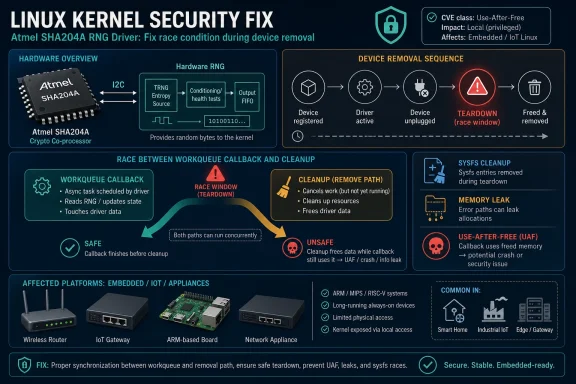
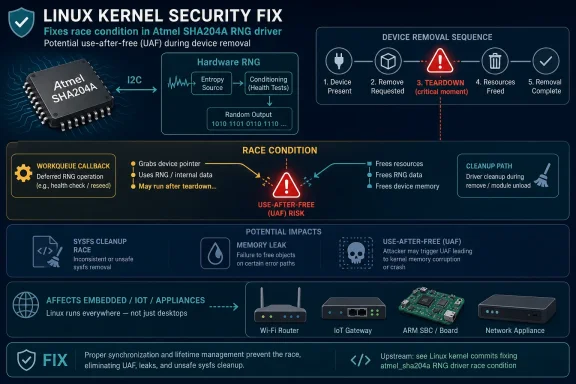
The affected code lives in the Linux kernel’s crypto: atmel-sha204a driver, which supports Atmel’s SHA204A hardware used for cryptographic functions including a hardware random number generator interface. The CVE description is terse, but it tells a familiar kernel story: unregister the hardware RNG before teardown, flush the I2C workqueue, and make sure sysfs entries and private memory are cleaned up even when the device appears busy.
That is not the language of a remote worm or a mass internet exploit. It is the language of lifecycle correctness. A driver creates kernel-visible objects, queues asynchronous work, exposes data through sysfs, and hands a callback path to another subsystem. If removal happens in the wrong order, a callback may fire after the object it expects has already been dismantled.
The result is described as a potential use-after-free, or UAF, plus a memory leak. A UAF is one of the more dangerous classes of memory-safety bugs because it means code may continue to reference memory after its ownership has ended. In practice, exploitability depends heavily on context: reachable code paths, attacker control, timing, kernel configuration, and whether the affected hardware is present.
That nuance matters. This CVE should not be treated as proof that every Linux machine is in immediate danger. It should be treated as another data point in the long-running argument that hardware drivers, especially niche ones, are security-relevant even when the hardware itself is not widely deployed.
The Removal Path Is Where Assumptions Go to Die
Most users think of driver bugs as problems that occur when hardware is active: reads, writes, interrupts, DMA, resume from sleep, or error handling under load. CVE-2026-46075 lives somewhere less glamorous: the remove path. That is the code that runs when the driver is being detached from the device.
Remove paths are deceptively hard to get right because they are full of assumptions about what is still alive. The device object may still exist, but the subsystem registration may need to end first. Work may already be queued. Sysfs files may still be visible. A userspace process may have just asked for data. An asynchronous callback may be waiting for a turn on a workqueue.
The fix described by the kernel record does three important things. It unregisters the hardware random number generator so new reads are not accepted. It flushes the Atmel I2C workqueue so already queued callbacks finish before teardown continues. It also removes an early return that could skip cleanup, ensuring sysfs entries are removed and the private hardware RNG pointer is freed.
That sequence is the whole story. If the RNG interface remains registered while the device is being removed, new read activity can race with destruction. If queued I2C work is allowed to run after the associated state is gone, the kernel may touch freed memory. If cleanup exits early because the device is busy, the system avoids one immediate problem by leaving another behind.
The phrase “device is busy” often sounds like a reason to stop. In cleanup code, it can become a trap. Returning early may preserve state that should not remain visible, and it may keep allocations alive indefinitely. In this case, the fix appears to prefer deterministic teardown over a defensive retreat.
Hardware RNGs Sit Closer to Trust Than Their Size Suggests
Hardware random number generators occupy a strange place in system design. They are tiny components in the stack, but they feed one of the most sensitive resources a system has: entropy. Cryptographic keys, session tokens, nonce generation, and other security operations all depend on randomness that is good enough and delivered safely enough.
The Atmel SHA204A has already had attention from kernel developers before, including work to lower the reported quality of its random output. That earlier concern is separate from CVE-2026-46075, but it gives the driver a useful backdrop. This is not just an obscure I2C peripheral doing something cosmetic; it is a chip that can participate in the kernel’s randomness plumbing.
The vulnerability at hand is not an allegation that the chip produces bad random numbers. It is about teardown ordering around the driver’s hardware RNG registration and its queued I2C operations. Still, the security context is hard to ignore. Bugs in RNG-adjacent code are treated seriously because they sit near trust boundaries that administrators usually do not inspect day to day.
For most WindowsForum readers, the immediate question is whether this affects a Windows PC. In the ordinary sense, no. This is a Linux kernel driver issue. But that answer is too narrow for modern IT. Linux kernels run in routers, storage appliances, development boards, security cameras, kiosks, hypervisors, containers hosts, and industrial systems that Windows shops often manage indirectly.
The device-specific nature of the bug narrows exposure, but it does not erase it. If an appliance vendor ships a kernel with this driver enabled and matching hardware present, the customer inherits the vendor’s patching discipline. That is where obscure kernel CVEs become operationally relevant.
NVD Has the Record, but Not Yet the Risk Rating
The NVD entry for CVE-2026-46075 was published on May 27, 2026, and was still marked as awaiting enrichment at the time of the record shown. That means NVD had accepted the CVE and listed the kernel.org description and references, but had not yet provided its own CVSS vector or base score.
That absence is not unusual for freshly published kernel CVEs, but it does create a familiar problem for vulnerability management teams. Dashboards want numbers. Patch meetings want severity labels. Asset owners want to know whether something is critical, high, medium, or background noise. The vulnerability record, however, is not yet giving them that shortcut.
In cases like this, the first responsible answer is to resist inventing certainty. The presence of “use-after-free” in a description should raise attention, because UAFs can sometimes be exploitable for privilege escalation or denial of service. But the words “potential UAF” in a device remove path do not automatically imply an easy attack path.
The likely practical risk depends on several conditions. The affected kernel must include the vulnerable code. The Atmel SHA204A driver must be built and active. The relevant hardware or device tree configuration must exist. An attacker would need a way to trigger or influence removal timing, RNG reads, or related driver activity. Those are meaningful constraints.
This is why NVD enrichment matters, but it should not be treated as the beginning of risk analysis. Administrators can act before a score appears by identifying whether the driver is present, whether the hardware exists, and whether their distribution or vendor kernel has pulled in the stable fix.
Kernel.org’s CVE Stream Makes the Plumbing Visible
Linux kernel CVE handling has become more aggressive and more automated in recent years, and CVE-2026-46075 fits that pattern. A bug is fixed upstream or in stable branches, the CVE record describes the fix, and downstream consumers are left to map the change onto their own kernels. This approach has benefits: it surfaces flaws that might otherwise remain buried in changelogs, and it gives vendors a common identifier.
It also creates noise. Many Linux kernel CVEs are not internet-facing bugs with clear exploit chains. They are often highly conditional flaws in drivers, filesystems, protocol implementations, or hardware-specific paths. That does not make them fake. It makes them hard to prioritize.
The better way to read this CVE is as a patch provenance marker. It tells administrators and vendors: here is a known correctness and safety fix, here are the stable commits, and here is the class of failure being addressed. The security consequence may vary by environment, but the code was wrong enough to fix and security-relevant enough to assign an identifier.
For enterprise IT, that distinction is useful. A CVE number is not a panic button. It is an indexing system for risk conversations. The job is not to scream at every identifier; it is to decide which identifiers intersect with the hardware, software, and threat model actually present in the estate.
CVE-2026-46075 is a good example of that discipline. It should move quickly for vendors shipping affected embedded platforms. It may be irrelevant for a cloud VM with no such driver. It may be a compliance item for organizations that track all kernel CVEs regardless of reachability. It may be a practical concern for anyone maintaining custom Linux images for ARM boards or appliance-like devices.
The Bug Is Less About Crypto Than About Concurrency
The word “crypto” in the component path can mislead. This is not a broken cipher, a weak key schedule, or a protocol failure. The vulnerability is about concurrency and lifetime management.
The driver uses I2C work, and that means operations can be queued and completed asynchronously. That is normal. It is also where mistakes happen. If the teardown path assumes no work will run after a certain point, but the workqueue disagrees, the kernel can end up executing a callback with a pointer to memory that has already been released.
The fix’s emphasis on flushing the workqueue is therefore central. Flushing is a synchronization point. It says: before we destroy the structures that queued work may reference, make sure that work has drained. Without that ordering, removal becomes a race between cleanup and callback execution.
The hardware RNG unregister step is the other half of the fix. As long as the hwrng device remains registered, the broader kernel can call into the driver’s read path. During removal, that is exactly what should stop first. Unregistration closes the front door before the furniture is carried out.
This is one of those bugs that looks obvious only after the patch exists. In a live kernel, subsystems are stacked: I2C, crypto, hwrng, sysfs, device-managed resources, workqueues, and module lifecycle rules. Each layer has its own idea of when something is alive. Correctness means making all of those ideas line up.
Windows Shops Should Care Because Linux Is in Their Blind Spots
A Windows-focused administrator could reasonably ask why this belongs on a Windows community site. The answer is that Windows environments no longer end at Windows endpoints. The network closet, the hypervisor host, the backup appliance, the firewall, the NAS, the Kubernetes worker, the developer workstation running Linux containers, and the vendor-managed edge box may all carry Linux kernels.
The risk from CVE-2026-46075 is unlikely to be a direct threat to a standard Windows laptop. But Windows-heavy organizations often have Linux in places where inventory is weaker and patch accountability is fuzzier. That is where obscure driver CVEs become interesting. Not because every one is urgent, but because they expose assets the organization may not be watching closely.
Embedded Linux is especially relevant. Devices with I2C-attached secure elements, random number generators, or authentication chips are common in industrial, IoT, and appliance contexts. The Atmel SHA204A family belongs to that general world of small hardware security components. If a vendor built support into a long-lived kernel and rarely updates it, the customer may not see the risk until a scanner flags the CVE months later.
The practical move is not to audit every Windows desktop for an Atmel driver it does not have. The practical move is to ask where Linux kernels exist in the environment and whether those kernels are vendor-maintained, distribution-maintained, or effectively frozen. The last category is where small kernel bugs can accumulate into a large operational liability.
Security teams should also be careful with scanner output. A CVE match against a kernel version does not always prove the affected driver is built, loaded, or reachable. Conversely, a vendor kernel may backport the fix without changing the version string in a way the scanner understands. Kernel vulnerability management requires more than version comparison.
Patch Management Needs Hardware Context, Not Just CVE Counting
The most concrete administrative lesson from CVE-2026-46075 is that hardware context matters. Linux kernels are modular, configurable, and frequently patched downstream. A vulnerability in a specific driver is not the same as a vulnerability in every running instance of Linux.
That creates a challenge for organizations using generic vulnerability tooling. A scanner may report the CVE based on a package version. A distribution advisory may include it among dozens or hundreds of kernel fixes. A vendor appliance may never expose enough detail to tell whether the exact driver is enabled. The result is either overreaction or complacency, depending on the culture.
A better process starts with asset grouping. General-purpose servers, desktop Linux systems, container hosts, embedded appliances, ARM development boards, and vendor-managed devices should not be handled as one blob. Driver CVEs are most meaningful where the relevant hardware class exists.
For self-managed Linux systems, administrators can inspect kernel configuration, loaded modules, device tree data, and hardware inventory. For vendor appliances, the route is often less satisfying: advisory tracking, support tickets, firmware release notes, and sometimes contractual pressure. That is not elegant, but it is real.
The patch itself should be low drama where it is available through a maintained stable kernel or distribution update. The fix is targeted and defensive. It changes teardown ordering rather than introducing a new feature. That does not mean it is risk-free, but it is the kind of patch that downstream maintainers generally prefer to absorb.
The Memory Leak Is the Quiet Half of the Story
Use-after-free gets the attention because it carries the possibility of crashes or exploitation. The memory leak deserves its own mention because it reveals the same underlying flaw: cleanup was not guaranteed. Dropping the early return ensures sysfs entries are removed and the private hardware RNG allocation is freed.
Memory leaks in kernel drivers can be boring until they are not. A one-off leak during device removal may not matter on a workstation that rarely removes the device. On systems where devices are reprobed, hotplugged, reset, or managed dynamically, leaks can become stability problems. In embedded systems with limited memory and long uptimes, even small leaks can matter.
The sysfs cleanup angle is also important. Sysfs is one of the ways the kernel exposes device state to userspace. Leaving sysfs entries behind after the underlying state is gone can produce confusing behavior and, in some cases, dangerous dangling interfaces. Cleanup must remove not only memory allocations but also the visible hooks that invite future access.
This is why the early return is so revealing. It was probably intended as a safety check: if there are active users, warn and avoid tearing down something in use. But cleanup code often cannot simply walk away. If the device is being removed, the driver must transition it to a safe terminal state. Half-removal is where dangling references live.
The fix therefore does more than plug a leak. It changes the driver’s posture from “stop if busy” to “shut down the public interface, drain pending work, and then clean up.” That is the safer pattern.
The Absence of a Score Is Not the Absence of a Decision
Security teams often wait for a CVSS score before deciding what to do. That can be sensible when the score is imminent and the vulnerability is broad. For hardware-specific kernel issues, waiting for enrichment may not add much. The score will still be generic, while the organization’s exposure will be specific.
The decision tree here is straightforward. If you do not run Linux kernels with this driver or hardware, the CVE is a tracking item, not an emergency. If you ship or maintain devices that use Atmel SHA204A through the Linux kernel driver, the fix should be pulled into the next suitable update cycle. If you operate third-party appliances that may include the hardware, ask the vendor whether their kernel includes the stable fix.
The most awkward category is custom Linux. Many organizations have old board support packages, vendor kernels, or one-off images built years ago for a specific device. Those environments often lack the clean advisory pipeline that mainstream distributions provide. CVE-2026-46075 is exactly the sort of issue that should prompt a review of whether those images still have a maintainer.
There is also a testing lesson. Remove paths are easy to miss in validation because normal functional testing focuses on successful operation. The driver reads, the RNG appears, sysfs files show up, and the device works. But removal, reprobe, module unload, error recovery, and concurrent access under teardown are where lifetime bugs hide.
Kernel fuzzing, fault injection, and lifecycle testing have improved dramatically, but hardware-specific paths remain difficult. You need the right device, the right configuration, and the right timing. That is why small driver fixes keep appearing in stable kernels: the long tail of hardware is hard to exhaustively test.
The Stable Kernel Model Does Its Job, Quietly
One reassuring aspect of this CVE is that the fix is already represented through stable kernel references. That is the Linux ecosystem working as designed. A targeted driver bug is identified, reviewed, signed off, and carried into maintained branches so downstreams can consume it.
The hard part is not producing the fix. The hard part is delivery. Mainline and stable trees move quickly; distributions move at their own cadence; appliance vendors may move slowly; end users may not know which kernel they are running. The distance between a fixed commit and a fixed fleet can be short in a well-managed server estate and very long in embedded environments.
This is where Windows and Linux cultures differ in a way that matters operationally. Windows Update gives Microsoft a central channel for most consumer and enterprise endpoints, even if administrators control rings and deferrals. Linux security updates are federated through distributions, vendors, integrators, and device makers. That flexibility is powerful, but it pushes responsibility outward.
For administrators, the lesson is to track the channel that actually supplies the kernel. A Debian system, Ubuntu appliance image, Yocto build, Android-derived device, enterprise distribution, and vendor fork may all carry different backport histories. The string returned by uname is only the beginning of the conversation.
The CVE also reinforces why “we are not exposed because we do not use Linux servers” is no longer a serious inventory statement. If the organization owns networked hardware, it almost certainly owns Linux somewhere. The question is whether anyone knows where.
The Atmel Fix Draws a Line Between Noise and Neglect
CVE-2026-46075 should sit in the middle of the priority stack: not ignored, not sensationalized. Its reach is constrained by hardware and driver presence. Its bug class is serious enough to deserve attention. Its patch is concrete. Its NVD scoring was not yet available at publication, so local context must fill the gap.
That is the shape of modern vulnerability work. The biggest danger is not that every new CVE is catastrophic. The danger is that teams become so numbed by volume that they stop distinguishing between irrelevant noise, conditional exposure, and quiet but real risk.
For WindowsForum’s audience, the best use of this CVE is as a prompt to tighten Linux visibility around nontraditional assets. The driver name may be obscure, but the pattern is common: asynchronous work, device teardown, subsystem unregistering, sysfs cleanup, and memory lifetime. Those are the ingredients of many kernel bugs.
This case also argues for a more mature reading of vulnerability feeds. “Awaiting enrichment” does not mean “safe.” “Potential UAF” does not mean “actively exploitable.” “Linux kernel” does not mean “every Linux system.” “Crypto driver” does not mean “broken encryption.” Each phrase needs translation into architecture, reachability, and operations.
The Practical Reading for This Specific CVE
The useful administrator response is narrow and concrete. Start with whether the relevant Linux kernels and hardware are in your environment, then follow the kernel or vendor update path rather than treating the CVE as a universal emergency.
- CVE-2026-46075 affects the Linux kernel’s Atmel SHA204A crypto driver, specifically the removal path around hardware RNG registration, queued I2C work, sysfs cleanup, and private memory.
- The vulnerability was published by NVD on May 27, 2026, and the NVD record was awaiting enrichment, with no NVD CVSS score assigned in the provided record.
- The practical exposure is likely limited to systems with the affected driver built and relevant Atmel SHA204A hardware or configurations present.
- The fix unregisters the hardware RNG, flushes the Atmel I2C workqueue, and ensures cleanup continues instead of returning early when the device appears busy.
- Windows endpoints are not directly affected, but Windows-heavy organizations may still carry exposure through Linux-based appliances, embedded devices, development boards, or vendor-managed systems.
- The right remediation path is to take updated stable kernels or vendor firmware when applicable, and to verify backports rather than relying only on superficial kernel version matching.
CVE-2026-46075 is not the sort of vulnerability that should dominate a security meeting, but it is exactly the sort that separates disciplined patch management from checkbox vulnerability handling. The kernel keeps getting safer through small, specific fixes like this one, and the organizations that benefit most will be the ones that know where their Linux kernels actually are, who maintains them, and how quickly a quiet driver fix can move from upstream commit to deployed system.
Attachments
References
- CVE-2026-46075 crypto: atmel-sha204a - Fix potential UAF and memory leak in remove path NVD / Linux Kernel · 2026-05-28T01:02:17-07:00