

CVE-2026-46314 is a newly published Linux kernel denial-of-service vulnerability, disclosed through kernel.org and added to NVD on June 8, 2026, that affects the Broadcom V3D DRM graphics driver by allowing a local user to trigger an infinite kernel loop through a malformed ioctl extension chain. The bug is not a remote-code-execution fire alarm, and it is not a Windows vulnerability. But it is exactly the kind of small, sharp kernel flaw that matters in mixed estates, developer workstations, embedded devices, Raspberry Pi-class systems, and Linux workloads that Windows administrators increasingly find themselves responsible for. Its lesson is bigger than its blast radius: modern graphics drivers are no longer peripheral code paths, and a local denial of service in the GPU stack can still be a real operational problem.
The vulnerability sits in the Linux kernel’s Direct Rendering Manager subsystem, specifically the
Yet the narrowness is deceptive. The kernel graphics stack is one of those areas that administrators often classify as “desktop stuff” until it appears in thin clients, kiosks, lab machines, development boards, CI runners, education fleets, IoT appliances, and container hosts with GPU access. The more Linux becomes part of Windows-adjacent operations through WSL, dual-boot systems, hypervisors, edge devices, and build farms, the less useful it is to divide vulnerabilities into “our platform” and “someone else’s platform.”
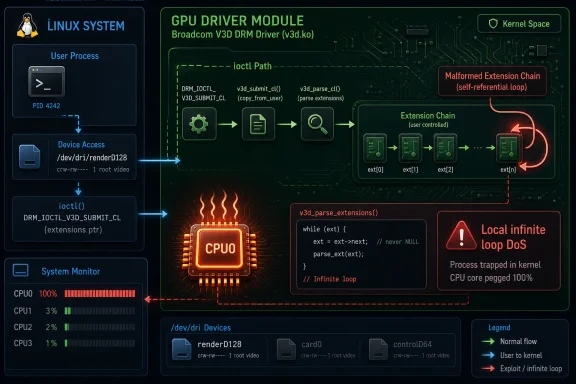
The mechanics of CVE-2026-46314 are almost comically simple. The affected code walks a userspace-provided singly linked list of ioctl extensions without a hard bound on the chain length. If userspace supplies an extension whose
Normally, duplicate-extension handling should stop this sort of thing. In this case, the duplicate guard depends on synchronization counters being nonzero. By setting both the input and output sync counts to zero, an attacker creates an empty multisync extension that carries no useful synchronization information but still keeps the parser walking forever.
That is the bug in one sentence: the driver trusted a structure enough to traverse it, but did not require it to contain anything meaningful enough to justify traversal. The fix rejects an empty multisync extension by returning
But kernel-context infinite loops are not ordinary application hangs. A userspace process stuck in a bad loop can usually be killed, throttled, isolated, or restarted. A kernel path that can be made to spin indefinitely changes the operational texture of the problem because the caller is trapped inside privileged code, consuming CPU and potentially resisting the usual administrative cleanup path.
The CVE description says the result is an infinite loop in kernel context, blocking the calling thread and pegging a CPU core indefinitely. That is a precise, practical impact. On a single-board computer, kiosk device, or resource-constrained system, one pinned core may be enough to make the machine sluggish or unresponsive. On a multi-user Linux workstation, it can become a nuisance attack. On a shared lab or education fleet, it is the sort of bug a bored user can turn into a help-desk pattern.
The requirement for local access matters, but local access is not the same thing as trusted access. Universities, makerspaces, embedded-device vendors, CI systems, developer desktops, and remote shell environments all routinely grant local execution to users or workloads that should not be able to degrade the kernel at will. In a perfect world, every local account is trusted. In the world administrators actually inhabit, local execution is often a boundary with consequences.
This is where CVE scoring can obscure more than it explains. At the time of publication, NVD had not yet assigned a CVSS score for the record, while third-party vulnerability databases were already beginning to classify it. That gap is not unusual in 2026’s vulnerability pipeline, but it reinforces a point: administrators should not wait for a single number to decide whether a kernel bug matters to their environment.
That kind of patch is easy to underestimate because it does not come with exploit drama. There is no glamorous memory corruption primitive, no heap grooming, no public proof-of-concept splashed across GitHub in the advisory text. But validation bugs are the daily work of kernel security. They are where trust boundaries meet messy userspace inputs.
The more interesting detail is that the prior duplicate-extension guard was not absent; it was incomplete. It rejected a repeated multisync extension only when either the input or output sync count had already been populated. When both counts were zero, the helper that would have set them returned immediately, leaving the same zero state on each pass through the loop.
That creates a classic security lesson: a guard that depends on side effects can be bypassed when the side effect does not occur. The code did not simply forget to check for duplicates. It checked in a way that assumed useful work had happened earlier. An empty object broke the assumption.
The new behavior is also a useful example of negative capability in secure API design. Not every syntactically valid structure should be semantically accepted. An extension that exists only to keep a linked list alive is not harmless just because it contains no payload. Sometimes “empty” is itself the malicious input.
The V3D driver is not the sprawling proprietary Windows graphics stack that usually attracts attention after a Patch Tuesday advisory. It is an open Linux DRM driver for Broadcom GPU hardware, familiar to many through Raspberry Pi and related ARM systems. That makes this CVE especially relevant outside the conventional server-room picture of Linux.
The modern GPU path is full of ioctls, buffer objects, synchronization primitives, scheduler interactions, and userspace-controlled command submission. That is a large attack surface. It is also an attack surface that often sits below the level of application monitoring, endpoint tooling, and ordinary process supervision.
Administrators who patch browsers and remote-access daemons promptly may not think about the GPU driver in a headless-looking appliance. Developers who use Linux boards for prototyping may not think of local GPU access as a security boundary. Security teams reviewing container workloads may focus on network exposure while missing device nodes that expose kernel driver interfaces to untrusted code.
CVE-2026-46314 is not proof that every GPU stack is fragile. It is proof that graphics drivers should not be treated as ornamental. Once a driver accepts structured input from userspace and runs parser logic in kernel context, it becomes part of the system’s security perimeter.
CVE-2026-46314 is unlikely to affect Windows Subsystem for Linux directly in the way a native Windows kernel vulnerability would. WSL does not simply expose arbitrary Linux kernel graphics drivers from a Raspberry Pi-class system inside a Windows kernel. But that does not make the CVE irrelevant to Windows shops. It matters because many Windows administrators now own the surrounding Linux estate, whether the org chart admits it or not.
A corporate environment might have Windows endpoints, Linux build agents, Raspberry Pi signage controllers, Ubuntu developer boxes, Debian-based lab equipment, and cloud-hosted Linux VMs under the same patch-management umbrella. A vulnerability like this forces asset owners to answer a practical question: where do we run kernels that include the V3D driver, and who is responsible for updating them?
That question is more difficult than it should be. Kernel vulnerabilities often propagate through distributions at different speeds, and embedded vendors may backport fixes without changing the version number in a way that looks obvious to inventory tooling. An NVD entry may name the upstream kernel issue, but the operational fix may arrive as a distro kernel update, a vendor firmware refresh, or a stable-branch backport.
This is where Windows administrators have an advantage if they bring Patch Tuesday discipline to Linux rather than assuming Linux is someone else’s artisanal garden. The right response is not panic. It is inventory, exposure mapping, patch tracking, and a realistic understanding of which users can execute code on which machines.
NVD enrichment delays and gaps have become a fact of life for vulnerability management. Even when NVD is functioning as designed, its role is not to be an oracle of local operational risk. CVSS is useful for normalization, but it is necessarily generic. It cannot know that a supposedly minor local DoS affects the kiosk fleet that runs your visitor check-in system, or the lab machines students can log into during finals week, or the embedded board controlling a production display.
The lack of a score also exposes a weakness in compliance-driven patching. If your process says “patch criticals and highs first,” what happens to a fresh CVE with no score? If your scanner depends on CPE matching that has not yet been enriched, what happens to a kernel bug whose affected range must be inferred from upstream commits and downstream backports? If your risk register treats “N/A” as “not applicable,” you have built a blind spot.
For this particular flaw, the absence of a score should push teams toward contextual triage. Is V3D present? Is the system multi-user? Are untrusted users or workloads able to reach the relevant DRM device? Is the machine resource-constrained? Is it part of a fleet where a trivial local hang would cause visible disruption? Those answers matter more than the eventual decimal.
This does not mean every unscored Linux CVE deserves emergency treatment. It means the first response to an unscored kernel CVE should be analysis, not dismissal. The scoreboard is late; the bug is already described.
On a single-user desktop, the logged-in user may already have access to render nodes. On a shared system, that access may be narrower. In a containerized environment, device exposure may be explicit. In an embedded product, the vendor may have made assumptions about which processes can reach the GPU path, sometimes for performance reasons rather than security reasons.
This is why local kernel bugs are so environment-sensitive. The same CVE can be almost irrelevant on one hardened server and annoyingly exploitable on a classroom workstation. It can be unreachable in a default container but exposed in a media-processing container granted GPU devices for acceleration. It can be theoretical on x86 enterprise desktops but very real on ARM devices with Broadcom graphics.
The practical defense is layered. Patch the kernel when updates are available. Restrict local users where feasible. Audit device-node exposure. Avoid passing GPU devices into containers casually. Treat kiosk and lab users as untrusted unless there is a specific reason not to. None of those steps is exotic, but all of them require knowing that graphics access is a meaningful privilege.
There is also a cultural lesson here. Linux device permissions are often adjusted to “make the app work,” especially in maker, lab, and embedded environments. A one-line udev rule that grants broad access to a device node may solve a deployment problem while quietly expanding the blast radius of the next driver bug. CVE-2026-46314 is a reminder that convenience permissions are still permissions.
For upstream users, the relevant fix is the commit that rejects empty multisync extensions in the V3D submit dependency path. For distribution users, the relevant fix is whatever kernel update incorporates that change into the supported branch. For embedded vendors, the relevant fix may be a vendor kernel tree that quietly absorbs the upstream patch while leaving the apparent kernel version far behind mainline.
This is where version-based vulnerability management can mislead. A device may report an older kernel version but include the backported fix. Another may report a newer-looking vendor build that lacks the specific patch. The only reliable answers come from vendor advisories, changelogs, package metadata, or direct source inspection.
Administrators should resist the urge to equate “Linux kernel version” with “vulnerability state” too mechanically. That works better for some userland packages than it does for heavily backported kernels. Enterprise distributions, in particular, often carry security fixes without rebasing to a newer upstream kernel.
For Windows-centric teams newly responsible for Linux fleets, this can feel like a regression from the relative clarity of Microsoft KBs. It is not necessarily worse, but it is different. The patch boundary is not always a version number. Sometimes it is a specific commit’s presence in a specific downstream tree.
Grounded does not mean trivial. Availability bugs are often underweighted because they lack the drama of compromise. But availability is a security property, and local users who can degrade a system indefinitely can create real costs. A denial of service that can be reproduced cheaply is especially irritating in environments where users are semi-trusted but not benevolent.
Think of shared Linux desktops in a lab, digital signage controllers in a public area, unattended kiosks, classroom devices, or developer machines used for demos and CI tasks. A local account, misbehaving workload, or sandbox escape that reaches the driver path could turn one obscure GPU ioctl into a persistent support incident. That is not a nation-state scenario. It is ordinary operational entropy with a CVE number attached.
For cloud and enterprise server teams, the relevance depends heavily on hardware and device exposure. Many conventional Linux servers will not use the V3D driver at all. Many virtual machines will not expose it. But ARM-based systems, Raspberry Pi-derived deployments, and specialized appliances deserve closer attention.
The most responsible reading is neither alarmist nor complacent. This is a bounded local denial-of-service vulnerability in a specific Linux graphics driver. If you do not run the affected driver or expose the relevant device interface, it is not your emergency. If you do, the fix is small enough and the failure mode annoying enough that patching should be routine rather than deferred.
This pattern appears across software systems because linked structures are easy to reason about when all participants are honest. A singly linked list is simple: each node points to the next, and eventually the list ends. But when the list comes from an adversary, every property becomes suspect. The next pointer may point backward, sideways, to itself, or to an object crafted to preserve the illusion of progress.
Robust parsers defend against this in several ways. They impose maximum depth. They track visited elements. They reject semantically empty objects. They validate that each step changes state in an expected direction. They fail closed when the structure does not make sense.
The V3D fix chooses the semantically empty-object route for this particular case. Since a multisync extension with zero input syncs and zero output syncs carries no synchronization information, there is no legitimate reason to accept it. That closes the self-referential loop described in the CVE without necessarily redesigning the entire extension-walking mechanism.
There is an argument that bounded chain traversal would be a more general defense, and the public patch discussion around this area reportedly considered limiting extension-chain depth. But the accepted fix targets the malformed empty multisync condition. That distinction matters because security fixes often arrive as narrow corrections to the specific bug, not as comprehensive hardening of every adjacent pattern.
Start with obvious candidates: Raspberry Pi devices, ARM development boards, Linux kiosks, digital signage systems, education labs, maker-space machines, and any embedded product known to use Broadcom graphics. Then widen the search to Linux images maintained by engineering teams rather than central IT. Those are the assets most likely to have local users, unusual device permissions, and inconsistent patch cadence.
The second question is whether untrusted or semi-trusted code can reach the V3D DRM interface. If only a locked-down service account on an appliance can access the device, the practical risk is narrower. If any local user session can open the render node, the risk is broader. If containers are granted GPU devices, the container boundary deserves scrutiny.
The third question is how updates flow. On a standard distribution, the answer may be “install the next kernel security update.” On an embedded device, it may require vendor firmware. On a hand-built kernel, it may require pulling the stable patch and rebuilding. On an abandoned appliance, it may require compensating controls or replacement.
This is the unglamorous part of vulnerability management, but it is also where real security happens. The exploit description tells you what is possible. Your inventory tells you whether it matters.
The bigger story is that operating-system security has become less about brand boundaries and more about neglected interfaces. A Windows administrator may never touch the vulnerable line of V3D code, but they may still own the device that runs it, the user who can reach it, the dashboard that fails to score it, and the outage that follows if it is ignored. CVE-2026-46314 is a small Linux graphics-driver fix with a broad operational moral: inventory the obscure parts, patch the boring bugs, and stop assuming that local-only means consequence-free.
 A Tiny Graphics Bug Exposes a Large Assumption
The vulnerability sits in the Linux kernel’s Direct Rendering Manager subsystem, specifically the drm/v3d driver used for Broadcom’s V3D GPU hardware. That immediately narrows the affected universe. This is not a generic Linux networking bug, not an OpenSSH-style remote exposure, and not a flaw that threatens every server simply because it runs Linux.Yet the narrowness is deceptive. The kernel graphics stack is one of those areas that administrators often classify as “desktop stuff” until it appears in thin clients, kiosks, lab machines, development boards, CI runners, education fleets, IoT appliances, and container hosts with GPU access. The more Linux becomes part of Windows-adjacent operations through WSL, dual-boot systems, hypervisors, edge devices, and build farms, the less useful it is to divide vulnerabilities into “our platform” and “someone else’s platform.”
The mechanics of CVE-2026-46314 are almost comically simple. The affected code walks a userspace-provided singly linked list of ioctl extensions without a hard bound on the chain length. If userspace supplies an extension whose
next pointer points back to itself, the kernel can be persuaded to follow the same object indefinitely.Normally, duplicate-extension handling should stop this sort of thing. In this case, the duplicate guard depends on synchronization counters being nonzero. By setting both the input and output sync counts to zero, an attacker creates an empty multisync extension that carries no useful synchronization information but still keeps the parser walking forever.
That is the bug in one sentence: the driver trusted a structure enough to traverse it, but did not require it to contain anything meaningful enough to justify traversal. The fix rejects an empty multisync extension by returning
-EINVAL when both counts are zero. It is not a sweeping redesign. It is the sort of patch that looks obvious after the fact, which is also why it deserves attention.The Exploit Is Local, but the Failure Mode Is Kernel-Level
A local denial of service often gets dismissed too quickly. Security teams are trained, for good reason, to prioritize remote unauthenticated execution, privilege escalation, credential theft, and exposed internet-facing services. Compared with those, a flaw that requires local access and “only” pegs a CPU core sounds tame.But kernel-context infinite loops are not ordinary application hangs. A userspace process stuck in a bad loop can usually be killed, throttled, isolated, or restarted. A kernel path that can be made to spin indefinitely changes the operational texture of the problem because the caller is trapped inside privileged code, consuming CPU and potentially resisting the usual administrative cleanup path.
The CVE description says the result is an infinite loop in kernel context, blocking the calling thread and pegging a CPU core indefinitely. That is a precise, practical impact. On a single-board computer, kiosk device, or resource-constrained system, one pinned core may be enough to make the machine sluggish or unresponsive. On a multi-user Linux workstation, it can become a nuisance attack. On a shared lab or education fleet, it is the sort of bug a bored user can turn into a help-desk pattern.
The requirement for local access matters, but local access is not the same thing as trusted access. Universities, makerspaces, embedded-device vendors, CI systems, developer desktops, and remote shell environments all routinely grant local execution to users or workloads that should not be able to degrade the kernel at will. In a perfect world, every local account is trusted. In the world administrators actually inhabit, local execution is often a boundary with consequences.
This is where CVE scoring can obscure more than it explains. At the time of publication, NVD had not yet assigned a CVSS score for the record, while third-party vulnerability databases were already beginning to classify it. That gap is not unusual in 2026’s vulnerability pipeline, but it reinforces a point: administrators should not wait for a single number to decide whether a kernel bug matters to their environment.
The Patch Says More Than the Scoreboard
The fix for CVE-2026-46314 is conceptually modest: reject a multisync extension that declares no input syncs and no output syncs. In kernel-driver terms, that is a validation hardening change rather than a dramatic mitigation. It says, in effect, that if an extension contributes no synchronization data, the driver should refuse it instead of treating it as part of a legitimate extension chain.That kind of patch is easy to underestimate because it does not come with exploit drama. There is no glamorous memory corruption primitive, no heap grooming, no public proof-of-concept splashed across GitHub in the advisory text. But validation bugs are the daily work of kernel security. They are where trust boundaries meet messy userspace inputs.
The more interesting detail is that the prior duplicate-extension guard was not absent; it was incomplete. It rejected a repeated multisync extension only when either the input or output sync count had already been populated. When both counts were zero, the helper that would have set them returned immediately, leaving the same zero state on each pass through the loop.
That creates a classic security lesson: a guard that depends on side effects can be bypassed when the side effect does not occur. The code did not simply forget to check for duplicates. It checked in a way that assumed useful work had happened earlier. An empty object broke the assumption.
The new behavior is also a useful example of negative capability in secure API design. Not every syntactically valid structure should be semantically accepted. An extension that exists only to keep a linked list alive is not harmless just because it contains no payload. Sometimes “empty” is itself the malicious input.
GPU Drivers Have Become Part of the Attack Surface Everyone Forgets
Graphics drivers live in an awkward mental category. To gamers, they are performance software. To desktop users, they are responsible for display glitches. To kernel developers, they are complicated interfaces between untrusted userspace command streams and privileged hardware management. To security teams, they are increasingly hard to ignore.The V3D driver is not the sprawling proprietary Windows graphics stack that usually attracts attention after a Patch Tuesday advisory. It is an open Linux DRM driver for Broadcom GPU hardware, familiar to many through Raspberry Pi and related ARM systems. That makes this CVE especially relevant outside the conventional server-room picture of Linux.
The modern GPU path is full of ioctls, buffer objects, synchronization primitives, scheduler interactions, and userspace-controlled command submission. That is a large attack surface. It is also an attack surface that often sits below the level of application monitoring, endpoint tooling, and ordinary process supervision.
Administrators who patch browsers and remote-access daemons promptly may not think about the GPU driver in a headless-looking appliance. Developers who use Linux boards for prototyping may not think of local GPU access as a security boundary. Security teams reviewing container workloads may focus on network exposure while missing device nodes that expose kernel driver interfaces to untrusted code.
CVE-2026-46314 is not proof that every GPU stack is fragile. It is proof that graphics drivers should not be treated as ornamental. Once a driver accepts structured input from userspace and runs parser logic in kernel context, it becomes part of the system’s security perimeter.
This Is a Linux CVE With Windows-Relevant Consequences
For WindowsForum readers, the obvious question is why a Linux V3D bug belongs in the conversation at all. The answer is that Windows environments stopped being Windows-only years ago. The modern Microsoft ecosystem is full of Linux dependencies, from Azure images and Kubernetes clusters to developer laptops running WSL, GitHub-hosted build workflows, network appliances, and ARM boards tucked under desks doing useful but undocumented work.CVE-2026-46314 is unlikely to affect Windows Subsystem for Linux directly in the way a native Windows kernel vulnerability would. WSL does not simply expose arbitrary Linux kernel graphics drivers from a Raspberry Pi-class system inside a Windows kernel. But that does not make the CVE irrelevant to Windows shops. It matters because many Windows administrators now own the surrounding Linux estate, whether the org chart admits it or not.
A corporate environment might have Windows endpoints, Linux build agents, Raspberry Pi signage controllers, Ubuntu developer boxes, Debian-based lab equipment, and cloud-hosted Linux VMs under the same patch-management umbrella. A vulnerability like this forces asset owners to answer a practical question: where do we run kernels that include the V3D driver, and who is responsible for updating them?
That question is more difficult than it should be. Kernel vulnerabilities often propagate through distributions at different speeds, and embedded vendors may backport fixes without changing the version number in a way that looks obvious to inventory tooling. An NVD entry may name the upstream kernel issue, but the operational fix may arrive as a distro kernel update, a vendor firmware refresh, or a stable-branch backport.
This is where Windows administrators have an advantage if they bring Patch Tuesday discipline to Linux rather than assuming Linux is someone else’s artisanal garden. The right response is not panic. It is inventory, exposure mapping, patch tracking, and a realistic understanding of which users can execute code on which machines.
NVD’s Missing Score Is a Symptom, Not a Reprieve
The NVD record for CVE-2026-46314 was published on June 8, 2026, but at publication time it did not include NIST-provided CVSS 4.0, 3.x, or 2.0 scoring. That absence will tempt some scanners and dashboards to treat the issue as indeterminate or low priority. It should not.NVD enrichment delays and gaps have become a fact of life for vulnerability management. Even when NVD is functioning as designed, its role is not to be an oracle of local operational risk. CVSS is useful for normalization, but it is necessarily generic. It cannot know that a supposedly minor local DoS affects the kiosk fleet that runs your visitor check-in system, or the lab machines students can log into during finals week, or the embedded board controlling a production display.
The lack of a score also exposes a weakness in compliance-driven patching. If your process says “patch criticals and highs first,” what happens to a fresh CVE with no score? If your scanner depends on CPE matching that has not yet been enriched, what happens to a kernel bug whose affected range must be inferred from upstream commits and downstream backports? If your risk register treats “N/A” as “not applicable,” you have built a blind spot.
For this particular flaw, the absence of a score should push teams toward contextual triage. Is V3D present? Is the system multi-user? Are untrusted users or workloads able to reach the relevant DRM device? Is the machine resource-constrained? Is it part of a fleet where a trivial local hang would cause visible disruption? Those answers matter more than the eventual decimal.
This does not mean every unscored Linux CVE deserves emergency treatment. It means the first response to an unscored kernel CVE should be analysis, not dismissal. The scoreboard is late; the bug is already described.
The Attack Requires a Door, but Some Systems Leave It Open
The vulnerability depends on local interaction with the driver’s ioctl interface. That naturally raises the question of access to DRM device nodes. On typical Linux systems, direct rendering devices are exposed through/dev/dri, with permissions mediated by groups, logind sessions, udev rules, container configuration, and distribution defaults.On a single-user desktop, the logged-in user may already have access to render nodes. On a shared system, that access may be narrower. In a containerized environment, device exposure may be explicit. In an embedded product, the vendor may have made assumptions about which processes can reach the GPU path, sometimes for performance reasons rather than security reasons.
This is why local kernel bugs are so environment-sensitive. The same CVE can be almost irrelevant on one hardened server and annoyingly exploitable on a classroom workstation. It can be unreachable in a default container but exposed in a media-processing container granted GPU devices for acceleration. It can be theoretical on x86 enterprise desktops but very real on ARM devices with Broadcom graphics.
The practical defense is layered. Patch the kernel when updates are available. Restrict local users where feasible. Audit device-node exposure. Avoid passing GPU devices into containers casually. Treat kiosk and lab users as untrusted unless there is a specific reason not to. None of those steps is exotic, but all of them require knowing that graphics access is a meaningful privilege.
There is also a cultural lesson here. Linux device permissions are often adjusted to “make the app work,” especially in maker, lab, and embedded environments. A one-line udev rule that grants broad access to a device node may solve a deployment problem while quietly expanding the blast radius of the next driver bug. CVE-2026-46314 is a reminder that convenience permissions are still permissions.
Stable Kernel Fixes Are the Real Patch Boundary
The NVD entry references upstream stable commits rather than a neat product version list. That is common for Linux kernel CVEs, and it is often frustrating for administrators who want a simple affected/not-affected table. The kernel is not distributed like a single Windows cumulative update; it is integrated, backported, patched, and branded by distributions and vendors.For upstream users, the relevant fix is the commit that rejects empty multisync extensions in the V3D submit dependency path. For distribution users, the relevant fix is whatever kernel update incorporates that change into the supported branch. For embedded vendors, the relevant fix may be a vendor kernel tree that quietly absorbs the upstream patch while leaving the apparent kernel version far behind mainline.
This is where version-based vulnerability management can mislead. A device may report an older kernel version but include the backported fix. Another may report a newer-looking vendor build that lacks the specific patch. The only reliable answers come from vendor advisories, changelogs, package metadata, or direct source inspection.
Administrators should resist the urge to equate “Linux kernel version” with “vulnerability state” too mechanically. That works better for some userland packages than it does for heavily backported kernels. Enterprise distributions, in particular, often carry security fixes without rebasing to a newer upstream kernel.
For Windows-centric teams newly responsible for Linux fleets, this can feel like a regression from the relative clarity of Microsoft KBs. It is not necessarily worse, but it is different. The patch boundary is not always a version number. Sometimes it is a specific commit’s presence in a specific downstream tree.
The Real Risk Is Operational, Not Cinematic
There is no evidence from the CVE description that CVE-2026-46314 enables privilege escalation, data theft, or arbitrary code execution. The stated impact is an infinite loop in kernel context, with CPU pegging and a blocked calling thread. That should keep the threat model grounded.Grounded does not mean trivial. Availability bugs are often underweighted because they lack the drama of compromise. But availability is a security property, and local users who can degrade a system indefinitely can create real costs. A denial of service that can be reproduced cheaply is especially irritating in environments where users are semi-trusted but not benevolent.
Think of shared Linux desktops in a lab, digital signage controllers in a public area, unattended kiosks, classroom devices, or developer machines used for demos and CI tasks. A local account, misbehaving workload, or sandbox escape that reaches the driver path could turn one obscure GPU ioctl into a persistent support incident. That is not a nation-state scenario. It is ordinary operational entropy with a CVE number attached.
For cloud and enterprise server teams, the relevance depends heavily on hardware and device exposure. Many conventional Linux servers will not use the V3D driver at all. Many virtual machines will not expose it. But ARM-based systems, Raspberry Pi-derived deployments, and specialized appliances deserve closer attention.
The most responsible reading is neither alarmist nor complacent. This is a bounded local denial-of-service vulnerability in a specific Linux graphics driver. If you do not run the affected driver or expose the relevant device interface, it is not your emergency. If you do, the fix is small enough and the failure mode annoying enough that patching should be routine rather than deferred.
The Bug Belongs to a Bigger Class of Parser Failures
CVE-2026-46314 is, at heart, a parser problem. The kernel receives a structure from userspace, interprets it as a linked chain of extensions, and walks it. The attacker supplies a chain that is not really a chain. The code follows it anyway.This pattern appears across software systems because linked structures are easy to reason about when all participants are honest. A singly linked list is simple: each node points to the next, and eventually the list ends. But when the list comes from an adversary, every property becomes suspect. The next pointer may point backward, sideways, to itself, or to an object crafted to preserve the illusion of progress.
Robust parsers defend against this in several ways. They impose maximum depth. They track visited elements. They reject semantically empty objects. They validate that each step changes state in an expected direction. They fail closed when the structure does not make sense.
The V3D fix chooses the semantically empty-object route for this particular case. Since a multisync extension with zero input syncs and zero output syncs carries no synchronization information, there is no legitimate reason to accept it. That closes the self-referential loop described in the CVE without necessarily redesigning the entire extension-walking mechanism.
There is an argument that bounded chain traversal would be a more general defense, and the public patch discussion around this area reportedly considered limiting extension-chain depth. But the accepted fix targets the malformed empty multisync condition. That distinction matters because security fixes often arrive as narrow corrections to the specific bug, not as comprehensive hardening of every adjacent pattern.
For Administrators, the Useful Question Is Exposure
The first operational question is not “What is the CVSS?” but “Do we have affected systems?” For many Windows-heavy organizations, the answer may be “only in places nobody has inventoried recently.” That is precisely why small Linux kernel CVEs are worth discussing on a Windows-focused forum.Start with obvious candidates: Raspberry Pi devices, ARM development boards, Linux kiosks, digital signage systems, education labs, maker-space machines, and any embedded product known to use Broadcom graphics. Then widen the search to Linux images maintained by engineering teams rather than central IT. Those are the assets most likely to have local users, unusual device permissions, and inconsistent patch cadence.
The second question is whether untrusted or semi-trusted code can reach the V3D DRM interface. If only a locked-down service account on an appliance can access the device, the practical risk is narrower. If any local user session can open the render node, the risk is broader. If containers are granted GPU devices, the container boundary deserves scrutiny.
The third question is how updates flow. On a standard distribution, the answer may be “install the next kernel security update.” On an embedded device, it may require vendor firmware. On a hand-built kernel, it may require pulling the stable patch and rebuilding. On an abandoned appliance, it may require compensating controls or replacement.
This is the unglamorous part of vulnerability management, but it is also where real security happens. The exploit description tells you what is possible. Your inventory tells you whether it matters.
The Small Patch That Should Change a Few Habits
CVE-2026-46314 should not send anyone ripping Linux devices out of production, and it should not be inflated into a cross-platform crisis. It should, however, adjust a few habits in shops that treat kernel graphics drivers as background noise. The most important changes are practical, not philosophical.- Inventory Linux systems that use Broadcom V3D graphics, especially Raspberry Pi-class boards, kiosks, lab devices, signage controllers, and embedded appliances.
- Track distribution and vendor kernel updates for the V3D driver fix rather than relying only on the upstream kernel version string.
- Review which local users, services, containers, or desktop sessions can access
/dev/dridevices on systems where the driver is present. - Treat unscored NVD entries as pending triage items, not as automatically low-risk findings.
- Avoid granting broad GPU device access to containers or service accounts unless the workload genuinely requires it.
- Document ownership for small Linux devices in Windows-heavy environments, because the patch that nobody owns is the patch that never lands.
The bigger story is that operating-system security has become less about brand boundaries and more about neglected interfaces. A Windows administrator may never touch the vulnerable line of V3D code, but they may still own the device that runs it, the user who can reach it, the dashboard that fails to score it, and the outage that follows if it is ignored. CVE-2026-46314 is a small Linux graphics-driver fix with a broad operational moral: inventory the obscure parts, patch the boring bugs, and stop assuming that local-only means consequence-free.
References
- Primary source: NVD / Linux Kernel
Published: 2026-06-10T01:04:40-07:00
NVD - CVE-2026-46314
 nvd.nist.gov
- Security advisory: MSRC
Published: 2026-06-10T01:04:40-07:00
Original feed URL
Security Update Guide - Microsoft Security Response Center
 msrc.microsoft.com
- Official source: nist.gov
National Vulnerability Database
NIST maintains the National Vulnerability Database (NVD), a repository of information on software and hardware flaws that can compromise computer security. This is a key piece of the nation’s cybersecurity infrastructure.www.nist.gov - Related coverage: korg.docs.kernel.org
- Related coverage: labs.cloudsecurityalliance.org
NVD Enrichment Triage: Enterprise Vulnerability Programs Must Adapt
PDF documentlabs.cloudsecurityalliance.org
