

CVE-2026-46049 is a newly published Linux kernel vulnerability from kernel.org, disclosed by NVD on May 27, 2026, affecting the ALSA ctxfi driver’s S/PDIF passthrough path for Creative Sound Blaster X-Fi–class PCI audio hardware. The bug is not a remote-code-execution scare story, and it is not a Windows vulnerability. It is a reminder that old hardware support, real-time media paths, and kernel security classification now collide in places most users never think to audit. For WindowsForum readers, the lesson is less “panic about S/PDIF” than “legacy drivers still shape the reliability and risk profile of modern machines.”
The vulnerability description is almost comically narrow: a function named
That is the sort of bug that, in a user-space media player, would usually be filed as a hang. In the kernel, it becomes more interesting. An infinite loop inside a driver can tie up CPU time, degrade responsiveness, and in the wrong context contribute to denial-of-service behavior. The Linux CVE process has increasingly treated these “resolved in kernel” defects as security-relevant even when exploitation is local, hardware-specific, or more reliability-driven than intrusion-driven.
The fix itself is tiny. Instead of blindly using
This is the kernel at its most revealing. The patch is only a couple of lines, but those lines sit at the boundary between a user’s audio configuration and the operating system’s privileged execution core. A value that should never have been zero becomes zero, and a loop that should terminate no longer does.
That would be a mistake. Old PC hardware has a habit of living far longer in enthusiast rigs, lab benches, home theater PCs, retro gaming systems, audio workstations, and industrial-adjacent setups than platform vendors expect. Linux, unlike Windows, often keeps this hardware viable long after official vendor utilities and driver packages have fossilized.
The Windows angle here is indirect but real. Many WindowsForum readers run dual-boot systems, Proxmox hosts, Linux media boxes, Steam machines, or recovery environments alongside Windows desktops. A Creative X-Fi card might be irrelevant to a modern Windows 11 laptop, but it can still be present in a tower under someone’s desk, a rackmount workstation, or a garage-built media server feeding digital audio to a receiver.
That matters because security exposure is not only about the newest device in the room. It is about the oldest device that still has kernel privileges.
Most driver bugs have this flavor. Hardware has registers, clocks, buffers, routing tables, and side effects. The driver has structures, cached state, assumptions, and shortcuts. When those two views diverge, the result can be silence, distortion, a crash, a data leak, or, as here, a loop that never exits.
S/PDIF passthrough makes the failure more specific. Passthrough is not ordinary PCM mixing; it is a mode where encoded audio data is carried over a digital link for an external receiver or decoder. That path tends to be less exercised than default stereo playback, and it often contains hardware-specific resource management. The bug appears only when the setup path takes a route that avoids refreshing the PLL rate, leaving the calculation to multiply against zero.
The important phrase in the vulnerability text is “spin indefinitely.” A spin is not a graceful failure. It is not a clean error code back to the application. It is the driver continuing to execute in a way that can monopolize resources and make the system feel wedged.
This is now common for Linux kernel CVEs. The vulnerability record often begins with the upstream commit text, stable backport references, and a sparse description of the resolved condition. Severity assessment follows later, sometimes with a score that feels too high for administrators who see a niche local hang, or too low for defenders who view any kernel-triggered denial of service as material.
For IT teams, the practical response should not wait for a number. CVSS is useful for triage at scale, but the first questions are simpler. Do you run Linux systems with the
If the answer is no, this CVE is informational. If the answer is yes, it belongs in the routine kernel-update queue rather than the emergency bridge.
This is particularly true on multi-user systems. A desktop owner triggering a broken audio path is an annoyance. A shared workstation, lab machine, kiosk, or remote Linux desktop where one user can degrade the machine for others is a different story. The same bug can be operational trivia in one environment and a policy violation in another.
The Linux kernel’s broad hardware support magnifies the problem. Every old PCI sound card, obscure capture device, DVB tuner, RAID controller, USB gadget, and embedded bus driver extends the amount of privileged code that distributions may ship. That hardware support is one of Linux’s strengths, but it also means the attack surface is not limited to the devices that appear in cloud threat models.
Windows has moved in the opposite direction in many areas, cutting off older hardware through driver signing, platform requirements, and compatibility gates. That creates its own frustrations. But it also reduces some classes of legacy driver exposure on mainstream consumer systems. Linux keeps more doors open, and every open door needs maintenance.
The stable commit trail also tells us something about the bug’s perceived importance. This was not treated as a speculative cleanup suitable only for future development. It was backported because the defective logic exists in supported kernel branches and the fix is small, targeted, and low-risk.
That last point is important. Kernel patches are never risk-free, but this one is conceptually conservative. It does not redesign the S/PDIF path. It does not introduce a new policy. It changes the source of a reference rate from “use this cached value even if it is zero” to “use the cached PLL rate if present, otherwise use the already configured default rate.”
That is the sort of patch administrators want: narrow blast radius, clear failure mode, obvious fallback.
But modern Windows environments are rarely Windows-only in practice. Enthusiasts dual-boot. Developers use Linux workstations. Small businesses run Linux appliances next to Windows clients. Home labs run hypervisors and pass through old PCIe devices. Media PCs may run Linux precisely because Windows abandoned a particular card, codec path, or receiver workflow.
The boundary also matters for incident response. If a system freezes during S/PDIF passthrough, an administrator might blame PipeWire, PulseAudio, Kodi, VLC, ALSA configuration, a receiver handshake, or a flaky sound card. CVE-2026-46049 says at least one such hang had a root cause in kernel driver state. That does not mean every S/PDIF problem is this bug, but it gives troubleshooters a sharper hypothesis.
For WindowsForum’s audience, the broader message is to inventory the non-Windows parts of the environment with the same seriousness as the Windows parts. A dual-boot machine is not two separate computers. It is one hardware platform whose risk changes depending on which kernel currently owns the devices.
The modern Linux audio stack adds another layer of perception. Many users think in terms of PipeWire because that is what their desktop exposes. Before that, they thought in PulseAudio. Before that, ALSA device names and mixer controls. But underneath those layers, the kernel driver remains the piece that touches the hardware directly.
CVE-2026-46049 is not a PipeWire bug. It is not a desktop environment bug. It is not a codec pack issue. It sits below all of that, in the driver that prepares the X-Fi card’s S/PDIF passthrough playback resources.
That layering is why audio bugs can be so maddening to diagnose. The user changes an application setting, the session server changes a route, ALSA opens a PCM device, and the kernel driver enters a hardware-specific path. By the time the system hangs, the visible trigger may be several abstractions away from the line of code that actually failed.
CVE-2026-46049 lands squarely in the operational camp. The issue is narrow, local, and hardware-dependent. It also has a clear infinite-loop condition in kernel code and a committed fix. For enterprises and public-sector shops, the CVE is the handle that lets the patch be tracked, audited, and closed.
There is a downside. CVE inflation can fatigue administrators, especially when vulnerability dashboards present a niche sound-driver bug next to a remotely exploitable network flaw. Without context, both become red rectangles demanding attention. That encourages either overreaction or, worse, blanket cynicism.
The answer is not to ignore small CVEs. It is to classify them properly. This one should be treated as a reliability-linked kernel availability bug affecting systems with a specific ALSA driver and hardware path. That is less dramatic than the CVE banner, but more useful.
That is boring in the best possible way. Kernel security is not only emergency mitigations, embargoed advisories, and exploit write-ups. It is also the accumulated discipline of fixing small correctness bugs before they become folklore in forum threads and distribution bug trackers.
The ALSA subsystem has carried PC audio across an absurd variety of hardware generations. That longevity is not free. Every hardware-specific path has to keep making sense as the rest of the kernel evolves, as audio servers change, and as users rediscover old devices in new configurations.
Creative’s X-Fi cards are a useful example because they sit at the intersection of enthusiast nostalgia and real driver complexity. They are not anonymous commodity codecs. They have DSPs, routing quirks, digital outputs, and feature sets that once justified entire retail boxes. Supporting them in 2026 means preserving code paths that most kernel users will never touch, but some users still depend on.
The affected population is smaller: Linux systems using the ALSA
Administrators should resist both extremes. Do not treat this as a fleet-wide crisis unless your fleet actually contains the hardware. Do not dismiss it as meaningless if your environment allows untrusted local users or automated workloads to exercise audio devices on affected systems.
The right response is the least glamorous one: apply distribution kernel updates, reboot into the fixed kernel, and verify that any X-Fi S/PDIF workflows still behave as expected.
 A Tiny Audio Fix Became a CVE Because the Kernel Is the Attack Surface
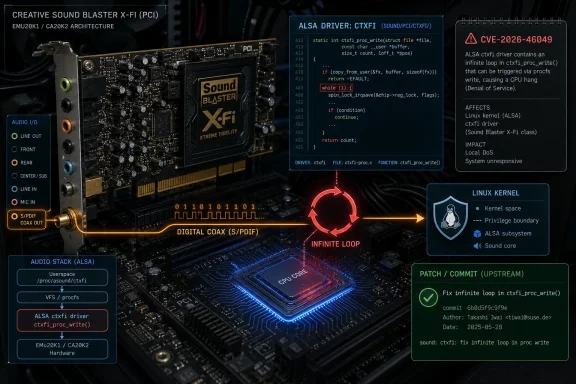
The vulnerability description is almost comically narrow: a function named spdif_passthru_playback_get_resources() uses atc->pll_rate as the reference sample rate, but that value can remain zero after initialization. In one particular S/PDIF passthrough setup path, especially around 32,000 Hz audio, the driver skips the function that would normally update the PLL rate. The result is an MSR calculation loop where the multiplier never advances the arithmetic out of zero, and the loop can spin indefinitely.That is the sort of bug that, in a user-space media player, would usually be filed as a hang. In the kernel, it becomes more interesting. An infinite loop inside a driver can tie up CPU time, degrade responsiveness, and in the wrong context contribute to denial-of-service behavior. The Linux CVE process has increasingly treated these “resolved in kernel” defects as security-relevant even when exploitation is local, hardware-specific, or more reliability-driven than intrusion-driven.
The fix itself is tiny. Instead of blindly using
atc->pll_rate, the driver now falls back to atc->rsr when pll_rate is zero. That reflects the hardware state because the card initialization path already configures the PLL to the default reference sample rate. In plain English: if the driver’s cached PLL rate is missing, use the rate the hardware was actually initialized with.This is the kernel at its most revealing. The patch is only a couple of lines, but those lines sit at the boundary between a user’s audio configuration and the operating system’s privileged execution core. A value that should never have been zero becomes zero, and a loop that should terminate no longer does.
Creative’s X-Fi Hardware Is Old, but Old Is Not the Same as Irrelevant
Thectxfi driver supports Creative’s X-Fi family, a line of PCI and PCIe sound cards that had their cultural peak in the Windows XP and Windows 7 eras. For many readers, that hardware evokes EAX, front-panel breakout boxes, coaxial digital outputs, and the long tail of “real” sound cards before motherboard audio became good enough for most people. It would be easy to dismiss the bug as archaeological.That would be a mistake. Old PC hardware has a habit of living far longer in enthusiast rigs, lab benches, home theater PCs, retro gaming systems, audio workstations, and industrial-adjacent setups than platform vendors expect. Linux, unlike Windows, often keeps this hardware viable long after official vendor utilities and driver packages have fossilized.
The Windows angle here is indirect but real. Many WindowsForum readers run dual-boot systems, Proxmox hosts, Linux media boxes, Steam machines, or recovery environments alongside Windows desktops. A Creative X-Fi card might be irrelevant to a modern Windows 11 laptop, but it can still be present in a tower under someone’s desk, a rackmount workstation, or a garage-built media server feeding digital audio to a receiver.
That matters because security exposure is not only about the newest device in the room. It is about the oldest device that still has kernel privileges.
The Bug Lives in the Gap Between Hardware State and Driver Memory
The technical heart of CVE-2026-46049 is a mismatch between what the hardware knows and what the driver remembers. The card initialization path configures the PLL to a default reference sample rate. But the software variablepll_rate is only updated in one initialization function and not another. Later, when the S/PDIF passthrough path asks for resources, it assumes that cached value is valid.Most driver bugs have this flavor. Hardware has registers, clocks, buffers, routing tables, and side effects. The driver has structures, cached state, assumptions, and shortcuts. When those two views diverge, the result can be silence, distortion, a crash, a data leak, or, as here, a loop that never exits.
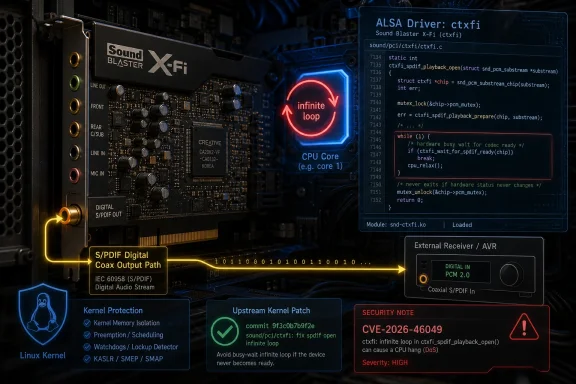
S/PDIF passthrough makes the failure more specific. Passthrough is not ordinary PCM mixing; it is a mode where encoded audio data is carried over a digital link for an external receiver or decoder. That path tends to be less exercised than default stereo playback, and it often contains hardware-specific resource management. The bug appears only when the setup path takes a route that avoids refreshing the PLL rate, leaving the calculation to multiply against zero.
The important phrase in the vulnerability text is “spin indefinitely.” A spin is not a graceful failure. It is not a clean error code back to the application. It is the driver continuing to execute in a way that can monopolize resources and make the system feel wedged.
NVD Has Not Scored It Yet, and That Is Part of the Story
As of publication, NVD lists CVE-2026-46049 as awaiting enrichment, with no CVSS 4.0, 3.x, or 2.0 score assigned by NIST. That absence should not be read as safety, nor should the CVE label be read as catastrophe. It means the public record is still catching up to the kernel fix.This is now common for Linux kernel CVEs. The vulnerability record often begins with the upstream commit text, stable backport references, and a sparse description of the resolved condition. Severity assessment follows later, sometimes with a score that feels too high for administrators who see a niche local hang, or too low for defenders who view any kernel-triggered denial of service as material.
For IT teams, the practical response should not wait for a number. CVSS is useful for triage at scale, but the first questions are simpler. Do you run Linux systems with the
ctxfi driver? Do any of them have Creative X-Fi hardware? Are they exposed to untrusted local users, remote desktop sessions, containers with audio access, or automated media workloads? Are they pinned to older kernels?If the answer is no, this CVE is informational. If the answer is yes, it belongs in the routine kernel-update queue rather than the emergency bridge.
The Security Industry Keeps Rediscovering Reliability Bugs
CVE-2026-46049 illustrates a shift that has made vulnerability feeds noisier but also more honest. A kernel hang is not always an exploit in the movie-trailer sense. There may be no shell, no stolen credential, no cross-network worm, and no dramatic payload. Yet a condition that lets a local action wedge privileged kernel code is a security concern because availability is a security property.This is particularly true on multi-user systems. A desktop owner triggering a broken audio path is an annoyance. A shared workstation, lab machine, kiosk, or remote Linux desktop where one user can degrade the machine for others is a different story. The same bug can be operational trivia in one environment and a policy violation in another.
The Linux kernel’s broad hardware support magnifies the problem. Every old PCI sound card, obscure capture device, DVB tuner, RAID controller, USB gadget, and embedded bus driver extends the amount of privileged code that distributions may ship. That hardware support is one of Linux’s strengths, but it also means the attack surface is not limited to the devices that appear in cloud threat models.
Windows has moved in the opposite direction in many areas, cutting off older hardware through driver signing, platform requirements, and compatibility gates. That creates its own frustrations. But it also reduces some classes of legacy driver exposure on mainstream consumer systems. Linux keeps more doors open, and every open door needs maintenance.
Stable Backports Are the Real Product Here
The fix for CVE-2026-46049 was not merely merged upstream; it was routed through stable kernel updates. That is the quiet machinery that matters most to administrators. Few people affected by a Creative X-Fi S/PDIF bug are compiling mainline kernels by hand. They are waiting for Debian, Ubuntu, Fedora, Arch, openSUSE, Gentoo, Proxmox, or another distribution to carry the patch into the kernel they actually boot.The stable commit trail also tells us something about the bug’s perceived importance. This was not treated as a speculative cleanup suitable only for future development. It was backported because the defective logic exists in supported kernel branches and the fix is small, targeted, and low-risk.
That last point is important. Kernel patches are never risk-free, but this one is conceptually conservative. It does not redesign the S/PDIF path. It does not introduce a new policy. It changes the source of a reference rate from “use this cached value even if it is zero” to “use the cached PLL rate if present, otherwise use the already configured default rate.”
That is the sort of patch administrators want: narrow blast radius, clear failure mode, obvious fallback.
Windows Users Should Care Only If Linux Is in Their Stack
No one should misread this as a Windows 11 threat. The vulnerable code is in the Linux kernel’s ALSA subsystem, specifically thectxfi driver. A stock Windows installation using Creative’s Windows driver stack is not affected by this CVE.But modern Windows environments are rarely Windows-only in practice. Enthusiasts dual-boot. Developers use Linux workstations. Small businesses run Linux appliances next to Windows clients. Home labs run hypervisors and pass through old PCIe devices. Media PCs may run Linux precisely because Windows abandoned a particular card, codec path, or receiver workflow.
The boundary also matters for incident response. If a system freezes during S/PDIF passthrough, an administrator might blame PipeWire, PulseAudio, Kodi, VLC, ALSA configuration, a receiver handshake, or a flaky sound card. CVE-2026-46049 says at least one such hang had a root cause in kernel driver state. That does not mean every S/PDIF problem is this bug, but it gives troubleshooters a sharper hypothesis.
For WindowsForum’s audience, the broader message is to inventory the non-Windows parts of the environment with the same seriousness as the Windows parts. A dual-boot machine is not two separate computers. It is one hardware platform whose risk changes depending on which kernel currently owns the devices.
Audio Drivers Sit Closer to the Kernel Than Their Reputation Suggests
Audio feels low-stakes because the user-visible failure mode is usually obvious: no sound, crackling, wrong output, bad sample rate, or a receiver that refuses to light up the Dolby Digital indicator. That familiarity hides the fact that audio drivers are deeply privileged and extremely stateful. They allocate DMA buffers, program clocks, manage interrupts, route signal paths, and interact with user-space servers that are themselves complex.The modern Linux audio stack adds another layer of perception. Many users think in terms of PipeWire because that is what their desktop exposes. Before that, they thought in PulseAudio. Before that, ALSA device names and mixer controls. But underneath those layers, the kernel driver remains the piece that touches the hardware directly.
CVE-2026-46049 is not a PipeWire bug. It is not a desktop environment bug. It is not a codec pack issue. It sits below all of that, in the driver that prepares the X-Fi card’s S/PDIF passthrough playback resources.
That layering is why audio bugs can be so maddening to diagnose. The user changes an application setting, the session server changes a route, ALSA opens a PCM device, and the kernel driver enters a hardware-specific path. By the time the system hangs, the visible trigger may be several abstractions away from the line of code that actually failed.
The CVE Label Is Becoming a Maintenance Signal
Security professionals have spent years arguing over whether every kernel bug should get a CVE. The purist view says a vulnerability should require a plausible security boundary violation. The operational view says a kernel defect with denial-of-service potential deserves tracking because patch systems, scanners, and compliance workflows are built around CVE identifiers.CVE-2026-46049 lands squarely in the operational camp. The issue is narrow, local, and hardware-dependent. It also has a clear infinite-loop condition in kernel code and a committed fix. For enterprises and public-sector shops, the CVE is the handle that lets the patch be tracked, audited, and closed.
There is a downside. CVE inflation can fatigue administrators, especially when vulnerability dashboards present a niche sound-driver bug next to a remotely exploitable network flaw. Without context, both become red rectangles demanding attention. That encourages either overreaction or, worse, blanket cynicism.
The answer is not to ignore small CVEs. It is to classify them properly. This one should be treated as a reliability-linked kernel availability bug affecting systems with a specific ALSA driver and hardware path. That is less dramatic than the CVE banner, but more useful.
The Patch Says More About Kernel Discipline Than Kernel Danger
The encouraging part of this story is that the fix is exactly what one would hope to see from a mature subsystem. The bug report identifies a precise initialization mismatch. The patch uses an existing state variable as the fallback. The change is minimal. It is marked for stable. Maintainers sign off and distribute it through the normal review machinery.That is boring in the best possible way. Kernel security is not only emergency mitigations, embargoed advisories, and exploit write-ups. It is also the accumulated discipline of fixing small correctness bugs before they become folklore in forum threads and distribution bug trackers.
The ALSA subsystem has carried PC audio across an absurd variety of hardware generations. That longevity is not free. Every hardware-specific path has to keep making sense as the rest of the kernel evolves, as audio servers change, and as users rediscover old devices in new configurations.
Creative’s X-Fi cards are a useful example because they sit at the intersection of enthusiast nostalgia and real driver complexity. They are not anonymous commodity codecs. They have DSPs, routing quirks, digital outputs, and feature sets that once justified entire retail boxes. Supporting them in 2026 means preserving code paths that most kernel users will never touch, but some users still depend on.
The Practical Risk Is Narrow, but the Operational Lesson Is Wide
For most readers, CVE-2026-46049 will never be exploitable because the required hardware and playback path are absent. A laptop with Intel, Realtek, AMD HDMI, or USB audio does not suddenly inherit risk from an X-Fi-specific ALSA driver. A Windows-only gaming desktop does not need a Linux kernel patch for a driver it never loads.The affected population is smaller: Linux systems using the ALSA
ctxfi driver for Creative X-Fi hardware, especially where S/PDIF passthrough is exercised. That includes hobbyist home theater PCs, older desktop towers, audio-focused Linux installations, and perhaps a few long-lived workstations whose owners sensibly kept hardware that still works.Administrators should resist both extremes. Do not treat this as a fleet-wide crisis unless your fleet actually contains the hardware. Do not dismiss it as meaningless if your environment allows untrusted local users or automated workloads to exercise audio devices on affected systems.
The right response is the least glamorous one: apply distribution kernel updates, reboot into the fixed kernel, and verify that any X-Fi S/PDIF workflows still behave as expected.
The X-Fi S/PDIF Bug Leaves a Small but Useful Checklist
The concrete action here is modest, but modest action is still action. CVE-2026-46049 is the kind of vulnerability that rewards asset awareness more than fear. If you know what hardware you have and which kernels you run, the decision is straightforward.- Systems that do not run Linux are not affected by this Linux kernel CVE.
- Linux systems without Creative X-Fi hardware using the
ctxfidriver are unlikely to be affected in practice. - Systems that rely on S/PDIF passthrough from X-Fi cards should receive the next available stable kernel update from their distribution.
- Administrators should prioritize the fix more highly on shared, kiosk, lab, or remotely accessible Linux systems where a local denial of service has operational impact.
- Troubleshooters investigating unexplained hangs during 32,000 Hz S/PDIF passthrough should consider the kernel driver path, not only PipeWire, PulseAudio, or application settings.
- Security dashboards should classify this as a narrow kernel availability issue rather than a broad compromise vector.
References
- Primary source: NVD / Linux Kernel
Published: 2026-05-28T01:03:58-07:00
NVD - CVE-2026-46049
 nvd.nist.gov
- Security advisory: MSRC
Published: 2026-05-28T01:03:58-07:00
Original feed URL
Security Update Guide - Microsoft Security Response Center
 msrc.microsoft.com
- Related coverage: codebrowser.dev

ctatc.c source code [linux/sound/pci/ctxfi/ctatc.c] - Codebrowser
Source code of linux/sound/pci/ctxfi/ctatc.c linux v6.19-r on KDAB Codebrowser
codebrowser.dev
- Related coverage: spinics.net
[PATCH v2 5/6] ALSA: ctxfi: Add support for dedicated RCA switching — Linux Kernel
Linux Kernel: [PATCH v2 5/6] ALSA: ctxfi: Add support for dedicated RCA switching www.spinics.net
- Related coverage: cve.imfht.com
CVE-2026-23318: ALSA: usb-audio: Use correct version for UAC3 header validation - Vulnerability Platform
[中危] Overview There is a logic error in the driver of the ALSA subsystem in the Linux kernel. In the validator table entry for the UAC3 (USB Audio Class 3) cve.imfht.com
- Related coverage: git.ti.com
ctatc.c « ctxfi « pci « sound - processor-sdk/processor-sdk-linux - Project for various Processor-SDK related git repositories - Linux kernel staging tree for processor-sdk.
Texas Instruments Git Open Source Repositoriesgit.ti.com
- Related coverage: kernel.googlesource.com
Attachments
Last edited:
