

CVE-2026-53245 is a newly published Linux kernel vulnerability, added to NVD on June 25, 2026, in the Multiple Registration Protocol parser under net/802/mrp.c, where malformed vector attributes can make the kernel misread MRP events and corrupt subsequent packet parsing. The bug is not the kind of headline-grabbing remote-code-execution flaw that empties patch windows overnight. It is more interesting, and arguably more useful to understand, because it sits in the quiet machinery of Layer 2 networking where correctness is security. For WindowsForum readers running Linux in routers, bridges, hypervisors, appliances, WSL-adjacent lab stacks, or mixed enterprise networks, this is a reminder that kernel CVEs often matter less because of their branding than because of where the affected code is reachable.
The core of CVE-2026-53245 is almost comically small: an event counter in
That makes this a classic parser bug: not a cryptographic failure, not a permissions model collapse, but a mismatch between a protocol’s compact encoding and the code that walks through it. The kernel’s MRP code is supposed to interpret a highly structured PDU; instead, under certain length combinations, it can apply an event that was never actually present. The result described in the CVE is a spurious event reaching the MRP applicant state machine.
The second flaw is just as revealing. When
The third flaw is the one that makes the bug feel less like an off-by-one and more like a broken walk through a sequence. When
The fix is correspondingly surgical. Decrement the counter after the third event, skip FirstValue parsing when
That obscurity cuts both ways. On one hand, a vulnerability in MRP is unlikely to affect the average Windows laptop sitting behind a consumer NAT router. On the other hand, infrastructure code has a habit of appearing in places nobody describes as “Linux servers” during procurement: industrial gateways, embedded switches, storage networks, virtualization hosts, NAS appliances, lab routers, and network-edge boxes with a Linux kernel somewhere under the branding.
The affected file,
That is why this CVE should not be read as “everyone panic” or “nobody cares.” The right posture is narrower and more professional: determine whether Linux systems in your environment participate in Ethernet bridging or registration-protocol-heavy networks, then confirm whether your vendor kernel has absorbed the stable fix. The blast radius is likely specialized, but specialized infrastructure is exactly where uptime expectations are highest.
A CVSS score would need to answer questions the CVE text alone does not fully settle. Is the bug reachable by an adjacent network attacker sending crafted MRP frames? Does it require a host to have specific bridging features enabled? Is the practical impact limited to incorrect state transitions, or can offset corruption lead to denial of service or more severe memory-safety consequences in real configurations? The CVE description tells us the parser can consume the wrong data and corrupt parsing state, but it does not claim code execution.
That distinction matters. Security teams often treat “kernel” and “network parser” as words that automatically imply emergency severity, and sometimes they are right. But Linux kernel CVEs are now published at high volume, including many fixes that upstream maintainers reasonably classify as security-relevant without necessarily proving exploitability in the wild. Treating all of them as equal creates alert fatigue; treating all of them as academic creates exposure.
The practical reading is that CVE-2026-53245 is a correctness bug in a privileged network parser with externally supplied input. That is enough to justify patching in normal kernel update cycles, and enough to accelerate review for systems that process MRP traffic. It is not enough, based on the public record so far, to declare a broad emergency for ordinary endpoints.
Those version numbers are the operational heart of the story. Most administrators do not run “Linux” in the abstract; they run vendor kernels, long-term support kernels, hypervisor kernels, cloud kernels, container-host kernels, and appliance kernels. The question is not whether a commit exists upstream, but whether your distribution or vendor has backported it into the kernel you actually boot.
This is especially important because kernel version strings can mislead. A distribution may ship a kernel that appears older than an upstream fixed release while carrying the patch as a backport. Conversely, a custom or appliance kernel may report a familiar base version while lagging on selected networking fixes. In Linux vulnerability management, the package changelog and vendor advisory often matter more than the headline upstream version.
For Windows-heavy shops, this is where the Linux island problem appears. The Linux hosts that matter most may not be in the same patching process as Windows endpoints. They may be managed by network teams, storage teams, developers, lab owners, or appliance vendors. CVE-2026-53245 is a small bug, but it touches a big organizational weakness: low-level Linux components often sit outside the clean perimeter of enterprise endpoint management.
The more network-centric the Linux role, the more interesting this CVE becomes. A Linux machine acting as a bridge is a different risk object than a Linux VM running a web app behind a virtual NIC. A router or switch-like appliance that processes Layer 2 control traffic has a different exposure profile than a server that merely sends ordinary TCP traffic. MRP is not something most users encounter directly, but it lives in the part of the stack where topology and trust boundaries can get blurry.
This is also a reminder that vulnerability scanners often flatten nuance. A scanner may report CVE-2026-53245 on every Linux kernel package in sight, whether or not the affected code is reachable. Another scanner may miss the practical exposure entirely if it relies on package names and the system is an appliance with opaque firmware. The right answer is not to worship the scanner but to use it as the opening bid in a more grounded investigation.
For Windows administrators, the action is to coordinate rather than overreact. Ask which Linux-based network devices, hypervisors, and appliances sit on the same Layer 2 domains as sensitive systems. Ask whether their vendors have shipped kernels at or beyond the fixed stable points. Ask whether MRP is enabled, compiled, or relevant. These are boring questions, which is precisely why they prevent exciting outages.
A parser is a contract between bytes on the wire and meaning inside the kernel. Once the offset is wrong, the parser may stop interpreting the frame the sender actually produced and start interpreting a phantom structure made from adjacent bytes. Sometimes that only causes the parser to reject the packet. Sometimes it mutates state. Sometimes, in less lucky code paths, it creates memory-safety trouble.
The public CVE description does not say that CVE-2026-53245 causes memory corruption in the classic exploit-development sense. It describes logical corruption of parsing position and state interpretation. That distinction should be preserved, because exaggerating every parser bug into a remote kernel takeover makes defenders worse at prioritizing real emergencies.
Still, the offset bug is why this CVE should not be dismissed as bookkeeping. In network protocols, where you are in the packet is as important as what byte you are reading. If an attacker can influence the shape of the PDU and force the parser to advance incorrectly, the downstream behavior becomes dependent on code paths that may not have been designed for that malformed sequence.
There is a tendency to complain that this produces too many CVEs. That complaint is not entirely wrong; vulnerability-management systems built around quarterly patch triage and severity buckets strain under the pace of kernel disclosures. But the alternative is worse: silently fixing bugs in privileged protocol parsers without making downstream consumers aware that a security-relevant flaw existed.
CVE-2026-53245 is a case where the CVE record is both precise and incomplete. It precisely identifies the file, function, parsing mistakes, and stable fixes. It does not yet provide a scored severity, exploitability assessment, or broad ecosystem impact statement. That is not a failure so much as a division of labor. The kernel community supplies the fix; vendors package it; administrators decide exposure.
For enterprise teams, the lesson is to stop waiting for every kernel CVE to arrive as a fully formed risk memo. The public data now often looks like this: a commit trail, affected version ranges, and a compact technical description. Mature programs will learn to convert that into environment-specific risk quickly.
That makes topology the missing dimension in many patch programs. Version inventory tells you whether software is affected in principle. Network role tells you whether an attacker can plausibly deliver the input that exercises the bug. Kernel configuration tells you whether the code exists in the running system. Runtime state tells you whether the relevant interface and protocol handling are active.
The frustrating part is that no single tool usually answers all of those questions. Asset management knows hostnames. Network diagrams know links. Vulnerability scanners know package versions. Kernel configs know built-in and module options. Operations teams know what is actually carrying production traffic. CVE-2026-53245 sits at the intersection of all four.
That is why the right remediation plan should be boring but deliberate. Update kernels through vendor-supported channels, especially on systems acting as bridges, routers, virtualization hosts, or network appliances. For devices where direct patching is vendor-controlled, demand firmware or kernel advisory clarity. For systems where MRP is irrelevant and the code is unreachable, document the rationale rather than pretending the CVE does not exist.
That does not mean every appliance is affected. It does mean administrators should resist the lazy assumption that “we do not run Linux” is a meaningful statement. If a device bridges Ethernet, parses control-plane traffic, or exposes advanced networking features, it may be closer to this CVE than a conventional Linux server is.
Vendors vary widely in how they communicate kernel CVEs. Some publish detailed advisories with affected models, fixed firmware, and mitigations. Others bury the kernel update in a generic maintenance release. Some never mention the CVE unless a customer opens a support case. For a bug like CVE-2026-53245, where practical exposure depends heavily on role and configuration, vendor silence is not the same as non-exposure.
The best pressure customers can apply is specific. Ask whether the product includes Linux kernel MRP support, whether
But the pattern is broad. Compact protocol encodings are easy to parse almost correctly. State machines are easy to perturb with edge cases that fall between specification and implementation. Kernel networking code is privileged, performance-sensitive, and historically full of logic that assumes packets will be at least somewhat sane. None of that makes exploitation automatic, but all of it makes correctness consequential.
The vulnerability also shows why “memory-safe rewrites” are not a complete answer to infrastructure security, even if they are part of the long-term answer. This bug is about counters, offsets, and protocol semantics. A safer language can reduce entire classes of memory corruption, but it cannot by itself guarantee that an implementation walks a variable-length network structure in the same way the standard intended.
The immediate fix is a patch. The durable fix is a culture that treats parsers as attack surfaces, even when the protocol is obscure and the code path is far from the browser, the login prompt, or the cloud API.
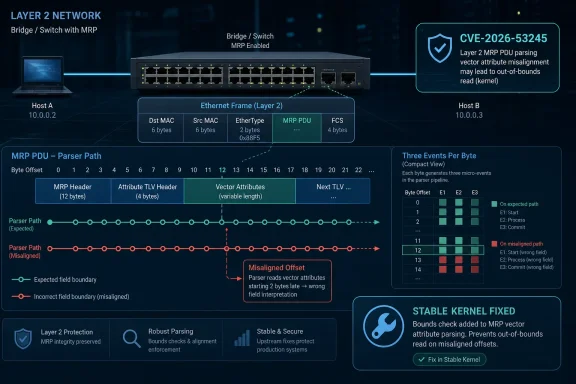 A Three-Events-Per-Byte Bug Becomes a Kernel CVE
The core of CVE-2026-53245 is almost comically small: an event counter in mrp_pdu_parse_vecattr() was decremented after the first and second events in a byte, but not after the third. In MRP vector attributes, events are packed three per byte, and the parser uses valen to track how many remain. If the number of events is exactly divisible by three, the parser can keep going one step too far and treat the next byte as another event byte.That makes this a classic parser bug: not a cryptographic failure, not a permissions model collapse, but a mismatch between a protocol’s compact encoding and the code that walks through it. The kernel’s MRP code is supposed to interpret a highly structured PDU; instead, under certain length combinations, it can apply an event that was never actually present. The result described in the CVE is a spurious event reaching the MRP applicant state machine.
The second flaw is just as revealing. When
valen is zero, the parser still consumes bytes as if a FirstValue field exists, even though the IEEE 802.1ak model allows a VectorAttribute containing only a LeaveAllEvent with no FirstValue or Vector fields. That does not merely mishandle a value; it moves the parser offset, meaning the next piece of the PDU may be read from the wrong place.The third flaw is the one that makes the bug feel less like an off-by-one and more like a broken walk through a sequence. When
valen exceeds three, the parser crosses byte boundaries but does not increment the attribute value between the last event of one byte and the first event of the next. So the first event in the next byte is associated with the wrong value, causing the state machine to reason over a shifted version of the frame.The fix is correspondingly surgical. Decrement the counter after the third event, skip FirstValue parsing when
valen is zero, and increment the attribute value at the end of each loop iteration. In kernel security, the difference between “boring cleanup” and “CVE” is often whether malformed external input can drag an internal state machine out of alignment.MRP Is Obscure Until It Is Sitting in Your Switching Path
Multiple Registration Protocol is not a household acronym, even among people who know their way around SMB, Kerberos, VLANs, and Windows Update rings. It lives lower in the stack, in the neighborhood of Ethernet bridging and registration protocols, where devices coordinate membership and attributes across a Layer 2 domain. It is the kind of code that can sit unnoticed for years because it is not part of the default mental model of desktop security.That obscurity cuts both ways. On one hand, a vulnerability in MRP is unlikely to affect the average Windows laptop sitting behind a consumer NAT router. On the other hand, infrastructure code has a habit of appearing in places nobody describes as “Linux servers” during procurement: industrial gateways, embedded switches, storage networks, virtualization hosts, NAS appliances, lab routers, and network-edge boxes with a Linux kernel somewhere under the branding.
The affected file,
net/802/mrp.c, is not a userland daemon that an administrator can easily inventory with a package query. It is kernel networking code. Whether it is compiled, loaded, reachable, or meaningfully exposed depends on distribution configuration, device role, network topology, and whether MRP traffic can arrive at the host.That is why this CVE should not be read as “everyone panic” or “nobody cares.” The right posture is narrower and more professional: determine whether Linux systems in your environment participate in Ethernet bridging or registration-protocol-heavy networks, then confirm whether your vendor kernel has absorbed the stable fix. The blast radius is likely specialized, but specialized infrastructure is exactly where uptime expectations are highest.
The Absence of a CVSS Score Is Not the Same as the Absence of Risk
As of publication in NVD, CVE-2026-53245 does not yet have NVD-provided CVSS 4.0, 3.x, or 2.0 scoring. That absence will frustrate scanners, dashboards, and vulnerability-management workflows that want a single colored number to decide urgency. But it is also a useful warning about the limits of score-first security operations.A CVSS score would need to answer questions the CVE text alone does not fully settle. Is the bug reachable by an adjacent network attacker sending crafted MRP frames? Does it require a host to have specific bridging features enabled? Is the practical impact limited to incorrect state transitions, or can offset corruption lead to denial of service or more severe memory-safety consequences in real configurations? The CVE description tells us the parser can consume the wrong data and corrupt parsing state, but it does not claim code execution.
That distinction matters. Security teams often treat “kernel” and “network parser” as words that automatically imply emergency severity, and sometimes they are right. But Linux kernel CVEs are now published at high volume, including many fixes that upstream maintainers reasonably classify as security-relevant without necessarily proving exploitability in the wild. Treating all of them as equal creates alert fatigue; treating all of them as academic creates exposure.
The practical reading is that CVE-2026-53245 is a correctness bug in a privileged network parser with externally supplied input. That is enough to justify patching in normal kernel update cycles, and enough to accelerate review for systems that process MRP traffic. It is not enough, based on the public record so far, to declare a broad emergency for ordinary endpoints.
Stable Trees Tell the Real Story Better Than the CVE Blurb
The CVE record points to multiple stable commits, which is a strong signal that the fix was propagated across maintained Linux kernel lines rather than left as a single mainline-only repair. The affected version history begins at Linux 3.9, while fixed or unaffected stable points include 5.10.259, 5.15.210, 6.1.176, 6.6.143, 6.12.94, 6.18.36, 7.0.13, and the 7.1 fix lineage.Those version numbers are the operational heart of the story. Most administrators do not run “Linux” in the abstract; they run vendor kernels, long-term support kernels, hypervisor kernels, cloud kernels, container-host kernels, and appliance kernels. The question is not whether a commit exists upstream, but whether your distribution or vendor has backported it into the kernel you actually boot.
This is especially important because kernel version strings can mislead. A distribution may ship a kernel that appears older than an upstream fixed release while carrying the patch as a backport. Conversely, a custom or appliance kernel may report a familiar base version while lagging on selected networking fixes. In Linux vulnerability management, the package changelog and vendor advisory often matter more than the headline upstream version.
For Windows-heavy shops, this is where the Linux island problem appears. The Linux hosts that matter most may not be in the same patching process as Windows endpoints. They may be managed by network teams, storage teams, developers, lab owners, or appliance vendors. CVE-2026-53245 is a small bug, but it touches a big organizational weakness: low-level Linux components often sit outside the clean perimeter of enterprise endpoint management.
This Is Not a Windows Bug, But Windows Shops Still Own the Risk
A WindowsForum audience could reasonably ask why a Linux kernel MRP parser bug belongs on its radar. The answer is that modern Windows environments are rarely Windows-only environments. Hyper-V clusters may talk to Linux storage. Windows Server estates may depend on Linux-based firewalls, monitoring taps, bridges, routers, and container hosts. Developers may run Linux kernels locally through virtualization, WSL-related workflows, or test appliances.The more network-centric the Linux role, the more interesting this CVE becomes. A Linux machine acting as a bridge is a different risk object than a Linux VM running a web app behind a virtual NIC. A router or switch-like appliance that processes Layer 2 control traffic has a different exposure profile than a server that merely sends ordinary TCP traffic. MRP is not something most users encounter directly, but it lives in the part of the stack where topology and trust boundaries can get blurry.
This is also a reminder that vulnerability scanners often flatten nuance. A scanner may report CVE-2026-53245 on every Linux kernel package in sight, whether or not the affected code is reachable. Another scanner may miss the practical exposure entirely if it relies on package names and the system is an appliance with opaque firmware. The right answer is not to worship the scanner but to use it as the opening bid in a more grounded investigation.
For Windows administrators, the action is to coordinate rather than overreact. Ask which Linux-based network devices, hypervisors, and appliances sit on the same Layer 2 domains as sensitive systems. Ask whether their vendors have shipped kernels at or beyond the fixed stable points. Ask whether MRP is enabled, compiled, or relevant. These are boring questions, which is precisely why they prevent exciting outages.
The Parser Offset Is the Part Security Teams Should Watch
The most technically important phrase in the CVE text is not “spurious event,” though that matters. It is the claim that consuming FirstValue whenvalen is zero “corrupts the offset for subsequent PDU parsing.” Parser offset corruption is where minor-looking protocol bugs can become unpredictable.A parser is a contract between bytes on the wire and meaning inside the kernel. Once the offset is wrong, the parser may stop interpreting the frame the sender actually produced and start interpreting a phantom structure made from adjacent bytes. Sometimes that only causes the parser to reject the packet. Sometimes it mutates state. Sometimes, in less lucky code paths, it creates memory-safety trouble.
The public CVE description does not say that CVE-2026-53245 causes memory corruption in the classic exploit-development sense. It describes logical corruption of parsing position and state interpretation. That distinction should be preserved, because exaggerating every parser bug into a remote kernel takeover makes defenders worse at prioritizing real emergencies.
Still, the offset bug is why this CVE should not be dismissed as bookkeeping. In network protocols, where you are in the packet is as important as what byte you are reading. If an attacker can influence the shape of the PDU and force the parser to advance incorrectly, the downstream behavior becomes dependent on code paths that may not have been designed for that malformed sequence.
The Linux Kernel CVE Machine Is Doing What It Was Built to Do
This record also illustrates the new normal of Linux kernel vulnerability disclosure: fixes are landing, CVEs are being assigned, and NVD is ingesting records even when enrichment is incomplete. That means defenders are seeing more kernel CVEs with sparse scoring, terse descriptions, and commit-oriented remediation details. The pipeline is faster and more transparent, but it shifts more interpretation work onto administrators.There is a tendency to complain that this produces too many CVEs. That complaint is not entirely wrong; vulnerability-management systems built around quarterly patch triage and severity buckets strain under the pace of kernel disclosures. But the alternative is worse: silently fixing bugs in privileged protocol parsers without making downstream consumers aware that a security-relevant flaw existed.
CVE-2026-53245 is a case where the CVE record is both precise and incomplete. It precisely identifies the file, function, parsing mistakes, and stable fixes. It does not yet provide a scored severity, exploitability assessment, or broad ecosystem impact statement. That is not a failure so much as a division of labor. The kernel community supplies the fix; vendors package it; administrators decide exposure.
For enterprise teams, the lesson is to stop waiting for every kernel CVE to arrive as a fully formed risk memo. The public data now often looks like this: a commit trail, affected version ranges, and a compact technical description. Mature programs will learn to convert that into environment-specific risk quickly.
Patch Management Needs to Think in Topology, Not Just Version Strings
The systems most likely to care about CVE-2026-53245 are not necessarily the systems with the most users. They are the systems in positions to process relevant Layer 2 traffic. A lightly used Linux bridge in a lab may be more exposed than a heavily used Linux application server in a segmented cloud subnet. A storage or virtualization appliance may be more relevant than a fleet of developer laptops.That makes topology the missing dimension in many patch programs. Version inventory tells you whether software is affected in principle. Network role tells you whether an attacker can plausibly deliver the input that exercises the bug. Kernel configuration tells you whether the code exists in the running system. Runtime state tells you whether the relevant interface and protocol handling are active.
The frustrating part is that no single tool usually answers all of those questions. Asset management knows hostnames. Network diagrams know links. Vulnerability scanners know package versions. Kernel configs know built-in and module options. Operations teams know what is actually carrying production traffic. CVE-2026-53245 sits at the intersection of all four.
That is why the right remediation plan should be boring but deliberate. Update kernels through vendor-supported channels, especially on systems acting as bridges, routers, virtualization hosts, or network appliances. For devices where direct patching is vendor-controlled, demand firmware or kernel advisory clarity. For systems where MRP is irrelevant and the code is unreachable, document the rationale rather than pretending the CVE does not exist.
Appliance Vendors Will Be the Slowest Link
The hardest part of kernel CVEs like this is not patching a mainstream Linux distribution. It is finding the kernel inside the box you bought to avoid managing Linux in the first place. Network appliances, security gateways, industrial controllers, NAS devices, hyperconverged systems, and monitoring probes may all contain kernels whose security posture depends on a vendor release train.That does not mean every appliance is affected. It does mean administrators should resist the lazy assumption that “we do not run Linux” is a meaningful statement. If a device bridges Ethernet, parses control-plane traffic, or exposes advanced networking features, it may be closer to this CVE than a conventional Linux server is.
Vendors vary widely in how they communicate kernel CVEs. Some publish detailed advisories with affected models, fixed firmware, and mitigations. Others bury the kernel update in a generic maintenance release. Some never mention the CVE unless a customer opens a support case. For a bug like CVE-2026-53245, where practical exposure depends heavily on role and configuration, vendor silence is not the same as non-exposure.
The best pressure customers can apply is specific. Ask whether the product includes Linux kernel MRP support, whether
net/802/mrp.c is present in the shipped kernel, whether the stable fix has been backported, and which firmware version contains it. Those questions are harder for support to wave away than “Are you affected by this CVE?”The Risk Is Narrow, But the Pattern Is Broad
CVE-2026-53245 is not likely to become a household vulnerability name. It has no catchy logo, no published exploit in the public record, and no NVD severity score at the time of writing. Its affected component is a specialized kernel networking parser rather than a ubiquitous user-facing service.But the pattern is broad. Compact protocol encodings are easy to parse almost correctly. State machines are easy to perturb with edge cases that fall between specification and implementation. Kernel networking code is privileged, performance-sensitive, and historically full of logic that assumes packets will be at least somewhat sane. None of that makes exploitation automatic, but all of it makes correctness consequential.
The vulnerability also shows why “memory-safe rewrites” are not a complete answer to infrastructure security, even if they are part of the long-term answer. This bug is about counters, offsets, and protocol semantics. A safer language can reduce entire classes of memory corruption, but it cannot by itself guarantee that an implementation walks a variable-length network structure in the same way the standard intended.
The immediate fix is a patch. The durable fix is a culture that treats parsers as attack surfaces, even when the protocol is obscure and the code path is far from the browser, the login prompt, or the cloud API.
The MRP Bug’s Practical Lessons Fit on One Maintenance Window
For most organizations, CVE-2026-53245 should land as a targeted kernel-maintenance item rather than an all-hands incident. The value is in identifying the Linux systems that actually process relevant Layer 2 traffic and making sure their vendor kernels have absorbed the stable fix.- CVE-2026-53245 affects Linux kernel MRP parsing in
net/802/mrp.c, specifically the handling of vector attributes inmrp_pdu_parse_vecattr(). - The public record says NVD received and published the CVE on June 25, 2026, with no NVD CVSS score assigned at the time of publication.
- The bug can cause the parser to process a spurious event, consume fields that should not exist when
valenis zero, and associate events with the wrong attribute value across byte boundaries. - The fixed stable kernel points include 5.10.259, 5.15.210, 6.1.176, 6.6.143, 6.12.94, 6.18.36, 7.0.13, and the 7.1 fix lineage, though vendor backports may change how this appears on production systems.
- The highest-priority review belongs to Linux-based bridges, routers, network appliances, virtualization hosts, and other systems that may process MRP or adjacent Layer 2 control traffic.
- Ordinary Windows endpoints are not directly affected, but Windows-centric environments may still depend on Linux infrastructure that is.
References
- Primary source: NVD / Linux Kernel
Published: 2026-06-28T01:45:13-07:00
NVD - CVE-2026-53245
 nvd.nist.gov
- Security advisory: MSRC
Published: 2026-06-28T01:45:13-07:00
Original feed URL
Security Update Guide - Microsoft Security Response Center
 msrc.microsoft.com
- Related coverage: kernel.googlesource.com
- Related coverage: support.bull.com
- Related coverage: kernel.org
