

CVE-2026-53269 is a medium-severity Linux kernel netfilter SYNPROXY vulnerability in
Immediate remediation block:
For WindowsForum readers, the useful angle is operational ownership. Many Windows-focused teams also own Linux-based firewall nodes, lab servers, edge appliances, storage devices, development VMs, or cloud systems that support Windows services. If one of those systems uses netfilter SYNPROXY and falls below the fixed threshold for its kernel line, the remediation belongs in the same availability-focused patch workflow as other infrastructure fixes.
NVD’s CVSS vector is the right starting point because it limits the claim. The attack vector is local. Attack complexity is low. Low privileges are required. No user interaction is required. Scope is unchanged. Confidentiality and integrity are listed as not impacted. Availability is listed as high impact.
That combination argues against both hype and dismissal. The public record supports an availability concern in a Linux kernel firewall subsystem. It does not support claims of remote compromise, data theft, broad packet-triggered exploitation, or compromise of unrelated firewall products.
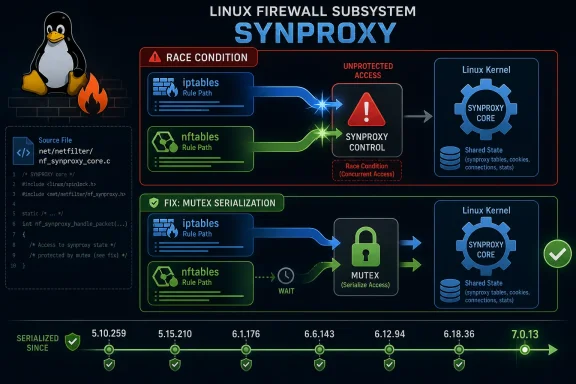
The kernel.org-sourced description carried by NVD says the SYNPROXY infrastructure registers netfilter hooks on demand when a user adds the first iptables target or nftables expression. If those actions occur concurrently, the two frontends can race each other. The fix is to introduce a mutex that serializes access to the reference-count control blocks from both frontends.
In plainer English, two setup paths can reach the same kernel bookkeeping at the same time. The vulnerable area is the shared lifecycle logic around SYNPROXY hook registration. The fix makes that shared update path single-file instead of concurrent.
That specificity matters. The issue is not described as nftables being generally unsafe, iptables being inherently dangerous, or SYNPROXY packet handling being fundamentally broken. The described bug is a race in shared control logic when the iptables and nftables paths both interact with SYNPROXY infrastructure.
The CVSS vector says the modeled access vector is local, and the description points to configuration-time hook registration rather than ordinary packet processing alone. Administrators should therefore focus on three questions:
Review automation only when it can actually modify the affected path. A generic tool is not relevant merely because it is network-adjacent. The concrete condition to look for is SYNPROXY setup through iptables targets, nftables expressions, or both, especially when rule generation can overlap during startup, deployment, reload, or maintenance.
The vulnerable state is in shared reference-count control. Reference counting is lifecycle bookkeeping: when the first user arrives, the kernel may need to register infrastructure; when the last user leaves, it may need to unregister it. If two setup paths update that bookkeeping at the same time without sufficient serialization, the state can become inconsistent.
The fix confirms the nature of the bug. The description does not say the patch validates a packet header, tightens a permission check, or rewrites SYNPROXY behavior. It says the fix serializes access to reference-count control blocks from both frontends by adding a mutex.
That is the operational takeaway: the affected code is shared setup and lifecycle management for SYNPROXY, not every use of netfilter and not every system that happens to have iptables or nftables installed.
The important word is “before.” A system running an upstream kernel earlier than the fixed threshold for its line falls on the affected side of the upstream matrix. A system at or beyond the fixed threshold for that line falls on the unaffected side, assuming the running build contains the upstream fixed code.
Vendor validation is still required. A distribution may publish a fixed package version, errata entry, changelog note, or security advisory rather than moving to the exact upstream release number. An appliance vendor may ship the fix inside a firmware update. A custom kernel maintainer may need to verify the patch directly in source.
For custom kernels, the file path gives a concrete review target:
That profile belongs in a normal patch queue with appropriate priority. It does not justify emergency language for systems that do not use SYNPROXY and do not expose relevant rule-management paths. It also should not be ignored on systems where firewall reliability matters and local or delegated rule changes are possible.
The “no user interaction” component means the modeled path does not require persuading an administrator to click or open something. The “high availability” component means the modeled impact is disruption. The unchanged scope component means the impact remains within the same security authority.
NVD lists the weakness as
First, identify systems where SYNPROXY is configured. Do not stop at package presence. A system can have iptables and nftables tools installed without using SYNPROXY. What matters is whether SYNPROXY rules or expressions are actually part of the firewall setup.
Second, identify whether both frontends are involved. A host that uses only one clearly controlled path is easier to reason about than one where older iptables scripts and newer nftables rules coexist. The CVE description specifically involves concurrent addition of the first iptables target or nftables expression that triggers SYNPROXY hook registration.
Third, check who can change the rules. If only trusted administrators can modify netfilter state, the exposure picture differs from a shared system where service accounts, delegated operators, development scripts, or untrusted local users can influence firewall configuration.
Fourth, verify the fix through the correct channel. For distribution kernels, use the distribution advisory or package changelog. For appliances, use the vendor firmware advisory. For custom builds, inspect the source tree and confirm that the mutex-based fix is present in
This is also where Windows-centric teams should be precise. A Linux VM supporting a Windows lab, a Linux firewall in front of a Windows service, or a NAS appliance used by Windows clients can matter to Windows operations if it uses affected SYNPROXY code. The actionable question is not “Do we have Linux somewhere?” It is “Do we have Linux systems using netfilter SYNPROXY below the fixed threshold or without a vendor-confirmed backport?”
The key is that the iptables and nftables frontends can converge on common SYNPROXY infrastructure. The bug lives in the shared lifecycle path where hooks are registered on demand. The mutex prevents both frontends from manipulating the relevant control blocks concurrently.
That does not mean administrators should abandon SYNPROXY. It does not mean nftables should be avoided. It does not mean iptables usage alone is a vulnerability. It means systems that use SYNPROXY through these frontends need the kernel fix.
The description also notes that a per-namespace mutex might be more efficient but is not needed for target/expression use like SYNPROXY. For operators, the practical conclusion is simple: this is a targeted synchronization fix for setup-time lifecycle control.
The record includes the CVSS v3.1 score of 5.5 MEDIUM, the vector
The kernel.org-sourced description identifies the fix as introducing a mutex to serialize access to reference-count control blocks from both frontends.
For compliance and change records, use the dates and fixed-build information from the vendor advisory that applies to the system you actually run. Scanner metadata can help find candidates, but remediation proof should come from the package, firmware, advisory, or source tree that supplies the fixed kernel.
For custom kernel maintainers, the NVD patch references and file path are directly useful. The review target is
For appliance owners, ask a specific vendor question: does the firmware include the fix for CVE-2026-53269 in Linux
For lab and development systems, keep the response proportional. A single-user system with no SYNPROXY configuration and no untrusted local rule-management path is not the same risk as a shared firewall host. But labs often accumulate legacy firewall scripts and mixed tooling. If SYNPROXY is present, patch instead of guessing.
A system standardized on one controlled rule-management path is easier to assess. A system where older iptables scripts coexist with newer nftables rules deserves closer review. That mixed state can happen during migrations, in legacy boot scripts, or in environments where different administrators or tools manage different parts of the firewall.
The goal is not to remove every trace of one tool or the other without analysis. The goal is to identify duplicated or overlapping SYNPROXY activation paths. If nftables rules provide the intended SYNPROXY policy, an old iptables-based SYNPROXY setup script should not remain active by accident. If a product or appliance uses iptables internally, administrators should be cautious about layering separate nftables SYNPROXY expressions on top without clear ownership.
Documentation matters here. Firewall state should be treated as a controlled system: which component owns SYNPROXY policy, which tool is authoritative, when rules are loaded, and which automation is allowed to make changes. CVE-2026-53269 is a reminder that final ruleset appearance is not the only concern. Setup ordering and concurrent management can matter too.
A concrete WindowsForum audience use case is a mixed estate where a Windows team owns a Windows application but also owns the Linux firewall, reverse-proxy host, lab gateway, or storage appliance that supports it. If that Linux system uses SYNPROXY and runs an affected kernel, the availability risk can land on the same operations team that responds when Windows users lose access.
Another concrete case is a development or test environment where Windows workstations depend on a Linux gateway or VM for network segmentation, test ingress, or lab routing. If that system uses SYNPROXY rules and has mixed iptables/nftables management, it should be checked like any other affected Linux host.
The practical workflow is straightforward: do not scan every Windows endpoint for a Linux kernel CVE unless your tooling is meant to find Linux components. Instead, inventory the Linux systems and appliances that Windows services depend on, confirm SYNPROXY usage, compare kernel lines with the upstream thresholds, and validate vendor fixes.
Avoid assuming that Windows update dashboards will prove remediation for Linux appliances or guest systems. Windows Update, WSUS, Intune, or Configuration Manager may be central to Windows patching, but they may not show whether a Linux kernel inside a firewall appliance, NAS, VM, or custom image contains the SYNPROXY mutex fix.
For an upstream or custom kernel, useful proof includes the running kernel version at or beyond the fixed threshold for the relevant line, or a source-tree confirmation that
For a distribution kernel, useful proof includes the vendor advisory, fixed package version, installed package version, and post-reboot running kernel. If the vendor backported the fix without changing to the upstream threshold number, the advisory or changelog is the evidence that matters.
For an appliance, useful proof includes the firmware version and vendor statement that the build contains the fix for CVE-2026-53269. If the appliance exposes SYN flood protection, firewall acceleration, gateway filtering, or other high-level network controls, ask the vendor directly whether SYNPROXY is used and whether the Linux kernel fix is included.
For systems where no patch is immediately available, risk acceptance should be specific. Record whether SYNPROXY is configured, whether both iptables and nftables paths are used, who can modify those rules, and what compensating administrative controls are in place until the vendor provides a fixed build.
The right response is targeted maintenance. Find the systems that use SYNPROXY. Check whether iptables, nftables, or both can configure it. Compare upstream kernels against the exact fixed thresholds. Then validate the vendor package, firmware, or source tree that contains the mutex fix.
Bottom line: affected systems are Linux kernels in the listed upstream ranges that use or can configure netfilter SYNPROXY through iptables targets, nftables expressions, or both. Check for SYNPROXY usage, mixed frontend rule management, and the running kernel line. Proof of remediation should be a vendor advisory or package showing the fixed build, a firmware release that explicitly includes the CVE-2026-53269 fix, or a source tree where
net/netfilter/nf_synproxy_core.c. It affects specific upstream kernel ranges where concurrent iptables and nftables SYNPROXY setup can race while registering hooks and managing shared reference-count control blocks. NVD scores it 5.5 MEDIUM under CVSS v3.1 with the vector CVSS:3.1/AV:L/AC:L/PR:L/UI:N/S:U/C:N/I:N/A:H.Immediate remediation block:
- Identify the affected kernel line for each Linux system, custom image, appliance, or firmware build that may use netfilter SYNPROXY.
- Confirm whether SYNPROXY is enabled or configured through an iptables target, an nftables expression, or both.
- Compare the running kernel against the upstream fixed thresholds: 5.10.259, 5.15.210, 6.1.176, 6.6.143, 6.12.94, 6.18.36, and 7.0.13. Upstream 7.1 release candidates rc1 through rc6 are listed as affected.
- Verify the vendor advisory, fixed package, firmware release, or source tree that contains the mutex-based fix for SYNPROXY reference-count control in
net/netfilter/nf_synproxy_core.c.
For WindowsForum readers, the useful angle is operational ownership. Many Windows-focused teams also own Linux-based firewall nodes, lab servers, edge appliances, storage devices, development VMs, or cloud systems that support Windows services. If one of those systems uses netfilter SYNPROXY and falls below the fixed threshold for its kernel line, the remediation belongs in the same availability-focused patch workflow as other infrastructure fixes.
 A Medium CVE With a Specific Blast Radius
NVD’s CVSS vector is the right starting point because it limits the claim. The attack vector is local. Attack complexity is low. Low privileges are required. No user interaction is required. Scope is unchanged. Confidentiality and integrity are listed as not impacted. Availability is listed as high impact.That combination argues against both hype and dismissal. The public record supports an availability concern in a Linux kernel firewall subsystem. It does not support claims of remote compromise, data theft, broad packet-triggered exploitation, or compromise of unrelated firewall products.
The kernel.org-sourced description carried by NVD says the SYNPROXY infrastructure registers netfilter hooks on demand when a user adds the first iptables target or nftables expression. If those actions occur concurrently, the two frontends can race each other. The fix is to introduce a mutex that serializes access to the reference-count control blocks from both frontends.
In plainer English, two setup paths can reach the same kernel bookkeeping at the same time. The vulnerable area is the shared lifecycle logic around SYNPROXY hook registration. The fix makes that shared update path single-file instead of concurrent.
That specificity matters. The issue is not described as nftables being generally unsafe, iptables being inherently dangerous, or SYNPROXY packet handling being fundamentally broken. The described bug is a race in shared control logic when the iptables and nftables paths both interact with SYNPROXY infrastructure.
What SYNPROXY Changes About the Response
SYNPROXY is firewall infrastructure. Systems that use it are often placed where network availability matters. That does not automatically make every SYNPROXY deployment exploitable, but it does make patch verification important.The CVSS vector says the modeled access vector is local, and the description points to configuration-time hook registration rather than ordinary packet processing alone. Administrators should therefore focus on three questions:
- Is SYNPROXY configured on this system?
- Can SYNPROXY setup be reached through iptables, nftables, or both?
- Who or what can add, remove, or regenerate those rules?
Review automation only when it can actually modify the affected path. A generic tool is not relevant merely because it is network-adjacent. The concrete condition to look for is SYNPROXY setup through iptables targets, nftables expressions, or both, especially when rule generation can overlap during startup, deployment, reload, or maintenance.
The Race Is Between Two Firewall Frontends Sharing One Kernel Path
iptables and nftables are user-facing ways to program Linux packet-filtering behavior. In this CVE, both can reach SYNPROXY: through an iptables target or an nftables expression. The kernel then manages hook registration so the feature is wired into netfilter.The vulnerable state is in shared reference-count control. Reference counting is lifecycle bookkeeping: when the first user arrives, the kernel may need to register infrastructure; when the last user leaves, it may need to unregister it. If two setup paths update that bookkeeping at the same time without sufficient serialization, the state can become inconsistent.
The fix confirms the nature of the bug. The description does not say the patch validates a packet header, tightens a permission check, or rewrites SYNPROXY behavior. It says the fix serializes access to reference-count control blocks from both frontends by adding a mutex.
That is the operational takeaway: the affected code is shared setup and lifecycle management for SYNPROXY, not every use of netfilter and not every system that happens to have iptables or nftables installed.
Upstream Affected Ranges and Fixed Thresholds
The following table is an upstream-only version screen based on the affected ranges and fixed thresholds in the public CVE record. It is not a substitute for vendor advisories. Distribution kernels, appliance kernels, cloud images, and firmware builds may carry backported fixes without matching the upstream version number exactly.| Upstream kernel line or range | NVD affected status | First upstream unaffected threshold or note |
|---|---|---|
| 5.3 to before 5.10.259 | Affected | 5.10.259 |
| 5.11 to before 5.15.210 | Affected | 5.15.210 |
| 5.16 to before 6.1.176 | Affected | 6.1.176 |
| 6.2 to before 6.6.143 | Affected | 6.6.143 |
| 6.7 to before 6.12.94 | Affected | 6.12.94 |
| 6.13 to before 6.18.36 | Affected | 6.18.36 |
| 6.19 to before 7.0.13 | Affected | 7.0.13 |
| 7.1 rc1 through rc6 | Affected | Release-candidate builds listed as affected |
Vendor validation is still required. A distribution may publish a fixed package version, errata entry, changelog note, or security advisory rather than moving to the exact upstream release number. An appliance vendor may ship the fix inside a firmware update. A custom kernel maintainer may need to verify the patch directly in source.
For custom kernels, the file path gives a concrete review target:
net/netfilter/nf_synproxy_core.c. The change to look for is the mutex-based serialization of SYNPROXY reference-count control across the iptables and nftables frontends.CVSS: Why the Score Is Medium but the Availability Impact Matters
The 5.5 MEDIUM rating should be read with the vector, not in isolation. Local access, low complexity, low privileges, no user interaction, unchanged scope, no confidentiality impact, no integrity impact, and high availability impact describe a reliability-oriented kernel issue.That profile belongs in a normal patch queue with appropriate priority. It does not justify emergency language for systems that do not use SYNPROXY and do not expose relevant rule-management paths. It also should not be ignored on systems where firewall reliability matters and local or delegated rule changes are possible.
The “no user interaction” component means the modeled path does not require persuading an administrator to click or open something. The “high availability” component means the modeled impact is disruption. The unchanged scope component means the impact remains within the same security authority.
NVD lists the weakness as
NVD-CWE-noinfo, named “Insufficient Information.” That means NVD has not assigned a more specific CWE classification in the record. It does not erase the kernel description, which identifies a race and the mutex-based fix.Operator Impact: Keep the Review Tied to SYNPROXY
The most useful operational review starts small and stays tied to the verified bug.First, identify systems where SYNPROXY is configured. Do not stop at package presence. A system can have iptables and nftables tools installed without using SYNPROXY. What matters is whether SYNPROXY rules or expressions are actually part of the firewall setup.
Second, identify whether both frontends are involved. A host that uses only one clearly controlled path is easier to reason about than one where older iptables scripts and newer nftables rules coexist. The CVE description specifically involves concurrent addition of the first iptables target or nftables expression that triggers SYNPROXY hook registration.
Third, check who can change the rules. If only trusted administrators can modify netfilter state, the exposure picture differs from a shared system where service accounts, delegated operators, development scripts, or untrusted local users can influence firewall configuration.
Fourth, verify the fix through the correct channel. For distribution kernels, use the distribution advisory or package changelog. For appliances, use the vendor firmware advisory. For custom builds, inspect the source tree and confirm that the mutex-based fix is present in
net/netfilter/nf_synproxy_core.c.This is also where Windows-centric teams should be precise. A Linux VM supporting a Windows lab, a Linux firewall in front of a Windows service, or a NAS appliance used by Windows clients can matter to Windows operations if it uses affected SYNPROXY code. The actionable question is not “Do we have Linux somewhere?” It is “Do we have Linux systems using netfilter SYNPROXY below the fixed threshold or without a vendor-confirmed backport?”
What the Patch Choice Says About the Bug
The fix is modest in concept: add a mutex around shared reference-count control. That kind of change can look small, but kernel availability often depends on correct synchronization around shared state.The key is that the iptables and nftables frontends can converge on common SYNPROXY infrastructure. The bug lives in the shared lifecycle path where hooks are registered on demand. The mutex prevents both frontends from manipulating the relevant control blocks concurrently.
That does not mean administrators should abandon SYNPROXY. It does not mean nftables should be avoided. It does not mean iptables usage alone is a vulnerability. It means systems that use SYNPROXY through these frontends need the kernel fix.
The description also notes that a per-namespace mutex might be more efficient but is not needed for target/expression use like SYNPROXY. For operators, the practical conclusion is simple: this is a targeted synchronization fix for setup-time lifecycle control.
Timeline
NVD published CVE-2026-53269 with a kernel.org-sourced description of a SYNPROXY hook reference-counting race involving concurrent iptables and nftables setup.The record includes the CVSS v3.1 score of 5.5 MEDIUM, the vector
CVSS:3.1/AV:L/AC:L/PR:L/UI:N/S:U/C:N/I:N/A:H, affected upstream kernel ranges, fixed thresholds, and kernel.org patch references.The kernel.org-sourced description identifies the fix as introducing a mutex to serialize access to reference-count control blocks from both frontends.
For compliance and change records, use the dates and fixed-build information from the vendor advisory that applies to the system you actually run. Scanner metadata can help find candidates, but remediation proof should come from the package, firmware, advisory, or source tree that supplies the fixed kernel.
Patch-Management Notes
For mainstream Linux distributions, the safest path is the vendor kernel update. Do not rely only onuname -r compared with upstream versions unless the vendor tells you that comparison is valid. Many vendors backport security fixes while keeping a stable package version scheme.For custom kernel maintainers, the NVD patch references and file path are directly useful. The review target is
net/netfilter/nf_synproxy_core.c, and the change to verify is mutex-based serialization of SYNPROXY reference-count control across the iptables and nftables paths. After the source is confirmed, rebuild, deploy, reboot if required, and verify the running kernel is the intended fixed build.For appliance owners, ask a specific vendor question: does the firmware include the fix for CVE-2026-53269 in Linux
nf_synproxy_core.c, and which firmware build contains it? Avoid accepting a generic “kernel updates included” statement when the device is a firewall, gateway, router, storage system, or other network-facing appliance where SYNPROXY could plausibly be part of the feature set.For lab and development systems, keep the response proportional. A single-user system with no SYNPROXY configuration and no untrusted local rule-management path is not the same risk as a shared firewall host. But labs often accumulate legacy firewall scripts and mixed tooling. If SYNPROXY is present, patch instead of guessing.
Action Checklist for Admins
- Inventory Linux systems, appliances, virtual machines, firmware builds, and custom kernels where netfilter SYNPROXY may be configured.
- Confirm whether SYNPROXY is enabled through iptables targets, nftables expressions, or both.
- Identify the running kernel line and compare it with the upstream fixed thresholds: 5.10.259, 5.15.210, 6.1.176, 6.6.143, 6.12.94, 6.18.36, and 7.0.13.
- Treat 7.1 rc1 through rc6 as affected if those release-candidate builds are in use.
- Validate remediation against the relevant vendor advisory, fixed package version, firmware release, or source tree.
- For custom kernels, confirm the mutex-based fix in
net/netfilter/nf_synproxy_core.c. - Review rule-management permissions so unnecessary low-privileged users, scripts, or service accounts cannot modify relevant netfilter/SYNPROXY state.
- Check startup, reload, deployment, and configuration-management paths where both iptables and nftables could attempt SYNPROXY setup.
- Reboot or restart according to normal kernel-update procedure, then verify the running kernel or firmware is the fixed build.
- Keep evidence: advisory ID, package version, firmware version, changelog entry, source commit, or source-tree diff showing the mutex fix.
Mixed iptables and nftables Estates Need Special Attention
The most important environmental clue in the description is the mention of both iptables and nftables. The bug is about concurrent setup through two frontends that share SYNPROXY hook infrastructure.A system standardized on one controlled rule-management path is easier to assess. A system where older iptables scripts coexist with newer nftables rules deserves closer review. That mixed state can happen during migrations, in legacy boot scripts, or in environments where different administrators or tools manage different parts of the firewall.
The goal is not to remove every trace of one tool or the other without analysis. The goal is to identify duplicated or overlapping SYNPROXY activation paths. If nftables rules provide the intended SYNPROXY policy, an old iptables-based SYNPROXY setup script should not remain active by accident. If a product or appliance uses iptables internally, administrators should be cautious about layering separate nftables SYNPROXY expressions on top without clear ownership.
Documentation matters here. Firewall state should be treated as a controlled system: which component owns SYNPROXY policy, which tool is authoritative, when rules are loaded, and which automation is allowed to make changes. CVE-2026-53269 is a reminder that final ruleset appearance is not the only concern. Setup ordering and concurrent management can matter too.
Why Windows-Centric Teams Should Still Care
WindowsForum readers do not need to become Linux kernel developers to act on this CVE. They need to know whether Linux systems inside their operational boundary use the affected subsystem.A concrete WindowsForum audience use case is a mixed estate where a Windows team owns a Windows application but also owns the Linux firewall, reverse-proxy host, lab gateway, or storage appliance that supports it. If that Linux system uses SYNPROXY and runs an affected kernel, the availability risk can land on the same operations team that responds when Windows users lose access.
Another concrete case is a development or test environment where Windows workstations depend on a Linux gateway or VM for network segmentation, test ingress, or lab routing. If that system uses SYNPROXY rules and has mixed iptables/nftables management, it should be checked like any other affected Linux host.
The practical workflow is straightforward: do not scan every Windows endpoint for a Linux kernel CVE unless your tooling is meant to find Linux components. Instead, inventory the Linux systems and appliances that Windows services depend on, confirm SYNPROXY usage, compare kernel lines with the upstream thresholds, and validate vendor fixes.
Avoid assuming that Windows update dashboards will prove remediation for Linux appliances or guest systems. Windows Update, WSUS, Intune, or Configuration Manager may be central to Windows patching, but they may not show whether a Linux kernel inside a firewall appliance, NAS, VM, or custom image contains the SYNPROXY mutex fix.
Admin Checklist for Evidence and Closure
A closed ticket for CVE-2026-53269 should contain more than “patched.” It should show what was checked and why the system is no longer considered affected.For an upstream or custom kernel, useful proof includes the running kernel version at or beyond the fixed threshold for the relevant line, or a source-tree confirmation that
net/netfilter/nf_synproxy_core.c contains the mutex-based serialization fix. If the organization maintains its own kernel tree, keep the source commit or diff in the change record.For a distribution kernel, useful proof includes the vendor advisory, fixed package version, installed package version, and post-reboot running kernel. If the vendor backported the fix without changing to the upstream threshold number, the advisory or changelog is the evidence that matters.
For an appliance, useful proof includes the firmware version and vendor statement that the build contains the fix for CVE-2026-53269. If the appliance exposes SYN flood protection, firewall acceleration, gateway filtering, or other high-level network controls, ask the vendor directly whether SYNPROXY is used and whether the Linux kernel fix is included.
For systems where no patch is immediately available, risk acceptance should be specific. Record whether SYNPROXY is configured, whether both iptables and nftables paths are used, who can modify those rules, and what compensating administrative controls are in place until the vendor provides a fixed build.
Forward Look
CVE-2026-53269 is a small-looking kernel synchronization bug with a practical lesson for infrastructure teams: shared setup paths matter. Firewall features are often treated as static policy, but the kernel still has to create, reference, and tear down the structures behind that policy. When legacy and newer control planes meet in the same subsystem, lifecycle code becomes security-relevant.The right response is targeted maintenance. Find the systems that use SYNPROXY. Check whether iptables, nftables, or both can configure it. Compare upstream kernels against the exact fixed thresholds. Then validate the vendor package, firmware, or source tree that contains the mutex fix.
Bottom line: affected systems are Linux kernels in the listed upstream ranges that use or can configure netfilter SYNPROXY through iptables targets, nftables expressions, or both. Check for SYNPROXY usage, mixed frontend rule management, and the running kernel line. Proof of remediation should be a vendor advisory or package showing the fixed build, a firmware release that explicitly includes the CVE-2026-53269 fix, or a source tree where
net/netfilter/nf_synproxy_core.c contains the mutex-based serialization fix for SYNPROXY reference-count control.References
- Primary source: NVD / Linux Kernel
Published: 2026-07-09T01:02:32-07:00
Loading…
nvd.nist.gov - Security advisory: MSRC
Published: 2026-07-09T01:02:32-07:00
Original feed URL
Loading…
msrc.microsoft.com - Related coverage: wiki.nftables.org
Loading…
wiki.nftables.org - Related coverage: cve.imfht.com
Loading…
cve.imfht.com - Related coverage: vulnerability.circl.lu
Loading…
vulnerability.circl.lu - Related coverage: git.netfilter.org
Loading…
git.netfilter.org