

Linux kernel maintainers disclosed CVE-2026-53293 on June 26, 2026, for an AMDGPU driver flaw in
CVE-2026-53293 is the kind of Linux kernel vulnerability that looks small until you read the verbs. The affected code did not merely return the wrong value or mishandle a corner-case flag. It took locks in the wrong order, copied data back to user space while holding a lock, allocated memory while holding a reset semaphore, and used a non-blocking reset lock where the correct behavior was to wait for reset completion.
That is not the glamorous end of vulnerability research. There is no branded logo, no cinematic exploit chain, and, at publication time, no NVD severity score to turn into a patching dashboard heat map. Yet the mechanics matter because they sit in a path that mediates access between user space and low-level AMD GPU registers.
The function named in the CVE,
The security significance here is mostly about availability and kernel robustness, not about a confirmed remote code execution disaster. The CVE text points to deadlock risks, and deadlocks are availability failures by definition: a system can hang, a GPU reset path can stall, and a desktop or compute node can become unresponsive in ways that are painful to diagnose.
No score does not mean no impact. It means the scoring machinery has not yet reduced the bug to a vector string. For Linux kernel issues, especially driver bugs, that reduction can be deceptively hard because impact depends on hardware, enabled modules, local access, distribution kernel configuration, and whether an attacker can reach the relevant ioctl or information path.
The useful question is not “is this critical?” but “where is this code reachable in my estate?” On a headless server with no AMDGPU module loaded, the practical answer may be “nowhere.” On a Linux gaming machine, developer workstation, GPU compute box, or AMD-powered thin client, the answer is more interesting.
That is why the absence of an NVD score should push administrators toward inventory rather than complacency. A CVE in a driver you do not load is usually noise. A CVE in a driver that handles the display path for your users, your lab machines, or your remote desktops is operational debt waiting for a maintenance window.
Each of those details sounds like internal plumbing. Together, they describe a classic kernel-driver trap: code that works most of the time until reset, memory pressure, and user-space interaction collide. GPU drivers are particularly exposed to this because they are constantly bridging worlds that do not move at the same speed.
The user-space graphics stack wants answers now. The hardware may be busy, wedged, recovering, or being reset. The kernel driver has to serialize access without blocking forever, but it also has to avoid holding locks while doing operations that may sleep, allocate, fault, or otherwise wait on unrelated subsystems.
That is the real lesson of CVE-2026-53293. The vulnerability is not just that one AMDGPU helper had an embarrassing lock-ordering problem. It is that modern GPU drivers behave less like “display adapters” and more like operating systems inside the operating system, complete with schedulers, memory managers, firmware interfaces, reset logic, telemetry paths, and untrusted user-space callers.
A Windows enthusiast may dual-boot into Linux for gaming, benchmarking, emulation, or development. A sysadmin may support Linux workstations used for CAD, media production, machine learning, or browser-testing farms. A developer may run Linux on a spare AMD desktop precisely because the open-source graphics stack is good enough to make that machine useful.
The AMDGPU driver is also part of the trust boundary around graphical remote access, container-adjacent workflows, and GPU-accelerated workloads. Even when Windows is the primary desktop OS, Linux machines with AMD GPUs often sit in the same home lab, studio, classroom, or business network. Their reliability problems become everyone’s support problems.
This is where the old mental model of graphics drivers breaks down. In the 2000s, a graphics driver bug meant a bad frame, a crash in a game, or a blue screen after a driver update. In 2026, a graphics driver bug can mean a kernel CVE, a fleet patch decision, a hypervisor compatibility question, and a security scanner exception that someone must justify.
Local bugs matter because “local” is not the same as “trusted.” Multi-user Linux systems still exist. Developer workstations run untrusted code from package managers, build scripts, containers, games, plug-ins, browser sandboxes, and test harnesses. Shared GPU hosts are common in research, rendering, CI, and AI-adjacent workloads.
Even when a bug is “only” a denial-of-service risk, availability can be a security property. If a user-space process can trigger a driver deadlock under the right conditions, that can disrupt work, kill remote sessions, corrupt user confidence, or force hard resets. In environments where the GPU is part of production work, a hang is not cosmetic.
The more subtle risk is exploitability drift. Many kernel bugs begin life as reliability fixes. Once a CVE lands, researchers and attackers can compare vulnerable and fixed code, reason about reachable paths, and test whether a deadlock primitive can be turned into something more useful. There is no public indication that CVE-2026-53293 is being exploited in the wild, but patch-diff analysis is now routine enough that defenders should not treat driver CVEs as academic curiosities.
The affected record names
The practical reading is simpler. If you run a distribution kernel, wait for your vendor’s kernel update and apply it. If you run mainline or stable kernels yourself, move to a fixed stable release rather than trying to reason from the CVE text alone. If you build custom kernels, confirm that the relevant AMDGPU patch is present in your source tree.
This is where Windows administrators who also maintain Linux systems should resist the temptation to treat upstream kernel CVEs like Windows KBs. Microsoft’s patch packaging usually gives you a fairly clear “install this cumulative update” path. Linux’s patch reality is distributed across upstream stable, distribution backports, enterprise kernels, live-patching services, and downstream advisories.
That information is useful, but it is not the whole truth for most users. Distribution kernels routinely carry backported fixes while retaining older version numbers. An Ubuntu, Fedora, Debian, Arch, SUSE, or Red Hat kernel may not line up neatly with upstream version strings, and enterprise vendors often patch without changing the apparent base kernel in the way casual users expect.
The safe operational move is to consult your distribution’s security advisory and installed kernel changelog. If the vendor says the CVE is fixed in a particular package build, that package build is the thing that matters. If you are running a self-compiled kernel, the upstream commit history matters more.
For home users, this collapses into a familiar recommendation: update the kernel when your distro offers the update, then reboot. For administrators, it becomes an inventory question: which systems load AMDGPU, which kernels are they running, and which of those kernels have the fix?
But WindowsForum readers increasingly live in mixed-platform reality. The same desktop may boot Windows for games and Linux for development. The same sysadmin may patch Windows Server on Tuesday and Linux GPU nodes on Thursday. The same security team may see “AMD GPU driver vulnerability” in a scanner and need to explain why the Windows machines are out of scope while certain Linux systems are not.
That distinction matters because sloppy vulnerability communication creates unnecessary noise. AMDGPU is the open-source Linux kernel driver for AMD GPUs. AMD’s Windows graphics driver stack is a different codebase, a different driver model, and a different update channel. The shared hardware brand does not imply shared vulnerability.
Still, the operational habit transfers. Graphics drivers deserve the same patch discipline as network drivers, storage drivers, and hypervisor components. If your endpoint management culture treats GPU drivers as optional performance accessories, CVE-2026-53293 is another small argument against that complacency.
But kernel deadlocks can cross trust boundaries in ways that justify security tracking. If unprivileged user space can reach a kernel path and force the system into a stuck state, that is a denial-of-service condition. If the stuck state happens under reset handling, the blast radius can include the graphical session, GPU compute work, or the whole machine.
The AMDGPU case is especially sensitive because GPU reset paths are already where users feel failures most sharply. A reset that recovers cleanly is invisible or mildly annoying. A reset that collides with the wrong lock can strand the desktop, wedge a compositor, kill acceleration, or leave a remote administrator staring at a dead session.
The kernel community’s decision to issue CVEs for these resolved bugs is sometimes controversial because it floods scanners with low-context findings. Yet the alternative — leaving driver deadlocks buried in commit logs — is worse for organizations that need to decide whether a bug is relevant to their fleet.
Security teams will ask for a severity. NVD currently provides none. Operations teams will ask whether the system is exploitable. The answer depends on kernel version, driver load state, AMD GPU presence, and local access. Desktop teams will ask whether users are reporting freezes. They may or may not be, because the triggering conditions may be narrow.
The right response is to avoid both extremes. Do not declare an emergency across the whole estate without evidence of exposure. Do not waive it forever because “it’s just AMD graphics.” Treat it as a kernel driver availability issue with a clear upstream fix and prioritize systems where AMDGPU is actually in use.
That means Linux workstations, AMD-based gaming systems, developer desktops, graphics labs, and GPU compute nodes should move ahead of generic servers that do not load the module. If a fleet has no AMD GPUs and no AMDGPU module, the CVE becomes documentation rather than fire drill.
That does not make them unimportant. It means vulnerability management must become more kernel-aware. A flat list of CVE IDs is not enough; teams need to map CVEs to loaded modules, hardware inventory, kernel package provenance, and vendor backport status.
This is particularly important for organizations that standardized on Linux desktops for technical staff. A developer workstation with a modern GPU is not a toy endpoint. It may hold source code, credentials, SSH keys, containers, build artifacts, and access to production systems. A local denial-of-service bug on that workstation may not be as severe as a remote root flaw, but it is still worth fixing promptly.
The same is true in home labs and enthusiast setups, which increasingly resemble small enterprise networks. A Windows gaming PC, a Linux workstation, a NAS, a Proxmox host, and a few containers can share credentials, storage, and remote access paths. The weakest patched machine is often the one nobody remembers is doing real work.
That transparency can make the stack look worse than closed alternatives because the sausage-making is searchable. But the underlying challenge is industry-wide. GPU drivers are enormous privileged components that translate hostile or buggy user-space requests into hardware operations on devices with their own firmware, memory, queues, engines, and reset semantics.
NVIDIA, Intel, AMD, Microsoft, Mesa, Wayland compositors, game runtimes, compute frameworks, and virtualization vendors all live somewhere in this complexity. The more we ask GPUs to do — graphics, video encode, AI inference, browser acceleration, remote desktop, sandboxed compute, telemetry, power management — the more the driver becomes a security-critical subsystem.
CVE-2026-53293 is not a catastrophe. It is a symptom. The GPU is no longer a peripheral in the old sense; it is a privileged co-processor with a large software attack surface.
On rolling distributions, fixed kernels may arrive quickly, and reboot discipline becomes the main challenge. On enterprise distributions, the fix may arrive as a backport inside a vendor kernel package with a version string that does not obviously match upstream stable. On custom kernels, the burden falls on the maintainer to verify the patch.
For individual Linux users with AMD GPUs, this is a good moment to remember that kernel updates are not fully applied until the machine boots into the new kernel. Installing packages and then suspending the laptop for three weeks does not close the exposure window. For servers and workstations, maintenance windows should include confirmation that the running kernel changed after reboot.
For Windows-first users, the action item is mostly classification. Do not apply Linux CVEs to Windows AMD driver installations. Do identify dual-boot systems, Linux partitions, SteamOS-style handhelds, and lab machines where AMDGPU may actually be present.
AMDGPU_INFO_READ_MMR_REG that could deadlock systems because the driver mixed reset locking, memory allocation, and user-copy operations in the wrong order. The vulnerability is not a Windows bug, and it is not an AMD Adrenalin driver emergency. But for anyone running Linux on AMD graphics hardware — gaming desktops, workstations, lab machines, GPU servers, SteamOS-like appliances, and WSL-adjacent dual-boot rigs — it is another reminder that graphics drivers now sit squarely inside the security and reliability perimeter.
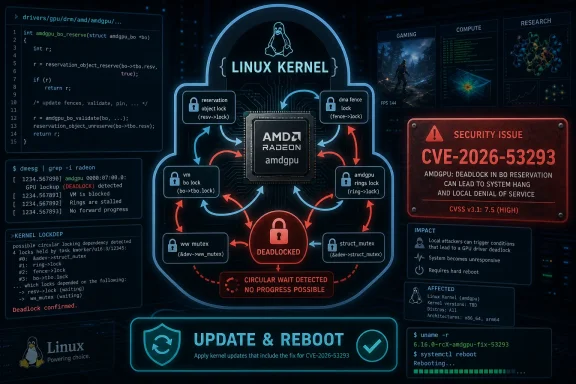 A GPU Register Helper Becomes a Kernel Security Story
CVE-2026-53293 is the kind of Linux kernel vulnerability that looks small until you read the verbs. The affected code did not merely return the wrong value or mishandle a corner-case flag. It took locks in the wrong order, copied data back to user space while holding a lock, allocated memory while holding a reset semaphore, and used a non-blocking reset lock where the correct behavior was to wait for reset completion.That is not the glamorous end of vulnerability research. There is no branded logo, no cinematic exploit chain, and, at publication time, no NVD severity score to turn into a patching dashboard heat map. Yet the mechanics matter because they sit in a path that mediates access between user space and low-level AMD GPU registers.
The function named in the CVE,
AMDGPU_INFO_READ_MMR_REG, lives in the AMDGPU kernel driver’s information-query interface. In plain English, this is part of the machinery that lets user-space components ask the kernel driver for details about the graphics device. That may sound mundane, but modern graphics stacks are full of privileged state, reset handling, firmware conversations, power-management transitions, and hardware queues that can freeze a machine when the ordering goes wrong.The security significance here is mostly about availability and kernel robustness, not about a confirmed remote code execution disaster. The CVE text points to deadlock risks, and deadlocks are availability failures by definition: a system can hang, a GPU reset path can stall, and a desktop or compute node can become unresponsive in ways that are painful to diagnose.
The Missing CVSS Score Is Not a Permission Slip
The NVD entry for CVE-2026-53293 arrived without a CVSS 4.0, 3.x, or 2.0 score from NIST. That is common in the early life of kernel CVEs, especially when the record is sourced from upstream maintainers and enrichment has not caught up. It is also where too many organizations make the wrong inference.No score does not mean no impact. It means the scoring machinery has not yet reduced the bug to a vector string. For Linux kernel issues, especially driver bugs, that reduction can be deceptively hard because impact depends on hardware, enabled modules, local access, distribution kernel configuration, and whether an attacker can reach the relevant ioctl or information path.
The useful question is not “is this critical?” but “where is this code reachable in my estate?” On a headless server with no AMDGPU module loaded, the practical answer may be “nowhere.” On a Linux gaming machine, developer workstation, GPU compute box, or AMD-powered thin client, the answer is more interesting.
That is why the absence of an NVD score should push administrators toward inventory rather than complacency. A CVE in a driver you do not load is usually noise. A CVE in a driver that handles the display path for your users, your lab machines, or your remote desktops is operational debt waiting for a maintenance window.
The Bug Is About Ordering, and Ordering Is Where Kernels Bleed
The kernel.org description is unusually direct about what went wrong. The reset semaphore andmm_lock were taken in the wrong order. copy_to_user, the kernel mechanism for copying data back into a user-space buffer, could be called while a lock was held. Memory allocation happened while the reset semaphore was held. Finally, the code used down_read_trylock() rather than waiting for a GPU reset operation to finish.Each of those details sounds like internal plumbing. Together, they describe a classic kernel-driver trap: code that works most of the time until reset, memory pressure, and user-space interaction collide. GPU drivers are particularly exposed to this because they are constantly bridging worlds that do not move at the same speed.
The user-space graphics stack wants answers now. The hardware may be busy, wedged, recovering, or being reset. The kernel driver has to serialize access without blocking forever, but it also has to avoid holding locks while doing operations that may sleep, allocate, fault, or otherwise wait on unrelated subsystems.
That is the real lesson of CVE-2026-53293. The vulnerability is not just that one AMDGPU helper had an embarrassing lock-ordering problem. It is that modern GPU drivers behave less like “display adapters” and more like operating systems inside the operating system, complete with schedulers, memory managers, firmware interfaces, reset logic, telemetry paths, and untrusted user-space callers.
AMDGPU Is Not Just a Gaming Driver Anymore
Windows users may be tempted to file this under “Linux people problems.” That would be too easy. The reason this CVE matters to a WindowsForum audience is that AMDGPU has become a central component in environments where Windows and Linux increasingly coexist.A Windows enthusiast may dual-boot into Linux for gaming, benchmarking, emulation, or development. A sysadmin may support Linux workstations used for CAD, media production, machine learning, or browser-testing farms. A developer may run Linux on a spare AMD desktop precisely because the open-source graphics stack is good enough to make that machine useful.
The AMDGPU driver is also part of the trust boundary around graphical remote access, container-adjacent workflows, and GPU-accelerated workloads. Even when Windows is the primary desktop OS, Linux machines with AMD GPUs often sit in the same home lab, studio, classroom, or business network. Their reliability problems become everyone’s support problems.
This is where the old mental model of graphics drivers breaks down. In the 2000s, a graphics driver bug meant a bad frame, a crash in a game, or a blue screen after a driver update. In 2026, a graphics driver bug can mean a kernel CVE, a fleet patch decision, a hypervisor compatibility question, and a security scanner exception that someone must justify.
The Threat Is Local, but Local Is Not Harmless
Nothing in the published CVE text points to a remote network attack. The vulnerable path appears tied to local interaction with the AMDGPU driver. That should lower the panic level, but it should not erase the patching obligation.Local bugs matter because “local” is not the same as “trusted.” Multi-user Linux systems still exist. Developer workstations run untrusted code from package managers, build scripts, containers, games, plug-ins, browser sandboxes, and test harnesses. Shared GPU hosts are common in research, rendering, CI, and AI-adjacent workloads.
Even when a bug is “only” a denial-of-service risk, availability can be a security property. If a user-space process can trigger a driver deadlock under the right conditions, that can disrupt work, kill remote sessions, corrupt user confidence, or force hard resets. In environments where the GPU is part of production work, a hang is not cosmetic.
The more subtle risk is exploitability drift. Many kernel bugs begin life as reliability fixes. Once a CVE lands, researchers and attackers can compare vulnerable and fixed code, reason about reachable paths, and test whether a deadlock primitive can be turned into something more useful. There is no public indication that CVE-2026-53293 is being exploited in the wild, but patch-diff analysis is now routine enough that defenders should not treat driver CVEs as academic curiosities.
The Fix Says More Than the CVE Record
The fix referenced by the CVE was cherry-picked from an upstream commit and then backported across stable kernel branches. That detail matters because it tells us this is not a speculative database-only vulnerability. It is a real kernel maintenance fix that landed in the tree and then had to be carried into supported lines.The affected record names
drivers/gpu/drm/amd/amdgpu/amdgpu_kms.c, which places the bug in the AMDGPU kernel mode-setting path. The version information in the CVE record is messy in the way Linux kernel vulnerability metadata often is: it lists git commit ranges, stable branch ranges, and several unaffected branch versions where the fix has landed.The practical reading is simpler. If you run a distribution kernel, wait for your vendor’s kernel update and apply it. If you run mainline or stable kernels yourself, move to a fixed stable release rather than trying to reason from the CVE text alone. If you build custom kernels, confirm that the relevant AMDGPU patch is present in your source tree.
This is where Windows administrators who also maintain Linux systems should resist the temptation to treat upstream kernel CVEs like Windows KBs. Microsoft’s patch packaging usually gives you a fairly clear “install this cumulative update” path. Linux’s patch reality is distributed across upstream stable, distribution backports, enterprise kernels, live-patching services, and downstream advisories.
Version Ranges Are a Map, Not the Territory
The CVE record includes affected semantic-version ranges such as 6.6.55 up to before 6.6.141, 6.10.14 up to before 6.11, and 6.11.3 up to before 6.12. It also indicates fixed or unaffected status for later stable branch points, including 6.6.141, 6.12.91, 6.18.33, and 7.0.10 in the provided record.That information is useful, but it is not the whole truth for most users. Distribution kernels routinely carry backported fixes while retaining older version numbers. An Ubuntu, Fedora, Debian, Arch, SUSE, or Red Hat kernel may not line up neatly with upstream version strings, and enterprise vendors often patch without changing the apparent base kernel in the way casual users expect.
The safe operational move is to consult your distribution’s security advisory and installed kernel changelog. If the vendor says the CVE is fixed in a particular package build, that package build is the thing that matters. If you are running a self-compiled kernel, the upstream commit history matters more.
For home users, this collapses into a familiar recommendation: update the kernel when your distro offers the update, then reboot. For administrators, it becomes an inventory question: which systems load AMDGPU, which kernels are they running, and which of those kernels have the fix?
The Windows Angle Is Indirect but Real
This CVE does not affect Windows 10 or Windows 11 directly. It is not a flaw in the Windows Display Driver Model, AMD’s Windows driver package, DirectX, or Microsoft’s kernel graphics subsystem. Windows users should not go hunting for an emergency Adrenalin update because of CVE-2026-53293.But WindowsForum readers increasingly live in mixed-platform reality. The same desktop may boot Windows for games and Linux for development. The same sysadmin may patch Windows Server on Tuesday and Linux GPU nodes on Thursday. The same security team may see “AMD GPU driver vulnerability” in a scanner and need to explain why the Windows machines are out of scope while certain Linux systems are not.
That distinction matters because sloppy vulnerability communication creates unnecessary noise. AMDGPU is the open-source Linux kernel driver for AMD GPUs. AMD’s Windows graphics driver stack is a different codebase, a different driver model, and a different update channel. The shared hardware brand does not imply shared vulnerability.
Still, the operational habit transfers. Graphics drivers deserve the same patch discipline as network drivers, storage drivers, and hypervisor components. If your endpoint management culture treats GPU drivers as optional performance accessories, CVE-2026-53293 is another small argument against that complacency.
Deadlocks Are Security Bugs When They Cross Trust Boundaries
Some readers will look at the description and see a reliability bug dressed up as a CVE. That reaction is understandable. Deadlocks do not have the emotional force of memory corruption, credential theft, or sandbox escape.But kernel deadlocks can cross trust boundaries in ways that justify security tracking. If unprivileged user space can reach a kernel path and force the system into a stuck state, that is a denial-of-service condition. If the stuck state happens under reset handling, the blast radius can include the graphical session, GPU compute work, or the whole machine.
The AMDGPU case is especially sensitive because GPU reset paths are already where users feel failures most sharply. A reset that recovers cleanly is invisible or mildly annoying. A reset that collides with the wrong lock can strand the desktop, wedge a compositor, kill acceleration, or leave a remote administrator staring at a dead session.
The kernel community’s decision to issue CVEs for these resolved bugs is sometimes controversial because it floods scanners with low-context findings. Yet the alternative — leaving driver deadlocks buried in commit logs — is worse for organizations that need to decide whether a bug is relevant to their fleet.
The Scanner Will Be Louder Than the Exploit
For many organizations, the first encounter with CVE-2026-53293 will not be a crash report. It will be a vulnerability scanner flagging Linux kernels as affected. That is where the real work begins.Security teams will ask for a severity. NVD currently provides none. Operations teams will ask whether the system is exploitable. The answer depends on kernel version, driver load state, AMD GPU presence, and local access. Desktop teams will ask whether users are reporting freezes. They may or may not be, because the triggering conditions may be narrow.
The right response is to avoid both extremes. Do not declare an emergency across the whole estate without evidence of exposure. Do not waive it forever because “it’s just AMD graphics.” Treat it as a kernel driver availability issue with a clear upstream fix and prioritize systems where AMDGPU is actually in use.
That means Linux workstations, AMD-based gaming systems, developer desktops, graphics labs, and GPU compute nodes should move ahead of generic servers that do not load the module. If a fleet has no AMD GPUs and no AMDGPU module, the CVE becomes documentation rather than fire drill.
Kernel CVEs Have Become a Patch-Management Tax
CVE-2026-53293 also illustrates a broader problem: Linux kernel CVEs are now issued at a pace and granularity that can overwhelm human triage. Many are real bugs. Many are fixed before the CVE record becomes widely visible. Many lack complete scoring when they first appear. Some affect only narrow configurations.That does not make them unimportant. It means vulnerability management must become more kernel-aware. A flat list of CVE IDs is not enough; teams need to map CVEs to loaded modules, hardware inventory, kernel package provenance, and vendor backport status.
This is particularly important for organizations that standardized on Linux desktops for technical staff. A developer workstation with a modern GPU is not a toy endpoint. It may hold source code, credentials, SSH keys, containers, build artifacts, and access to production systems. A local denial-of-service bug on that workstation may not be as severe as a remote root flaw, but it is still worth fixing promptly.
The same is true in home labs and enthusiast setups, which increasingly resemble small enterprise networks. A Windows gaming PC, a Linux workstation, a NAS, a Proxmox host, and a few containers can share credentials, storage, and remote access paths. The weakest patched machine is often the one nobody remembers is doing real work.
AMD Is Not the Villain; Complexity Is
It is tempting to read any AMDGPU CVE as a vendor indictment. That would miss the point. AMDGPU is one of the most important open-source graphics drivers in the Linux ecosystem, and its visibility means its bugs are fixed in public, backported in public, and cataloged in public.That transparency can make the stack look worse than closed alternatives because the sausage-making is searchable. But the underlying challenge is industry-wide. GPU drivers are enormous privileged components that translate hostile or buggy user-space requests into hardware operations on devices with their own firmware, memory, queues, engines, and reset semantics.
NVIDIA, Intel, AMD, Microsoft, Mesa, Wayland compositors, game runtimes, compute frameworks, and virtualization vendors all live somewhere in this complexity. The more we ask GPUs to do — graphics, video encode, AI inference, browser acceleration, remote desktop, sandboxed compute, telemetry, power management — the more the driver becomes a security-critical subsystem.
CVE-2026-53293 is not a catastrophe. It is a symptom. The GPU is no longer a peripheral in the old sense; it is a privileged co-processor with a large software attack surface.
The Practical Playbook Is Boring, Which Is Good
There is no need for exotic mitigation advice here. The fix is in the kernel, and the sensible path is to take a kernel update from a trusted channel. That may disappoint anyone looking for a dramatic workaround, but boring patch guidance is exactly what administrators should want.On rolling distributions, fixed kernels may arrive quickly, and reboot discipline becomes the main challenge. On enterprise distributions, the fix may arrive as a backport inside a vendor kernel package with a version string that does not obviously match upstream stable. On custom kernels, the burden falls on the maintainer to verify the patch.
For individual Linux users with AMD GPUs, this is a good moment to remember that kernel updates are not fully applied until the machine boots into the new kernel. Installing packages and then suspending the laptop for three weeks does not close the exposure window. For servers and workstations, maintenance windows should include confirmation that the running kernel changed after reboot.
For Windows-first users, the action item is mostly classification. Do not apply Linux CVEs to Windows AMD driver installations. Do identify dual-boot systems, Linux partitions, SteamOS-style handhelds, and lab machines where AMDGPU may actually be present.
This One AMDGPU CVE Draws a Clean Line Through the Patch Queue
The operational lesson from CVE-2026-53293 is not complicated, but it rewards precision. The affected component is narrow, the fix path is conventional, and the business impact depends heavily on whether AMDGPU is active on the machine in front of you.- Systems running Linux with AMD GPUs should receive a kernel update that includes the AMDGPU fix, followed by a reboot into the updated kernel.
- Windows systems using AMD graphics drivers are not directly affected by this Linux kernel CVE.
- The lack of an NVD CVSS score should not be treated as evidence that the bug has no security or reliability impact.
- Distribution kernel package status matters more than upstream version strings when vendors have backported the fix.
- The highest-priority systems are Linux desktops, workstations, gaming rigs, GPU compute nodes, and shared machines where local users or untrusted workloads can reach the AMDGPU driver.
References
- Primary source: NVD / Linux Kernel
Published: 2026-06-28T01:03:33-07:00
NVD - CVE-2026-53293
 nvd.nist.gov
- Security advisory: MSRC
Published: 2026-06-28T01:03:33-07:00
Original feed URL
Security Update Guide - Microsoft Security Response Center
 msrc.microsoft.com
- Related coverage: tomshardware.com
CISA flags actively exploited ‘Copy Fail’ Linux kernel flaw enabling root takeover across major distros — unpatched systems may remain vulnerable to attack | Tom's Hardware
Researchers released a working exploit before patches were ready.www.tomshardware.com - Related coverage: techradar.com
Another major Linux security issue uncovered - new Fragnesia flaw allows attackers to run malicious code as root | TechRadar
The flaw is in the same family as Dirty Fragwww.techradar.com - Related coverage: labs.cloudsecurityalliance.org
CSA research note linux copy fail CVE 2026 31431 20260503 csa styled
PDF documentlabs.cloudsecurityalliance.org
- Related coverage: amdgpu-install.readthedocs.io
