

CVE-2026-46218 is a newly published Linux kernel vulnerability, disclosed by kernel.org on May 28, 2026, in AMD’s amdgpu graphics driver, where UVD, VCE, and VCN video paths could access indirect buffers at fixed offsets without first confirming the buffer was large enough. The fix is small, but the lesson is larger: GPU drivers are now part of the operating system’s attack surface in the same way filesystems, network stacks, and hypervisors have long been. For WindowsForum readers, this is not a “Windows vulnerability,” but it matters to anyone running Linux on AMD hardware, maintaining dual-boot workstations, managing Linux fleets, or using GPU-backed virtualization and compute nodes.
The patch behind CVE-2026-46218 changes helper functions in the amdgpu driver so they no longer blindly read or write an indirect buffer slot based on an index. If the index is within the buffer’s
That may sound mundane, and in one sense it is. Bounds checks are the plumbing of safe systems programming. But in kernel code, mundane plumbing is often the difference between an invalid command being discarded and an attacker-controlled path reaching memory it should never touch.
The vulnerable area is tied to AMD’s video decode and encode machinery: UVD, VCE, and VCN. These blocks are not decorative driver features. They are the parts of AMD GPUs that accelerate media workloads, stream decoding, encoding, and other video-related jobs that modern desktops and servers now perform constantly.
The NVD entry is still marked as awaiting enrichment, with no CVSS score from NIST at publication time. That absence should not be confused with a clean bill of health. It means the record is young and the formal scoring process has not caught up with the kernel.org disclosure.
An indirect buffer, or IB, is a chunk of GPU command data. Drivers use it as a vehicle for work submitted to the GPU. If code walks that buffer using expected offsets, but a malformed or unexpectedly short buffer reaches the parser, the driver can end up reading from or writing to memory outside the intended range.
This is not the sort of vulnerability that arrives with a glossy exploit narrative on day one. There is no public scoring yet, no NVD weakness classification, and no confirmed exploit chain in the disclosure material. The security issue is instead defined by a pattern kernel engineers know well: unchecked indexing in privileged code, sitting near a boundary where user-controlled or workload-controlled data can influence what the kernel parses.
The patch’s second change is just as revealing as the first. By making the index unsigned and fixed-width, the developer avoids a class of overflow or sign-conversion surprises that can make a bounds check look correct while still being bypassable. That is the quiet craft of kernel hardening: not simply adding an
That breadth is why GPU drivers keep appearing in security advisories. They are privileged, complex, performance-sensitive, and constantly fed structured data from userspace. Every modern browser tab, video player, compositor, game engine, AI runtime, and remote desktop session can potentially exercise GPU paths that used to be niche.
The video blocks named in this bug make the point neatly. UVD, VCE, and VCN represent generations of AMD video decode and encode hardware. They exist to move media processing off the CPU and into dedicated silicon, but that also means the kernel driver must accept, validate, patch, and submit GPU commands describing those operations.
A malformed command buffer does not need to look dramatic to matter. It only needs to be shaped in a way that violates a parser’s assumptions. CVE-2026-46218 is a reminder that hardware acceleration is not magic; it is a contract among applications, userspace libraries, kernel code, firmware, and silicon.
The patch was originally posted to the AMD graphics mailing list in March 2026 by AMD’s Benjamin Cheng and later carried into stable kernel trees. It was reviewed by AMD graphics maintainers and routed through the normal stable process. By the time the CVE appeared in the NVD feed on May 28, the engineering trail already showed a bug that had moved from patch review into backport territory.
That sequence matters because it reflects how Linux kernel CVEs now often work. The CVE may look “new” to vulnerability scanners on the day it appears, while the relevant patch may already have been circulating for weeks. Administrators who treat the NVD timestamp as the beginning of the technical story will often be late to understanding which kernels are actually fixed.
The presence of multiple stable commit references also signals that this is not confined to a single development snapshot. Kernel maintainers saw enough relevance to backport the fix across maintained branches. That does not automatically tell us every affected version, but it does tell us the bug was considered worth carrying into stable updates rather than leaving only in mainline.
CVSS is useful, but it is not a substitute for engineering judgment. It can lag publication, flatten context, or fail to express how a vulnerability fits into a particular environment. A media workstation, a kiosk fleet, a Linux gaming rig, a GPU compute node, and a hardened server with no AMD GPU exposed do not share the same risk.
For a laptop or desktop running an AMD GPU on a mainstream Linux distribution, the practical answer is simple: install the next kernel security or stable update when it arrives. For enterprise Linux systems, the answer is less about panic and more about inventory. If amdgpu is loaded, AMD hardware is present, and untrusted local users or workloads can exercise video paths, this should be tracked as more than a theoretical advisory.
The lack of public exploit detail cuts both ways. It reduces immediate alarm, but it also means defenders cannot rely on exploit signatures or obvious indicators of compromise. The right operational posture is patch-first, then watch vendor advisories as scoring and affected-version data mature.
Dual-boot systems are the obvious case. A gaming or development PC may spend weekdays in Windows and evenings in Linux, with the same Radeon GPU exposed to both operating systems. The Windows driver is not implicated by this CVE, but the hardware owner still has a Linux patching obligation.
WSL is a more nuanced case. The standard Windows Subsystem for Linux model does not simply load the host’s Linux amdgpu kernel driver in the way a bare-metal Linux installation does. GPU acceleration in WSL relies on Microsoft’s Windows-side GPU virtualization plumbing rather than a normal Linux desktop driver stack. That means CVE-2026-46218 should not be treated as a direct WSL panic item, though Linux kernels used in custom or specialized virtualization environments still deserve scrutiny.
The bigger exposure is in homelabs, developer workstations, and small business infrastructure. Proxmox hosts, passthrough gaming VMs, Linux media servers, ROCm experimentation boxes, and CI machines with AMD GPUs all sit in the overlap between Windows enthusiasm and Linux administration. Those are exactly the systems where a “Linux-only” graphics driver bug can quietly matter to a Windows-heavy household or shop.
That distinction is not academic. In a host-owned model, a driver flaw can threaten the stability of the host that multiple workloads depend on. In a passthrough model, the blast radius may be closer to the VM, though device reset behavior, IOMMU configuration, and platform quirks can still turn GPU failures into host pain.
CVE-2026-46218 does not currently come with a public statement proving host escape, privilege escalation, or remote code execution. It should not be described as any of those without evidence. The safer and more accurate framing is that unchecked bounds in a kernel GPU parser are the kind of primitive administrators do not want sitting in a privileged path.
For IT teams, the question is not “Can this specific CVE break out of my VM today?” The question is whether your patch process treats GPU drivers with the same seriousness as storage, networking, and hypervisor components. In 2026, it should.
The amdgpu UVD, VCE, and VCN code paths are particularly interesting because they sit near workloads that can be triggered by ordinary user behavior. A web page, a media file, a conferencing client, or a transcoding job may cause video acceleration to engage. That does not mean CVE-2026-46218 is remotely exploitable through any of those paths, but it does explain why video-driver parsing bugs get attention.
Modern browsers and media frameworks also layer sandboxing, userspace validation, and driver APIs between untrusted content and kernel code. Those layers matter. But security engineering is not built on assuming one layer will always catch malformed input before the next layer sees it.
The kernel patch’s philosophy is therefore the right one: even if callers are supposed to behave, the callee should not trust a buffer length it has not checked. Defense in depth is often just that prosaic.
For rolling distributions, that can happen quickly. For enterprise distributions, it may arrive through a vendor advisory with backported patches and a version number that does not resemble upstream mainline. For appliance-like systems, it may lag until the vendor refreshes its kernel bundle.
This is where many vulnerability scanners confuse rather than clarify. A scanner might flag CVE-2026-46218 because it sees an apparently affected kernel version, even though a distribution has already backported the fix. Conversely, a system may look “new enough” by version branding but still lack the specific patch if it is running a custom or vendor-frozen kernel.
The only reliable answer is to consult the distribution’s kernel changelog or security advisory once available. On systems you own directly, checking whether the running kernel includes the relevant amdgpu patch is better than guessing from the upstream version alone. Kernel security in the stable era is increasingly commit-based, not merely version-based.
Linux gaming systems are also worth mentioning. Steam, Proton, Mesa, Vulkan, VA-API, browser video decode, capture tools, and streaming software all contribute to a busy graphics stack. A bug in a kernel helper used by video paths may be invisible to the user until it is not.
Still, this is not a reason to disable AMD graphics acceleration across the board. There is no public evidence in the disclosure that users should abandon amdgpu or turn off hardware video decode as a general mitigation. The sensible response is to update the kernel through normal channels and reboot into the fixed kernel.
For administrators with high-risk shared Linux desktops, temporary risk reduction can include limiting untrusted local access, avoiding experimental media workloads, and prioritizing kernel updates on AMD GPU systems. But workarounds should not become folklore. The durable fix is the bounds check.
That uncertainty often produces two bad reactions. One camp waves away anything without a high CVSS score as noise. Another treats every kernel out-of-bounds access as an imminent root exploit. Both reactions miss the actual discipline required.
A better model is to ask three concrete questions. Is the vulnerable driver loaded? Can untrusted users or workloads reach the affected path? Is a fixed kernel available from the vendor? For CVE-2026-46218, those questions lead to a practical patching decision without exaggerating what is publicly known.
The broader strategic point is that GPUs are now general-purpose system components with privileged software stacks. Security teams that still inventory them as peripherals are behind the curve.
For readers trying to turn the disclosure into action, the concrete guidance is narrow but useful:
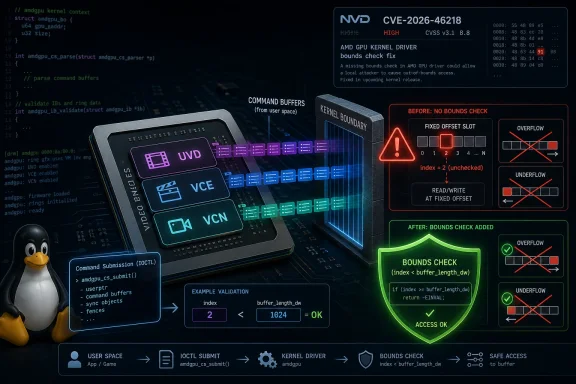 A Tiny Bounds Check Lands in a Very Large Attack Surface
The patch behind CVE-2026-46218 changes helper functions in the amdgpu driver so they no longer blindly read or write an indirect buffer slot based on an index. If the index is within the buffer’s length_dw, the access proceeds; if it is outside the buffer, the read returns zero and the write is skipped. The patch also changes the index type to uint32_t, explicitly closing off overflow behavior that could otherwise undermine the comparison.That may sound mundane, and in one sense it is. Bounds checks are the plumbing of safe systems programming. But in kernel code, mundane plumbing is often the difference between an invalid command being discarded and an attacker-controlled path reaching memory it should never touch.
The vulnerable area is tied to AMD’s video decode and encode machinery: UVD, VCE, and VCN. These blocks are not decorative driver features. They are the parts of AMD GPUs that accelerate media workloads, stream decoding, encoding, and other video-related jobs that modern desktops and servers now perform constantly.
The NVD entry is still marked as awaiting enrichment, with no CVSS score from NIST at publication time. That absence should not be confused with a clean bill of health. It means the record is young and the formal scoring process has not caught up with the kernel.org disclosure.
The Bug Is Boring in Exactly the Way Kernel Bugs Are Dangerous
The vulnerability description is terse: the code accessed an indirect buffer at predefined offsets without checking that the buffer was large enough. In practice, that means parsing code assumed a structure was present because the command path expected it to be present. The fix stops making that assumption.An indirect buffer, or IB, is a chunk of GPU command data. Drivers use it as a vehicle for work submitted to the GPU. If code walks that buffer using expected offsets, but a malformed or unexpectedly short buffer reaches the parser, the driver can end up reading from or writing to memory outside the intended range.
This is not the sort of vulnerability that arrives with a glossy exploit narrative on day one. There is no public scoring yet, no NVD weakness classification, and no confirmed exploit chain in the disclosure material. The security issue is instead defined by a pattern kernel engineers know well: unchecked indexing in privileged code, sitting near a boundary where user-controlled or workload-controlled data can influence what the kernel parses.
The patch’s second change is just as revealing as the first. By making the index unsigned and fixed-width, the developer avoids a class of overflow or sign-conversion surprises that can make a bounds check look correct while still being bypassable. That is the quiet craft of kernel hardening: not simply adding an
if, but making the comparison mean what it appears to mean.AMDGPU Is Not Just a Display Driver Anymore
For many Windows veterans, a graphics driver still sounds like something that paints pixels and occasionally crashes a game. On Linux in 2026, that mental model is badly out of date. The amdgpu driver handles display, memory management, command submission, scheduling, power management, video acceleration, compute-adjacent paths, and interactions with userspace graphics stacks.That breadth is why GPU drivers keep appearing in security advisories. They are privileged, complex, performance-sensitive, and constantly fed structured data from userspace. Every modern browser tab, video player, compositor, game engine, AI runtime, and remote desktop session can potentially exercise GPU paths that used to be niche.
The video blocks named in this bug make the point neatly. UVD, VCE, and VCN represent generations of AMD video decode and encode hardware. They exist to move media processing off the CPU and into dedicated silicon, but that also means the kernel driver must accept, validate, patch, and submit GPU commands describing those operations.
A malformed command buffer does not need to look dramatic to matter. It only needs to be shaped in a way that violates a parser’s assumptions. CVE-2026-46218 is a reminder that hardware acceleration is not magic; it is a contract among applications, userspace libraries, kernel code, firmware, and silicon.
The Patch Reads Like a Security Culture Shift
The code change is almost comically small: check the index before dereferencing the buffer pointer, return zero on out-of-range reads, and ignore out-of-range writes. Yet that smallness is the story. The Linux kernel’s security posture increasingly depends on finding these assumptions before an external researcher or attacker turns them into a reproducer.The patch was originally posted to the AMD graphics mailing list in March 2026 by AMD’s Benjamin Cheng and later carried into stable kernel trees. It was reviewed by AMD graphics maintainers and routed through the normal stable process. By the time the CVE appeared in the NVD feed on May 28, the engineering trail already showed a bug that had moved from patch review into backport territory.
That sequence matters because it reflects how Linux kernel CVEs now often work. The CVE may look “new” to vulnerability scanners on the day it appears, while the relevant patch may already have been circulating for weeks. Administrators who treat the NVD timestamp as the beginning of the technical story will often be late to understanding which kernels are actually fixed.
The presence of multiple stable commit references also signals that this is not confined to a single development snapshot. Kernel maintainers saw enough relevance to backport the fix across maintained branches. That does not automatically tell us every affected version, but it does tell us the bug was considered worth carrying into stable updates rather than leaving only in mainline.
The Missing CVSS Score Is a Trap for Lazy Prioritization
Because NVD has not yet assigned a CVSS score, some patch dashboards will treat CVE-2026-46218 as ambiguous noise. That is understandable, but it is not good practice. A kernel graphics driver flaw with an out-of-bounds access pattern deserves triage even before the score arrives.CVSS is useful, but it is not a substitute for engineering judgment. It can lag publication, flatten context, or fail to express how a vulnerability fits into a particular environment. A media workstation, a kiosk fleet, a Linux gaming rig, a GPU compute node, and a hardened server with no AMD GPU exposed do not share the same risk.
For a laptop or desktop running an AMD GPU on a mainstream Linux distribution, the practical answer is simple: install the next kernel security or stable update when it arrives. For enterprise Linux systems, the answer is less about panic and more about inventory. If amdgpu is loaded, AMD hardware is present, and untrusted local users or workloads can exercise video paths, this should be tracked as more than a theoretical advisory.
The lack of public exploit detail cuts both ways. It reduces immediate alarm, but it also means defenders cannot rely on exploit signatures or obvious indicators of compromise. The right operational posture is patch-first, then watch vendor advisories as scoring and affected-version data mature.
Where Windows Users Actually Touch This Linux Bug
WindowsForum readers are right to ask why they should care about a Linux kernel CVE. The answer is that the old clean line between “Windows machine” and “Linux machine” has blurred. Plenty of Windows-centric environments now run Linux somewhere important, often on the same AMD hardware.Dual-boot systems are the obvious case. A gaming or development PC may spend weekdays in Windows and evenings in Linux, with the same Radeon GPU exposed to both operating systems. The Windows driver is not implicated by this CVE, but the hardware owner still has a Linux patching obligation.
WSL is a more nuanced case. The standard Windows Subsystem for Linux model does not simply load the host’s Linux amdgpu kernel driver in the way a bare-metal Linux installation does. GPU acceleration in WSL relies on Microsoft’s Windows-side GPU virtualization plumbing rather than a normal Linux desktop driver stack. That means CVE-2026-46218 should not be treated as a direct WSL panic item, though Linux kernels used in custom or specialized virtualization environments still deserve scrutiny.
The bigger exposure is in homelabs, developer workstations, and small business infrastructure. Proxmox hosts, passthrough gaming VMs, Linux media servers, ROCm experimentation boxes, and CI machines with AMD GPUs all sit in the overlap between Windows enthusiasm and Linux administration. Those are exactly the systems where a “Linux-only” graphics driver bug can quietly matter to a Windows-heavy household or shop.
Virtualization Turns Driver Bugs Into Boundary Questions
GPU virtualization and passthrough complicate any vulnerability discussion because the driver boundary changes depending on the architecture. If a Linux host owns the AMD GPU and exposes acceleration to guests, the host kernel’s amdgpu driver is a privileged component. If a guest owns a passed-through GPU directly, the guest driver becomes the component parsing that workload’s command stream.That distinction is not academic. In a host-owned model, a driver flaw can threaten the stability of the host that multiple workloads depend on. In a passthrough model, the blast radius may be closer to the VM, though device reset behavior, IOMMU configuration, and platform quirks can still turn GPU failures into host pain.
CVE-2026-46218 does not currently come with a public statement proving host escape, privilege escalation, or remote code execution. It should not be described as any of those without evidence. The safer and more accurate framing is that unchecked bounds in a kernel GPU parser are the kind of primitive administrators do not want sitting in a privileged path.
For IT teams, the question is not “Can this specific CVE break out of my VM today?” The question is whether your patch process treats GPU drivers with the same seriousness as storage, networking, and hypervisor components. In 2026, it should.
Media Paths Are an Underrated Security Boundary
Video acceleration has a way of seeming harmless because users experience it as convenience: smoother playback, lower CPU use, better battery life, faster transcoding. Under the hood, however, media paths often parse complex command streams, buffer layouts, codecs, metadata, and memory objects. Complexity is the enemy of casual trust.The amdgpu UVD, VCE, and VCN code paths are particularly interesting because they sit near workloads that can be triggered by ordinary user behavior. A web page, a media file, a conferencing client, or a transcoding job may cause video acceleration to engage. That does not mean CVE-2026-46218 is remotely exploitable through any of those paths, but it does explain why video-driver parsing bugs get attention.
Modern browsers and media frameworks also layer sandboxing, userspace validation, and driver APIs between untrusted content and kernel code. Those layers matter. But security engineering is not built on assuming one layer will always catch malformed input before the next layer sees it.
The kernel patch’s philosophy is therefore the right one: even if callers are supposed to behave, the callee should not trust a buffer length it has not checked. Defense in depth is often just that prosaic.
The Stable Kernel Conveyor Belt Is the Real Remediation Story
The NVD entry lists several stable kernel commit references, which is the practical clue administrators should follow. Most users will not cherry-pick a commit into a custom kernel. They will receive the fix through a distribution kernel update, a vendor appliance update, or a stable kernel package.For rolling distributions, that can happen quickly. For enterprise distributions, it may arrive through a vendor advisory with backported patches and a version number that does not resemble upstream mainline. For appliance-like systems, it may lag until the vendor refreshes its kernel bundle.
This is where many vulnerability scanners confuse rather than clarify. A scanner might flag CVE-2026-46218 because it sees an apparently affected kernel version, even though a distribution has already backported the fix. Conversely, a system may look “new enough” by version branding but still lack the specific patch if it is running a custom or vendor-frozen kernel.
The only reliable answer is to consult the distribution’s kernel changelog or security advisory once available. On systems you own directly, checking whether the running kernel includes the relevant amdgpu patch is better than guessing from the upstream version alone. Kernel security in the stable era is increasingly commit-based, not merely version-based.
For Desktop Linux, This Is a Patch-Now, Panic-Never Bug
The most likely real-world impact for ordinary Linux desktop users is not a cinematic compromise but instability or a possible local attack primitive if someone can feed malformed work into the driver. That still matters. Local privilege boundaries are important on shared machines, developer workstations, university labs, and any system running untrusted code.Linux gaming systems are also worth mentioning. Steam, Proton, Mesa, Vulkan, VA-API, browser video decode, capture tools, and streaming software all contribute to a busy graphics stack. A bug in a kernel helper used by video paths may be invisible to the user until it is not.
Still, this is not a reason to disable AMD graphics acceleration across the board. There is no public evidence in the disclosure that users should abandon amdgpu or turn off hardware video decode as a general mitigation. The sensible response is to update the kernel through normal channels and reboot into the fixed kernel.
For administrators with high-risk shared Linux desktops, temporary risk reduction can include limiting untrusted local access, avoiding experimental media workloads, and prioritizing kernel updates on AMD GPU systems. But workarounds should not become folklore. The durable fix is the bounds check.
The Security Industry Still Struggles With GPU Severity
One reason bugs like CVE-2026-46218 feel awkward is that the industry has not fully settled how to rank GPU driver vulnerabilities. The attack surface is real, but exploitability can be highly dependent on hardware generation, firmware behavior, userspace stack, memory layout, sandboxing, and whether the relevant code path is reachable by an attacker.That uncertainty often produces two bad reactions. One camp waves away anything without a high CVSS score as noise. Another treats every kernel out-of-bounds access as an imminent root exploit. Both reactions miss the actual discipline required.
A better model is to ask three concrete questions. Is the vulnerable driver loaded? Can untrusted users or workloads reach the affected path? Is a fixed kernel available from the vendor? For CVE-2026-46218, those questions lead to a practical patching decision without exaggerating what is publicly known.
The broader strategic point is that GPUs are now general-purpose system components with privileged software stacks. Security teams that still inventory them as peripherals are behind the curve.
What Kernel Maintainers Fixed Before the Scoreboard Caught Up
The clearest lesson from CVE-2026-46218 is that the fix was already obvious to the engineers closest to the code: never access the indirect buffer outside its recorded length. That is not glamorous, but it is exactly the kind of change that prevents low-level parsing bugs from becoming incident reports.For readers trying to turn the disclosure into action, the concrete guidance is narrow but useful:
- Systems running Linux with AMD GPUs should receive the next kernel update that includes the amdgpu bounds-checking fix.
- Administrators should not rely solely on the missing NVD score when deciding whether to triage this vulnerability.
- Windows systems using AMD’s Windows driver are not the target of this Linux kernel CVE.
- WSL users should distinguish Microsoft’s Windows-hosted GPU virtualization path from a bare-metal Linux amdgpu deployment.
- Virtualization hosts, passthrough rigs, media servers, and GPU compute boxes deserve priority because they often expose GPU paths to more varied workloads.
- Distribution backports may fix the issue without changing the kernel version in an obvious upstream-looking way.
References
- Primary source: NVD / Linux Kernel
Published: 2026-05-29T01:06:51-07:00
NVD - CVE-2026-46218
 nvd.nist.gov
- Security advisory: MSRC
Published: 2026-05-29T01:06:51-07:00
Original feed URL
Security Update Guide - Microsoft Security Response Center
 msrc.microsoft.com
- Related coverage: kernel.org
- Related coverage: codebrowser.dev

amdgpu_vce.c source code [linux/drivers/gpu/drm/amd/amdgpu/amdgpu_vce.c] - Codebrowser
Source code of linux/drivers/gpu/drm/amd/amdgpu/amdgpu_vce.c linux v6.19-r on KDAB Codebrowser
codebrowser.dev
- Related coverage: cregit.linuxsources.org

drivers/gpu/drm/amd/amdgpu/amdgpu_vce.c · cregit-Linux
cregit.linuxsources.org
- Related coverage: cve.imfht.com
CVE-2026-43400: drm/amdgpu: add upper bound check on user inputs in signal ioctl - Vulnerability Platform
[-] Overview This vulnerability involves the function in the driver of the Linux kernel. The issue stems from the lack of upper bound checks on user input cve.imfht.com

- Related coverage: dri.freedesktop.org

drm/amdgpu AMDgpu driver — The Linux Kernel documentation
dri.freedesktop.org
- Related coverage: support.bull.com
- Related coverage: opennet.ru
