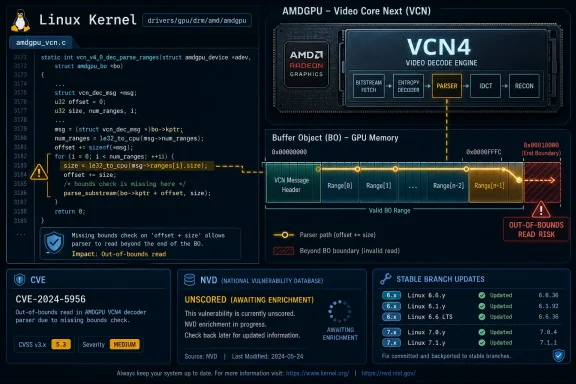
CVE-2026-46199 is a newly published Linux kernel vulnerability, disclosed by kernel.org and listed by NVD on May 28, 2026, in the AMDGPU VCN4 video decode path, where insufficient bounds checking could allow out-of-bounds reads while parsing decoder messages. The practical headline is not that every Linux desktop with an AMD GPU is suddenly on fire. It is that another low-level graphics-driver flaw has entered the security pipeline before the public scoring machinery has caught up. For WindowsForum readers, that makes this less a Linux-only curiosity than a reminder that GPU drivers now sit squarely in the operating-system attack surface.
There was a time when a graphics driver bug mostly meant flicker, a black screen, or a forum thread full of increasingly desperate kernel parameters. CVE-2026-46199 belongs to a newer class of driver issue: small, highly specific, buried in a hardware enablement path, and potentially relevant to security tooling before it is fully understood by the broader patch ecosystem.
The vulnerability sits in
The fix described by the kernel CVE record is terse: check bounds against the end of the BO whenever accessing the message. That is the sort of sentence that sounds bureaucratic until you remember what it means. Kernel code was reading structured data supplied through a buffer path without consistently proving that the read stayed inside the memory region it was supposed to inspect.
Out-of-bounds reads are often less dramatic than writes, but they should not be dismissed. Depending on context, they can cause crashes, leak adjacent memory, produce undefined behavior, or become useful primitives in a larger exploit chain. The current public record does not establish real-world exploitation, privilege escalation, or a weaponized proof of concept. It does establish that kernel maintainers treated the bug as a vulnerability and backported fixes across stable lines.
On a modern Linux desktop, a browser, media player, game launcher, remote desktop client, containerized graphical app, or machine-learning adjacent media pipeline may all touch hardware acceleration paths. The kernel driver brokers access to the GPU, schedules work, maps buffers, and interprets data structures that travel across layers most users never see. That makes every parser in the path a security-relevant parser.
The VCN decode path is a particularly good example of this shift. Video decoding is a high-throughput workload that must be fast enough not to irritate users and flexible enough to handle real-world media. Performance pressure and hardware complexity are exactly the environment where small assumptions about buffer length and message layout tend to survive code review until a fuzzing run, audit, or crash report proves otherwise.
The patch’s emphasis on checking against the end of the buffer object suggests a classic defensive programming correction: do not trust that the next field is available merely because the message format says it should be. In kernel space, that principle is unforgiving. A parser that walks beyond the end of a BO is no longer just parsing badly; it is reading memory outside the intended contract.
NVD enrichment is a downstream classification process. The fact that a CVE has not yet received a NIST score does not mean the bug is harmless, theoretical, or unimportant. It means the federal database has not yet attached the extra metadata that many vulnerability management systems use for sorting, deduplication, and reporting.
This has become a recurring problem for organizations that rely too heavily on CVSS as the first filter. A Linux kernel CVE can appear with a precise subsystem, a stable-tree fix, affected version ranges, and still lack the one number that many enterprise dashboards are built around. In that gap, the useful question is not “what is the score?” but “where is this code running, and how quickly will my distribution absorb the fix?”
The missing score also matters because graphics drivers do not fit neatly into old vulnerability categories. A server without a display may still have GPU hardware for compute or media transcoding. A workstation may expose hardware decode through a browser. A virtualization host may pass GPUs through to guests or rely on accelerated display stacks. Severity depends heavily on deployment context.
That matters more than the CVE prose. Kernel security response is often a branch-by-branch reality, not a single magic version number. A user running a distribution kernel labeled 6.12 may or may not be protected depending on whether the distro has pulled the relevant stable update or backported the specific commit.
For rolling-release users, the answer is usually straightforward: update once the patched kernel package lands, reboot, and verify the running kernel. For enterprise distributions, the version string may be misleading because vendors frequently backport fixes without changing the headline upstream kernel version. The only reliable answer is the vendor advisory or package changelog.
The risk is especially easy to misread on systems that rarely reboot. Kernel packages can install successfully while the machine continues running the vulnerable kernel until the next maintenance window. That is a familiar Windows problem as well: the installed patch and the active code are not always the same thing. Linux simply makes the mismatch easier to overlook because package managers can complete their work without forcing the issue.
That complexity is unavoidable. A contemporary GPU is not a single device so much as a federation of engines: display, command processing, memory management, video decode, video encode, firmware interfaces, power management, scheduling, and more. Each block has its own rings, buffers, packets, registers, and microcode interactions.
Security bugs in this territory rarely announce themselves with cinematic clarity. They look like a missing length check in a decoder message. They look like an assumption that a metrics structure is present. They look like code written for valid firmware-driver traffic that later has to survive invalid, malicious, corrupted, or merely unexpected input.
The lesson is not that AMD’s Linux driver is unusually unsafe. The lesson is that GPU drivers are now operating-system infrastructure, and operating-system infrastructure accumulates security debt wherever parsing and privilege meet. The more useful and capable the driver becomes, the more places there are for small memory-safety bugs to matter.
GPU security is also cross-platform in spirit even when the bug is platform-specific in code. Windows and Linux use different driver models, different kernels, and different vendor packaging channels, but they expose similar hardware capabilities to similar workloads. A flaw in Linux’s AMDGPU VCN4 parser does not imply the same defect exists in AMD’s Windows driver. It does remind us that the attack surface around hardware media acceleration is shared conceptually across ecosystems.
The Windows angle is particularly sharp for administrators who use Linux for infrastructure but Windows for management. Vulnerability management teams often triage Linux kernel CVEs from Windows dashboards, ticketing systems, and asset platforms. When NVD has not enriched the record, those systems can under-describe the exposure or fail to rank it cleanly.
There is also a workstation reality. Developers, security researchers, AI hobbyists, and gamers increasingly run high-end AMD hardware across multiple operating systems. The same person who ignores a Linux kernel CVE because “my main machine is Windows” may have a Fedora partition, a Proxmox host, a SteamOS-like handheld, or a Linux media box using the relevant AMDGPU path.
But sober is not the same as passive. Kernel CVEs with stable fixes should enter the normal patch process promptly, especially on machines that process untrusted media, expose graphical sessions to multiple users, or use GPU acceleration in shared environments. The practical work is modest: identify affected kernels, watch distribution advisories, deploy the fixed kernel when available, and reboot.
The most exposed systems are not necessarily the most obvious. A headless server with no monitor may still use AMD hardware for transcoding. A virtual desktop host may have GPU acceleration enabled for user sessions. A lab machine may process arbitrary sample media. A developer workstation may run containers or sandboxed apps that still touch host graphics interfaces through carefully configured device access.
Security teams should also be careful about compensating controls. Disabling hardware video acceleration might reduce exposure in some desktop scenarios, but it is a blunt and often impractical measure. The better default is to patch the kernel rather than turn a media pipeline into a performance incident.
This creates friction with enterprise tooling built for a smaller, more curated era of vulnerability disclosure. A firewall appliance flaw with a vendor advisory, exploit narrative, CVSS score, and mitigation section is easy to operationalize. A kernel driver CVE saying “prevent OOB reads when parsing dec msg” is harder. It requires someone to understand the subsystem, the affected versions, the distribution’s backport policy, and the asset context.
That difficulty should not be mistaken for low value. The kernel community’s stable process is often the earliest and most accurate source of remediation information. If the fix is in stable trees, distributions have something concrete to consume. The advisory may be plain, but the patch path is real.
The industry is still adjusting to this volume. As more kernel fixes receive CVE identifiers, organizations will need triage rules that combine vendor severity, exploit signals, subsystem exposure, asset role, and patch availability. A missing NVD score can no longer be a stop sign.
The AMDGPU VCN4 fix is a reminder that memory safety is not only a language debate. Even in C code written by expert maintainers, the decisive question is often whether every access is guarded by the right local fact. Is the pointer still inside the object? Is the field available before it is read? Does the parser stop when the buffer ends rather than when the message format would ideally end?
Those questions become more urgent in drivers because drivers translate between trust domains. User space, kernel space, firmware, device memory, and DMA-capable hardware all meet in the same neighborhood. A small read past the intended boundary can be less like reading one extra byte in an app and more like violating a carefully negotiated truce between layers.
The industry’s long-term answer may include more Rust in kernel components, more fuzzing of driver parsers, better sanitizers, and tighter hardware interface contracts. The short-term answer remains unglamorous: find the missing check, backport it, ship the kernel, reboot the machines.
Administrators should treat the vulnerability as a reminder to align patching with actual exposure rather than database completeness. If a system runs Linux with AMDGPU and VCN4-capable hardware, the relevant question is whether the running kernel contains the fix. If it does not, the next question is how soon the vendor-supported update can be deployed.
The most concrete points are these:
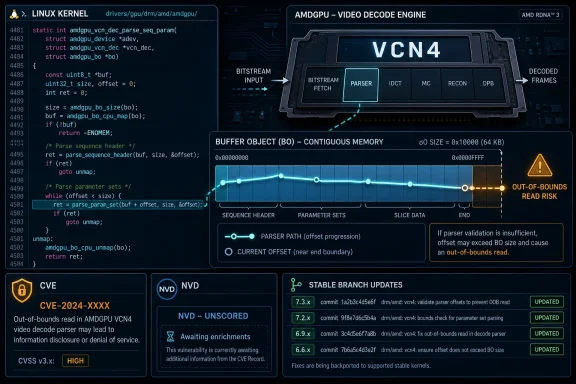 The GPU Driver Is No Longer Just a Display Problem
There was a time when a graphics driver bug mostly meant flicker, a black screen, or a forum thread full of increasingly desperate kernel parameters. CVE-2026-46199 belongs to a newer class of driver issue: small, highly specific, buried in a hardware enablement path, and potentially relevant to security tooling before it is fully understood by the broader patch ecosystem.The vulnerability sits in
drm/amdgpu/vcn4, part of the Linux kernel’s AMDGPU Direct Rendering Manager driver. VCN stands for Video Core Next, AMD’s dedicated video encode/decode block, and VCN4 is associated with newer AMD GPU generations. The affected code parses decoder messages and reads metrics from a buffer object, commonly shortened to BO in kernel graphics code.The fix described by the kernel CVE record is terse: check bounds against the end of the BO whenever accessing the message. That is the sort of sentence that sounds bureaucratic until you remember what it means. Kernel code was reading structured data supplied through a buffer path without consistently proving that the read stayed inside the memory region it was supposed to inspect.
Out-of-bounds reads are often less dramatic than writes, but they should not be dismissed. Depending on context, they can cause crashes, leak adjacent memory, produce undefined behavior, or become useful primitives in a larger exploit chain. The current public record does not establish real-world exploitation, privilege escalation, or a weaponized proof of concept. It does establish that kernel maintainers treated the bug as a vulnerability and backported fixes across stable lines.
A One-Line-Sounding Fix Hides a Large Trust Boundary
The interesting thing about this CVE is not that a driver needed another bounds check. It is that the boundary being checked exists between modern media workloads, GPU firmware-facing machinery, user-space acceleration stacks, and kernel memory safety. Video decode no longer means a passive helper chip quietly turning compressed frames into pixels.On a modern Linux desktop, a browser, media player, game launcher, remote desktop client, containerized graphical app, or machine-learning adjacent media pipeline may all touch hardware acceleration paths. The kernel driver brokers access to the GPU, schedules work, maps buffers, and interprets data structures that travel across layers most users never see. That makes every parser in the path a security-relevant parser.
The VCN decode path is a particularly good example of this shift. Video decoding is a high-throughput workload that must be fast enough not to irritate users and flexible enough to handle real-world media. Performance pressure and hardware complexity are exactly the environment where small assumptions about buffer length and message layout tend to survive code review until a fuzzing run, audit, or crash report proves otherwise.
The patch’s emphasis on checking against the end of the buffer object suggests a classic defensive programming correction: do not trust that the next field is available merely because the message format says it should be. In kernel space, that principle is unforgiving. A parser that walks beyond the end of a BO is no longer just parsing badly; it is reading memory outside the intended contract.
NVD’s Blank Score Is a Signal, Not an All-Clear
At publication, NVD marks CVE-2026-46199 as awaiting enrichment and shows no CVSS 4.0, 3.x, or 2.0 score from NIST. That absence will tempt some dashboards to treat the item as low priority or incomplete noise. Administrators should resist that temptation.NVD enrichment is a downstream classification process. The fact that a CVE has not yet received a NIST score does not mean the bug is harmless, theoretical, or unimportant. It means the federal database has not yet attached the extra metadata that many vulnerability management systems use for sorting, deduplication, and reporting.
This has become a recurring problem for organizations that rely too heavily on CVSS as the first filter. A Linux kernel CVE can appear with a precise subsystem, a stable-tree fix, affected version ranges, and still lack the one number that many enterprise dashboards are built around. In that gap, the useful question is not “what is the score?” but “where is this code running, and how quickly will my distribution absorb the fix?”
The missing score also matters because graphics drivers do not fit neatly into old vulnerability categories. A server without a display may still have GPU hardware for compute or media transcoding. A workstation may expose hardware decode through a browser. A virtualization host may pass GPUs through to guests or rely on accelerated display stacks. Severity depends heavily on deployment context.
The Affected Kernel Lines Tell the Real Patch Story
The public CVE metadata identifies the affected component asdrivers/gpu/drm/amd/amdgpu/vcn_v4_0.c and lists stable fixes across multiple kernel lines. The unaffected versions listed in public CVE aggregators include 6.6.140, 6.12.90, 6.18.32, 7.0.9, and 7.1-rc1. In plain terms, the fix has been carried into several supported branches rather than left only in a future mainline release.That matters more than the CVE prose. Kernel security response is often a branch-by-branch reality, not a single magic version number. A user running a distribution kernel labeled 6.12 may or may not be protected depending on whether the distro has pulled the relevant stable update or backported the specific commit.
For rolling-release users, the answer is usually straightforward: update once the patched kernel package lands, reboot, and verify the running kernel. For enterprise distributions, the version string may be misleading because vendors frequently backport fixes without changing the headline upstream kernel version. The only reliable answer is the vendor advisory or package changelog.
The risk is especially easy to misread on systems that rarely reboot. Kernel packages can install successfully while the machine continues running the vulnerable kernel until the next maintenance window. That is a familiar Windows problem as well: the installed patch and the active code are not always the same thing. Linux simply makes the mismatch easier to overlook because package managers can complete their work without forcing the issue.
AMDGPU’s Strength Is Also Its Exposure
The AMDGPU driver has been a major open-source success story. AMD’s upstream kernel work has helped make modern Radeon hardware a first-class Linux citizen, especially compared with the fragmented and proprietary pain that defined parts of the GPU world for years. But the same openness and breadth that make AMDGPU attractive also mean the driver carries a vast amount of hardware-specific complexity in public kernel code.That complexity is unavoidable. A contemporary GPU is not a single device so much as a federation of engines: display, command processing, memory management, video decode, video encode, firmware interfaces, power management, scheduling, and more. Each block has its own rings, buffers, packets, registers, and microcode interactions.
Security bugs in this territory rarely announce themselves with cinematic clarity. They look like a missing length check in a decoder message. They look like an assumption that a metrics structure is present. They look like code written for valid firmware-driver traffic that later has to survive invalid, malicious, corrupted, or merely unexpected input.
The lesson is not that AMD’s Linux driver is unusually unsafe. The lesson is that GPU drivers are now operating-system infrastructure, and operating-system infrastructure accumulates security debt wherever parsing and privilege meet. The more useful and capable the driver becomes, the more places there are for small memory-safety bugs to matter.
Windows Users Should Still Care About a Linux CVE
A Linux kernel CVE may seem outside the WindowsForum wheelhouse, but the boundary is thinner than it looks. Many Windows users now run Linux through WSL, dual-boot for development or gaming, maintain Linux servers at work, or administer mixed fleets where Windows endpoints coexist with Linux build hosts, Kubernetes nodes, media servers, and GPU-backed workstations.GPU security is also cross-platform in spirit even when the bug is platform-specific in code. Windows and Linux use different driver models, different kernels, and different vendor packaging channels, but they expose similar hardware capabilities to similar workloads. A flaw in Linux’s AMDGPU VCN4 parser does not imply the same defect exists in AMD’s Windows driver. It does remind us that the attack surface around hardware media acceleration is shared conceptually across ecosystems.
The Windows angle is particularly sharp for administrators who use Linux for infrastructure but Windows for management. Vulnerability management teams often triage Linux kernel CVEs from Windows dashboards, ticketing systems, and asset platforms. When NVD has not enriched the record, those systems can under-describe the exposure or fail to rank it cleanly.
There is also a workstation reality. Developers, security researchers, AI hobbyists, and gamers increasingly run high-end AMD hardware across multiple operating systems. The same person who ignores a Linux kernel CVE because “my main machine is Windows” may have a Fedora partition, a Proxmox host, a SteamOS-like handheld, or a Linux media box using the relevant AMDGPU path.
No Evidence of Exploitation Does Not Mean No Operational Work
The public record for CVE-2026-46199 does not currently show known exploitation in the wild. It also does not provide a NIST severity score or a detailed exploitability analysis. That should keep the conversation sober. This is not a reason to declare an emergency across every AMD-powered Linux desktop.But sober is not the same as passive. Kernel CVEs with stable fixes should enter the normal patch process promptly, especially on machines that process untrusted media, expose graphical sessions to multiple users, or use GPU acceleration in shared environments. The practical work is modest: identify affected kernels, watch distribution advisories, deploy the fixed kernel when available, and reboot.
The most exposed systems are not necessarily the most obvious. A headless server with no monitor may still use AMD hardware for transcoding. A virtual desktop host may have GPU acceleration enabled for user sessions. A lab machine may process arbitrary sample media. A developer workstation may run containers or sandboxed apps that still touch host graphics interfaces through carefully configured device access.
Security teams should also be careful about compensating controls. Disabling hardware video acceleration might reduce exposure in some desktop scenarios, but it is a blunt and often impractical measure. The better default is to patch the kernel rather than turn a media pipeline into a performance incident.
The CVE Factory Is Now Part of Kernel Life
One reason this item feels both precise and under-explained is that kernel.org has become more systematic about assigning CVEs to fixed kernel bugs. That is good for transparency, but it changes the texture of vulnerability feeds. Security teams now see many kernel CVEs that read like commit messages because, in essence, that is where the security truth begins.This creates friction with enterprise tooling built for a smaller, more curated era of vulnerability disclosure. A firewall appliance flaw with a vendor advisory, exploit narrative, CVSS score, and mitigation section is easy to operationalize. A kernel driver CVE saying “prevent OOB reads when parsing dec msg” is harder. It requires someone to understand the subsystem, the affected versions, the distribution’s backport policy, and the asset context.
That difficulty should not be mistaken for low value. The kernel community’s stable process is often the earliest and most accurate source of remediation information. If the fix is in stable trees, distributions have something concrete to consume. The advisory may be plain, but the patch path is real.
The industry is still adjusting to this volume. As more kernel fixes receive CVE identifiers, organizations will need triage rules that combine vendor severity, exploit signals, subsystem exposure, asset role, and patch availability. A missing NVD score can no longer be a stop sign.
The Patch Is Small Because the Lesson Is Old
Bounds checking is one of computing’s oldest security lessons, and yet it remains one of the most persistent. That is not because kernel developers do not know the rule. It is because real systems are full of structured buffers whose shape depends on hardware, firmware, negotiated capabilities, and assumptions inherited from earlier code.The AMDGPU VCN4 fix is a reminder that memory safety is not only a language debate. Even in C code written by expert maintainers, the decisive question is often whether every access is guarded by the right local fact. Is the pointer still inside the object? Is the field available before it is read? Does the parser stop when the buffer ends rather than when the message format would ideally end?
Those questions become more urgent in drivers because drivers translate between trust domains. User space, kernel space, firmware, device memory, and DMA-capable hardware all meet in the same neighborhood. A small read past the intended boundary can be less like reading one extra byte in an app and more like violating a carefully negotiated truce between layers.
The industry’s long-term answer may include more Rust in kernel components, more fuzzing of driver parsers, better sanitizers, and tighter hardware interface contracts. The short-term answer remains unglamorous: find the missing check, backport it, ship the kernel, reboot the machines.
The Real Risk Is Letting an Unscored Driver Bug Drift
For most WindowsForum readers, CVE-2026-46199 is not a panic item. It is a process item. The danger is that an unscored, narrowly described kernel GPU bug slips beneath the threshold of attention until it becomes part of the permanent backlog.Administrators should treat the vulnerability as a reminder to align patching with actual exposure rather than database completeness. If a system runs Linux with AMDGPU and VCN4-capable hardware, the relevant question is whether the running kernel contains the fix. If it does not, the next question is how soon the vendor-supported update can be deployed.
The most concrete points are these:
- CVE-2026-46199 affects the Linux kernel AMDGPU VCN4 video decode path and was published by NVD on May 28, 2026.
- The bug involves out-of-bounds reads while parsing decoder messages, with the fix adding bounds checks against the end of the buffer object.
- NVD had not assigned a CVSS score at publication time, so vulnerability dashboards may under-prioritize the issue unless teams apply their own context.
- Public metadata indicates fixes across multiple stable kernel lines, including 6.6.140, 6.12.90, 6.18.32, 7.0.9, and 7.1-rc1.
- The practical mitigation is to install the vendor’s patched kernel and reboot into it, not merely to install packages and assume the running system changed.
- Windows administrators should still track the issue if they manage Linux workstations, GPU-backed servers, dual-boot systems, media workloads, or mixed enterprise fleets.
References
- Primary source: NVD / Linux Kernel
Published: 2026-05-29T01:08:50-07:00
NVD - CVE-2026-46199
 nvd.nist.gov
- Security advisory: MSRC
Published: 2026-05-29T01:08:50-07:00
Original feed URL
Security Update Guide - Microsoft Security Response Center
 msrc.microsoft.com
- Official source: nist.gov
National Vulnerability Database
NIST maintains the National Vulnerability Database (NVD), a repository of information on software and hardware flaws that can compromise computer security. This is a key piece of the nation’s cybersecurity infrastructure.www.nist.gov - Related coverage: opennet.ru
- Related coverage: labs.cloudsecurityalliance.org
NVD Enrichment Triage: Enterprise Vulnerability Programs Must Adapt
PDF documentlabs.cloudsecurityalliance.org
- Related coverage: phoronix.com
AMD Posts Linux Driver Patches For New "VCN 4.0" IP Block - Phoronix
After last week AMD began posting the 'GFX11' patches for RDNA3, today AMD published a set of patches enabling the VCN 4.0 IP block for next-generation video encode/decode capabilities.www.phoronix.com
- Related coverage: kernel.org
- Related coverage: kernel.googlesource.com
- Related coverage: tomshardware.com
CISA flags actively exploited ‘Copy Fail’ Linux kernel flaw enabling root takeover across major distros — unpatched systems may remain vulnerable to attack | Tom's Hardware
Researchers released a working exploit before patches were ready.www.tomshardware.com - Related coverage: techradar.com
US government warns Linux flaw is now being exploited for ransomware attacks | TechRadar
A bug patched over a year ago is now being used for ransomwarewww.techradar.com