

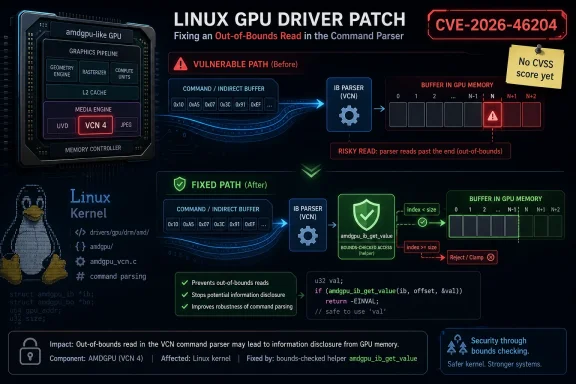
CVE-2026-46204 is a newly published Linux kernel vulnerability from kernel.org, disclosed by NVD on May 28, 2026, affecting AMDGPU VCN 4 command parsing in the
The phrase “out-of-bounds read” has a way of sounding less alarming than “remote code execution” or “privilege escalation,” but in kernel space the distinction is not comfort. CVE-2026-46204 lives in the AMDGPU driver’s VCN 4 path, where the kernel parses GPU indirect buffers tied to AMD’s video codec hardware. If that parser reads past the bounds of the buffer it was meant to inspect, the failure mode can range from a rejected job to a crash, information exposure, or a hard-to-debug GPU reset.
The upstream fix is telling because it is not a sweeping redesign. The kernel patch rewrites the relevant IB parsing to use
That kind of bug is common in driver code because drivers sit at the edge between structured software assumptions and hostile or malformed inputs. A GPU command stream is not a Word document attachment, but it is still input. It can be produced by user-space components, media stacks, browsers, game runtimes, containerized workloads, or compute frameworks, depending on the system.
For WindowsForum readers, the Linux label should not be a dismissal. Windows users increasingly touch Linux kernels through WSL, dual-boot workstations, homelab servers, media appliances, SteamOS-style gaming systems, and GPU-accelerated CI or AI boxes. The modern Windows ecosystem is not Windows-only; it is Windows plus adjacent kernels, shared hardware, and operational habits that often lag behind that reality.
This is now a familiar pattern for Linux kernel CVEs. The public record often appears with a terse description, a handful of stable-tree commit references, and very little context about exploitability. The kernel project may have already resolved the defect, while NVD has not yet attached a severity vector or full weakness classification. Patch management dashboards, however, tend to treat CVSS as oxygen.
That dependency creates a bad incentive. If an organization waits for a number, it may delay a fix that is already available. If it treats every unscored kernel CVE as urgent, it burns maintenance windows and administrator patience. CVE-2026-46204 sits squarely in the messy middle, where security operations must use engineering judgment rather than a red, orange, or green badge.
The practical question is not “what is the score?” but “where do AMDGPU VCN 4 workloads run in my environment?” A developer laptop with an AMD APU is different from a multi-user Linux workstation, which is different from a headless transcoding server, which is different again from a GPU node running untrusted containers. Same CVE, different blast radius.
The vulnerable area is not simply “the screen driver.” It is code involved in parsing indirect buffers used by the GPU command submission path. Indirect buffers are a normal part of how drivers hand work to the GPU: user space prepares commands, the kernel validates and patches them, and the hardware executes what is allowed. The security boundary is the validation step.
That boundary matters because the GPU is no longer a dumb display adapter. It is a programmable, shared, stateful accelerator with access to memory, firmware, queues, and complex scheduling. Every time the kernel accepts a command stream, it must distinguish legitimate work from malformed work without trusting the producer too much.
CVE-2026-46204 is therefore best understood as a parser hardening bug in a privileged driver. The patch’s move to a bounds-checked helper is not glamorous, but it is exactly the kind of change that prevents one malformed command from turning into memory the parser had no business reading.
That matters because Linux deployment is fragmented by design. Desktop distributions, enterprise distributions, appliance vendors, cloud images, NAS operating systems, and gaming-oriented builds may all carry different kernels with different patch cadences. A fix landing in the stable tree is the beginning of remediation, not the end of it.
For most users, the action is not to cherry-pick one Git commit by hand. The action is to take the next kernel update from the distribution or vendor that carries the AMDGPU stable fixes. For administrators maintaining custom kernels, the commit references are the audit trail: confirm whether the relevant stable fix has been merged into your branch, then test with the same GPU and workload profile that made you carry a custom kernel in the first place.
There is a subtle trap here for appliance-style systems. Media servers, gaming boxes, and lab machines often sit outside the normal patch discipline applied to corporate laptops and domain-joined Windows endpoints. They are exactly the systems likely to use hardware video acceleration, and exactly the systems likely to be updated “when something breaks.” CVE-2026-46204 is a reminder that GPU driver updates are security maintenance, not just performance tuning.
The attack surface is also constrained by hardware and code path. Systems without AMD GPUs using the affected VCN 4 path are not the same risk as systems actively exposing accelerated video decode or encode to untrusted workloads. A generic Linux server with no AMDGPU driver loaded has a very different exposure profile from a shared GPU workstation.
But “narrower” is not “irrelevant.” Local attack surfaces matter on multi-user machines, developer workstations, virtual desktop hosts, container hosts with GPU passthrough, and media services that process files supplied by others. Bugs in validation logic are especially interesting because they sit before the kernel has fully decided whether a command is safe.
The right posture is measured urgency. This is not a reason to panic-reboot every Linux system in the building before lunch. It is a reason to identify AMDGPU-equipped Linux machines, prioritize those processing untrusted media or serving multiple users, and schedule kernel updates without waiting for the CVSS bureaucracy to catch up.
WSL itself is not automatically the center of this particular issue. Typical WSL workloads do not own the host’s AMDGPU kernel driver in the way a native Linux install does. But the habits WSL created — treating Linux as a companion environment rather than a separate asset — are relevant. People who patch Windows monthly may leave their Linux GPU host on an old kernel for a year because it “just runs media.”
Enterprise environments have their own version of the same blind spot. Developer workstations with AMD GPUs, Linux-based render nodes, test benches, and edge devices often sit between IT and engineering ownership. Security teams may see the CVE in a feed, while the team that knows whether VCN 4 is actually used sits elsewhere.
This is where asset inventory beats vulnerability theater. If you can answer which Linux systems load
Kernel drivers are full of historical code shaped by performance concerns, hardware quirks, and incremental feature additions. A parser may start simple, then grow branches for new firmware messages, new chip families, and new command formats. Over time, the distance between “we checked the buffer length” and “we read this indexed value” can become security-relevant.
Centralized helpers are not a cure-all. They can be misused, bypassed, or misunderstood. But they reduce the number of places where a developer has to manually get integer arithmetic, buffer length, and command layout right under pressure.
That is why this CVE is more interesting than its current metadata suggests. It is a small example of the kernel community turning a bug report into a safer idiom. The immediate result is a fixed parser; the longer-term benefit is pressure to make adjacent parser paths harder to get wrong.
Systems that deserve earlier attention are the ones where untrusted or semi-trusted users can exercise the AMDGPU media path. Shared Linux desktops, GPU-backed remote workstations, student labs, render farms, and media processing services should move ahead of single-user hobby machines. If a service processes arbitrary video uploads and relies on hardware acceleration, it belongs higher still.
For home users, the advice is simpler. If you are on a rolling distribution, take the next kernel update and reboot. If you are on a stable distribution, watch for the next security or kernel update from your vendor. If you run a media server on AMD hardware and rarely patch it, this is a good excuse to do the maintenance you already knew was overdue.
Custom-kernel users have the hardest job because they do not get to outsource integration. They should inspect whether the stable commits referenced by the CVE are present in their branch, then test GPU video decode and encode paths after applying the fix. GPU regressions are real, and rushed kernel surgery can create availability problems even when the security patch is correct.
The concrete lessons are straightforward:
drm/amdgpu driver and fixed by replacing unsafe indirect-buffer reads with a bounds-checked helper. The bug is not yet scored by NVD, which means defenders are being asked to make patching decisions before the usual severity shorthand exists. That uncertainty is the story: another small kernel parsing flaw has arrived in the space where graphics drivers, media acceleration, and increasingly GPU-heavy workloads meet production risk.
 A Graphics Driver Bug Is Still a Kernel Bug
The phrase “out-of-bounds read” has a way of sounding less alarming than “remote code execution” or “privilege escalation,” but in kernel space the distinction is not comfort. CVE-2026-46204 lives in the AMDGPU driver’s VCN 4 path, where the kernel parses GPU indirect buffers tied to AMD’s video codec hardware. If that parser reads past the bounds of the buffer it was meant to inspect, the failure mode can range from a rejected job to a crash, information exposure, or a hard-to-debug GPU reset.The upstream fix is telling because it is not a sweeping redesign. The kernel patch rewrites the relevant IB parsing to use
amdgpu_ib_get_value(), a helper that performs bounds checks before returning data. In plain English, the vulnerable code was reading from a command buffer in a way that trusted indexes too much; the fixed code centralizes the read through a function designed to say “no” before the parser walks off the end.That kind of bug is common in driver code because drivers sit at the edge between structured software assumptions and hostile or malformed inputs. A GPU command stream is not a Word document attachment, but it is still input. It can be produced by user-space components, media stacks, browsers, game runtimes, containerized workloads, or compute frameworks, depending on the system.
For WindowsForum readers, the Linux label should not be a dismissal. Windows users increasingly touch Linux kernels through WSL, dual-boot workstations, homelab servers, media appliances, SteamOS-style gaming systems, and GPU-accelerated CI or AI boxes. The modern Windows ecosystem is not Windows-only; it is Windows plus adjacent kernels, shared hardware, and operational habits that often lag behind that reality.
The Missing CVSS Score Is a Governance Problem, Not a Safety Signal
NVD currently lists CVE-2026-46204 as awaiting enrichment, with no CVSS 4.0, 3.x, or 2.0 base score from NIST. That absence should not be read as “low risk.” It means the record is early, the metadata is incomplete, and security teams have to reason from the patch, the affected subsystem, and their own exposure.This is now a familiar pattern for Linux kernel CVEs. The public record often appears with a terse description, a handful of stable-tree commit references, and very little context about exploitability. The kernel project may have already resolved the defect, while NVD has not yet attached a severity vector or full weakness classification. Patch management dashboards, however, tend to treat CVSS as oxygen.
That dependency creates a bad incentive. If an organization waits for a number, it may delay a fix that is already available. If it treats every unscored kernel CVE as urgent, it burns maintenance windows and administrator patience. CVE-2026-46204 sits squarely in the messy middle, where security operations must use engineering judgment rather than a red, orange, or green badge.
The practical question is not “what is the score?” but “where do AMDGPU VCN 4 workloads run in my environment?” A developer laptop with an AMD APU is different from a multi-user Linux workstation, which is different from a headless transcoding server, which is different again from a GPU node running untrusted containers. Same CVE, different blast radius.
VCN 4 Puts the Bug in the Media Path, Not the Display Path Alone
AMD’s VCN block is the Video Core Next engine, the hardware responsible for video encode and decode acceleration on supported GPUs and APUs. VCN 4 appears in more recent AMD graphics generations, which makes this less about ancient hardware and more about contemporary systems that use GPU media acceleration as a normal part of the stack. That includes desktops, gaming handhelds, home servers, and Linux workstations handling video pipelines.The vulnerable area is not simply “the screen driver.” It is code involved in parsing indirect buffers used by the GPU command submission path. Indirect buffers are a normal part of how drivers hand work to the GPU: user space prepares commands, the kernel validates and patches them, and the hardware executes what is allowed. The security boundary is the validation step.
That boundary matters because the GPU is no longer a dumb display adapter. It is a programmable, shared, stateful accelerator with access to memory, firmware, queues, and complex scheduling. Every time the kernel accepts a command stream, it must distinguish legitimate work from malformed work without trusting the producer too much.
CVE-2026-46204 is therefore best understood as a parser hardening bug in a privileged driver. The patch’s move to a bounds-checked helper is not glamorous, but it is exactly the kind of change that prevents one malformed command from turning into memory the parser had no business reading.
The Stable-Tree References Say This Was Backported, Not Merely Fixed Upstream
The CVE record includes multiple stable kernel commit references, which is an important signal. A vulnerability fixed only in mainline is useful for developers and bleeding-edge distributions; a vulnerability fixed across stable trees is useful for real administrators. Backports mean the kernel maintainers judged the correction appropriate for maintained release lines, not just future kernels.That matters because Linux deployment is fragmented by design. Desktop distributions, enterprise distributions, appliance vendors, cloud images, NAS operating systems, and gaming-oriented builds may all carry different kernels with different patch cadences. A fix landing in the stable tree is the beginning of remediation, not the end of it.
For most users, the action is not to cherry-pick one Git commit by hand. The action is to take the next kernel update from the distribution or vendor that carries the AMDGPU stable fixes. For administrators maintaining custom kernels, the commit references are the audit trail: confirm whether the relevant stable fix has been merged into your branch, then test with the same GPU and workload profile that made you carry a custom kernel in the first place.
There is a subtle trap here for appliance-style systems. Media servers, gaming boxes, and lab machines often sit outside the normal patch discipline applied to corporate laptops and domain-joined Windows endpoints. They are exactly the systems likely to use hardware video acceleration, and exactly the systems likely to be updated “when something breaks.” CVE-2026-46204 is a reminder that GPU driver updates are security maintenance, not just performance tuning.
Exploitability Is Probably Narrower Than the Word “Kernel” Implies
A sober reading does not make this a sky-is-falling event. The description points to out-of-bounds reads during IB parsing, not arbitrary writes, not a confirmed privilege escalation, and not remote unauthenticated compromise. NVD has not provided a severity score, and the public material does not establish a weaponized exploit chain.The attack surface is also constrained by hardware and code path. Systems without AMD GPUs using the affected VCN 4 path are not the same risk as systems actively exposing accelerated video decode or encode to untrusted workloads. A generic Linux server with no AMDGPU driver loaded has a very different exposure profile from a shared GPU workstation.
But “narrower” is not “irrelevant.” Local attack surfaces matter on multi-user machines, developer workstations, virtual desktop hosts, container hosts with GPU passthrough, and media services that process files supplied by others. Bugs in validation logic are especially interesting because they sit before the kernel has fully decided whether a command is safe.
The right posture is measured urgency. This is not a reason to panic-reboot every Linux system in the building before lunch. It is a reason to identify AMDGPU-equipped Linux machines, prioritize those processing untrusted media or serving multiple users, and schedule kernel updates without waiting for the CVSS bureaucracy to catch up.
Windows Users Are Exposed Through the Systems They Forgot Were Linux
Most Windows enthusiasts no longer live in a single-kernel world. A Windows 11 desktop may run WSL for development, a separate Linux box for Plex or Jellyfin, a SteamOS handheld for gaming, and a Proxmox host in the closet. The security model of that household or small business is the sum of all those systems, not the badge on the main laptop.WSL itself is not automatically the center of this particular issue. Typical WSL workloads do not own the host’s AMDGPU kernel driver in the way a native Linux install does. But the habits WSL created — treating Linux as a companion environment rather than a separate asset — are relevant. People who patch Windows monthly may leave their Linux GPU host on an old kernel for a year because it “just runs media.”
Enterprise environments have their own version of the same blind spot. Developer workstations with AMD GPUs, Linux-based render nodes, test benches, and edge devices often sit between IT and engineering ownership. Security teams may see the CVE in a feed, while the team that knows whether VCN 4 is actually used sits elsewhere.
This is where asset inventory beats vulnerability theater. If you can answer which Linux systems load
amdgpu, which ones expose video acceleration to users or containers, and which kernel branch each one tracks, CVE-2026-46204 becomes manageable. If you cannot, the missing CVSS score is the least of your problems.The Patch Teaches the Larger Lesson: Bounds Checks Belong at the Access Point
The specific code change is small but philosophically important. Moving reads throughamdgpu_ib_get_value() means bounds checking becomes part of the access pattern rather than an optional precondition scattered around the parser. That is how mature low-level code gets safer: not by assuming every future edit remembers the rule, but by making the safer path the default path.Kernel drivers are full of historical code shaped by performance concerns, hardware quirks, and incremental feature additions. A parser may start simple, then grow branches for new firmware messages, new chip families, and new command formats. Over time, the distance between “we checked the buffer length” and “we read this indexed value” can become security-relevant.
Centralized helpers are not a cure-all. They can be misused, bypassed, or misunderstood. But they reduce the number of places where a developer has to manually get integer arithmetic, buffer length, and command layout right under pressure.
That is why this CVE is more interesting than its current metadata suggests. It is a small example of the kernel community turning a bug report into a safer idiom. The immediate result is a fixed parser; the longer-term benefit is pressure to make adjacent parser paths harder to get wrong.
Administrators Should Treat This Like a Driver-Scope Patch Window
For admins, the remediation path is conventional: update the kernel through the distribution or vendor channel, reboot into the fixed kernel, and confirm the running kernel is the one you intended. The less conventional part is deciding how quickly to do it before NVD provides severity enrichment.Systems that deserve earlier attention are the ones where untrusted or semi-trusted users can exercise the AMDGPU media path. Shared Linux desktops, GPU-backed remote workstations, student labs, render farms, and media processing services should move ahead of single-user hobby machines. If a service processes arbitrary video uploads and relies on hardware acceleration, it belongs higher still.
For home users, the advice is simpler. If you are on a rolling distribution, take the next kernel update and reboot. If you are on a stable distribution, watch for the next security or kernel update from your vendor. If you run a media server on AMD hardware and rarely patch it, this is a good excuse to do the maintenance you already knew was overdue.
Custom-kernel users have the hardest job because they do not get to outsource integration. They should inspect whether the stable commits referenced by the CVE are present in their branch, then test GPU video decode and encode paths after applying the fix. GPU regressions are real, and rushed kernel surgery can create availability problems even when the security patch is correct.
The Signal Hidden in One Small AMDGPU CVE
CVE-2026-46204 is not the kind of vulnerability that will dominate cable news, but it is precisely the kind that reveals how modern platform risk accumulates. The record is sparse, the score is missing, the patch is narrow, and the affected component is easy for non-Linux administrators to mentally file under “not my problem.” That is how real exposure often survives.The concrete lessons are straightforward:
- CVE-2026-46204 affects the Linux kernel’s AMDGPU VCN 4 parsing path and was published by NVD on May 28, 2026.
- The fix replaces direct or unsafe indirect-buffer reads with
amdgpu_ib_get_value(), which performs bounds checking. - NVD has not yet assigned CVSS scores, so organizations should not wait for severity metadata before assessing exposure.
- Systems with AMD GPUs that process untrusted media, support multiple users, or expose GPU acceleration to containers deserve priority.
- Most users should remediate through normal distribution kernel updates rather than manually applying individual stable-tree commits.
- Windows-centric teams should still inventory Linux GPU systems, because WSL-era infrastructure often includes Linux machines outside traditional endpoint patch routines.
References
- Primary source: NVD / Linux Kernel
Published: 2026-05-29T01:07:12-07:00
NVD - CVE-2026-46204
 nvd.nist.gov
- Security advisory: MSRC
Published: 2026-05-29T01:07:12-07:00
Original feed URL
Security Update Guide - Microsoft Security Response Center
 msrc.microsoft.com
