

CVE-2026-46230 is a newly published Linux kernel vulnerability, received by NVD from kernel.org on May 28, 2026, affecting AMDGPU’s VCN3 video decode message parsing path and fixed by adding bounds checks before accessing message metrics in GPU buffer objects. The immediate story is not a headline-grabbing remote takeover; it is a reminder that modern graphics drivers are part of the operating system’s attack surface, not decorative plumbing. For WindowsForum readers who live mostly in the Microsoft ecosystem, the useful lesson is broader: GPU acceleration, media decode, virtualization, and Linux-in-Windows workflows have collapsed the old boundary between “desktop feature” and “kernel security exposure.”
The kernel.org description of CVE-2026-46230 is almost aggressively terse: AMDGPU’s VCN3 decoder message parser could perform out-of-bounds reads while parsing a decode message, and the fix checks bounds against the end of the buffer object whenever the driver accesses
But the boring phrasing is the point. The vulnerable code sits in the Direct Rendering Manager stack, inside AMD’s open Linux graphics driver, in logic connected to VCN — AMD’s Video Core Next hardware block used for media encode and decode acceleration. The bug class is familiar: a parser trusts structured data in a buffer too far, or checks one part of a structure without checking each later access against the real end of the allocation.
Out-of-bounds reads are not automatically catastrophic. They can crash a subsystem, leak adjacent memory, or become useful as one primitive in a larger exploit chain, depending on exactly what can be influenced and what data can be observed. In a kernel driver, though, even modest memory-safety mistakes deserve respect because the parsing code runs close to the hardware boundary and inside the privileged kernel environment.
That is why this CVE matters despite the lack of a score. It is not because every AMD Linux desktop is suddenly in visible danger. It is because another GPU driver fix has been promoted into the CVE stream, and the industry’s long assumption that graphics bugs are merely “display bugs” continues to age badly.
That world is gone. GPUs now sit under browser compositing, video conferencing, hardware media decode, local AI workloads, remote desktop acceleration, containerized compute, and virtualization pass-through. A workstation may never launch a game and still exercise the GPU stack all day through Teams, Edge, Chrome, Electron apps, video playback, machine-learning tooling, or a Linux VM.
Linux made this even more interesting because major GPU drivers, including AMDGPU, live in the kernel tree and move through the same stable-branch machinery as storage, networking, and filesystem fixes. A patch to
VCN3 narrows the affected area to a particular AMD video-generation path, but not to an exotic use case. Hardware video decode is ordinary now. If a malformed command stream or crafted decode message can lead a driver to read beyond the buffer object it was meant to inspect, that lives in the same family of problems security engineers have spent years eliminating from image parsers, font engines, network protocol stacks, and filesystem metadata handlers.
The lesson is not that AMD is uniquely careless. The lesson is that GPU drivers are enormous, stateful, performance-sensitive parsers for attacker-influenced data. That combination produces a steady supply of bugs across vendors and operating systems.
That is a dangerous habit for kernel bugs. The Linux kernel CVE process now produces records for many fixes that would previously have remained as commit messages and mailing-list archaeology. Some are serious, some are narrow, and many require local access or particular hardware. The CVE label by itself does not tell you whether to wake the incident bridge, but the lack of a CVSS score does not tell you to ignore it either.
CVE-2026-46230 is a good example of the middle ground. There is no public indication in the supplied record that the flaw is being exploited in the wild. There is no NVD severity. The description does not claim privilege escalation, arbitrary code execution, or remote compromise. At the same time, the fix exists across multiple stable references, which means the kernel maintainers considered it appropriate to backport rather than leave it as a future cleanup.
The practical response is therefore boring and correct: track the kernel versions your distribution ships, confirm whether the AMDGPU VCN3 fix has landed in your update channel, and patch through your normal cadence unless your environment has an unusually exposed media-processing or untrusted-GPU-workload profile. The absence of drama is not the absence of work.
That creates a classic parser problem. A structure may begin within a valid allocation, but later fields, nested fields, or variable-length members may extend beyond it. A check that validates the start of a message is insufficient if subsequent reads walk past the end of the buffer.
The CVE text says the fix checks bounds whenever
Security impact depends on what an attacker can control and what the out-of-bounds data can influence. If the data is only read and discarded, the result may be a denial-of-service condition. If the data can be surfaced back to user space or used to steer logic, the implications become more serious. The public CVE record does not provide enough evidence to claim either path, and responsible coverage should not invent an exploit story to fill the gap.
Still, the fix pattern is recognizable. Defensive kernel code must validate not just object existence but object extent. GPU drivers, with their mix of user-submitted jobs, firmware interfaces, and hardware command formats, are exactly where “this pointer points somewhere valid” is not good enough.
But many WindowsForum readers now run Linux in places that sit beside or underneath their Windows workflows. WSL2 uses a real Linux kernel, developers boot Linux on secondary partitions, homelab users run Proxmox or other Linux-based hypervisors, and gaming enthusiasts increasingly use Linux distributions on AMD-powered desktops and handhelds. The Windows endpoint may be fine while the Linux environment on the same desk, rack, or device still needs attention.
WSL deserves a careful note. WSL2’s GPU compute and graphics integration does not simply make every Linux DRM driver bug applicable to every Windows machine. Microsoft’s architecture, kernel packaging, and device exposure model differ from a native Linux desktop. Administrators should avoid assuming that an upstream AMDGPU CVE maps directly to WSL risk without a Microsoft advisory or a specific affected component path.
Dual-boot and native Linux systems are simpler. If the machine boots a vulnerable Linux kernel with AMDGPU enabled on affected hardware, it belongs in scope. That includes developer workstations, media boxes, Linux gaming rigs, lab machines, and any appliance-like deployment using a general-purpose distribution on AMD graphics hardware.
The awkward modern reality is that “Windows shop” no longer means “Windows-only kernel exposure.” Once Linux appears in the workstation, CI runner, GPU node, or hypervisor layer, Linux kernel CVEs become part of the same patch conversation.
A corporate laptop fleet with Windows-only images probably has no direct exposure from this CVE. A mixed engineering fleet with Fedora, Ubuntu, Arch, or Debian testing on AMD desktops may. A media-transcoding server that accepts untrusted uploads and uses hardware decode deserves more scrutiny than a single-user Linux workstation playing local files. A GPU-enabled multi-user Linux host deserves still more.
Multi-user systems are where local driver bugs become more interesting. If unprivileged users can submit workloads to GPU queues, invoke accelerated media paths, or run containers with access to render nodes, then a kernel driver parser bug is not merely a theoretical local issue. It becomes part of the boundary between one user’s workload and the host kernel.
That does not mean this CVE is known to enable privilege escalation. It means the placement of the bug is security-relevant. The DRM render-node model intentionally gives unprivileged applications access to GPU services because modern desktops and compute stacks require it. Every parser reachable through that model must be held to kernel-grade memory-safety standards.
For administrators, the useful action is to map hardware, kernel versions, and workload trust. The least useful action is to argue about severity in the abstract while leaving kernel updates waiting for the next maintenance window.
That is both good and bad. More CVEs make it easier for scanners and asset systems to notice kernel fixes that matter. They also create noise, especially when NVD enrichment lags behind kernel.org publication. A record can exist with a short description, several stable commits, no severity, no weakness classification, and no distribution-specific package mapping.
Security teams have to adapt. CVE presence should trigger triage, not panic. CVSS absence should trigger investigation, not dismissal. Kernel subsystem, hardware reachability, local-versus-remote exposure, and distribution backport status often matter more than the first score that appears in a dashboard.
Linux distributions complicate this further because package versions do not always map neatly to upstream version strings. A distribution may backport the specific AMDGPU fix into an older kernel package without changing to a visibly “new” upstream kernel release. Conversely, a self-managed mainline kernel can look newer while still lacking a particular downstream patch if it was built before the fix landed.
That is why the serious answer is always distribution-aware. Check your vendor’s security tracker, package changelog, and kernel build notes. The upstream CVE tells you what was fixed; your distribution tells you whether your installed package actually contains the fix.
But openness also exposes just how much complexity lives in modern graphics stacks. A single GPU driver spans memory management, scheduling, display, video encode and decode, power management, firmware messaging, virtualization hooks, and user-space ABI compatibility. Every one of those areas has to evolve without breaking existing systems.
VCN decoder message parsing is a narrow slice of that machine. Yet it is representative of the broader challenge: hardware acceleration turns media formats and application requests into privileged driver interactions. When performance pressure is high and data structures are hardware-shaped, the temptation is always to assume that earlier validation covers later access. CVE-2026-46230 is the sort of bug that says, plainly, it did not.
This is not an indictment of open drivers. If anything, it is an argument for them. Public code paths can be audited, fuzzed, patched, backported, and discussed. The uncomfortable part is that transparency reveals a truth proprietary driver ecosystems often hide: GPU drivers are operating-system subsystems of comparable importance to networking and storage.
For Linux users on AMD hardware, the open model means the remediation path is conventional. Update the kernel package from the distribution or move to a stable kernel that includes the fix. Avoid random patch cherry-picking unless you own the support burden. Let the tested kernel stream do its job.
Any subsystem that consumes media-adjacent input deserves scrutiny because media is one of the internet’s favorite delivery formats. Users open videos casually. Browsers decode streams automatically. Collaboration tools preview content. Servers transcode uploads. The more hardware acceleration participates, the more kernel and firmware surfaces join what used to be a user-space parser problem.
Again, there is no public evidence that CVE-2026-46230 is remotely exploitable through an ordinary video file. The public record only says the kernel driver could read out of bounds when parsing a decoder message. But defenders should pay attention to the direction of travel. Media handling keeps moving downward into privileged acceleration layers, while untrusted content keeps flowing in from everywhere.
This is why browser sandboxes, GPU process isolation, render-node permissions, and kernel hardening are all parts of the same story. A bug in a GPU path may be unreachable in one architecture and reachable in another. It may be harmless on a single-user desktop and more worrying on a shared acceleration host. The exploitability is contextual, but the class of risk is not imaginary.
If your Linux systems process untrusted media at scale, GPU acceleration should be included in threat modeling. That does not mean turning it off by reflex. It means patching it, isolating it, monitoring it, and understanding which users or services can reach it.
That sounds elementary, but it is the hardest kind of elementary: the rule is simple, the codebase is vast, and the edge cases are buried in performance-critical paths that must preserve ABI behavior. Kernel developers do not get to rewrite every parser in a memory-safe language overnight. They fix one boundary, then another, then another, and stable maintainers carry those fixes back to the branches people actually run.
For security teams, this should temper both cynicism and complacency. Cynicism says, “Another Linux CVE, they are endless.” Complacency says, “It is only an out-of-bounds read with no score.” Both miss the maintenance reality. Kernel security is often a grinding process of eliminating small unsafe assumptions before they become useful exploit ingredients.
The best organizations treat such bugs as patch hygiene rather than emergency theater. They maintain hardware-aware inventories, follow vendor kernels, test updates promptly, and avoid letting GPU-enabled Linux boxes become snowflakes. That discipline matters more than any single CVE write-up.
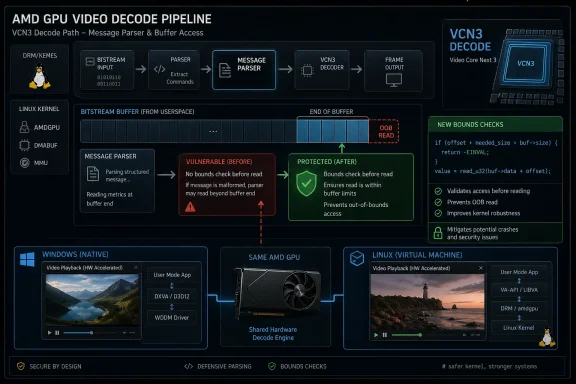 A Small Bounds Check Lands in a Very Large Attack Surface
The kernel.org description of CVE-2026-46230 is almost aggressively terse: AMDGPU’s VCN3 decoder message parser could perform out-of-bounds reads while parsing a decode message, and the fix checks bounds against the end of the buffer object whenever the driver accesses msg. That is the sort of sentence that can disappear into a weekly vulnerability feed, especially while NVD is still awaiting enrichment and has not assigned a CVSS score.But the boring phrasing is the point. The vulnerable code sits in the Direct Rendering Manager stack, inside AMD’s open Linux graphics driver, in logic connected to VCN — AMD’s Video Core Next hardware block used for media encode and decode acceleration. The bug class is familiar: a parser trusts structured data in a buffer too far, or checks one part of a structure without checking each later access against the real end of the allocation.
Out-of-bounds reads are not automatically catastrophic. They can crash a subsystem, leak adjacent memory, or become useful as one primitive in a larger exploit chain, depending on exactly what can be influenced and what data can be observed. In a kernel driver, though, even modest memory-safety mistakes deserve respect because the parsing code runs close to the hardware boundary and inside the privileged kernel environment.
That is why this CVE matters despite the lack of a score. It is not because every AMD Linux desktop is suddenly in visible danger. It is because another GPU driver fix has been promoted into the CVE stream, and the industry’s long assumption that graphics bugs are merely “display bugs” continues to age badly.
The GPU Driver Is No Longer Just a Driver
A decade ago, many administrators treated GPU drivers as client-side performance baggage. They were updated to fix flicker, game crashes, or CAD workstation quirks. Security teams cared, but GPU drivers rarely sat at the center of ordinary infrastructure risk discussions unless a workstation fleet depended on them.That world is gone. GPUs now sit under browser compositing, video conferencing, hardware media decode, local AI workloads, remote desktop acceleration, containerized compute, and virtualization pass-through. A workstation may never launch a game and still exercise the GPU stack all day through Teams, Edge, Chrome, Electron apps, video playback, machine-learning tooling, or a Linux VM.
Linux made this even more interesting because major GPU drivers, including AMDGPU, live in the kernel tree and move through the same stable-branch machinery as storage, networking, and filesystem fixes. A patch to
drm/amdgpu is not an optional vendor control-panel update in the Windows sense. It can be part of the kernel package that decides what code runs in ring 0 on a developer laptop, a media server, a SteamOS-style gaming handheld, or a GPU-enabled compute node.VCN3 narrows the affected area to a particular AMD video-generation path, but not to an exotic use case. Hardware video decode is ordinary now. If a malformed command stream or crafted decode message can lead a driver to read beyond the buffer object it was meant to inspect, that lives in the same family of problems security engineers have spent years eliminating from image parsers, font engines, network protocol stacks, and filesystem metadata handlers.
The lesson is not that AMD is uniquely careless. The lesson is that GPU drivers are enormous, stateful, performance-sensitive parsers for attacker-influenced data. That combination produces a steady supply of bugs across vendors and operating systems.
NVD’s Empty Scoreboard Should Not Be Mistaken for an All-Clear
At publication time, NVD marks CVE-2026-46230 as awaiting enrichment, with no CVSS 4.0, 3.x, or 2.0 score from NIST. That absence is administratively important but operationally limited. Security teams often sort vulnerability queues by CVSS, and a CVE without a score can be misread as a low-priority item simply because dashboards have not yet learned how to rank it.That is a dangerous habit for kernel bugs. The Linux kernel CVE process now produces records for many fixes that would previously have remained as commit messages and mailing-list archaeology. Some are serious, some are narrow, and many require local access or particular hardware. The CVE label by itself does not tell you whether to wake the incident bridge, but the lack of a CVSS score does not tell you to ignore it either.
CVE-2026-46230 is a good example of the middle ground. There is no public indication in the supplied record that the flaw is being exploited in the wild. There is no NVD severity. The description does not claim privilege escalation, arbitrary code execution, or remote compromise. At the same time, the fix exists across multiple stable references, which means the kernel maintainers considered it appropriate to backport rather than leave it as a future cleanup.
The practical response is therefore boring and correct: track the kernel versions your distribution ships, confirm whether the AMDGPU VCN3 fix has landed in your update channel, and patch through your normal cadence unless your environment has an unusually exposed media-processing or untrusted-GPU-workload profile. The absence of drama is not the absence of work.
The Buffer Object Boundary Is the Real Story
The phrase “end of the BO” in the kernel description is doing a lot of work. In DRM and GPU driver terminology, a buffer object is a chunk of memory managed for GPU use. User space and kernel code coordinate through these objects, and drivers frequently parse command buffers or messages that describe what the hardware should do.That creates a classic parser problem. A structure may begin within a valid allocation, but later fields, nested fields, or variable-length members may extend beyond it. A check that validates the start of a message is insufficient if subsequent reads walk past the end of the buffer.
The CVE text says the fix checks bounds whenever
msg is accessed. That wording suggests the old code may have validated too little or too early, then assumed later metric fields were still inside the buffer. In ordinary application code, this might be an information-disclosure bug or a crash. In a kernel driver, it is a privileged read from memory the code had no business touching.Security impact depends on what an attacker can control and what the out-of-bounds data can influence. If the data is only read and discarded, the result may be a denial-of-service condition. If the data can be surfaced back to user space or used to steer logic, the implications become more serious. The public CVE record does not provide enough evidence to claim either path, and responsible coverage should not invent an exploit story to fill the gap.
Still, the fix pattern is recognizable. Defensive kernel code must validate not just object existence but object extent. GPU drivers, with their mix of user-submitted jobs, firmware interfaces, and hardware command formats, are exactly where “this pointer points somewhere valid” is not good enough.
Windows Users Are Not the Target, but They Are Not Outside the Blast Radius
This is a Linux kernel CVE, not a Windows kernel CVE. A standard Windows 11 installation using AMD’s Windows display driver is not directly affected by this Linux AMDGPU flaw. That distinction matters, because cross-platform component names can make vulnerability feeds sound broader than they are.But many WindowsForum readers now run Linux in places that sit beside or underneath their Windows workflows. WSL2 uses a real Linux kernel, developers boot Linux on secondary partitions, homelab users run Proxmox or other Linux-based hypervisors, and gaming enthusiasts increasingly use Linux distributions on AMD-powered desktops and handhelds. The Windows endpoint may be fine while the Linux environment on the same desk, rack, or device still needs attention.
WSL deserves a careful note. WSL2’s GPU compute and graphics integration does not simply make every Linux DRM driver bug applicable to every Windows machine. Microsoft’s architecture, kernel packaging, and device exposure model differ from a native Linux desktop. Administrators should avoid assuming that an upstream AMDGPU CVE maps directly to WSL risk without a Microsoft advisory or a specific affected component path.
Dual-boot and native Linux systems are simpler. If the machine boots a vulnerable Linux kernel with AMDGPU enabled on affected hardware, it belongs in scope. That includes developer workstations, media boxes, Linux gaming rigs, lab machines, and any appliance-like deployment using a general-purpose distribution on AMD graphics hardware.
The awkward modern reality is that “Windows shop” no longer means “Windows-only kernel exposure.” Once Linux appears in the workstation, CI runner, GPU node, or hypervisor layer, Linux kernel CVEs become part of the same patch conversation.
Enterprise IT Should Care Most About Inventory, Not Panic
The right operational question is not “Is CVE-2026-46230 critical?” The right question is “Where do we run affected kernels with AMDGPU VCN3 paths reachable by untrusted or semi-trusted workloads?” That answer will vary wildly.A corporate laptop fleet with Windows-only images probably has no direct exposure from this CVE. A mixed engineering fleet with Fedora, Ubuntu, Arch, or Debian testing on AMD desktops may. A media-transcoding server that accepts untrusted uploads and uses hardware decode deserves more scrutiny than a single-user Linux workstation playing local files. A GPU-enabled multi-user Linux host deserves still more.
Multi-user systems are where local driver bugs become more interesting. If unprivileged users can submit workloads to GPU queues, invoke accelerated media paths, or run containers with access to render nodes, then a kernel driver parser bug is not merely a theoretical local issue. It becomes part of the boundary between one user’s workload and the host kernel.
That does not mean this CVE is known to enable privilege escalation. It means the placement of the bug is security-relevant. The DRM render-node model intentionally gives unprivileged applications access to GPU services because modern desktops and compute stacks require it. Every parser reachable through that model must be held to kernel-grade memory-safety standards.
For administrators, the useful action is to map hardware, kernel versions, and workload trust. The least useful action is to argue about severity in the abstract while leaving kernel updates waiting for the next maintenance window.
The Kernel CVE Firehose Is Changing How We Read Linux Security
CVE-2026-46230 also sits inside a larger shift: Linux kernel fixes now appear as CVEs more routinely, and that has changed the texture of vulnerability management. The old model forced administrators to infer security relevance from commit messages, stable changelogs, distribution advisories, and vendor backports. The new model creates more CVE records, but not necessarily more immediate clarity.That is both good and bad. More CVEs make it easier for scanners and asset systems to notice kernel fixes that matter. They also create noise, especially when NVD enrichment lags behind kernel.org publication. A record can exist with a short description, several stable commits, no severity, no weakness classification, and no distribution-specific package mapping.
Security teams have to adapt. CVE presence should trigger triage, not panic. CVSS absence should trigger investigation, not dismissal. Kernel subsystem, hardware reachability, local-versus-remote exposure, and distribution backport status often matter more than the first score that appears in a dashboard.
Linux distributions complicate this further because package versions do not always map neatly to upstream version strings. A distribution may backport the specific AMDGPU fix into an older kernel package without changing to a visibly “new” upstream kernel release. Conversely, a self-managed mainline kernel can look newer while still lacking a particular downstream patch if it was built before the fix landed.
That is why the serious answer is always distribution-aware. Check your vendor’s security tracker, package changelog, and kernel build notes. The upstream CVE tells you what was fixed; your distribution tells you whether your installed package actually contains the fix.
AMDGPU’s Openness Cuts Both Ways
AMDGPU’s presence in the upstream Linux kernel is a strength. Bugs can be reviewed publicly, fixed in stable branches, and consumed by distributions without waiting for a black-box binary driver release cycle. The CVE references point to stable kernel commits rather than a vague vendor advisory promising that a future installer will resolve the issue.But openness also exposes just how much complexity lives in modern graphics stacks. A single GPU driver spans memory management, scheduling, display, video encode and decode, power management, firmware messaging, virtualization hooks, and user-space ABI compatibility. Every one of those areas has to evolve without breaking existing systems.
VCN decoder message parsing is a narrow slice of that machine. Yet it is representative of the broader challenge: hardware acceleration turns media formats and application requests into privileged driver interactions. When performance pressure is high and data structures are hardware-shaped, the temptation is always to assume that earlier validation covers later access. CVE-2026-46230 is the sort of bug that says, plainly, it did not.
This is not an indictment of open drivers. If anything, it is an argument for them. Public code paths can be audited, fuzzed, patched, backported, and discussed. The uncomfortable part is that transparency reveals a truth proprietary driver ecosystems often hide: GPU drivers are operating-system subsystems of comparable importance to networking and storage.
For Linux users on AMD hardware, the open model means the remediation path is conventional. Update the kernel package from the distribution or move to a stable kernel that includes the fix. Avoid random patch cherry-picking unless you own the support burden. Let the tested kernel stream do its job.
The Media Path Is Becoming a Security Boundary
The most interesting word in the CVE title may be “dec,” shorthand for decode. Media decode used to feel like a convenience feature. Today it is an always-on optimization across browsers, conferencing tools, streaming clients, remote desktops, and AI-adjacent video workflows.Any subsystem that consumes media-adjacent input deserves scrutiny because media is one of the internet’s favorite delivery formats. Users open videos casually. Browsers decode streams automatically. Collaboration tools preview content. Servers transcode uploads. The more hardware acceleration participates, the more kernel and firmware surfaces join what used to be a user-space parser problem.
Again, there is no public evidence that CVE-2026-46230 is remotely exploitable through an ordinary video file. The public record only says the kernel driver could read out of bounds when parsing a decoder message. But defenders should pay attention to the direction of travel. Media handling keeps moving downward into privileged acceleration layers, while untrusted content keeps flowing in from everywhere.
This is why browser sandboxes, GPU process isolation, render-node permissions, and kernel hardening are all parts of the same story. A bug in a GPU path may be unreachable in one architecture and reachable in another. It may be harmless on a single-user desktop and more worrying on a shared acceleration host. The exploitability is contextual, but the class of risk is not imaginary.
If your Linux systems process untrusted media at scale, GPU acceleration should be included in threat modeling. That does not mean turning it off by reflex. It means patching it, isolating it, monitoring it, and understanding which users or services can reach it.
The Patch Is Simple Because the Failure Mode Is Old
There is a humility in fixes like this. The kernel does not need a new security architecture to address this particular flaw. It needs the parser to check that each access stays within the buffer object it was handed.That sounds elementary, but it is the hardest kind of elementary: the rule is simple, the codebase is vast, and the edge cases are buried in performance-critical paths that must preserve ABI behavior. Kernel developers do not get to rewrite every parser in a memory-safe language overnight. They fix one boundary, then another, then another, and stable maintainers carry those fixes back to the branches people actually run.
For security teams, this should temper both cynicism and complacency. Cynicism says, “Another Linux CVE, they are endless.” Complacency says, “It is only an out-of-bounds read with no score.” Both miss the maintenance reality. Kernel security is often a grinding process of eliminating small unsafe assumptions before they become useful exploit ingredients.
The best organizations treat such bugs as patch hygiene rather than emergency theater. They maintain hardware-aware inventories, follow vendor kernels, test updates promptly, and avoid letting GPU-enabled Linux boxes become snowflakes. That discipline matters more than any single CVE write-up.
The Practical Signal Hidden in CVE-2026-46230
CVE-2026-46230 is not the vulnerability that should make a Windows administrator suddenly fear every AMD GPU. It is the vulnerability that should make a mixed-platform administrator ask whether GPU drivers are visible in the same patch and inventory systems as kernels, browsers, and hypervisors. That is the real maturity test.- Systems running only Windows display drivers are not directly affected by this Linux kernel AMDGPU CVE.
- Native Linux systems using AMDGPU on hardware that exercises the VCN3 video path should receive kernel updates from their distribution or stable kernel provider.
- NVD’s lack of a CVSS score as of May 29, 2026, should be treated as missing metadata, not as proof of low risk.
- Multi-user Linux hosts, GPU compute boxes, media-processing systems, and developer workstations deserve higher triage priority than single-purpose machines with no untrusted GPU workloads.
- WSL2 exposure should not be assumed from the upstream Linux CVE alone; administrators should wait for Microsoft-specific guidance or inspect the actual kernel and device-exposure model in use.
- Distribution backports matter more than upstream version numerology, so package changelogs and vendor advisories are the authoritative operational sources.
References
- Primary source: NVD / Linux Kernel
Published: 2026-05-29T01:06:35-07:00
NVD - CVE-2026-46230
 nvd.nist.gov
- Security advisory: MSRC
Published: 2026-05-29T01:06:35-07:00
Original feed URL
Security Update Guide - Microsoft Security Response Center
 msrc.microsoft.com
- Related coverage: kernel.googlesource.com
- Related coverage: opennet.ru
- Related coverage: vuldb.com
CVE-2026-23030 Linux Kernel inno-usb2 rockchip_usb2phy_probe double free
A flaw has been found in Linux Kernel up to 6.6.121/6.12.66/6.18.6/6.19-rc5. This vulnerability appears as CVE-2026-23030. You should upgrade the affected component.vuldb.com - Related coverage: labs.cloudsecurityalliance.org
CSA research note dirty frag linux lpe container 20260509 csa styled
PDF documentlabs.cloudsecurityalliance.org
- Related coverage: support.bull.com
- Related coverage: cvepremium.circl.lu
Vulnerability-Lookup
Vulnerability-Lookup - Fast vulnerability lookup correlation from different sources.cvepremium.circl.lu - Related coverage: vulnerability.circl.lu
Vulnerability-Lookup
Vulnerability-Lookup - Fast vulnerability lookup correlation from different sources.vulnerability.circl.lu - Related coverage: cve.circl.lu
Vulnerability-Lookup
Vulnerability-Lookup - Fast vulnerability lookup correlation from different sources.cve.circl.lu
