

CVE-2026-46197 is a newly published Linux kernel vulnerability, received by NVD on May 28, 2026, in AMD’s amdkfd GPU compute driver, where an unchecked user-controlled SVM attribute count could allow out-of-bounds buffer access before the kernel-side ioctl handler validates the request. The fix is small, but the lesson is not. Modern GPU drivers are no longer peripheral plumbing; they are part of the attack surface for AI workstations, Linux desktops, compute clusters, and Windows-adjacent environments running Linux kernels under virtualization or dual-boot workflows. This is the kind of CVE that looks forgettable in a dashboard and still deserves a serious read.
The patch behind CVE-2026-46197 does not introduce a dramatic subsystem rewrite. It validates the
That is classic kernel-hardening work: turn implicit trust into explicit accounting. A userspace caller says, in effect, “I am sending you this many attributes,” and the kernel must verify that the buffer is large enough before walking through them. If it does not, the driver risks reading or touching memory beyond the intended structure.
The affected code sits in
That distinction matters. A flaw in a GPU compute ioctl is not the same as a remote wormable network bug, but it is also not “just graphics.” The GPU stack has become a privileged broker for memory, processes, accelerators, and high-throughput workloads, and every ioctl exposed to userspace is a contract the kernel must enforce precisely.
This is now routine for Linux kernel CVEs. Since the kernel project began assigning CVEs at far greater scale, many entries appear first as terse descriptions of resolved commits rather than fully contextualized vulnerability advisories. Security teams get a sentence, a subsystem, a commit list, and a clock that starts ticking before traditional enrichment arrives.
For administrators, that changes the workflow. Waiting for a polished severity score can be rational for application CVEs where exploitability is unclear, but kernel driver bugs often need to be triaged by exposure. Is the driver built? Is the hardware present? Is untrusted local code allowed? Are containers, GPU workloads, or shared developer systems in play?
The right first reaction is not panic. It is inventory.
If the count is larger than the buffer can legitimately contain, the kernel may operate beyond the intended boundary. In the public patch discussion, the fix adds a validation hook for the SVM ioctl and uses a safe size calculation to ensure that the structure plus
That is important not only because it blocks this specific path, but because it puts validation at the ioctl dispatch layer. The patch does not rely on deeper SVM logic to discover that the request is malformed after state has already been interpreted. It rejects the shape of the request before the handler does meaningful work.
The phrase “out-of-bounds buffer access” can cover a range of consequences, from denial of service to information disclosure to more serious memory corruption primitives depending on direction, context, compiler behavior, and reachable code paths. The public record for this CVE does not currently establish a practical exploit chain, privilege escalation path, or remote attack scenario. The responsible reading is narrower: malformed local input to the AMDKFD SVM ioctl could cross a buffer boundary, and the kernel patch closes that gap.
Local kernel attack surface matters because local users are not always trusted users. A build server may execute third-party code. A research workstation may run student workloads. A desktop may run packages pulled from sprawling language ecosystems. A container host may expose GPU devices into workloads that administrators think of as isolated but that still share kernel driver code underneath.
The ioctl boundary is particularly sensitive because it is a designed entry point from userspace into privileged code. Linux drivers expose ioctl commands when ordinary read/write abstractions are insufficient, which is almost always the case for complex devices. That flexibility comes at a price: every field must be treated as hostile until validated.
For WindowsForum readers, the Linux label does not make this irrelevant. Many Windows professionals now administer mixed estates where Windows 11, WSL, Hyper-V, Linux servers, Proxmox hosts, and GPU-accelerated developer environments coexist. A vulnerability in Linux’s AMD GPU stack may not touch a stock Windows desktop, but it can absolutely matter to the same organization, the same hardware fleet, and the same people managing risk.
The affected SVM path is tied to shared virtual memory, a mechanism intended to make CPU and GPU memory interactions more coherent for compute programs. In broad terms, SVM reduces the awkwardness of shuttling data between host and accelerator by allowing a programming model where memory can be shared or addressed more naturally across processors. That is useful for performance and programmability, but it also means the kernel driver is mediating subtle memory-management requests from userspace.
Subtle memory-management interfaces are unforgiving. A bad count field, an unchecked length, or an integer overflow in a size calculation can undermine assumptions that later code depends upon. The patch’s use of a safe structure-size calculation is not glamorous, but it is exactly the kind of defensive programming that kernel interfaces need.
This is also why GPU driver CVEs can feel under-described. The exploitability of a specific ioctl bug depends on kernel configuration, device access permissions, hardware presence, driver version, and the surrounding code path. A one-line CVE description cannot capture all of that. The administrator’s job is to translate the subsystem name into operational exposure.
For most users, the answer is not to pull a raw commit from kernel.org and build a custom kernel. The answer is to watch the distribution kernel stream. Ubuntu, Debian, Fedora, Arch, SUSE, Red Hat-derived distributions, and specialized workstation images all have their own cadence for consuming stable fixes. Enterprise kernels may backport the fix without changing the visible upstream version number, which is why package changelogs and vendor advisories matter more than
Rolling-release users may receive this quickly. Enterprise users may receive it through a security or bug-fix kernel update after vendor testing. Appliance-like Linux installations may lag until the vendor ships an image. That unevenness is not a failure of Linux; it is how a broad kernel supply chain works.
The risk for organizations is assuming that “fixed upstream” means “fixed here.” It does not. The kernel community can resolve the bug, stable maintainers can queue it, and distributions can still take time to package, test, sign, and distribute the update. Your exposure ends when your running kernel contains the fix, not when the CVE page exists.
That is why severity must be contextual. A home user who dual-boots into Linux once a month and does not run untrusted local code has a different risk profile from a university GPU lab. A CI system compiling random pull requests on AMD GPU hosts has a different profile from a single-user desktop. A container platform that passes
The absence of NVD scoring also creates a communication problem. Patch dashboards may sort it into an unprioritized bucket. Ticketing systems may fail to route it because the severity field is blank. Security teams that automate too aggressively around CVSS can miss fresh kernel CVEs during the most important window: after disclosure but before enrichment.
The better rule is simple: if a kernel CVE touches a driver you expose to users or workloads, triage it even before the score arrives. You can downgrade later if the environment is not affected.
This does not mean every containerized AMD GPU workload is exploitable. It means the security boundary deserves scrutiny. Device passthrough, group permissions, runtime hooks, and orchestration defaults all determine whether untrusted or semi-trusted code can talk to AMDKFD.
GPU-enabled containers are common in AI and media environments because acceleration is the point. Administrators often grant device access broadly to make frameworks work, then forget how much privilege that implies. A vulnerability like CVE-2026-46197 is a reminder that GPU access is not merely a performance feature; it is an entry into a large kernel driver.
Windows-heavy shops can fall into the same trap when Linux GPU hosts are treated as specialist infrastructure outside normal endpoint governance. The workstation under the researcher’s desk or the lab server running ROCm is still part of the attack surface. If it runs untrusted code and exposes GPU devices, it belongs in the vulnerability-management program.
WSL complicates the mental model but not enough to justify alarmism. WSL 2 uses a Microsoft-provided Linux kernel and a virtualization-based graphics integration model rather than simply loading the host’s native Linux AMD kernel driver as though the machine had booted Linux directly. That makes the exposure different from a bare-metal Linux install with
The practical advice for WSL users is still boring and correct: keep Windows updated, keep WSL updated, and do not assume that every upstream Linux driver CVE maps cleanly onto WSL. Administrators managing GPU compute inside WSL should verify the specific kernel and GPU interface they expose rather than relying on the CVE name alone.
Dual-boot systems are different. If the same hardware boots a Linux distribution with AMDGPU and AMDKFD support, the Linux side should be patched like any other affected Linux machine. The fact that the computer spends most of its life in Windows does not patch the kernel it boots on Thursdays.
That can be frustrating for defenders. The CVE feed gets noisier. Entries arrive with sparse prose. Scores lag. Some issues are serious in one environment and irrelevant in another. The result is a vulnerability-management workload that feels less like reading advisories and more like doing source-aware operations.
But there is a positive side. More identifiers mean fewer silent fixes buried in changelogs. A small bounds check in a GPU ioctl now gets a tracking number, stable references, and a place in the public vulnerability record. That helps organizations that would otherwise never notice a driver patch unless it caused a regression.
The trade-off is that teams need better filtering. “Linux kernel CVE” is not enough information. The useful fields are subsystem, driver, configuration, hardware, privilege boundary, and whether untrusted users can reach the interface. CVE-2026-46197 is best understood through that lens.
Good security patches often look like this. They do not announce a new architecture. They close a trust gap that should never have existed and add a reusable hook so the same kind of validation can be attached cleanly. In this case, the ioctl descriptor gains a validation function, and the SVM ioctl uses it.
That design is preferable to sprinkling ad hoc checks deep inside handler logic. Early validation makes malformed input fail before the driver’s internal assumptions become complicated. It also makes future review easier because the ioctl table advertises which commands have special validation requirements.
The broader engineering lesson is that flexible ABI structures need rigorous size checks at the boundary. Variable-length arrays, count fields, and userspace-controlled metadata are unavoidable in complex drivers. They are also where kernel code must be most suspicious.
On a single-user Linux desktop, the practical step is to install kernel updates as soon as the distribution ships them and reboot into the updated kernel. On shared systems, administrators should additionally review group membership and device permissions. Access to GPU compute devices should be intentional, not inherited accidentally because a user needed one experiment to run six months ago.
For fleets, the hard part is usually visibility. Kernel package versions vary, vendor backports obscure upstream version numbers, and GPU-capable hosts may sit outside normal server inventories. Security teams should tag systems by hardware and workload class, not just operating system. “Linux” is too broad; “Linux hosts exposing AMD KFD to non-admin users” is actionable.
Where patching must wait, access control is the interim lever. Reducing which users or containers can issue ioctls to the affected driver lowers exposure while the kernel update moves through testing. That is not a substitute for patching, but it is a useful containment measure.
A few points should survive the next dashboard refresh:
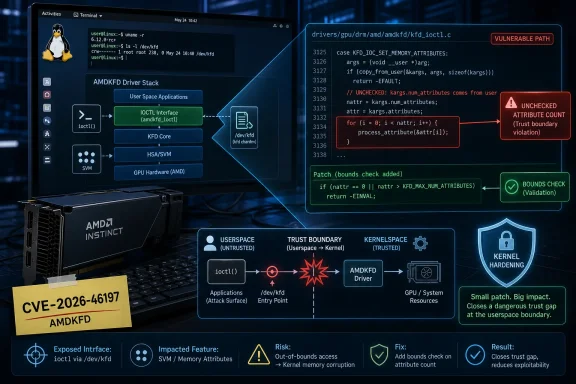 A Tiny Bounds Check Lands in a Very Large Attack Surface
The patch behind CVE-2026-46197 does not introduce a dramatic subsystem rewrite. It validates the nattr field used by the AMDKFD SVM ioctl against the size of the user-provided buffer, rejecting malformed input when the declared number of attributes would exceed the data actually supplied.That is classic kernel-hardening work: turn implicit trust into explicit accounting. A userspace caller says, in effect, “I am sending you this many attributes,” and the kernel must verify that the buffer is large enough before walking through them. If it does not, the driver risks reading or touching memory beyond the intended structure.
The affected code sits in
drm/amdkfd, the AMD Kernel Fusion Driver used for GPU compute support. AMDKFD is tied to HSA-style compute workloads, ROCm-adjacent use cases, and GPU memory management paths that ordinary desktop users may never intentionally invoke but that can still be present on machines with supported AMD hardware and drivers.That distinction matters. A flaw in a GPU compute ioctl is not the same as a remote wormable network bug, but it is also not “just graphics.” The GPU stack has become a privileged broker for memory, processes, accelerators, and high-throughput workloads, and every ioctl exposed to userspace is a contract the kernel must enforce precisely.
The CVE Arrived Before the Risk Score Did
NVD currently marks CVE-2026-46197 as awaiting enrichment, with no CVSS 4.0, CVSS 3.x, or CVSS 2.0 score assigned by NIST at publication time. That absence should not be mistaken for low severity. It means the public record is still in the early administrative stage: the identifier exists, the description is known, and the upstream references point to kernel stable commits, but the scoring machinery has not caught up.This is now routine for Linux kernel CVEs. Since the kernel project began assigning CVEs at far greater scale, many entries appear first as terse descriptions of resolved commits rather than fully contextualized vulnerability advisories. Security teams get a sentence, a subsystem, a commit list, and a clock that starts ticking before traditional enrichment arrives.
For administrators, that changes the workflow. Waiting for a polished severity score can be rational for application CVEs where exploitability is unclear, but kernel driver bugs often need to be triaged by exposure. Is the driver built? Is the hardware present? Is untrusted local code allowed? Are containers, GPU workloads, or shared developer systems in play?
The right first reaction is not panic. It is inventory.
The Bug Is About Trusting a Count Too Early
The vulnerable pattern is easy to understand because it is one of the oldest classes of systems programming mistakes. Userspace provides a structure containing a count field and a variable-length array of attributes. The kernel receives the request, copies data into a kernel buffer, and later uses the count to decide how much attribute data to process.If the count is larger than the buffer can legitimately contain, the kernel may operate beyond the intended boundary. In the public patch discussion, the fix adds a validation hook for the SVM ioctl and uses a safe size calculation to ensure that the structure plus
nattr attributes fits within the supplied ioctl buffer. If the computed size overflows or exceeds the user buffer size, the call fails with -EINVAL.That is important not only because it blocks this specific path, but because it puts validation at the ioctl dispatch layer. The patch does not rely on deeper SVM logic to discover that the request is malformed after state has already been interpreted. It rejects the shape of the request before the handler does meaningful work.
The phrase “out-of-bounds buffer access” can cover a range of consequences, from denial of service to information disclosure to more serious memory corruption primitives depending on direction, context, compiler behavior, and reachable code paths. The public record for this CVE does not currently establish a practical exploit chain, privilege escalation path, or remote attack scenario. The responsible reading is narrower: malformed local input to the AMDKFD SVM ioctl could cross a buffer boundary, and the kernel patch closes that gap.
Local Kernel Bugs Still Matter in the Age of Shared GPUs
It is tempting to classify this as a niche local bug and move on. That would have been easier a decade ago, when GPU compute was mostly the territory of specialized workstations and HPC clusters. In 2026, GPU compute is everywhere: AI development boxes, university labs, media pipelines, cloud workstations, container hosts, and engineering desktops with large AMD cards installed for workloads that blur the line between graphics and compute.Local kernel attack surface matters because local users are not always trusted users. A build server may execute third-party code. A research workstation may run student workloads. A desktop may run packages pulled from sprawling language ecosystems. A container host may expose GPU devices into workloads that administrators think of as isolated but that still share kernel driver code underneath.
The ioctl boundary is particularly sensitive because it is a designed entry point from userspace into privileged code. Linux drivers expose ioctl commands when ordinary read/write abstractions are insufficient, which is almost always the case for complex devices. That flexibility comes at a price: every field must be treated as hostile until validated.
For WindowsForum readers, the Linux label does not make this irrelevant. Many Windows professionals now administer mixed estates where Windows 11, WSL, Hyper-V, Linux servers, Proxmox hosts, and GPU-accelerated developer environments coexist. A vulnerability in Linux’s AMD GPU stack may not touch a stock Windows desktop, but it can absolutely matter to the same organization, the same hardware fleet, and the same people managing risk.
AMD’s Compute Driver Is No Longer an Exotic Corner
AMDKFD began as infrastructure for heterogeneous compute, but the world has moved toward it. ROCm, open GPU compute, and AI workloads have made the AMD Linux graphics stack more strategically important than it used to be. That makes the driver’s security posture more visible.The affected SVM path is tied to shared virtual memory, a mechanism intended to make CPU and GPU memory interactions more coherent for compute programs. In broad terms, SVM reduces the awkwardness of shuttling data between host and accelerator by allowing a programming model where memory can be shared or addressed more naturally across processors. That is useful for performance and programmability, but it also means the kernel driver is mediating subtle memory-management requests from userspace.
Subtle memory-management interfaces are unforgiving. A bad count field, an unchecked length, or an integer overflow in a size calculation can undermine assumptions that later code depends upon. The patch’s use of a safe structure-size calculation is not glamorous, but it is exactly the kind of defensive programming that kernel interfaces need.
This is also why GPU driver CVEs can feel under-described. The exploitability of a specific ioctl bug depends on kernel configuration, device access permissions, hardware presence, driver version, and the surrounding code path. A one-line CVE description cannot capture all of that. The administrator’s job is to translate the subsystem name into operational exposure.
Stable Backports Are the Real Advisory
The NVD entry points to multiple stable kernel commits, which is usually the practical signal that maintainers considered the fix suitable for supported stable branches. In the Linux ecosystem, that often matters more than the CVE prose. A patch that lands across stable lines is a patch that distribution kernels will likely absorb through their normal update channels.For most users, the answer is not to pull a raw commit from kernel.org and build a custom kernel. The answer is to watch the distribution kernel stream. Ubuntu, Debian, Fedora, Arch, SUSE, Red Hat-derived distributions, and specialized workstation images all have their own cadence for consuming stable fixes. Enterprise kernels may backport the fix without changing the visible upstream version number, which is why package changelogs and vendor advisories matter more than
uname -r alone.Rolling-release users may receive this quickly. Enterprise users may receive it through a security or bug-fix kernel update after vendor testing. Appliance-like Linux installations may lag until the vendor ships an image. That unevenness is not a failure of Linux; it is how a broad kernel supply chain works.
The risk for organizations is assuming that “fixed upstream” means “fixed here.” It does not. The kernel community can resolve the bug, stable maintainers can queue it, and distributions can still take time to package, test, sign, and distribute the update. Your exposure ends when your running kernel contains the fix, not when the CVE page exists.
The Missing CVSS Score Should Not Drive the Patch Calendar
CVSS is useful, but it is often late and sometimes misleading for kernel driver bugs. A local flaw in a device-specific path may score lower than a remote network vulnerability, yet still be urgent on a shared GPU workstation. Conversely, a scary phrase like “out-of-bounds” may have limited practical reach if the driver is absent, the hardware is unsupported, or device node permissions block untrusted users.That is why severity must be contextual. A home user who dual-boots into Linux once a month and does not run untrusted local code has a different risk profile from a university GPU lab. A CI system compiling random pull requests on AMD GPU hosts has a different profile from a single-user desktop. A container platform that passes
/dev/kfd into workloads has a different profile again.The absence of NVD scoring also creates a communication problem. Patch dashboards may sort it into an unprioritized bucket. Ticketing systems may fail to route it because the severity field is blank. Security teams that automate too aggressively around CVSS can miss fresh kernel CVEs during the most important window: after disclosure but before enrichment.
The better rule is simple: if a kernel CVE touches a driver you expose to users or workloads, triage it even before the score arrives. You can downgrade later if the environment is not affected.
Containers Do Not Magically Contain Kernel Drivers
One of the most important practical questions is whether GPU access is exposed into containers or sandboxed workloads. Containers share the host kernel. If a workload can reach the relevant device node and issue ioctls to the driver, the kernel does not care that the process began life inside a container abstraction.This does not mean every containerized AMD GPU workload is exploitable. It means the security boundary deserves scrutiny. Device passthrough, group permissions, runtime hooks, and orchestration defaults all determine whether untrusted or semi-trusted code can talk to AMDKFD.
GPU-enabled containers are common in AI and media environments because acceleration is the point. Administrators often grant device access broadly to make frameworks work, then forget how much privilege that implies. A vulnerability like CVE-2026-46197 is a reminder that GPU access is not merely a performance feature; it is an entry into a large kernel driver.
Windows-heavy shops can fall into the same trap when Linux GPU hosts are treated as specialist infrastructure outside normal endpoint governance. The workstation under the researcher’s desk or the lab server running ROCm is still part of the attack surface. If it runs untrusted code and exposes GPU devices, it belongs in the vulnerability-management program.
WSL Is Adjacent, Not Automatically Exposed
For Windows users, the obvious question is whether this affects Windows Subsystem for Linux. The safest answer is that CVE-2026-46197 is a Linux kernel AMD driver issue, not a Windows kernel CVE, and ordinary Windows installations do not run the upstream Linux AMDKFD driver as their native GPU stack.WSL complicates the mental model but not enough to justify alarmism. WSL 2 uses a Microsoft-provided Linux kernel and a virtualization-based graphics integration model rather than simply loading the host’s native Linux AMD kernel driver as though the machine had booted Linux directly. That makes the exposure different from a bare-metal Linux install with
/dev/kfd available.The practical advice for WSL users is still boring and correct: keep Windows updated, keep WSL updated, and do not assume that every upstream Linux driver CVE maps cleanly onto WSL. Administrators managing GPU compute inside WSL should verify the specific kernel and GPU interface they expose rather than relying on the CVE name alone.
Dual-boot systems are different. If the same hardware boots a Linux distribution with AMDGPU and AMDKFD support, the Linux side should be patched like any other affected Linux machine. The fact that the computer spends most of its life in Windows does not patch the kernel it boots on Thursdays.
The Patch Tells a Broader Story About Kernel CVE Volume
CVE-2026-46197 is also an example of the modern Linux kernel CVE pipeline. The kernel is enormous, fast-moving, and heavily backported. Many fixes that once would have been seen as ordinary robustness improvements now receive CVE identifiers when they resolve reachable memory-safety defects.That can be frustrating for defenders. The CVE feed gets noisier. Entries arrive with sparse prose. Scores lag. Some issues are serious in one environment and irrelevant in another. The result is a vulnerability-management workload that feels less like reading advisories and more like doing source-aware operations.
But there is a positive side. More identifiers mean fewer silent fixes buried in changelogs. A small bounds check in a GPU ioctl now gets a tracking number, stable references, and a place in the public vulnerability record. That helps organizations that would otherwise never notice a driver patch unless it caused a regression.
The trade-off is that teams need better filtering. “Linux kernel CVE” is not enough information. The useful fields are subsystem, driver, configuration, hardware, privilege boundary, and whether untrusted users can reach the interface. CVE-2026-46197 is best understood through that lens.
The Patch Is Small Because the Contract Was Simple
The most striking thing about the fix is its simplicity. The kernel already knows the size of the copied ioctl buffer. The SVM arguments already contain the number of attributes. The missing step was to compare those two facts safely before trusting the count.Good security patches often look like this. They do not announce a new architecture. They close a trust gap that should never have existed and add a reusable hook so the same kind of validation can be attached cleanly. In this case, the ioctl descriptor gains a validation function, and the SVM ioctl uses it.
That design is preferable to sprinkling ad hoc checks deep inside handler logic. Early validation makes malformed input fail before the driver’s internal assumptions become complicated. It also makes future review easier because the ioctl table advertises which commands have special validation requirements.
The broader engineering lesson is that flexible ABI structures need rigorous size checks at the boundary. Variable-length arrays, count fields, and userspace-controlled metadata are unavoidable in complex drivers. They are also where kernel code must be most suspicious.
What Administrators Should Actually Do
The operational response should be proportionate. This is not a reason to disable every AMD GPU or yank Linux workstations off the network. It is a reason to identify where AMDKFD is present, where/dev/kfd is accessible, and where untrusted workloads can run.On a single-user Linux desktop, the practical step is to install kernel updates as soon as the distribution ships them and reboot into the updated kernel. On shared systems, administrators should additionally review group membership and device permissions. Access to GPU compute devices should be intentional, not inherited accidentally because a user needed one experiment to run six months ago.
For fleets, the hard part is usually visibility. Kernel package versions vary, vendor backports obscure upstream version numbers, and GPU-capable hosts may sit outside normal server inventories. Security teams should tag systems by hardware and workload class, not just operating system. “Linux” is too broad; “Linux hosts exposing AMD KFD to non-admin users” is actionable.
Where patching must wait, access control is the interim lever. Reducing which users or containers can issue ioctls to the affected driver lowers exposure while the kernel update moves through testing. That is not a substitute for patching, but it is a useful containment measure.
The Signal Hidden in This AMDGPU Fix
The concrete lesson of CVE-2026-46197 is not that AMD’s Linux driver is uniquely dangerous. It is that GPU drivers have joined the same security conversation as filesystems, network stacks, hypervisors, and container runtimes. They broker privileged operations for increasingly untrusted workloads.A few points should survive the next dashboard refresh:
- CVE-2026-46197 affects the Linux kernel’s AMD KFD GPU compute driver, specifically validation of the SVM ioctl attribute count against the supplied buffer size.
- The vulnerability was published by NVD on May 28, 2026, but NVD had not yet assigned CVSS scores at the time of the public entry.
- The upstream fix rejects malformed SVM ioctl requests when the computed attribute structure size overflows or exceeds the user buffer.
- Systems without the relevant AMDGPU/AMDKFD exposure are unlikely to have the same practical risk as shared Linux GPU hosts.
- Containers and developer workloads can still reach kernel driver attack surface if GPU device nodes are passed through.
- The safest remediation path is to apply distribution kernel updates containing the stable backport and reboot into the fixed kernel.
References
- Primary source: NVD / Linux Kernel
Published: 2026-05-29T01:04:57-07:00
NVD - CVE-2026-46197
 nvd.nist.gov
- Security advisory: MSRC
Published: 2026-05-29T01:04:57-07:00
Original feed URL
Security Update Guide - Microsoft Security Response Center
 msrc.microsoft.com
- Related coverage: gitlab.com
