

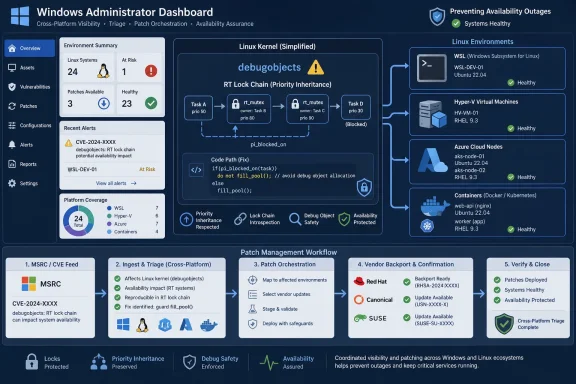
Microsoft’s Security Update Guide now lists CVE-2026-53327, a Linux kernel debugobjects flaw in which real-time kernels can trip over priority-inheritance state while refilling the debug-object pool, turning an internal correctness bug into a plausible availability problem. The important part is not that Windows suddenly has a new Linux kernel bug; it is that Microsoft’s security ecosystem increasingly has to track Linux plumbing because Windows shops increasingly run Linux in WSL, Hyper-V, Azure, containers, appliances, and developer workstations. This is a small CVE with a large lesson: mixed Windows-and-Linux fleets have made “not my operating system” a bad patch-management strategy.
The vulnerability is titled “debugobjects: Do not fill_pool() if pi_blocked_on,” and the fix is exactly as terse as that sounds. On RT-enabled kernels, the kernel’s debug object infrastructure could call into locking code while the current task was already blocked on a priority-inheritance lock. The kernel-side patch expands the condition so the pool refill path does not run when that
That makes CVE-2026-53327 less glamorous than a browser zero-day and more important than its name suggests. It is not a mass-market phishing payload waiting to happen; it is a reminder that kernel reliability bugs become security issues when they can be made to crash systems that users and businesses depend on.
The story begins with an odd-looking pairing: a Microsoft Security Response Center page for a Linux kernel CVE. That can look, at first glance, like a category error. Microsoft’s advisory surface is associated in most administrators’ minds with Windows, Edge, Office, Exchange, SharePoint, .NET, Azure, and the company’s monthly patch cadence.
But the modern Microsoft estate is no longer a Windows-only estate. WSL 2 runs a Linux kernel in a lightweight virtualized environment. Azure customers operate Linux images at enormous scale. Windows developers routinely build, test, and ship software inside Linux containers. Enterprise security teams ingest MSRC, NVD, distro, GitHub, and vendor feeds into the same vulnerability-management platforms.
So when Microsoft lists CVE-2026-53327, the practical reading is not “Windows 11 is vulnerable because Linux debugobjects exists.” The better reading is: Microsoft is one of the many places administrators may now encounter a Linux kernel vulnerability, and the presence of that CVE in a Microsoft-facing feed can be enough to trigger scanners, tickets, exceptions, and confused help-desk escalations.
That confusion matters because the bug itself is narrow. Per the NVD description, the vulnerable path involves Linux kernel debugobjects on RT-enabled kernels, where
In plain English, the kernel can reach a state where its own debugging infrastructure asks for more debug objects at exactly the wrong time. On a real-time kernel, that can collide with the lock-state rules that keep priority inheritance sane. The fix is not a mitigation knob or a firewall rule; it is a code-path guard.
The patch posted to the Linux kernel mailing list by Helen Koike describes the bug with the bluntness typical of kernel work. In RT context,
That sentence is dense, but it carries the whole security meaning. Priority inheritance exists to stop high-priority real-time tasks from being indefinitely blocked behind lower-priority tasks. The kernel tracks who is waiting on what so it can temporarily boost priority and preserve latency guarantees. If that chain is corrupted or overwritten, the kernel is no longer in a state where it can safely reason about its locks.
For most WindowsForum readers, the immediate implication is not “panic.” It is “scope.” This is a Linux kernel real-time configuration bug in
The Microsoft wrinkle is still real. Microsoft’s infrastructure, tools, and user base are now close enough to Linux that a Linux CVE may land in a Windows admin’s queue. The wrong reaction is to dismiss it because the word “Linux” appears. The equally wrong reaction is to assume every Windows endpoint needs emergency remediation. The right reaction is to map where Linux kernels actually exist in your estate.
A crash in a developer’s disposable test VM is noise. A crash in a low-latency control environment, embedded Linux appliance, virtualization host, storage path, lab instrument, or production node can be an outage. Real-time Linux deployments often exist precisely where latency and uptime are not academic concerns.
The bug also has an awkward relationship with debugging and hardening builds. Debug infrastructure is frequently more prominent in development, validation, fuzzing, and specialized kernels than in ordinary consumer distributions. That does not make the bug irrelevant; it means the affected population may be smaller but more operationally sensitive.
This is why CVE labels can mislead. A CVE that is narrow in exploitability may still be painful in the wrong environment. A kernel panic on a single-node appliance, a CI worker, or a line-of-business Linux VM can do more damage to a business process than a theoretically scarier bug that is unreachable in the deployed configuration.
The public reporting so far does not support treating CVE-2026-53327 as a widespread active-exploitation event. OpenCVE characterizes it as a medium-severity issue with very low exploitation probability and no known-exploited status. That should inform prioritization, not justify ignoring it.
The table should not be read as a command to download an upstream kernel and drop it into production. Enterprise distributions backport fixes, carry custom patches, and expose version strings that do not map cleanly to upstream stable numbers. Red Hat, SUSE, Ubuntu, Debian, appliance vendors, cloud image vendors, and embedded platform maintainers may all fix the same bug without advertising one of those exact upstream versions in
That is where Windows-heavy organizations often stumble. A vulnerability scanner sees a kernel version, compares it with upstream metadata, and opens a ticket. The admin sees an enterprise distro kernel that looks “old” but may contain the fix. The security team sees a CVE in a Microsoft or NVD feed and wants proof. The answer is vendor advisory correlation, not guesswork from a single version string.
If you maintain custom Linux kernels, the task is more direct. Check whether your tree contains the debugobjects change that avoids
The kernel patch itself captures that difference. It notes that, for non-RT kernels, assumptions about
That is not a user-friendly vulnerability description, but it is unusually revealing. The bug is not simply “a bad function was called.” It is “a function that may be tolerable in one kernel configuration becomes dangerous when the kernel’s locking model changes.” This is exactly why real-time and low-latency variants deserve their own patch review, not blind inheritance from generic server guidance.
The practical upshot is that administrators should not ask only, “What kernel version are we running?” They should also ask, “What kernel configuration are we running?”
For developers using WSL, this distinction is helpful. The presence of a Linux kernel under Windows does not automatically mean the RT/debugobjects combination is present or reachable. For platform teams running tuned Linux images, custom kernels, or real-time workloads, the distinction is less comforting and more actionable.
That language is standard, but it is not meaningless. It tells administrators something they already know but often wish were not true: advisory pages are not operational guarantees. A vendor page can tell you a vulnerability exists, point you to summary text, and publish references. It cannot know whether your custom kernel, appliance image, air-gapped lab machine, WSL environment, or distro-backported package is actually exposed.
For WindowsForum readers, that is the key distinction between “security information” and “security decision.” MSRC can surface CVE-2026-53327. NVD can summarize the kernel.org CVE record. The Linux mailing list can show the patch rationale. OpenCVE can aggregate severity and status. None of those individually knows your fleet.
That is why the phrase “as is” matters operationally, not just legally. The burden shifts to the organization to correlate source, environment, vendor packaging, configuration, and business impact. A scanner finding is not the end of that process; it is the beginning.
May 18, 2026 — Public kernel trees show the debugobjects fix appearing in the broader Linux development flow.
July 1, 2026 — The CVE record for CVE-2026-53327 is published, with the NVD entry describing the Linux kernel vulnerability and listing affected version ranges.
July 4, 2026 — Public CVE aggregation data shows the record updated, including affected-version metadata and references to stable kernel fixes.
The sequence is ordinary, which is part of the point. A kernel bug is reported, patched, merged, backported, assigned a CVE, and then absorbed by vulnerability-management systems. By the time many enterprise teams see the issue, it is no longer a patch email; it is a compliance object with a CVE ID, affected-version ranges, scanner logic, and remediation deadlines.
That lag creates friction. Kernel developers think in patches and trees. Security teams think in CVEs and SLAs. Windows administrators think in KBs, builds, and reboot rings. Linux distribution maintainers think in backports and package revisions. CVE-2026-53327 sits at the intersection of those worlds.
The best organizations translate between them instead of letting one vocabulary dominate. If the security ticket says “CVE-2026-53327,” the platform answer should say whether the relevant Linux systems are running RT-enabled kernels, whether debugobjects is enabled, what distro package contains the fix, and what reboot or live-patching path applies.
Start with developer machines. WSL has made Linux tooling normal on Windows laptops, but it has also made kernel provenance a new inventory concern. Most developer workstations are unlikely to be running custom RT debug kernels inside WSL, but security teams still need a policy for how WSL kernel updates are tracked, especially in regulated environments.
Then consider Hyper-V and virtualization labs. Windows-centric infrastructure teams often host Linux VMs for build agents, test harnesses, monitoring tools, network appliances, or vendor-provided virtual appliances. Those systems may sit outside the main Linux server program precisely because they are “just a utility VM.” That is how small kernel bugs become unmanaged risk.
Azure broadens the picture further. Linux dominates many cloud-native workloads, and Microsoft’s cloud customers may run marketplace images, custom images, container hosts, Kubernetes nodes, or appliances that inherit kernel exposure from a base image. The fact that a Microsoft-facing advisory exists may be the first way a Windows-heavy team notices a Linux kernel issue in an Azure estate.
Containers are more subtle. A container image does not carry its own host kernel in the ordinary Linux container model. The vulnerable component is the host kernel, not a userspace image layer. That means rebuilding an application container is not the fix; patching or replacing the node kernel is. This distinction is especially important for teams that are comfortable patching Windows applications but newer to Linux container-host security.
Finally, there are vendor appliances. Backup products, firewalls, storage gateways, telemetry collectors, lab systems, and industrial devices may run Linux under a web UI. The vendor, not the customer, controls kernel patching. CVE-2026-53327 is exactly the kind of issue where the right question to a vendor is not “Are you vulnerable because NVD says Linux?” but “Do your affected products use RT-enabled kernels with debugobjects, and have you incorporated the upstream fix?”
A mature triage process should separate four questions. Is the system running Linux? Is the kernel in an affected lineage? Is the vulnerable configuration present? Has the vendor or maintainer shipped the fix? Only after those are answered does it make sense to debate urgency, maintenance windows, or compensating controls.
The weakest version of patch management answers only the first two questions. It sees “Linux” and “affected version” and demands action. The strongest version gets to configuration and vendor provenance. It knows that a backported enterprise kernel may be fixed despite an old-looking version string, and that a custom real-time kernel may be exposed despite looking modern enough at a glance.
This is also why administrators should keep kernel configuration artifacts, package changelogs, and vendor advisories close to vulnerability tickets. A screenshot of
That is precisely why it is useful. It shows how vulnerability management now works in the real world: small upstream bugs become CVEs, CVEs become scanner findings, scanner findings cross product boundaries, and Windows administrators end up interpreting Linux kernel state. The job is no longer to memorize one vendor’s patch calendar. The job is to understand how software stacks overlap.
For organizations that live mostly in Microsoft tooling, the operational lesson is simple but uncomfortable. MSRC showing a Linux CVE is not a reason to panic, and it is not a reason to shrug. It is a prompt to verify whether your Microsoft-adjacent estate includes affected Linux kernels and whether those kernels are patched by the people who actually maintain them.
CVE-2026-53327 is a narrow Linux kernel fix with a Microsoft-shaped distribution lesson: the future of enterprise patching is not one operating system, one vendor feed, or one monthly ritual, but a continuous exercise in knowing where your kernels are, who built them, which configuration they carry, and how quickly you can turn an upstream patch into operational certainty.
The vulnerability is titled “debugobjects: Do not fill_pool() if pi_blocked_on,” and the fix is exactly as terse as that sounds. On RT-enabled kernels, the kernel’s debug object infrastructure could call into locking code while the current task was already blocked on a priority-inheritance lock. The kernel-side patch expands the condition so the pool refill path does not run when that
pi_blocked_on state is present.That makes CVE-2026-53327 less glamorous than a browser zero-day and more important than its name suggests. It is not a mass-market phishing payload waiting to happen; it is a reminder that kernel reliability bugs become security issues when they can be made to crash systems that users and businesses depend on.
 Microsoft’s CVE Page Is the Signal, Not the Whole Story
The story begins with an odd-looking pairing: a Microsoft Security Response Center page for a Linux kernel CVE. That can look, at first glance, like a category error. Microsoft’s advisory surface is associated in most administrators’ minds with Windows, Edge, Office, Exchange, SharePoint, .NET, Azure, and the company’s monthly patch cadence.But the modern Microsoft estate is no longer a Windows-only estate. WSL 2 runs a Linux kernel in a lightweight virtualized environment. Azure customers operate Linux images at enormous scale. Windows developers routinely build, test, and ship software inside Linux containers. Enterprise security teams ingest MSRC, NVD, distro, GitHub, and vendor feeds into the same vulnerability-management platforms.
So when Microsoft lists CVE-2026-53327, the practical reading is not “Windows 11 is vulnerable because Linux debugobjects exists.” The better reading is: Microsoft is one of the many places administrators may now encounter a Linux kernel vulnerability, and the presence of that CVE in a Microsoft-facing feed can be enough to trigger scanners, tickets, exceptions, and confused help-desk escalations.
That confusion matters because the bug itself is narrow. Per the NVD description, the vulnerable path involves Linux kernel debugobjects on RT-enabled kernels, where
fill_pool() can end up calling rtlock_lock() while current::pi_blocked_on is set. The underlying concern is priority inheritance: a task should not be blocked on more than one lock in a way that corrupts the chain the real-time locking machinery relies on.In plain English, the kernel can reach a state where its own debugging infrastructure asks for more debug objects at exactly the wrong time. On a real-time kernel, that can collide with the lock-state rules that keep priority inheritance sane. The fix is not a mitigation knob or a firewall rule; it is a code-path guard.
The Bug Lives in the Kernel’s Safety Equipment
Debugobjects is not an application feature. It is kernel infrastructure meant to help catch misuse of certain kernel objects. That is why this CVE has the uncomfortable feel of a smoke detector shorting out the power panel: the thing built to help the kernel detect trouble can itself participate in a crash path under the right conditions.The patch posted to the Linux kernel mailing list by Helen Koike describes the bug with the bluntness typical of kernel work. In RT context,
fill_pool() can call rtlock_lock(), which asserts if pi_blocked_on is set. The note says this can cause an issue in priority-inheritance logic because the waiter can be overridden. The fix is to avoid calling that path when the condition exists.That sentence is dense, but it carries the whole security meaning. Priority inheritance exists to stop high-priority real-time tasks from being indefinitely blocked behind lower-priority tasks. The kernel tracks who is waiting on what so it can temporarily boost priority and preserve latency guarantees. If that chain is corrupted or overwritten, the kernel is no longer in a state where it can safely reason about its locks.
For most WindowsForum readers, the immediate implication is not “panic.” It is “scope.” This is a Linux kernel real-time configuration bug in
lib/debugobjects.c, not an ordinary Windows desktop flaw. It matters most where organizations run real-time or preemptible Linux kernels, custom kernels, test kernels, embedded Linux systems, CI kernels with debug options, industrial systems, or vendor appliances built on affected trees.The Microsoft wrinkle is still real. Microsoft’s infrastructure, tools, and user base are now close enough to Linux that a Linux CVE may land in a Windows admin’s queue. The wrong reaction is to dismiss it because the word “Linux” appears. The equally wrong reaction is to assume every Windows endpoint needs emergency remediation. The right reaction is to map where Linux kernels actually exist in your estate.
This Is an Availability Bug, Not a Hollywood Exploit
CVE-2026-53327 is best understood as an availability risk. The source descriptions point to an assertion and priority-inheritance-chain corruption risk, not credential theft, remote code execution, browser sandbox escape, or privilege escalation. That distinction matters because severity is not just a property of the code; it is a property of the code in the place you run it.A crash in a developer’s disposable test VM is noise. A crash in a low-latency control environment, embedded Linux appliance, virtualization host, storage path, lab instrument, or production node can be an outage. Real-time Linux deployments often exist precisely where latency and uptime are not academic concerns.
The bug also has an awkward relationship with debugging and hardening builds. Debug infrastructure is frequently more prominent in development, validation, fuzzing, and specialized kernels than in ordinary consumer distributions. That does not make the bug irrelevant; it means the affected population may be smaller but more operationally sensitive.
This is why CVE labels can mislead. A CVE that is narrow in exploitability may still be painful in the wrong environment. A kernel panic on a single-node appliance, a CI worker, or a line-of-business Linux VM can do more damage to a business process than a theoretically scarier bug that is unreachable in the deployed configuration.
The public reporting so far does not support treating CVE-2026-53327 as a widespread active-exploitation event. OpenCVE characterizes it as a medium-severity issue with very low exploitation probability and no known-exploited status. That should inform prioritization, not justify ignoring it.
The Affected-Version Matrix Is Where Admins Should Start
The NVD record gives the most useful operational view of affected and fixed kernel lines. It identifies Linux as the vendor and product, points tolib/debugobjects.c, and describes affected ranges in both commit and version terms. The version view is the one most administrators will actually use.| Kernel line or version marker | Status shown in public CVE data | Practical reading for admins |
|---|---|---|
| Earlier than 5.15 | Unaffected | Do not assume exposure solely from age; verify distro backports anyway. |
| 5.15 | Affected | Check vendor kernel advisories and downstream patch status. |
| 6.1.177 and later in 6.1.* | Unaffected | Fixed point for the 6.1 stable line. |
| 6.6.144 and later in 6.6.* | Unaffected | Fixed point for the 6.6 stable line. |
| 6.12.95 and later in 6.12.* | Unaffected | Fixed point for the 6.12 stable line. |
| 6.18.37 and later in 6.18.* | Unaffected | Fixed point for the 6.18 stable line. |
| 7.0.13 and later in 7.0.* | Unaffected | Fixed point for the 7.0 stable line. |
| 7.1 and later | Unaffected | The original fixed line according to the public CVE record. |
uname.That is where Windows-heavy organizations often stumble. A vulnerability scanner sees a kernel version, compares it with upstream metadata, and opens a ticket. The admin sees an enterprise distro kernel that looks “old” but may contain the fix. The security team sees a CVE in a Microsoft or NVD feed and wants proof. The answer is vendor advisory correlation, not guesswork from a single version string.
If you maintain custom Linux kernels, the task is more direct. Check whether your tree contains the debugobjects change that avoids
fill_pool() when pi_blocked_on is set. If your kernel is built with real-time preemption and debugobjects, treat this as a patch candidate even if no external attacker path has been demonstrated.Why Real-Time Linux Makes a Small Race Look Larger
TheRT in the CVE description is the hinge. Real-time Linux changes locking behavior so the kernel can offer more predictable scheduling latency. That makes certain locks sleepable and turns lock-state correctness into something even more delicate than usual. Code that “works fine” on a non-RT kernel can become illegal or explosive when the same path runs under real-time constraints.The kernel patch itself captures that difference. It notes that, for non-RT kernels, assumptions about
spinlock_t and raw_spinlock_t mean the lock-type inversion works. For RT-enabled kernels, the refill must happen in preemptible context and not while enqueued on an RT mutex. The fixed condition adds that missing state check.That is not a user-friendly vulnerability description, but it is unusually revealing. The bug is not simply “a bad function was called.” It is “a function that may be tolerable in one kernel configuration becomes dangerous when the kernel’s locking model changes.” This is exactly why real-time and low-latency variants deserve their own patch review, not blind inheritance from generic server guidance.
The practical upshot is that administrators should not ask only, “What kernel version are we running?” They should also ask, “What kernel configuration are we running?”
CONFIG_PREEMPT_RT and CONFIG_DEBUG_OBJECTS are the kind of build-time facts that ordinary endpoint inventory often misses. In a conventional Windows fleet, build numbers and KBs dominate the conversation. In Linux kernel security, configuration can be just as important as version.For developers using WSL, this distinction is helpful. The presence of a Linux kernel under Windows does not automatically mean the RT/debugobjects combination is present or reachable. For platform teams running tuned Linux images, custom kernels, or real-time workloads, the distinction is less comforting and more actionable.
The Microsoft Disclaimer Is a Reminder About Responsibility
The source material for the Microsoft Knowledge Base entry includes the familiar legal scaffolding: the information is provided “as is” without warranty of any kind. Microsoft disclaims express and implied warranties, including merchantability and fitness for a particular purpose. It also limits liability for damages including direct, indirect, incidental, consequential, loss of business profits, and special damages, while noting that some states do not allow such exclusions or limitations.That language is standard, but it is not meaningless. It tells administrators something they already know but often wish were not true: advisory pages are not operational guarantees. A vendor page can tell you a vulnerability exists, point you to summary text, and publish references. It cannot know whether your custom kernel, appliance image, air-gapped lab machine, WSL environment, or distro-backported package is actually exposed.
For WindowsForum readers, that is the key distinction between “security information” and “security decision.” MSRC can surface CVE-2026-53327. NVD can summarize the kernel.org CVE record. The Linux mailing list can show the patch rationale. OpenCVE can aggregate severity and status. None of those individually knows your fleet.
That is why the phrase “as is” matters operationally, not just legally. The burden shifts to the organization to correlate source, environment, vendor packaging, configuration, and business impact. A scanner finding is not the end of that process; it is the beginning.
The Timeline Shows a Normal Kernel Fix Becoming a CVE
Timeline
May 11, 2026 — Helen Koike posts the Linux kernel patch titled “debugobjects: do not fill_pool() if pi_blocked_on,” describing the RT-context assertion and priority-inheritance concern.May 18, 2026 — Public kernel trees show the debugobjects fix appearing in the broader Linux development flow.
July 1, 2026 — The CVE record for CVE-2026-53327 is published, with the NVD entry describing the Linux kernel vulnerability and listing affected version ranges.
July 4, 2026 — Public CVE aggregation data shows the record updated, including affected-version metadata and references to stable kernel fixes.
The sequence is ordinary, which is part of the point. A kernel bug is reported, patched, merged, backported, assigned a CVE, and then absorbed by vulnerability-management systems. By the time many enterprise teams see the issue, it is no longer a patch email; it is a compliance object with a CVE ID, affected-version ranges, scanner logic, and remediation deadlines.
That lag creates friction. Kernel developers think in patches and trees. Security teams think in CVEs and SLAs. Windows administrators think in KBs, builds, and reboot rings. Linux distribution maintainers think in backports and package revisions. CVE-2026-53327 sits at the intersection of those worlds.
The best organizations translate between them instead of letting one vocabulary dominate. If the security ticket says “CVE-2026-53327,” the platform answer should say whether the relevant Linux systems are running RT-enabled kernels, whether debugobjects is enabled, what distro package contains the fix, and what reboot or live-patching path applies.
Where This Can Touch a Windows Shop
The obvious affected systems are Linux systems. The less obvious affected systems are the Linux systems Windows shops forget to count.Start with developer machines. WSL has made Linux tooling normal on Windows laptops, but it has also made kernel provenance a new inventory concern. Most developer workstations are unlikely to be running custom RT debug kernels inside WSL, but security teams still need a policy for how WSL kernel updates are tracked, especially in regulated environments.
Then consider Hyper-V and virtualization labs. Windows-centric infrastructure teams often host Linux VMs for build agents, test harnesses, monitoring tools, network appliances, or vendor-provided virtual appliances. Those systems may sit outside the main Linux server program precisely because they are “just a utility VM.” That is how small kernel bugs become unmanaged risk.
Azure broadens the picture further. Linux dominates many cloud-native workloads, and Microsoft’s cloud customers may run marketplace images, custom images, container hosts, Kubernetes nodes, or appliances that inherit kernel exposure from a base image. The fact that a Microsoft-facing advisory exists may be the first way a Windows-heavy team notices a Linux kernel issue in an Azure estate.
Containers are more subtle. A container image does not carry its own host kernel in the ordinary Linux container model. The vulnerable component is the host kernel, not a userspace image layer. That means rebuilding an application container is not the fix; patching or replacing the node kernel is. This distinction is especially important for teams that are comfortable patching Windows applications but newer to Linux container-host security.
Finally, there are vendor appliances. Backup products, firewalls, storage gateways, telemetry collectors, lab systems, and industrial devices may run Linux under a web UI. The vendor, not the customer, controls kernel patching. CVE-2026-53327 is exactly the kind of issue where the right question to a vendor is not “Are you vulnerable because NVD says Linux?” but “Do your affected products use RT-enabled kernels with debugobjects, and have you incorporated the upstream fix?”
Action checklist for admins
- Inventory where Linux kernels exist in Windows-managed environments: WSL, Hyper-V guests, Azure images, Kubernetes nodes, appliances, CI runners, and embedded systems.
- Identify systems running RT-enabled or custom kernels, especially where
CONFIG_PREEMPT_RTand kernel debug options may be enabled. - Correlate kernel versions against vendor advisories rather than relying only on upstream version strings from scanners.
- For custom kernels, confirm the debugobjects change that avoids
fill_pool()whenpi_blocked_onis set has been merged. - Prioritize patching for availability-sensitive systems, real-time workloads, appliances, and single-node services.
- Document false positives where vendor backports already contain the fix, so the same ticket does not reopen every scan cycle.
Scanner Noise Is Inevitable; Bad Triage Is Optional
CVE-2026-53327 will probably generate more confusion than emergency response. That is common for Linux kernel CVEs in mixed environments. The vulnerability data is real, but scanner interpretation can be crude, especially when upstream kernel versions, distro backports, build configurations, and appliance packaging collide.A mature triage process should separate four questions. Is the system running Linux? Is the kernel in an affected lineage? Is the vulnerable configuration present? Has the vendor or maintainer shipped the fix? Only after those are answered does it make sense to debate urgency, maintenance windows, or compensating controls.
The weakest version of patch management answers only the first two questions. It sees “Linux” and “affected version” and demands action. The strongest version gets to configuration and vendor provenance. It knows that a backported enterprise kernel may be fixed despite an old-looking version string, and that a custom real-time kernel may be exposed despite looking modern enough at a glance.
This is also why administrators should keep kernel configuration artifacts, package changelogs, and vendor advisories close to vulnerability tickets. A screenshot of
uname -a is rarely enough. For Linux kernel issues, especially ones tied to RT or debug options, configuration evidence is often the difference between real exposure and spreadsheet theater.The Low Drama Is the Lesson
CVE-2026-53327 is not the kind of vulnerability that will dominate a Patch Tuesday cycle. It has no consumer-friendly branding, no exploit video, and no obvious Windows desktop blast radius. Its name is a kernel developer’s instruction to future kernel code: do not refill this pool when the task is already in priority-inheritance trouble.That is precisely why it is useful. It shows how vulnerability management now works in the real world: small upstream bugs become CVEs, CVEs become scanner findings, scanner findings cross product boundaries, and Windows administrators end up interpreting Linux kernel state. The job is no longer to memorize one vendor’s patch calendar. The job is to understand how software stacks overlap.
For organizations that live mostly in Microsoft tooling, the operational lesson is simple but uncomfortable. MSRC showing a Linux CVE is not a reason to panic, and it is not a reason to shrug. It is a prompt to verify whether your Microsoft-adjacent estate includes affected Linux kernels and whether those kernels are patched by the people who actually maintain them.
What Matters After the Ticket Opens
The useful facts are concrete enough to act on:- CVE-2026-53327 concerns Linux kernel debugobjects and the
fill_pool()path whenpi_blocked_onis set. - The vulnerable condition is tied to RT-enabled kernels and priority-inheritance locking behavior.
- The issue is best treated as an availability risk unless new reporting shows a broader exploitation path.
- Microsoft’s listing does not make ordinary Windows desktops the affected platform; it makes the issue visible to Microsoft-centered security workflows.
- Version checks must be reconciled with distro backports, custom kernel trees, and vendor appliance advisories.
- Systems with real-time workloads, custom kernels, or operationally critical Linux nodes deserve the first review.
CVE-2026-53327 is a narrow Linux kernel fix with a Microsoft-shaped distribution lesson: the future of enterprise patching is not one operating system, one vendor feed, or one monthly ritual, but a continuous exercise in knowing where your kernels are, who built them, which configuration they carry, and how quickly you can turn an upstream patch into operational certainty.
References
- Primary source: MSRC
Published: 2026-07-09T01:44:25-07:00
Security Update Guide - Microsoft Security Response Center
 msrc.microsoft.com
