

Microsoft’s Security Update Guide entry for CVE-2026-53332 tracks a Linux kernel flaw titled “slimbus: qcom-ngd-ctrl: Register callbacks after creating the ngd,” a Qualcomm SLIMbus controller initialization bug that can let callbacks hit uninitialized driver state during early hardware bring-up on affected boards. The phrase is almost comically narrow, but the lesson is broad: modern platform security increasingly lives in the dullest parts of the boot path, where audio buses, firmware-adjacent processors, and kernel driver ordering all meet. This is not a flashy remote-code-execution story, and it should not be treated like a mass Windows desktop emergency. It is, instead, a useful reminder that Microsoft’s vulnerability pipeline now has to account for Linux kernel plumbing because Microsoft’s products, services, and customers do too.
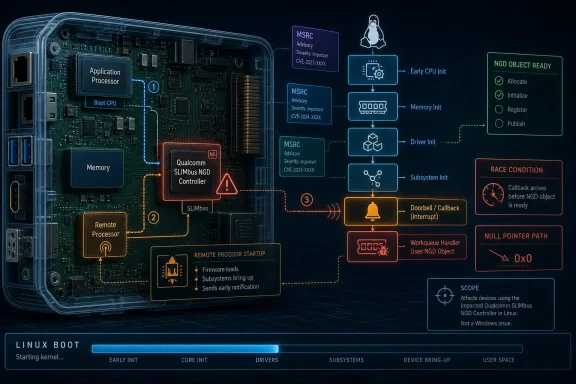
The core issue, as described in the public vulnerability record, is a race in the Qualcomm NGD controller driver for SLIMbus. If a remote processor starts while the NGD driver is still being probed, or if the relevant service-discovery path is already active when the driver registers callbacks, those callbacks can run before the driver has finished setting up the data structures they expect. In plainer English: the system wires up a doorbell before the room behind the door is ready, and then something rings it.
That kind of bug is easy to underestimate because it does not sound like an attacker narrative. There is no obvious phishing lure, no browser sandbox escape, no domain controller compromise. But boot-time kernel races are exactly the class of defect that turns into unreliable hardware, strange board-specific failures, and security advisories that look disconnected from the machines most people think they own.
The first trap in CVE-2026-53332 is branding. Seeing a Microsoft Security Response Center page attached to a Linux kernel issue invites the wrong conclusion: that every Windows PC is somehow implicated by a Qualcomm SLIMbus bug. That is not what the available material says.
What the MSRC listing does mean is that Microsoft is surfacing the issue through the same machinery it uses to help customers track vulnerabilities across the Microsoft ecosystem. That ecosystem is no longer a neat stack of Windows client, Windows Server, Office, and Edge. It includes cloud infrastructure, Linux-based components, container hosts, developer environments, security products, and third-party open-source dependencies that show up in places Windows administrators still have to defend.
The vulnerability title itself tells the real story. “slimbus: qcom-ngd-ctrl: Register callbacks after creating the ngd” is written in the native dialect of kernel commit messages, not in the polished language of a product bulletin. It points to a driver-level sequencing fix: create the NGD object first, then register callbacks that might use it. The security relevance is not that the bug is glamorous; it is that the kernel has admitted a bad ordering condition that can expose uninitialized state.
That makes CVE-2026-53332 the opposite of a mass-market scare headline. It is a supply-chain and platform-integrity story. If your systems do not build, ship, manage, or depend on Linux kernels with the Qualcomm SLIMbus NGD controller enabled, this is probably not your Friday-night incident bridge. If you do operate Qualcomm-based Linux devices, embedded boards, custom kernels, Android-derived platforms, or validation labs that test such hardware, this is the kind of CVE that belongs on the engineering queue before it becomes a ghost in the boot logs.
The practical consequence for WindowsForum readers is therefore nuanced. Classic Windows desktop administrators should not pretend this is a Patch Tuesday client crisis. But IT teams responsible for mixed fleets should not ignore it just because the subsystem name looks alien. The same asset inventories that track Windows cumulative updates now need to know which Linux kernels are running in appliances, developer machines, cloud workloads, edge devices, and build systems.
That detail matters. Security advisories often flatten issues into a single risk label, but the mechanics here are everything. The problem is not simply that callbacks exist, nor that the driver talks to hardware, nor that the system uses remote processors. The problem is that events from outside the driver’s carefully imagined setup sequence can arrive while the setup sequence is still incomplete.
Kernel developers spend enormous effort trying to make initialization look linear. Probe the device. Allocate structures. Initialize locks and work items. Register with a bus. Enable interrupts. Announce yourself to the rest of the system. In reality, modern systems are full of asynchronous actors: firmware components, auxiliary processors, service-discovery mechanisms, interrupts, runtime power management, and workqueues. The moment a driver exposes a callback or enables an interrupt, it has invited the rest of the system to call back into code that must already be safe.
CVE-2026-53332 exists because that invitation can arrive too early. The public record describes a case where a notification function schedules work on a NULL work item. That is the kind of kernel failure that can look like a generic boot problem until someone follows the call trace back to the specific race.
The fix implied by the title is wonderfully mundane: register callbacks after creating the NGD. But mundane is not the same as trivial. In kernel code, moving a registration later can change the lifetime assumptions of a device, alter which events are visible, and expose hidden dependencies between platform driver code and subsystem code. The public description even suggests that the design could be further refined by moving initialization into a different probe path and reducing the platform-driver model’s role. That is a polite way of saying that the bug is not just one misplaced line; it is a symptom of complicated ownership boundaries.
For administrators, this is why the phrase “just a driver race” should not be comforting. Race conditions are often workload-sensitive, board-sensitive, and timing-sensitive. They can disappear under a debugger, reproduce only on warm boots, surface after unrelated firmware changes, or show up in continuous-integration labs long before they are obvious in production. A fix that merely changes ordering may be exactly what prevents the next round of unexplained boot instability.
That obscurity is precisely why CVE-2026-53332 is interesting. The most important software in a device is often the least visible. A user sees a boot logo, a login prompt, or a frozen screen. Underneath, the kernel is trying to bring up controllers, discover services, coordinate with remote processors, allocate DMA resources, and register notifiers in an order that leaves no gap for an unexpected event.
The public vulnerability description names several ways the race can be reached. A remote processor may start in parallel with the NGD driver probe. The relevant lookup may be registered while the remote processor is already up. An interrupt from hardware could theoretically arrive at the wrong moment. These are not exotic attack-stage phrases; they are normal life inside a modern system-on-chip.
That is why the affected symptom described publicly is boot trouble on affected boards rather than a neat user-facing exploit chain. Board bring-up failures are ugly because they blur security, reliability, and hardware enablement. A kernel warning during initialization can be a denial-of-service condition for an embedded product, a blocker for an OEM validation run, or a sporadic failure in a lab that nobody can reproduce on demand.
There is also a lesson here for administrators who think only in terms of operating-system names. The vulnerability is in the Linux kernel, but the hardware ecosystem it touches is not confined to hobbyist Linux desktops. Qualcomm platforms appear in mobile, embedded, edge, and specialized computing contexts. Microsoft’s decision to surface a record for the issue should be read against that modern cross-platform reality, not against the old mental model in which Microsoft advisories were only about Windows binaries.
The right question is not “Do I have SLIMbus?” Most enterprise admins will not know offhand. The better question is “Do I have an inventory good enough to tell me whether any managed Linux kernel, device image, appliance, or OEM platform in my environment enables this driver?” If the answer is no, CVE-2026-53332 is a small example of a much larger inventory problem.
That scarcity of coverage creates a predictable vacuum. One camp will overstate the issue because “Microsoft” and “CVE” appear in the same sentence. Another will dismiss it because it lives in an obscure Linux driver. Both reactions miss the point.
The responsible reading is narrower and more useful. CVE-2026-53332 is a kernel driver initialization flaw involving callbacks, uninitialized state, and Qualcomm SLIMbus NGD handling. It can create boot issues on affected boards according to the public vulnerability description. The apparent fix is to delay callback registration until after the NGD object exists. Everything beyond that should be handled as inventory-specific risk, not internet-wide panic.
This is also where the difference between vulnerability management and headline scanning becomes obvious. A vulnerability team that only prioritizes by name recognition will skip this. A team that understands product exposure will ask whether any of its Linux images include the relevant driver, whether any OEMs it depends on ship Qualcomm-based systems with that path, and whether any internal kernel forks need the upstream fix. A team responsible for embedded or edge hardware will care more than a team responsible only for office laptops.
There is a subtle MSRC angle as well. The user-facing source material for the Microsoft page may load through a JavaScript-heavy application, and when that fails the browser can show generic network troubleshooting text rather than the advisory itself. That is not a security fact about the CVE, but it is a usability problem for people trying to verify advisories during an incident. Security data is most useful when it is easy to retrieve, archive, diff, and automate against. A vulnerability record that depends on a front-end app is harder to consume than a simple static bulletin, especially for teams building internal scanners and compliance evidence.
That does not mean Microsoft’s listing is wrong. It means administrators should not rely on a single rendered page as their only source of truth. For a Linux kernel CVE, the useful chain is broader: MSRC for Microsoft ecosystem tracking, public CVE and NVD-style records for the vulnerability description, upstream kernel history for the code-level fix, and vendor or OEM advisories for actual device exposure.
A driver probe function may assume it can initialize local state before anything external calls into it. A remote processor framework may assume that notifications can be delivered as soon as a service becomes visible. Hardware may generate an interrupt whenever it is ready, not whenever the driver author wishes it would. Each subsystem is locally reasonable. The bug lives in the space between their assumptions.
That is why callback registration is such a recurring fault line. Register a callback too early and you create a path into half-built state. Register it too late and you may miss an event the rest of the system expects you to handle. The art of kernel driver design is finding the moment at which the driver is externally visible but internally complete enough to survive being called.
CVE-2026-53332’s title says the answer here is to create the NGD before registering callbacks. The public description says the existing ordering could let notifications operate on uninitialized data. That is an unglamorous but fundamental invariant: do not publish a callable interface until the object it refers to exists.
This matters to supply-chain security because most organizations do not patch this kind of bug directly. They inherit it. The fix arrives through upstream kernel changes, downstream stable trees, distribution kernels, Android or embedded vendor branches, OEM firmware packages, device images, or cloud provider maintenance. Each step can add delay, backporting complexity, or ambiguity about whether a particular device is actually exposed.
That inherited-risk model is familiar to Windows admins from driver packages and firmware advisories. The difference is that in Linux-based embedded and edge systems, the operating system may be heavily customized and rarely updated through a conventional package manager. A vulnerability can be “fixed upstream” while still lingering in field images that will not be rebuilt until the next product release, if ever.
For WindowsForum’s IT audience, the takeaway is not to become kernel maintainers overnight. It is to force vendors and internal platform teams to answer exposure questions in concrete terms. Is the driver present? Is it enabled? Is the affected code reachable on the hardware we ship or manage? Has the fix been integrated into our kernel branch? If the answer is “we don’t know,” that is a governance problem, not merely a Linux problem.
Still, reliability issues in the kernel can be security issues. Availability is one leg of the classic security triad, and boot failure is a severe availability failure for a device that has to be remotely managed, deployed at the edge, or embedded in a product. In some environments, a board that intermittently fails to boot is not a nuisance; it is a failed service-level objective, a truck roll, or a production-line halt.
The affected population is likely to be highly dependent on hardware, kernel configuration, and vendor integration. Systems that do not use the Qualcomm SLIMbus NGD controller path are not implicated by the mechanics described. Systems that do use it may still vary depending on timing, remote processor behavior, interrupt ordering, and whether the fix has already landed in the kernel they run. That is why exposure management here belongs with platform teams, not just the central Windows patch desk.
Administrators should also resist the urge to map this CVE directly onto Windows Update. The source material does not provide a Windows KB, a Windows build number, or a Microsoft product version matrix. If a Microsoft product or service has exposure, Microsoft’s own servicing channel would be the authority for that product. If a non-Microsoft Linux device has exposure, its vendor’s kernel update path matters more than the presence of the CVE on MSRC.
This distinction is important because mixed-platform vulnerability dashboards often flatten everything into one queue. A CVE enters the feed, gets assigned to “Microsoft” because MSRC lists it, and suddenly a Windows endpoint team is asked to remediate a Linux kernel driver on hardware it does not own. That is not risk management. It is metadata confusion.
The right routing is by asset and code ownership. Windows client teams should note the advisory but look for Microsoft product-specific servicing guidance before acting. Linux operations teams should check distributions and kernel branches. Embedded teams should check board support packages and OEM firmware. Security teams should track the CVE centrally but avoid pretending one patch mechanism fits all exposures.
Traditional enterprise patching was built around recognizable endpoints. A Windows laptop reports an OS build. A server reports installed updates. A browser reports its version. But Linux kernel code can be buried in appliances, lab boards, developer kits, mobile-derived devices, network-adjacent boxes, industrial gateways, and vendor-managed images. Some of those assets report into corporate inventory systems. Many do not.
That is why obscure kernel CVEs keep showing up as unpleasant surprises. They are not always high-severity in isolation, but they expose the seams between procurement, engineering, security, and operations. The security team sees a CVE. The infrastructure team says it does not own the device. The vendor says the product is based on a custom kernel. The engineering team says the affected driver is not enabled, but nobody has a reproducible build manifest. The audit team asks for evidence.
CVE-2026-53332 is a good test case for whether an organization can answer a narrow technical question without a week of archaeology. Do you know which kernels you ship or operate? Do you know their configuration? Do you know whether Qualcomm-specific SLIMbus support is enabled? Do you know which vendor branch your device image was built from? Can you prove that the callback-ordering fix is present?
For many Windows-centric organizations, the honest answer will be “not consistently.” That is not a failure caused by this CVE. It is a failure revealed by it.
Kernel commit-style titles encode locality and intent. “slimbus” tells you the subsystem neighborhood. “qcom-ngd-ctrl” identifies the driver area. “Register callbacks after creating the ngd” tells you the change in behavior. For engineers, that is far more useful than a generic label like “Linux kernel vulnerability.” For everyone else, it looks impenetrable.
This mismatch is one reason vulnerability communication is so difficult. Security teams want severity, exploitability, affected products, and remediation. Engineers want code paths, locks, lifetimes, and ordering. Executives want business impact. CVE-2026-53332 arrives with the engineer’s view most visible, and administrators have to translate it into operational terms.
The translation should not oversimplify the issue into “Qualcomm bug” or “Microsoft bug.” The public record points to a Linux kernel driver issue in Qualcomm-oriented SLIMbus handling. Microsoft’s role is as an advisory publisher in its Security Update Guide context, not necessarily as the author of the vulnerable code path. Qualcomm’s platform context matters because the driver is for Qualcomm hardware. The Linux kernel context matters because the fix is in kernel driver ordering. The customer context matters because exposure depends on actual devices and kernels.
That multi-party shape is normal now. A vulnerability can originate in upstream open-source code, affect a hardware-specific path, be consumed by a cloud or operating-system vendor, and land on an enterprise dashboard under a brand name that confuses the people assigned to remediate it. The answer is not to ignore the brand name. The answer is to map it back to code ownership and asset exposure.
There is another naming lesson here. The phrase “Register callbacks after creating the ngd” is a compact description of a security invariant: do not make unfinished state observable. That invariant appears everywhere, from web services registering health checks before dependencies are ready, to Windows services accepting requests before policy is loaded, to kernel drivers enabling interrupts before queues are initialized. The subsystem is obscure; the engineering principle is universal.
But boot is one of the most security-sensitive phases of a system’s life. The machine is assembling its trust relationships. Drivers are binding to hardware. Firmware-adjacent processors are coming online. Workqueues, notifiers, interrupts, and runtime power management are being connected. A mistake there can undermine reliability before higher-level defenses even have a chance to operate.
CVE-2026-53332 appears to be about exactly that early-life fragility. The public description says the callbacks can be invoked when the remote processor starts in parallel with the NGD driver probe, when the remote processor is already up during lookup registration, or in a theoretical interrupt timing case. Each scenario is a version of the same problem: the platform’s asynchronous reality outruns the driver’s initialization assumptions.
For field devices, that kind of bug can be punishing. A device that fails on one boot and succeeds on the next is hard to triage remotely. A board that only shows the problem under a certain firmware timing condition may pass basic validation and fail later after an unrelated update. A crash trace in a workqueue path may look disconnected from the actual ordering mistake that made the work item NULL.
This is why the fix’s simplicity should not lead to complacency. Moving callback registration after NGD creation may be a small code change, but the behavior it protects is foundational. It says the driver should not expose external entry points until the object graph behind those entry points is valid. That is defensive engineering at the kernel boundary.
Windows administrators have seen the same category of pain in different clothing. Storage drivers that initialize too late can cause boot loops. Firmware updates can expose assumptions in Secure Boot paths. Network drivers can fail during early initialization and leave management agents blind. The names differ, but the operational lesson is the same: early boot is where small ordering bugs become expensive outages.
Security teams increasingly automate everything. They ingest CVE feeds, correlate vendor advisories, map assets, generate tickets, and produce evidence for auditors. JavaScript-heavy advisory pages and sparse product context make that harder. When a page fails to render and the visible content devolves into generic browser network advice, the human trying to verify a CVE is left with less than the machine-readable pipeline should provide.
For a vulnerability like this, the useful advisory would answer several operational questions directly. Is Microsoft listing the CVE only for awareness, or because a Microsoft product or service includes the affected component? If a Microsoft product is affected, which one? Is there a Microsoft-serviced update path? If exposure depends entirely on third-party Linux kernels, should customers treat the MSRC record as informational?
The provided material does not supply those answers. That does not invalidate the CVE, but it forces administrators to complete the chain themselves. They must combine MSRC awareness, public vulnerability database details, upstream kernel information, and vendor-specific exposure statements. Mature organizations can do that. Smaller teams may either overreact or miss the issue entirely.
Microsoft is hardly alone here. The whole vulnerability ecosystem struggles with inherited open-source components, hardware-specific kernel paths, and advisories that are simultaneously too terse for risk owners and too generic for engineers. But Microsoft’s customer base includes a large number of Windows-first administrators who will see “MSRC” and expect Windows-style patch clarity. When the underlying issue is Linux kernel plumbing, the advisory needs extra context, not less.
The better future is advisory metadata that clearly separates awareness, product exposure, and remediation responsibility. CVE-2026-53332 would then appear not as a mysterious Microsoft-flavored Linux item, but as a specific kernel driver flaw with clearly routed ownership. That would reduce noise for Windows endpoint teams and increase urgency for the platform teams that actually need to act.
Start with asset classes. Developer laptops running ordinary desktop Linux distributions are less likely to be the interesting population unless they are Qualcomm-based or used for kernel development involving this driver. Edge devices, embedded systems, lab boards, mobile-derived platforms, and vendor appliances deserve more attention. Cloud workloads matter if they include custom kernels or device passthrough scenarios, but the provided material does not support assuming broad cloud exposure.
Next, look at ownership. If a device is vendor-managed, ask the vendor for a statement. If the kernel is internally built, ask the kernel or platform team to identify whether the fix is present. If the affected path is not built, document that. If the path is built but the hardware is absent, document that too. Non-exposure evidence is valuable because it prevents the same CVE from reopening every quarter.
Then consider symptoms. If you already have Qualcomm-based boards showing intermittent boot warnings or initialization failures around SLIMbus, NGD, remote processor startup, or workqueue scheduling, this CVE gives you a strong lead. It does not prove causation for every boot issue, but it describes a plausible failure mode that should be checked against logs and kernel history.
Finally, avoid ticket laundering. Do not assign this to the Windows desktop patch team because the advisory appeared under Microsoft. Do not close it as irrelevant because the word Linux appears. Assign it to the team that can actually answer whether the affected code exists in your fleet.
This is what mature vulnerability management looks like in 2026: not every CVE becomes an emergency, but every CVE gets mapped to the right owner, evidence, and remediation path.
The core issue, as described in the public vulnerability record, is a race in the Qualcomm NGD controller driver for SLIMbus. If a remote processor starts while the NGD driver is still being probed, or if the relevant service-discovery path is already active when the driver registers callbacks, those callbacks can run before the driver has finished setting up the data structures they expect. In plainer English: the system wires up a doorbell before the room behind the door is ready, and then something rings it.
That kind of bug is easy to underestimate because it does not sound like an attacker narrative. There is no obvious phishing lure, no browser sandbox escape, no domain controller compromise. But boot-time kernel races are exactly the class of defect that turns into unreliable hardware, strange board-specific failures, and security advisories that look disconnected from the machines most people think they own.
 Microsoft’s Linux CVE Is a Windows Story Only If You Understand Microsoft in 2026
The first trap in CVE-2026-53332 is branding. Seeing a Microsoft Security Response Center page attached to a Linux kernel issue invites the wrong conclusion: that every Windows PC is somehow implicated by a Qualcomm SLIMbus bug. That is not what the available material says.What the MSRC listing does mean is that Microsoft is surfacing the issue through the same machinery it uses to help customers track vulnerabilities across the Microsoft ecosystem. That ecosystem is no longer a neat stack of Windows client, Windows Server, Office, and Edge. It includes cloud infrastructure, Linux-based components, container hosts, developer environments, security products, and third-party open-source dependencies that show up in places Windows administrators still have to defend.
The vulnerability title itself tells the real story. “slimbus: qcom-ngd-ctrl: Register callbacks after creating the ngd” is written in the native dialect of kernel commit messages, not in the polished language of a product bulletin. It points to a driver-level sequencing fix: create the NGD object first, then register callbacks that might use it. The security relevance is not that the bug is glamorous; it is that the kernel has admitted a bad ordering condition that can expose uninitialized state.
That makes CVE-2026-53332 the opposite of a mass-market scare headline. It is a supply-chain and platform-integrity story. If your systems do not build, ship, manage, or depend on Linux kernels with the Qualcomm SLIMbus NGD controller enabled, this is probably not your Friday-night incident bridge. If you do operate Qualcomm-based Linux devices, embedded boards, custom kernels, Android-derived platforms, or validation labs that test such hardware, this is the kind of CVE that belongs on the engineering queue before it becomes a ghost in the boot logs.
The practical consequence for WindowsForum readers is therefore nuanced. Classic Windows desktop administrators should not pretend this is a Patch Tuesday client crisis. But IT teams responsible for mixed fleets should not ignore it just because the subsystem name looks alien. The same asset inventories that track Windows cumulative updates now need to know which Linux kernels are running in appliances, developer machines, cloud workloads, edge devices, and build systems.
The Bug Is Not the Callback; It Is the Timing
The vulnerability is best understood as an initialization-order failure. The affected driver is concerned with Qualcomm’s SLIMbus NGD controller, and the public description says the problematic callbacks can be reached when remote processor startup and NGD driver probing overlap. The callback path may then operate on data that has not yet been initialized.That detail matters. Security advisories often flatten issues into a single risk label, but the mechanics here are everything. The problem is not simply that callbacks exist, nor that the driver talks to hardware, nor that the system uses remote processors. The problem is that events from outside the driver’s carefully imagined setup sequence can arrive while the setup sequence is still incomplete.
Kernel developers spend enormous effort trying to make initialization look linear. Probe the device. Allocate structures. Initialize locks and work items. Register with a bus. Enable interrupts. Announce yourself to the rest of the system. In reality, modern systems are full of asynchronous actors: firmware components, auxiliary processors, service-discovery mechanisms, interrupts, runtime power management, and workqueues. The moment a driver exposes a callback or enables an interrupt, it has invited the rest of the system to call back into code that must already be safe.
CVE-2026-53332 exists because that invitation can arrive too early. The public record describes a case where a notification function schedules work on a NULL work item. That is the kind of kernel failure that can look like a generic boot problem until someone follows the call trace back to the specific race.
The fix implied by the title is wonderfully mundane: register callbacks after creating the NGD. But mundane is not the same as trivial. In kernel code, moving a registration later can change the lifetime assumptions of a device, alter which events are visible, and expose hidden dependencies between platform driver code and subsystem code. The public description even suggests that the design could be further refined by moving initialization into a different probe path and reducing the platform-driver model’s role. That is a polite way of saying that the bug is not just one misplaced line; it is a symptom of complicated ownership boundaries.
For administrators, this is why the phrase “just a driver race” should not be comforting. Race conditions are often workload-sensitive, board-sensitive, and timing-sensitive. They can disappear under a debugger, reproduce only on warm boots, surface after unrelated firmware changes, or show up in continuous-integration labs long before they are obvious in production. A fix that merely changes ordering may be exactly what prevents the next round of unexplained boot instability.
Qualcomm SLIMbus Is Obscure Until It Blocks the Boot
SLIMbus is not a household term, even among many Windows administrators. It sits in the category of platform buses and controller drivers that most users never see unless something breaks. In Qualcomm-oriented systems, the NGD controller driver is part of the glue that lets software communicate with hardware components over the bus while coordinating with other platform pieces.That obscurity is precisely why CVE-2026-53332 is interesting. The most important software in a device is often the least visible. A user sees a boot logo, a login prompt, or a frozen screen. Underneath, the kernel is trying to bring up controllers, discover services, coordinate with remote processors, allocate DMA resources, and register notifiers in an order that leaves no gap for an unexpected event.
The public vulnerability description names several ways the race can be reached. A remote processor may start in parallel with the NGD driver probe. The relevant lookup may be registered while the remote processor is already up. An interrupt from hardware could theoretically arrive at the wrong moment. These are not exotic attack-stage phrases; they are normal life inside a modern system-on-chip.
That is why the affected symptom described publicly is boot trouble on affected boards rather than a neat user-facing exploit chain. Board bring-up failures are ugly because they blur security, reliability, and hardware enablement. A kernel warning during initialization can be a denial-of-service condition for an embedded product, a blocker for an OEM validation run, or a sporadic failure in a lab that nobody can reproduce on demand.
There is also a lesson here for administrators who think only in terms of operating-system names. The vulnerability is in the Linux kernel, but the hardware ecosystem it touches is not confined to hobbyist Linux desktops. Qualcomm platforms appear in mobile, embedded, edge, and specialized computing contexts. Microsoft’s decision to surface a record for the issue should be read against that modern cross-platform reality, not against the old mental model in which Microsoft advisories were only about Windows binaries.
The right question is not “Do I have SLIMbus?” Most enterprise admins will not know offhand. The better question is “Do I have an inventory good enough to tell me whether any managed Linux kernel, device image, appliance, or OEM platform in my environment enables this driver?” If the answer is no, CVE-2026-53332 is a small example of a much larger inventory problem.
The Public Record Is Thin, Which Makes Precision More Important
Compared with the major vulnerabilities that dominate security news, CVE-2026-53332 arrives with very little public drama. Microsoft’s page identifies the CVE, while the richer public description available through vulnerability databases explains the Linux kernel race and the NGD callback ordering issue. There is no broad consumer advisory, no emergency mitigation campaign, and no evidence in the provided material of a Windows desktop blast radius.That scarcity of coverage creates a predictable vacuum. One camp will overstate the issue because “Microsoft” and “CVE” appear in the same sentence. Another will dismiss it because it lives in an obscure Linux driver. Both reactions miss the point.
The responsible reading is narrower and more useful. CVE-2026-53332 is a kernel driver initialization flaw involving callbacks, uninitialized state, and Qualcomm SLIMbus NGD handling. It can create boot issues on affected boards according to the public vulnerability description. The apparent fix is to delay callback registration until after the NGD object exists. Everything beyond that should be handled as inventory-specific risk, not internet-wide panic.
This is also where the difference between vulnerability management and headline scanning becomes obvious. A vulnerability team that only prioritizes by name recognition will skip this. A team that understands product exposure will ask whether any of its Linux images include the relevant driver, whether any OEMs it depends on ship Qualcomm-based systems with that path, and whether any internal kernel forks need the upstream fix. A team responsible for embedded or edge hardware will care more than a team responsible only for office laptops.
There is a subtle MSRC angle as well. The user-facing source material for the Microsoft page may load through a JavaScript-heavy application, and when that fails the browser can show generic network troubleshooting text rather than the advisory itself. That is not a security fact about the CVE, but it is a usability problem for people trying to verify advisories during an incident. Security data is most useful when it is easy to retrieve, archive, diff, and automate against. A vulnerability record that depends on a front-end app is harder to consume than a simple static bulletin, especially for teams building internal scanners and compliance evidence.
That does not mean Microsoft’s listing is wrong. It means administrators should not rely on a single rendered page as their only source of truth. For a Linux kernel CVE, the useful chain is broader: MSRC for Microsoft ecosystem tracking, public CVE and NVD-style records for the vulnerability description, upstream kernel history for the code-level fix, and vendor or OEM advisories for actual device exposure.
This Is a Race Condition Wearing a Supply-Chain Badge
The most important security theme in CVE-2026-53332 is not Qualcomm, SLIMbus, or even Linux. It is lifecycle ordering. Modern systems break when components assume they are in charge of time.A driver probe function may assume it can initialize local state before anything external calls into it. A remote processor framework may assume that notifications can be delivered as soon as a service becomes visible. Hardware may generate an interrupt whenever it is ready, not whenever the driver author wishes it would. Each subsystem is locally reasonable. The bug lives in the space between their assumptions.
That is why callback registration is such a recurring fault line. Register a callback too early and you create a path into half-built state. Register it too late and you may miss an event the rest of the system expects you to handle. The art of kernel driver design is finding the moment at which the driver is externally visible but internally complete enough to survive being called.
CVE-2026-53332’s title says the answer here is to create the NGD before registering callbacks. The public description says the existing ordering could let notifications operate on uninitialized data. That is an unglamorous but fundamental invariant: do not publish a callable interface until the object it refers to exists.
This matters to supply-chain security because most organizations do not patch this kind of bug directly. They inherit it. The fix arrives through upstream kernel changes, downstream stable trees, distribution kernels, Android or embedded vendor branches, OEM firmware packages, device images, or cloud provider maintenance. Each step can add delay, backporting complexity, or ambiguity about whether a particular device is actually exposed.
That inherited-risk model is familiar to Windows admins from driver packages and firmware advisories. The difference is that in Linux-based embedded and edge systems, the operating system may be heavily customized and rarely updated through a conventional package manager. A vulnerability can be “fixed upstream” while still lingering in field images that will not be rebuilt until the next product release, if ever.
For WindowsForum’s IT audience, the takeaway is not to become kernel maintainers overnight. It is to force vendors and internal platform teams to answer exposure questions in concrete terms. Is the driver present? Is it enabled? Is the affected code reachable on the hardware we ship or manage? Has the fix been integrated into our kernel branch? If the answer is “we don’t know,” that is a governance problem, not merely a Linux problem.
Where the Risk Actually Lands
The available facts point to a reliability-impacting kernel flaw in a specific Qualcomm-oriented driver path, not a broad user-triggered exploit against ordinary Windows endpoints. The public description centers on boot issues on affected boards and a workqueue warning caused by a callback touching NULL state. That is materially different from a remote attacker compromising a system over the network.Still, reliability issues in the kernel can be security issues. Availability is one leg of the classic security triad, and boot failure is a severe availability failure for a device that has to be remotely managed, deployed at the edge, or embedded in a product. In some environments, a board that intermittently fails to boot is not a nuisance; it is a failed service-level objective, a truck roll, or a production-line halt.
The affected population is likely to be highly dependent on hardware, kernel configuration, and vendor integration. Systems that do not use the Qualcomm SLIMbus NGD controller path are not implicated by the mechanics described. Systems that do use it may still vary depending on timing, remote processor behavior, interrupt ordering, and whether the fix has already landed in the kernel they run. That is why exposure management here belongs with platform teams, not just the central Windows patch desk.
Administrators should also resist the urge to map this CVE directly onto Windows Update. The source material does not provide a Windows KB, a Windows build number, or a Microsoft product version matrix. If a Microsoft product or service has exposure, Microsoft’s own servicing channel would be the authority for that product. If a non-Microsoft Linux device has exposure, its vendor’s kernel update path matters more than the presence of the CVE on MSRC.
This distinction is important because mixed-platform vulnerability dashboards often flatten everything into one queue. A CVE enters the feed, gets assigned to “Microsoft” because MSRC lists it, and suddenly a Windows endpoint team is asked to remediate a Linux kernel driver on hardware it does not own. That is not risk management. It is metadata confusion.
The right routing is by asset and code ownership. Windows client teams should note the advisory but look for Microsoft product-specific servicing guidance before acting. Linux operations teams should check distributions and kernel branches. Embedded teams should check board support packages and OEM firmware. Security teams should track the CVE centrally but avoid pretending one patch mechanism fits all exposures.
The Admin Problem Is Discoverability, Not Drama
The hardest part of responding to CVE-2026-53332 is not understanding the bug. Once translated, it is straightforward: callbacks may run before the NGD structure is ready. The hard part is finding every place in an organization where that code might exist.Traditional enterprise patching was built around recognizable endpoints. A Windows laptop reports an OS build. A server reports installed updates. A browser reports its version. But Linux kernel code can be buried in appliances, lab boards, developer kits, mobile-derived devices, network-adjacent boxes, industrial gateways, and vendor-managed images. Some of those assets report into corporate inventory systems. Many do not.
That is why obscure kernel CVEs keep showing up as unpleasant surprises. They are not always high-severity in isolation, but they expose the seams between procurement, engineering, security, and operations. The security team sees a CVE. The infrastructure team says it does not own the device. The vendor says the product is based on a custom kernel. The engineering team says the affected driver is not enabled, but nobody has a reproducible build manifest. The audit team asks for evidence.
CVE-2026-53332 is a good test case for whether an organization can answer a narrow technical question without a week of archaeology. Do you know which kernels you ship or operate? Do you know their configuration? Do you know whether Qualcomm-specific SLIMbus support is enabled? Do you know which vendor branch your device image was built from? Can you prove that the callback-ordering fix is present?
For many Windows-centric organizations, the honest answer will be “not consistently.” That is not a failure caused by this CVE. It is a failure revealed by it.
Action checklist for admins
- Route CVE-2026-53332 to the team responsible for Linux kernels, embedded images, Qualcomm-based platforms, or vendor-managed appliances rather than treating it as a generic Windows endpoint patch.
- Check whether any managed Linux kernel or device image includes the Qualcomm SLIMbus NGD controller driver path referenced by the vulnerability title.
- Ask OEMs, device vendors, and internal platform owners whether their shipped kernel contains the callback-ordering fix described by the CVE.
- Review boot logs from affected Qualcomm-based boards for workqueue warnings, NULL work-item symptoms, or NGD/SLIMbus initialization failures if unexplained boot instability has already been observed.
- Track remediation through the actual servicing channel for the affected asset: upstream kernel, distribution kernel, board support package, firmware image, appliance update, or Microsoft product servicing guidance if Microsoft later identifies a product-specific exposure.
- Preserve evidence of non-exposure where applicable, including kernel configuration, driver absence, hardware non-applicability, or vendor attestation.
The Naming Tells You This Came From Engineering, Not Marketing
The title “slimbus: qcom-ngd-ctrl: Register callbacks after creating the ngd” is not written for CISOs. It is written for maintainers. That is a feature, not a flaw.Kernel commit-style titles encode locality and intent. “slimbus” tells you the subsystem neighborhood. “qcom-ngd-ctrl” identifies the driver area. “Register callbacks after creating the ngd” tells you the change in behavior. For engineers, that is far more useful than a generic label like “Linux kernel vulnerability.” For everyone else, it looks impenetrable.
This mismatch is one reason vulnerability communication is so difficult. Security teams want severity, exploitability, affected products, and remediation. Engineers want code paths, locks, lifetimes, and ordering. Executives want business impact. CVE-2026-53332 arrives with the engineer’s view most visible, and administrators have to translate it into operational terms.
The translation should not oversimplify the issue into “Qualcomm bug” or “Microsoft bug.” The public record points to a Linux kernel driver issue in Qualcomm-oriented SLIMbus handling. Microsoft’s role is as an advisory publisher in its Security Update Guide context, not necessarily as the author of the vulnerable code path. Qualcomm’s platform context matters because the driver is for Qualcomm hardware. The Linux kernel context matters because the fix is in kernel driver ordering. The customer context matters because exposure depends on actual devices and kernels.
That multi-party shape is normal now. A vulnerability can originate in upstream open-source code, affect a hardware-specific path, be consumed by a cloud or operating-system vendor, and land on an enterprise dashboard under a brand name that confuses the people assigned to remediate it. The answer is not to ignore the brand name. The answer is to map it back to code ownership and asset exposure.
There is another naming lesson here. The phrase “Register callbacks after creating the ngd” is a compact description of a security invariant: do not make unfinished state observable. That invariant appears everywhere, from web services registering health checks before dependencies are ready, to Windows services accepting requests before policy is loaded, to kernel drivers enabling interrupts before queues are initialized. The subsystem is obscure; the engineering principle is universal.
Why Boot Bugs Deserve More Respect
Security culture tends to reward vulnerabilities that can be demonstrated dramatically. A proof-of-concept opens Calculator. A remote exploit drops a shell. A browser bug escapes a sandbox. Boot bugs rarely perform well on stage. They hang, warn, race, and frustrate.But boot is one of the most security-sensitive phases of a system’s life. The machine is assembling its trust relationships. Drivers are binding to hardware. Firmware-adjacent processors are coming online. Workqueues, notifiers, interrupts, and runtime power management are being connected. A mistake there can undermine reliability before higher-level defenses even have a chance to operate.
CVE-2026-53332 appears to be about exactly that early-life fragility. The public description says the callbacks can be invoked when the remote processor starts in parallel with the NGD driver probe, when the remote processor is already up during lookup registration, or in a theoretical interrupt timing case. Each scenario is a version of the same problem: the platform’s asynchronous reality outruns the driver’s initialization assumptions.
For field devices, that kind of bug can be punishing. A device that fails on one boot and succeeds on the next is hard to triage remotely. A board that only shows the problem under a certain firmware timing condition may pass basic validation and fail later after an unrelated update. A crash trace in a workqueue path may look disconnected from the actual ordering mistake that made the work item NULL.
This is why the fix’s simplicity should not lead to complacency. Moving callback registration after NGD creation may be a small code change, but the behavior it protects is foundational. It says the driver should not expose external entry points until the object graph behind those entry points is valid. That is defensive engineering at the kernel boundary.
Windows administrators have seen the same category of pain in different clothing. Storage drivers that initialize too late can cause boot loops. Firmware updates can expose assumptions in Secure Boot paths. Network drivers can fail during early initialization and leave management agents blind. The names differ, but the operational lesson is the same: early boot is where small ordering bugs become expensive outages.
What Microsoft Should Make Easier
MSRC deserves credit for surfacing vulnerabilities beyond the old Windows-only perimeter. Customers need a central place to understand security exposure across Microsoft’s widening stack. But CVE-2026-53332 also shows how advisory consumption still needs to improve.Security teams increasingly automate everything. They ingest CVE feeds, correlate vendor advisories, map assets, generate tickets, and produce evidence for auditors. JavaScript-heavy advisory pages and sparse product context make that harder. When a page fails to render and the visible content devolves into generic browser network advice, the human trying to verify a CVE is left with less than the machine-readable pipeline should provide.
For a vulnerability like this, the useful advisory would answer several operational questions directly. Is Microsoft listing the CVE only for awareness, or because a Microsoft product or service includes the affected component? If a Microsoft product is affected, which one? Is there a Microsoft-serviced update path? If exposure depends entirely on third-party Linux kernels, should customers treat the MSRC record as informational?
The provided material does not supply those answers. That does not invalidate the CVE, but it forces administrators to complete the chain themselves. They must combine MSRC awareness, public vulnerability database details, upstream kernel information, and vendor-specific exposure statements. Mature organizations can do that. Smaller teams may either overreact or miss the issue entirely.
Microsoft is hardly alone here. The whole vulnerability ecosystem struggles with inherited open-source components, hardware-specific kernel paths, and advisories that are simultaneously too terse for risk owners and too generic for engineers. But Microsoft’s customer base includes a large number of Windows-first administrators who will see “MSRC” and expect Windows-style patch clarity. When the underlying issue is Linux kernel plumbing, the advisory needs extra context, not less.
The better future is advisory metadata that clearly separates awareness, product exposure, and remediation responsibility. CVE-2026-53332 would then appear not as a mysterious Microsoft-flavored Linux item, but as a specific kernel driver flaw with clearly routed ownership. That would reduce noise for Windows endpoint teams and increase urgency for the platform teams that actually need to act.
The Concrete Reading for Mixed Windows and Linux Shops
For organizations that run both Windows and Linux, CVE-2026-53332 should be handled as a routing and inventory exercise. The vulnerability is real, but the action is not universal. The question is whether your environment contains the relevant Linux kernel driver path on hardware where it can be reached.Start with asset classes. Developer laptops running ordinary desktop Linux distributions are less likely to be the interesting population unless they are Qualcomm-based or used for kernel development involving this driver. Edge devices, embedded systems, lab boards, mobile-derived platforms, and vendor appliances deserve more attention. Cloud workloads matter if they include custom kernels or device passthrough scenarios, but the provided material does not support assuming broad cloud exposure.
Next, look at ownership. If a device is vendor-managed, ask the vendor for a statement. If the kernel is internally built, ask the kernel or platform team to identify whether the fix is present. If the affected path is not built, document that. If the path is built but the hardware is absent, document that too. Non-exposure evidence is valuable because it prevents the same CVE from reopening every quarter.
Then consider symptoms. If you already have Qualcomm-based boards showing intermittent boot warnings or initialization failures around SLIMbus, NGD, remote processor startup, or workqueue scheduling, this CVE gives you a strong lead. It does not prove causation for every boot issue, but it describes a plausible failure mode that should be checked against logs and kernel history.
Finally, avoid ticket laundering. Do not assign this to the Windows desktop patch team because the advisory appeared under Microsoft. Do not close it as irrelevant because the word Linux appears. Assign it to the team that can actually answer whether the affected code exists in your fleet.
This is what mature vulnerability management looks like in 2026: not every CVE becomes an emergency, but every CVE gets mapped to the right owner, evidence, and remediation path.
The Small Driver Bug With the Big Platform Lesson
The most concrete thing to know about CVE-2026-53332 is that it is a Linux kernel Qualcomm SLIMbus NGD controller flaw involving callback registration before the NGD state is safely created. The most important thing to learn from it is that platform security now depends on understanding obscure components that sit far below the application layer.- CVE-2026-53332 is tied to the vulnerability title “slimbus: qcom-ngd-ctrl: Register callbacks after creating the ngd.”
- The public description centers on callbacks operating on uninitialized data during remote processor or hardware-event timing.
- The known impact described in public material is boot trouble on affected boards, including a workqueue path touching NULL state.
- The MSRC listing should not be read as proof of a broad Windows desktop issue without product-specific Microsoft guidance.
- The likely remediation path depends on the real asset: upstream kernel, distribution kernel, embedded image, OEM firmware, appliance update, or Microsoft-serviced component if Microsoft identifies one.
- The right response is inventory-driven: find whether the relevant driver path exists and is reachable in your environment.
References
- Primary source: MSRC
Published: 2026-07-09T01:44:16-07:00
Loading…
msrc.microsoft.com - Related coverage: android.googlesource.com
Loading…
android.googlesource.com - Related coverage: codebrowser.dev
Loading…
codebrowser.dev - Related coverage: kernel.googlesource.com
Loading…
kernel.googlesource.com - Related coverage: linux.googlesource.com
Loading…
linux.googlesource.com - Related coverage: cateee.net
Loading…
cateee.net