

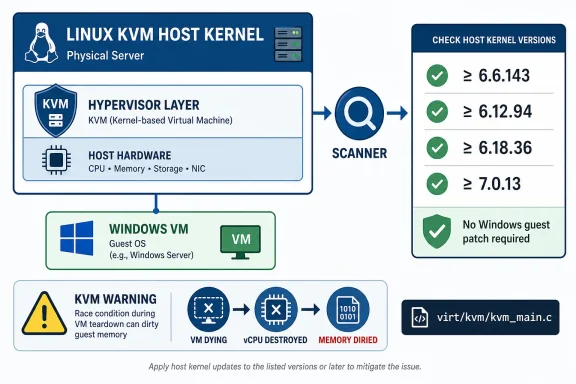
CVE-2026-53345 is a Linux KVM host-kernel issue, not a Windows guest vulnerability. The change fixes an overbroad KVM warning that can fire while a dying x86 SEV-ES virtual machine is being torn down and guest memory is dirtied without a running vCPU. Admins should identify Linux systems that act as KVM hosts, check whether they are on an affected upstream kernel range or a vendor package that has not backported the fix, and schedule host-kernel updates through normal virtualization maintenance. Windows teams should treat this as a host-side infrastructure item: Windows guests are not the affected component.
The key wording in the kernel.org description is direct: “KVM: Don’t WARN if memory is dirtied without a vCPU when the VM is dying.” That framing matters. The resolved issue is not described as a missing bounds check, a privilege-escalation chain, or a remote code-execution path. It is a KVM correctness fix for a diagnostic warning that can fire in a lifecycle state the kernel now treats as legitimate.
The affected code path is in
NVD’s record, as reflected in the provided facts, does not provide CVSS 4.0, CVSS 3.x, or CVSS 2.0 scoring. The absence of a score should not be read as a severity rating. It simply means the record has not been enriched with those metrics in the material at hand. For administrators, the useful triage questions are narrower and more concrete: Is this system a KVM host? Does it run an affected kernel line? Does it use the x86 SEV-ES path described by the kernel fix? Has the distribution or platform vendor shipped the relevant backport?
The kernel-side explanation is more useful than a generic scanner label. KVM dirties guest memory, sees no running or loaded vCPU, and historically warned because dirty tracking normally depends on reporting changed guest pages to userspace. The bug appears in a teardown case: the VM is already dying, and the kernel description says the condition does not represent a meaningful missed dirty-ring notification because userspace can no longer have the dirty-ring mapping that would consume it. The fix narrows the warning so it does not fire once the VM is no longer alive.
That makes CVE-2026-53345 best understood as a host-kernel robustness and lifecycle-correctness fix for KVM, specifically described around x86 SEV-ES VM teardown. It should be patched, but the available description does not support treating it as a direct Windows vulnerability or as a broad guest-to-host compromise claim.
The edge case is what happens when userspace never calls
That expectation is sensible during the normal life of a VM. Dirty tracking exists so userspace can learn which guest pages changed. If KVM dirtied memory in a live VM without reporting the change through the expected path, userspace could miss state that matters to the operation it is performing. That is why the warning existed in the first place.
The teardown case is different. The kernel description says that when the VM’s refcount has already reached zero, userspace cannot still have a dirty-ring mapping that would make the missing notification meaningful. The logic is not that dirty tracking no longer matters generally. The logic is that this specific warning should not fire after the VM has crossed the point where the relevant userspace consumer can still exist.
The fix therefore follows the lifecycle boundary: complain only if the VM is still alive. That is a small code-level change, but it is a precise one. KVM is not discarding the dirty-tracking invariant. It is limiting the warning to the part of the VM lifecycle where the invariant can still protect an observable userspace contract.
That is enough to scope the administrator response without adding broader claims about confidential-computing risk. The actionable point is simple: the described trigger path is not every Linux system and not every virtual machine. It is a KVM host-side path associated with x86 SEV-ES VM exits and VM teardown.
For WindowsForum readers, the distinction is important. A Windows workstation, Windows Server guest, or Windows endpoint is not the component named by the affected file path. The affected code is in Linux KVM. The Windows angle is infrastructure: many Windows estates still rely on Linux hosts, appliances, private clouds, test labs, or service-provider platforms underneath their workloads.
That should also shape incident wording. “Windows systems are vulnerable to CVE-2026-53345” is too broad and likely misleading. “Linux KVM hosts should be checked for the CVE-2026-53345 host-kernel fix” is the better operational message.
The kernel description also rejects a workaround-style approach of temporarily loading a vCPU merely to suppress the warning. Instead of manufacturing vCPU state during destruction, the fix changes the condition under which the warning is emitted. That choice reinforces the main point: the warning itself was too broad for the teardown state.
CVE-2026-53345 turns on the teardown exception. The kernel.org explanation says that once the VM’s refcount has dropped to zero, there cannot still be userspace mappings to the dirty ring. If no userspace mapping can remain, then the absence of a dirty-ring push is not a missed notification that userspace could observe.
That is why the phrase “false positive” is important but should not be overstretched. The issue is not that KVM warnings are unimportant. It is that this specific warning can fire in a state where the kernel has determined the dirty-ring consumer no longer exists. The fix makes the warning match the lifecycle reality.
This also avoids overstating the risk. The provided facts do not support a claim that this CVE leaks guest memory, exposes secrets, enables guest escape, or creates a direct compromise path. The grounded claim is narrower: KVM could warn when memory is dirtied without a running vCPU during teardown of a dying SEV-ES VM, and the fix suppresses that warning when the VM is no longer alive.
For triage, start with role. A Linux machine that is not a KVM host is not the same kind of asset as a Linux machine running production VMs. A Linux guest with a scanner finding is not equivalent to the bare-metal host executing KVM code. A host using the SEV-ES path described by the kernel fix deserves closer attention than an unrelated Linux server with no virtualization role.
Then check patch status. If the kernel is upstream or close to upstream, compare it with the affected and unaffected thresholds. If it is a distribution kernel, use the vendor’s package information to confirm whether the relevant fix was backported. Do not invent a local severity score to fill the NVD gap, and do not assume that an older-looking enterprise kernel is unpatched without checking the vendor’s maintenance stream.
That is the cleanest way to handle an unscored kernel CVE: identify the affected component, map it to actual asset role, verify the fixed package, and patch through the existing host-maintenance process.
The provided affected block also lists git ranges beginning at commit
That is where precision matters. The upstream thresholds are authoritative for the version ranges described in the record, but they are not a universal packaging rule for every enterprise distribution. A vendor may backport the fix into a kernel package whose base version looks older than the upstream fixed threshold. Conversely, a custom-built kernel from an affected source tree may remain affected even if the surrounding platform branding looks current.
The safe operational test is therefore two-layered. First, determine whether the running host kernel corresponds to an affected upstream range. Second, determine whether the vendor or platform maintainer has shipped the fix for that kernel package. If you cannot prove the backport and the host is in scope, treat it as needing an update.
The first affected population is Linux systems acting as KVM hosts. Those are the machines where the host kernel executes KVM code for virtual machines.
The second population is narrower: hosts using the x86 SEV-ES path described in the kernel fix. The provided description specifically discusses SEV-ES VM exits and teardown of a dying SEV-ES VM. That does not mean administrators should ignore KVM host patching if they are unsure about SEV-ES usage. It does mean the known trigger path should guide prioritization.
The third group is organizations whose ownership boundaries obscure the host. Windows teams may own the guest operating systems while a Linux platform team owns the hypervisor. Cloud teams may own the service contract while a provider owns the physical host. Security teams may see only the CVE label without the virtualization role. CVE-2026-53345 is exactly the kind of finding where those boundaries matter.
A scanner result on a Linux VM should not automatically be treated like a finding on the Linux KVM host. The component that matters is the host kernel running KVM. If a system is only a guest and does not provide KVM virtualization to other workloads, the operational significance is different from a bare-metal virtualization host.
That is the right shape for the described bug. A warning is useful only when it reflects an invariant that should hold. During normal VM operation, dirtying memory without the expected vCPU context can be suspicious. During teardown after the VM has crossed the lifetime boundary described in the record, the same warning is no longer meaningful.
This is a lifecycle fix. KVM has to handle the common path, where userspace exits and re-enters a vCPU, and the less common path, where userspace exits and never calls
That is also why the issue should not be inflated into a broad lesson unsupported by the available facts. The record supports a concrete remediation message: update affected KVM host kernels. It does not support claims about a new class of confidential-computing attacks, a cloud-wide blast radius, or a direct Windows guest compromise.
The reason to patch is not that the available facts show a direct exploit chain. The reason to patch is that the host kernel should not warn on a legitimate cleanup path for a dying VM, and the maintained kernel lines have defined fixed versions. Virtualization hosts sit below workloads, so host-kernel fixes deserve disciplined maintenance even when the CVE is not a dramatic break-in story.
For most environments, this belongs in normal host maintenance rather than emergency Windows endpoint response. For KVM hosts that match the affected ranges, the practical remediation is straightforward: install the vendor-fixed kernel or move to the relevant unaffected upstream version, then reboot or otherwise activate the updated host kernel according to the platform’s normal process.
That distinction should drive communication. If the organization runs Windows guests on Linux KVM, the guest administrators may see service impact from host maintenance, but they are not patching Windows to fix this CVE. The Linux host owner is the team that needs to validate kernel affectedness and apply the update.
This matters in mixed environments. A Windows Server team may own the guest OS. A Linux team may own the host. A platform team may own the virtualization cluster. A security team may own the scanner. The CVE crosses those administrative boundaries because the vulnerable component sits below the guest operating systems.
The right Windows-facing message is concise: no Windows guest action is required for the CVE itself, but maintenance may be needed on Linux KVM hosts that run Windows workloads. If the host is managed by a provider, ask for confirmation that the host kernel has received the relevant KVM fix. If the host is self-managed, validate the kernel version or vendor backport status and patch accordingly.
One possible mistake is underreaction. Because the provided NVD data has no CVSS score, a tool may leave the finding in an “unknown” or “unscored” bucket. That should not stop teams from checking whether important KVM hosts are on affected kernels.
Another possible mistake is overreaction. A tool may flag a Linux system based on a package version without distinguishing between a KVM host and a Linux guest. For this issue, that distinction is central. The affected file is KVM host-kernel code, and the described path involves VM teardown in KVM.
A third mistake is version confusion. The upstream fixed thresholds are clear for the listed stable lines, but distribution kernels may include backported fixes. A base kernel number that appears older than an upstream threshold is not, by itself, proof that the package lacks the fix. Vendor confirmation matters.
The answer is not to ignore scanner findings. The answer is to enrich them with role and patch-status data: Is the asset a KVM host? Is it running an affected line? Is the relevant fix backported? Has the updated kernel been activated? Those questions turn a generic CVE result into an actionable host-maintenance item.
For administrators, the path forward is not speculative. Do not build a Windows endpoint campaign around this CVE. Do not claim a guest compromise path that the provided description does not establish. Do not rely solely on an absent CVSS score. Instead, identify KVM hosts, verify affected kernel ranges or vendor backports, and patch the host kernel through normal maintenance.
For WindowsForum readers, that is the durable takeaway: the affected layer is underneath the guest. If your Windows workloads run on Linux KVM infrastructure, make sure the Linux host owner has checked CVE-2026-53345 against the fixed kernel thresholds or the relevant vendor update. If your systems are Windows guests only, the action is coordination and verification, not a Windows-side fix.
 A CVE Built Around a Warning, Not a Break-In
The key wording in the kernel.org description is direct: “KVM: Don’t WARN if memory is dirtied without a vCPU when the VM is dying.” That framing matters. The resolved issue is not described as a missing bounds check, a privilege-escalation chain, or a remote code-execution path. It is a KVM correctness fix for a diagnostic warning that can fire in a lifecycle state the kernel now treats as legitimate.The affected code path is in
virt/kvm/kvm_main.c, which scopes the issue to Linux KVM host behavior. A Windows VM running as a guest is not the vulnerable component. A Windows-heavy organization may still care if it runs Windows workloads on Linux KVM hosts, uses Linux virtualization appliances, operates lab hypervisors, or depends on infrastructure where KVM is part of the platform. But the remediation target is the Linux host kernel, not the Windows guest.NVD’s record, as reflected in the provided facts, does not provide CVSS 4.0, CVSS 3.x, or CVSS 2.0 scoring. The absence of a score should not be read as a severity rating. It simply means the record has not been enriched with those metrics in the material at hand. For administrators, the useful triage questions are narrower and more concrete: Is this system a KVM host? Does it run an affected kernel line? Does it use the x86 SEV-ES path described by the kernel fix? Has the distribution or platform vendor shipped the relevant backport?
The kernel-side explanation is more useful than a generic scanner label. KVM dirties guest memory, sees no running or loaded vCPU, and historically warned because dirty tracking normally depends on reporting changed guest pages to userspace. The bug appears in a teardown case: the VM is already dying, and the kernel description says the condition does not represent a meaningful missed dirty-ring notification because userspace can no longer have the dirty-ring mapping that would consume it. The fix narrows the warning so it does not fire once the VM is no longer alive.
That makes CVE-2026-53345 best understood as a host-kernel robustness and lifecycle-correctness fix for KVM, specifically described around x86 SEV-ES VM teardown. It should be patched, but the available description does not support treating it as a direct Windows vulnerability or as a broad guest-to-host compromise claim.
What to Do Today
- Identify Linux systems that act as KVM hosts. Prioritize systems that actually run virtual machines over Linux guests that merely report a kernel package version.
- Check whether those hosts run one of the affected upstream kernel ranges listed for CVE-2026-53345.
- Compare against the fixed upstream thresholds: 6.6.143, 6.12.94, 6.18.36, and 7.0.13 for their respective stable lines.
- If the host uses a distribution kernel, check that vendor’s advisory, changelog, or package metadata for a backport instead of relying only on the upstream-looking kernel version string.
- Schedule host-kernel updates and reboots through the same process used for other virtualization-layer fixes.
- Make clear in internal messaging that Windows guests are not the affected component; the relevant asset is the Linux KVM host kernel.
The Bug Lives in the Gap Between VM Exit and VM Death
The kernel.org description lays out a narrow teardown sequence. For some SEV-ES VM exits, KVM can keep a writable mapping of a guest page across an exit to userspace. In the normal flow, that mapping would be cleaned up on the nextKVM_RUN, because userspace would re-enter the vCPU and KVM would have a natural point to finish the bookkeeping.The edge case is what happens when userspace never calls
KVM_RUN again. Instead, the VM is torn down, the vCPU is destroyed, and KVM still needs to unmap the page it had kept writable. That unmap can dirty memory. The dirtying then reaches code that expects dirty tracking to be associated with a running or loaded vCPU.That expectation is sensible during the normal life of a VM. Dirty tracking exists so userspace can learn which guest pages changed. If KVM dirtied memory in a live VM without reporting the change through the expected path, userspace could miss state that matters to the operation it is performing. That is why the warning existed in the first place.
The teardown case is different. The kernel description says that when the VM’s refcount has already reached zero, userspace cannot still have a dirty-ring mapping that would make the missing notification meaningful. The logic is not that dirty tracking no longer matters generally. The logic is that this specific warning should not fire after the VM has crossed the point where the relevant userspace consumer can still exist.
The fix therefore follows the lifecycle boundary: complain only if the VM is still alive. That is a small code-level change, but it is a precise one. KVM is not discarding the dirty-tracking invariant. It is limiting the warning to the part of the VM lifecycle where the invariant can still protect an observable userspace contract.
Why SEV-ES Is the Trigger Context
The provided description anchors the issue in x86 SEV-ES behavior. In this CVE, SEV-ES matters because it is the path where KVM can keep a writable mapping of a guest page across an exit to userspace and then later clean it up during vCPU destruction if the guest is not re-entered.That is enough to scope the administrator response without adding broader claims about confidential-computing risk. The actionable point is simple: the described trigger path is not every Linux system and not every virtual machine. It is a KVM host-side path associated with x86 SEV-ES VM exits and VM teardown.
For WindowsForum readers, the distinction is important. A Windows workstation, Windows Server guest, or Windows endpoint is not the component named by the affected file path. The affected code is in Linux KVM. The Windows angle is infrastructure: many Windows estates still rely on Linux hosts, appliances, private clouds, test labs, or service-provider platforms underneath their workloads.
That should also shape incident wording. “Windows systems are vulnerable to CVE-2026-53345” is too broad and likely misleading. “Linux KVM hosts should be checked for the CVE-2026-53345 host-kernel fix” is the better operational message.
The kernel description also rejects a workaround-style approach of temporarily loading a vCPU merely to suppress the warning. Instead of manufacturing vCPU state during destruction, the fix changes the condition under which the warning is emitted. That choice reinforces the main point: the warning itself was too broad for the teardown state.
The Dirty Ring Is the Boundary Line
The most important technical boundary in the provided material is the dirty ring. KVM’s warning was concerned with a page being dirtied without an active vCPU context through which the dirty update could be pushed. In a live VM, that can be a meaningful concern because userspace may depend on dirty-page reporting.CVE-2026-53345 turns on the teardown exception. The kernel.org explanation says that once the VM’s refcount has dropped to zero, there cannot still be userspace mappings to the dirty ring. If no userspace mapping can remain, then the absence of a dirty-ring push is not a missed notification that userspace could observe.
That is why the phrase “false positive” is important but should not be overstretched. The issue is not that KVM warnings are unimportant. It is that this specific warning can fire in a state where the kernel has determined the dirty-ring consumer no longer exists. The fix makes the warning match the lifecycle reality.
This also avoids overstating the risk. The provided facts do not support a claim that this CVE leaks guest memory, exposes secrets, enables guest escape, or creates a direct compromise path. The grounded claim is narrower: KVM could warn when memory is dirtied without a running vCPU during teardown of a dying SEV-ES VM, and the fix suppresses that warning when the VM is no longer alive.
NVD’s Missing Score Is Not a Risk Decision
The provided NVD facts list CVSS fields as not available. That does not mean “safe,” “critical,” or “ignore.” It means administrators need to make the first pass from affectedness and role instead of from a completed score.For triage, start with role. A Linux machine that is not a KVM host is not the same kind of asset as a Linux machine running production VMs. A Linux guest with a scanner finding is not equivalent to the bare-metal host executing KVM code. A host using the SEV-ES path described by the kernel fix deserves closer attention than an unrelated Linux server with no virtualization role.
Then check patch status. If the kernel is upstream or close to upstream, compare it with the affected and unaffected thresholds. If it is a distribution kernel, use the vendor’s package information to confirm whether the relevant fix was backported. Do not invent a local severity score to fill the NVD gap, and do not assume that an older-looking enterprise kernel is unpatched without checking the vendor’s maintenance stream.
That is the cleanest way to handle an unscored kernel CVE: identify the affected component, map it to actual asset role, verify the fixed package, and patch through the existing host-maintenance process.
The Version Matrix Is Simple; The Packaging Reality Needs Care
The affected-version data in the provided record gives four upstream stable thresholds and one original fix version. Kernel versions below 6.6.143, 6.12.94, 6.18.36, and 7.0.13 are marked affected for their respective lines. Those versions and later within the same listed stable series are marked unaffected. The record also identifies 7.1 as the original fix version.| Kernel line | Affected versions | Unaffected from | Practical reading |
|---|---|---|---|
| 6.6 stable | Below 6.6.143 | 6.6.143 through 6.6.* | Update within the 6.6 line if the host is in scope |
| 6.12 stable | Below 6.12.94 | 6.12.94 through 6.12.* | Update within the 6.12 line if the host is in scope |
| 6.18 stable | Below 6.18.36 | 6.18.36 through 6.18.* | Update within the 6.18 line if the host is in scope |
| 7.0 stable | Below 7.0.13 | 7.0.13 through 7.0.* | Update within the 7.0 line if the host is in scope |
| 7.1 | Not listed as affected in the provided threshold summary | 7.1 identified as the original fix version | Treat 7.1 as carrying the original fix |
1da177e4c3f41524e886b7f1b8a0c1fc7321cac2 and ending before five stable commit upper bounds: 033d39e41fc30f484f4e4f37fb4cd76b12cbb18e, 66a8e7ddd901023c89a2733494d827eca3f9c1b0, 343e95c8ecc40e0738975ef4ee24c0c35e800e6b, 99d7d43784ae3235026581e9bf892c036e04c8e6, and 8618004d3e897c0f1b71d9a9ab860461289bb89a. Those hashes are useful for kernel maintainers, vendors, and teams building their own kernels. Most administrators, however, will consume the fix as a distribution or platform kernel update.That is where precision matters. The upstream thresholds are authoritative for the version ranges described in the record, but they are not a universal packaging rule for every enterprise distribution. A vendor may backport the fix into a kernel package whose base version looks older than the upstream fixed threshold. Conversely, a custom-built kernel from an affected source tree may remain affected even if the surrounding platform branding looks current.
The safe operational test is therefore two-layered. First, determine whether the running host kernel corresponds to an affected upstream range. Second, determine whether the vendor or platform maintainer has shipped the fix for that kernel package. If you cannot prove the backport and the host is in scope, treat it as needing an update.
The File Path Tells You Who Should Care
The affected program file isvirt/kvm/kvm_main.c. That file path is a strong scoping clue. The issue is in KVM core code inside the Linux kernel. It is not a Windows component, a Windows service, a browser issue, or a generic application package.The first affected population is Linux systems acting as KVM hosts. Those are the machines where the host kernel executes KVM code for virtual machines.
The second population is narrower: hosts using the x86 SEV-ES path described in the kernel fix. The provided description specifically discusses SEV-ES VM exits and teardown of a dying SEV-ES VM. That does not mean administrators should ignore KVM host patching if they are unsure about SEV-ES usage. It does mean the known trigger path should guide prioritization.
The third group is organizations whose ownership boundaries obscure the host. Windows teams may own the guest operating systems while a Linux platform team owns the hypervisor. Cloud teams may own the service contract while a provider owns the physical host. Security teams may see only the CVE label without the virtualization role. CVE-2026-53345 is exactly the kind of finding where those boundaries matter.
A scanner result on a Linux VM should not automatically be treated like a finding on the Linux KVM host. The component that matters is the host kernel running KVM. If a system is only a guest and does not provide KVM virtualization to other workloads, the operational significance is different from a bare-metal virtualization host.
The Kernel Fix Chooses Lifecycle Accuracy
The kernel could have tried to silence the warning by arranging for a vCPU to appear loaded during destruction. The provided description says that approach was rejected. Instead, the fix changes the warning condition so it does not trigger when the VM is already dying.That is the right shape for the described bug. A warning is useful only when it reflects an invariant that should hold. During normal VM operation, dirtying memory without the expected vCPU context can be suspicious. During teardown after the VM has crossed the lifetime boundary described in the record, the same warning is no longer meaningful.
This is a lifecycle fix. KVM has to handle the common path, where userspace exits and re-enters a vCPU, and the less common path, where userspace exits and never calls
KVM_RUN again. The latter path still requires cleanup. The fix makes sure that cleanup is not mislabeled as a warning-worthy violation when the userspace dirty-ring consumer can no longer exist.That is also why the issue should not be inflated into a broad lesson unsupported by the available facts. The record supports a concrete remediation message: update affected KVM host kernels. It does not support claims about a new class of confidential-computing attacks, a cloud-wide blast radius, or a direct Windows guest compromise.
Why “False Positive” Still Deserves a Patch
The kernel.org text describes the warning as effectively a false positive in this teardown state. That does not make the patch optional for KVM hosts. Kernel diagnostics are part of operational correctness, and a warning in teardown code is still a defect worth fixing when maintainers have identified the proper lifecycle boundary.The reason to patch is not that the available facts show a direct exploit chain. The reason to patch is that the host kernel should not warn on a legitimate cleanup path for a dying VM, and the maintained kernel lines have defined fixed versions. Virtualization hosts sit below workloads, so host-kernel fixes deserve disciplined maintenance even when the CVE is not a dramatic break-in story.
For most environments, this belongs in normal host maintenance rather than emergency Windows endpoint response. For KVM hosts that match the affected ranges, the practical remediation is straightforward: install the vendor-fixed kernel or move to the relevant unaffected upstream version, then reboot or otherwise activate the updated host kernel according to the platform’s normal process.
Action Checklist for Admins
- Inventory Linux machines that act as KVM hosts.
- Confirm whether the host is running an affected upstream kernel line: below 6.6.143, below 6.12.94, below 6.18.36, or below 7.0.13 for the listed stable series.
- Treat 6.6.143, 6.12.94, 6.18.36, and 7.0.13 as the fixed thresholds for their respective upstream lines.
- Treat 7.1 as the original fix version identified in the provided record.
- For distribution kernels, confirm the fix through vendor package notes, advisories, changelogs, or support channels.
- Prioritize actual KVM hosts over Linux guests that do not provide virtualization services.
- Communicate clearly that Windows guests are not the affected component.
- Patch and activate the updated host kernel using the organization’s normal virtualization maintenance workflow.
The Windows Angle Is the Infrastructure Underneath
For Windows users, the safest headline is this: CVE-2026-53345 is not a Windows vulnerability, but Windows estates may still depend on Linux KVM hosts where the fix matters.That distinction should drive communication. If the organization runs Windows guests on Linux KVM, the guest administrators may see service impact from host maintenance, but they are not patching Windows to fix this CVE. The Linux host owner is the team that needs to validate kernel affectedness and apply the update.
This matters in mixed environments. A Windows Server team may own the guest OS. A Linux team may own the host. A platform team may own the virtualization cluster. A security team may own the scanner. The CVE crosses those administrative boundaries because the vulnerable component sits below the guest operating systems.
The right Windows-facing message is concise: no Windows guest action is required for the CVE itself, but maintenance may be needed on Linux KVM hosts that run Windows workloads. If the host is managed by a provider, ask for confirmation that the host kernel has received the relevant KVM fix. If the host is self-managed, validate the kernel version or vendor backport status and patch accordingly.
Where Scanner Output Can Mislead
Scanner output can be useful, but this CVE needs asset context.One possible mistake is underreaction. Because the provided NVD data has no CVSS score, a tool may leave the finding in an “unknown” or “unscored” bucket. That should not stop teams from checking whether important KVM hosts are on affected kernels.
Another possible mistake is overreaction. A tool may flag a Linux system based on a package version without distinguishing between a KVM host and a Linux guest. For this issue, that distinction is central. The affected file is KVM host-kernel code, and the described path involves VM teardown in KVM.
A third mistake is version confusion. The upstream fixed thresholds are clear for the listed stable lines, but distribution kernels may include backported fixes. A base kernel number that appears older than an upstream threshold is not, by itself, proof that the package lacks the fix. Vendor confirmation matters.
The answer is not to ignore scanner findings. The answer is to enrich them with role and patch-status data: Is the asset a KVM host? Is it running an affected line? Is the relevant fix backported? Has the updated kernel been activated? Those questions turn a generic CVE result into an actionable host-maintenance item.
Timeline
| Item | Status from the provided facts |
|---|---|
| Issue | KVM warning when memory is dirtied without a vCPU while the VM is dying |
| Affected component | Linux kernel KVM code in virt/kvm/kvm_main.c |
| Trigger context described | Teardown of a dying x86 SEV-ES VM |
| NVD scoring | CVSS 4.0, 3.x, and 2.0 not available in the provided record |
| Fixed upstream thresholds | 6.6.143, 6.12.94, 6.18.36, 7.0.13 |
| Original fix version | 7.1 |
| Windows guest status | Not the affected component |
The Small Fix With a Practical Lesson
CVE-2026-53345 is a small-looking kernel change with a practical infrastructure message. KVM had a warning that made sense for live VM dirty tracking, but the same warning was too broad for a teardown state where the VM was already dying and the relevant userspace dirty-ring mapping could no longer exist. The fix aligns the warning with the VM lifecycle.For administrators, the path forward is not speculative. Do not build a Windows endpoint campaign around this CVE. Do not claim a guest compromise path that the provided description does not establish. Do not rely solely on an absent CVSS score. Instead, identify KVM hosts, verify affected kernel ranges or vendor backports, and patch the host kernel through normal maintenance.
For WindowsForum readers, that is the durable takeaway: the affected layer is underneath the guest. If your Windows workloads run on Linux KVM infrastructure, make sure the Linux host owner has checked CVE-2026-53345 against the fixed kernel thresholds or the relevant vendor update. If your systems are Windows guests only, the action is coordination and verification, not a Windows-side fix.
References
- Primary source: NVD / Linux Kernel
Published: 2026-07-09T01:44:09-07:00
NVD - CVE-2026-53345
 nvd.nist.gov
- Security advisory: MSRC
Published: 2026-07-09T01:44:09-07:00
Original feed URL
Security Update Guide - Microsoft Security Response Center
 msrc.microsoft.com
- Related coverage: cvefeed.io
CVE-2026-53345 - KVM: Don't WARN if memory is dirtied without a vCPU when the VM is dying
In the Linux kernel, the following vulnerability has been resolved: KVM: Don't WARN if memory is dirtied without a vCPU when the VM is dying When marking a page dirty, complain about not having a running/loaded vCPU if and only if the VM is still alive, i.e. its refcount is …cvefeed.io - Related coverage: kernel.googlesource.com
- Related coverage: db.gcve.eu
Vulnerability-Lookup
Vulnerability-Lookup - Fast vulnerability lookup correlation from different sources.db.gcve.eu - Related coverage: docs.redhat.com
- Related coverage: kernel.org
- Related coverage: chiark.greenend.org.uk
- Related coverage: qemu.org
- Related coverage: linux.googlesource.com
- Related coverage: dri.freedesktop.org

Secure Encrypted Virtualization (SEV) — The Linux Kernel documentation
dri.freedesktop.org


