

CVE-2026-56434 is a newly disclosed NGINX vulnerability that deserves prompt attention from administrators, but it is not the broad, Internet-wide denial-of-service flaw that a quick reading of generic availability-impact language might suggest. The issue is a configuration-dependent use-after-free in
CVE-2026-56434 affects the NGINX HTTP SSI module, formally known as
The vulnerability was disclosed on July 15, 2026, although the Microsoft Security Response Center entry referenced in the initial report was published on July 22, 2026. That distinction matters for operations teams tracking publication dates through multiple vulnerability-management feeds: the NGINX and F5 security material identifies July 15 as the release date of the fixed software, while downstream databases and vendor portals may surface the CVE later.
A worker restart is not automatically equivalent to taking down the entire NGINX instance. NGINX’s master-and-worker architecture is designed to supervise workers, and a healthy master process can spawn replacements. But repeated crashes, busy worker pools, connection loss, request failures, and cascading stress on upstream applications can produce a very real denial-of-service outcome—particularly at peak traffic periods or where capacity has been tuned tightly.
NGINX supports this behavior through
That convenience comes with architectural cost. The HTTP response is no longer simply a byte stream passed from origin to client; it becomes input to a parser and, in many scenarios, a generator of internal subrequests. Each added transformation stage creates state to manage, edge cases around partial data, and potential interactions with proxying, caching, compression, and connection handling.
For Windows administrators, the critical inventory question is therefore not simply whether a standalone
The NGINX advisory also characterizes the result as a heap buffer over-read in the worker process. These descriptions are not necessarily contradictory. A memory-lifetime mistake can lead to stale pointers being dereferenced, which in turn can result in reading memory beyond the intended valid object or buffer. The significant point for defenders is that this is a memory-safety defect in a performance-critical HTTP processing path.
Streaming has legitimate uses. It is often selected for long-lived responses, server-sent events, some API patterns, real-time dashboards, download paths, or workloads where the administrator wants to minimize buffering latency. But it also changes lifecycle timing. Response chunks can arrive incrementally, downstream clients can disconnect at inconvenient times, and filters such as SSI must correctly maintain state across partial buffers.
This distinction should guide incident triage. CVE-2026-56434 is not described as an administrative takeover vulnerability, nor is it currently characterized as arbitrary remote code execution. It is primarily a stability and availability concern in traffic processing, with a limited integrity component arising from possible memory modification.
The corrected Open Source releases are NGINX 1.31.3 on the mainline branch and NGINX 1.30.4 on the stable branch. Organizations using a supported package channel should prioritize moving to one of those fixed versions or a newer release that incorporates the fix.
NGINX Plus users should not assume that an Open Source version number is sufficient for their patch decision. Plus release nomenclature, vendor support commitments, and appliance integrations differ from Open Source package management. The appropriate action is to consult the deployed Plus release, confirm the vendor-supported upgrade target, and account for the possibility that the NGINX runtime is embedded in a broader application-delivery platform.
Administrators running old distributions, custom builds, frozen appliance images, or vendor-maintained NGINX forks should assume they need further investigation. A very old NGINX build combined with SSI and unbuffered proxying should be treated as potentially exposed until the software supplier or maintainer proves otherwise.
The NGINX directive
The key is not merely finding each directive anywhere in the configuration. The question is whether they apply together to the same response-processing path. A global
Administrators can then review the emitted configuration for SSI, proxying, buffering overrides, and location inheritance. Version checks should be collected at the same time:
The capital
This makes the vulnerability part of a broader trust-chain problem. NGINX may be functioning correctly as a reverse proxy in a logical sense, but it is vulnerable when it processes malicious content from a source it trusts and when its filtering and streaming configuration meets the affected pattern.
That assumption is increasingly fragile. A compromised workload, rogue sidecar, misconfigured service mesh, exposed node, poisoned route, or lateral-movement foothold can all turn internal upstream traffic into an attacker-controlled channel. The vulnerability does not mean every internal HTTP connection is compromised; it means that encrypted and authenticated upstream paths have more security value than simply protecting data confidentiality.
Repeated worker restarts can also obscure diagnosis. A service may appear to recover after each event, leaving intermittent 502, 504, connection reset, or timeout errors in logs rather than a clean, obvious outage. That intermittent pattern can be particularly disruptive to APIs and authentication services where clients retry aggressively.
A worker restart can interrupt active connections handled by that worker. Depending on the operating system, configuration, traffic protocol, and workload type, users may see failed page loads, interrupted downloads, broken streaming sessions, transient application errors, or failed API calls.
Applications that depend on long-lived connections are more vulnerable to user-visible disruption. WebSockets, event streams, media relays, continuous dashboards, and software-update delivery paths can all suffer when the proxy process responsible for a live connection exits unexpectedly.
The operational impact can therefore be nonlinear. A narrow vulnerability in an SSI-enabled location might cause repeated instability in a worker pool serving unrelated routes if workers are shared broadly. This is another reason to investigate configuration scope rather than assume the vulnerable endpoint is isolated.
Teams should also verify how their NGINX instance is launched. A manually started process, a scheduled task, a Windows service wrapper, and a vendor-controlled application service may each restart differently and produce logs in different locations.
Where immediate patching is not possible, organizations can reduce exposure by breaking one of the necessary conditions. The safest temporary workaround is usually to disable SSI for the affected proxied locations if that does not break application behavior.
The responsible approach is targeted change. Start with the specific location blocks where SSI,
A staged process reduces the chance that security remediation becomes an availability incident of its own.
Administrators should follow their supported vendor or distribution procedure. On Windows, where operational conventions differ from Linux service management, the focus should be on ensuring the new executable is actually running, the service wrapper points to the intended path, and health checks verify application availability after the process transition.
An organization that patches quickly will gain more from good validation and monitoring than from speculative signature hunting.
Organizations should ensure that NGINX error logs are centrally collected and retained long enough to compare crashes with upstream anomalies. They should also collect host-level telemetry around process creation, process termination, service recovery, and network connections. On Windows, this may include native event logging, endpoint detection telemetry, and application-specific service logs.
The most useful question is not “Do we run NGINX?” but “Can an untrusted or compromised upstream response reach an SSI-enabled, unbuffered proxy path?” That question connects software inventory, configuration management, network architecture, TLS design, and incident response.
For enterprises, this should reinforce the value of version standardization. A small number of approved NGINX base images, package repositories, and configuration patterns is much easier to patch and audit than a collection of bespoke builds distributed across Windows servers, Linux hosts, containers, edge nodes, and vendor appliances.
Where SSI must remain, keep it narrowly scoped. Apply it only to explicitly approved locations and MIME types, avoid unbuffered upstream streaming unless there is a demonstrated requirement, use encrypted upstream connections, and isolate legacy composition workloads from shared high-value ingress tiers.
CVE-2026-56434 is best understood as a conditional but credible NGINX availability risk: it does not threaten every deployment, and it does not turn an ordinary client into an instant server-crashing attacker, yet it can become a serious operational vulnerability where legacy SSI, streamed proxy responses, and weak upstream trust boundaries intersect. The right response is disciplined rather than alarmist—verify the configuration, upgrade to a fixed release, tighten the upstream path, and use this incident to remove web-serving patterns whose convenience no longer justifies their security and reliability cost.
ngx_http_ssi_module, the Server-Side Includes filter, and it requires a specific deployment pattern: SSI enabled, content obtained through proxy_pass, buffering explicitly disabled, and an attacker able to manipulate responses from the upstream server in a man-in-the-middle scenario. Still, the practical consequence can be serious: a crafted upstream response may destabilize or restart an NGINX worker process, producing service disruption at the data plane. NGINX Open Source 1.31.3 and 1.30.4, along with NGINX Plus R36 P7 and corresponding supported patched releases, address the issue.
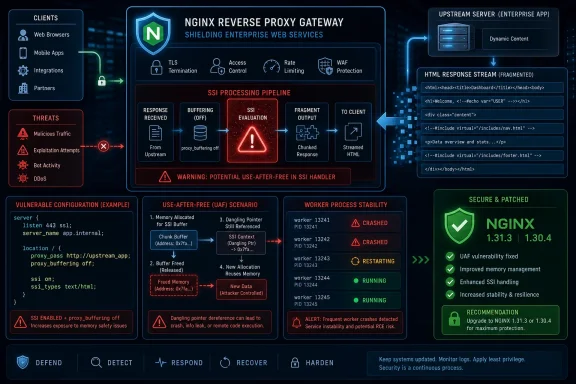 Overview
CVE-2026-56434 affects the NGINX HTTP SSI module, formally known as ngx_http_ssi_module. NGINX classifies it as a medium-severity use-after-free vulnerability, while the technical impact includes the possibility of limited memory modification or an NGINX worker restart under the vulnerable configuration. The fault is in a feature that processes Server-Side Includes in HTTP responses as those responses pass through NGINX.The vulnerability was disclosed on July 15, 2026, although the Microsoft Security Response Center entry referenced in the initial report was published on July 22, 2026. That distinction matters for operations teams tracking publication dates through multiple vulnerability-management feeds: the NGINX and F5 security material identifies July 15 as the release date of the fixed software, while downstream databases and vendor portals may surface the CVE later.
The practical exposure conditions
This is not a vulnerability exposed merely by running NGINX. The affected path requires all of the following conditions to align:- The SSI filter must be enabled in the effective NGINX configuration.
- The relevant location must proxy traffic upstream using
proxy_pass. - Upstream response buffering must be disabled with
proxy_buffering off. - An attacker must be able to control or alter the upstream response stream, typically through a man-in-the-middle position or an already compromised upstream application, service, or network path.
Why the availability language needs context
The impact description supplied with the report emphasizes a total loss of availability. That language reflects the possibility that repeated exploitation can keep a service unavailable or repeatedly prevent it from serving new requests. In this specific case, the public technical description is more precise: exploitation may cause an NGINX worker process to restart.A worker restart is not automatically equivalent to taking down the entire NGINX instance. NGINX’s master-and-worker architecture is designed to supervise workers, and a healthy master process can spawn replacements. But repeated crashes, busy worker pools, connection loss, request failures, and cascading stress on upstream applications can produce a very real denial-of-service outcome—particularly at peak traffic periods or where capacity has been tuned tightly.
Background
Server-Side Includes predate today’s application frameworks, edge-rendering systems, and JavaScript-heavy front ends. SSI was built for a simpler web era: a web server could parse an HTML response, recognize a directive embedded in a comment-like construct, and dynamically insert a fragment, evaluate a variable, or include another resource before returning the final page to the client.NGINX supports this behavior through
ngx_http_ssi_module, an HTTP filter module. It is not enabled by default. When configured, it examines qualifying responses—typically text/html—and processes supported SSI commands while the response is being delivered. The module can also process additional MIME types when an administrator expands ssi_types.SSI’s original role and its modern niche
SSI remains useful where teams need lightweight composition without changing an older application. A content header, status banner, footer, maintenance notice, localized fragment, or server-rendered widget can be assembled at the web-server layer rather than inside the application code.That convenience comes with architectural cost. The HTTP response is no longer simply a byte stream passed from origin to client; it becomes input to a parser and, in many scenarios, a generator of internal subrequests. Each added transformation stage creates state to manage, edge cases around partial data, and potential interactions with proxying, caching, compression, and connection handling.
NGINX as a Windows-adjacent infrastructure component
Although NGINX is commonly associated with Linux servers, it remains relevant to Windows environments. NGINX can run on Windows, and more importantly, Windows organizations regularly encounter it in front of IIS applications, .NET services, Node.js workloads, Windows containers, hybrid Kubernetes environments, appliance software, and bundled third-party products.For Windows administrators, the critical inventory question is therefore not simply whether a standalone
nginx.exe process exists on a server. It is whether a product, edge service, container image, or reverse-proxy tier uses an affected NGINX build and an exposed configuration. The answer may be hidden behind a vendor-managed deployment, a Docker image, or a platform team’s ingress configuration.The Vulnerability Mechanics
CVE-2026-56434 is described as a use-after-free condition, categorized as CWE-416. Use-after-free vulnerabilities occur when software continues to access memory after that memory has been released or repurposed. Because the original object’s lifetime has ended, later access can produce unpredictable results: corrupted data, application instability, a crash, or—in some cases—limited memory modification.The NGINX advisory also characterizes the result as a heap buffer over-read in the worker process. These descriptions are not necessarily contradictory. A memory-lifetime mistake can lead to stale pointers being dereferenced, which in turn can result in reading memory beyond the intended valid object or buffer. The significant point for defenders is that this is a memory-safety defect in a performance-critical HTTP processing path.
Why response streaming is central
The affected configuration includesproxy_buffering off. With response buffering enabled, NGINX normally receives upstream content into buffers before forwarding it downstream. Disabling buffering changes that behavior: response data is streamed more directly from the upstream server toward the client.Streaming has legitimate uses. It is often selected for long-lived responses, server-sent events, some API patterns, real-time dashboards, download paths, or workloads where the administrator wants to minimize buffering latency. But it also changes lifecycle timing. Response chunks can arrive incrementally, downstream clients can disconnect at inconvenient times, and filters such as SSI must correctly maintain state across partial buffers.
The risky interaction
In a vulnerable deployment, NGINX is simultaneously doing three things:- Receiving a response from an upstream service.
- Streaming that response because buffering is off.
- Parsing and potentially transforming the response through the SSI filter.
No control-plane exposure
The advisory specifically identifies this as a data-plane issue only. That means the disclosed flaw does not provide a direct route to NGINX management interfaces, administrative APIs, configuration endpoints, licensing systems, or the NGINX Plus control plane.This distinction should guide incident triage. CVE-2026-56434 is not described as an administrative takeover vulnerability, nor is it currently characterized as arbitrary remote code execution. It is primarily a stability and availability concern in traffic processing, with a limited integrity component arising from possible memory modification.
Affected Versions and Fixed Builds
The breadth of the affected version range is notable. For NGINX Open Source, the vulnerable range begins at version 0.8.11 and extends through 1.31.2. That means the bug existed across a very long historical period, even though exploitation requires a narrow feature and configuration combination.The corrected Open Source releases are NGINX 1.31.3 on the mainline branch and NGINX 1.30.4 on the stable branch. Organizations using a supported package channel should prioritize moving to one of those fixed versions or a newer release that incorporates the fix.
NGINX Plus exposure
For NGINX Plus customers, the relevant patched release is NGINX Plus R36 P7. The affected range also includes earlier supported Plus release trains identified in the vendor’s CVE data, including Plus R36 before Patch 7 and earlier eligible versions.NGINX Plus users should not assume that an Open Source version number is sufficient for their patch decision. Plus release nomenclature, vendor support commitments, and appliance integrations differ from Open Source package management. The appropriate action is to consult the deployed Plus release, confirm the vendor-supported upgrade target, and account for the possibility that the NGINX runtime is embedded in a broader application-delivery platform.
End-of-support caveat
The vendor has noted that versions that have reached end of technical support are not evaluated. This is important because “not evaluated” does not mean “not vulnerable.” It means the vendor has not made a supported determination for that release.Administrators running old distributions, custom builds, frozen appliance images, or vendor-maintained NGINX forks should assume they need further investigation. A very old NGINX build combined with SSI and unbuffered proxying should be treated as potentially exposed until the software supplier or maintainer proves otherwise.
Identifying Real-World Exposure
The first operational task is to identify whether SSI is actually enabled where proxied content is streamed without buffering. A version scan alone will overstate exposure, while a configuration-only review without version data will understate remediation needs. Teams need both.The NGINX directive
ssi defaults to off, which is good news: many installations will not use the affected filter at all. Yet an inherited setting can enable SSI at the http, server, location, or if in location level, and configuration sprawl often makes inherited behavior difficult to see at a glance.A focused configuration review
Administrators should inspect effective configuration, including all included files, for the following directives:
Code:
ssi on;
proxy_pass http://upstream_backend;
proxy_buffering off;ssi on;, a server-level proxy_buffering off;, and a location-level proxy_pass may combine into exposure even if no single file contains all three lines.Commands worth using carefully
On a managed NGINX host, a configuration dump is often more useful than manually searching directories because it expands included files:nginx -TAdministrators can then review the emitted configuration for SSI, proxying, buffering overrides, and location inheritance. Version checks should be collected at the same time:
Code:
nginx -v
nginx -V-V output is especially useful because it reveals build options and modules. The SSI module may be part of a standard build, disabled at compile time, or absent in a minimized custom build.Third-party and containerized deployments
Many of the most exposed systems will not be traditional package-based NGINX servers. They will be:- Container images deployed by CI/CD pipelines.
- Kubernetes ingress or gateway implementations.
- SaaS-connected edge appliances.
- Development stacks that bundle NGINX with an application.
- Windows-based commercial products that install NGINX as a supporting service.
- Legacy web platforms where NGINX configuration is generated by another tool.
nginx.exe or upgrade an image independently. The right response is to identify the owning product, determine its embedded NGINX version, and obtain a supported update rather than attempting an unsupported binary swap.Exploitability: Serious but Conditional
The most important fact about CVE-2026-56434 is that the attacker must be able to control responses from the upstream server or alter them in transit. That can happen through a network man-in-the-middle position, but it can also become relevant if the upstream application or an intermediate service has already been compromised.This makes the vulnerability part of a broader trust-chain problem. NGINX may be functioning correctly as a reverse proxy in a logical sense, but it is vulnerable when it processes malicious content from a source it trusts and when its filtering and streaming configuration meets the affected pattern.
The upstream trust boundary
A common deployment sends traffic from clients to NGINX over HTTPS, then from NGINX to an internal upstream over plain HTTP. Organizations sometimes consider internal transport inherently safe because it stays within a private subnet, virtual network, or cluster overlay.That assumption is increasingly fragile. A compromised workload, rogue sidecar, misconfigured service mesh, exposed node, poisoned route, or lateral-movement foothold can all turn internal upstream traffic into an attacker-controlled channel. The vulnerability does not mean every internal HTTP connection is compromised; it means that encrypted and authenticated upstream paths have more security value than simply protecting data confidentiality.
Why an attacker might prefer disruption
The disclosed impact centers on worker restart and limited memory modification rather than reliable code execution. An attacker seeking a practical outcome may therefore focus on stability: forcing request failures, causing worker churn, exhausting operational attention, or degrading a high-value public endpoint during another intrusion.Repeated worker restarts can also obscure diagnosis. A service may appear to recover after each event, leaving intermittent 502, 504, connection reset, or timeout errors in logs rather than a clean, obvious outage. That intermittent pattern can be particularly disruptive to APIs and authentication services where clients retry aggressively.
No known public exploitation claim
As of July 22, 2026, the available vulnerability information does not identify known active exploitation or a broadly available automated exploit. That status should lower panic, not lower patch priority. Once version ranges and configuration predicates are public, attackers can examine source changes, reproduce the behavior in test environments, and look for target organizations that use SSI with unbuffered proxying.Why NGINX Worker Restarts Matter
NGINX is intentionally engineered around a master process supervising worker processes. In routine conditions, replacing a failed worker can limit the blast radius of a crash. This resilience is a strength, but it should not be mistaken for immunity from denial-of-service.A worker restart can interrupt active connections handled by that worker. Depending on the operating system, configuration, traffic protocol, and workload type, users may see failed page loads, interrupted downloads, broken streaming sessions, transient application errors, or failed API calls.
Impact on web applications
For a low-traffic brochure site, one worker restart may look like a brief and isolated error. For a busy API gateway, login endpoint, payment workflow, or business portal, even brief interruptions can have material consequences. Client retries may amplify load against NGINX and upstream services precisely when those services are trying to recover.Applications that depend on long-lived connections are more vulnerable to user-visible disruption. WebSockets, event streams, media relays, continuous dashboards, and software-update delivery paths can all suffer when the proxy process responsible for a live connection exits unexpectedly.
Impact on enterprise services
Enterprise environments often use NGINX as a shared entry point. A single reverse-proxy cluster may front multiple internal applications, and its failure domain can extend well beyond one website. Identity platforms, developer portals, HR systems, line-of-business applications, and administrative dashboards may share the same NGINX tier.The operational impact can therefore be nonlinear. A narrow vulnerability in an SSI-enabled location might cause repeated instability in a worker pool serving unrelated routes if workers are shared broadly. This is another reason to investigate configuration scope rather than assume the vulnerable endpoint is isolated.
Windows operational considerations
On Windows hosts, administrators should correlate NGINX service events with Windows Event Viewer, service-control activity, process restarts, monitoring alerts, and load-balancer health-check behavior. An NGINX worker failure might surface as an application error, a service-monitor alert, an abnormal process event, or a pattern of failed health probes rather than a plainly labeled CVE event.Teams should also verify how their NGINX instance is launched. A manually started process, a scheduled task, a Windows service wrapper, and a vendor-controlled application service may each restart differently and produce logs in different locations.
Immediate Mitigations Before Patching
Patching remains the preferred remediation. The fixed releases correct the underlying defect, while configuration workarounds only reduce exposure. Still, a safe upgrade may require testing, maintenance windows, vendor approval, image rebuilds, or change-control review.Where immediate patching is not possible, organizations can reduce exposure by breaking one of the necessary conditions. The safest temporary workaround is usually to disable SSI for the affected proxied locations if that does not break application behavior.
Mitigation options
- Disable SSI where it is not required. Because
ssi offis the default, many legacy configurations can remove the feature with little or no user-facing impact after validation. - Restore proxy buffering where the application permits it. Replacing
proxy_buffering offwith an appropriate buffered configuration can remove the disclosed vulnerable condition, though it may change latency, memory use, streaming behavior, or compatibility. - Use authenticated and encrypted upstream transport. TLS does not replace patching, but it reduces the feasibility of a network-based response-tampering scenario. Mutual TLS can strengthen assurance that NGINX is speaking to the intended upstream.
- Segment the upstream network. Restrict which hosts, workloads, and service accounts can communicate with the upstream application. Private addressing alone is not a sufficient control.
- Limit SSI processing to required MIME types and locations. Avoid broad directives such as
ssi_types *;unless there is a validated technical need. - Separate sensitive proxy workloads. If an SSI-dependent legacy application cannot be changed quickly, place it in a dedicated NGINX tier or worker environment rather than exposing a larger shared ingress layer to the same risky configuration.
Why disabling buffering can be difficult
Some administrators may be tempted to switch buffering back on globally. That can be an effective mitigation for this CVE, but it can also introduce service regressions. Streaming applications may accumulate latency, server-sent events may behave differently, large responses may consume disk resources according to proxy temporary-file settings, and application assumptions may be invalidated.The responsible approach is targeted change. Start with the specific location blocks where SSI,
proxy_pass, and proxy_buffering off overlap. Test representative traffic, confirm headers and response behavior, and monitor resource use before expanding the change.Patch and Validation Strategy
A successful upgrade requires more than installing a new package. NGINX is often embedded in a traffic-management chain, and the update must be validated against certificates, modules, configuration syntax, upstream health, load balancers, WAF rules, and application expectations.A staged process reduces the chance that security remediation becomes an availability incident of its own.
Recommended sequence
- Inventory the executable and the effective configuration. Record NGINX version, build flags, modules, package source, active configuration, and every location using SSI or unbuffered proxying.
- Determine the supported fixed target. For Open Source, move to 1.31.3, 1.30.4, or a later supported build. For NGINX Plus, use R36 P7 or the appropriate later supported release for the organization’s subscription and platform.
- Test in a representative environment. Validate standard requests, error handling, proxy paths, streaming endpoints, SSI-dependent pages, compression, cache behavior, and failover behavior.
- Deploy with rollback planning. Use a load-balanced or canary approach where possible. Preserve the known-good package and configuration, while remembering that rollback restores vulnerability exposure.
- Confirm the running binary after deployment. Verify the version from the active service, not merely from a package-manager record or deployment report.
- Monitor worker health and error logs. Watch for unexpected restarts, failed configuration reloads, upstream connection changes, and elevated 5xx responses after the maintenance window.
Reload versus restart
NGINX is well known for supporting configuration reloads with minimal disruption, but a binary upgrade is different from an ordinary configuration edit. The exact deployment procedure depends on the operating system, packaging method, service manager, and whether the environment uses a graceful upgrade mechanism.Administrators should follow their supported vendor or distribution procedure. On Windows, where operational conventions differ from Linux service management, the focus should be on ensuring the new executable is actually running, the service wrapper points to the intended path, and health checks verify application availability after the process transition.
Detection and Monitoring
CVE-2026-56434 does not come with a simple request signature that defenders can reliably block at the edge. The attacker-controlled element is an upstream response, and the disclosed trigger depends on response processing and memory lifetime. Detection should therefore focus on exposure identification, upstream integrity, and abnormal worker behavior.An organization that patches quickly will gain more from good validation and monitoring than from speculative signature hunting.
Indicators worth investigating
The following conditions warrant review, especially on known-exposed systems:- Unexpected worker process exits or rapid worker respawning without an ordinary configuration reload or scheduled restart.
- Spikes in 502, 499, 504, connection-reset, or upstream-related errors concentrated around SSI-enabled proxied paths.
- Repeated application disruption affecting streaming or dynamically assembled HTML pages while the NGINX master process remains present.
- Unusual changes in upstream response patterns, including malformed, truncated, unexpectedly chunked, or anomalously timed content.
- Signs of upstream compromise or network interception, such as unauthorized certificates, routing changes, unexpected DNS behavior, suspicious service-account activity, or unexplained traffic between proxy and origin tiers.
Logging limitations
NGINX access logs record request-side details, while the malicious component in this scenario may be the response arriving from upstream. Error logs and operating-system process telemetry will often be more useful than access logs alone.Organizations should ensure that NGINX error logs are centrally collected and retained long enough to compare crashes with upstream anomalies. They should also collect host-level telemetry around process creation, process termination, service recovery, and network connections. On Windows, this may include native event logging, endpoint detection telemetry, and application-specific service logs.
Strengths and Opportunities
CVE-2026-56434 is disruptive enough to justify urgent remediation, but several characteristics reduce its immediate exposure compared with more conventional remote pre-authentication web server vulnerabilities.- SSI is disabled by default. Organizations that have never enabled the module’s processing behavior are unlikely to meet the primary configuration requirement.
- The vulnerable path requires multiple directives to align. SSI, reverse proxying, and disabled buffering must apply to the relevant request path rather than merely exist somewhere in the broader configuration.
- The attacker needs upstream response control. A normal Internet client sending crafted requests cannot meet the disclosed exploit condition on its own.
- The issue is limited to the data plane. The advisory does not describe direct exposure of NGINX management functions or control-plane interfaces.
- Fixed releases are already available. NGINX Open Source 1.31.3 and 1.30.4, plus NGINX Plus R36 P7, give administrators clear patch targets.
- The configuration review has security value beyond this CVE. Mapping SSI, buffering exceptions, and upstream transport security can expose obsolete legacy patterns and undocumented dependencies.
Risks and Concerns
The narrow exploit prerequisites should not lead organizations to defer action indefinitely. Several operational realities can turn the stated conditions into a practical attack path.- Legacy SSI usage is often poorly documented. Teams may not realize that a global or inherited
ssi ondirective affects a particular application route. - Internal upstream traffic is frequently unencrypted. A private network does not eliminate the risk created by a compromised workload, lateral movement, or traffic manipulation.
proxy_buffering offis common in specialized workloads. Streaming, event delivery, real-time applications, and troubleshooting-driven configuration changes can leave the setting enabled long after its original rationale is forgotten.- Worker restarts can be operationally expensive. Even if NGINX self-recovers, transient failure can trigger retries, overload origins, damage user trust, and disrupt transaction flows.
- Old NGINX versions may be difficult to upgrade. Unsupported operating systems, embedded appliances, and pinned container bases can turn a simple patch into a vendor-management exercise.
- This CVE arrived amid other July 2026 NGINX security fixes. Organizations should avoid treating it as an isolated patch event and instead assess whether their NGINX update process has fallen behind more broadly.
What to Watch Next
The immediate priority is confirmation of exposure and deployment of a fixed release. After that, security teams should monitor for changes in the vulnerability’s public status: proof-of-concept research, exploit reports, vendor updates for embedded products, or revised severity assessments could alter the urgency for organizations that initially considered their upstream network sufficiently trusted.The most useful question is not “Do we run NGINX?” but “Can an untrusted or compromised upstream response reach an SSI-enabled, unbuffered proxy path?” That question connects software inventory, configuration management, network architecture, TLS design, and incident response.
Broader NGINX patch hygiene
The July 15, 2026 NGINX releases also addressed other security issues, including a buffer overflow involvingmap and regular expressions and a memory-disclosure issue involving the slice module. That release context is a reminder that organizations should patch to the current supported fixed release rather than applying a narrowly targeted workaround for one CVE and remaining behind on the larger security update set.For enterprises, this should reinforce the value of version standardization. A small number of approved NGINX base images, package repositories, and configuration patterns is much easier to patch and audit than a collection of bespoke builds distributed across Windows servers, Linux hosts, containers, edge nodes, and vendor appliances.
A useful architecture review
CVE-2026-56434 also provides a reason to revisit whether SSI remains necessary. Modern applications often have alternatives: application-side templates, edge-side includes, API composition, static-site generation, content delivery platforms, or component rendering in the framework itself. None is universally better, but each can reduce the need to parse and transform arbitrary upstream HTML in the proxy layer.Where SSI must remain, keep it narrowly scoped. Apply it only to explicitly approved locations and MIME types, avoid unbuffered upstream streaming unless there is a demonstrated requirement, use encrypted upstream connections, and isolate legacy composition workloads from shared high-value ingress tiers.
CVE-2026-56434 is best understood as a conditional but credible NGINX availability risk: it does not threaten every deployment, and it does not turn an ordinary client into an instant server-crashing attacker, yet it can become a serious operational vulnerability where legacy SSI, streamed proxy responses, and weak upstream trust boundaries intersect. The right response is disciplined rather than alarmist—verify the configuration, upgrade to a fixed release, tighten the upstream path, and use this incident to remove web-serving patterns whose convenience no longer justifies their security and reliability cost.
References
- Primary source: MSRC
Published: 2026-07-22T01:41:55-07:00
Security Update Guide - Microsoft Security Response Center
 msrc.microsoft.com
- Related coverage: nginx.org
- Related coverage: nginx.ac.cn