

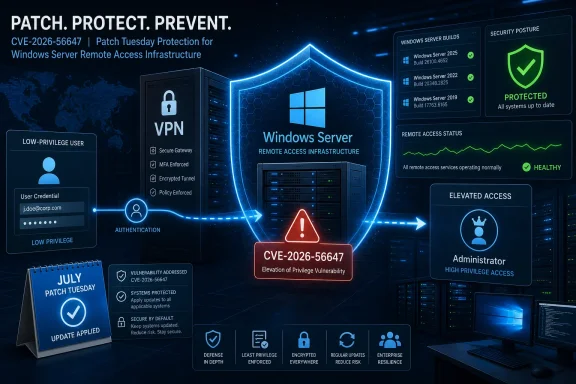
Microsoft’s Security Update Guide published the vulnerability as part of the July Patch Tuesday release. The National Vulnerability Database records Microsoft’s CVSS 3.1 score as 8.8 High, with a vector that combines network reachability, low attack complexity, low privileges required, no user interaction, and a potential full loss of confidentiality, integrity, and availability.
The underlying defect is an integer overflow or wraparound, classified as CWE-190. Microsoft’s public description is deliberately short: an authorized attacker could exploit the weakness to elevate privileges over a network. That leaves substantial implementation detail undisclosed, which is normal at release time—and good reason not to confuse a severe score with evidence of an immediately reusable exploit.
CISA’s initial SSVC enrichment marks exploitation as none and automatable exploitation as no. That is an important current distinction: there is no public indication that CVE-2026-56647 is being exploited in the wild, nor that attacks can simply sweep the internet for unauthenticated targets. But the record’s “total” technical-impact assessment means a successful exploit could provide a powerful privilege transition rather than merely cause a service disruption.
The First Credential Is the Security Boundary
The most useful way to read CVE-2026-56647 is as a post-compromise risk amplifier. The CVSS vector includes PR:L: an attacker must be authorized, holding at least low privileges, before they can attempt exploitation. It also includes AV:N and AC:L, indicating that the attack is network-reachable and does not depend on an unusually fragile or complex sequence of conditions.
For an unmanaged home PC, that combination may make the practical exposure lower than the raw 8.8 score suggests. A device with no exposed remote-access services and no untrusted users sharing its network is not the obvious target profile.
Enterprise environments should be more careful. A compromised standard account, a contractor account, a VPN credential obtained through phishing, or a foothold on a segmented internal network can all change the calculation. Remote-access infrastructure is often placed precisely where identity, networking, policy enforcement, and administrative boundaries meet; vulnerabilities there can be valuable to attackers seeking to move from an initial foothold toward broader control.
The name “Windows Remote Access Service Infrastructure” should not be read as a declaration that every RDP deployment, every VPN appliance, or every Windows client is directly exposed to the same attack path. Microsoft has not released those operational details. Administrators should avoid inventing a mitigation based on an assumed affected port, protocol, or service configuration. The security update—not an unverified firewall rule—is the primary remediation.
July’s Cumulative Updates Carry the Fix
Microsoft’s affected-product data includes a wide cross-section of Windows client and server releases: Windows 10 versions 1607, 1809, 21H2, and 22H2; Windows 11 versions 24H2, 25H2, and 26H1; plus Windows Server 2012 R2, Windows Server 2016, Windows Server 2019, Windows Server 2022, and Windows Server 2025. Both full-server and Server Core installations appear in the affected list where applicable.
For mainstream current deployments, the practical remediation is the July 14 cumulative update:
- Windows 11 version 24H2 and version 25H2 receive KB5101650, reaching builds 26100.8875 and 26200.8875 respectively.
- Windows 10 version 22H2 and supported 21H2/LTSC servicing paths receive KB5099539, reaching builds 19045.7548 and 19044.7548.
- Windows Server 2025 receives KB5099536, while Windows Server 2022 receives KB5099540 and build 20348.5386.
- Windows Server 2019 receives KB5099538 and build 17763.9020; Windows Server 2016 receives KB5099535 and build 14393.9339.
Microsoft’s release notes confirm that the July packages are cumulative: systems already patched through June need only install the latest package, rather than locate a separate hotfix for this CVE. Windows Update, Windows Update for Business, Windows Server Update Services, and the Microsoft Update Catalog remain the normal distribution channels, subject to an organization’s servicing configuration.
The Windows 10 line requires particular attention. Microsoft’s support documentation notes that ordinary Windows 10 version 22H2 support ended on October 14, 2025. Devices that remain on that release need the applicable Extended Security Updates entitlement to continue receiving the security package, while LTSC editions follow their own lifecycle. An unpatched Windows 10 endpoint is not made safer by the fact that this flaw requires credentials; a stolen or malware-obtained local account is still a credential.
Validate the Build, Not Just the Deployment Job
Patch-management consoles can report a deployment as successful before a device has completed the restart required to load all updated components. For CVE-2026-56647, as with any Windows cumulative-update vulnerability, remediation verification should include the installed OS build and not simply an “approved” or “installed” status in WSUS, Configuration Manager, Intune, or a third-party RMM tool.
Windows 11 administrators should confirm the 24H2 build is at least 26100.8875, or 26200.8875 on 25H2. Windows 10 administrators using the July package should confirm build 19045.7548 for version 22H2 or 19044.7548 for the relevant 21H2/LTSC branch. Server teams should validate the appropriate July build on every node, including Server Core machines that may be less visible in desktop-oriented reporting.
This month’s packages also contain changes beyond the CVE list. Microsoft’s Windows Server 2022 documentation, for example, calls out a hardening change involving third-party TDI transports and warns that applications using sockets over unregistered legacy transports can stop functioning. That does not diminish the priority of the security fix, but it reinforces the case for a short production ring and application-owner validation before broad rollout—especially on systems carrying older line-of-business networking components.
A focused deployment sequence is appropriate:
- Prioritize Windows servers that provide remote access, identity-adjacent services, or shared infrastructure to many authenticated users.
- Patch administrative workstations and jump hosts early, because they are high-value places for a low-privilege compromise to become a larger incident.
- Confirm restart completion and target build numbers rather than relying only on update compliance dashboards.
- Review accounts with remote-access permissions, including stale VPN users, contractors, and service accounts, while the patch moves through deployment rings.
No Evidence of Active Exploitation—Yet
The disclosure was published on July 14, and the NVD entry remains marked “Awaiting Enrichment,” meaning NIST has not yet added its own CVSS assessment or broader analytical context. The current public record originates with Microsoft, and CISA’s initial metadata does not indicate exploitation in the wild.
That makes CVE-2026-56647 a patch-now vulnerability, not a panic-now vulnerability. Its risk is rooted in the combination of network reachability, modest prerequisites, and high potential impact after successful exploitation—not in a confirmed worm, a public proof of concept, or a known mass-exploitation campaign.
The next meaningful milestones are whether Microsoft expands its advisory with exploitability assessment details or mitigations, whether researchers publish technical analysis, and whether CISA changes the exploitation status. Until then, the concrete action is straightforward: deploy the July 14 Windows cumulative update across the affected estate, verify the resulting builds, and treat exposed remote-access systems as the first wave rather than another item in an already crowded Patch Tuesday queue.
References
- CVE-2026-56647 Windows Remote Access Service Infrastructure Elevation of Privilege Vulnerability MSRC · 2026-07-14T07:00:00-07:00