

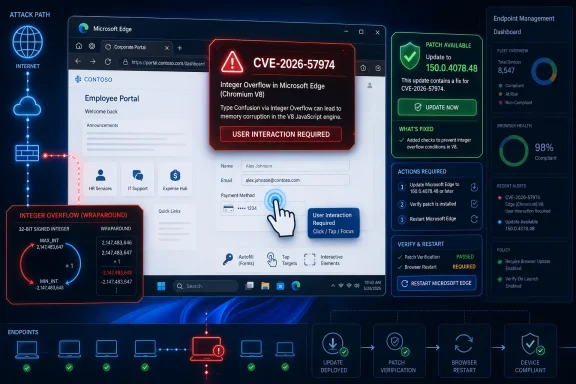
Microsoft published CVE-2026-57974 on July 3, 2026, as an Important remote code execution vulnerability in Chromium-based Microsoft Edge, fixed in Edge version 150.0.4078.48 and described by MSRC as an integer overflow or wraparound reachable over a network. The advisory is not a five-alarm zero-day bulletin, and that distinction matters. But it is also not a routine browser footnote that administrators can safely ignore until the next convenient maintenance window. The real story is the gap between Microsoft’s “exploitation unlikely” label and the practical reality of a browser bug that needs only a user, a crafted interaction, and a vulnerable build.
The Microsoft Security Response Center says CVE-2026-57974 affects Microsoft Edge, the Chromium-based browser that has become the default front door to the web on modern Windows systems. The vulnerability carries a CVSS 3.1 base score of 8.8, with network attack vector, low attack complexity, no privileges required, required user interaction, unchanged scope, and high impacts for confidentiality, integrity, and availability.
That combination is familiar to anyone who has watched browser security over the past decade. The bug is not advertised as a wormable network service flaw, and Microsoft says it has not been publicly disclosed or exploited at the time of publication. Yet the impact category is remote code execution, and the affected component is the browser — the one application enterprises have deliberately pushed into nearly every identity, SaaS, and administrative workflow.
Microsoft’s own release notes for Edge security updates list version 150.0.4078.48 as the July 2026 Stable Channel release that incorporates current Chromium security updates. The MSRC entry ties CVE-2026-57974 to that same fixed build and lists the underlying Chromium version as 150.0.7871.47. In plain English: if Edge is below that build, the browser is on the wrong side of this advisory.
The advisory also credits Kugelblitz with Microsoft, which strongly suggests coordinated handling rather than a surprise disclosure dumped into the public domain. That matters because it shapes the risk clock. Defenders get a patch before public exploit chatter, but attackers also get a map of the fixed surface as soon as the release ships.
Severity labels compress a lot of assumptions into a single word. Here, the CVSS vector says the attacker needs the user to participate, and Microsoft’s exploitability assessment says exploitation is unlikely. Those are meaningful dampers, especially compared with no-click flaws that can be triggered without any user action.
But user interaction is not a rare condition on the web. It is the business model of the web. Users click, tap, open files, approve prompts, accept autofill, and interact with authentication flows all day long, often under pressure and often inside browsers that are already trusted by corporate identity systems.
The MSRC FAQ makes the interaction requirement unusually specific but also unusually messy. One answer says the user must visit an attacker-controlled webpage and perform two tap gestures that cause autofill to activate. Another says the target context involves opening a specially crafted file from the attacker to initiate remote code execution. A third describes tricking a user into interacting with a malicious request that appears legitimate, allowing an attacker to obtain an access token and send it to an attacker-controlled location.
That blend of phrasing is awkward enough to raise eyebrows. It reads less like a clean textbook exploit path and more like the advisory text is describing several pieces of a browser-mediated attack chain: web content, user gestures, autofill behavior, crafted input, and token handling. The conservative reading is that Microsoft has confirmed the vulnerable condition, published the fix, and disclosed only enough detail to let defenders prioritize without handing exploit developers a recipe.
Report Confidence is one of the least glamorous CVSS fields, but it is often one of the most useful for triage. A high base score attached to a shaky report is different from a high base score attached to a vendor-confirmed flaw. In this case, Microsoft is both the assigning CNA and the vendor shipping the fix, and the advisory states the weakness class: CWE-190, integer overflow or wraparound.
That is a meaningful disclosure. Integer overflow bugs are not exotic by 2026 standards, but they are persistent because browser engines and browser-adjacent code spend their lives parsing complicated, hostile input at high speed. A value that wraps unexpectedly can become a mis-sized allocation, a bounds check bypass, a corrupted state transition, or the first step in a memory safety exploit.
Microsoft is not saying all of that happened here. It is saying enough to tell defenders that the root cause is not a mere UI spoofing glitch or a documentation issue. The affected Edge code path allowed an unauthorized attacker to execute code over a network, according to the executive summary. That is the sentence that should matter more than the comfort of the word Important.
That is why browser remote code execution vulnerabilities carry such awkward operational weight. The affected software may update outside Patch Tuesday. The browser may be managed by one team while identity risk belongs to another. Users may run Windows on managed endpoints, unmanaged contractor machines, virtual desktops, mobile devices, and kiosk-like systems where update behavior differs.
The Edge release train is faster than the traditional Windows servicing model, which is both a blessing and a source of confusion. A fixed browser can arrive quickly, but only if update controls, network egress rules, management profiles, and restart behavior actually let it arrive. A fleet that looks healthy in Windows Update for Business may still contain browsers lagging behind the Stable Channel.
The July 3 advisory is therefore a test of browser patch hygiene. Enterprises that can inventory Edge versions and force-restart stale browser processes have a small job. Enterprises that cannot answer which endpoints are still running pre-150.0.4078.48 builds have a measurement problem disguised as a vulnerability problem.
If exploitation requires a user to perform two tap gestures that activate autofill, the bug sits in an especially modern part of browser risk. This is not the old caricature of a user downloading an obviously suspicious executable. It is closer to a malicious webpage choreographing ordinary interactions until the browser or app performs an unsafe action in a trusted context.
That does not make the vulnerability automatically easy to weaponize. Microsoft’s temporal metrics list exploit code maturity as Unproven, and the exploitability assessment is “Exploitation Unlikely.” But the interaction model is plausible enough to deserve attention because mobile-style gestures, touch interfaces, and autofill flows now exist across laptops, tablets, and hybrid Windows devices.
The advisory also talks about a malicious request that appears legitimate and access tokens being sent to an attacker-controlled location. That language belongs to the gray zone where browser exploitation, identity phishing, consent abuse, and token theft begin to overlap. Even when the final CVE bucket says remote code execution, defenders should read the surrounding detail as a warning about trusted browser-mediated workflows.
Browser vulnerabilities change character after patches ship. Attackers can diff patched and unpatched builds, examine Chromium-adjacent code, and use advisory language to narrow the hunt. The absence of public exploit code on day one does not mean the vulnerability is permanently academic.
This is especially true for bugs with high impact and low attack complexity. The CVSS vector does not require privileges, and it assumes network reachability. User interaction is the main gating factor, but modern social engineering has repeatedly shown that user interaction is easier to obtain than defenders would like.
There is also a practical asymmetry here. Administrators have to update every relevant endpoint. Attackers only need one useful laggard, preferably a user with valuable tokens, privileged SaaS access, or access to internal applications that trust the browser session. The longer stale Edge builds remain in the fleet, the more favorable that asymmetry becomes.
There are benign explanations. Advisory templates are imperfect, browser bugs often span multiple surfaces, and vendors sometimes deliberately avoid describing the exploit path too cleanly before a patch has propagated. Still, mixed wording creates ambiguity, and ambiguity should not become an excuse for delay.
For defenders, the safe conclusion is simple: treat this as a confirmed Edge remote code execution issue fixed in a specific build, with user interaction required and no evidence of exploitation at publication. Do not over-rotate into panic. Do not under-rotate into complacency because the explanatory text is untidy.
This is one of those cases where the remediation is clearer than the vulnerability narrative. Update Edge to 150.0.4078.48 or later, verify that the update actually landed, and make sure old browser processes are not lingering. The fact that the advisory’s prose is less than elegant does not reduce the value of the patch.
The first operational question is inventory. Security teams should be able to query Edge versions across Windows clients and servers where Edge is present, with special attention to machines that do not reboot often. Browser updates can be installed while old processes remain alive, and the user’s actual exposure may persist until the browser restarts.
The second question is channel discipline. Stable, Extended Stable, Beta, Dev, and mobile channels do not all move in lockstep. This advisory’s fixed build is for the Chromium-based Edge Stable release identified by MSRC, and organizations using other channels need to map their exposure against Microsoft’s release notes rather than assume one number covers every estate.
The third question is policy. Edge can be managed through Group Policy, Microsoft Intune, configuration profiles, and enterprise update controls. If those controls slow security updates more than intended, CVE-2026-57974 is a good reason to revisit them before a truly exploited browser zero-day arrives.
A compromised or manipulated browser session may expose data that sits well beyond the local machine. That includes SaaS sessions, cloud consoles, internal portals, password managers, device-bound credentials, and identity provider flows. The browser is often the place where an attacker can turn a low-friction user action into a high-value authorization event.
This is why administrators should pair patching with telemetry review. If an environment has strong browser, identity, and endpoint logging, the advisory is a chance to look for suspicious consent prompts, unusual token activity, unexpected autofill behavior, and browser crashes around the disclosure window. Microsoft says exploitation was not observed at publication, but enterprise defenders should still validate their own environment rather than outsource situational awareness to a vendor status field.
The good news is that the same modern stack that expands browser risk can also improve detection. Conditional access policies, device compliance, session risk signals, endpoint detection, and cloud app logs can make a browser exploit less useful after the first click. But those controls only matter if they are tuned for browser-mediated abuse, not merely traditional malware execution.
The user-interaction requirement is also a reminder that basic browser hygiene still matters. Avoiding unfamiliar files, distrusting suspicious prompts, and being careful around pages that push users into hurried taps or approvals are not obsolete lessons. They are exactly the behaviors that reduce the value of vulnerabilities like this one.
Still, the burden should not fall entirely on users. Browser vendors know that people interact with webpages; that is the point of the software. The meaningful fix is the code fix Microsoft has shipped, not a lecture about perfect clicking habits.
Home users who rely on Edge’s autofill and password features do not need to abandon them because of one advisory. They should, however, keep the browser updated, use multifactor authentication where available, and treat unexpected authentication or permission prompts as a reason to slow down. The safest browser convenience feature is one running on a patched browser.
Yet the experience remains fragmented. Administrators have to connect MSRC, Edge release notes, Chromium versioning, channel behavior, and enterprise update controls. The CVE page says one thing in security language; the release notes say another in channel language; endpoint tools then report whatever build happens to be installed.
This fragmentation is not unique to Microsoft. It is the cost of building a browser on a fast-moving upstream engine while also integrating it deeply into an operating system, identity stack, and enterprise management model. But Microsoft has made Edge a strategic platform, not merely a bundled application. The security communication needs to match that role.
A stronger advisory pattern would separate the exploit path more cleanly, especially when FAQ entries appear to describe web interaction, crafted files, and token flows in the same breath. Defenders do not need exploit code. They do need crisp enough language to map risk to controls.
Security teams should use the advisory to tighten the parts of browser servicing that are easy to neglect. The point is not merely to close this one CVE, but to prove the organization can move quickly when the next Edge or Chromium issue arrives with active exploitation attached.
 Microsoft’s Edge Patch Is a Browser Story, Not Just a CVE Story
The Microsoft Security Response Center says CVE-2026-57974 affects Microsoft Edge, the Chromium-based browser that has become the default front door to the web on modern Windows systems. The vulnerability carries a CVSS 3.1 base score of 8.8, with network attack vector, low attack complexity, no privileges required, required user interaction, unchanged scope, and high impacts for confidentiality, integrity, and availability.That combination is familiar to anyone who has watched browser security over the past decade. The bug is not advertised as a wormable network service flaw, and Microsoft says it has not been publicly disclosed or exploited at the time of publication. Yet the impact category is remote code execution, and the affected component is the browser — the one application enterprises have deliberately pushed into nearly every identity, SaaS, and administrative workflow.
Microsoft’s own release notes for Edge security updates list version 150.0.4078.48 as the July 2026 Stable Channel release that incorporates current Chromium security updates. The MSRC entry ties CVE-2026-57974 to that same fixed build and lists the underlying Chromium version as 150.0.7871.47. In plain English: if Edge is below that build, the browser is on the wrong side of this advisory.
The advisory also credits Kugelblitz with Microsoft, which strongly suggests coordinated handling rather than a surprise disclosure dumped into the public domain. That matters because it shapes the risk clock. Defenders get a patch before public exploit chatter, but attackers also get a map of the fixed surface as soon as the release ships.
“Important” Does Not Mean “Unimportant”
Microsoft assigns CVE-2026-57974 a maximum severity of Important, not Critical. That label will tempt some patch queues to demote it beneath flashier server-side vulnerabilities. For a browser flaw, that would be a category error.Severity labels compress a lot of assumptions into a single word. Here, the CVSS vector says the attacker needs the user to participate, and Microsoft’s exploitability assessment says exploitation is unlikely. Those are meaningful dampers, especially compared with no-click flaws that can be triggered without any user action.
But user interaction is not a rare condition on the web. It is the business model of the web. Users click, tap, open files, approve prompts, accept autofill, and interact with authentication flows all day long, often under pressure and often inside browsers that are already trusted by corporate identity systems.
The MSRC FAQ makes the interaction requirement unusually specific but also unusually messy. One answer says the user must visit an attacker-controlled webpage and perform two tap gestures that cause autofill to activate. Another says the target context involves opening a specially crafted file from the attacker to initiate remote code execution. A third describes tricking a user into interacting with a malicious request that appears legitimate, allowing an attacker to obtain an access token and send it to an attacker-controlled location.
That blend of phrasing is awkward enough to raise eyebrows. It reads less like a clean textbook exploit path and more like the advisory text is describing several pieces of a browser-mediated attack chain: web content, user gestures, autofill behavior, crafted input, and token handling. The conservative reading is that Microsoft has confirmed the vulnerable condition, published the fix, and disclosed only enough detail to let defenders prioritize without handing exploit developers a recipe.
The Confirmed Metric Is the Quiet Signal
The user-supplied excerpt focuses on CVSS Report Confidence, and that is the right place to look. MSRC marks CVE-2026-57974 as Confirmed. That does not mean attacks are happening. It means Microsoft is not treating this as rumor, speculation, or a vague class of undesirable behavior.Report Confidence is one of the least glamorous CVSS fields, but it is often one of the most useful for triage. A high base score attached to a shaky report is different from a high base score attached to a vendor-confirmed flaw. In this case, Microsoft is both the assigning CNA and the vendor shipping the fix, and the advisory states the weakness class: CWE-190, integer overflow or wraparound.
That is a meaningful disclosure. Integer overflow bugs are not exotic by 2026 standards, but they are persistent because browser engines and browser-adjacent code spend their lives parsing complicated, hostile input at high speed. A value that wraps unexpectedly can become a mis-sized allocation, a bounds check bypass, a corrupted state transition, or the first step in a memory safety exploit.
Microsoft is not saying all of that happened here. It is saying enough to tell defenders that the root cause is not a mere UI spoofing glitch or a documentation issue. The affected Edge code path allowed an unauthorized attacker to execute code over a network, according to the executive summary. That is the sentence that should matter more than the comfort of the word Important.
The Browser Has Become the Enterprise Shell
Edge’s security posture matters because Edge is no longer just a browser icon pinned to the Windows taskbar. In Microsoft-centric organizations, it is an identity broker, a PDF viewer, a password and autofill surface, a policy endpoint, a web app runtime, and a delivery vehicle for everything from SharePoint to Entra-backed SaaS sessions.That is why browser remote code execution vulnerabilities carry such awkward operational weight. The affected software may update outside Patch Tuesday. The browser may be managed by one team while identity risk belongs to another. Users may run Windows on managed endpoints, unmanaged contractor machines, virtual desktops, mobile devices, and kiosk-like systems where update behavior differs.
The Edge release train is faster than the traditional Windows servicing model, which is both a blessing and a source of confusion. A fixed browser can arrive quickly, but only if update controls, network egress rules, management profiles, and restart behavior actually let it arrive. A fleet that looks healthy in Windows Update for Business may still contain browsers lagging behind the Stable Channel.
The July 3 advisory is therefore a test of browser patch hygiene. Enterprises that can inventory Edge versions and force-restart stale browser processes have a small job. Enterprises that cannot answer which endpoints are still running pre-150.0.4078.48 builds have a measurement problem disguised as a vulnerability problem.
Autofill Turns Convenience Into Attack Surface
The MSRC FAQ’s reference to autofill is the most intriguing detail in the advisory. Autofill is one of those features users experience as harmless convenience and security teams experience as a persistent compromise between usability and exposure. It exists to reduce friction, but attackers make a living out of turning reduced friction into unintended consent.If exploitation requires a user to perform two tap gestures that activate autofill, the bug sits in an especially modern part of browser risk. This is not the old caricature of a user downloading an obviously suspicious executable. It is closer to a malicious webpage choreographing ordinary interactions until the browser or app performs an unsafe action in a trusted context.
That does not make the vulnerability automatically easy to weaponize. Microsoft’s temporal metrics list exploit code maturity as Unproven, and the exploitability assessment is “Exploitation Unlikely.” But the interaction model is plausible enough to deserve attention because mobile-style gestures, touch interfaces, and autofill flows now exist across laptops, tablets, and hybrid Windows devices.
The advisory also talks about a malicious request that appears legitimate and access tokens being sent to an attacker-controlled location. That language belongs to the gray zone where browser exploitation, identity phishing, consent abuse, and token theft begin to overlap. Even when the final CVE bucket says remote code execution, defenders should read the surrounding detail as a warning about trusted browser-mediated workflows.
“Exploitation Unlikely” Is a Snapshot, Not a Strategy
Microsoft’s exploitability assessment is useful, but it is time-bound. At original publication, MSRC says CVE-2026-57974 was not publicly disclosed, not exploited, and unlikely to be exploited. That is a responsible status report; it is not a guarantee about next week.Browser vulnerabilities change character after patches ship. Attackers can diff patched and unpatched builds, examine Chromium-adjacent code, and use advisory language to narrow the hunt. The absence of public exploit code on day one does not mean the vulnerability is permanently academic.
This is especially true for bugs with high impact and low attack complexity. The CVSS vector does not require privileges, and it assumes network reachability. User interaction is the main gating factor, but modern social engineering has repeatedly shown that user interaction is easier to obtain than defenders would like.
There is also a practical asymmetry here. Administrators have to update every relevant endpoint. Attackers only need one useful laggard, preferably a user with valuable tokens, privileged SaaS access, or access to internal applications that trust the browser session. The longer stale Edge builds remain in the fleet, the more favorable that asymmetry becomes.
The Advisory’s Mixed Wording Should Make Defenders More Conservative
One of the oddities in CVE-2026-57974 is the way the FAQ language seems to pull in different exploit narratives. A user visiting an attacker-controlled webpage and tapping to activate autofill is one scenario. Opening a specially crafted file is another. Approving a malicious request that leads to token capture is a third.There are benign explanations. Advisory templates are imperfect, browser bugs often span multiple surfaces, and vendors sometimes deliberately avoid describing the exploit path too cleanly before a patch has propagated. Still, mixed wording creates ambiguity, and ambiguity should not become an excuse for delay.
For defenders, the safe conclusion is simple: treat this as a confirmed Edge remote code execution issue fixed in a specific build, with user interaction required and no evidence of exploitation at publication. Do not over-rotate into panic. Do not under-rotate into complacency because the explanatory text is untidy.
This is one of those cases where the remediation is clearer than the vulnerability narrative. Update Edge to 150.0.4078.48 or later, verify that the update actually landed, and make sure old browser processes are not lingering. The fact that the advisory’s prose is less than elegant does not reduce the value of the patch.
Windows Shops Need to Stop Treating Edge as Self-Healing
Edge is designed to update quickly, and in consumer scenarios it often does. Enterprise environments are different. Update rings, endpoint management policies, proxies, application control products, virtual desktop images, and change windows can all turn “the browser updates itself” into an optimistic assumption.The first operational question is inventory. Security teams should be able to query Edge versions across Windows clients and servers where Edge is present, with special attention to machines that do not reboot often. Browser updates can be installed while old processes remain alive, and the user’s actual exposure may persist until the browser restarts.
The second question is channel discipline. Stable, Extended Stable, Beta, Dev, and mobile channels do not all move in lockstep. This advisory’s fixed build is for the Chromium-based Edge Stable release identified by MSRC, and organizations using other channels need to map their exposure against Microsoft’s release notes rather than assume one number covers every estate.
The third question is policy. Edge can be managed through Group Policy, Microsoft Intune, configuration profiles, and enterprise update controls. If those controls slow security updates more than intended, CVE-2026-57974 is a good reason to revisit them before a truly exploited browser zero-day arrives.
The Identity Angle Is Bigger Than the Memory Bug
The advisory’s access-token language should not be ignored just because the CVE title says remote code execution. In modern Windows environments, a browser compromise is not only about arbitrary code running inside a local process. It is about what that process can see, request, cache, autofill, synchronize, and authenticate.A compromised or manipulated browser session may expose data that sits well beyond the local machine. That includes SaaS sessions, cloud consoles, internal portals, password managers, device-bound credentials, and identity provider flows. The browser is often the place where an attacker can turn a low-friction user action into a high-value authorization event.
This is why administrators should pair patching with telemetry review. If an environment has strong browser, identity, and endpoint logging, the advisory is a chance to look for suspicious consent prompts, unusual token activity, unexpected autofill behavior, and browser crashes around the disclosure window. Microsoft says exploitation was not observed at publication, but enterprise defenders should still validate their own environment rather than outsource situational awareness to a vendor status field.
The good news is that the same modern stack that expands browser risk can also improve detection. Conditional access policies, device compliance, session risk signals, endpoint detection, and cloud app logs can make a browser exploit less useful after the first click. But those controls only matter if they are tuned for browser-mediated abuse, not merely traditional malware execution.
Home Users Should Patch, Not Panic
For ordinary Windows users, the advice is less dramatic. Edge should update itself, but users should still check that the browser is current, especially if they keep it open for days at a time. A browser restart is often the difference between having the update installed and actually running the fixed code.The user-interaction requirement is also a reminder that basic browser hygiene still matters. Avoiding unfamiliar files, distrusting suspicious prompts, and being careful around pages that push users into hurried taps or approvals are not obsolete lessons. They are exactly the behaviors that reduce the value of vulnerabilities like this one.
Still, the burden should not fall entirely on users. Browser vendors know that people interact with webpages; that is the point of the software. The meaningful fix is the code fix Microsoft has shipped, not a lecture about perfect clicking habits.
Home users who rely on Edge’s autofill and password features do not need to abandon them because of one advisory. They should, however, keep the browser updated, use multifactor authentication where available, and treat unexpected authentication or permission prompts as a reason to slow down. The safest browser convenience feature is one running on a patched browser.
Microsoft’s Transparency Is Useful, but the Browser Patch Cadence Still Feels Fragmented
Microsoft deserves credit for publishing a concrete advisory with CVSS details, exploitability status, weakness classification, fixed build information, and release chronology. The Security Update Guide is doing what it is supposed to do: giving defenders enough structure to make a decision. The Edge release notes then provide the operational bridge from CVE to browser build.Yet the experience remains fragmented. Administrators have to connect MSRC, Edge release notes, Chromium versioning, channel behavior, and enterprise update controls. The CVE page says one thing in security language; the release notes say another in channel language; endpoint tools then report whatever build happens to be installed.
This fragmentation is not unique to Microsoft. It is the cost of building a browser on a fast-moving upstream engine while also integrating it deeply into an operating system, identity stack, and enterprise management model. But Microsoft has made Edge a strategic platform, not merely a bundled application. The security communication needs to match that role.
A stronger advisory pattern would separate the exploit path more cleanly, especially when FAQ entries appear to describe web interaction, crafted files, and token flows in the same breath. Defenders do not need exploit code. They do need crisp enough language to map risk to controls.
The Sensible Response Is Fast Verification, Not Emergency Theater
The right posture for CVE-2026-57974 sits between alarmism and indifference. This is a confirmed, high-scoring Edge remote code execution vulnerability with an official fix and no reported exploitation at publication. That makes it a practical patch-management event, not a reason to pull browsers off the network.Security teams should use the advisory to tighten the parts of browser servicing that are easy to neglect. The point is not merely to close this one CVE, but to prove the organization can move quickly when the next Edge or Chromium issue arrives with active exploitation attached.
- Microsoft published CVE-2026-57974 on July 3, 2026, and fixed it in Microsoft Edge version 150.0.4078.48.
- The vulnerability is a confirmed integer overflow or wraparound issue with remote code execution impact and a CVSS 3.1 base score of 8.8.
- Microsoft says the bug was not publicly disclosed or exploited at original publication, and its exploitability assessment is “Exploitation Unlikely.”
- User interaction is required, but the advisory’s references to attacker-controlled webpages, autofill gestures, crafted files, and token-related prompts make the browser workflow risk worth taking seriously.
- Enterprises should verify Edge build numbers across managed endpoints and ensure browser restarts complete the remediation, rather than assuming automatic updates have already solved the problem.
- The advisory is a useful reminder that Edge patching belongs in the same operational conversation as endpoint security, identity protection, and SaaS access control.
References
- Primary source: MSRC
Published: 2026-07-03T07:00:00-07:00
Security Update Guide - Microsoft Security Response Center
 msrc.microsoft.com
